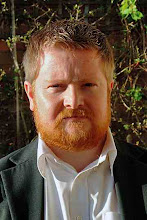
In ‘Danse Macabre’, Stephen King describes James Herbert’s writing style as that of someone who puts on his combat boots and goes out to assault the reader with horror. ‘Danse Macabre’ was published in 1981 and the statement is fairly appropriate to the seven or eight titles Herbert had published by then (with the possible exception of ‘Fluke’). Certainly, the one-two punch of ‘The Rats’ and ‘The Fog’ – the former blithely disregarding, within its first ten pages, any audience pleasing aesthetic of having a baby or a cute dog survive; and the latter containing a scene in an elite boarding school gymnasium that you’ll probably never get out of your head – announced two simple facts: here was a horror writer who put balls-to-the-wall propulsive narrative first; and here was someone who wasn’t afraid to go to some pretty dark places.
James Herbert died a few days, less than a year after publishing his 23rd novel, ‘Ash’, completing a trilogy that began with ‘Haunted’ and ‘The Ghosts of Sleath’. There had been a six-year gap between ‘Ash’ and his previous novel, ‘The Secret of Crickley Hall’, which was adapted to general acclaim by the BBC last year. The hiatus was indicative of a reduced output in the latter stages of Herbert’s career. ‘Ash’ was his only work this decade; there were just three books from him last decade. Not as excessive as the decade-long gaps in Donna Tartt’s bibliography, but poignant and frustrating in roughly equal measures now that he’s gone and there will be no new James Herbert novels.
A key observation in the many tributes that have pervaded the internet like a effulgent fog (sorry, couldn’t resist) is the discovery of Herbert’s novels in one’s teenage years. The illicit reading of well-thumbed paperbacks, gasping in shock at the visceral horror, eyes widening over the tactile sex scenes. As a kid, I went to a school where you were liable to get thumped if you were seen with a book in your hands; the exception was the black cover and glossy gold or silver lettering of a James Herbert title. A salivating rat on the cover, or the dead eyes of a doll’s head (I’ll never forget that cover of ‘The Survivor’, the first Herbert novel I read. I was thirteen).
And it’s for those novels – full-on, gory, shouldn’t-really-have-been-reading-this-stuff-as-kids – that Herbert will be remembered. Which is a tad unfair to him. Because his style and his approach changed, and he made a committed attempt – whilst never sacrificing narrative, entertainment and the love of his readers – to develop as a novelist. ‘Fluke’ was an anthropomorphic fable, kind of Disney by way of Edgar Allan Poe. ‘The Magic Cottage’ and ‘Once’ deconstruct fairy tale tropes. ‘Shrine’ is a provocative discourse on theological politics, economic exploitation and the nature of faith. ‘Creed’ and ‘Nobody True’ are essentially cross-genre detective stories. ‘48’ is an alterative history tale which, for my money, is a fuckload more entertaining than, say, Len Deighton’s ‘SSGB’ or Robert Harris’s ‘Fatherland’. Throw in Herbert’s demonstrable interest in the atmospherics of the traditional ghost over the graphic horror of the earlier works, and you have an author who really shouldn’t have been pigeonholed.
‘Haunted’ is perhaps Herbert’s most distilled imagining of the traditional ghost story, even if it raised some eyebrows on publication. I recall Fear magazine, latching onto the novel’s lack of big gruesome set pieces, wondering if a ‘Woman’s Hour’ serialization was on the cards. And while it’s not necessarily my favourite Herbert (I’d probably go with ‘Moon’ or ‘48’), it introduced arguably his most enduring character: David Ash, a guilt-ridden, cynical, borderline alcoholic parapsychologist. And if this description doesn’t sound anything like Aidan Quinn’s character in Lewis Gilbert’s 1995 adaptation, then here we come to an awkward segue into the film review part of this article, and our first indication that there are quite a few things wrong with ‘Haunted’ the movie.

So why in the name of buggery am I reviewing it on Agitation? Two reasons. One: I wanted to write about Herbert and dedicate a post to his memory. He was one of those magnificently unpretentious, politically incorrect writers for whom story was everything and fuck the naysayers – i.e. the kind of writer I discovered at exactly the right age and to whom, even though my bookshelves are now piled with writers who are considered “better”, I owe my love of reading. Two: as a comment on how badly served Herbert was in terms of adaptations.
For a man who became a bestselling writer with his first novel in 1974 (‘The Rats’ sold out its first print run in three weeks!), it wasn’t until 1981 that anything of his was filmed. ‘The Survivor’ is an intermittently intriguing but ultimately flawed adaptation of Herbert’s third novel, written for the screen by David Ambrose and directed by David Hemmings. A good cast – Robert Powell, Joseph Cotten and Jenny Agutter – wander through an evasive storyline, while heavy cuts pre-release (the film clocks in at barely over an hour twenty minutes) don’t help the narrative coherence. A pre-production decision to attempt a cerebral rather than scary movie was ill-advised.
Although not as ill-advised as dressing dachshunds up as rats in the big screen (oh all right then, direct-to-video screen) version of ‘The Rats’ a year later. It was inexplicably retitled ‘Deadly Eyes’. Which essentially gives us a film version of ‘The Rats’ with dogs as rats and a title that sounds like a Zalman King top-shelf trouser-arouser. Oh dear. Over a decade passed, then 1995 gave us two Herbert adaptations: ‘Haunted’, and Carlo Carlei’s ‘Fluke’. This is the poster for ‘Fluke’:

I think we can see where this one misses the mark. Of how ‘Haunted’ misses the mark, more later.
‘The Secret of Crickley Hall’, a three-part mini-series, emerges as the most faithful, and best written of the bunch. And when television is besting what’s being done for the big screen, that’s a pretty depressing state of affairs. It’s to be hoped that more of his work reaches the big screen and is done properly. ‘48’ would make for one hell of a good movie, budget permitting. Or how about an 18-rated-and-earning-it headfuck based on ‘The Jonah’ and directed by the guy behind ‘A Serbian Film’? Brad Anderson ratcheting the tension up on ‘Moon’? Fuck, let’s give Mel Gibson a chunk of money, a copy of ‘Shrine’ and let him revisit the religious controversy of ‘The Passion of the Christ’. Note to Hollywood: I’ll settle for an executive producer credit and a small fee. Aw, hell, consider the fee waved – just make a really good James Herbert movie. Please?
Okay: 1,100 words of avoidance in the can. Deep breath. ‘Haunted’: un film de Lewis Gilbert. Let’s deal with this mo’ fo’. Originally written as a screenplay for the BBC, Herbert recrafted the story into a novel when the script went unproduced. The book has David Ash undertake an assignment to disprove a haunting at a crumbling stately home inhabited by three siblings – brothers Simon and Robert Mariell and their seductive sister Christina – and their elderly housekeeper whom they rather patronisingly called “Nanny” Tess. Ash is haunted (the novel’s title works on several levels) by the death of his sister in childhood, a drowning he not only failed to prevent but benefited from in terms of the abrupt cessation (at least in a worldly form) of her constant and malicious bullying. Ash is temperamental and a heavy drinker. He takes against the Mariell brothers from the off, resenting their toffee-nosed demeanour and their petty little games. He just wants to scientifically disprove the haunting of Edbrook (their family pile) and split. Only Christina proves immensely distracting, and a series of occurrences leave him wondering if there isn’t something supernatural lurking in Edbrook after all.

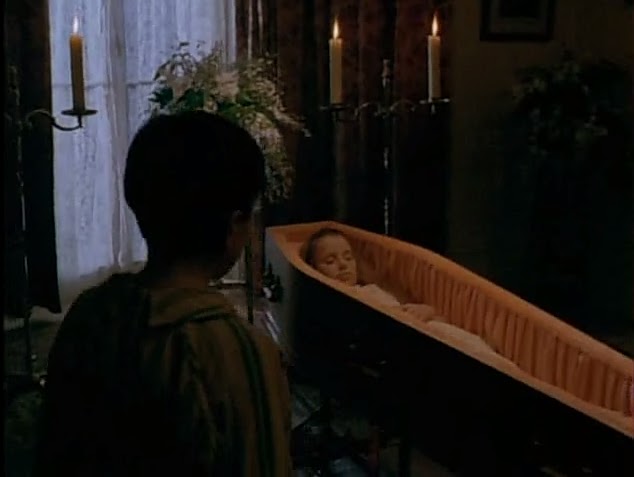
Gilbert’s film – his penultimate as director, after 51 years calling the shots (he’d shoot his final movie, an adaptation of Shelagh Stephenson’s play ‘Before You Go’ in 2002 at the age of 82) – strips Ash of all his emotional baggage. Even the death of his sister, delineated in a frankly ridiculous pre-credits scene (she plunges into a stream barely a foot wide that, as soon as the camera plunges underwater, opens out into something deeper and wider than the River Styx), is depicted as an unfortunate accident rather than the wished-for deus ex machina that ends the young Ash’s physical torments and kicks off his spiritual ones in the novel. Likewise, the nature of his sister’s reappearance towards the end of the film – as well as the provenance behind the haunting – drastically differ from the novel to such an extent that the entire point is missed and you wonder why Gilbert and co didn’t just cook up their own haunted house story.
The largest and most curious deviation of all is the decision to make ‘Haunted’ a period drama. The novel is set contemporaneously but deliberately evokes the isolationism and trappings of, say, an M.R. James story. It’s the dynamic between gothicism and the modern world that give the Ash trilogy their edge. That, and the fact that Ash himself is an unpredictable and vicariously fucked-up protagonist. The Ash of the film is about as edgy and fucked-up as an unrefrigerated lettuce leaf. The period paraphernalia serve only to prettify the film version. Watching it today, for only the second time since it first came out, I was struck by the similarity to James Watkins’ recent take on ‘The Woman in Black’: a Sunday afternoon glossing over of source material that is not only cruel and cynical, but whose cruelness and cynicism is the entire fucking point.
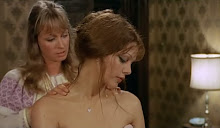
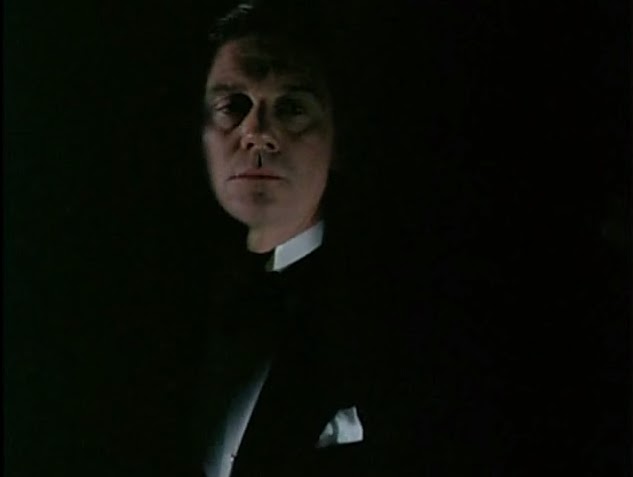
There are a few grace notes to Gilbert’s film, though. As Simon and Robert, Alex Lowe and Anthony Andrews strike the right note of sybaritic smugness. Stalwarts Anna Massey and John Gielgud bring some old-school gravitas to the proceedings. And Kate Beckinsale, in her early twenties and already starting to chalk up some memorable feature film appearances, knocks it out of the park as Christina, flipping between dreamily coquettish and spikily vampish without missing a beat. She gives the film a beating heart (and a quickened pulse!) where otherwise it would have remained moribund.

A few scenes come close to evoking the novel, particularly a wine-cellar conflagration, and the siblings’ creepily childish insistence on parlour games. Mostly, though, opportunities are squandered. A tense and sustained chapter where Ash is menaced by the Mariells’ hunting dog as he flees through the woodland and discovers the family tomb is completely missing. His claustrophobic submergence in a lichen-scummed ornamental pond is reimagined as a scene on a jetty that just looks silly. The last-moment resurgence of horror when Ash thinks himself free of Edbrook and its spirits is rendered as a yawnsomely predictable final shot. And sad to say, Quinn – an actor who I usually have a lot of time for – is wooden and unappealing here.
‘Haunted’ could do with another outing – set contemporarily, with a fucked-up Ash, tormented by nightmares and fuelled by neat vodka; a David Ash who’s on the verge of meltdown. Paddy Consodine, full of intensity and keeping it real? Hayley Atwell as Christina? Nick Murphy in the director’s chair? Stick to the novel. Embrace the real darkness of the backstory. A good James Herbert movie.
Anyone?
(i.m. James Herbert, 8 April 1943 – 20 March 2013)