Showing posts with label Shots on the Blog. Show all posts

Saturday, June 30, 2012

Mesrine: Public Enemy No. 1


Here’s irony for you: ‘Mesrine: Killer Instinct’, at 110 minutes, could have done with being at least half an hour longer to develop and expand the material; to give a real sense of the period of time that the film covers; while on the other hand the sluggish ‘Mesrine: Public Enemy No.1’, at two hours ten minutes, could have done with being at least twenty minutes shorter.

Although ‘Public Enemy’ adheres to the same tick-box approach to the narrative of Jacques Mesrine’s life, presenting us with a “greatest hits” compilation of prison breaks, shoot outs, verbal sparrings with judges and brutal retribution on gentlemen of the press who dare paint him as anything other than the Robin Hood figure he seems to believe he is, what makes it such a long haul is its inherent lack of suspense. We know how it’s going to end.

‘Killer Instinct’ opens with a terrific split screen sequence in which Mesrine and vampish consort Sylvia (Ludivine Sagnier) attempt a low-key flight from Paris, only to be ambushed by a bunch of gunmen in the back of a truck. The rest of ‘Killer Instinct’ plays out in defiance of its protagonist’s fate, and it’s precisely this attitude that gives the film its power.


‘Public Enemy’ starts with the bullet-riddled body of Mesrine being removed from his car, crime scene tape around the scene and police officers keeping the crowds back. The architect of this coup de grace is immediately revealed as Commissaire Broussard (Olivier Gourmet). A flashback has Mesrine being interrogated by Broussard post-arrest. Something about the structure the film falls into annoys already. It’s too self-conscious. Mesrine’s almost good-natured bantering with Broussard is evidently meant to come off as poignant or ironic in light of his inevitable demise as a result of Broussard’s operation, but it just reinforces the sense that ‘Public Enemy’ is a long haul towards a denouement we watched one movie ago.

I’ve watched the film twice now and really wanted to like it both times. And there are some effective moments – such as Mesrine playing to the gallery at a retrial, taking the piss out of the judge prior to pulling off a risky but ballsy escape – but there’s barely a frame that doesn’t betray how enamoured director Jean-François Richet has become with his subject. Two examples: Mesrine post-jailbreak romping with a couple of hookers while fellow escapee François Besse (Mathieu Alamric) tuts and shakes his head; and Mesrine coercing a family to get him through a roadblock, making the children laugh and giving the parents a big wad of cash as a thank you. The first example essentially says (adopts Cockney accent) “Oy oy saveloy, one o’ the lads, innit? He shoots he scores. Get in there, son, it’s yer birthday.” The second would have you believe (same accent) “Gor blimey, guv, that Mesrine geezer, he’s yer axshul bleedin’ Robin Hood, innit, stealin’ from the rich ‘n’ givin’ to the poor, Gawd bless him!” Both sentiments are total bollocks.


Late in the game, Richet seems to remember that Mesrine was stone-cold killer and throws in a weirdly protracted sequence in which the gangster lures a journalist who has impugned him a print with the promise of an exclusive interview only to deliver a beating and a burial alive. It’s a stark reminder of Mesrine as a dangerous and unpredictable man, and gives some indication of how dark and nasty ‘Public Enemy’ could have been, but coming after so much larking around and rose-tinted adulation, it just seems awkward.

Cassel remains just as compelling in the lead role, so often rising above the script’s deficiencies; he really is one of the best actors in the business. The period evocation, here focusing on the 70s, is just as detailed and evocative as in ‘Killer Instinct’. And Ludivine Sagnier doesn’t just provide the romantic interest but matches Mesrine in all manner of badassery. She alone gives the film a frisson no-one else achieves.


If Cassel’s Mesrine would sell his grandmother down the river to pull off a bank job or instigate a prison break, Sagnier’s Sylvia would make a priest kick a hole in a stained glass window. I know who I’d throw in my lot with.

Thursday, June 28, 2012

Mesrine: Killer Instinct


For the benefit of the uninitiated, Jacques Mesrine can probably still lay claim – for all that he died over 30 years ago – to the title of “France’s most notorious criminal”. A bank robber, kidnapper, ice-cold killer, accomplished jail-breaker, memoirist, self-styled political activist, something of a master of disguise and an all-round bad mo’ fo’, it was inevitable that someone would make a movie about him.

Indeed, the first cinematic attempt to capture his life and crimes came just five years after his death: ‘Mesrine’, written and directed by André Génovès, starred Nicolas Silberg as Mesrine and concentrated on the last 18 months of his life, from his escape from La Santé prison to his death in a police operation that was little more than a sanctioned assassination.

In 2008, Jean-François Richet premiered his two-part biopic with Vincent Cassel in the lead role. Unlike Génovès’s film, Richet’s epic covers the entirety of Mesrine’s widely-reported career, kicking off in the late 50s as he returns from military service in Algeria and gets in involved in the Parisian underworld under the aegis of mob boss Guido (Gerard Depardieu).


An early scene has a uniformed Mesrine standing guard while a couple of other soldiers brutally interrogate an Algerian freedom fighter over the location of an incendiary device. The prisoner’s sister is hauled in and Mesrine is ordered to shoot her. Instead, he blows away the terrorist. It’s a histrionic and utterly uncontextualised scene (Mesrine’s political ideals don’t surface till the second film and he doesn’t really act on them other than talking about getting involved with the Red Brigade), and I can’t help feeling that, as with much in both films, it merely serves to tick a box as Richet waltzes us through a Jacques Mesrine “greatest hits” compilation.

‘Killer Instinct’ just about makes the dance worthwhile. Richet nails the late 50s/early 60s period recreation as Mesrine embraces the criminal lifestyle, gets involved with the good-natured Sofia (Elena Anaya) and tries to reform after a prison sentence for armed robbery; redundancy and the lure of easy money by hooking up with his erstwhile cronies combine to drive him back to a life of crime.

Richet plays much of this in the vein of Jean-Pierre Melville. An interlude in Canada and the US – Mesrine accompanied by new girlfriend Jeanne (Cecile de France) – lets the director cut loose with some explicitly American iconography, which in one respect is apposite since Melville himself rooted his aesthetic in American crime cinema and in another is completely hackneyed due to the over-reliance on Bonnie and Clyde style tropes.


An abrupt shift into the prison break genre follows when Mesrine is arrested, extradited to Quebec and sentenced to the St-Vincent-de-Paul maximum security facility. This section plays like ‘Midnight Express’ as sadistic guards routinely beat the shit out of Mesrine and hose him down with jets of cold water. His escape is so laughably easy that it makes ‘Two Way Stretch’ look like ‘The Shawshank Redemption’; if you didn’t know it was based on fact, you’d find your suspension of disbelief stretched to breaking point.

Ranking equally in the this-would-be-fucking-ludicrous-if-it-hadn-t-actually-happened stakes is the climactic scene where Mesrine and fellow escapee Jean-Paul Mercier (Roy Dupuis) attempt to spring their fellow prisoners, provoking a gun battle with the prison guards and sustaining injuries but failing in their intent.

Richet compresses a hell of a lot of incident into 110 minutes. ‘Killer Instinct’ occasionally feels like it ought to be a two and half hour movie, with the narrative and the passage of time and the character interrelationships having the proper time to breathe and make sense and be developed. Instead, a sense of truncation lies heavily across the production. Script and editing conspire to ellipsis. Ultimately, the production design, the period recreation and Cassel’s flamboyant central performance carry it. No classic, but enough decent material to perk one’s interest for part two.

Sunday, June 24, 2012

Assault on Precinct 13


A police lieutenant with a sense of honour bridles at being assigned to a babysitting job at an about-to-close station house. A prison bus makes a detour when one of the convicts falls ill. A gang pull off a hit that leaves a young girl dead. A grieving father takes the law into his own hands. The paths of these disparate characters converge at the titular Precinct 13. A siege ensues.

John Carpenter’s brutally efficient thriller really doesn’t need a synopsis. It probably doesn’t even need a review. Only his second feature length film – it followed ‘Dark Star’ and was made two years before ‘Hallowe’en’ – ‘Assault on Precinct 13’ sets out a goodly number of what would become Carpenter’s trademarks, much as the basis of Sam Peckinpah’s aesthetic was established by his second film, ‘Ride the High Country’.

The Peckinpah comparison is perhaps more apposite than might readily be apparent. Although Carpenter has yet to make a western, the genre informs much of his filmography. His touchstone isn’t a Peckinpah film, however, but Howard Hawks’s ‘Rio Bravo’, a movie that defines its own genre credentials: the western as siege drama. (As well as writing, directing and scoring ‘Assault on Precinct 13’, Carpenter also edited the movie, crediting himself under the pseudonym John T Chance – the name of John Wayne’s character in ‘Rio Bravo’.)


In ‘Halloween’, the town of Haddonfield is laid siege to by the legacy (and murderous reappearance) of Michael Myers; in ‘The Fog’, Antonio Bay is besieged by … well, the clue’s in the title; in ‘Prince of Darkness’, a church is threatened from without and within by evil; even his most recent film ‘The Ward’ engages with the theme, albeit on a psychological level. Appropriately, much of his work is confined to a single locale (the asylum in ‘The Ward’; the arctic research station in ‘The Thing’) or a restricted setting (the walled off Manhattan prison in ‘Escape from New York’). John Carpenter at his best does claustrophobia better than any other filmmaker.

Other Carpenter tropes present in ‘Assault on Precinct 13’: the widescreen cinematography that juxtaposes dangerously open spaces with tight interiors (DoP Douglas Knapp pre-supposes Dean Cundey’s work on ‘Halloween’, ‘The Fog’, ‘The Thing’, et al); a minimalist score by the director himself; the anti-hero as main character (Darwin Joston’s laconic portrayal of Napoleon Wilson, all rockabilly quiff, insouciant attitude and total lack of compunction when it comes to the use of weapons, lays some of the groundwork for Kurt Russell’s iconic Snake Plissken); and the interaction and development of characters in a pressurised environment (one of the chief pleasures of ‘Assault’ is watching Laurie Zimmer’s transformation from lip-glossed sweater girl to gun-toting action heroine, unflinchingly blowing away numerous bad guys despite a wound that’s paralysed one arm!)


Clocking in at just under an hour and a half (with the siege itself starting roughly at the 40 minute mark), the script is as minimal as the score. There is little or no backstory – the script hints at some revelation as to Wilson’s charismatic first name, but deliberately refuses to deliver – and the dialogue is pared down to what’s strictly necessary. Wilson’s much repeated “You got a smoke?” ultimately takes on as much weight as any discussion of what the mob want and whether our beleaguered protagonists have any means of escape.

In addition to proving himself remarkably intuitive as a director of action and suspense, Carpenter drew memorable performances from his three leads: it’s surprising that neither Joston or Austin Stoker (who plays Lieutenant Bishop) had bigger film careers, while Zimmer’s complete disappearance from the acting world at the end of the 70s was nothing short of enigmatic and inspired Charlotte Szlovak’s 2003 documentary short ‘Do You Remember Laurie Zimmer?’

Remember her? Based on ‘Assault on Precinct 13’, I’d say the lady was pretty damn unforgettable.

Wednesday, June 20, 2012

Romanzo Criminale


Word of advice to anyone approaching Michele Placido’s two and a half hour crime movie: bone up on Italian political history first. Pay particular attention to the 70s. Litmus test: if you don’t know who Aldo Moro was and what happened to him, you’re going to struggle.

‘Romanzo Criminale’ starts with four juvenile delinquents stealing a car and going hell for leather through a police roadblock (they casually run down a cop) before holing up at a beachside caravan they use as their hideout. One of them, thrown against the steering column during the hit and run, is in agony; nonetheless, they treat the aftermath of their stunt flippantly and discuss what gang-style nicknames they’d like to be known by. They settle on Lebanese, Ice, Dandy and Grand. At this point the cops show up. Grand is left behind as the others leg it. Ice is fetched to the ground by a couple of cops, Lebanese is injured trying to help him, and Dandy just runs like hell and lets the other two take the fall (not to mention the prison sentence).

Flash forward to adulthood. Lebanese (Pierfrancesco Favino) and Ice (Kim Rossi Stuart) get out of the nick, reunite with Dandy (Claudio Santamaria), put together a gang of fellow felons, pull off a kidnapping and use the ransom money to finance a take-over of Rome’s criminal underground. This they achieve via muscling in on drug baron Terrible (Massimo Popolizio)’s operation, forming an edgy alliance with Mafioso patriarch Uncle Carlo (Luigi Angelillo), and basically wiping everyone else the fuck out.


Meanwhile, Police Commissioner Scialoja (Stefano Accorsi) gets a lead on high class hooker Patrizia (Anna Mouglalis), who’s spending a chunk of the ransom money like it’s going out of style; she leads him to Dandy, who’s infatuated with her to the point where Lebanese and Ice have to coerce her into accepting his overtures in order to keep his mind on the job. Scialoja meticulously builds his case, but his superiors are unsupportive and, no sooner has he managed to arrest Lebanese, than a shadowy government operative secures his release and sabotages Scialoja’s case. Now the gang find themselves in the debt of a mysterious benefactor who calls in favours of an increasingly political nature.

‘Romanzo Criminale’ – the title translates as ‘Crime Novel’ – is based on a novel by Giancarlo De Cataldo, a former judge who based his magnum opus on his experience in the trials of the notorious Magliana gang. It’s clear that Placido intended his adaptation to be a sweeping epic in the vein of ‘The Godfather’ or ‘Goodfellas’, spanning several decades and plotting the rise and fall of Lebanese, Ice and Dandy’s empire against a blood-red period of Italian social and political history. And in a few places, he comes close to achieving that, such as in the dizzyingly fast-paced sequence which takes in Lebanese and Ice’s release from jail, formation of the gang and execution of the kidnapping. Elsewhere, Lebanese’s cocaine-fuelled paranoia over his benefactor and the rivalry between Dandy and Scialoja over Patrizia generate some frisson.


Where ‘Romanzo Criminale’ suffers is in Placido’s uneven pacing, and an aesthetic that seems more fitted to the small screen. The material cries out for magisterial visuals and powerhouse acting, and instead we get set-pieces that are often curiously flat and TV-quality acting. For the most part Placido casts pretty boys rather than tough guys, making it difficult to believe in his cast as hardcore, ruthless and brutal recidivists. A romantic subplot between Ice and the unbelievably naïve Roberta (Jasmine Trinca) doesn’t really convince either.

Most frustratingly, the political elements are firmly backgrounded, only affording us glimpses of two players in the great Machiavellian conspiracy which, whenever it’s touched upon, hints at a far more intriguing and compelling story than the one we’re actually watching. Had these scenes been explored deeper – and imbued with the knife-edge cynicism of, say, ‘The Parallax View’ or ‘Three Days of the Condor’ – ‘Romanzo Criminale’ might have emerged as something really special.

Monday, June 18, 2012

A tale of two Italian Jobs

Hang on, lads, I’ve had a great idea: let’s compare Peter Collinson’s 1969 Cock-er-nee crime caper with F Gary Gray’s Stateside remake.


What’s it all about?
The original starts with Charlie Croker (Michael Caine) getting out of prison, a job in Italy all nicely lined up for him. Unfortunately, his contact has met with a nasty accident courtesy of the Mafia who figure said job – the wholesale theft of several million in gold bullion – as a nice little earner for themselves. Still eager to pull off the heist, Charlie turns to upper class crime boss Mr Bridger (Noel Coward) – who runs his felonious empire from inside a prison cell (albeit a nicely appointed one) – for backing. Under Bridger’s aegis, Charlie puts together a team. They plan the heist meticulously then head to Turin. With the city crowded for an England vs Italy football match, and with Mafia supremo Altabani (Raf Vallone) on their case, the pressure is on to intercept the gold and make a clean getaway.

The remake starts in Venice as veteran safecracker John Bridger (Donald Sutherland) undertakes the proverbial one last job before handing the operation over to his protégé Charlie Croker (Mark Wahlberg). The heist goes smoothly and the getaway equally so … until one of Bridger’s team – Steve (Ed Norton) – double-crosses them, shoots Bridger, leaves the others for dead and absconds with the gold. A year later, in Philadelphia, Charlie gets a lead on Steve, who is fencing the gold a bar at a time. Charlie and the team join forces with Bridger’s daughter Stella (Charlize Theron) – who’s as much of a dab hand at opening safes as her old man but has thus far been putting her talents to legitimate use – and track Steve to California where they set out to steal back the gold from under his nose.

Conventional wisdom would have it that Collinson’s film is an evergreen classic while Gray’s is just another tired remake emblematic of Hollywood’s lack of originality. But we don’t do conventional here at Agitation. And we’re not renowned for doing wisdom either. So let’s put both movies on the starting blocks and see which pulls away faster, corners better and blasts past the chequered flag first.


Best guv’nor
Michael Caine – exudes 60s cool; gets to say “You’re only supposed to blow the bloody doors off.”

Mark Wahlberg – does an okay job; ain’t no Michael Caine.

WINNER: the original.

Best crew
Caine’s crew are a fairly anonymous bunch who are generally only there for comic relief. Perhaps the most famous face is Benny Hill. Let us never forget that the original ‘Italian Job’ is a film where Benny Hill gets third billing.

Wahlberg’s crew consists of Seth Green, Mos Def, Jason Statham and Charlize Theron. Green and Def I can take or leave, but when you’ve got The Stat on your team that means you’re serious.

WINNER: the remake.

Best plot Collinson’s film consists of: Charlie gets out of prison, pause for low-brow comedy, Charlie plans the job, pause for low-brow comedy, Charlie and the lads execute the job, pause while Benny Hill does some gurning, tyre-squealing getaway.

Gray’s film actually has a plot, as well as making an attempt at backstory and even tipping its hat in the direction of characterisation. Gor blimey, guv’nor!

WINNER: the remake.

Best heist
Caine and crew pull a very inelegant armoured car job before the real business of the stunt driving gets underway.

Wahlberg and his team pull two heists, and plan but are forced to avert another. Their heists are meticulously conceived and excitingly staged.

WINNER: the remake.

Best Mr Bridger Noel Coward mixes snobbery with menace and creates an unforgettably satirical character. His walk from cell to prison dining hall as his also-incarcerated minions cheer at the news of the successful heist is a show-stopper.

Donald Sutherland plays a character called Bridger.

WINNER: the original.


Best last scene
Caine and crew are left dangling over a precipice in a literal cliffhanger.

Wahlberg’s team celebrate a job well done as they leave town on a train.

WINNER: the original.

Best use of Italian locations The original depicts Turin as one big traffic jam and has some horribly stereotyped Italian characters; however, it earns the title ‘The Italian Job’ in way the remake doesn’t.

The remake gives us an evocative opening heist set in Venice, however the remaining hour and a quarter plays out in America.

WINNER? Let’s call it a draw.

Best music
Caine and his cohorts belt out a lusty tune about “the self-preservation society” as they abscond with the goods.

John Powell’s score ramps up the urgency and against-the-clock nature of the heists in the remake, but you’ll not find yourself humming it every time you see a Mini being driven above the speed limit.

WINNER: the original.

Best car chase
Twenty minutes of unsafe driving around, above and through the sewers of Turin.

Twenty minutes of unsafe driving around California and through its sewers and subway system. Oh, and there’s also a car vs helicopter set-piece.

WINNER? I’m almost tempted to declare this a draw, but for two things: (i) the business with the Minis is the only reason, if we’re being perfectly honest, to watch either version and Collinson’s film did it first; (ii) the Minis in the remake were retro-styled by BMW, while the Minis in the original are … well … the original!

Sexiest endorsement of the Mini
Charlize Theron drives one in the remake. No point even debating this one. WINNER: the remake.


Results
Based on ten criteria, Peter Collinson’s film scores five, F Gary Gray’s scores four, and they tie in one category. The kudos, then, should go to the original, but having watched them back-to-back I’d be a liar if I didn’t admit that I find the remake more satisfying in its script, direction and craftsmanship. The original, however, has the eminently quotable “you were only supposed to blow the bloody doors off” line, an unforgettable final scene and, in the final analysis, captures a cultural and national zeitgeist in a way the remake doesn’t … and, in fact, couldn’t. Let’s face it: does the sight of a group of Americans pulling a getaway in an American city at the wheels of three British-made cars with, respectively, red, white and blue paint jobs actually mean anything, let alone what it means in the original? F Gary Gray earns a raised glass and a tip of the chapeau for turning in the better example of filmmaking, but ultimately Peter Collinson’s film, for all its flaws, achieves something genuinely iconic.

Friday, June 15, 2012

Magnum Force


“A man’s got to know his limitations.”

The first of four sequels to Don Siegel’s epochal ‘Dirty Harry’, and the only one of them that even begins to engage with that film’s considerations of vigilantism vs due process and the moral erosion of the already thin dividing line between cop and killer, ‘Magnum Force’ is an often powerful and occasionally flawed movie. It’s also notable for being written by directors-in-waiting John Milius and Michael Cimino, both of whom would turn in infinitely more iconoclastic work than its actual director, Ted Post.

The opening credits play out over the stark image, against a red background, of Harry Callahan (Clint Eastwood)’s trademark Magnum .45 clutched in a hefty fist. A slow zoom in ensures that, by the time the thumb has moved to the trigger and cocked it, the gun is occupying the whole of the screen. The fist angles it in the audience’s direction. The gun fires. It’s almost the antithesis of 007 shooting the audience in the intros to the Bond movies. There, Bond is being tracked through a gun barrel but gets his shot in first. Here, Callahan just turns his gun on the audience and blasts.

Utterly unsubtle, but a perfect definition of what the film is about. And perhaps the only instance in cinema of a prop, not a person, breaking the fourth wall. This is what you came for, isn’t it? the gun asks (can a weapon sneer?). This is why you bought your ticket and that large tub of popcorn and sat your ass down in this theatre. And, with the benefit of hindsight: This is why you stumped for this movie on DVD. Isn’t it punk? This is why you watch anything with Clint in. Because deep down the right-winger in you wants to see the bad guys, the pimps and the pushers and the scum of the earth, get blown away without all the time-consuming business of bureaucracy intruding.

The gun tips you the wink. It reminds you of Callahan’s mano-a-mano battle with the Scorpio killer in the original movie – a grudge match that was settled without lawyers, judges or the ministrations of twelve men good and true.

‘Magnum Force’ then spends two hours subverting these expectations. Glossing over the fact that Callahan tossed away his badge at the end of ‘Dirty Harry’, we have him busted down to stakeout duty by his irascible superior Lieutenant Briggs (Hal Holbrook) and shoo’d away from a homicide scene. Callahan, bored with sitting in a car when he could be doing some real detective work, decides to involve himself in the case anyway. This doesn’t go over too well with his new partner “Early” Smith (Felton Perry), and with good reason. Callahan goes through partners they way Oliver Reed went through pubs. Put it this way: if it’s your first day with the San Francisco PD and the roster lists you for duty with Callahan, H … don’t bank on collecting your pension.


While Callahan probes the execution-style deaths of several major league villains who had hitherto flaunted their above-the-law status, he comes into contact with a group of motorcycle cops led by Aryan poster boy John Davis (David Soul). Bested by Davis in a shooting competition, Callahan muses on his limitations. But when the evidence points to them as a ton-up judge-jury-and-executioner squad, even Callahan’s scepticism about the system is sorely tested. Yup, this is a Dirty Harry movie in which our (anti)hero is given to considerations of morality, due process and human rights.

It’s perhaps disingenuous to delineate the aforementioned dividing line in terms of Harry Callahan only blows people away while they’re in the act, not because of what they may or may not have done in the past, but nonetheless it’s a very shaky exercise in semantics that differentiates him from Davis and co. 

The script, when it gets in gear, exploits this grey area brilliantly, continually challenging us as to why we find Callahan’s methods cathartic and Davis’s reprehensible. Are we really so shallow that we’ll accept rough justice and terminal judgement as long as it’s meted out by someone who looks cool, gets the girls and grunts pithy one-liners with the devil-may-care indifference of a gunslinger spitting out a stream of tobacco juice?


You know what? I rather think we are. ‘Magnum Force’ has two main problems. Number one: Ted Post’s direction is uninspired and he doesn’t seem able to rein his actors in – which is no problem as far as Eastwood, American cinema’s unchallenged king of minimalism, is concerned but fuck me if the usually excellent Holbrook doesn’t chew the scenery as if he’s just doused it in Tabasco sauce and had it brought to him with a side order of fries and a tub of coleslaw.

Number two: the script requires Callahan to float around for the first hour, marking time while the biker boys notch up enough hits to establish themselves as antagonists, whilst still reminding everyone that he’s the main character and a badass mo’ fo’ to boot. This results in numerous go-nowhere scenes such as an airport hijacking (curtailed in a thoroughly arbitrary manner), a convenience store stick-up and several flat scenes where various women throw themselves at him.

The second half, however, ramps up the drama and the action. A dockyard shoot-out is poundingly staged and edited, and the finale, in which an unarmed Callahan is caught up in a tense game of cat ‘n’ mouse through the rusting hulk of a decommissioned aircraft carrier, raises the bar on the grain-store chase scene that concluded ‘Dirty Harry’.

After this, only ‘The Enforcer’ with its Alcatraz-set finale would deliver any hint of frisson. ‘Magnum Force’ rides out the definitive pop-culture phenomenon of ‘Dirty Harry’ with a modicum of style and brings a few ideas of its own to the squad room. And, hey, it’s certainly the best film Ted Post ever made.

Wednesday, June 13, 2012

PERSONAL FAVES: A Clockwork Orange

Posted to coincide with Malcolm McDowell’s 69th birthday. Party well, little brother, party well.


“We all suffer from the popular desire to make the known notorious. The book I am best known for, or only known for, is a novel I am prepared to repudiate: written a quarter of a century ago, a jeu d’esprit knocked off for money in three weeks, it became known as the raw material for a film which seemed to glorify sex and violence. The film made it easy for readers of the book to misunderstand what it was about, and the misunderstanding will pursue me till I die.” Thus spake Anthony Burgess, author of the slim novella on which Stanley Kubrick’s symphony of visual mind-fuckery and ultra-violence is based. It’s a hell of a thing of a writer to repudiate one of their own works, let alone admit that said work has no value beyond the money it earned.

This contentious point, however, is accurate. In 1958, having published his ‘Malayan Trilogy’ but still essentially treating writing as something of a hobby, Burgess collapsed while lecturing to a class and was diagnosed with an inoperable brain tumour. This misdiagnosis was compounded by the clinician in question giving Burgess a year to live. Keen to provide for his wife, Burgess banged out four books in quick succession, one of which was ‘A Clockwork Orange’. It’s an amazing piece of work, not just for its immediacy, raw power and its prescient approach to youth-speak (narrator Alex uses “like” almost as punctual), but for its linguistic experimentalism.

The inspiration for the novella, if such a lofty word is appropriate to such a grim starting point, was the attack on the author’s wife by a gang of American GIs during the war. They were deserters; Burgess, serving in Gibraltar at the time, wasn’t allowed leave to visit her in hospital. She was pregnant at the time and subsequently miscarried. In approaching such violent material, and using a first person narrator, Burgess used the language of the book as a distancing technique. Using a mélange of corrupted Russian, cockney rhyming slang and Romany colloquialisms, he effectively created a language that any reader of the novella has to pick up as best they can during the first few pages. He called it Nadsat.

Stanley Kubrick – never one to let an author’s intentions get in the way of an adaptation (if you’re not sure what I’m talking about, Google “Stephen King Stanley Kubrick The Shining” and settle back for an evening of reading) – happily jettisoned the concept of Nadsat as a distancing technique from the violence, turning it instead into a verbal barrage of swaggering machismo that plunged the viewer further and further into the world of Alex and his droogs – a world basically defined by ultra-violence, the old in-out-in-out, and some lovely lovely Ludwig Van (the 9th Symphony a particular favourite). Put simply, Burgess’s novella is a dystopian investigation into societal dysfunction, governmental conditioning, wayward youth and eventual maturity; while Kubrick’s film is an unapologetically amoral romp that celebrates the darker impulses of the human psyche and sounds a triumphant Ode to Joy to free will, never mind that said freedom of choice is often knowingly deployed by bad people who luxuriate in their recidivism.


Or, put even more simply, the film is totally not what Burgess intended the book to be. This has much to do with Kubrick omitting the last chapter, in which Alex reflects on his misbegotten life and begins to entertain thoughts beyond the fighting, fucking and fuck-authority-ing that have defined his personal aesthetic thus far. 

And this is where I quit sitting on the fence, launch myself out of the middle ground and come down firmly in Camp Kubrick. As much as I love ‘A Clockwork Orange’ à la Burgess, I’ve always found that last chapter forced and just a smidge unconvincing. The note Kubrick ends the film version on, I completely buy into it even as it chills the hell out of me.

‘A Clockwork Orange’ probably isn’t Kubrick’s best film, and I will admit to some ambivalence regarding the director. I often find myself admiring his work rather than liking it. The lack of any real humanity to a good half of his (admittedly unprolific) output results in some jaw-droppingly amazing technical exercises rather than engaging and emotionally fulfilling works of art. ‘A Clockwork Orange’ remains my favourite, ironically, purely because it’s honest about its lack of humanity. The film introduces us – literally: in his first scene, he raises a glass to the audience – to a complete bastard, albeit an awesome cool one, in the form of Alex the droog, played, in what must rank as one of the greatest performances in the history of cinema, by Malcolm McDowell. Kubrick picked McDowell on the basis of his performance in the equally incendiary Lindsay Anderson film ‘If…’, and it’s easy to see Alex as Mick Travis with a few years on him and a decent classical music collection.

For two and quarter hours, we follow Alex’s rise, fall and restoration to his vicious ways. The first hour is an adrenalin rush of the reprehensible: Alex and his droogs kick the shit out of a drunken old homeless guy, run motorists off the road as they go joyriding, get stuck into a fight with a rival gang using fists, boots, knives, bicycle chains and broken bottles, and pull a “surprise visit” on an unsuspecting couple which concludes with very unsavoury business which plays out to ‘Singin’ in the Rain’. And our man Stan films it all with exuberant abandon.


After another B&E that similarly concludes in a welter of sexual violence (a porcelain phallus the size of a chair is used to deliver the coup de grace), Alex is abandoned by his droogs – it should be mentioned that he’s not twatting them for getting out of line – and arrested. By the kind of coppers who probably watch ‘The Sweeney’ as a refresher course. He’s booted and spat on and next thing he’s in the nick, hypocritically cosying up to the chaplain to get out of the more onerous work rota and fantasizing all the while about being one of the Roman soldiers whipping Christ on His way to Golgotha. (Think ‘Life of Brian’ without the laughs and you’ll pretty much have imagined this scene.)

When the prison’s pompous Elgar-loving governor mentions a revolutionary new “cure” for criminality – Ludovico’s Technique – Alex immediately volunteers, convinced it’ll win him a quick parole. Ludovico’s Technique involves Alex being strapped to a chair, his eyes forced open, while images of violence, destruction, degradation, Naziism and just about any other bad shit you can think of play out in front of him. He is being programmed to reject all such stuff. To respond with physical revulsion at the very thought of it. There’s an unforeseen side-effect, though. Throughout the treatment, the accompanying music is Alex’s personal favourite, Symphony N° 9 in D minor, Opus 125.

Released, unable to even consider lifting a hand in anger, Alex’s mind is also programmed to reject Beethoven. It’s an almost unpalatably horrible implication: deny free will and you’re taking great art out of the equation as well as the capacity for evil. Your choice folks: a world with all the horrors that Alex epitomises but which also has Beethoven’s 9th, or a world without any of it, the good or the bad. Think you’ve made your choice? Slip a microtape on and think again.


Deep, dark, troubling stuff … and you know what the worst (or perhaps the best) thing is? Kubrick plays it as comedy. Right down to the final sequence where Alex, suddenly a cause célèbre as the media rounds on the government in condemnation of Ludovico’s Technique, has the process reversed and gleefully takes up the mantle of his erstwhile persona, imagining himself feted and in flagrante as the ‘Ode to Joy’ reaches its crescendo. “I was cured all right,” Alex purrs as the music dies away and Burgess’s last chapter gets its head kicked in as thoroughly as any of Alex’s victims.

Two more things to mention: like Alex, my favourite piece of music is Beethoven’s 9th Symphony; unlike Alex, I regard it as the mankind’s highest artistic achievement in any medium. I’ve lost count of the amount of times I’ve heard it, and the amount of different recordings I’ve listened to (though the Karajan 1963 version with the Berlin Philharmonic on Deutsche Grammophon takes some beating – this review was written while listening to it at high volume), and there are still times, almost without realising it, that I find myself murmuring “I was cured all right” at the climax.

Second thing: the most recent Warner Brothers ‘Director’s Edition’ box set of Kubrick’s work features a documentary called ‘Great Bolshy Yarblockos’ as one of the special features. I’m one of the talking heads in the documentary. I get about thirty seconds’ screen time all told, but it was my bit they picked to explain the origins of Nadsat. I’m a bit proud of that.

Sunday, June 10, 2012

Ripley's Game


I was never that keen on Anthony Minghella’s ‘The Talented Mr Ripley’, an overlong and far too polished adaptation of Patricia Highsmith’s claustrophobic and bitingly cynical novel. But if its success contributed in any way to ‘Ripley’s Game’ getting made, then I tip my hat to the Minghella flick and wish it well.

Highsmith’s novels are studies in what Walter Scott called “the tangled web we weave / when first we practice to deceive”. The murder that necessitates another murder. The lie that requires another lie, then another, until a seemingly straightforward bit of deception finds itself drowning under gallons of whitewash. The consequences of an act. It takes a filmmaker who’s not scared of the darker recesses of the human psyche to engage effectively with Highsmith’s work.


Step forward Liliana Cavani. 

Liliana Cavani made ‘The Night Porter’. I’d say her credentials are in order. Like the fastidious, opera-loving Max (Dirk Bogarde) in that film, Ripley is an aesthete who presents to the world an impeccable façade that borders on prissiness, a façade that masks his insouciant capacity for doing bad things. “You know the most interesting thing about doing something terrible?” he asks Jonathan Trevanny (Dougray Scott) at one point: “After a few days, you can’t even remember it.” 

Ripley imparts this pearl of wisdom after the two of them have done some unmistakably terrible things, although in Trevanny’s defence he’s been largely coerced. It all starts when Ripley and a déclassé associate by the name of Reeves (Ray Winstone) conspire to sell some forged artwork to a Berlin dealer. This gentleman earns Ripley’s ire and violence and double-cross ensue. Ripley parts ways from Reeves and sets himself up in palatial style in an idyllic Italian village. Fast forward three years and he’s playing house with seductive harpsichordist Luisa Harari (Chiara Caselli) and enjoying the fruits of his ill-gotten gains. Two events disturb his pleasant, well-ordered existence. One is a slight from Trevanny at a party. The other is the reappearance of Reeves, now a club owner in Berlin, who wants Ripley to pull a hit on a Russian mobster who’s muscling in on his territory.


Trevanny – an English picture-framer with a wife, Sarah (Lena Headey), and a young child – is suffering from a terminal illness and struggling to earn enough from his business that they will be provided for upon his demise. Ripley elects to steer Trevanny into Reeves’s orbit, effecting the avian-duo-single-stone-usage result of getting Reeves off his back and teaching Trevanny a lesson. All well and good until Reeves calls in another favour and the fecal matter hits the air conditioning device. 

Malkovich plays Ripley – to draw upon a comparison made by Bryce of Things That Don’t Suck – as a sort of second cousin to Hannibal Lecter, deviating from the Ripley of the novels but still turning in a compelling piece of characterisation. What makes this film’s Ripley interesting is that, while a criminal, he’s better suited to the more gentlemanly business of forgery – he’ll use brute force when necessary (and sometimes to stomach-churning effect) but he’s the first to admit that it’s not his forte. “A garrotte doesn’t come with an instruction manual,” he muses with just a hint of ruefulness when an antagonist turns out to have survived his ministrations. He even admits to being “fucking terrified” when the chips are down and it’s just him and Trevanny holed up against a group of gunmen. 


Cavani understands claustrophia; understands the sweaty tension of the inevitable closing in. Another ‘Night Porter’ comparison: Bogarde and Charlotte Rampling unable to leave their hotel room but doomed anyway. One of the chief pleasures of ‘Ripley’s Game’ is how rooted Cavani’s aesthetic is in the 70s: the look of the film, its pacing, the performances, how comfortable the director is with an unsympathetic protagonist. I can easily imagine this had been made in 1974, the year the book was published … and I wonder what if it had, and how awesome it would have been with Dirk Bogarde as Tom Ripley. And that’s no disrespect to John Malkovich.

Saturday, June 09, 2012

Mona Lisa


This makes for a good double bill with ‘Get Carter’. Both are harsh crime dramas filmed in grim urban locations. Both make use of blue movies for important plot points. Both have women who are still really just girls misused by the adult world. Both feature Michael Caine playing a nasty bastard. ‘Mona Lisa’ has a more sympathetic protagonist than ‘Get Carter’ and has, if not a happy ending, then at least one imbued with a modicum of hope. Though what George (Bob Hoskins), our anti-hero of the day goes through before arriving at the ending, what he witnesses and what he begrudgingly has to give up on, make descriptions like “sympathetic” and “hope” very much relative concepts. 

Neil Jordan’s film – his third after ‘Angel’ and ‘The Company of Wolves’ and the first to break out to a significant audience – starts with George trying to make amends with his teenage daughter Jeannie (Zoe Nathenson) after being released from prison. He’s done seven years. His ex-wife vehemently turns him away, much to the entertainment of the neighbours. George loses his rag and a gets into a fight, against superior numbers (although he gives every impression of being able to handle himself). The situation is defused by the quick intervention of George’s best mate Thomas (Robbie Coltrane). Thomas is a Del Boy type, out to make a quick buck from various get-rich-quick schemes (spaghetti bolognese sculptures; glow-in-the-dark statues of Jesus) while running a rattletrap car repair business. 

George’s seven-stretch was an exercise in keeping his mouth shut and thereby keeping gang boss Mortwell (Caine) out of the slammer. George figures Mortwell owes him, but Mortwell is in the process of legitimising his business – though, as we discover later, he’s still doing some pretty malfeasant shit – and doesn’t want an uncouth “face” like George ruining his image. Mortwell’s club-owning number two Dudley (Joe Brown – yes, that Joe Brown) fobs George off with a gig chauffeuring around high class call girl Simone (Cathy Tyson). That George, ever the stranger to the reconstructed outlook, refers to her in conversation with Thomas as “a tall thin black tart” might give you some indication of how mismatched this pair are, and how badly they hit it off.


Over time, however (“time” in this instance equating to the first third of the movie), relations thaw between George and Simone. George seems to get over his incipient racism, while Simone gives him an image overhaul and sands some of the rougher edges off him. Eventually, Simone opens up about a girl she used to know back when she worked the streets – Cathy (Kate Hardie). Simone co-opts George first into driving around the seediest areas, trying to pick her out from the shadowy contingent of overly made-up and often spaced-out streetwalkers; and later into cruising the massage parlours and “gentlemen’s clubs” himself trying to find her. 

As George’s odyssey takes him into some dark places – an encounter with 15-year old May (Sammi Davis) brings it home to him that girls his daughter’s age are being forced into prostitution – increasingly he looks to Simone for his salvation. But as the tagline has it, “love is a weakness”. It’s also a tightrope and George is soon walking a perilous line between knife-wielding pimp Anderson (Clarke Peters) and Mortwell himself. 

Neil Jordan’s script – co-written with David Leland – trades in familiar film noir tropes: the loveless city, the little guy trapped by desperate circumstances, the beguiling but fallen woman, the hair’s-breadth chance of freedom and very real possibility of violent death that stands in the way. Between the palpable sense of claustrophobia as things inexorably close in on George, and the abject filth of the underworld he finds himself wading through, it’s a small mercy that Jordan and Leland leaven their story with some nicely judged touches of humour and humanity. An effective and unforced running joke has Thomas press onto George the battered paperback crime novels he reads with voracious appetite, challenging him to second guess the killer. This sets up two beautifully underplayed scenes: the first when George tries to talk to Thomas about Cathy and the only way he can verbalise the facts of the matter is as if it were the plot of a pulp thriller; the second after Thomas catches George mournfully watching a porno flick on VHS in which Simone has the starring role, and berates him for not finishing his book and yet “finding time to watch this crap”.


The humanity is underscored by the Johnny Mathis song that gives the film its title. It seems to be the only thing George listens to as he glides through the fetid underbelly of London in his classic Jaguar Mark II (later populised as the car Inspector Morse drove). Sweet music is a good description of Mathis’s output, and George clings to the yearning romanticism of the song. “Are you warm, are you real, Mona Lisa?” the lyric asks. By the end of the film, George has his answer. But this, albeit in shot in colour, made in the 80s and set in England, is film noir to the hilt, and the Gospel According to Mick and Keith applies. 

You can’t always get what you want.

Thursday, June 07, 2012

PERSONAL FAVES: Get Carter


Mike Hodges’ career has had its ups and downs, but fuck me if the man didn’t make a stone cold classic first time out. ‘Get Carter’, adapted from Ted Lewis’s stark novel ‘Jack’s Return Home’, is arguably the great British crime movie. A slice of grim and unflinching northern noir, it boasts authentically gritty locations, an unapologetically amoral aesthetic, and a career-defining turn from Michael Caine. 

I’ve neglected the Personal Faves project for a while. ‘Get Carter’ is a punchy and uncompromising choice to get back into the grove with. 

 Jack Carter (Caine) is a London-based villain whose associates aren’t too keen on the idea of him taking a sabbatical in his old stamping ground of Newcastle, but Carter’s insistent. His brother Frank has died – ostensibly in a car accident, ostensibly while drunk – and Carter’s convinced he was murdered. On the train up from London, he reads Raymond Chandler’s ‘Farewell My Lovely’, and what follows is as complex in its plotting and character interrelationships as anything by Chandler, even though Carter eschews Philip Marlowe’s laconic style for a brutally direct investigative approach. 

He starts out by bracing Eric Paice (Ian Hendry), a “face” from the old days. Eric is evasive when it comes to questions about Frank, and won’t say who he’s working for now. Carter wastes no time in determining that Paice is employed as a chauffeur for gang boss Cyril Kinnear (John Osborne). He also has some probing questions for Frank’s bit on the side, Margaret (Dorothy White). Carter’s expectations that Margaret will take care of Frank’s teenage daughter Doreen (Petra Markham) – who, it is heavily intimated, might well be Jack’s daughter – are met with reluctance. 


Carter’s blunderings earn him the disapprobation of the local underworld and increasing pressure is exerted on him to return to London. Meanwhile, bent property developer Cliff Brumby (Bryan Mosley) tries to coerce Carter into disposing of Kinnear in order to extricate himself from the mobster’s extortion. Aided by the booze-addled Glenda (Geraldine Moffat), sometime plaything to both Kinnear and Brumby, Carter’s search for the truth is given a nudge in an unpalatable direction by her offhanded revelation that she’s appeared in blue movies for Kinnear. 

‘Get Carter’, for all its plethora of characters and complexity of narrative, is an incredibly lean movie. Its aesthetic is stripped down. The cinematography is an exercise in documentary realism. The milieu is bleak. The dialogue, though mainly sparse, offers some eminently quotable dialogue: “A pint of bitter – in a thin glass”; “Get yourself a course in karate”; “You bloody whore!”; “You’re a big man, but you’re out of shape. For me, it’s a full-time job. Now behave yourself.” All of these lines are the more memorable for their context. No spoilers, but Caine’s delivery of “I know you didn’t kill him. I know!” is just as chilling as the action that accompanies it. 

Anyone even remotely familiar with the film won’t need me to tell them, particularly after the above quoted moments, how much of a bastard Jack Carter is. Caine’s interest in the role sprang from the people he’d seen, in his youth, dragged into crime as an escape from poverty, a fate that could easily have been his. He referred to Jack Carter in interviews as “the ghost of Michael Caine” and described the character as a corrective to the tendency, in British cinema, to portray gangsters as comedic or inept. As Caine pointed out in a much-quoted turn of phrase, “gangsters are neither funny nor stupid”. Carter certainly isn’t. Carter’s cold, ruthless and entirely self-serving. He uses violence without a second thought, yet the violence in the film is sudden, brief and not overused. There’d be no point in a man like Carter overdoing the violence. It’s a means to an end, as is virtually everything else in his life – nothing more.


 Caine’s is not the only terrific performance. Ian Hendry, struggling with alcoholism, his career marooned in TV while Caine was soaring high on the big screen, is a study in malevolent contempt as Paice; Hodges played on Hendry’s resentment to draw a performance from him that stands as a career best. Softly spoken playwright John Osborne was an offbeat choice for Kinnear, but kudos to Hodges for going with him – Osborne exudes menace, and the quieter he talks (some of his dialogue is a real strain to hear), the more threatening he seems. Tony Beckley and George Sewell – the latter British television’s hard man of choice in the 70s – deliver the goods as a couple of heavies who try to take Carter down in a dockside shoot-out. Bryan Mosley, who would go straight from ‘Get Carter’ to playing a greengrocer on soap opera ‘Coronation Street’, is suitably oleaginous as Brumby. 

Passing over Britt Ekland and her nothing role as gangster’s moll Anna (quite why she gets third billing for what’s essentially a cameo is a mystery), the ladies of the cast acquit themselves just as admirably, particularly Rosemarie Dunham as Edna, the landlady whose guesthouse Carter uses as his HQ. His ejection of two hoods at gunpoint from said establishment, while naked and during a Girl Guides march-past, is one of the highlights in a film not exactly robbed of highlights. 

Seriously: how many gangster movies – in fact, how many movies in general – have so many great scenes? ‘Get Carter’ boasts probably the best car chase in British cinema, at least two on-foot chases that capture the adrenaline and the breathlessness of pursuit, an act of brutal retribution at a multi-storey car park, the aforementioned gunplay on and around a ferry, a bit of business involving a sports car and the River Tyne, some nastiness at a bookie’s shop, and a blunt and unforgettable finale set against the backdrop of an aerial ropeway dumping buckets of slag out to sea. 


‘Get Carter’ ends, with a sense of the inevitable, on the least glamorous beach in the history of cinema. Which is apposite since ‘Get Carter’ embraces a genre so often beholden to iconography and showy set-pieces and boils it down to its harshest, bluntest elements.

Sunday, June 03, 2012

Men in Black 3


Does this one count as a Shots on the Blog review? Well, the franchise is about a couple of agents tasked with policing alien activity on earth; this latest (and belated) instalment starts with a prison break; and the plot centres around an attempt to prevent a murder. Yeah, that’s good enough for Shots inclusion.

Remember when the original ‘Men in Black’ was released in 1997? It was fun, frothy, irreverent and inventive; it boasted a who’d-a-thunk-it double act between Will Smith and Tommy Lee Jones that was quite simply a delight; and it’s hour and a half running time made for a slick blockbuster that utterly entertained and never outstayed its welcome.

The sequel appeared five years later. And it was “meh”. Five freakin’ years and they served us up an instantly forgettable piece of mediocrity. In the meantime, director Barry Sonnenfeld’s career nosedived. He’d proceeded ‘Men in Black 2’ with the misjudged ‘Wild Wild West’ and the just plain awful ‘Big Trouble’; he followed it with ‘RV: Runaway Vacation’, a film I’ve only seen ten minutes of which left me feeling profoundly despondent. Six years working in television followed.

To say I approached ‘Men in Black 3’ with trepidation is putting it mildly. To say I enjoyed it is nothing short of miraculous.


Not that the first twenty minutes or so are that promising. In short order, galactic uber-criminal Boris the Animal (Jemaine Clement) breaks out of a maximum security compound on the moon; then we’re reintroduced to Agents J (Smith) and K (Jones) ten years on from their last appearance, and several scenes of forced and un-engaging dialogue try to remind us how zippy the banter used to be. Following an okayish set-piece at a Chinese restaurant, some semblance of a plot kicks in. It turns out that Boris got sent down after being apprehended by K and he’s out for a little payback courtesy of a time-jump device, transporting himself back to the 1960s to assassinate K.

In the here and now, J suddenly finds himself bereft of his partner and perplexed as to why none of his colleagues can remember K. Then the full extent of Boris’s anarchic plans come to light and earth finds itself on the verge of defeat from an alien invasion. J travels back in time, intent on stopping Boris and under the dire warning to keep clear of K lest he create a paradox. The moment J steps into the late 60s, the film picks up no end. And when he encounters a forty-years-younger K (Josh Brolin), ‘Men in Black 3’ really hits his stride.

Brolin is the filmmaker’s secret weapon. He reverse engineers Tommy Lee Jones’s characterisation so perfectly that it’s not imitation or parody, but a damn good performance in its own right. Moreover, the chemistry between J and the younger K in this movie is reminiscent of that between J and the original K first time round. ‘Men in Black 3’ marks a return to the tone and style of the first film, and that can only be a good thing. There are some great visual jokes and nice concepts (Sixties counterculture provides an effective touchstone), the script plays fair with the time travel elements, and even if a late-in-the-game scene attempts to push the emotional buttons a bit too hamfistedly I’m prepared to turn a blind eye. It’s nice to see the MIBs back in a film that’s actually entertaining.

Friday, June 01, 2012

King of New York


Frank White (Christopher Walken) gets out of prison, is driven off in a stretch limo with two ladies of easy virtue present and correct on the back seat. He tours the old neighbourhood. Meanwhile, an old score is settled as a rival is aerated by several dozen shotgun rounds. Frank’s nocturne continues, the Vivaldi violin concerto striking an appropriately contrapuntal note on the soundtrack to the grim urban landscapes the mobster’s caddy glides through. Elsewhere in the city, Jimmy Jump (Laurence – billed as Larry – Fishburne) and Test Tube (Steve Buscemi) rip off some Latino dealers and fill them full of holes. This done, they rendezvous with Frank to celebrate his release, pay their tribute from the sting and get in on the ground floor for the Frank-White-reclaims-NY business proposition. 

So far, so fall-and-rise-of-Italian-American-mob-guy. But prison has changed Frank. Well, slightly. He now hangs out as much with the city’s prime legal movers – principally advocate Abraham Cott (Jay Julien) and sexy counsellor Jennifer (Janet Julian) – as he does with the pimps, pushers, whores and homies who constitute his usual retinue. And with a hospital in his old stamping ground due to close because of municipal budget reductions, he takes an uncharacteristic interest in philanthropy. But his do-gooding (financed by his not-so-do-gooding) is threatened by the tenacity of hard-bitten cop Roy Bishop (Victor Argo). Frustrated by the ministrations of Frank’s legal eagles, Roy’s number two – the righteously indignant and dangerously unpredictably Dennis Gilley (David Caruso) – posits a drastic plan of action and due process be damned.


For its first half, ‘King of New York’ plays less as a cohesive narrative than a collection of loosely connected sequences that suggest scripter Nicholas St John had presented director Abel Ferrara with a précis and some writing samples rather than a finished screenplay. Frank’s takeover of territories ruled by pretenders to his throne such as the straight-out-of-central-casting Artie Clay (Frank Gio) and the equally clichéd Larry Wong (Joey Chin) is reduced to a series of vignettes that lack any real sense of the scale of the operations involved. How prison changed him isn’t really explored, and the drive behind his determination to save the hospital is more a plot device than a result of characterisation and motivational development.

Likewise, the internal dynamic of Roy’s team comes across as shoehorned by the requirements of the script, instead of developing naturally. A terrific Irish wedding scene gives us our only real glance of who these guys are off-duty, after which they’re relegated to sparkplugs for an often disjointed narrative. The wedding scene is one of a cluster of great individual moments – it rates alongside a white-knuckle car chase/shoot-out by night, a risky hit at a cop funeral and Frank’s violent intrusion on Artie’s poker game – that add up to a film that’s never less than watchable despite its flaws. (The less said about the horribly staged Chinatown gundown, however, the better.)


The second half is somewhat more focused, with Frank’s still-embryonic empire beginning to crumble, but it’s hard to shake the feeling that ‘King of New York’, with its sparse running time (99 minutes) and production values indicative of a restrictive budget, is a gangster epic that wants to be sprawling and expansive, boasting a huge cast of colourful supporting characters, but has looked at the available funds, shrugged and tried to hit as many of the high notes as it can.

And yet … and yet …

Ferrara scores an incredibly effective point in the juxtaposition of Frank’s public façade – all swanky restaurants and high-class acquaintances and artsy milieus – with the reality of the criminal underworld: decrepit crack-houses, well-appointed but anonymous hotel rooms, edgy associates and glaze-eyed hookers. Drastically different aesthetics, but Ferrara shoots both as commentaries on lifestyle porn. If, in the final analysis, ‘King of New York’ can be said to have a theme, it’s about the reduction of success to surface sheen and death to designer ennui.

Tuesday, May 29, 2012

Coming attractions / Shots on the Blog

The sun is shining, the sky is blue, the temperature is high and the weather is glorious. Time for a season of cutesy, romantic, feelgood movies ... on some other blog!

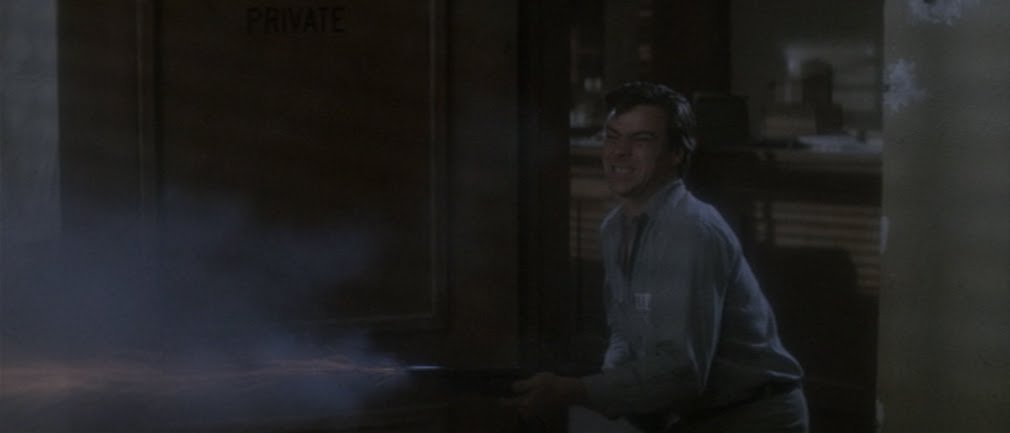
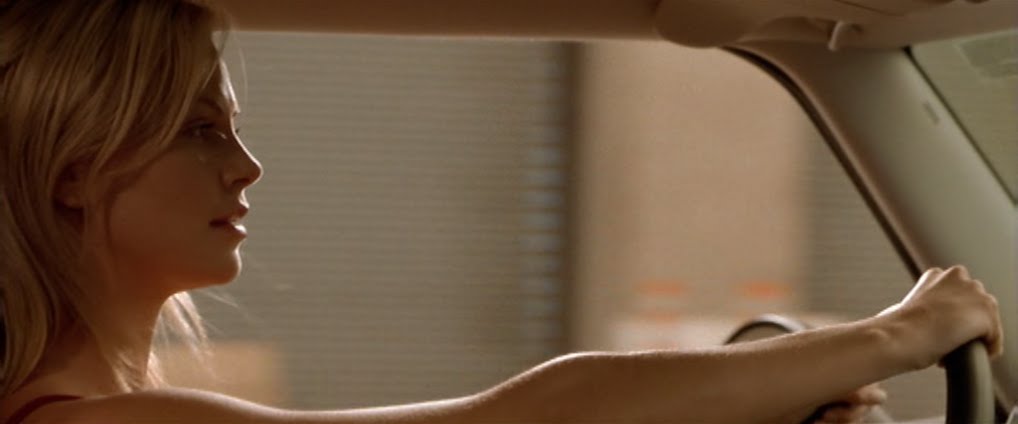
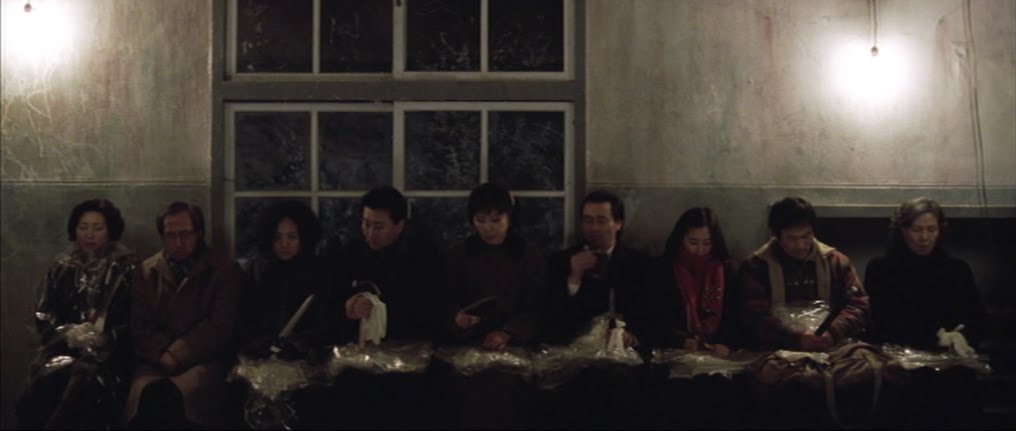
Here on The Agitation of the Mind, summer means one thing: crime. Shots on the Blog 2012 kicks off on Friday. Here's a small taster of what to expect:


Thursday, June 30, 2011

The Vengeance Trilogy


Although not a trilogy in the tradition sense – the three films share none of the same characters nor offer any narrative continuity – Chan-wook Park’s Vengeance Trilogy is as thematically focused and finely nuanced a set of films as, say, Ingmar Bergman’s trilogy on faith. Not that there’s any black market organ transplants, octopus eating, wrongful imprisonment, misuse of hammers or general artery ventilation in ‘Through a Glass Darkly’, ‘Winter Light’ or ‘The Silence’. Although the revelations at the end of ‘Oldboy’ will probably leave you feeling as brain-fucked as ‘The Silence’ leaves you depressed.

‘Sympathy for Mr Vengeance’ gets the trilogy off to a visceral and convention-defying start, even if the English language title does present a stumbling block. The whole ‘Mr Vengeance’ thing suggests that there is one character seeking revenge and that our sympathies will automatically lie with him. The indigenous Korean title translates more accurately as the biblical ‘Vengeance is Mine’. A much more apposite handle, as the film happily weaves itself into a web of ever more mind-boggling contrivances (and I use the word without any sense of pejorative) while cheerfully teasing the audience as to whose vengeance is being perpetrated at any given moment.


As briefly as possible: Ryu (Ha-kyun Shin) is a deaf-mute working at a foundry whose angelic sister (Ji-eun Lim) is likely to die unless she receives a kidney transplant. Ryu tries to donate his own kidney, but he’s the wrong blood type. With no guarantees when a suitable donor might be found, Ryu approaches a shady group who deal organs on the black market. He accepts a redundancy pay-off from his job and pays the full amount, as well as agreeing that the group can take one of his kidneys; in return they’ll perform the life-saving operation on his sister. Inevitably they rip him off, leaving him sans cash, sans kidney and sans any hope for his sister. The kicker is when her consultant contacts Ryu to inform him a donor has been located and he just needs to stump up the moolah for the operation.

If Ryu’s upset at himself, it’s nothing compared to how pissed off at him Yeong-mi (Doona Bae) is. Yeong-mi is Ryu’s activist girlfriend and, after giving him a good slapping for his stupidity, posits a perhaps even more stupid solution to his predicament: kidnap the daughter of a wealthy industrialist, demand a ransom and spend it on the medical bill. Which they do. Only the kidnapping takes an unexpected turn, leaving a bereaved and very pissed off Dong-jin Park (Kang-ho Song) on their trail.

Ostensibly, it would seem that Dong-jin is the Mr Vengeance of the bastardized title, and entirely justified with it. But the film also deals with Ryu’s vengeance against the organ dealers, as well as an eleventh-hour act of vengeance against – … ah, but that would be telling. In essence, ‘Sympathy for Mr Vengeance’ delineates how an act of violence – be it intended, accidental, gratuitous or justified – is merely the catalyst for further violence. There’s a novella by Tolstoy called ‘The Counterfeit Note’ where the passing of the forged currency of the title instigates a chain of events for the various characters involved, none of whom come out of it well. Park’s film follows a similar course, except with massive head trauma, electrocution, severed tendons and drowning.


For a work so thematically steeped in violence, the actual quota of onscreen viscera doesn’t add up to that many minutes. It’s just that Park delivers the red stuff unflinching when he does go for it. He uses humour, too; sometimes it softens the blow, sometimes it’s plain inappropriate. He finds quirkiness and absurdity in the darkest recesses of the human condition. The film is visually striking, with Park using overhead shots to bravura effect, and he uses imagery and symbolism in often subversive ways. Most notably in the juxtaposition of fire and water. The sulphurous depiction of the foundry seems to promise a Hadean backdrop, but actually represents the last vestige of normalcy that Ryu walks away from as he makes his ill-advised decision. Likewise, when Ryu goes down to the river (and I use the phrase in deliberate evocation of the old spiritual) for the first time it’s to expiate the grief he has caused his sister; to salve himself of his sins. Thereafter, that same stretch of the river is the scene of three (increasingly horrific) incidents. Never mind going down to the river to pray; Park frogmarches his characters there to pay.

‘Oldboy’ doesn’t, in its immediate set-up, present as a revenge movie; more as a twisted mystery or oblique thriller. Dae-su Oh (Min-sik Choi) is picked up by the police for public drunkenness one rainy evening. Subsequently released, he’s snatched off the street. He’s held captive in a blandly decorated room in an undisclosed location for 15 years. Just as randomly, he’s release. With the caveat that he has five days to track down his captor.

Fittingly, the imagery of ‘Oldboy’ is that of claustrophobic interiors: the tiny room Dae-su’s held in; the pillars that define his nemesis’s apartment the way bars define a prison cell; the long, narrow corridor in which Dae-su battles a gang of assailants in an eye-popping scene, shot to resemble a 1980s video game, that pretty much guaranteed ‘Oldboy’ cult classic status from the off.


When Park uses wide shots, it’s usually at critical points of the film, saving the most effective of his trademark overhead shots to symbolize the shattering aftermath of the final, almost unpalatable, revelation. I’m wary of discussing ‘Oldboy’ in too much detail, purely for the benefit of anyone reading this who hasn’t seen it. Suffice it to say, ‘Oldboy’ is the kind of film for which the expression “head-fuck” was invented.

The vengeance theme gets its proper exposition only in the last 20 minutes of ‘Oldboy’. In the hands of a lesser director, it would be a rug-pull; a sleight of hand. Park delivers it with a sense of terrible inevitability, even as he blindsides you with the full implications of exactly who is revenging themselves on who, and why. If ‘Sympathy for Mr Vengeance’ is about a series of events which spin off from one bad decision in a whirlwind of brutal but often ill-thought-out action, then ‘Oldboy’ is about damage done that has festered for years; that has grown cancerously into a considered and unhurried plan, its brutality (more psychological than physical) all the deeper for the thought that has gone into it.

Mercifully, a small but thankful glimmer of redemption is offered in ‘Lady Vengeance’. Again, the title – so obviously keyed into the English language release of the first film – isn’t quite representative of Park’s aesthetic design. Indigenously known as ‘The Kind-Hearted Ms Geum-Ja’, the titular protagonist (Yeong-ae Lee) is introduced having been released from jail after serving 13 years (shades of Dae-su’s “sentence”) for the kidnap and murder of a child. Whilst inside, she earns a reputation as an almost saintly figure (shades of Ryu’s sister), caring for her fellow inmates. And so what if she administered the odd bit of poisoning or committed murder against a fellow prisoner – it was there own fault; they shouldn’t have victimized Geum-Ja’s friends.


Once on the outside, it quickly becomes apparent that Geum-Ja was coerced into pleading guilty when the real killer, sociopathic schoolteacher Mr Baek (Min-sik Choi), threatened to kill Geum-Ja’s infant daughter. Once on the outside, Geum-Ja sets about (a) reintegrating into society, (b) making sure her daughter’s okay, and (c) perpetrating violent revenge on Baek. Park has fun playing with overlapping timelines and structuring an hilariously inappropriate melange of religious imagery around Geum-Ja’s acts of penal charity. He even goes as far, in Geum-Ja’s most saintly moments, as having soft light radiate around her like a halo.

There’s nothing angelic about what happens when she gets her hands on Baek, though. But just when the scene is set for a bit of cathartic Geum-Ja-on-Baek nastiness, Park pulls a narrative development as effective – if even it isn’t as much of an emotional sucker-punch – as that of ‘Oldboy’. Thus far in the trilogy, we’ve had several acts of vengeance as a result of one bad decision, and a single act of vengeance planned over time and orchestrated like a puppeteer pulling the strings, but with the one constant that in each instance the act of vengeance has been specific and personal. In ‘Lady Vengeance’, the revenge necessarily becomes a collective matter when Geum-Ja discovers the extent of Baek’s activities and realizes that she alone does not have the exclusive right to deal with him.


The last third of the film develops into a debate on the nature of revenge, individual vs collective responsibility, and the moral quandaries that ensue. That the final outcome is inevitable is less a point of contention than a setting of the scene for a final quarter of an hour that is frankly astounding. Remember that scene towards the end of ‘The Straight Story’: Alvin Straight (Richard Farnsworth) has almost reached the end of his journey, and stops off at a bar; he hasn’t drunk in ages, but now he orders a beer; it’s a crucial point for him, yet David Lynch’s camera follows the doddery old barman as he breaks off conversation with Alvin and wanders off to the opposite end of the bar to perform some utterly mundane task. It’s a moment where the camera, the director, the film itself and by extension the audience veer away from the enormity of what has gone before – in the case of ‘The Straight Story’, an octogenarian in ailing health travelling several hundred miles across America in all weathers on a ride-on lawnmower – and are presented with a small, still moment, almost pointless in its narrative and thematic insignificance, by which the preceding is thrown into even sharper relief. At a pinch, you could describe it as the cinematic equivalent of the via negative. Now imagine that scene, reconfigured as a borderline religious metaphor, coming after an extended sequence of largely offscreen but still obviously brutal violence, and ending on a snowy image that intermingles grief, loss, reunion and redemption.

That’s ‘Lady Vengeance’ for you. A beautiful, poignant, masterfully realized conclusion to the trilogy.