Showing posts with label Julian Barratt. Show all posts
Sunday, May 07, 2017
Mindhorn
High concept goes lo-fi in this British comedy that treads similar territory to 2013’s ‘Alan Partridge: Alpha Papa’. Hell, Steve Coogan’s in both of them. Here Coogan plays Peter Eastman, an actor who’s done rather well in a forensic detective TV drama called ‘Windjammer’, a spin off of 1980s hi-tech cop show ‘Mindhorn’ whose protagonist was played by insufferable egomaniac Richard Thorncroft (Julian Barratt) and which ended after three seasons when an embarrassingly drunk and coked up Thorncroft publically humiliated himself on a talk show, offended everyone associated with the show, dubbed the Isle of Man (the series’ setting) a “shithole”, and announced that he was off to Hollywood.
Twenty five years later, having abjectly failed to make it in Tinseltown, Thorncroft is reduced to making commercials, attending auditions for rubbish parts, and haranguing his long-suffering agent (Harriet Walter). When Paul Melly (Russell Tovey), the chief suspect in a murder case, contacts the Isle of Man Constabulary to say that he will only talk to Mindhorn, Chief Inspector Newsome (David Schofield) and D.C. Baines (Andrea Riseborough) reluctantly contact Thorncroft and ask him to resume his old role. What follows – as you’ll probably guess, given the involvement of both Coogan and ‘Mighty Boosh’ regular Barratt – is a comedy of embarrassments that is, by turns, genuinely funny, dispiritingly predictable and ploddingly laboured. The moments where it really hits its stride are certainly worth the ticket price, but ‘Alpha Papa’ it isn’t.
One of its funniest set pieces is the opening, which sets up the dynamic of the ‘Mindhorn’ TV show. Full of macho posturing, overly-dramatic line deliveries and opening credits delivered in a hideous font, it’s a spot on piece of spoofery. Imagine ‘Mindhorn’ as a cross between ‘The Six Million Dollar Man’ and ‘Bergerac’ with Thorncroft’s performance akin to that of “John Actor” playing Monkfish in the recurring ‘Fast Show’ sketches. (Mindhorn/Monkfish: I’m stating the obvious here, aren’t I?) Indeed, Thorncroft’s casual sexism recalls Monkfish’s “put your knickers on and make me a cup of tea” ethos.
Director Sean Foley, whose first film this is, mines a lot of humour from the cult of 1980s. A running gag about ‘Mindhorn’ merchandise pokes fun at any number of American hit shows of the era, while the ATV logo is sneakily inserted in the ‘Mindhorn’ opening credits. And there are a handful of bitchy jokes about ‘Bergerac’ (the John Nettles starrer that was set on Jersey). Essie Davis’s role as ‘Mindhorn’ co-star and romantic interest Patrica Deville is a thinly veiled nod to Louise Jameson’s nothing role on ‘Bergerac’.
But beyond nostalgic box-ticking for 80s TV fans, what does the movie have to offer? Sad to say that Barratt is probably the least of its attractions: not only does Thorncroft have to be an arrogant price for 90% of the running time to make the concept work, but Barratt seems to enjoy playing the façade a little too much, and when the time comes for the character’s redemption in the final act, it all feels very forced. Fortunately, everyone else is on form – Davis, Riseborough and an hilariously irascible Schofield are a delight to watch, Tovey takes a very trickily written character (Melly’s mental deficiency, while again necessary to the plot, verges on exploitative) and does fine work, and Simon Farnaby nabs the Agitation ‘Man of the Match’ award for his broadly comedic yet oleaginously creepy turn as Clive, Thorncroft’s former stuntman and now romantic rival.
The hour twenty five minute running time is just right. The pace is generally decent, except when Foley takes too long to set up a joke or labours the payoff (some business involving a switched videotape is a case in point). There’s one set-piece – an assassination attempt and a high speed getaway that are assumed to be part of a civic parade, a bored dignitary giving a running commentary on the whole thing – that is inspired in its concept and pitch perfect as an archetype of British humour. Had ‘Mindhorn’ scraped together another three or four moments this good, and Barratt redialled the performance just a tad, it could have been great. But there’s no reason why the same team, with just a slightly sharper approach, can’t deliver a bona fide belter next time round.
Monday, December 16, 2013
WINTER OF DISCONTENT: A Field in England
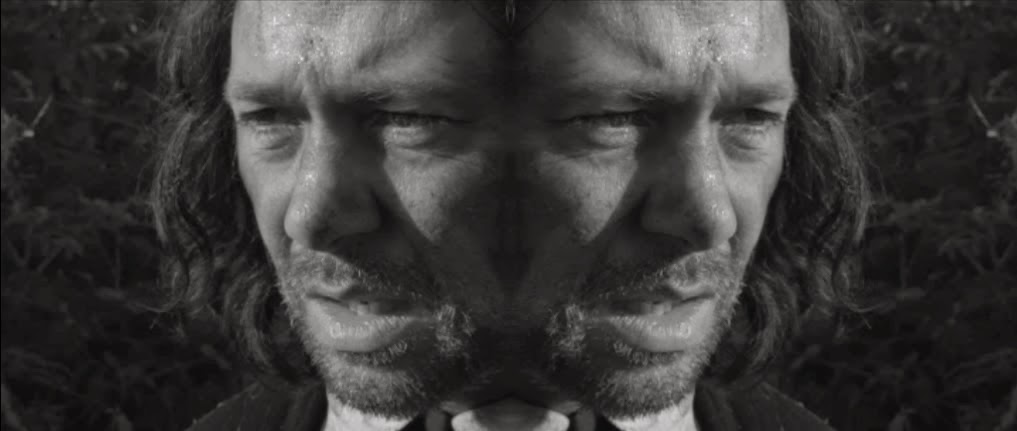
If the last reel of ‘Kill List’ saw Ben Wheatley getting his ‘Wicker Man’ funk on, then ‘A Field in England’ channels British cinema’s other great religious violence horror movie, ‘Witchfinder General’. Shot in deep, moody black and white that also brings to mind ‘Winstanley’ and ‘Onibaba’, ‘A Field in England’ is defined by the rural landscapes of England and describes a journey into the most primal, superstitious, self-loathing and class-enforced areas of the English psyche. It’s confusing, frustrating, nihilistic, exhilarating and up itself all at the same time. It’s about as far from being a laugh-fest as you can possibly imagine. Since I’ve loaded up this introductory paragraph with comparisons, let’s float this one: it’s like Ken Loach circa ‘The Devils’ meets Andrei Tarkovsky on a day when they both decided to toke the entire contents of Jim Morrison’s drugs stash.
In other words, it’s a Ben Wheatley film.
Four films into a career that’s shown no sign of anything but utterly going his own way, a Ben Wheatley film comes with certain prerequisites. Terms and conditions, if you like. First up, he will resolutely not make it easy for the viewer. You will be expected to pay attention, you will be made to think, you will not be given any pat explanations or conclusions, and you can (un)comfortably expect the film to get under your skin and fuck with your head for days afterwards. Secondly, narrative coherence or traditional structure are anathema to his aesthetic and were taken outside and given a good kicking before the first word of the screenplay was even typed. Thirdly, he doesn’t need to like his characters. And there’s an almost certain probability that you won’t either.
All of this makes for a viewing experience that’s sometimes visceral, sometimes compelling and sometimes downright annoying. ‘A Field in England’ is no exception. Filmed for just £300,000 and delivering pure widescreen visual beauty (even in its ugliest moments) that’d convince you the budget was ten times that, it’s set in the Civil War but jettisons any real Roundheads vs Cavaliers historical context for a hallucinogenic trip across a field and into a heart of darkness that would make Conrad weep and Coppola turn up the Wagner.
The plot – yeah, let’s be silly enough to use the word “plot” in the context of a Ben Wheatley joint – is basically this: the cowardly Whitehead (Reece Shearsmith) flees from his hectoring master Commander Trower (Julian Barratt) during the confusion of battle. He meets deserters Cutler (Ryan Pope), Jacob (Peter Ferdinando) and Friend (Richard Glover) who are similarly using the confusion to slip away. Their plan: find an alehouse. En route, they bump into the messianic O’Neill (Michael Smiley), an alchemist whom Trower had despatched Whitehead to apprehend. Instead, O’Neill takes Whitehead and the others prisoner and compels them to assist him in finding hidden treasure in a nearby, uh, field.
Hold off, I hear you say, why be pejorative about the idea of a Ben Wheatley film having a coherent narrative arc? Surely the events described above constitute a narrative arc, albeit a rather straightforward one. Surely the character dynamics are palpably evident.
Ah, well here’s the rub. Early on in the proceedings, our AWOL quartet improvise a meal of mushrooms. The rest of the film builds through hallucinations, paranoia, cold edgy fear and peasant superstition into a psychotronic wig-out that manages, simultaneously, to (a) emerge as the most purposefully calculated feat of editing I think I’ve ever seen and (b) give the impression that the filmmakers have entirely lost their grip on sanity and decided to take you with them as they go screaming headlong towards the abyss.
Like ‘Kill List’, ‘A Field in England’ isn’t the kind of film that lends itself to easy or conventional reviewing. There are elements that come on like absurdist humour but without a trace element on even the uneasiest of laughs. There are moments of arty-farty indulgence that would have been excised for shame from a student film. And there are entire swathes of brain-searing imagery and visual trickery that breaks down your molecules and refuses them into something entirely new and unexpected. The closest I can come to a defining statement on ‘A Field in England’ is that it’s a 91-minute Rorschach test and I’d advise anyone approaching it to be very wary of how deeply they peer into its shifting surfaces.
Subscribe to:
Posts (Atom)