In no particular order, and the only criteria being that I can't imagine these being attributable to any other film-maker, these are my ten favourite, most quinessential Herzog moments:
1) 'Aguirre, Wrath of God' - with the project doomed if its lead actor departed the jungle location, Herzog responded to Klaus Kinski threatening to pack up his things and board the next boat leaving for civilisation by assuring him that he had a rifle and nine bullets; eight of them would be in Kinski before he reached the first bend in the river, the ninth he would save for himself. Kinski decided to stay and finish shooting the film.
2) 'La Soufriere' - a Caribbean island's on the verge of destruction when a live volcano suddenly goes off the seismic scale. The islanders depart. The politicians and the police depart. The scientists measuring the volcano's activity depart. What does Herzog do? Round up a couple of cameramen and fly out there!
3) 'Fitzcarraldo' - shucking off the money men's suggestion that the film's centre-piece be achieved using a model boat in a greenhouse, Herzog has his cast and crew haul an honest-to-god steamship over a freakin' mountain!
4) 'Heart of Glass' - deciding that a dream-like atmosphere best suits this tale of a glass-works going out of business and causing the fiscal ruination of the town dependent on it, Herzog puts his cast under hypnosis.
5) 'Little Dieter Needs to Fly' - recreating Dieter Dengler's capture by the VC, Herzog eschews a simple "talking heads" account of the incident from Dengler himself, and spurns the docu-drama route of restaging key points of the narrative in a very polite, formal, more-tea-vicar BBC kind of way. Instead, he takes Dengler back to the jungle, handcuffs him, and has some big bastards shove him heavy-handedly through the foliage. Result: best documentary of the last two decades.
6) 'Even Dwarfs Started Small' - realising he would be putting his vertically-challenged cast through the ropes, he agreed that after the shoot was over he'd jump into a cactus field. The dwarfs did their scenes. The shoot concluded, Herzog threw himself happily into a field full of cactii.
7) 'The Enigma of Kaspar Hauser' - jettisoned any attempt at historical verisimilitude by casting mid-40s street musician Bruno S, as the 16-year-old Kaspar Hauser.
8) 'Woyzeck' - playing the hapless and much-put-upon soldier, Klaus Kinski decided that the opening sequence would benefit from the actor playing his drill sergeant giving him a real kicking. Herzog, making no attempt to dissuade either performer, filmed said kicking.
9) 'Stroszek' - ended this blackly comic tale of alienation and failure (yes, I know I just used "blackly comic", "alienation" and "failure" in the same sentence; trust me on this) with an interminable shot of a dancing chicken that so affronted DoP Thomas Mauch that Herzog had to explain the image thusly: "This is something very big. It looks unobstrusive when you see it with the naked eye in front of you, but don't you see that there is something big about it, something beyond what we are?" Mauch's response is unrecorded, but he filmed the chicken.
10) The Minnesota Declaration - declared war on Cinéma Vérité, describing at as "a merely superficial truth, the truth of accountants".
Showing posts with label Klaus Kinski. Show all posts
Showing posts with label Klaus Kinski. Show all posts
Sunday, September 06, 2009

Conquest of the Useless
 Can we agree that 'Fitzcarraldo' is Herzog's magnum opus, the most perfectly Herzogian thing in his filmography, and all the proof that one needs regarding the lengths the man is prepared to go in order to realise his vision?
We can? Thank you.
'Conquest of the Useless' (subtitled Reflections from the making of 'Fitzcarraldo') comprises Herzog's diaries, spanning June 1979 to December 1981, and documents the trials, tribulations and tendencies of its director to go native. Early entries see Herzog as Francis Ford Coppola's guest ("Coppola ... is displaying a strange combination of self-pity, neediness, professional work ethic, and sentimentality") while he labours on the script and deals with the moneymen:
"The unquestioned assumption is that a plastic model ship will be pulled over a ridge in a studio, or possibly in a botanical garden ... I told them the unquestioned assumption had to be a real steamship being hauled over a real mountain, though not for the sake of realism but for the stylization characteristic of grand opera. The pleasantries we exchanged from then on wore a thin coating of frost."
This is on page five. By page six (24 June 1979) we're in the jungle. It's not until page 117 (6 January 1981) that Herzog gets the first shot of 'Fitzcarraldo' in the can. 'Conquest of the Useless' is a very different beast to the usual "making of" text. Herzog's extended pre-production and location scouting in the jungle occupies nearly the first half of the book. He dwells less on the film project, writing instead of what he sees around him, of the indigenious population he meets, of lives the way they are lived in the most primitive of surroundings. When he writes of these things he is equal parts documentarist, participant and poet. In his prose as in the images of his films, Herzog brings to life landscapes and people most of us will never encounter, never see with our own eyes; but his account never feels as if it is being written on our behalf (Paul Theroux, great writer though he is, typifies this tendency), nor that he is playing up local colour for its own sake. Herzog is a poet of the extreme because, for him, the extreme is ordinary. Put him in a normal, ostensibly civilised scenario and he codifies it as something alien - evidenced by his slightly surreal depiction of San Francisco in the early entries.
Oh, did I say somewhere in that last paragraph that Herzog shot the first frame of 'Fitzcarraldo' in January 1981? Let me rephrase that. He shot the first frame of 'Fitzcarraldo' Version 1.0. Several weeks' worth of footage were shot with the original cast - Jason Robards as the eponymous would-be rubber baron, and Mick Jagger as his demented henchman - some of which remains, such as Fitzcarraldo's belltower declaration that he will build his opera house, and is featured in the documentary 'My Best Fiend'. It is interesting to speculate how 'Fitzcarraldo' starring Robards and Jagger would have turned out (the belltower scene suggests it could have been inspired and cringeingly embarrassing in roughly equal parts), but it wasn't to be.
Robards emerges as almost terrified by the jungle and appalled at the lack of creature comforts (though we have to remember that these are the perceptions of a man for whom the extreme is second nature; I'd probably have shared some of Robards' opinions). It's clear Herzog had no liking for him, even before Robards absconds, citing medical concerns, and damn near scuppers the production. Herzog's take on Jagger is undecided, admiring him for mucking in and driving fellow cast and crew members to their accommodation, then despairing of him for gloating over how much money he can get for some photos of a bikini'd Jerry Hall taken on set. Herzog sees this as the commercialisation of his vision and isn't happy about it.
After Robards departs, Herzog and co. resolutely remain in the jungle, clinging to what is left of the production. Two months later, Klaus Kinski takes on the role and filming resumes. Anyone who has seen 'My Best Fiend' will know that Kinski was Herzog's muse, nemesis and alter ego all rolled into one. They were bound together by a creative imperative, the fruitfulness of which was only equalled by its antagony. Their previous tropical collaboration, 'Aguirre, Wrath of God', culminated in Herzog forestalling Kinski's announced departure mid-shoot by threatening to empty a rifle into him. Both men must have known 'Fitzcarraldo' would be round two.
Put it this way: the fucking steamship enjoyed plainer sailing!
And yet Herzog is remarkably fair when he writes about Kinski. Sure, there are the expected tantrums, arguments and bouts of egomania, but equally Herzog writes of Kinski like a brother. This aspect of the latter half of 'Conquest of the Useless' proves as affecting as it is compelling. But what really makes the book such a wonderful and unmissable read is that the film, the ship, the crazed actor, the lunatic logistics or the director himself never force their way to the front of the narrative; the real star of Herzog's memoir is the jungle.
Wednesday, July 02, 2008
Interrupting the Shyamalan-a-thon ...
... which, frankly, I’ve been procrastinating over. I watched ‘Signs’ last weekend and have been implementing blogging-avoidance strategies ever since – and with only the pompous seriousness and house-of-cards twist of ‘The Village’ on the horizon, my motivation isn’t just ebbing but doing a pretty good impersonation of a fully-fledged drought.
But, still … interrupting the Shyamalan-a-thon:
Kudos to the BBC for last night’s ‘Imagine’ documentary on Werner Herzog. A joy to see Alan Yentob, who frequently puts himself at the centre of the programme (he all but elbowed the – admittedly reclusive – Japanese novelist Haruki Murakami out of the picture in last week’s programme), getting put in his place by the great director. “As a German living in Hollywood – ” Yentob begins, only for Herzog to correct him on two counts: he’s Bavarian and he lives in LA, not Hollywood. There is a difference.
The documentary itself was a bit scattershot, trying to reference too many of Herzog’s films (he’s made over 50) during its 60-minute running time; nonetheless, a through-line emerged of Herzog as a chronicler of the extreme, be it extreme conditions of filming (‘Aguirre: the Wrath of God’, ‘Fitzcarraldo’) or extreme personalities (Timothy Treadwell in ‘Grizzly Man’; Klaus Kinski in every film he made for Herzog); a man whose themes, concerns and images resonate down a four-decade filmography; a man attuned to the physicality and landscapes of the locations he shoots.
The payoff was fantastic, Herzog recounting a legendary incident during the filming of ‘Aguirre’: with ten days of principle photography remaning, Kinski, in one of his archetypal bouts of mania, had packed his belongings and was ready to zoom off in a speedboat. Herzog assured him he’d be shot before he reached the first bend in the river.
Dispelling the myth that he’d spent the film directing Kinski from behind a shotgun, Herzog recalled, “I didn’t have a gun in my hand when I told him this, but he knew I meant it.” (Incidentally, Herzog speaks in a very precise manner, his tone of voice always reasoned and calm; there is not a trace of hyperbole about him.)
Yentob, briefly speechless, responded, “And you seem like a gentle man.”
“I was very gentle with Kinski,” Herzog replied, “I gave him a choice. I would not have shot him without giving him a choice.”
Wunderbar! A large glass of Riesling was raised to Herr Herzog at chez Fulwood last night.
But, still … interrupting the Shyamalan-a-thon:
Kudos to the BBC for last night’s ‘Imagine’ documentary on Werner Herzog. A joy to see Alan Yentob, who frequently puts himself at the centre of the programme (he all but elbowed the – admittedly reclusive – Japanese novelist Haruki Murakami out of the picture in last week’s programme), getting put in his place by the great director. “As a German living in Hollywood – ” Yentob begins, only for Herzog to correct him on two counts: he’s Bavarian and he lives in LA, not Hollywood. There is a difference.
The documentary itself was a bit scattershot, trying to reference too many of Herzog’s films (he’s made over 50) during its 60-minute running time; nonetheless, a through-line emerged of Herzog as a chronicler of the extreme, be it extreme conditions of filming (‘Aguirre: the Wrath of God’, ‘Fitzcarraldo’) or extreme personalities (Timothy Treadwell in ‘Grizzly Man’; Klaus Kinski in every film he made for Herzog); a man whose themes, concerns and images resonate down a four-decade filmography; a man attuned to the physicality and landscapes of the locations he shoots.
The payoff was fantastic, Herzog recounting a legendary incident during the filming of ‘Aguirre’: with ten days of principle photography remaning, Kinski, in one of his archetypal bouts of mania, had packed his belongings and was ready to zoom off in a speedboat. Herzog assured him he’d be shot before he reached the first bend in the river.
Dispelling the myth that he’d spent the film directing Kinski from behind a shotgun, Herzog recalled, “I didn’t have a gun in my hand when I told him this, but he knew I meant it.” (Incidentally, Herzog speaks in a very precise manner, his tone of voice always reasoned and calm; there is not a trace of hyperbole about him.)
Yentob, briefly speechless, responded, “And you seem like a gentle man.”
“I was very gentle with Kinski,” Herzog replied, “I gave him a choice. I would not have shot him without giving him a choice.”
Wunderbar! A large glass of Riesling was raised to Herr Herzog at chez Fulwood last night.
Tuesday, November 27, 2007
My Best Fiend
‘My Best Fiend’ is a curiosity in many respects, not least because its translated English title (a one-letter-short corruption of “my best friend”) is wittier and far more effective than the German ‘Mein Leibster Feind’ (purpose of comparison: “feind”/“freunde” … not quite the same, is it?).
It’s a curiosity because I don’t know of any other director (though please feel free to correct me on this) making a film about his alter ego. My imagination takes over at this point. Kurosawa on Mifune: ‘My Best Samurai’. Losey on Bogarde: ‘My Best Repressed Englishman’. Scorsese on de Niro: ‘My Best Italian-American Before I Chucked Him For Leo’ …
Sorry, I digress. How you perceive ‘My Best Fiend’ depends on your definition of a documentary. Should it be an exercise in objectivity? If so, ‘My Best Fiend’ can be disallowed, purely because of Herzog’s relationship with his subject. (By this definition, Michael Moore’s entire output can also be excluded … they’re polemics, not documentaries. But, like ‘My Best Fiend’, they’re also good: provocative, compelling, always interesting to watch.)
In Herzog’s defence, he made the film almost a decade after Kinski’s death. No knee-jerk reaction or quick cash in. Also, he allows for the fact that Kinski can’t, by dint of mortality, have his say by allowing Eva Mattes and Claudia Cardinale (KK’s co-stars on ‘Woyzeck’ and ‘Fitzcarraldo’ respectively) to have theirs: both women attest to Kinski’s chivalrous, gentlemanly side. Mattes, particularly, pays attention to Kinski’s brilliance as an actor (the accompanying clip from ‘Woyzeck’ proves her point in fine style). The final scene, archive footage of Kinski, a childish grin on his face, watching a butterfly flit along his hand then alight on his ear, allows the audience to take away from the film a human, likeable Kinski, rather than the ranting egomaniac depicted in so many other scenes.
Scenes like:
Herzog recounting KK’s threatened walk-off during the filming of ‘Aguirre, the Wrath of God’ – Herzog tells him, very quietly and calmly, that he has a rifle and before Kinski reaches the next bend in the river, there’ll be eight bullets in him (“and the ninth will be for me”).
Kinski having a stand-up row (that quickly degenerates into the spectacle of a grown man determinedly throwing his toys out of the pram) with a producer on ‘Fitzcarraldo’. Herzog comes out of this scene just as badly, hovering in the background instead of bringing his errant star into line. The unfortunate producer, it must however be said, throws it back at Kinski in fine style … I’d love to stand the man a pint for his utter refusal to take Kinski’s shit.
Footage of Kinski’s controversial ‘Jesus’ tour, a one-man theatrical revue where he cast himself, in contemporary dress and language, as the abused and suffering Christ … only to abuse his audience vehemently for heckling.
There can be no doubt that Kinski was a victim of his own ego. Yet, for all that he recounts their clashes with avuncular calmness, there’s more than a hint of ego to Herzog’s centrality to ‘My Best Fiend’. At times, it seems less about Kinski than Herzog himself.
My partner, very much a newcomer to Herzog’s cinema and with only the sketchiest notion of who Kinski was, watched ‘My Best Fiend’ and offered the comment: “It’s like they both needed each other. Not surprising, really: they’re as mad as each other.”
It’s a curiosity because I don’t know of any other director (though please feel free to correct me on this) making a film about his alter ego. My imagination takes over at this point. Kurosawa on Mifune: ‘My Best Samurai’. Losey on Bogarde: ‘My Best Repressed Englishman’. Scorsese on de Niro: ‘My Best Italian-American Before I Chucked Him For Leo’ …
Sorry, I digress. How you perceive ‘My Best Fiend’ depends on your definition of a documentary. Should it be an exercise in objectivity? If so, ‘My Best Fiend’ can be disallowed, purely because of Herzog’s relationship with his subject. (By this definition, Michael Moore’s entire output can also be excluded … they’re polemics, not documentaries. But, like ‘My Best Fiend’, they’re also good: provocative, compelling, always interesting to watch.)
In Herzog’s defence, he made the film almost a decade after Kinski’s death. No knee-jerk reaction or quick cash in. Also, he allows for the fact that Kinski can’t, by dint of mortality, have his say by allowing Eva Mattes and Claudia Cardinale (KK’s co-stars on ‘Woyzeck’ and ‘Fitzcarraldo’ respectively) to have theirs: both women attest to Kinski’s chivalrous, gentlemanly side. Mattes, particularly, pays attention to Kinski’s brilliance as an actor (the accompanying clip from ‘Woyzeck’ proves her point in fine style). The final scene, archive footage of Kinski, a childish grin on his face, watching a butterfly flit along his hand then alight on his ear, allows the audience to take away from the film a human, likeable Kinski, rather than the ranting egomaniac depicted in so many other scenes.
Scenes like:
Herzog recounting KK’s threatened walk-off during the filming of ‘Aguirre, the Wrath of God’ – Herzog tells him, very quietly and calmly, that he has a rifle and before Kinski reaches the next bend in the river, there’ll be eight bullets in him (“and the ninth will be for me”).
Kinski having a stand-up row (that quickly degenerates into the spectacle of a grown man determinedly throwing his toys out of the pram) with a producer on ‘Fitzcarraldo’. Herzog comes out of this scene just as badly, hovering in the background instead of bringing his errant star into line. The unfortunate producer, it must however be said, throws it back at Kinski in fine style … I’d love to stand the man a pint for his utter refusal to take Kinski’s shit.
Footage of Kinski’s controversial ‘Jesus’ tour, a one-man theatrical revue where he cast himself, in contemporary dress and language, as the abused and suffering Christ … only to abuse his audience vehemently for heckling.
There can be no doubt that Kinski was a victim of his own ego. Yet, for all that he recounts their clashes with avuncular calmness, there’s more than a hint of ego to Herzog’s centrality to ‘My Best Fiend’. At times, it seems less about Kinski than Herzog himself.
My partner, very much a newcomer to Herzog’s cinema and with only the sketchiest notion of who Kinski was, watched ‘My Best Fiend’ and offered the comment: “It’s like they both needed each other. Not surprising, really: they’re as mad as each other.”
Sunday, November 25, 2007
Cobra Verde
I’ve not read Bruce Chatwin’s novel ‘The Viceroy of Ouidah’, so I can’t comment on ‘Cobra Verde’ in terms of an adaptation. I have to consider it, then, purely on its own merits.
And, yes, ‘Cobra Verde’ has its merits, particularly in Herzog’s observational depiction of West African rituals, importance of dance and sense of ceremony. There are at least three excellent set-pieces, even though one of them is more effective in its build-up than its resolution. But more of that later. There are some good performances – although not Kinski’s; the actor was clearly on his way out (he died four years after the film was completed). Again, more of that later.
What is beyond debate is that ‘Cobra Verde’ is the least of the Herzog/Kinski films. Why? Well, I started this blog in order to celebrate the movies I loved, not to knock the ones that don’t come up to scratch … hmmm, six posts in and I can feel my mission statement straining at the edges.
Let’s pause for plot synopsis:
A feared Mexican bandit, Francisco Manoel da Silva (Kinski), is hired unwittingly by a landowner, Don Octavio (José Lewgoy), to oversee his slaves. He promptly gets Don Octavio’s three daughters pregnant. By now aware that he’s a feared bandit, the don dispatches him to West Africa to take care of his interests in the slave trade, quietly hoping that da Silva (nicknamed Cobra Verde by the locals) will be put to death as soon as he sets foot on African soil. What makes him so sure is that the recently appointed King Bossa de Ahadey of Dahomey (played by real-life royal, H.R.H. Nana Agyejfi Kwane II of Nsein) is a loose cannon who hates the sight of white men. Da Silva accepts the commission, sails to Africa, establishes himself at abandoned Fort Elmina, and trades rifles for slaves. Everything is going well until King Bossa has him seized and brought before him. King Bossa orders da Silva put to death (da Silva’s face is blacked up to get around the technicality of not killing white men!), but he is rescued by a rival faction. Da Silva trains an army of topless warrior women (I am not making this up) and leads them against King Bossa, dethroning him. Promoted to viceroy and returned to Fort Elmina, da Silva learns that Don Octavio, having taken delivery of the shipment of slaves, has double-crossed him and da Silva is now a wanted man. He drags a boat down to the shore, intending to set sail, but dies as he tries to haul it the last few feet into the waves.
To say the narrative jumps around a bit is like saying Oliver Reed took the odd lemonade shandy. Narratively and structurally, the film is all over the place. Normally this wouldn’t matter in a Herzog movie – the sheer filmic spectacle of it would be enough. And with its cast of hundreds and locations that included Brazil, Ghana and Colombia, it should have looked awesome. Instead, it’s curiously flat. Herzog’s frequent collaborator Thomas Mauch quit as director of photography after one too many run-ins with Kinski, and was replaced by Viktor Ruzicka. Mauch’s loss is clear in every frame of the film.
Plotwise, major developments are skimmed over or not bothered with at all. Villagers flee from da Silva in the opening scenes, but the biggest landowner in the territory hasn’t heard of him and casually hires him. We’re told he’s doing a fine job, but we never see him at work. He has his wicked way with Don Octavio’s three daughters, but there’s not a shred of sexual tension and only the briefest of scenes suggesting a liaison. I’m not saying acres of exposed flesh should have been the order of the day (although there’s plenty of that in the latter half), but like so many of the necessary plot developments of the first hour, this element of the film just doesn't convince.
The two main set pieces – the restoration of Fort Elmina and the attack on King Bossa’s residence – occupy the mid-section of ‘Cobra Verde’, the film then lapsing into a tedious, conversation-driven final act as da Silva realises the extent of Don Octavio’s betrayal. Only the magnificent death-scene, played out against the silvery patterns of light on water, recaptures what Herzog and Kinski were capable of.
Finally, Kinski himself must shoulder much of the blame. Wasted, crazed, his very presence on set generating a more negative atmosphere than ever before, his excesses behind the camera were, for the first time in his career, not mirrored by a galvanising performance in front of it. He drifts through most of the film in a daze, only coming alive to rant and snarl maniacally towards the end.
His best moment comes as he leads the rebel army. They enter King Bossa’s residence only to find a snake coiling languidly in front of them. “They’ve taken the sacred python from the temple,” someone warns him; “no-one who passes will live.” Da Silva rounds on the man: “They named me for a snake in my country. Attack!” And so saying, he kicks the serpent out of the way (a moment all the more crazily iconic for him being barefoot) and leads the charge … Only for the scene to end, abruptly and bloodlessly, just seconds later.
So what does ‘Cobra Verde’ have going for it? Well, Lewgoy is excellent as Don Octavio, hypocritically leching after his womenservants then lambasting his daughters for sluts when they fall pregnant. Likewise Peter Berling (returning from ‘Aguirre, the Wrath of God’), who also paints an acidic portrait of hypocrisy as a missionary whose interest in some of his parishioners (notably the bare-breasted “nun’s choir”) extends beyond touching their souls …
Mainly, though, there’s Africa. Its people, its customs, its rhythms. I can’t help thinking that Herzog’s cameras would have been better employed in filming a documentary.
And, yes, ‘Cobra Verde’ has its merits, particularly in Herzog’s observational depiction of West African rituals, importance of dance and sense of ceremony. There are at least three excellent set-pieces, even though one of them is more effective in its build-up than its resolution. But more of that later. There are some good performances – although not Kinski’s; the actor was clearly on his way out (he died four years after the film was completed). Again, more of that later.
What is beyond debate is that ‘Cobra Verde’ is the least of the Herzog/Kinski films. Why? Well, I started this blog in order to celebrate the movies I loved, not to knock the ones that don’t come up to scratch … hmmm, six posts in and I can feel my mission statement straining at the edges.
Let’s pause for plot synopsis:
A feared Mexican bandit, Francisco Manoel da Silva (Kinski), is hired unwittingly by a landowner, Don Octavio (José Lewgoy), to oversee his slaves. He promptly gets Don Octavio’s three daughters pregnant. By now aware that he’s a feared bandit, the don dispatches him to West Africa to take care of his interests in the slave trade, quietly hoping that da Silva (nicknamed Cobra Verde by the locals) will be put to death as soon as he sets foot on African soil. What makes him so sure is that the recently appointed King Bossa de Ahadey of Dahomey (played by real-life royal, H.R.H. Nana Agyejfi Kwane II of Nsein) is a loose cannon who hates the sight of white men. Da Silva accepts the commission, sails to Africa, establishes himself at abandoned Fort Elmina, and trades rifles for slaves. Everything is going well until King Bossa has him seized and brought before him. King Bossa orders da Silva put to death (da Silva’s face is blacked up to get around the technicality of not killing white men!), but he is rescued by a rival faction. Da Silva trains an army of topless warrior women (I am not making this up) and leads them against King Bossa, dethroning him. Promoted to viceroy and returned to Fort Elmina, da Silva learns that Don Octavio, having taken delivery of the shipment of slaves, has double-crossed him and da Silva is now a wanted man. He drags a boat down to the shore, intending to set sail, but dies as he tries to haul it the last few feet into the waves.
To say the narrative jumps around a bit is like saying Oliver Reed took the odd lemonade shandy. Narratively and structurally, the film is all over the place. Normally this wouldn’t matter in a Herzog movie – the sheer filmic spectacle of it would be enough. And with its cast of hundreds and locations that included Brazil, Ghana and Colombia, it should have looked awesome. Instead, it’s curiously flat. Herzog’s frequent collaborator Thomas Mauch quit as director of photography after one too many run-ins with Kinski, and was replaced by Viktor Ruzicka. Mauch’s loss is clear in every frame of the film.
Plotwise, major developments are skimmed over or not bothered with at all. Villagers flee from da Silva in the opening scenes, but the biggest landowner in the territory hasn’t heard of him and casually hires him. We’re told he’s doing a fine job, but we never see him at work. He has his wicked way with Don Octavio’s three daughters, but there’s not a shred of sexual tension and only the briefest of scenes suggesting a liaison. I’m not saying acres of exposed flesh should have been the order of the day (although there’s plenty of that in the latter half), but like so many of the necessary plot developments of the first hour, this element of the film just doesn't convince.
The two main set pieces – the restoration of Fort Elmina and the attack on King Bossa’s residence – occupy the mid-section of ‘Cobra Verde’, the film then lapsing into a tedious, conversation-driven final act as da Silva realises the extent of Don Octavio’s betrayal. Only the magnificent death-scene, played out against the silvery patterns of light on water, recaptures what Herzog and Kinski were capable of.
Finally, Kinski himself must shoulder much of the blame. Wasted, crazed, his very presence on set generating a more negative atmosphere than ever before, his excesses behind the camera were, for the first time in his career, not mirrored by a galvanising performance in front of it. He drifts through most of the film in a daze, only coming alive to rant and snarl maniacally towards the end.
His best moment comes as he leads the rebel army. They enter King Bossa’s residence only to find a snake coiling languidly in front of them. “They’ve taken the sacred python from the temple,” someone warns him; “no-one who passes will live.” Da Silva rounds on the man: “They named me for a snake in my country. Attack!” And so saying, he kicks the serpent out of the way (a moment all the more crazily iconic for him being barefoot) and leads the charge … Only for the scene to end, abruptly and bloodlessly, just seconds later.
So what does ‘Cobra Verde’ have going for it? Well, Lewgoy is excellent as Don Octavio, hypocritically leching after his womenservants then lambasting his daughters for sluts when they fall pregnant. Likewise Peter Berling (returning from ‘Aguirre, the Wrath of God’), who also paints an acidic portrait of hypocrisy as a missionary whose interest in some of his parishioners (notably the bare-breasted “nun’s choir”) extends beyond touching their souls …
Mainly, though, there’s Africa. Its people, its customs, its rhythms. I can’t help thinking that Herzog’s cameras would have been better employed in filming a documentary.
Thursday, November 22, 2007
Fitzcarraldo
Some films are defined by a single scene or sequence:
‘Bullitt’ – the car chase.
‘The French Connection’ – the car/elevated train chase.
‘The Italian Job’ – bunch of Minis beetling about.
‘Apocalypse Now’ – the helicopter attack/Ride of the Valkyries.
Parenthetically: funny how all these films are defined, essentially, by modes of transport.
Mention ‘Fitzcarraldo’ to any serious film fan – or, more explicitly, just look at the poster – and you’re immediately in “ship gets dragged over mountain” territory.
Watching Herzog’s fourth collaboration with Kinski again recently, it struck me that, for audiences seeing the film for the first time (those, anyway, for whom the game hadn’t been given away by the poster), its central conceit must have been truly astounding. You see, it’s not till an hour and half in (‘Fitzcarraldo’ runs 157 minutes) that Kinski gleefully outlines his deliriously lunatic scheme to circumvent a dangerous set of rapids by dragging his rusting old wreck of a vessel a couple of miles overland at the point where two tributaries run closest to each other.
Up until this point, the film has been about something equally grandiose: the all-consuming obsession of Brian Sweeney Fitzgerald (Fitzcarraldo is the name the natives give him) to bring opera to the jungle. The man engages in business ventures not for personal profit, but so that he can build an opera house in the outer reaches of nowhere and have Enrico Caruso open it.
A German-Irish ex-patriot, at sea amongst the rubber barons and dissipates who have achieved what all white men in far-flung corners of the globe manage to achieve (the raping of the land and the subjugation of the indigenous population), he struggles to make his fortune. His one ally, also his consort, is Molly (Claudia Cardinale), madame of a prosperous brothel. With unerring faith, she sinks her savings into his latest venture, the acquisition of a rust-tub boat and a claim on a chunk of land rife with rubber trees. The only reason Fitzcarraldo’s peers haven’t already exploited the territory is its inaccessibility.
Fitzcarraldo is a laughing stock, principally because of his last failed venture, the Trans-Andean Railway, a project that got no further forward than a station, a waiting room and a few dozen yards of track. Mentioned several times in dialogue, Herzog actually depicts this tremendous folly about an hour in, and it’s the first indication of the scope, madness and resilience of both Herzog’s film and its eccentric protagonist.
Of the films I mentioned at the start of this post, ‘Apocalypse Now’ has the closest parallels to ‘Fitzcarraldo’: jungle setting, troubled production, director lionised by the press as egomaniacal. Also, both are hugely visual and visionary. For want of a better word, epic.
And not just in terms of running time. It’s the sheer concept of what the film-makers went through in order to achieve their vision that leaves you reeling. With the anachronistic exception of a bulldozer that was used to level ground and, on occasion, give the ship a helping tug, everything that Herzog puts on screen was physically effected by his cast and crew.
It’s easy to be blasé about visual effects nowadays: CGI can pretty much give shape and form to anything. But ‘Fitzcarraldo’ was made over twenty-five years ago. No green-screen and digital imagery back then. What there was back then, and what most directors would have opted for, was model work. (Remember the Airfix-kit-in-a-swimming-pool special effects of costly flop ‘Raise the Titanic’?) Not Mr Herzog. He keeps it real. And thank God he does. Even after multiple viewings, ‘Fitzcarraldo’ continues to astound, inspire and delight me.
True, the spectacle, the visuals, the look of the film (a raised glass here to cinematographer Thomas Mauch) are amazing. But beyond that, and for all that Fitzcarraldo’s scheme ultimately fails, the most delightful aspect of the film is its exuberance. Compare Kinski’s character here to his portrayals of Aguirre (crazed, violent, egocentric), Dracula (vampire; ’nuff said) or Woyzeck (persecuted, paranoid, driven to violence). As Fitzcarraldo, he laughs, he smiles (whether he’s in Molly’s arms or being transported by a scratchy recording of Caruso), he embodies jubilation even though his plans come to naught … in short, he never stops dreaming.
Aside, perhaps, from ‘Little Miss Sunshine’, I don’t think I’ve ever seen a film about failure that’s emerged as so gloriously life-affirming.
‘Bullitt’ – the car chase.
‘The French Connection’ – the car/elevated train chase.
‘The Italian Job’ – bunch of Minis beetling about.
‘Apocalypse Now’ – the helicopter attack/Ride of the Valkyries.
Parenthetically: funny how all these films are defined, essentially, by modes of transport.
Mention ‘Fitzcarraldo’ to any serious film fan – or, more explicitly, just look at the poster – and you’re immediately in “ship gets dragged over mountain” territory.
Watching Herzog’s fourth collaboration with Kinski again recently, it struck me that, for audiences seeing the film for the first time (those, anyway, for whom the game hadn’t been given away by the poster), its central conceit must have been truly astounding. You see, it’s not till an hour and half in (‘Fitzcarraldo’ runs 157 minutes) that Kinski gleefully outlines his deliriously lunatic scheme to circumvent a dangerous set of rapids by dragging his rusting old wreck of a vessel a couple of miles overland at the point where two tributaries run closest to each other.
Up until this point, the film has been about something equally grandiose: the all-consuming obsession of Brian Sweeney Fitzgerald (Fitzcarraldo is the name the natives give him) to bring opera to the jungle. The man engages in business ventures not for personal profit, but so that he can build an opera house in the outer reaches of nowhere and have Enrico Caruso open it.
A German-Irish ex-patriot, at sea amongst the rubber barons and dissipates who have achieved what all white men in far-flung corners of the globe manage to achieve (the raping of the land and the subjugation of the indigenous population), he struggles to make his fortune. His one ally, also his consort, is Molly (Claudia Cardinale), madame of a prosperous brothel. With unerring faith, she sinks her savings into his latest venture, the acquisition of a rust-tub boat and a claim on a chunk of land rife with rubber trees. The only reason Fitzcarraldo’s peers haven’t already exploited the territory is its inaccessibility.
Fitzcarraldo is a laughing stock, principally because of his last failed venture, the Trans-Andean Railway, a project that got no further forward than a station, a waiting room and a few dozen yards of track. Mentioned several times in dialogue, Herzog actually depicts this tremendous folly about an hour in, and it’s the first indication of the scope, madness and resilience of both Herzog’s film and its eccentric protagonist.
Of the films I mentioned at the start of this post, ‘Apocalypse Now’ has the closest parallels to ‘Fitzcarraldo’: jungle setting, troubled production, director lionised by the press as egomaniacal. Also, both are hugely visual and visionary. For want of a better word, epic.
And not just in terms of running time. It’s the sheer concept of what the film-makers went through in order to achieve their vision that leaves you reeling. With the anachronistic exception of a bulldozer that was used to level ground and, on occasion, give the ship a helping tug, everything that Herzog puts on screen was physically effected by his cast and crew.
It’s easy to be blasé about visual effects nowadays: CGI can pretty much give shape and form to anything. But ‘Fitzcarraldo’ was made over twenty-five years ago. No green-screen and digital imagery back then. What there was back then, and what most directors would have opted for, was model work. (Remember the Airfix-kit-in-a-swimming-pool special effects of costly flop ‘Raise the Titanic’?) Not Mr Herzog. He keeps it real. And thank God he does. Even after multiple viewings, ‘Fitzcarraldo’ continues to astound, inspire and delight me.
True, the spectacle, the visuals, the look of the film (a raised glass here to cinematographer Thomas Mauch) are amazing. But beyond that, and for all that Fitzcarraldo’s scheme ultimately fails, the most delightful aspect of the film is its exuberance. Compare Kinski’s character here to his portrayals of Aguirre (crazed, violent, egocentric), Dracula (vampire; ’nuff said) or Woyzeck (persecuted, paranoid, driven to violence). As Fitzcarraldo, he laughs, he smiles (whether he’s in Molly’s arms or being transported by a scratchy recording of Caruso), he embodies jubilation even though his plans come to naught … in short, he never stops dreaming.
Aside, perhaps, from ‘Little Miss Sunshine’, I don’t think I’ve ever seen a film about failure that’s emerged as so gloriously life-affirming.
Sunday, November 18, 2007
Woyzeck
Unfinished at the time of his death, Georg Büchner’s play ‘Woyzeck’ is nonetheless one of the most widely performed and critically acclaimed theatrical works in the German language. It has been adapted as an opera by Alban Berg and a musical by Robert Wilson and Tom Waits, subjected to numerous TV adaptations, and filmed by Giancarlo Cobelli (1973), Werner Herzog (1979), Guy Marignane (1993), János Szász (1994) and Álvaro Olavarría (2004).
Herzog made his version just days after ‘Nosferatu’ wrapped, using the same cast and with Kinski once more in the title role. (It’s interesting to note that all of their collaborations take their title from the protagonist’s name.) ‘Woyzeck’ was shot in eighteen days and edited in five. The finished product is simultaneously one of Herzog’s most formal and most experimental films.
The reason for this – and also the reason it was made so quickly – is that the film, which clocks in at a scant eighty minutes, consists of just twenty-seven cuts. That’s an average of one cut every three minutes. As opposed to your average Hollywood film which probably cuts every ten or fifteen seconds. (Or every three if you’re Michael Bay and pandering to a core audience with an MTV attention-span.)
This sometimes makes for a very theatrical viewing experience (curious given Herzog’s declaration that he detests the falsity of theatre), such as an early scene where Woyzeck shaves his captain while the old duffer spouts about morality, brow-beating Woyzeck for his lack thereof. Movement is minimal. The captain has virtually all the dialogue and remains a static figure throughout. Woyzeck bustles about him but is ordered to slow down, not to take life so hurriedly. The sequence slips into a strangely compelling torpor.
The contrast, then, is that much greater when, in a later scene – played out in its entirety in one take – Woyzeck confronts his faithless consort Marie (Eva Mattes). Kinski flings himself around the screen like a man possessed (which, basically, is what Woyzeck is), the camera whipping after him, edging in, pulling back, almost seeming alternately to probe towards and then retreat from him. It’s such a dynamic scene, so powerfully acted (and not just by Kinski – Mattes won a richly deserved Best Actress award at Cannes) that you forget it’s unedited.
Woyzeck, a peasant enlisted as a private in the army, supplements his pay by barbering for the captain and undergoing medical experiments for a doctor whose interest in the physical effects of extreme situations extends to throwing a cat out of the window and ordering Woyzeck to exist solely on a diet of peas. While his time is occupied in these pursuits, Marie conducts an affair with the battalion’s unrepentantly macho drum major.
In essence then, Woyzeck is the poor man, the little man, beset on all sides by a society who will always oppress him. The captain, corpulent and self-satisfied, represents wealth, greed, social standing and the hypocrisy that comes with it. The doctor embodies scientific enquiry at the cost of humanitarianism. The drum major, built like a brick outhouse and strutting his stuff before the town’s female populace, is a study in pride, arrogance and superficiality. He’s little more than a gigolo and, as such, complements Marie, whose easy virtue robs Woyzeck of the one thing he tries desperately to cling onto: her affection.
Naturally, it all ends badly. When Woyzeck finally loses his grip on reality, Herzog lifts from the film its structural formalism and renders Woyzeck’s climactic act of violent madness in Peckinpah-like slo-mo. (The opening credits sequence, in which Woyzeck comes sprinting round the side of his barracks, harangued by his drill sergeant, the footage speeded up, neatly prefigures this.)
I found ‘Woyzeck’ difficult the first time I saw it. The film seemed longer than its eighty minutes. I found the dialogue non-naturalistic (Büchner’s fragment was written in 1837) and the catalogue of Woyzeck’s miseries almost depressingly inevitable. The scope and the evocation of landscape that had so enthralled me in other Herzog films were missing.
Subsequently, even though it’s still considerably down the list in terms of my most watched Herzog DVDs, I’ve realised that just as the film opens and closes with a melancholy theme played by a string quartet, ‘Woyzeck’ is essentially a chamber piece. And it’s Kinski – haunted, harried, driven to desperation – who claws at the very fabric of the film with the immediacy of his performance.
Herzog made his version just days after ‘Nosferatu’ wrapped, using the same cast and with Kinski once more in the title role. (It’s interesting to note that all of their collaborations take their title from the protagonist’s name.) ‘Woyzeck’ was shot in eighteen days and edited in five. The finished product is simultaneously one of Herzog’s most formal and most experimental films.
The reason for this – and also the reason it was made so quickly – is that the film, which clocks in at a scant eighty minutes, consists of just twenty-seven cuts. That’s an average of one cut every three minutes. As opposed to your average Hollywood film which probably cuts every ten or fifteen seconds. (Or every three if you’re Michael Bay and pandering to a core audience with an MTV attention-span.)
This sometimes makes for a very theatrical viewing experience (curious given Herzog’s declaration that he detests the falsity of theatre), such as an early scene where Woyzeck shaves his captain while the old duffer spouts about morality, brow-beating Woyzeck for his lack thereof. Movement is minimal. The captain has virtually all the dialogue and remains a static figure throughout. Woyzeck bustles about him but is ordered to slow down, not to take life so hurriedly. The sequence slips into a strangely compelling torpor.
The contrast, then, is that much greater when, in a later scene – played out in its entirety in one take – Woyzeck confronts his faithless consort Marie (Eva Mattes). Kinski flings himself around the screen like a man possessed (which, basically, is what Woyzeck is), the camera whipping after him, edging in, pulling back, almost seeming alternately to probe towards and then retreat from him. It’s such a dynamic scene, so powerfully acted (and not just by Kinski – Mattes won a richly deserved Best Actress award at Cannes) that you forget it’s unedited.
Woyzeck, a peasant enlisted as a private in the army, supplements his pay by barbering for the captain and undergoing medical experiments for a doctor whose interest in the physical effects of extreme situations extends to throwing a cat out of the window and ordering Woyzeck to exist solely on a diet of peas. While his time is occupied in these pursuits, Marie conducts an affair with the battalion’s unrepentantly macho drum major.
In essence then, Woyzeck is the poor man, the little man, beset on all sides by a society who will always oppress him. The captain, corpulent and self-satisfied, represents wealth, greed, social standing and the hypocrisy that comes with it. The doctor embodies scientific enquiry at the cost of humanitarianism. The drum major, built like a brick outhouse and strutting his stuff before the town’s female populace, is a study in pride, arrogance and superficiality. He’s little more than a gigolo and, as such, complements Marie, whose easy virtue robs Woyzeck of the one thing he tries desperately to cling onto: her affection.
Naturally, it all ends badly. When Woyzeck finally loses his grip on reality, Herzog lifts from the film its structural formalism and renders Woyzeck’s climactic act of violent madness in Peckinpah-like slo-mo. (The opening credits sequence, in which Woyzeck comes sprinting round the side of his barracks, harangued by his drill sergeant, the footage speeded up, neatly prefigures this.)
I found ‘Woyzeck’ difficult the first time I saw it. The film seemed longer than its eighty minutes. I found the dialogue non-naturalistic (Büchner’s fragment was written in 1837) and the catalogue of Woyzeck’s miseries almost depressingly inevitable. The scope and the evocation of landscape that had so enthralled me in other Herzog films were missing.
Subsequently, even though it’s still considerably down the list in terms of my most watched Herzog DVDs, I’ve realised that just as the film opens and closes with a melancholy theme played by a string quartet, ‘Woyzeck’ is essentially a chamber piece. And it’s Kinski – haunted, harried, driven to desperation – who claws at the very fabric of the film with the immediacy of his performance.
Saturday, November 17, 2007
Nosferatu, Phantom der Nacht
F.W. Murnau’s 1922 silent classic ‘Nosferatu, eine Symphonie des Grauens’ (‘Nosferatu, a Symphony of Horrors’ is basically an adaptation of Bram Stoker’s ‘Dracula’ but with a different title, Van Helsing written out of the story and name of the vampire changed from Count Dracula to Count Orlok. The fact that Stoker’s novel was still in copyright at the time accounts for these changes.
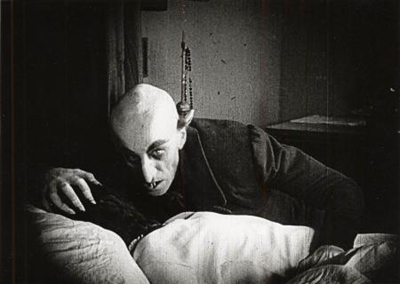
‘Nosferatu, eine Symphonie des Grauens’ is still an incredibly creepy film, eighty-five years after it was made; like Tod Browning’s ‘Freaks’ (1932), it retains an immediacy, a power to shock. The key element in Murnau’s film is the casting of the appropriately named Max Schreck (his surname is German for ‘terror’): bald, hollow-eyed, a rat-like mouth and bat-like ears, fingernails like a prototype Freddie Krueger, his appearance is genuinely unsettling.
There is a tradition in cinema of the vampire as suave and aristocratic. Not in German cinema, though. In German cinema the vampire is the stuff of nightmare. There was only ever going to be one casting option for the remake.
‘Nosferatu, eine Symphonie des Grauens’ is still an incredibly creepy film, eighty-five years after it was made; like Tod Browning’s ‘Freaks’ (1932), it retains an immediacy, a power to shock. The key element in Murnau’s film is the casting of the appropriately named Max Schreck (his surname is German for ‘terror’): bald, hollow-eyed, a rat-like mouth and bat-like ears, fingernails like a prototype Freddie Krueger, his appearance is genuinely unsettling.
There is a tradition in cinema of the vampire as suave and aristocratic. Not in German cinema, though. In German cinema the vampire is the stuff of nightmare. There was only ever going to be one casting option for the remake.
Heeeeeeeeeeeere’s Klaus!
Kinski’s ‘look’ in the film is one of several direct quotations from Murnau’s original: there’s also the iconic image of a deformed shadow creeping across a wall, as well as a scene the vampire rising from his coffin to stalk the empty decks of a ship by night (the fast clipper with its bustling crew has become a ghost ship by the time it makes land).
Elsewhere, however, it’s pure Herzog. Jonathan Harker (Bruno Ganz)’s journey to Castle Dracula is a study in landscapes. His arrival by night is strikingly lit, a visual hyper-stylization that wouldn’t look out of place in a Dario Argento movie. Harker encounters suspicious innkeepers and superstitious gypsies (and with good reason), and finally Dracula himself. These scenes are effective slices of gothic, and contrast well with almost clinical neatness of Delft, where the second half of the film is set.
Herzog restores the name Dracula to the character, as well as bringing Van Helsing back into the picture. Interestingly, though, Van Helsing is portrayed not as a dedicated vampire-hunter but a non-superstitious man of science. Herzog also deviates from Stoker’s archetypes with Harker who, after his against-the-clock race back from Castle Dracula, arrives in Delft delirious and unable to recognise his wife. Dracula, meanwhile, recognises her only too well.
Dracula goes to Delft in pursuit of Mina Harker (Isabelle Adjani), his desire for her terrible yet strangely poignant. He brings with him a plague of rats. The town is overrun. The council flees its crisis meeting. Order crumbles. A group of wealthy merchants, infected and resigned to their inevitable fate, hold a massive valedictory feast in the rat-strewn town square. This scene in particular – reminiscent of the monkeys swarming over Aguirre’s raft in ‘Aguirre, the Wrath of God’ – marks out ‘Nosferatu, Phantom der Nacht’ as unforgettably Herzog.
Image is of primary importance in telling the story: Jorg Schmidt-Reitwein, a frequent Herzog collaborator, was cinematographer. Cast-wise, Bruno Ganz gives a straightforward performance as Harker, writer and occasional actor Roland Topor steals every scene he’s in as a manic, giggling Renfield, and only Isabelle Adjani seems at a loss, given little to do but look wan and romantic as Mina. But it’s Kinski who stays in the memory, even though he has only twenty minutes’ screen time. Appropriately enough, he casts a shadow that permeates the whole film.
Kinski’s ‘look’ in the film is one of several direct quotations from Murnau’s original: there’s also the iconic image of a deformed shadow creeping across a wall, as well as a scene the vampire rising from his coffin to stalk the empty decks of a ship by night (the fast clipper with its bustling crew has become a ghost ship by the time it makes land).
Elsewhere, however, it’s pure Herzog. Jonathan Harker (Bruno Ganz)’s journey to Castle Dracula is a study in landscapes. His arrival by night is strikingly lit, a visual hyper-stylization that wouldn’t look out of place in a Dario Argento movie. Harker encounters suspicious innkeepers and superstitious gypsies (and with good reason), and finally Dracula himself. These scenes are effective slices of gothic, and contrast well with almost clinical neatness of Delft, where the second half of the film is set.
Herzog restores the name Dracula to the character, as well as bringing Van Helsing back into the picture. Interestingly, though, Van Helsing is portrayed not as a dedicated vampire-hunter but a non-superstitious man of science. Herzog also deviates from Stoker’s archetypes with Harker who, after his against-the-clock race back from Castle Dracula, arrives in Delft delirious and unable to recognise his wife. Dracula, meanwhile, recognises her only too well.
Dracula goes to Delft in pursuit of Mina Harker (Isabelle Adjani), his desire for her terrible yet strangely poignant. He brings with him a plague of rats. The town is overrun. The council flees its crisis meeting. Order crumbles. A group of wealthy merchants, infected and resigned to their inevitable fate, hold a massive valedictory feast in the rat-strewn town square. This scene in particular – reminiscent of the monkeys swarming over Aguirre’s raft in ‘Aguirre, the Wrath of God’ – marks out ‘Nosferatu, Phantom der Nacht’ as unforgettably Herzog.
Image is of primary importance in telling the story: Jorg Schmidt-Reitwein, a frequent Herzog collaborator, was cinematographer. Cast-wise, Bruno Ganz gives a straightforward performance as Harker, writer and occasional actor Roland Topor steals every scene he’s in as a manic, giggling Renfield, and only Isabelle Adjani seems at a loss, given little to do but look wan and romantic as Mina. But it’s Kinski who stays in the memory, even though he has only twenty minutes’ screen time. Appropriately enough, he casts a shadow that permeates the whole film.
Wednesday, November 14, 2007
Aguirre, the Wrath of God
‘Aguirre, der Zorn Gottes’, to use its stern-sounding original German title, was Werner Herzog’s first collaboration with Klaus Kinski and saddled both of them with reputations that neither ever really shook off:
Fraught production – check.
Inhospitable location – check (Herzog and Kinski would return to the jungle ten years later for the epic ‘Fitzcarraldo’).
Maverick director vs. egomaniacal actor – check.
The conflict between Herzog and Kinski continued across another four films, and was revisited, years after Kinski’s death, in Herzog’s ‘My Best Fiend’, a film that is part-documentary, part-black-Valentine.
‘Aguirre’ is set in 1560 and chronicles the journey, deep into the Peruvian rainforest, of an invading Spanish army in search of the legendary (and determinedly non-existent) city of El Dorado. The film opens with an extraordinary shot of a thousand Conquistadores in full armour and their captured indian guides/sherpas hauling pigs, horses, llamas, provisions and cannons down from the Andes into the jungle. The route is treacherous, the mountainside shrouded in mist. Herzog films their descent almost documentary-style: he’s not trying to impress by directing a big, show-offy scene; he’s simply recording their progress.
And that’s what he does for the rest of the film, recording not only their descent from the Andes, but their descent into treachery, distrust, death and – in Aguirre’s case – madness. But without any melodrama or moralizing. There are no big, actorly, grandstanding scenes. Even Kinski, never the subtlest performer, gives a controlled, gaunt-eyed performance (Herzog has said that he dealt with Kinski’s excesses by baiting him before the cameras rolled, letting him rant himself into exhaustion, then filming the scene).
There are notable performances, too, from Roy Guerra as Don Pedro de Ursua, whose leadership Aguirre overthrows; and Peter Berling as the pitiful Don Fernando de Guzman, whom Aguirre handpicks to replace Ursua. Aguirre takes his rebellion to extremes, declaring that the group are no longer answerable to church or state, and even goes as far as “crowning” Guzman King of the New World. Watch Peter Berling’s face in this scene: he communicates cowardice (Guzman knows he’s nothing but Aguirre’s puppet), misery and helplessness in just a few seconds without a hint of overacting. Guerra, too, effectively suggests the wounded Ursua’s struggle to retain dignity while the expedition – originally under his charge – draws closer to self-destruction the further into the jungle they penetrate.
But the real stars of the show are Herzog himself and cinematographer Thomas Mauch. ‘Aguirre’ bristles with stunning imagery. There’s the fog-wreathed mountainside at the start. There’s a hypnotically brilliant shot which holds on the tumbling brown river, muddy banks overhung with vegetation to either side, before cutting to a close-up of churning water – these two simple shots occupy over a minute of screen time. There’s the jungle itself – forget the lush, verdant expanse of Hollywood productions; Herzog’s jungle is dark, humid, visceral and alive.
And then there’s the unforgettable final image: Aguirre stumbling dazed around a slowly sinking raft overrun with chittering monkeys, delivering a crazed monologue: “I, the Wrath of God, will marry my own daughter and with her I will found the purest dynasty the world has ever seen. We shall rule this entire continent. We shall endure. I am the Wrath of God.” His daughter, probably mercifully for her, is dead by this point. So is everyone else. The only thing that endures is Aguirre’s madness.
Fraught production – check.
Inhospitable location – check (Herzog and Kinski would return to the jungle ten years later for the epic ‘Fitzcarraldo’).
Maverick director vs. egomaniacal actor – check.
The conflict between Herzog and Kinski continued across another four films, and was revisited, years after Kinski’s death, in Herzog’s ‘My Best Fiend’, a film that is part-documentary, part-black-Valentine.
‘Aguirre’ is set in 1560 and chronicles the journey, deep into the Peruvian rainforest, of an invading Spanish army in search of the legendary (and determinedly non-existent) city of El Dorado. The film opens with an extraordinary shot of a thousand Conquistadores in full armour and their captured indian guides/sherpas hauling pigs, horses, llamas, provisions and cannons down from the Andes into the jungle. The route is treacherous, the mountainside shrouded in mist. Herzog films their descent almost documentary-style: he’s not trying to impress by directing a big, show-offy scene; he’s simply recording their progress.
And that’s what he does for the rest of the film, recording not only their descent from the Andes, but their descent into treachery, distrust, death and – in Aguirre’s case – madness. But without any melodrama or moralizing. There are no big, actorly, grandstanding scenes. Even Kinski, never the subtlest performer, gives a controlled, gaunt-eyed performance (Herzog has said that he dealt with Kinski’s excesses by baiting him before the cameras rolled, letting him rant himself into exhaustion, then filming the scene).
There are notable performances, too, from Roy Guerra as Don Pedro de Ursua, whose leadership Aguirre overthrows; and Peter Berling as the pitiful Don Fernando de Guzman, whom Aguirre handpicks to replace Ursua. Aguirre takes his rebellion to extremes, declaring that the group are no longer answerable to church or state, and even goes as far as “crowning” Guzman King of the New World. Watch Peter Berling’s face in this scene: he communicates cowardice (Guzman knows he’s nothing but Aguirre’s puppet), misery and helplessness in just a few seconds without a hint of overacting. Guerra, too, effectively suggests the wounded Ursua’s struggle to retain dignity while the expedition – originally under his charge – draws closer to self-destruction the further into the jungle they penetrate.
But the real stars of the show are Herzog himself and cinematographer Thomas Mauch. ‘Aguirre’ bristles with stunning imagery. There’s the fog-wreathed mountainside at the start. There’s a hypnotically brilliant shot which holds on the tumbling brown river, muddy banks overhung with vegetation to either side, before cutting to a close-up of churning water – these two simple shots occupy over a minute of screen time. There’s the jungle itself – forget the lush, verdant expanse of Hollywood productions; Herzog’s jungle is dark, humid, visceral and alive.
And then there’s the unforgettable final image: Aguirre stumbling dazed around a slowly sinking raft overrun with chittering monkeys, delivering a crazed monologue: “I, the Wrath of God, will marry my own daughter and with her I will found the purest dynasty the world has ever seen. We shall rule this entire continent. We shall endure. I am the Wrath of God.” His daughter, probably mercifully for her, is dead by this point. So is everyone else. The only thing that endures is Aguirre’s madness.
Subscribe to:
Posts (Atom)