Showing posts with label Adolfo Celli. Show all posts
Sunday, November 13, 2016
WINTER OF DISCONTENT: Eye in the Labyrinth
Architecture porn is as integral to the giallo as operatic death scenes, bottles of J&B and winsome brunettes in peril, and just to make sure he’s got our attention from the off director Mario Caiano doubles down on the architecture porn in the opening sequence as psychiatrist Luca (Horst Frank) flees a knife-wielding assailant through the stark angles of a deserted building constructed in the brutalist style. His escape attempt fails. A knife rises and falls. Red gushes.
Turns out it’s a dream from which Luca’s girlfriend Julie (Rosemary Dexter) – Caiano doubles down on the winsome brunette factor, as well – awakes in a state of agitation. She gets even more agitated when she realises he’s disappeared. Enquiries at his clinic end with a deranged patient shouting a single word over and over. Cross-referencing it with a note in Luca’s appointments diary, Julie realises it’s the name of a small town and takes off to find him.
Arriving at said village, she’s coolly appraised by ex-pat American Frank (Adolfo Celli), and almost lured to her death by a manipulative local who directs her to a dangerously unstable building. If the opening sequence was giallo 101 architecture fetishism, then Julie’s hesitant exploration of the ruined house is the diametric opposite. It is to David Hemming’s 15-minute interrogation of a supposedly empty villa in ‘Deep Red’ what a three-minute punk single is to grand Italian opera.
Not that Julie seems to be doing herself any favours, engaging with all manner of dubious characters seemingly on a whim, and allowing herself to be led from situation to situation in wide-eyed complicity. Her attempt at amateur sleuthing is as if Nancy Drew were ten years older with a massive reduction in both IQ and the length of her skirts.
Eventually, she finds herself at the house of stern eccentric Gerda (Alida Valli), who seems to have some history with Frank. Gerda is playing host to a group of oddballs including gigolo Louis (Michael Maien), photographer Toni (Sybil Danning), actor Thomas (Gigi Rizzi), nervous and shifty Eugene (Franco Ressel) and mentally deficient teenager Saro (Benjamin Lev) who enjoys spying on pretty girls and painting weird canvases. Repeated close-ups of his latest opus and Frank’s clunky exposition that Saro has no imagination and can only paint what he sees point to a big clue. Or is it a red herring?
The coastal setting of ‘Eye in the Labryinth’ is apposite: entire shoals of red herring drift through the film. From the weird townspeople who are basically just there to wrongfoot you until Julie gets to Gerda’s villa, to the cat and mouse shenanigans at the villa itself, the narrative is less an exercise in plotting than an extended shell game. Indeed, the focus almost imperceptibly shifts from Julie to Frank as the amateur sleuth, the latter furthering his own agenda as he probes information from Gerda’s house guests.
Not that Frank ever becomes the default hero. When he’s not busy saving Julie from assassination attempts, he’s unsubtly trying to force himself on her. Nor does anyone else on the guest list emerge as even remotely sympathetic, particularly when it comes to light that Luca was known to them and all of them had good reason to wish him ill. Revelations about Luca quickly reveal him as a total bastard, at which point the film makes a sharp swerve from Agatha-Christie-with-topless-sunbathing and goes careering off in the direction of Roeg/Cammell style psychological head-fuckery. All of it accompanied by the most out of place lounge jazz soundtrack this side of the filmography of Jess Franco.
Caiano isn’t a name readily associated with gialli – he’s probably better known for a run of polizia in the vein of Fernando di Leo and the grubby exploitationer ‘Nazi Love Camp 27’ – but he does sterling work here, maintaining an excellent pace and getting the most out of the location work. ‘Eye of the Labyrinth’ is an incongruously sun-dappled example of the genre, and this as much as anything contributes to the film’s woozy and slightly disconnected aesthetic. An aesthetic that’s entirely in the service of the final reel.
Sunday, November 06, 2016
WINTER OF DISCONTENT: Live Like a Cop, Die Like a Man
On any list of maverick cops, Inspectors Harry Callaghan and Jack Regan are bound to feature highly. Fred and Tony – the, ahem, heroes of Ruggero Deodato’s ‘Live Like a Cop, Die Like a Man’ – are the kind of guys who make Callaghan and Regan look like Jessica Fletcher and Jane Marple respectively … or they would be if they weren’t played by Marc Porel and Ray Lovelock.
On paper, Fred and Tony are little more than licensed vigilantes, whose “means justify the end” work ethic reveals them as no better – perhaps even worse – than the crooks they pursue. On screen, however, Porel man-pouts with such moody determination that I rather suspect Robert Pattison used the film as a training video in order to perfect his characterisation for ‘Twilight’, while Lovelock struts and poses as if he were in some weird commercial for men’s fashions where a pistol is 1976’s must-have accessory and the best way to show off the cut of a sweater is to have the wearer beat up a suspect.
Still, for the purposes of this review let’s suspend disbelief (actually, let’s just expel the fucking thing – it’s quicker) and allow that Fred and Tony are hard, edgy characters with no moral code and not an ounce of human pity between them. As the film opens, they’ve just been transferred to a special squad under the command of Adolfo Celi. I can’t remember his character being given a name and IMDb bills Celi as “the Captain”. Anyway, Fred and Tony have been transferred to a special squad – it’s literally called the Special Squad – with the remit of stopping crimes before they’ve even been committed.
You see, the Special Squad have been given unlimited resources in the form of a very expensive computer that can predict crime (I kid you not: that’s the full extent of the exposition and Celi manages to deliver it without laughing). Now, exactly how nicking someone for a bank robbery before they’ve robbed it works in judicial terms, I’m not qualified to say. But surely it’s just intent at that point and the wannabe robbers would be back out on the streets within a few months.
Maybe that’s why Fred and Tony simply shoot everyone at the scene and leave the local beat cops to clean up with some vague promise of making sure their report clarifies everything. Not that there was even a single scene of them doing paperwork. There are plenty of scenes, however, of Fred and Tony behaving like due process never existed, and despite Porel and Lovelock’s inability to convince as hard-ass bad boys, it’s this tireless parade of unethical behaviour that ensures the film cracks along nicely, requiring no padding to reach its 100 minute running time. But desist with the technical details, I hear you cry; bugger the running time and don’t even think about boring us with aspect ratios and film stocks. Tell us about the unethical behaviour.
Well, it’s like this: Fred and Tony join the Special Squad and promptly go after gang boss Pasquini (Renato Salvatori), unaware that his inside man Daniele Dublino (again, I don’t recall the character having a name, and IMDb just goes with “corrupt cop”) is about to reveal their identities; and since that’s really all there is by way of narrative, Deodato and his three screenwriters (including ‘Milano Calibro 9’ helmer Fernando di Leo) basically ensure that Fred and Tony randomly get involved in any and all occurrences of mayhem on their way to the boatyard shoot-out that ends the film, be it pursuing a couple of snatch-and-grab artists in a six-minute motorcycle chase, crashing into a hostage situation, or gunning down the would-be perpetrators of an armoured truck heist for merely pulling on their balaclavas and looking at the truck.
And even when our boys are actually concentrating on the Pasquini plot, their modus operandi eschews such staples of policework as detection, forensics and evidence gathering in favour of arson, gunplay, duffing up the mobster’s associates and taking turns shagging his nympho sister Lina (Sofia Dionisio). If the surname’s familiar, that’s because she’s the younger sister of Silvia Dionisio, star of Deodato’s earlier ‘Waves of Lust’ and the director’s wife at the time. Sofia Dionisio has a nude scene in ‘Live Like a Cop, Die Like a Man’ that can only be described as sleazy. True, shooting a sleazy sex scene featuring your sister-in-law isn’t quite in the same league of ickiness as some of the stuff Dario Argento has cast his daughter in, but still …
While we’re speaking of the Dionisios, remember Silvia’s J&B scene in ‘Waves of Lust’? Well, Deodato breaks out the blended whisky for narratively redundant bit of iconography featuring Pasquini’s moll:
And while we’re discussing the film’s reductive treatment of its female cast, Silvia Dionisio plays Adolfo Celi’s secretary, to whom Fred and Tony behave in a manner that would make even Sid James in a ‘Carry On’ film break character and tell them off for being chauvinist pigs. Granted, the script gives Dionisio a few zingers to fire back at them, but she’s one of only three female characters who aren’t there to be a vamp or a victim (the other two are elderly housemaids incorporated for comedy value). And yes, casual misogyny isn’t exactly a hidden agenda in the film industry as a whole and 70s Italian exploitation pictures in particular, but even your most disreputable of gialli and sexploitation opuses give their actresses a bit more to do.
So what does ‘Live Like a Cop, Die Like a Man’ have to recommend it? Why splurge over 1000 words on it? Because, basically, it’s entertaining as all hell. That six-minute motorcycle chase? It kicks off literally moments after the opening credits, hurling the viewer full-tilt into Fred and Tony’s renegade way of doing things, and the pace doesn’t let up from there. There’s an action set-piece every ten minutes or so, the execution of which are generally pretty damn good – the bike chase is a stand-out; ditto a bit of cat ‘n’ mouse in a quarry, and a mob hit on one of Fred and Tony’s colleagues. Deodato’s craftsmanship is effective: he has a knack of establishing the dynamic of any given scene very economically, often using specific visual details to define location or character interrelationships. The editing is focused and rigorous, driving things forward all the time.
Also – and it would be remiss of me not to admit this – Porel and Lovelock make for an unforced double-act, creating a kind of bland chemistry that suggests they’ve worked together for so long that they don’t even bother playing off each other any more. It’s just a shame that they come across as moderately less dangerous than Bert and Ernie during a particularly well-behaved episode of ‘Sesame Street’.
Tuesday, April 24, 2012
BOND-A-THON: Thunderball
The story behind ‘Thunderball’ is arguably more eventful than either the resulting novel or film, so let’s spend a few hundred words on it.Four years before Saltzman and Broccoli kicked off the movie franchise with ‘Dr No’, Ian Fleming was already looking towards a big-screen incarnation of his protagonist. It was 1958 and Fleming’s friend Ivar Bryce put him in touch with Kevin McClory, a writer/director on the verge of making his debut with a film called ‘The Boy and the Bridge’. Another mutual friend of Fleming’s and Bryce’s – Ernest Cuneo (to whom the novel ‘Thunderball’ is dedicated) – joined the party and the foursome formed a production company, Xanadu Productions.
Taking Xanadu – pace Samuel Taylor Coleridge and the name of Charles Kane’s palatial bolthole in Orson Welles’s ‘Citizen Kane’ – as an elaborate folly, the name couldn’t have been better chosen.
Between the formation of Xanadu Productions and McClory’s ‘The Boy and the Bridge’ opening to public disinterest and meagre box office takings (at which point Fleming’s interest in making a film nosedived), the four men collaborated, to various degrees, on a basic idea involving a stolen plane and underwater action sequences which mutated through about ten different treatments and/or screenplay drafts. In late 1959, with Fleming about to depart on a round-the-world tour for a travelogue commissioned by The Sunday Times, McClory engaged the services of Jack Whittingham, who had two decades’ experience writing for film. With Whittingham on board, a full treatment was completed, followed quickly by a script. Whittingham and McClory’s title was ‘Longitude 78 West’. Fleming approved, albeit with the suggestion that it be retitled ‘Thunderball’.
The script never made it into production. Fleming, who customarily spent two months at his Jamaican house, Goldeneye, where he bashed out that year’s Bond novel working on a 2,000 words per day discipline interrupted only by snorkelling and Martinis, sat down at his typewriter in January 1960 and basically wrote a novelization. When, in 1961, McClory got hold of an advance copy of ‘Thunderball’, to say he was a tad miffed would be putting it mildly. He and Whittingham sued Fleming, initially petitioning to prevent publication. The High Court allowed ‘Thunderball’ to be published, but sanctioned any future action against Fleming by McClory and Whittingham.Fast forward to 1963, Bond has gone big-screen in a big way, and McClory is suing Fleming for plagiarism. Unwell (the author had only nine months left to live), Fleming acceded to Bryce’s suggestion that he settle out of court. The deal: Fleming retained rights to the novel, subsequent editions to carry the acknowledgement “based on a screen treatment by Kevin McClory, Jack Whittingham and the Author” (my 2008 centenary edition has this in very small letters); McClory gained the literary and film rights for the screenplay.
This put producers Saltzman and Broccoli in the compromised position of having to bring McClory on board as producer for the film version. The deal they cut him allowed for remake rights, but not until ten years after the release of ‘Thunderball’. In the event, McClory waited almost twenty, producing ‘Never Say Never Again’ (featuring Connery in his unofficial return to the role) in 1983. The script was reworked by Lorenzo Semple Jnr with uncredited additions, on Connery’s insistence, from Dick Clement and Ian la Frenais (the background to ‘Never Say Never Again’ demands its own article); Irvin Kershner directed. ‘The Boy and the Bridge’ would remain McClory’s only directorial outing. McClory spent much of his career trying to kick-start his own rival Bond franchise and in the 90s unsuccessfully pitched a re-remake of ‘Thunderball’, under the frankly rubbish title ‘Warhead 2000’, starring Liam Neeson. It didn’t happen.
The Fleming-McClory/‘Thunderball’-‘Never Say Never Again’-‘Warhead 2000’ saga – spanning one novel, two films, and four decades – yielded enough material for a book of its own, Robert Sellers’s ‘The Battle for Bond’. Almost inevitably, this publication created its own flurry of controversy. The Ian Fleming Will Trust, apparently unhappy at the unapproved use of quotes from Fleming’s private papers, took action against the publisher, resulting in a hastily issued second edition, shorn of the contentious passages and unsubtly marketed as “the book they tried to ban”.
All of which brings us, 700 words into this review, to the film itself. ‘Goldfinger’ had made Bond an icon; ‘Thunderball’ rode its popularity to box office glory. Adjusting its box office take for inflation, ‘Thunderball’ is arguably the most successful entry in the franchise. Marking Terence Young’s return to the director’s chair (albeit for the last time on a 007 production), it establishes a few “firsts” in the
It’s also – at least in my opinion – the first Bond film to feel just a little bit perfunctory. The pre-credits sequence, while reintroducing some of the “modifications” on the Aston Martin DB5 from ‘Goldfinger’ (and seemingly forgetting that it got written off in that film), throws in a jet-pack for good measure, promising all kinds of high-flying fun and games. Yet its mini-story, involving a fake funeral and Bond (Connery)’s revenge on the assassin of his colleagues, plays out in muted colours, without any of the style or urgency of the explosive opening to ‘Goldfinger’, and features a bit of hand-to-hand that’s pretty shoddily staged and edited. This done, it’s on to the plot proper as Bond, convalescing at a health farm, becomes suspicious of a fellow guest. He’s right to be: conspiracy is afoot, and SPECTRE are behind it all. But before Bond can get a handle on things, a meticulously detailed plan is put into operation, an RAF bomber is hijacked, two atomic devices disappear and our old buddy Ernst Stavo Blofield (again unseen, again played by Anthony Dawson) is holding the world to ransom for … one hundred million pounds. (Yeah, take that, Dr Evil!)The only lead is a French NATO pilot who was onboard the bomber; his sister, Domino (Claudine Auger), is holidaying in Nassau, so Bond convinces M (Bernard Lee) that it’s worth, ahem, checking her out, so it’s off to the Bahamas for a little sun, sea, sand and sex (oh, and a bit of spying, not that you’d notice) while the shadow of atomic destruction hangs over the free world. Unusually for a Bond movie, however, 007 doesn’t get his briefing from M till 45 minutes into the film. Terence Young spends a quite a bit of time setting out his stall, observing the intricacies of the SPECTRE plan – overseen by the suitably villainous Emilio Largo (Aldofo Celi) – with an attention to detail which brings to mind that of, say, John Frankenheimer charting the movements of Von Waldheim and LaBiche’s respective locomotives as if they were pieces on a chessboard in ‘The Train’. It’s easily my favourite part of the film.
When Bond gets to Nassau, commences his dalliance with Domino, starts staking out Largo’s operation and does his best to avoid death at the hands of SPECTRE hitwoman Fiona Volpe (Luciana Paluzzi), the film settles into a steady plod. It’s never boring, and there are a few scenes which turn the heat up a bit – Bond’s encounter with Largo’s pet sharks; Fiona and her henchmen stalking Bond through a carnival – but there’s no major set-piece, nothing really iconic goes on and everyone just seems to be marking time ready for the big finale: an underwater battle followed by some derring-do on Largo’s hydrofoil yacht. But before we don the snorkel and oxygen tank, let’s cast an eye over the Bond girls.
In the novel, Domino is Italian; the film makes her French in line with Auger’s nationality (she was Miss France 1958, sexism fans). Likewise, Richard Maibaum and John Hopkins’s original draft of the script had Fiona as a flame-haired Irish femme fatale, Fiona Kelly. With Paluzzi delivering the goods in the redhead stakes but not the Gaelic ones, the character’s name was changed to Fiona Volpe, Fiona being – y’know – a traditional Italian girl’s name. In all fairness, though, Paluzzi is pretty awesome and certainly captures the imagination in a way Auger doesn’t.Adolfo Celi makes for a pretty intimidating villain; he’s ostensibly sophisticated in the way of most Bond nemeses, but Celi’s brooding physicality leaves you in no doubt that, under the surface, Largo is a thug – and a brutally efficient one at that. Speaking of “under the surface”, let’s effect an inelegant segue into the final section of this review (and with another 700 words on the clock since I last hit the word count button, it’s probably high time I started wrapping it up): the sub-aquatic stuff.
Fleming was a big scuba-diving fan and several of his novels feature highly descriptive passages of marine life. ‘Thunderball’ contains a remarkable sequence, sadly not replicated in the film, where Bond swims through the fuselage of a submerged aircraft to find it alive with octopi – “a red-eyed catacomb”. It’s surreal, creepy, and one of the very few moments in the Bond bibliography where the usually unflappable agent seriously loses his cool.With a budget of $9million – a huge increase compared to the incremental pattern of ‘Dr No’ ($1million), ‘From Russia with Love’ ($2million) and ‘Goldfinger’ ($3million) – the filmmakers invested a hell of a lot in the underwater sequences. Some $90,000 was invested in diving equipment alone, while Largo’s yacht set the production back a cool half million. You know that old saw about how it’s all up there on screen? That’s certainly true of ‘Thunderball’ … perhaps to its detriment. There are five major bits of sub-aquatic shenanigans: the scuppering of the hijacked bomber and its camouflage on the sea bed; Bond’s nocturnal assessment of the yacht; Bond’s escape from Largo’s shark pool; Largo’s transfer of the atomic devices to the yacht; and the harpoons ‘n’ scuba gear free-for-all which occupies most of the last quarter of an hour and seems like a hell of a lot longer. These scenes grow increasingly interminable, as if, having spent so much on them, Young and the producers were damned if they weren’t going edit every goddamn bit of undersea footage into the final cut.
In the climatic battle, Bond and CIA contact Felix Leiter (Rik Van Nutter)’s American reserves wear red wetsuits; Largo’s bunch of all-purpose bad guys – appropriately enough – wear black. So when you get a shot like this one (he’s a good guy) …
… or this one (he isn’t) …
… things are fine. But there are way too many shots like this one …
… where the screen is full of indistinguishable figures framed in meaningless tableaux. After three or four minutes, it was a case of full fathom five my capacity to give a shit lies. And the appalling speeded-up footage which constitutes Bond’s mano-a-mano smackdown with Largo … let us not speak of it. In fact, let us speak of just two more things:Early release prints promised that James Bond would return in ‘On Her Majesty’s Secret Service’, but production difficulties resulted in ‘You Only Live Twice’ being selected as the next instalment and the credit was dropped.
The theme song is by Tom Jones. Johnny Cash actually submitted a song. Johnny Cash. Someone laid it over the opening credits and posted it on YouTube. Here’s the link. If 2,000 words on what isn’t even in my top five favourite Bond movies isn’t enough to make you question your sanity, this just might.
Friday, May 23, 2008
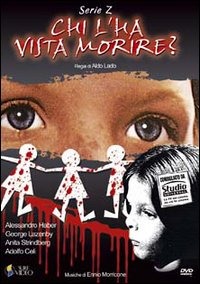
Who Saw Her Die?
With Daniel Craig established as a Bond to rival Sean Connery courtesy of 'Casino Royale', the only certainty nowadays in any poll is who would come bottom of the list: George Lazenby.In all fairness, it's hardly his fault. A former male model, whose only previous acting experience had been a small role in the low budget spy spoof 'Espionage in Tangiers' - that the producers plucked him from nowhere and expected him to fill Connery's shoes was a spectacular bit of bad judgement, one compounded by further hamstringing him with a script as wet as an out-of-season weekend in Bognor Regis and pitifully lacking in the ruthless do-or-die ethos that characterises the best instalments of the franchise.
But I digress.
I have little interest in writing about 'On Her Majesty's Secret Service'; what is worth mentioning, however, is what George did next. He followed his solo Bond appearance with a lead role in Cy Endfield's largely forgotten mercenary drama 'Universal Soldier' (nothing to do with the Dolph Lundgren/Jean-Claude van Damme flick), after which he found himself negotiating the dank, dangerous, non-tourist-promoted backwaters of Venice in Aldo Lado's dark and compelling giallo 'Who Saw Her Die?'
Lazenby plays Franco Serpieri, a sculptor living in Venice whose desultory affair with a local woman barely masks with pain of his estrangement from his wife Elizabeth (Anita Strindberg). Dishevelled, gaunt (Lazenby lost weight for the role), at odds with the cliquey society of art dealers and collectors, personified by his patron Serafian (Adolfo Celli - star of an earlier Bond film, 'Thunderball'), upon whom his livelihood depends, Serpieri's malaise is temporarily relieved by a visit from his vivacious young daughter Roberta (Nicoletta Elmi).
Temporarily, because red-headed Roberta falls foul of a black-gloved murderer a third of the way into the film and Serpieri, reconciled with Elizabeth through the harshest of tragedies, becomes obsessed with finding her killer.
At which point I need to stop talking about Lazenby. His physical transformation for the role is remarkable - coming a scant three years after 'OHMSS', he's almost unrecognisable: gone, the chiselled good looks that secured his erstwhile modelling profession, gone the coiffured, clean-shaven image; the Lazenby of 'Who Saw Her Die?' is an emaciated scruff of the first order - but his range as an actor is limited. Which is more than can be said for Strindberg. Often cast in gialli purely for her striking, high-cheek-boned looks, she has seldom been saddled with a more useless eye-candy/set-dressing/"woman in peril" role than here. (You can imagine Lado's direction: "Anita, look glacial ... Anita, look scared ... Anita, scream like you've never screamed before.")
I should mention instead Celli's effortless portrayal of Serafian as a sybarite/sensualist/degenerate (delete according to personal aesthetics), fine work from a wonderfully expressive actor who, in this film particularly, comes across as a Peter Ustinov gone bad. He's great; his scenes bootstrap the film up to a higher level.
But there's two people who really turn 'Who Saw Her Die?' into, if not a top-flight, then certainly an inspired giallo.
One is director Aldo Lado. Not just the only director, to the best of my knowledge, who first name and surname are an anagram of each other, he also worked as assistant director to Bertolucci on 'The Conformist'. Unjustly overlooked, Lado's contributions to the giallo are the equal of anything Bava achieved, and his capacity for spatial dislocation/disorientation and sustained setpieces (notably a tense cat-and-mouse sequence which takes in a fog-wreathed harbour and an abandoned factory) come close to the prowling, subjective camerawork of Argento at his best.
And speaking of those two maestros: remember Nicoletta Elmi, the creepy kid in Bava's 'A Bay of Blood' and the even creepier kid in Argento's 'Deep Red'? Here she plays a decidedly non-creepy kid. An actually quite adorable kid. Just eight years old when she starred in 'Who Saw Her Die?', Elmi acts everyone offscreen. The first act of the film, in which the killer makes two failed attempts at abducting Roberta before finally - fatally - succeeding, rises above the genre checklist it could easily have become. It's the doomed Roberta you remember more than the driven Serpieri. It's her terrible vulnerability, her achingly poignant innocence, than define the film, long after the shoal of red herrings have been forgotten and the almost awkwardly abrupt ending has ceased to bother the casual viewer.
Nicoletta Elmi has acted in only a handful of films and TV shows.An early, very small role, was in Visconti's masterpiece 'Death in Venice'; a decade and a half later, she proved the only good thing in Lamberto Bava's so-bad-it-was-almost-good-but-ultimately-was-just-plain-bloody-awful 'Demons'. In her mid-twenties, she turned her back on acting and studied medicine. A loss to cinema, but I applaud her humanity.
Labels:
Adolfo Celli,
Aldo Lado,
Dario Argento,
George Lazenby,
giallo,
Mario Bava,
Nicoletta Elmi
Subscribe to:
Posts (Atom)