Showing posts with label giallo. Show all posts
Tuesday, November 22, 2016
WINTER OF DISCONTENT: The Card Player
There’s a bit of a tradition on The Agitation of the Mind, when discussing anything directed by Dario Argento in the last three decades, to identify ‘Opera’ (1987) as his last great work as director and everything that followed as something of a rollercoaster where the upswings can best be described as mildly disappointing and the plummeting descents are outright visits to Shitsville. And, Christ, isn’t it depressing to ruminate that the man who gave us ‘Deep Red’, ‘Suspiria’, ‘Tenebrae’ and half a dozen other great genre movies has – with the exceptions of two episodes of ‘Masters of Horror’ and the almost-there ‘Stendhal Syndrome’ – spent almost thirty years in a tailspin of negative quality control?
He followed the aforementioned ‘Stendhal Syndrome’ with what is reckoned to be his career nadir, ‘The Phantom of the Opera’, before making a bit of a box-office comeback (in his native Italy at least) with ‘Sleepless’, a rather studied throwback to the classic gialli of old. Three years later, he went back to the giallo well for ‘The Card Player’. It’s a curious piece, which in some places feels like Argento’s attempt to do ‘The Silence of the Lambs’ but also contains a stultifying number of scenes of cops standing around in institutional and brutally utilitarian interiors looking moody and spouting exposition, for all the world as if Argento were putting together a showreel for the producers of ‘CSI’.
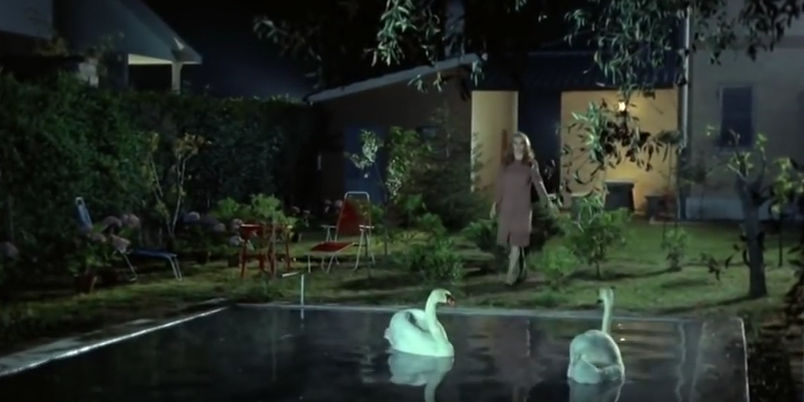
Elsewhere, though, shadows of Argento the demented visual stylist and master of the set piece are visible, particularly in the scene where a home invasion is preceded by the creepy reflection of a masked intruder on the convex surface of a glass bowl … But I’m getting ahead of myself.
‘The Card Player’ starts with brittle cop Inspector Anna Mari (Stefania Rocca) fending off the ingratiating advances of colleague Inspector Morgani (Mario Opinato) while trying to find a tourist – a young woman – who has gone missing in room. She quickly gets a lead: an email from the abductor inviting the police to play an online poker game with the girl’s life as the prize. When Police Commissioner Marini (Adalberto Maria Merli) forbids participation, abductor turns killer, knifing his victim to death on camera. Later, Marini’s daughter Lucia (Fiore Argento) falls into the psycho’s hands.
Meanwhile, Anna finds herself working with – and falling for – alcoholic Irish cop John Brennan (Liam Cunningham), on secondment to the British embassy in Rome after an armed response fiasco back in the UK which saw a minor dead and Brennan made the scapegoat. Brennan strides into the movie, all piss and vinegar, and within seconds gets in a fight with one of Anna’s colleagues after dismissing said individual’s deductive prowess as “bollocks”. Inbetween knocking back the hard stuff from a hipflask and drunkenly crashing at Anna’s pad after belting out a tone deaf rendition of ‘Danny Boy’ (cliché alert!), Brennan proves himself a forensics expert and tenacious as all hell when he becomes obsessed by an almost overlooked detail that – in true giallo fashion – he can’t quite put his finger on.
Thus it is, that after twenty minutes or so of bland procedural narrative and dull cinematography, ‘The Card Player’ suddenly gets its funk on and things start to move. Anna and Brennan recruit wunderkind poker player Remo (Silvio Muccino). The killer ups the ante by snatching Marini’s daughter. Anna is targeted in her own home and proves highly proficient in responding to the threat. Remo is played for a fool by a honeytrap and finds himself in a game where he has no control over the odds. Brennan finally cracks the crucial clue and, unadvisedly, goes haring off without any back-up. These scenes move the action out of the insipid interiors and into a cityscape that is soulless, graffiti’d and either awash with flat harsh light in the daytime or a symphony of shadows at night.
Granted, there’s none of the bravura camerawork or prowling POV shots that define Argento’s best work, but it has a modicum of visual style and narrative focus. For a while, at least. Its middle third is ‘The Card Player’ at its best and, unfortunately, when it stops being pretty good, it doesn’t just slope off to not that good or even mediocre. Nope, it degenerates like a time-lapse fast-forward of a putrefying corpse. The twist isn’t something you just see coming. Nope, it flies over the DVD rental store in a biplane with a fifty-foot banner behind on which is printed in heavy capital letters the phrase “obvious from the fucking outset”. The ending isn’t just clichéd and hackneyed (the damsel in distress is shackled to the fucking railway tracks, for fuck’s fucking sake”). Nope, it’s actually profoundly embarrassing. And then there’s the out-of-nowhere final scene that is, presumably, meant to be life-affirming, about which I can only say: Dario, we don’t come to you for affirmation, mate; we come to you for rococo set design and operatic death scenes.
‘The Card Player’ was originally conceived as a sequel to ‘The Stendhal Syndrome’, with Asia Argento reprising her role of Detective Anna Manni – though how that would have worked given the ending of ‘The Stendhal Syndrome’, I have no idea – and the find-and-replace retrofitting of Anna Manni to Anna Mari is indicative of the laziness that blights the script. Ditto the character of John Brennan. John Russo in the first draft, with Matthieu Kassovitz set to star. When he dropped out and was replaced by Cunningham, one perfunctory scene was scribbled down to account for an Irish cop having any form of jurisdiction in Rome. Curiously, a big deal is made of his twenty-year residency in London only for said piece of information to have absolutely no bearing on the rest of the film. Likewise Anna’s emotional backstory – she’s still coming to terms with her father’s suicide – proves to be nothing but the set-up for the ludicrous finale.
‘The Card Player’ exists in that mid-to-late period of the Argento filmography where considered critical analysis is replaced by a trade-off against the other films: it’s not quite as good as the not-as-good-as-they-could-be ‘Stendhal Syndrome’ or ‘Sleepless’, but neither is it the abject train wreck of ‘Phantom of the Opera’ or ‘Mother of Tears’, and at the very least it’s more coherent than ‘Giallo’. It’s a poor way to evaluate a film’s worth, but you work with what you’ve got.
Friday, November 18, 2016
WINTER OF DISCONTENT: The Bloodstained Butterfly
Between ‘Death Occurred Last Night’ and today’s offering, I think if we were to ask the question “when is a giallo not a giallo?”, we could offer “when it’s directed by Duccio Tessari” as a fairly comprehensive answer.
Where ‘Death Occurred Last Night’ switches gears between police procedural and vigilante thriller whilst retaining just enough of the giallo in its overall aesthetic, ‘The Bloodstained Butterfly’ is an out-and-out giallo – it boasts more flamboyant cinematography and sustained set-pieces than its predecessor (‘DOLN’ was made in 1970, ‘TBB’ in 1971), and has a more obviously giallo title – albeit one that falls into three distinct acts, each one characterised by its dependence on other genres.
The film begins with an extended sequence that sets up several characters, whose interrelationships will gradually be revealed, and several locations, the whole montage scored to a bizarre medley where Tchaikovsky’s Piano Concerto No. 1 gives way to lounge jazz. The scene shifts to a park; two children are playing; they discover a corpse. The police are summoned; someone flees the scene; the viewpoints of several witnesses are established. The next twenty minutes or so are a strict procedural; had Tessari continued in this vein, there would have been no way you could have hung the giallo on ‘The Bloodstained Butterfly’.
Where the procedural takes us narratively is: the aforementioned corpse is that of young French student Françoise Pigaut (Carole André), whose best friend at the Italian university they attended was Sarah (Wendy d’Olive), the daughter of TV personality Alessandro Marchi (Giancarlo Sbragia). Inspector Berardi (Silvano Tranquilli) and his much put-upon assistant (Peter Shepherd) – I don’t recall him having a name and IMDb goes with “the inspector’s assistant” – launch an investigation, contending with foul weather that turns their crime scene into a quagmire and the presence of TV reporters whose coverage is cynical. Nonetheless, they rigorously apply forensic techniques and try to determine the killer’s motive and identity. Then a witness turns up at Berardi’s office saying she recognised the killer from the TV programme …
And ‘The Bloodstained Butterfly’ promptly tosses aside the procedural playbook, leaps forward in time (I’m guessing several months at least; it isn’t made clear), and gets its courtroom drama funk on for the next half hour. Marchi’s in the dock, his ice-queen wife Maria (Evelyn Stewart) is becoming increasingly distant, and Sarah is devastated. The prosecutor (Wolfgang Preiss) is building a pretty damning case, but Marchi’s lawyer Guilio Cordaro (Günther Stoll) has a few cards up his sleeve. Much depends, though, on whether Marchi will publically trash his marriage and reputation by ’fessing up to being with his mistress Marta Clerici (Lorella De Luca) at the time of the murder. While all of this is going on, Sarah’s relationship with entitled music student Giorgio (Helmut Berger) is fragmenting and suspicion surrounds a certain bit of evidence that Giorgio gave under oath in Marchi’s favour …
And no sooner has the courtroom drama wrapped up in dour fashion than the film gets its psycho-sexual funk on: two more murders occur, Maria’s dalliance with one of her husband’s associates gives her an ulterior motive as regards the convenience of his incarceration, and Sarah distances herself from Giorgio as his behaviour lurches from sexual cruelty to self-hate.
After a trio of not-particularly-graphic murders and only two set-pieces (the original killing and the perpetrator’s flight from the park, and the cat ‘n’ mouse scene that culminates in the third murder), Tessari goes for broke in the last third: from the tensions brokered between Maria and Sarah by the former’s lover to Marchi’s homophobic beat-down on a cellmate, from Giorgio’s spectacular meltdown to an urgent chase scene after Berardi and his men finally figure it out (or at least think they do), ‘The Bloodstained Butterfly’ does so much pick up the pace as strap a rocket to itself. Everything comes down to a stand-off in an abandoned and part-demolished factory building where motives are clarified and the moral waters muddied at one and the same time. Tessari delivers a finale that dabbles in the shared guilt considerations of, say, Argento’s ‘Deep Red’ or ‘Tenebrae’ while coming on all histrionically melodramatic, like a homoerotic version of King Vidor’s ‘Duel in the Sun’.
‘The Bloodstained Butterfly’ is a divisive film amongst giallo fans. Some find it muddled and far too talky. For others, it’s a fascinating oddity. I’m definitely in the latter camp. It isn’t entirely free of problems – not least in its two sex scenes, which are supposed to be edgy and guilt-ridden but just seem awkward – but it’s certainly never dull.
Thursday, November 17, 2016
WINTER OF DISCONTENT: Death Occurred Last Night
Duccio Tessari’s 1970 giallo ‘Death Occurred Last Night’ is something of a hybrid, combining elements of the procedural, the vigilante thriller and one of the sleazier tropes of the giallo itself – the prostitution ring. But unlike ‘What Have They Done to Solange’ and ‘What Have They Done to Your Daughters’, the two immediate genre touchstones that deal in said scenario, ‘Death Occurred Last Night’ plays out as a missing person drama for a good chunk of its running time, before revealing what happened to the unfortunate Donatella (Gillian Bray).
Donatella is a tall, attractive 25-year-old whose over-protective father Amanzio Berzaghi (Raf Vallone) is over-protective for a damn good reason: Donatella has the mental age of a child of three. Her innocence is such that she’s an easy target for predatory men – to her, flashing her knickers or behaving playfully is just that: playfulness. Berzaghi, working mornings as a transport officer at a trucking company, has an intricate locking system on his apartment door and grilles fitted to the windows. Donatella’s vulnerability preys on him, but his love for and commitment to her is total.
‘Death Occurred Last Night’ begins in media res with Berzaghi, fobbed off by police at the precinct nearest to him, blagging his way into Captain Duca Lamberti (Frank Wolff)’s office, and pouring his heart out re: his daughter’s recent disappearance. Lamberti is something of a journeyman copper, his career overshadowed by the achievements of his younger wife (Eva Renzi), a photojournalist whose first book is about to be published. During a rare argument, she accuses him of getting too old to make a difference. On another occasion, she (rightly) dismisses as bullshit his reasoning for not having a minor surgical procedure that would improve his quality of life (workload; responsibility; the unlikelihood of the city’s criminal contingent desisting from their efforts during his recuperation); “You’re not the only policeman,” she reminds him. Responding to Berzaghi’s plight – a regular guy who’s lost everything that gave his life some meaning – Lamberti throws himself into tracking down Donatella.
Intuiting that a mentally incapacitated young woman who has disappeared from a stable home was probably deliberately targeted for the sex trade, Lamberti and junior officer Mascaranti (Gabriele Tinti) brace pimp turned car salesman Salvatore (Gigi Rizi). Initially unwilling to assist in assuaging their access to the various brothels where Donatella might have ended up, Lamberti arranges for a few kilos of coke to be planted at Salvatore’s showroom, whereupon he promptly u-turns as regards assisting them with their enquiries.
What follows is the weirdest sequence in the film, Lamberti and Mascaranti happily traipsing from cat-house to cat-house, dallying with some of the most unprepossessing hookers that exploitation cinema has ever presented to the viewing public, and tossing around money like confetti (“you can claim anything on expenses as long as you know how to fill the forms in,” Lamberti declares, suggesting that he missed his calling as an accountant). Mascaranti in particular seems to take to this avenue of investigation rather too enthusiastically. But then again, he gives every impression of being Italy’s Dirty Harry in waiting, at one point tendering his resignation to Lamberti so that he can beat the shit out of a pimp without risking a formal complaint. Beating complete and information extracted, Lamberti casually reinstates him.
Still, Lamberti and Mascaranti buck the giallo trend of useless coppers and it’s entertaining spend the first half of the film in their company as they do their best to track down the missing girl. Then – and this is only a minor spoiler – the discovery of a severely burned corpse changes the perameters of their investigation. At which point Berzaghi takes centre stage again.
What follows is a dual narrative with Lamberti and Mascaranti closing in on the perpetrators by means of dogged procedural detective work, while the grieving Berzaghi stumbles upon a clue (more by luck than judgement) which categorically establishes that at least one of the guilty parties is resident in his apartment block. Vigilantism with a dash of ‘Rear Window’.
‘Death Occurred Last Night’ uses many well-worn narrative devices, from the generation gap bickering between Lamberti and Mascaranti – I was reminded of the Commissioner and his Deputy in ‘Milano Calibro 9’ (another Frank Wolff starrer) but without the politics – to Berzaghi’s ‘Virgin Spring’-like transition from loving father to stone-cold avenging killer. The parallel investigations are join-the-dots affairs rather than a showcase for any great deductive leaps and there’s none of the overlooked-detail-proving-vitally-important that’s one of the giallo’s stock-in-trades.
Indeed, Lamberti’s first significant break comes as a result of a conversation his wife has with alcoholic prostitute Herrero (Beryl Cunningham). An actress who appeared in a couple of dozen exploitationers between the early Sixties and early Eighties, Cunningham is a striking presence in this film, alternately taunting Lamberti for being no better than the pimps and johns who define her life (they all want something from her, the only difference is Lamberti wants information) and lapsing into self-anaesthetism when the mask of her defiance slips and the reality of her life catches up with her. Two other performances match it: Bray’s as the emotionally retarded Donatella – a nothing role on paper that she imbues with such winsomeness and fragility that her few brief scenes are heartbreaking – and Vallone, no stranger to good solid performances but who is revelatory here.
The quality of performances, aligned with Tessari’s pacy but unobtrusive direction, are what make ‘Death Occurred Last Night’ such a taut and compelling piece of work. They transcend the almost total lack of action – there are two foot chases, neither of which last more than a minute, and both of which occur significantly past the hour mark – and bootstrap the movie above the boilerplate genre beats of its narrative. Nor are there any of the overt stylisations or grand guignol set-pieces traditionally associated with the giallo*. And while these leave a lot of boxes on the Agitation of the Mind giallo checklist unticked, they benefit the film immeasurably in terms of its dramatic impact.
*Having said that, the film still has its moments of what-the-fuckery, including a mortuary scene where the corpse is apparently identified by its feet, and Lamberti taking time out from the investigation to strum his guitar and make up a little song about his sinusitis. Plus there’s a continuity error that the filmmakers blithely overlook in order to ram the title into a line of dialogue.
Sunday, November 13, 2016
WINTER OF DISCONTENT: Eye in the Labyrinth
Architecture porn is as integral to the giallo as operatic death scenes, bottles of J&B and winsome brunettes in peril, and just to make sure he’s got our attention from the off director Mario Caiano doubles down on the architecture porn in the opening sequence as psychiatrist Luca (Horst Frank) flees a knife-wielding assailant through the stark angles of a deserted building constructed in the brutalist style. His escape attempt fails. A knife rises and falls. Red gushes.
Turns out it’s a dream from which Luca’s girlfriend Julie (Rosemary Dexter) – Caiano doubles down on the winsome brunette factor, as well – awakes in a state of agitation. She gets even more agitated when she realises he’s disappeared. Enquiries at his clinic end with a deranged patient shouting a single word over and over. Cross-referencing it with a note in Luca’s appointments diary, Julie realises it’s the name of a small town and takes off to find him.
Arriving at said village, she’s coolly appraised by ex-pat American Frank (Adolfo Celli), and almost lured to her death by a manipulative local who directs her to a dangerously unstable building. If the opening sequence was giallo 101 architecture fetishism, then Julie’s hesitant exploration of the ruined house is the diametric opposite. It is to David Hemming’s 15-minute interrogation of a supposedly empty villa in ‘Deep Red’ what a three-minute punk single is to grand Italian opera.
Not that Julie seems to be doing herself any favours, engaging with all manner of dubious characters seemingly on a whim, and allowing herself to be led from situation to situation in wide-eyed complicity. Her attempt at amateur sleuthing is as if Nancy Drew were ten years older with a massive reduction in both IQ and the length of her skirts.
Eventually, she finds herself at the house of stern eccentric Gerda (Alida Valli), who seems to have some history with Frank. Gerda is playing host to a group of oddballs including gigolo Louis (Michael Maien), photographer Toni (Sybil Danning), actor Thomas (Gigi Rizzi), nervous and shifty Eugene (Franco Ressel) and mentally deficient teenager Saro (Benjamin Lev) who enjoys spying on pretty girls and painting weird canvases. Repeated close-ups of his latest opus and Frank’s clunky exposition that Saro has no imagination and can only paint what he sees point to a big clue. Or is it a red herring?
The coastal setting of ‘Eye in the Labryinth’ is apposite: entire shoals of red herring drift through the film. From the weird townspeople who are basically just there to wrongfoot you until Julie gets to Gerda’s villa, to the cat and mouse shenanigans at the villa itself, the narrative is less an exercise in plotting than an extended shell game. Indeed, the focus almost imperceptibly shifts from Julie to Frank as the amateur sleuth, the latter furthering his own agenda as he probes information from Gerda’s house guests.
Not that Frank ever becomes the default hero. When he’s not busy saving Julie from assassination attempts, he’s unsubtly trying to force himself on her. Nor does anyone else on the guest list emerge as even remotely sympathetic, particularly when it comes to light that Luca was known to them and all of them had good reason to wish him ill. Revelations about Luca quickly reveal him as a total bastard, at which point the film makes a sharp swerve from Agatha-Christie-with-topless-sunbathing and goes careering off in the direction of Roeg/Cammell style psychological head-fuckery. All of it accompanied by the most out of place lounge jazz soundtrack this side of the filmography of Jess Franco.
Caiano isn’t a name readily associated with gialli – he’s probably better known for a run of polizia in the vein of Fernando di Leo and the grubby exploitationer ‘Nazi Love Camp 27’ – but he does sterling work here, maintaining an excellent pace and getting the most out of the location work. ‘Eye of the Labyrinth’ is an incongruously sun-dappled example of the genre, and this as much as anything contributes to the film’s woozy and slightly disconnected aesthetic. An aesthetic that’s entirely in the service of the final reel.
Tuesday, November 08, 2016
WINTER OF DISCONTENT: So Sweet, So Dead
It’s a subject that’s been covered in these pages several times before: Italian exploitation movies and their multiplicity of alternative titles. But in the case of Roberto Montero’s ‘So Sweet, So Dead’, it’s worth revisiting. The indigenous title is ‘Rivelazioni di un maniaco sessuale al capo della squadra mobile’, which even the non-linguist should automatically be able to intuit as definitely not translating to ‘So Sweet, So Dead’ based on nothing more than the sheer amount of words in the original title.
Known in Britain as ‘So Sweet, So Dead’ and in America as, variously, ‘Bad Girls’, ‘Penetration’ (a heavily re-edited hardcore version) and ‘The Slasher … is the Sex Maniac’, its original title translates as ‘Revelations of a Sex Maniac to the Head of the Criminal Investigation Division’. Which is not only magnificently unwieldy (it’s up there with ‘What Are These Strange Drops of Blood Doing on the Body of Jennifer’ and ‘The Corpses Presented Traces of Carnal Violence’) but a spoiler of the highest order, happily giving away what should have been an out-of-the-blue final act rug-pull where Inspector Capuana (Farley Granger), having embarked on a risky strategy to flush out the killer, receives a phone call from said nutjob and discovers that … But I’m getting ahead of myself.
‘So Sweet, So Dead’ opens in lurid fashion with a police photographer taking his time snapping the dead body of a naked woman whose throat has been cut (this on top of the multiple stab wounds). Snapshots of a compromising nature were left at the scene. Capuana tries to get a handle on the case: jealous husband, impotent psychotic, voyeur? Is the murder connected to the woman’s husband, a senior army officer? Forensic psychologist Professor Casali (Chris Avram) posits that the murderer is gay, though no real reason is expounded on; besides, Capuana is more concerned about Casali’s protégé Gastone (Luciano Rossi), a mortician whose interest in corpses seems a little unhealthy.
Further killings occur, always of society women, all of whom are conducting affairs. Always the slashed throat and stab wounds; always the photographs. Always the closing of ranks by the elite so that Capuana’s investigation never gains traction. His superiors demand results but are quick to upbraid him when he ruffles feathers. At home, he bitches about the job to long-suffering wife Barbara (Sylva Koscina) but refuses the easy way out of a job with her father’s manufacturing firm.
Dario Argento once famously remarked, when quizzed about the incipient misogyny of gialli, that it’s more aesthetically pleasing to watch a beautiful woman menaced by a killer than a man – an argument that’s as intellectually facile as defending the use of the word “fuck” in front of a group of five-year-olds by dint of it being marginally less offensive than saying “cunt”. Let’s consider the Argento protocol at a slightly – and I mean nanometrically – deeper level: it’s okay to be misogynistic about your choice of victim because women are nicer to look at. So much face; so much palm.
If ever there was a film that bowed, curtsied, fellated and generally loved Argento’s dictum long-time (even more so, I hasten to add, than ‘Strip Nude for Your Killer’ or ‘The Sister of Ursula’) then that film is ‘So Sweet, So Dead’. It doesn’t just want its share of eye candy – the female cast extends beyond the frankly gorgeous Koscina to include Femi Benussi, Annabelle Incontrera, Krista Nell and Susan Scott – but paints them as shameless adulteresses and engineers their death scenes to incorporate as much gratuitous nudity as possible.
Not only is the lack of a proactive heroine frustrating – the film flirts with lawyer’s daughter Bettina (Angela Covello) as witness to the killing and therefore potential amateur sleuth or next victim, only to completely abandon either narrative possibility – but to stuff a movie this full of genre icons and not give Benussi or Scott or Koscina or Incontrera a single fucking interesting thing to do is just criminal.
So, with the ladies of the cast devalued, the film’s giallo credentials rest on two things: the efficacy of Capuana’s investigation and the film’s effectiveness as a mystery. The former can’t be overstated: gialli are rife with fucking useless coppers. Any giallo drinking game would perforce include: number in the title, colour in the title, eyeball searing interior decoration, architecture porn, amateur sleuth, all-important clue that said amateur sleuth just can’t quite put their finger on, bottle of J&B, killer who favours black gloves and fedora, useless fucking copper. Capuana isn’t necessarily a useless copper, just an unengaging one. Farley, either a scenery-chewer par excellence or a somnambulist of the highest order, is on sleep-walk mode here. (Granted, I’d rather have a subdued Farley performance than one in which he mistakes the interior design for a mixed grill.)
As a mystery, ‘So Sweet, So Dead’ sucks donkey balls. In fact it sucks the balls of those depraved enough to suck donkey balls. I’d even go so far as to say it sucks donkey balls while reading The Daily Mail and listening to Justin Bieber. As a mystery, it’s fucking pathetic and hinges on Capuana’s final reel recollection of something that surely to God he’d have reflected was significant waaaay earlier in the movie; something, moreover, that hasn’t even been referenced by the lazy-assed script. The resolution of ‘So Sweet, So Dead’ hinges on a shoehorned-in series of flashbacks utterly uncontextualised by anything that has gone before. It’s like reading Conan Doyle’s ‘The Final Problem’ and only having one reference to Moriarty in a footnote appended to the last sentence. It’s not a twist, it’s a toss off.
Friday, November 04, 2016
WINTER OF DISCONTENT: The Sister of Ursula
Hello, kiddies, and welcome to Uncle Neil’s film club. Now, can anyone answer this question: what’s the sleaziest giallo ever made?
What’s that? ‘The French Sex Murders’? Good choice, but I think we can find something sleazier.
‘Strip Nude for Your Killer’? Very good choice. Extra points for referencing a film that stars Edwige Fenech and Femi Benussi. But we can still hoist ourselves a few more rungs up the ladder of sleaze.
‘Amuck’, you say? With its slow-mo Rosalba Neri/Barbara Bouchet scene? Oh, well played. Well played indeed. But is it quite as sleazy as …
… drum roll, please …
… ‘The Sister of Ursula’? Let’s find out. But before we do, let’s consider the circumstances under which the film came to be made. It’s a far more interesting story than the tawdry narrative we’ll be deconstructing in a couple of paragraphs’ time.
First-time director Enzo Milioni had ambitions to make an art-house film starring Dirk Bogarde; his producer encouraged him to make something commercial, with the intention of securing financing for the Bogarde film on the back of it. Said project never came to fruition, and what we’re left with – the first of only five features Milioni would ever direct – is ‘The Sister of Ursula’, a piece of work whose own director admits is hack-work and which most of the cast look uncomfortable, if not outright embarrassed, to be a part of.
Let’s meet the cast and see what part they play in the whole sordid mess. We have the eponymous siblings Ursula (Barbara Magnolfi) and Dagmar Beyne (Stefania D’Amario), who as the film opens check into a coastal hotel run by the oleaginous Roberto Delleri (Vanni Materassi). Roberto’s wife Vanessa (Anna Zinnemann) actually owns the establishment and would rather Roberto were out of the way so she could take up permanent residence with her lover Jenny (Antiniska Nemour), while Roberto would rather Vanessa were out of the way so he could play hide the salami with improbably named nightclub singer Stella Shining (Yvonne Harlow). Meanwhile, man-pout specialist Filippo Andrei (Marc Porel) moons over Stella while pursuing his own ambiguous agenda.
Wending our way back to Ursula and Dagmar, they’re residing at Roberto’s hotel while they track down their estranged mother in order to make over to her a share of their late father’s estate. Beyne mère, it turns out, was a successful actress who left Beyne père for her career and the attention of numerous admirers. Quite why Ursula and Dagmar don’t establish contact with her via her agent is left unexplained.
Oh, and did I mention that Ursula has some kind of psychic gift that vacillates between precognition and telepathy depending on the requirements of the plot? Or that said gift is explained away by the hotel’s resident doctor (Giancarlo Zanetti) along the lines of “oh, something traumatic happened to her so it brought out the supernatural”?
For a film in which sod all happens apart from extended naked writhings, ‘The Sister of Ursula’ sure is heavy on backstory!
What’s that? You would like to hear more of these naked writhings of which I speak? Are you sure? Okay. Let us take as our text the old adage that if a movie features nudity with its first five minutes, it isn’t a skin flick. Because, heaven help us, even pornography has the decency to build up to the old in-out-in-out. Milioni manages three and a half minutes before Ursula and Dagmar get up to their hotel room and the latter casually disrobes. Hereafter, at intervals of roughly ten minutes, nubile subsidiary characters get nekkid and roll around on top of each other for a while, after which the female participant is brutally murdered.
Ladies and gentlemen, ‘The Sister of Ursula’.
The only surprise is that neither of the titular siblings get an honest-to-God sex scene. Dagmar almost instigates a relationship with Filippo, but then he goes chasing after Stella so Dagmar consoles herself by masturbating with a chunky necklace (which isn’t a sentence I’d ever imagined myself typing, but hey that’s gialli for you); elsewhere, she simply sashays naked around the hotel room. Barbara Magnolfi as Ursula must have had a one boob only clause in the contract because she occasionally comes awake from a nightmare only for one strap of her nightdress to slide off and one … well, you get the picture. Everyone else in the cast lets it all hang out (there’s even a glimpse of semi-tumescence from one of the gentlemen), even though none of them seem to be enjoying the proceedings in the slightest. Particularly the two teenage runaways who buy the farm after they get turned away from the hotel and seek shelter instead in a strange old folly decorated with weird sculptures: their make-out session is noted by him trying to get to the end of the scene as quickly as possible before his mum finds out what kind of film he’s making and her responding as if his technique were a guaranteed cure for insomnia. Shame really, as they’re rudely interrupted soon enough.
So. Yeah. Erm. What was I saying about Ursula having nightmares? Yes, that was it: Ursula has nightmares about her deceased father and intimates to Dagmar that she keeps seeing his ghost. None of this adds up to much narratively so in order to pad things out Filippo plods around the resort town acting suspiciously while Roberto and Vanessa have dramatic moments as if they were in a telenovela and Stella turns out to be something more than the world’s worst nightclub singer. Meanwhile a certain decorative wood carving is put to an improper use.
Ladies and gentlemen, ‘The Sister of Ursula’.
But let’s be honest, Milioni and his creative team are so obsessed with phallocentricity that even the hotel’s verandah is decked out with miniature cannons angled so rampantly that you’d think they were on the verge of spunking up over the coastline. (Didn’t imagine myself typing that sentence either.)
Is it the sleaziest giallo ever made? Quite possibly. Is it one of the worst? Indubitably? This is a film in which everyone involved gave up trying about thirty seconds before Milioni called “action” on the first day of shooting. This is a film where the killer’s eyes are always in a penumbra of shadow even when it’s broad fucking daylight. This is a film where they pull that old routine where the victim looks up startled, breathes a sigh of relief as she mutters “oh, it’s you”, then screams her lungs out as she realises that she is in danger after all … only for you to realise as the end credits roll that at no fucking previous fucking point in the fucking proceedings did she ever fucking meet the killer. This is a film in which Magnolfi – a striking presence in Argento’s ‘Suspiria’ – tries to play Ursula as moody and troubled but just ends up with film-long resting bitch face.
This is a film whose last ten minutes aren’t so much a narrative train-wreck as an out-and-out holocaust against the very concept of rail travel. A film whose producers tried to claim that the actress who played Stella Shining – Stella (as in Latin for star) fucking Shining, for fuck’s sake – was the granddaughter of Jean Harlow. Actually, given the denouement the script tries to sell the audience, that particular chunk of BS is credible plus VAT by comparison!
Sunday, October 23, 2016
13 FOR HALLOWEEN #8: Five Dolls for an August Moon
Boasting one of the most spurious titles in the entire history of the giallo, Mario Bava’s essay in lifestyle chic and amorality proves that sometimes style over substance wins the day – particularly when you’ve got access to a beach house that would make Frank Lloyd Wright weep in envy, the retro-coolest set design ever, and a cast – including Edwige Fenech, Ira von Furstenberg, Helena Ronee, Edith Meloni and Ely Galleani – for whom the term “eye candy” could well have been coined.
Essentially, the narrative is little more than this: a bunch of dudes with hot wives/mistresses/girlfriends invite a dude who has something they want (as well as a hot wife of his own) to an island where they make him various offers to acquire the thing he has that they want. The dude who has the thing the other dudes want won’t sell, and as tempers run higher, a murderer strikes. And strikes again. And again. And … well, you get the picture.
Filling in the above paragraph, Professor Farrell (William Berger) and his wife Trudy (von Furstenberg) accept an invitation to stay at the island home of industrialist George Sagan (Teodoro Corra) and his wife Jill (Meloni); the other guests include Nick and Marie (a.k.a. Pook) Cheney (Maurice Poli and Edwige Fenech), and Jack and Peggy Davidson (Howard Ross and Helena Renee). Ostensibly, Sagan, Cheney and Davidson have formed a consortium to buy a formula for an industrial resin that Farrell has developed, but each is keen to cut a deal with Farrell directly and shaft the others. Offers are made to Farrell. Serious offers. At one point, there’s five million on the table.
Mind you, that’s in lire, and the best currency conversion I could come up with in the five minutes I bothered to spend on the internet – bearing in mind lire was replaced by the Euro over 15 years ago – is about $3500, or £2685. It was probably worth a bit more in 1970, when the film was made.
But I digress. Farrell refuses because he wants his formula to be used for the good of mankind … and just pull the McGuffin omnibus over to the side of the Fuck-The-Audience-They’re-Not-Bothered highway. An industrial resin? Like fucking glue? Like a particularly strong fucking glue? Seriously: this Farrell geezer has just reinvented motherfucking Araldite and everyone’s offering him blank cheques and a quick feel of Edwige Fenech for it?
Anyway, that’s the basic set up. Dude who has summat. Other dudes who want it. Hot wives. Fucking glue. And because this irresistible narrative hook ain’t never going to fill even the skimpy 77 minute running time, Bava throws a bunch of other stuff into the mix. Stuff like: Pook having it off on the quiet with the Sagans’ houseboy. Stuff like: Sapphic tensions simmering away between Trudy and Jill. Stuff like: island girl Isabel (Galleani, appearing under her pseudonym Justine Gall) flitting about all over the place and guiltily spying on everyone.
All well and good, except we’ve barely had a glimpse of Fenech sans chemise when the houseboy turns up dead, and the Trudy/Jill subplot is never developed in an aesthetically satisfactory manner. If you know what I mean.
But let’s get back to the houseboy for a moment. Not only is the poor bastard denied his liaison with the pert and prepossessing Pook, but the party who discover him are faced with the quandary of leaving him on the beach until the police arrive (immediate problem: sand crabs looking for a midnight snack) or wrapping his body in plastic and hanging it in the meat store. The increasing proliferation of bodies in the deep freeze, each new cadaver swinging merrily on its hook to the accompaniment of lounge jazz, is the best joke in a film that Bava seems to have conceived as an absurdist comedy from the outset.
It certainly doesn’t function as a thriller – we’re past the hour mark before he throws in the one single scene that even bothers to function as an Agatha Christie-lite “hey let’s all try to figure out how the seemingly impossible happened” mystery – and it only just makes the cut as a horror movie thanks to a couple of genuinely effective and grotesque images. Mainly, he just lets a group of rich, nasty, sexy people roam around a picturesque island, frequently cutting away from them to admire the architecture of the beach house.
Most gialli dabble in architecture porn; ‘Five Dolls for an August Moon’ is architecture eroticism. I’m not kidding. For the entire duration of the film – I watched the American release, which runs ten minutes shorter than the Italian cut and still feels like it drags – I wanted that beach house. And I wanted its 1970 interior design. And if Edwige Fenech and Ely Galleani fancied popping over for the housewarming, I wouldn’t have said no.
Tuesday, October 18, 2016
13 FOR HALLOWEEN #6: Autopsy (a.k.a. Sunspots)
Armando Crispino’s ‘Autopsy’ is a film of two halves. In the first half, a wave of suicides sweeps Rome, somehow connected to solar activity. Overworked pathology intern Simona (Mimsy Farmer) labours on her thesis about staged suicides as a cover for homicide, icily rebuffs the advances of lecherous colleague Ivo (Ernesto Colli) and lecherous boyfriend-in-waiting Riccardo (Ray Lovelock), and is intrigued by her mysterious neighbour Betty Lenox (Gaby Wagner) who seems to be hiding a secret. Simona is also tormented by visions of the dead rising up from the morgue for a big ol’ undead orgy. When Betty turns up on a mortuary slab, Simona is thrown together with Betty’s brother Paul Lenox (Barry Primus), a former racing driver turned Catholic priest with the mother of all guilt complexes and some serious anger management issues.
To recap: aloof but sexy pathologist and nutjob priest team up to investigate suicides caused by the motherfucking sun! This is ‘Autopsy’ at its best, firing on all cylinders and gloriously demented. It lasts about twenty minutes.
The second half devolves into a generic mystery that manages to be both labyrinthine in its contrivances and utterly boilerplate in execution. Basically, Simona discovers – as if nobody could have guessed given the nature of her thesis – that Betty was murdered under the guise of her death being a suicide. This established, we hear no more of heatwave-related by-one’s-own-hand demises, nor is Simona troubled by any further visions of corpses doing the nasty. All of the good, lurid stuff that makes the first twenty minutes move and groove and tick all the right boxes is cursorily junked in favour of Nancy Drew Meets Father Dowling With A Restraining Order.
The mystery plays out in bloodless fashion as suspects ranging from Simona’s playboy father Gianni (Massimo Serato) to his current squeeze Danielle (Angela Goodwin) by way of the creepy caretaker (Leonardo Severino) in Simona’s apartment complex all take their turn to traipse in front of the camera, behave suspiciously for a while then bugger off again. Or get offed just to prove they were red herrings. There are a lot of red herrings in ‘Autopsy’ and rather than add to the suspense, they try the patience. Round about the hour mark, the whole thing had got so needlessly complex, without a single decent set-piece or stylish directorial flourish, that my interest waned. It didn’t help, either, that character interactions quickly devolve to the level of telenovella melodrama.
Ultimately, ‘Autopsy’ can’t decide what it wants to be. It starts off with a bizarro concept and a grab-bag of horror-specific imagery, then its tries to be a giallo but without any of the visual panache or narrative urgency that are the hallmarks of the best of that genre, before ending up as a mainstream-audience-friendly romantic thriller with a vertiginous finale that wants to ape Hitchcock. Oh, and just in case the audience start getting bored, it throws in a fair bit of nudity without ever trying to generate the frisson of eroticism.
Still, it’s got that splendid opening section and Farmer and Primus play off each well. In an alternative universe, though, there’s a cut of ‘Autopsy’ that makes good on these things, Simona and Father Lenox hurtling elliptically through the swelteringly surreal landscape of a Rome heat-seared into mania – a sort of ‘Footprints on the Moon’ but with the sun.
Labels:
Armando Crispino,
Barry Primus,
Gaby Wagner,
giallo,
Mimsy Farmer,
Ray Lovelock
Sunday, October 27, 2013
ITALIAN HORROR BLOGATHON: What Have They Done to Your Daughters?
Posted as part of the Hugo Stiglitz Makes Movies 4th Italian Horror Blogathon.
Okay, I’m probably stretching it a bit including this in the Italian Horror Blogathon, since it’s more of a polizia than anything else, but it was marketed strongly as a giallo and contains enough elements of that genre that you can just about make a case for it. As usual with 70s Italian exploitationers, the English language title isn’t an exact translation. It was released in Italy as ‘La polizia chiede aiuto’, i.e. ‘The Police Ask for Help’, which makes it sound more like one of “Milano” polizias – Lenzi’s ‘Milano odio: la polizia non puo sparare’ (retitled as ‘Almost Human’ for foreign distribution) or Martino’s ‘Milano trema: la polizia vuole giustizia’. The sleazier, more suggestive ‘What Have They Done to Your Daughters’ (hereinafter ‘WHTDtYD’ in the interests of brevity) suggests that it’s a sequel to Massimo Dallamano’s earlier, traditionally structured giallo ‘What Have You Done to Solange?’ It isn’t, but there are similarities.
‘WHTDtYD’ starts in urgent style with Inspector Valentini (Mario Adorf) kicking down a door and finding
The post-mortem on 15-year-old but sexually precocious Silvia reveals “semen in the vagina, anus and stomach”. It’s a pull-no-punches line of dialogue, delivered with almost callous detachment, and it sets the scene for much of what follows. ‘WHTDtYD’ soon reveals itself as a sordid drama about the lengths high-profile individuals will go to cover up their involvement in a schoolgirl prostitution ring.
Let me just repeat that last bit: schoolgirl prostitution ring.
At this point in the review, I wouldn’t blame you if you’d formed an opinion of ‘WHTDtYD’ as on par with ‘Strip Nude for Your Killer’ or ‘The Sister of Ursula’ in terms of grubbiness, seediness and all-round venality. But with the exception of one topless scene from Buchanan, Dallamano keeps the underage nookie offscreen relying on the discovery of some audio tapes to provide the details of what the girls are coerced into.
The first half of the film is a fairly standard procedural. Once the post-mortem confirms that Silvia was killed elsewhere and the hanging was staged to approximate a suicide, Valentini is joined in the investigation new-to-the-job DA Vittoria Stori (Giovanna Ralli) and cynical old-school cop Inspector Silvestri (Claudio Cassinelli) – leading, as they variously take centre stage or fade into the background, to a never-resolved uncertainty as to who the actual protagonist is. Valentini has a daughter of Silvia’s age who turns out to have a level of involvement that suggests Valentini going off on a personal quest for the truth a la George C Scott in ‘Hardcore’; however, this potential dramatic development is left unexplored.
Bracing Silvia’s parents – Marina Berti and a long-in-the-tooth Farley Granger – our dogged investigators learn that Mrs Polvesi, frustrated at her daughter’s blithe attitude to promiscuity and refusal to tell her parents who she’s seeing, has hired a private eye to keep tabs on her. Said gumshoe is discovered in a car boot, neatly vivisected and wrapped in plastic bags. This occasions one of the film’s starkest images, after his less than grieving widow ignores the pathologist’s admonition that she should only look at the face. “Take the sheet off, I want to see how the cheating bastard died,” she responds. The sheet is yanked back: his corpse is arranged in a grisly pattern, like one of those 3D jigsaw puzzles. But with viscera.
From the severed shamus, Silvestri backtracks to his hospitalised secretary Rosa (Micaela Pignatelli) and all of a sudden ‘WHTDtYD’ gets its giallo funk on and the rest of the film is a race against time – or rather a race against a hatchet wielding nutjob in biker leathers and an identity-obscuring crash helmet – to link the clues and interview the witnesses before they’re despatched in bluntly violent fashion.
Dallamano has already established a pacy rhythm to the film – even the office-based scenes are sharply edited montages of information being ripped off teleprinters, phones slammed down, doors yanked open, and quick-march walk ‘n’ talk exposition as coppers negotiate corridors; that, or whip-pan camerawork during terse Q&A scenes. With the appearance of the biker/killer, Dallamano pulls out the action stops, and delivers a tense pursuit through a hospital which ends with a graphic use of the aforementioned cleaver; a motorcycle chase that takes in the urban sprawl, open three-lane highways, a quarry and a railway tunnel; and a white-knuckle sequence where the killer stalks Vittoria through an underground car park. Granted, this last steals heavily from ‘The Strange Vice of Mrs Wardh’, made four years earlier. Having said that, ‘WHTDtYD’ was happily ripped off a year later when the black-clad biker-as-killer iconography was recycled by Andrea Bianchi in ‘Strip Nude for Your Killer’.
It’s fair to say, in fact, that there isn’t much going on in ‘WHTDtYD’ that’s remotely original – and the denouement is a tad anti-climactic. True, it makes a salient point about people in high places being essentially inviolate, but it hardly does so with the élan of, say, ‘Chinatown’. Still, ‘WHTDtYD’ crackles with energy, exercises commendable stringency where it could easily have lapsed into outright sleaze, and remains a highly entertaining genre hybrid. It also boasts a score by Stelvio Cipriani that is magnificently inappropriate, in its soft romantic sighings, to absolutely every single thing that happens onscreen.
Tuesday, October 02, 2012
13 FOR HALLOWEEN #1: Tenebrae
“When you have eliminated the impossible, what remains – however improbable – must be the truth.” This quote, from Conan Doyle’s ‘The Hound of the Baskervilles’, is central to the construction of Dario Argento’s fiendishly brilliant ‘Tenebrae’.
Having scored a big hit first time out with his debut ‘The Bird with the Crystal Plumage’ – and followed it up in fine style with ‘Cat o’ Nine Tails’ and ‘Four Flies on Grey Velvet’ – Argento pretty much defined the giallo with the magisterial masterclass in mind-fuckery ‘Deep Red’. That was in 1975, when the genre was peaking. Seven years later, the giallo was on the wane but that didn’t stop Argento delivering his second flat-out classic of the form.
‘Tenebrae’ follows American thriller writer Peter Neal (Anthony Franciosa) as he embarks on a publicity tour in Rome. The whirlwind round of interviews and TV appearances has been organised by his European agent, an expatriate fellow American by the name of Bullmer (John Saxon). Secretary Anne (Daria Nicolodi) and Bullmer’s protégé Gianni (Christian Borromeo) round out his entourage.
He’s barely arrived when detectives Germani (Giuliano Gemma) and Altieri (Carola Stagnaro) turn up in his hotel room wondering if he knows anything about Elsa Manni (Ania Pieroni) – a kleptomaniac first glimpsed swiping a paperback copy of Neal’s latest novel – who has recently been murdered by a black-gloved killer wielding a straight-razor. Neal, understandably since this is his first time in Rome, had never met the lady. Nor can he explain why the killer had stuffed torn out pages of his novel in her mouth.
Neal soon receives an anonymous letter in cut-out newsprint quoting a line from his book. Germani warns him to be vigilant and report any further threatening correspondence. Further killings occur, including a savage attack on loose-living same sex couple Marion (Mirella Banti) and Tilda (Mirella d’Angelo). Anne thinks she spots Neal’s possessive and mentally unstable ex-wife Jane (Veronica Laria) driving past the hotel. Gianni alternates between eagerly assisting Neal (his idol) in his own unofficial investigating and lusting after hotelier’s daughter Maria (Lara Wendel). Maria, meanwhile, endures a series of escalating misfortunes after an argument with her actual boyfriend and the ministrations of a psychotic dog end with her seeking refuge in the house of a murderer.
‘Tenebrae’ befuddles, bamboozles and wrong-foots the viewer from the outset. It boasts more red herrings than a Communist fishery. Even the title misleads. “Tenebrae” is Latin for “shadows” or “darkness” (as well as being the title of Peter Neal’s latest opus), yet much of the film is shot in a cold hard light that allows neither for shadows nor places to hide. Indeed, an image of something very briefly hidden and then shockingly revealed is crucial to the bravura denouement.
The protagonist is challenged as much as the audience, mainly by TV pundit Christiano Berti (John Steiner), a man whose antagony towards Neal’s fiction seems to border on the obsessive. But even before Berti gets in on the act, the first reporter who interviews Neal – someone he is acquainted with and considers sympathetic – suddenly challenges him: “ ‘Tenebrae’ is a sexist novel. Why do you despise women so much? Women as victims, ciphers. The male heroes with their hairy macho bullshit!” Absent the macho male heroes – most of Argento’s male leads, from the edgy Sam Dalmas in ‘The Bird with the Crystal Plumage’ to the outright nervous Marc Daly in ‘Deep Red’ are more petrified than pro-active – and the accusation is one that has often been made against Argento himself, particularly in light of this controversy-baiting statement of principles: “I like women, especially beautiful ones. If they have a good face and figure, I would much prefer to watch them being murdered than an ugly girl or man. I certainly don`t have to justify myself to anyone about this. I don`t care what anyone thinks or reads into it. I have often had journalists walk out of interviews when I say what I feel about this subject.” And indeed Argento gives us a world-class selection of women-in-peril in ‘Tenebrae’ …
… as well as creating an air of sexual ambiguity by casting transsexual Eva Robins as a seductive and vengeful femme fatale in an enigmatic and fetishistic flashback whose import is not revealed in full until very late in the day.
Pay close attention to his/her red shoes. There’s a learned paper to be written on the parallels between Dario Argento and Powell & Pressburger. The touchstones are more apparent than you might think.
As with all gialli, style is everything; and ‘Tenebrae’ creates an architectural style that is dislocated, borderline surreal and utterly unique. Although it’s established from the opening scenes that the film takes place in Rome, Argento creates a Rome that is as far removed from the Eternal City of Fellini and myriad other filmmakers, a Rome that repudiates landmarks and tourist hives. A city of stark avenues, unexpected open spaces and sprawling post-modern buildings in which Argento creates some of his most memorable set-pieces, from Elsa’s flight from a rapacious vagrant only to find herself in greater danger the moment she think she’s found sanctuary to a three-minute build-up to a murder committed in plain sight that is worthy of Hitchcock. The stand-out, though, is the justly celebrated two-and-a-half minute Louma crane sequence in which the camera prowls the exterior of Marion and Tilda’s house, occasionally probing through the windows to track their movements. Scored to the thunderous and jarring music of Goblin, it’s a symphony of voyeurism and subjective excess. It exists purely for the technical achievement of pulling it off in the first place, it breaks all the rules of perspective and POV, and it’s absolutely gorgeously fucking brilliant.
The script slyly works in references to several of Argento’s previous works, including a fake death à la ‘The Bird with the Crystal Plumage’ and a conceptual homage to ‘Deep Red’ that I’d like to discuss at great length but won’t because I’d really hate to ruin the film for anyone reading this who has yet to have the experience of discovering ‘Tenebrae’ for themselves. All I’ll say is that where ‘Deep Red’ ends with a bloody but reflective shot, the implications of which are left to worm their way into the viewer’s subconscious, ‘Tenebrae’ gives us a traumatized survivor screaming and screaming and screaming even as the screen fades to black and Goblin tries to drown them out.
Subscribe to:
Posts (Atom)