Although not a trilogy in the tradition sense – the three films share none of the same characters nor offer any narrative continuity – Chan-wook Park’s Vengeance Trilogy is as thematically focused and finely nuanced a set of films as, say, Ingmar Bergman’s trilogy on faith. Not that there’s any black market organ transplants, octopus eating, wrongful imprisonment, misuse of hammers or general artery ventilation in ‘Through a Glass Darkly’, ‘Winter Light’ or ‘The Silence’. Although the revelations at the end of ‘Oldboy’ will probably leave you feeling as brain-fucked as ‘The Silence’ leaves you depressed.
‘Sympathy for Mr Vengeance’ gets the trilogy off to a visceral and convention-defying start, even if the English language title does present a stumbling block. The whole ‘Mr Vengeance’ thing suggests that there is one character seeking revenge and that our sympathies will automatically lie with him. The indigenous Korean title translates more accurately as the biblical ‘Vengeance is Mine’. A much more apposite handle, as the film happily weaves itself into a web of ever more mind-boggling contrivances (and I use the word without any sense of pejorative) while cheerfully teasing the audience as to whose vengeance is being perpetrated at any given moment.

As briefly as possible: Ryu (Ha-kyun Shin) is a deaf-mute working at a foundry whose angelic sister (Ji-eun Lim) is likely to die unless she receives a kidney transplant. Ryu tries to donate his own kidney, but he’s the wrong blood type. With no guarantees when a suitable donor might be found, Ryu approaches a shady group who deal organs on the black market. He accepts a redundancy pay-off from his job and pays the full amount, as well as agreeing that the group can take one of his kidneys; in return they’ll perform the life-saving operation on his sister. Inevitably they rip him off, leaving him sans cash, sans kidney and sans any hope for his sister. The kicker is when her consultant contacts Ryu to inform him a donor has been located and he just needs to stump up the moolah for the operation.
If Ryu’s upset at himself, it’s nothing compared to how pissed off at him Yeong-mi (Doona Bae) is. Yeong-mi is Ryu’s activist girlfriend and, after giving him a good slapping for his stupidity, posits a perhaps even more stupid solution to his predicament: kidnap the daughter of a wealthy industrialist, demand a ransom and spend it on the medical bill. Which they do. Only the kidnapping takes an unexpected turn, leaving a bereaved and very pissed off Dong-jin Park (Kang-ho Song) on their trail.
Ostensibly, it would seem that Dong-jin is the Mr Vengeance of the bastardized title, and entirely justified with it. But the film also deals with Ryu’s vengeance against the organ dealers, as well as an eleventh-hour act of vengeance against – … ah, but that would be telling. In essence, ‘Sympathy for Mr Vengeance’ delineates how an act of violence – be it intended, accidental, gratuitous or justified – is merely the catalyst for further violence. There’s a novella by Tolstoy called ‘The Counterfeit Note’ where the passing of the forged currency of the title instigates a chain of events for the various characters involved, none of whom come out of it well. Park’s film follows a similar course, except with massive head trauma, electrocution, severed tendons and drowning.

For a work so thematically steeped in violence, the actual quota of onscreen viscera doesn’t add up to that many minutes. It’s just that Park delivers the red stuff unflinching when he does go for it. He uses humour, too; sometimes it softens the blow, sometimes it’s plain inappropriate. He finds quirkiness and absurdity in the darkest recesses of the human condition. The film is visually striking, with Park using overhead shots to bravura effect, and he uses imagery and symbolism in often subversive ways. Most notably in the juxtaposition of fire and water. The sulphurous depiction of the foundry seems to promise a Hadean backdrop, but actually represents the last vestige of normalcy that Ryu walks away from as he makes his ill-advised decision. Likewise, when Ryu goes down to the river (and I use the phrase in deliberate evocation of the old spiritual) for the first time it’s to expiate the grief he has caused his sister; to salve himself of his sins. Thereafter, that same stretch of the river is the scene of three (increasingly horrific) incidents. Never mind going down to the river to pray; Park frogmarches his characters there to pay.
‘Oldboy’ doesn’t, in its immediate set-up, present as a revenge movie; more as a twisted mystery or oblique thriller. Dae-su Oh (Min-sik Choi) is picked up by the police for public drunkenness one rainy evening. Subsequently released, he’s snatched off the street. He’s held captive in a blandly decorated room in an undisclosed location for 15 years. Just as randomly, he’s release. With the caveat that he has five days to track down his captor.
Fittingly, the imagery of ‘Oldboy’ is that of claustrophobic interiors: the tiny room Dae-su’s held in; the pillars that define his nemesis’s apartment the way bars define a prison cell; the long, narrow corridor in which Dae-su battles a gang of assailants in an eye-popping scene, shot to resemble a 1980s video game, that pretty much guaranteed ‘Oldboy’ cult classic status from the off.

When Park uses wide shots, it’s usually at critical points of the film, saving the most effective of his trademark overhead shots to symbolize the shattering aftermath of the final, almost unpalatable, revelation. I’m wary of discussing ‘Oldboy’ in too much detail, purely for the benefit of anyone reading this who hasn’t seen it. Suffice it to say, ‘Oldboy’ is the kind of film for which the expression “head-fuck” was invented.
The vengeance theme gets its proper exposition only in the last 20 minutes of ‘Oldboy’. In the hands of a lesser director, it would be a rug-pull; a sleight of hand. Park delivers it with a sense of terrible inevitability, even as he blindsides you with the full implications of exactly who is revenging themselves on who, and why. If ‘Sympathy for Mr Vengeance’ is about a series of events which spin off from one bad decision in a whirlwind of brutal but often ill-thought-out action, then ‘Oldboy’ is about damage done that has festered for years; that has grown cancerously into a considered and unhurried plan, its brutality (more psychological than physical) all the deeper for the thought that has gone into it.
Mercifully, a small but thankful glimmer of redemption is offered in ‘Lady Vengeance’. Again, the title – so obviously keyed into the English language release of the first film – isn’t quite representative of Park’s aesthetic design. Indigenously known as ‘The Kind-Hearted Ms Geum-Ja’, the titular protagonist (Yeong-ae Lee) is introduced having been released from jail after serving 13 years (shades of Dae-su’s “sentence”) for the kidnap and murder of a child. Whilst inside, she earns a reputation as an almost saintly figure (shades of Ryu’s sister), caring for her fellow inmates. And so what if she administered the odd bit of poisoning or committed murder against a fellow prisoner – it was there own fault; they shouldn’t have victimized Geum-Ja’s friends.

Once on the outside, it quickly becomes apparent that Geum-Ja was coerced into pleading guilty when the real killer, sociopathic schoolteacher Mr Baek (Min-sik Choi), threatened to kill Geum-Ja’s infant daughter. Once on the outside, Geum-Ja sets about (a) reintegrating into society, (b) making sure her daughter’s okay, and (c) perpetrating violent revenge on Baek. Park has fun playing with overlapping timelines and structuring an hilariously inappropriate melange of religious imagery around Geum-Ja’s acts of penal charity. He even goes as far, in Geum-Ja’s most saintly moments, as having soft light radiate around her like a halo.
There’s nothing angelic about what happens when she gets her hands on Baek, though. But just when the scene is set for a bit of cathartic Geum-Ja-on-Baek nastiness, Park pulls a narrative development as effective – if even it isn’t as much of an emotional sucker-punch – as that of ‘Oldboy’. Thus far in the trilogy, we’ve had several acts of vengeance as a result of one bad decision, and a single act of vengeance planned over time and orchestrated like a puppeteer pulling the strings, but with the one constant that in each instance the act of vengeance has been specific and personal. In ‘Lady Vengeance’, the revenge necessarily becomes a collective matter when Geum-Ja discovers the extent of Baek’s activities and realizes that she alone does not have the exclusive right to deal with him.
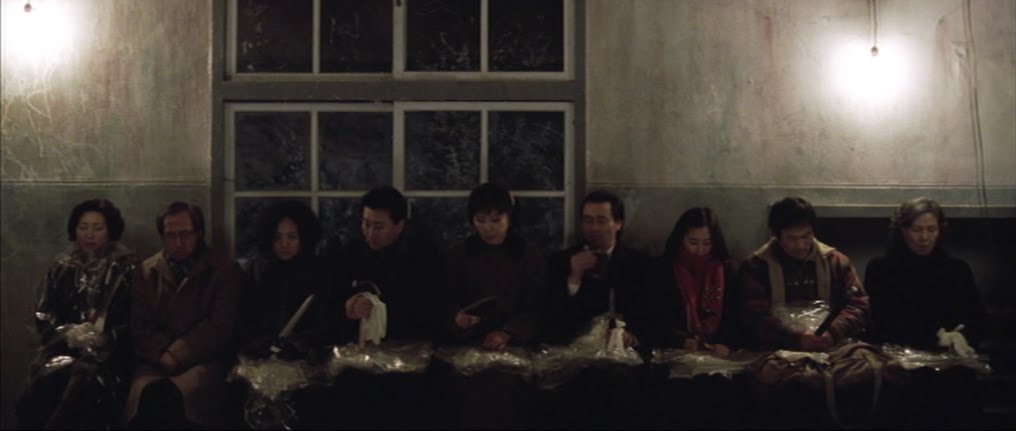
The last third of the film develops into a debate on the nature of revenge, individual vs collective responsibility, and the moral quandaries that ensue. That the final outcome is inevitable is less a point of contention than a setting of the scene for a final quarter of an hour that is frankly astounding. Remember that scene towards the end of ‘The Straight Story’: Alvin Straight (Richard Farnsworth) has almost reached the end of his journey, and stops off at a bar; he hasn’t drunk in ages, but now he orders a beer; it’s a crucial point for him, yet David Lynch’s camera follows the doddery old barman as he breaks off conversation with Alvin and wanders off to the opposite end of the bar to perform some utterly mundane task. It’s a moment where the camera, the director, the film itself and by extension the audience veer away from the enormity of what has gone before – in the case of ‘The Straight Story’, an octogenarian in ailing health travelling several hundred miles across America in all weathers on a ride-on lawnmower – and are presented with a small, still moment, almost pointless in its narrative and thematic insignificance, by which the preceding is thrown into even sharper relief. At a pinch, you could describe it as the cinematic equivalent of the via negative. Now imagine that scene, reconfigured as a borderline religious metaphor, coming after an extended sequence of largely offscreen but still obviously brutal violence, and ending on a snowy image that intermingles grief, loss, reunion and redemption.
That’s ‘Lady Vengeance’ for you. A beautiful, poignant, masterfully realized conclusion to the trilogy.