Showing posts with label Corinne Cleary. Show all posts

Sunday, November 04, 2012

WINTER OF DISCONTENT: Hitch-Hike


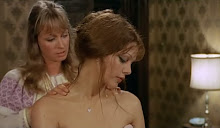
To hear Franco Nero, Corinne Clery and David Hess reminiscing on the special features “making of” documentary about how well they got on during filming and how proud they are of the work they produced, you’d think ‘Hitch-Hike’ was a high-point of world cinema, something worthy of comparison to Fellini or Antonioni. Actually, it’s a mean-spirited little exploitationer that was directed by Pasquale Festa Campanile. 

Campanile was incredibly prolific in three disciplines: as novelist, screenwriter and director. He was apparently something of an aesthete. You wouldn’t think it to watch ‘Hitch-Hike’. Its original Italian language title is ‘Autostop Rosso Sangue’ which means exactly what you think. ‘Blood Red Autostop’ – not exactly subtle, is it?


In a film utterly devoid of likeable or sympathetic characters our ostensible protagonists are Walter and Eve Mancini (Nero and Clery), an Italian couple holidaying in America. Walter is a burned out and borderline alcoholic reporter stuck in a stagnant decade-long marriage to his boss’s daughter. Apparently affluent enough (they’re tootling round the States in a big car with an even bigger caravan behind it and doing the odd bit of hunting with a pair of expensive-looking rifles), their lifestyle seems little compensation for the fact that they can’t stand each other. Walter is boorish and verbose. He treats his wife like a piece of meat – in an early scene, he mauls her in the back of 4x4 next to the corpse of a deer he’s just bagged – and that’s when he’s not fantasizing about doing her in.


The opening credits play out over Walter tracking Eve through the cross-hairs of his rifle, only hesitating from pulling the trigger when a deer presents itself as an easier target. Eve is waspish and petulant, not averse to attracting attention from other quarters in order to score points against her husband.

After spending quarter of an hour with these two, it’s almost a relief when – against Walter’s express instructions – Eve pulls over to offer a hitch-hiker a lift. Oh, wait a minute, the hitch-hiker’s played by David Hess. Yeah, this one’s going to end badly.


Hess began his career in the music industry, first as a singer (recording ‘All Shook Up’ a year before Elvis took it to the top of the charts and scoring a middling hit with a cover version of ‘Living Doll’), then as a song-writer (random pick from the CV: Pat Boone’s ‘Speedy Gonzales’), before establishing himself as an actor as the loathsome Krug in ‘Last House on the Left’ (he also wrote the score), a persona he continued to draw upon in ‘Hitch-Hike’ and ‘The House on the Edge of the Park’. Yes, folks, we live in a world where Wes Craven and Ruggero Deodato’s go-to guy when they needed a deranged rapist once recorded a Cliff Richard cover. Personally, I’m counting that one single fact as more mind-warpingly fucked up than anything I have ever featured as part of the Winter of Discontent.


Hess’s character is called Adam, hence various references in the script – adapted from the sensitively titled novel ‘The Violence and the Fury’ by Peter Kane – to Adam and Eve. Which would imply that Walter is the serpent. Events in the last third suggest there might be something to this reading. Indeed, it’s in the last third that Campanile starts to do something really interesting with the material, having rather abruptly curtailed the Adam-terrorizes-Walter-and-Eve/will-Adam-rape-Eve-before-Walter-fights-back dynamic of the first hour. And let’s face it, said first hour trades on sexual threat and a leering objectification of its leading lady to such an extent that it would have become utterly tedious if Campanile had played his string out any longer.


‘Hitch-Hike’ delivers its best moments in the early scenes when Adam is happily playing Walter and Eve off against each other (at one point Adam, picking up on Walter’s disaffection with his job, offers him the story of a lifetime tagging along in his swathe of crime and brutality as official biographer, kind of a Beauchamp to his English Bob), and towards the end when a confluence of wounded masculinity and bad influence bring things full circle.

Challenges to Walter’s full-blooded Italian masculine imperative are rife: his marriage has devolved into a lust-hate relationship; his father-in-law is his employer, to whom his vocational ambitions are in hock; early on he breaks his fingers, necessitating a surrender of the driving duties to Eve; he gets drunk easily, suggesting an inability to hold his booze; Adam goads him into a stunningly politically incorrect debate on how gays are making the world their own (I can’t help but wonder whether the drunken dwarf’s monologue on blacks vs whites in ‘In Bruges’ owes a debt to ‘Hitch-Hike’); and ends up on the receiving end of a sadistically executed practical joke by a bunch of free-loading students.


While the scenario presents him as the ostensible hero – tested to the limits in order to prove himself – Walter is continually painted as little better than Adam. Verbosity, quick-temperedness and self-importance are traits they shared. And while the scenario presents Eve as the ostensible victim she does herself no favours, deliberately provoking Adam when commonsense ought to compel her to fade into the background. That the sexual rivalry and one-upmanship resolves in the most ambiguous rape scene this side of ‘Straw Dogs’ just adds to the general unpleasantness and moral retardation on offer.

It’d be reprehensible and worthy of immediate dismissal … but it’s just too well made.

Sunday, July 01, 2012

BOND-A-THON: Moonraker


Memory can play tricks on you. It had been a while – actually, a good decade or so – since I’d last seen ‘Moonraker’ and I recalled it as being dumb but fun. Mrs F had the same recollection and, though she’d not participated in any of the viewings for the Bond-a-thon beyond a couple of the Connery titles, sat down to watch it with me. We groaned, face-palmed and talked sarcastically over the movie for two solid hours.

The trickery of one person’s memory may be considered unfortunate, two people’s smacks of conspiracy. “Why did I waste two hours on that piece of shit?” my wife enquired as the end credits rolled. I could offer no answer. It may be of some cold comfort that at least she doesn’t have to write this fucking review; one, moreover, that forces me to reappraise my earlier opinion of ‘The Man with the Golden Gun’ as the series’ nadir. Although perhaps ‘TMwtGG’ is more bitterly disappointing because of the flashes of potential it displays – ‘Moonraker’ simply starts bad and stays bad.

How bad? Even allowing for the extravagancies and unsubtleties that are emblematic of the Roger Moore opuses, ‘Moonraker’ is god-awful. The pacing is leaden, the action scenes perfunctory, the humour sub-juvenile, the plot meaningless, the gadgets dull, the Bond girls duller and the villain dullest of all, Michel Lonsdale not even attempting to act but delivering a series of monotone line readings with all the conviction of an automaton.


Let’s spend a few hundred words finding out why, wrap this up as quickly as possible, and in ten days’ time we can enjoy ‘For Your Eyes Only’ which at least has Carole Bouquet, Topol, some nice scenery and no fucking idiotic space battles.

‘The Spy Who Loved Me’ ended with the promise “James Bond will return in ‘For Your Eyes Only’”, however producer Albert Broccoli – his antennae, as always, attuned to what was bringing in the biggest box office bucks at any given moment – realised that audiences were responding to sci-fi spectaculars. ‘Star Wars’, released the same year as ‘The Spy Who Loved Me’, had left 007 standing in terms of ticket sales (and ‘TSWLM’ was no flop either, earning its budget back at least ten times over). ‘For Your Eyes Only’ was put on hold and ‘Moonraker’ was rushed into production.

The biggest rush job was arguably the script. If Christopher Wood took more than a weekend over it, I’d be amazed. Wood was the chap Lewis Gilbert brought on board to add a dash of humour to Richard Maibaum’s script for ‘The Spy Who Loved Me’. Earning himself a solo writing credit for ‘Moonraker’, Wood basically rewrote ‘TSWLM’ substituting “up in space” for “under the sea”. Hence we have reclusive billionaire Stromberg who wants to destroy earth and rule a new master race under the sea reimagined as reclusive billionaire Sir Hugo Drax who wants to destroy earth and rule a new master race in the stars; sexy helicopter pilot Naomi replaced by sexy helicopter pilot Corinne; the plot kickstarter of a stolen submarine rehashed as a stolen spacecraft (deepening levels of self-plagiarism here, with ‘Moonraker’ essentially ripping off ‘The Spy Who Loved Me’ which essentially ripped off ‘You Only Live Twice’); Bond’s emergence from the sea in a car/submarine occasioning a nearby drinker to glance at the bottle and shake his head in disbelief restaged as Bond’s transition from canal to piazza in gondola/hovercraft occasioning a nearby drinker to … well, you get the picture.


A musical gag is also repeated: a snatch of Maurice Jarre’s score to ‘Lawrence of Arabia’ as Bond crosses a desert in ‘TSWLM’; a bit of Elmer Bernstein’s ‘Magnificent Seven’ theme as Bond rides a horse dressed in western gear. Elsewhere, a security keypad plays the famous motif from ‘Close Encounters of the Third Kind’ (Spielberg repaid the homage by featuring the Bond theme in ‘The Goonies’, which he produced), and a hunt is opened by horn players sounding the opening notes of ‘Also Sprach Zarathustra’, the Richard Strauss tone poem forever associated with ‘2001: A Space Odyssey’. Just one of these would have maybe provided a cute little touch; stuffing them all into the film, along with its plentiful self-borrowings, turns it into a tedious plod through a decaying mulch of unoriginal material.

Jaws (Richard Kiel) returns, ostensibly in Drax’s employ but helping Bond during the mind-numbingly horrible space station battle at the end. His reversal of sympathies was due to Broccoli receiving tons of mail from kids whose imagination had been captured by the steel-toothed giant in the previous and had written to ask, in so many words, “Please mister, we think Jaws is dead cool, can’t he be a goodie this time and help Bond?” And so their requests were fulfilled; ergo a little more kerr-chinggg at the box office. Also, the big dude gets a girlfriend [insert “Jaws scores” pun here] and is allowed to deliver his only line of dialogue (“Here’s to us”).


By this point in the franchise, putting the words “Some Actor isJames Bond 007 in ‘Totally Interchangable Title’” over a big ballad and some naked women gyrating in silhouette was a guarantee in and of itself of at least $150million in box office returns, and for me it’s this foregone conclusion of profitability that makes ‘Moonraker’ such a depressing thing to watch. Every bit of it is a cynical calculation with a dollar bottom line that’s so unabashedly obvious it swamps even the faintest smidgin of technical ingenuity or entertainment value. More depressing is the fact that it worked; for all that ‘Moonraker’ took a deserved kicking from the critics, it made $210million from a $34million investment (double the budget of ‘The Spy Who Loved Me’).

Still, columns of figures are not the yardstick for this Bond-a-thon; these are tentpole movies whose mainstream appeal should be based on how entertaining they are; how much fun to watch. And ‘Moonraker’ delivers very little in the entertainment stakes. Everyone involved seems to be going through the motions: Gilbert’s direction is pedestrian, Moore’s performance is perhaps his most wooden turn in the franchise, Corine Cleary and Lois Chiles – saddled with underwritten characters – just phone in it, Lonsdale as mentioned earlier merely reads his lines and leaves it at that; the action scenes lack any frisson, with a potentially exciting speed boat chase reduced to a yawn-inducing a few minutes of padding and the explosive finale managing by some weird reverse alchemy to be as OTT as it is boring.

There’s not much else to say about the whole fiasco – at least not without getting into an overlong diatribe on how little sense the plot makes, even by the logic-starved standards of your average Bond movie, and I really don’t want to waste any more time or words on ‘Moonraker’ – except that it marks Bernard Lee’s final appearance as M. Which is a bloody shame. He deserved a better swansong.