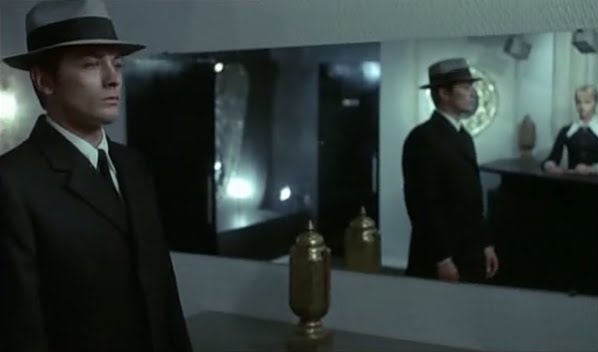
‘Le Cercle Rouge’, like ‘Le Samourai’, opens with a portentous quote: “Siddhartha Gautama, the Buddha, drew a circle with a piece of red chalk and said: ‘When men, even unknowingly, are to meet one day, whatever may befall each, whatever the diverging paths, on the said day, they will inevitably come together in the red circle’.” Like ‘Le Samourai’, it lends an ice cool crime flick a quasi-mystical subtext. Like ‘Le Samourai’, the attribution is total bollocks; Melville made it up.
It defines the film as a study in fatalism and the grimly inevitable, though; no question about that.

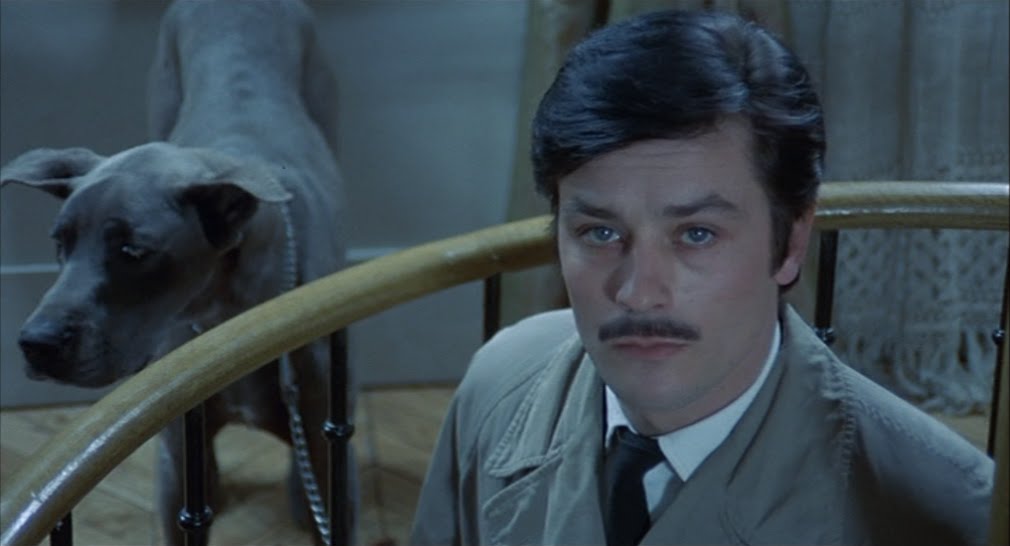
The two narrative strands that set things in motion occur pretty much simultaneously: Corey (Alain Delon) is released from prison; Vogel (Gian Maria Volonté) escapes from custody. The release/flight contrast is further emphasized by the authority figures who prove their nemeses: just prior to release, Corey is coerced into executing a jewellery heist by a crooked prison guard (Pierre Collet); Vogel goes on the run after getting the jump on Mattei (the mononymous Bourvil), the doggedly by-the-book copper assigned to escorting him across country to stand trial. Another point of comparison is their ages: Corey is the older, aloof, old-school professional criminal; Vogel is the edgy, unpredictable younger man. Their relationship is shadowed by that between Mattei and his boss, the cynically pragmatic Chief of Police (Paul Amiot) who believes that all men are corruptible. ‘Le Cercle Rouge’ is a film of parallels, contracts and corrosive ironies.

At two and a quarter hours (one of the longest works in Melville’s canon – only ‘Army of Shadows’, his Resistance epic, is marginally longer), it’s slow-burn and then some, the pace even more stately than the glacially iconic ‘Le Samourai’. But it exerts a grip like a python with a spine of tungsten carbide. Vogel’s escape from the train, despite Mattei having him handcuffed, is an object lesson in how to set up, develop tension from and excitingly resolve a major set-piece – and it’s just for starters.
Corey’s post-release settling of scores with those responsible for his incarceration recalls Maurice at the start of ‘Le Doulos’; the way he moves through a dangerous underworld with a ruthless lack of emotion is comparable to Jeff Costello in ‘Le Samourai’. No doubt about it, Alain Delon was Melville’s alter ego: enigmatic, relentless, icily cool.
The chance of fate that throws Corey and Vogel together in their jewellery-heisting enterprise is effect by the mobsters who come after Corey following his vengeful exploits. In a squirmily unhurried set-piece that prefigures ‘Miller’s Crossing’, two heavies take Corey into the words with the express intention of leaving him there, riddled with lead. Vogel, hidden in the trunk of Corey’s (obligatorily) flash American car, puts in a surprise appearance: a new element, in effect, is introduced into an already volatile situation.

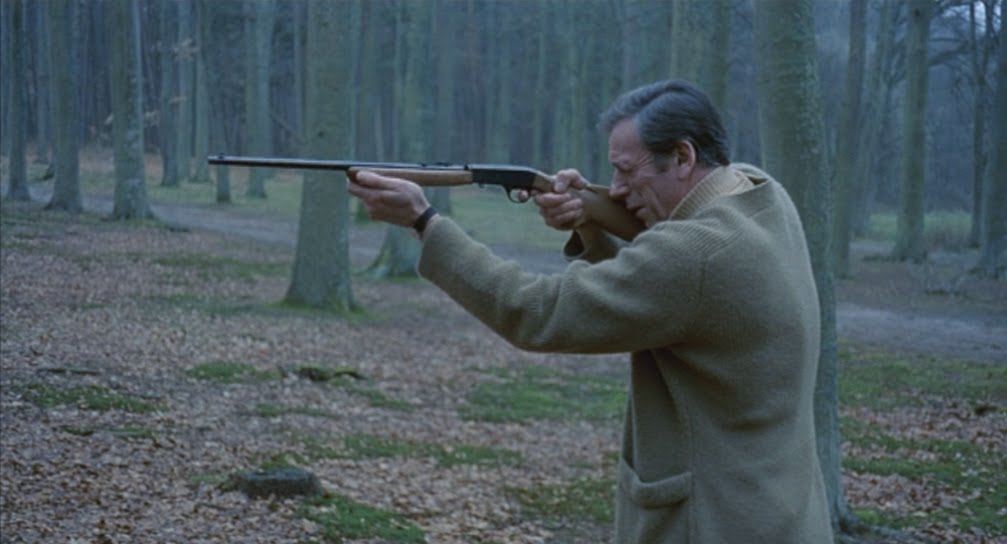
This scene is a good metaphor for the film entire. Corey and Vogel recruit Jansen (Yves Montand), a former police sniper with a narcotics habit, a monkey on his back and a tendency to hallucinatory episodes of the DTs. A new element; an unpredictable set of variables. (Jansen’s memorable target practice scene – again set in the leafy silence of the woods – prefigures Edward Fox’s bullet-in-the-melon moment in ‘Day of the Jackal’.)
Mattei, pressured by his boss into getting a result, leans on Corey’s associate, nightclub owner Santi (François Périer). A new element; an unpredictable set of variables. Melville’s line-up of criminals, be they world-weary or rigorously disciplined, function with as decisive a sense of purpose as ever, but the difference this time round is how defining a part the vagaries of chance play in the way things resolve.
The colloquial principle Sod’s Law states that if a thing can go wrong it will. If ‘Bob le Flambeur’ functions, in its visual aesthetic, as a metaphor for the cosmic chequerboard on which fate moves us like chess pieces, then ‘Le Cercle Rouge’ demonstrates that fate is also capable of considerably less elegance on occasion; that it can swipe the pieces off the board with all the spiteful vehemence of a moody child. That fate can do such a thing to an ensemble of French cinema’s finest makes it all the more galling.