Showing posts with label Yves Montand. Show all posts

Thursday, June 23, 2011

Le Cercle Rouge


‘Le Cercle Rouge’, like ‘Le Samourai’, opens with a portentous quote: “Siddhartha Gautama, the Buddha, drew a circle with a piece of red chalk and said: ‘When men, even unknowingly, are to meet one day, whatever may befall each, whatever the diverging paths, on the said day, they will inevitably come together in the red circle’.” Like ‘Le Samourai’, it lends an ice cool crime flick a quasi-mystical subtext. Like ‘Le Samourai’, the attribution is total bollocks; Melville made it up.

It defines the film as a study in fatalism and the grimly inevitable, though; no question about that.


The two narrative strands that set things in motion occur pretty much simultaneously: Corey (Alain Delon) is released from prison; Vogel (Gian Maria Volonté) escapes from custody. The release/flight contrast is further emphasized by the authority figures who prove their nemeses: just prior to release, Corey is coerced into executing a jewellery heist by a crooked prison guard (Pierre Collet); Vogel goes on the run after getting the jump on Mattei (the mononymous Bourvil), the doggedly by-the-book copper assigned to escorting him across country to stand trial. Another point of comparison is their ages: Corey is the older, aloof, old-school professional criminal; Vogel is the edgy, unpredictable younger man. Their relationship is shadowed by that between Mattei and his boss, the cynically pragmatic Chief of Police (Paul Amiot) who believes that all men are corruptible. ‘Le Cercle Rouge’ is a film of parallels, contracts and corrosive ironies.


At two and a quarter hours (one of the longest works in Melville’s canon – only ‘Army of Shadows’, his Resistance epic, is marginally longer), it’s slow-burn and then some, the pace even more stately than the glacially iconic ‘Le Samourai’. But it exerts a grip like a python with a spine of tungsten carbide. Vogel’s escape from the train, despite Mattei having him handcuffed, is an object lesson in how to set up, develop tension from and excitingly resolve a major set-piece – and it’s just for starters.

Corey’s post-release settling of scores with those responsible for his incarceration recalls Maurice at the start of ‘Le Doulos’; the way he moves through a dangerous underworld with a ruthless lack of emotion is comparable to Jeff Costello in ‘Le Samourai’. No doubt about it, Alain Delon was Melville’s alter ego: enigmatic, relentless, icily cool.
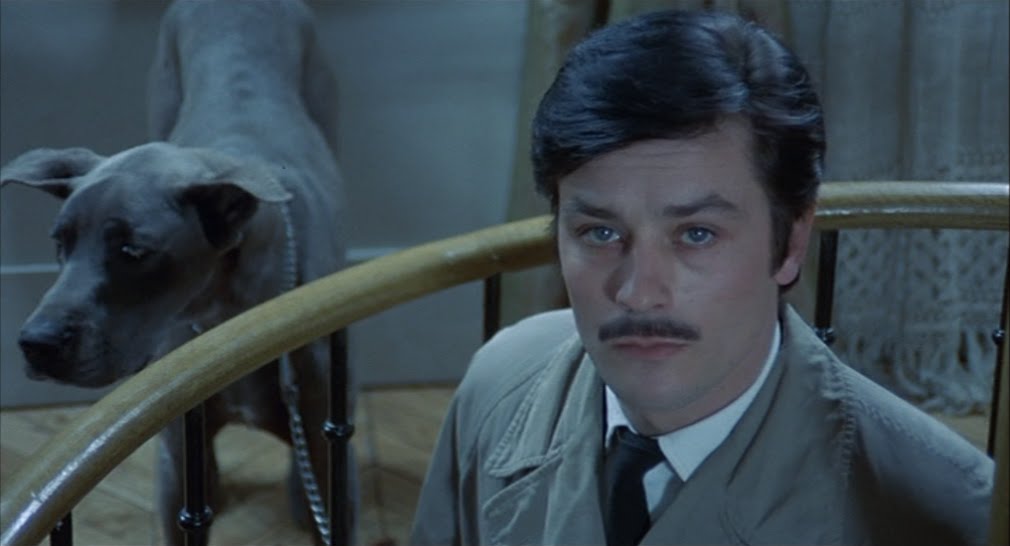


The chance of fate that throws Corey and Vogel together in their jewellery-heisting enterprise is effect by the mobsters who come after Corey following his vengeful exploits. In a squirmily unhurried set-piece that prefigures ‘Miller’s Crossing’, two heavies take Corey into the words with the express intention of leaving him there, riddled with lead. Vogel, hidden in the trunk of Corey’s (obligatorily) flash American car, puts in a surprise appearance: a new element, in effect, is introduced into an already volatile situation.


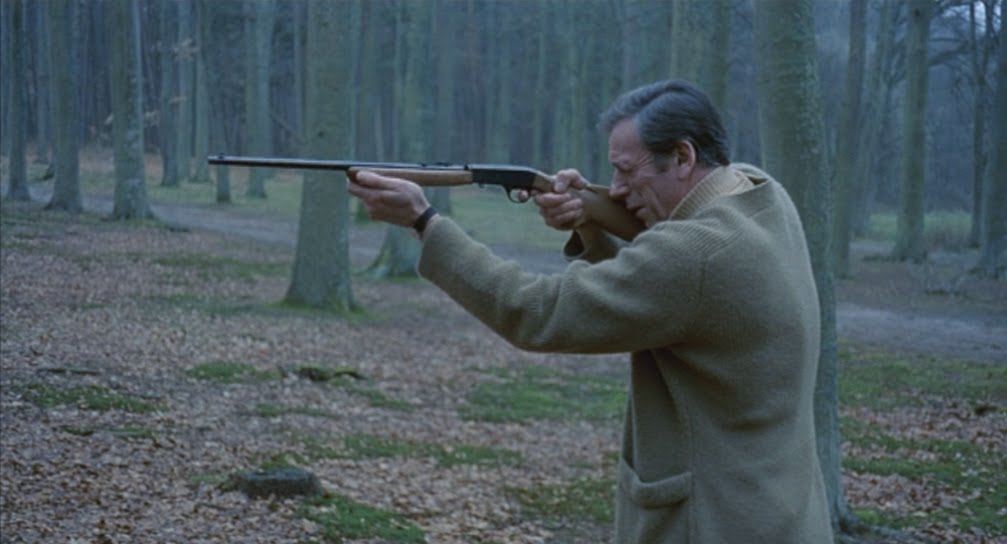
This scene is a good metaphor for the film entire. Corey and Vogel recruit Jansen (Yves Montand), a former police sniper with a narcotics habit, a monkey on his back and a tendency to hallucinatory episodes of the DTs. A new element; an unpredictable set of variables. (Jansen’s memorable target practice scene – again set in the leafy silence of the woods – prefigures Edward Fox’s bullet-in-the-melon moment in ‘Day of the Jackal’.)


Mattei, pressured by his boss into getting a result, leans on Corey’s associate, nightclub owner Santi (François Périer). A new element; an unpredictable set of variables. Melville’s line-up of criminals, be they world-weary or rigorously disciplined, function with as decisive a sense of purpose as ever, but the difference this time round is how defining a part the vagaries of chance play in the way things resolve.

The colloquial principle Sod’s Law states that if a thing can go wrong it will. If ‘Bob le Flambeur’ functions, in its visual aesthetic, as a metaphor for the cosmic chequerboard on which fate moves us like chess pieces, then ‘Le Cercle Rouge’ demonstrates that fate is also capable of considerably less elegance on occasion; that it can swipe the pieces off the board with all the spiteful vehemence of a moody child. That fate can do such a thing to an ensemble of French cinema’s finest makes it all the more galling.

Wednesday, April 08, 2009

The Wages of Fear (slight return)

Quite apart from inspiring William Friedkin’s fully-fledged remake ‘Sorcerer’, it occurred to me watching ‘The Wages of Fear’ a couple of nights ago just how influential it’s been on other film-makers.

One guy pegs it while one guy drives in ‘The Wages of Fear’ …


… one guy pegs it while one guy drives in ‘Thunderbolt and Lightfoot’

Yves Montand stares at the flames in ‘The Wages of Fear’ …

… Daniel Day Lewis stares at the flames in ‘There Will Be Blood’

Charles Vanel surfaces in ‘The Wages of Fear’ …

… Martin Sheen surfaces in ‘Apocalypse Now’

Tuesday, April 07, 2009

PERSONAL FAVES: The Wages of Fear

Picture the scene: a flea-bitten South American town where children walk unclothed through the rutted streets and vultures lazily watch them; where the airstrip is nothing but the hard baked earth, the airport a shed and the customs official gimlet-eyed and corrupt and wanting his kick-back from every new arrival; where expatriates sweat it out under an unforgiving sun as they wait for an opportunity to get the hell out of there; where the local bar provides the only social outlet and tempers threaten to flair into violence.

It’s here that Mario (Yves Montand) is killing time, arguing with the locals and enduring the clinging attentions of bar girl Linda (Véra Clouzot). Then fellow Parisian Jo (Charles Vanel), swish in his tropical suit and talking a tough line of macho BS, arrives. Mario and Jo strike up an immediate (and borderline homo-erotic) friendship. They drink together, bemoan their surroundings and start some shit with Luigi (Folco Lulli), an Italian who is perhaps the only sympathetic character in the whole film.

Jo has an ‘in’ with Bill O’Brien (William Tubbs), foreman at the Southern Oil Company plant just outside of town, an American outfit who are laying a pipeline across the country. Jo’s pleas for a cushy number and some easy money fall on deaf ears, however.

Then an oil fire blazes out of control at a rig miles away from the plant and O’Brien makes an on-the-spot executive decision at an emergency meeting: load up two trucks with a tonne of nitro-glycerine apiece, get non-union drivers (ie. ones who won’t be missed if they get blown to smithereens), send them across 300 miles of bad road (or at times no road) and hope that at least one truck arrives. (Take dynamite to a fire? you may ask. A conflagration as severe as an oil well fire can really only be extinguished one way: trigger an explosion that consumes the oxygen around the fire.)

So O’Brien puts the word out that he’s looking to hire four drivers, at $2000 a man, to take their lives into their own hands. See why it’s called ‘The Wages of Fear’?

The, ahem, lucky four are Mario and Jo in one truck, Luigi and German ex-fighter pilot Bimba (Peter van Eyck) in the other. Now, bear in the mind that this was a French production made just seven years after the end of the war. The Italian and the German remain calm and resolute as they encounter one pitfall on the road after another, while the two Frenchman prove themselves callous (Mario) and cowardly (Jo).

That said, it was the anti-American sentiment that generated the most controversy on the film’s release. The choice of Southern Oil as the name of the oil company didn’t go over too well with Standard Oil, and the depiction of American bosses as anti-union, indifferent to the indigenous workers who die in the fire and unconcerned as to the fate of Mario and co. led to about twenty minutes’ worth of cuts being made for its US release.

Which is harsh. This is, after all, an Henri-Georges Clouzot film – and for H.G. Clouzot, despair at the human condition went beyond mere matters of nationality. From ‘Le Corbeau’ (1943), a venal study of provincial jealousies and poison pen letters, to his last film ‘La Prisonnière’ (1968), an examination of voyeurism and sexual objectification, Clouzot painted portraits of nihilism on the blackest of canvases. There is, in his filmography, simply no hope. I mentioned that Luigi and Bimba stay calm and resolute in the face of adversity; more so than Mario and Jo, they’re the closest ‘The Wages of Fear’ has to heroes. Doesn’t prevent ’em from going up in flames though.

Oh, sorry. Should have put a “SPOILER ALERT” warning there. But like I said before, this is an H.G. Clouzot film – you didn’t expect a happy ending, did you?

There is a whole article to be written about why Clouzot was cinema’s master miserablist. His first films were produced by the Continental Film Company, a Goebbels-authorised propagandist production company operating in Nazi-occupied France, which essentially branded him a collaborator (even though ‘Le Corbeau’ can be read as a very subtle comment on life under occupation). Nevertheless, he was barred from film production after ‘Le Corbeau’ until 1947. He suffered ill-health throughout his life, including a four-year spell in a sanatorium recovering from tuberculosis. He was a perfectionist who demanded the absolute from his cast and crew (on ‘The Wages of Fear’, Montand and Vanel contracted conjunctivitis after filming a scene that has them floundering in a pool of crude oil) that created tension and bad feeling on set. You could easily call him the French Kubrick … except that his continued fame owes much to his status as the French Hitchcock.

Gloomy old sod or no, Clouzot could create a scene of suspense second to none. Personally, I’d rank ‘The Wages of Fear’ as a more accomplished nerve-shredder than anything Hitch did. Four set-pieces in particular induce sphincter-tightening, knuckle-whitening, squirmy agitation every time I watch it: the drivers speeding up to 40mph to take a stretch of pot-holed road (any slower and the bumps and jolts would set off the nitro); a mountain pass with a bend so tight that navigating it necessitates backing onto a rickety wooden platform overhanging a sheer drop (you’ve heard the expression “cliffhanger”; this film makes it literal) – there are two trucks, so Clouzot puts you through the whole risky manoeuvre twice; a landslide blocking the road that sees Bimba utilise some of his cargo to blast the way clear; and a nasty bit of business involving a ruptured pipeline, a deepening pool of crude oil, a slip (again quite literally) on Jo’s part and a heartless decision on Mario’s.

And then, when it’s all over and the payload delivered, Clouzot signs off with barbed irony that’s both utterly inevitable and a slap in the face. I don’t think I can honestly say that I know of a film so bleak that manages to be so tense, exciting and, in places, even exhilarating. It makes ‘Ice Road Truckers’ look like a Sunday drive.