Showing posts with label Howard Ross. Show all posts
Sunday, October 23, 2016
13 FOR HALLOWEEN #8: Five Dolls for an August Moon
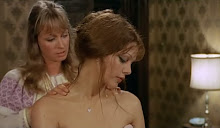
Boasting one of the most spurious titles in the entire history of the giallo, Mario Bava’s essay in lifestyle chic and amorality proves that sometimes style over substance wins the day – particularly when you’ve got access to a beach house that would make Frank Lloyd Wright weep in envy, the retro-coolest set design ever, and a cast – including Edwige Fenech, Ira von Furstenberg, Helena Ronee, Edith Meloni and Ely Galleani – for whom the term “eye candy” could well have been coined.
Essentially, the narrative is little more than this: a bunch of dudes with hot wives/mistresses/girlfriends invite a dude who has something they want (as well as a hot wife of his own) to an island where they make him various offers to acquire the thing he has that they want. The dude who has the thing the other dudes want won’t sell, and as tempers run higher, a murderer strikes. And strikes again. And again. And … well, you get the picture.
Filling in the above paragraph, Professor Farrell (William Berger) and his wife Trudy (von Furstenberg) accept an invitation to stay at the island home of industrialist George Sagan (Teodoro Corra) and his wife Jill (Meloni); the other guests include Nick and Marie (a.k.a. Pook) Cheney (Maurice Poli and Edwige Fenech), and Jack and Peggy Davidson (Howard Ross and Helena Renee). Ostensibly, Sagan, Cheney and Davidson have formed a consortium to buy a formula for an industrial resin that Farrell has developed, but each is keen to cut a deal with Farrell directly and shaft the others. Offers are made to Farrell. Serious offers. At one point, there’s five million on the table.
Mind you, that’s in lire, and the best currency conversion I could come up with in the five minutes I bothered to spend on the internet – bearing in mind lire was replaced by the Euro over 15 years ago – is about $3500, or £2685. It was probably worth a bit more in 1970, when the film was made.
But I digress. Farrell refuses because he wants his formula to be used for the good of mankind … and just pull the McGuffin omnibus over to the side of the Fuck-The-Audience-They’re-Not-Bothered highway. An industrial resin? Like fucking glue? Like a particularly strong fucking glue? Seriously: this Farrell geezer has just reinvented motherfucking Araldite and everyone’s offering him blank cheques and a quick feel of Edwige Fenech for it?
Anyway, that’s the basic set up. Dude who has summat. Other dudes who want it. Hot wives. Fucking glue. And because this irresistible narrative hook ain’t never going to fill even the skimpy 77 minute running time, Bava throws a bunch of other stuff into the mix. Stuff like: Pook having it off on the quiet with the Sagans’ houseboy. Stuff like: Sapphic tensions simmering away between Trudy and Jill. Stuff like: island girl Isabel (Galleani, appearing under her pseudonym Justine Gall) flitting about all over the place and guiltily spying on everyone.
All well and good, except we’ve barely had a glimpse of Fenech sans chemise when the houseboy turns up dead, and the Trudy/Jill subplot is never developed in an aesthetically satisfactory manner. If you know what I mean.
But let’s get back to the houseboy for a moment. Not only is the poor bastard denied his liaison with the pert and prepossessing Pook, but the party who discover him are faced with the quandary of leaving him on the beach until the police arrive (immediate problem: sand crabs looking for a midnight snack) or wrapping his body in plastic and hanging it in the meat store. The increasing proliferation of bodies in the deep freeze, each new cadaver swinging merrily on its hook to the accompaniment of lounge jazz, is the best joke in a film that Bava seems to have conceived as an absurdist comedy from the outset.
It certainly doesn’t function as a thriller – we’re past the hour mark before he throws in the one single scene that even bothers to function as an Agatha Christie-lite “hey let’s all try to figure out how the seemingly impossible happened” mystery – and it only just makes the cut as a horror movie thanks to a couple of genuinely effective and grotesque images. Mainly, he just lets a group of rich, nasty, sexy people roam around a picturesque island, frequently cutting away from them to admire the architecture of the beach house.
Most gialli dabble in architecture porn; ‘Five Dolls for an August Moon’ is architecture eroticism. I’m not kidding. For the entire duration of the film – I watched the American release, which runs ten minutes shorter than the Italian cut and still feels like it drags – I wanted that beach house. And I wanted its 1970 interior design. And if Edwige Fenech and Ely Galleani fancied popping over for the housewarming, I wouldn’t have said no.
Sunday, February 13, 2011
GIALLO SUNDAY: The New York Ripper
Early in Lucio Fulci’s censor-baiting controversy-magnet ‘The New York Ripper’ – that staple of the BBFC and DOP hit lists, a film that remains so infamous that even mentioning the title gets you filthy looks in most social situations (try it; five points for talking about it at work, ten at the kids’ playground, fifteen in front of your mother, twenty in church) – there’s a scene where pathologist Dr Jones (Giordano Falzoni) performs an autopsy on a young woman who has been brutally murdered by the eponymous nut job, and describes his findings to Detective Williams (Jack Hedley). The murder weapon: a fucking big knife. The application thereof: “He stuck it up her love trail.”Allow me to repeat that, just in case you didn’t pick up on the subtleties and nuances on a first reading:
“He stuck it up her love trail.”
Ladies and gentlemen, abandon your sense of aesthetics, put your aspirations to classy entertainment in cold storage, mothball your morality and drape the dust covers over your finer feelings. We’re about to submerge ourselves in 93 minutes of sleaze, depravity and nastily sexualized violence. (Well, what else were you going to do on a Sunday afternoon?)
An old man out walking his dog finds the mutilated corpse of a young woman. Williams pegs it as the same modus operandi as the killing of a hooker some weeks earlier. A cyclist in hot pants has an altercation with a motorist and is brutally assaulted and killed on the Manhattan ferry shortly thereafter. Jane Lodge (Alexandra Delli Colli), the sexually provocative wife of respected academic Dr Lodge (Laurence Welles) attends a sex show after which one of the performers is murdered by way of a broken bottle applied to her nether regions. Jane’s taste for the seedier side of life brings her into the orbit of Mickey Scellenda (Howard Ross), a small time thug who might know more about the “Ripper” case than he’s letting on.
Meanwhile, troubled student Fay Majors (Alamanta Keller) has a narrow escape from a stalker on the subway. She’s the only witness Williams has, but with the taunting phone calls he’s receiving from the killer, and his somewhat seedy private life about to go public, can Williams hold it together, nail the “Ripper” and keep Fay out of danger? And does Fay herself have something to hide? Will her milquetoast boyfriend Peter Bunch (Andrew Painter) be able to defend her? And why does cynical psychologist Dr Paul Davis (Paolo Malco) so eagerly respond to Williams’s invitation to help profile the killer?
On the one hand, ‘The New York Ripper’ has all the elements of a clinically efficient giallo, ticking all the boxes as regards sleaze, nudity, protracted death scenes, cod-psychology and a pass-the-parcel red herrings game in which most of the major characters have good reason to invite suspicion at one time or another. Add to this the presence of Lucio Fulci – a man who, for all his notoriety, was a highly capable director who knew how to generate tension and keep a film’s narrative going, even when the script was no great shakes – and there ought to be enough here to mount a sterling defence of ‘The New York Ripper’ as a minor classic, undeservedly tainted by the smug, hyperbolic moralizing of the chattering classes.But for one small problem.
It is fucking nasty. It is, in fact, one of the nastiest, seediest, grubbiest and downright unpleasant pieces of work I’ve seen. I’d make a case for the artistic integrity of ‘Cannibal Holocaust’ over ‘The New York Ripper’. ‘Cannibal Holocaust’ at least reserves its journey into the most joyless recesses of the human psyche for the last half hour or so – and delivers its catalogue of cruelties in the service of a statement about the manipulation of the medium and whether “civilized” man is actually more reprehensible in his actions than the so-called savage.
‘The New York Ripper’, however, presents an interminable succession of women being murdered and sexually objectified, usually at the same time. Even scene that don’t end in slaughter treat the female characters like so much meat. Case in point: the narratively redundant but gratuitously lingered-on moment (for “moment” read “about ten minutes”) when Jane wanders into a pool hall and gets frigged by a latino thug’s toe. (Which is not a sentence I imagined myself typing when I got up this morning.) It’s a scene that serves no discernible purpose (it’s already been established that Jane likes it kinky), yet Fulci’s camera gloats over it like a voyeur.Moreover, there’s none of the visual brilliance of ‘The Beyond’, ‘A Lizard in a Woman’s Skin’, ‘Murder to the Tune of Seven Black Notes’ or ‘Don’t Torture a Duckling’. In fact, the only commonality with that straight-up giallo classic is the duck-like voice the killer adopts prior to offing another poor woman or making a “you can’t catch me” call to Williams. Subject of whom, for all that Hedley tries to imbue him with some world-weary characterization, there’s no backstory to the cop, no motivational factor, and no indication of why the “Ripper” targets him when he rings the cops to bait them about his latest atrocity. In fact, this entire element seems to have been included purely as parallel to the actual Jack the Ripper case, where JtR wrote provocative letters to the press, mocking the police’s inability to catch him.
I’m not sure whether Fulci took the decision from the outset to make the film as visually dreary as possible, but he certainly succeeds in painting one of the unloveliest cinematic pictures of New York.
So, with an arguably deliberate anti-aesthetic, little to no emotional investment in the characters, and the procedural aspects of the story purely an exercise in mechanics (even the race-against-time finale is blandly by-the-numbers), all that is left are the killings themselves. All of which of have an explicitly sexual imperative. When the defining shot of a film is a close-up of a straight razor being applied to a woman’s breast, that pretty much tells you all you need to know.
There’s a lot of hate for ‘The New York Ripper’ – and it’s been earned.
Labels:
Alamanta Keller,
giallo,
Howard Ross,
Jack Hedley,
Lucio Fulci
Subscribe to:
Posts (Atom)