Showing posts with label Julian Glover. Show all posts

Friday, July 20, 2012

BOND-A-THON: For Your Eyes Only


With the proviso that you turn off the DVD at 1:58:22, thereby saving yourself an excruciating scene in which Margaret Thatcher (Janet Brown) conducts a flirtatious telephone conversation with a parrot she believes to be agent 007, ‘For Your Eyes Only’ is the high point of the Roger Moore years with a back-to-basics aesthetic that atones in a most welcome fashion for the excesses and idiocies of ‘Moonraker’. (Parenthetically, John Gardner’s turgid 1989 continuation novel ‘Win, Lose or Die’ has Bond in the role of counter-terrorist, safeguarding Thatcher and George Bush at a summit conference. Which is strange because he usually finds himself pitted against crackpot megalomaniacs hellbent on world domination.)

‘For Your Eyes Only’ marks two notable firsts in the franchise: it’s the first Bond to feature a writing credit for Michael G. Wilson, and the first to be directed by former editor John Glen. Both men would continue in these roles for the next four movies. At what point in pre-production and who banged the drum for it the loudest I can’t say, but the decision was made to back away from the outlandish spectacle of ‘Moonraker’ and take the character (and, to a greater or lesser degree, the series) back to basics. Less gadgetry, tighter action sequences, more focus on narrative. ‘For Your Eyes Only’ strikes the right balance, delivering what is basically a thriller while remembering that Roger Moore is the punster Bond and allowing him to toss off the requisite amount of audience-friendly quips.

The plot is a magnificent piece of MacGuffin deployment, cheekily revisiting the race to recover a gizmo that threatens the safety of British nuclear submarines scenario of ‘The Spy Who Loved Me’. Here, the device is still within the wreck of a British naval vessel; a spy-boat of sorts operating in foreign waters and therefore unable to benefit from an official salvage operation. When Sir Timothy Havelock (Jack Hedley), an oceanologist with ties to the government, is murdered in front of his daughter Melina (Carole Bouquet) by a hitman identified as Hector Gonzales (Stefan Kalipha), Bond is sent to intercept Gonzales and find out who he’s working for.


Bond’s briefing is given by MI6 Chief of Staff Bill Tanner (James Villiers) and the Minister of Defence (Geoffrey Keen), during which it’s mentioned the M is “on leave”. It’s a subtle and graceful acknowledgement of Bernard Lee’s passing and I’m glad that they didn’t replace him immediately. Robert Brown would take up the mantle for the rest of the Moore years and during Timothy Dalton’s short-lived tenure, before Dame Judi Dench made the character her own in ‘Goldeneye’.

Bond discovers Gonzales – who, for such an infamous and supposedly deadly hitman, is (a) crap at hiding his identity and (b) really easy to track down – hosting the kind of pool party that wouldn’t be out of place in an Akon video. Before he can brace the pistol-packer (or hit on any of the chicks), Melina pops up with a crossbow and gets some payback. An awesome moment courtesy of an awesome actress. Bouquet is never less than fabulous whatever she’s in. The scene where Melina witnesses her parents’ murder is the best bit of screening acting by anyone in any Bond film, and DoP Alan Hume is wise enough to zoom in on Bouquet’s piercing eyes. The look she projects right into the camera – an expression knife-edge between heartbroken and vengeful – is powerhouse.


Added to this, Melina is easily the best-written Bond girl in the series to date; there’s no simpering, no swooning, no floundering around waiting to be rescued by Bond (in fact she saves his ass at one point, the only Bond girl to do so since Claudine Auger’s Domino in ‘Thunderball’). Nor is she paired up with 007 for the whole movie. During the first half particularly, she drifts in and out of the narrative as Bond flits from Spain to Italy to Corfu, always a striking presence, her cold-blooded agenda giving the film a real edge.

It’s tempting to wrap the review up here and now with a simple reiteration: this movie is a rattling good unpretentious thriller and Carole Bouquet brings her A-game. But that would be to rob a few other luminaries of some well-earned words of praise. Moore delivers in this one; he hinted at it in ‘Live and Let Die’, but here he plays Bond with gravitas. Indeed, he comes as close as he ever would to the brutal Bond of Connery circa ‘From Russia with Love’, particularly when he despatches an assassin who’s garrotted a colleague. The assassin’s Mercedes, its escape route interrupted by Bond’s bullet, teeters on a cliff edge; Bond coldly walks up to it, tosses in the dove pendant (the killer’s calling card) taken from his friend’s body, and lands a hefty kick against Merc, sending it plunging. A Falstaffian Bond he may be in virtually every other film, but in this one scene Roger Moore is badass.


A raised glass to Topol. As Milos Columbo, a former freedom fighter now enjoying life as a smuggler, Topol is evidently having a blast, cracking nuts, packing heat and looking way cooler in a leather jacket than a paunchy middle-aged guy with a grey-haired comb-over has any right to. Topol’s flamboyance contrasts nicely with Julian Glover’s rigidly controlled characterisation of Aris Kristatos. And it’s a change to have a Bond villain who’s not a world domination obsessed sociopath with a penchant for monologues. Here, Kristatos is basically a businessman looking to do what all businessman do – make a fuckton of money, albeit by murderously obtaining an intelligence item which he can sell to the Russians (in the form of M’s opposite number General Gogol, played again by Walter Gotell).

Weak points? The score is pretty horrible (when Sheena Easton’s title song can be said to be the high point musically, then you know something’s wrong), any and all scenes involving Kristatos’s Olympic protégé Bibi (former skating champion Lynn-Holly Johnson) are borderline embarrassing, a snowbound chase scene that runs almost ten minutes gets fairly tedious very early, and there’s another one of those protracted underwater sequences that the Bond movies are so fond of.


But mainly, though, the problem with ‘For Your Eyes Only’ is well … the bookends. It starts with a sequence that I’ve sat through half a dozen times now and which still strikes me as odd in its tone and utterly out of place with the rest of the film. Bond is visiting a churchyard, where he places flowers on a headstone. The inscription reads “Teresa Bond, 1943 – 1969, beloved wife of James Bond. We have all the time in the world.” Thus, ‘For Your Eyes Only’ – one of the few post-‘OHMSS’ entries that acknowledges Bond as a widower – starts on a reflective, slightly melancholy note. A priest hurries over and tells 007 that his office has sent a helicopter for him; some kind of emergency. Bond clambers into the whirlybird, only to see the vicar making the sign of the cross. Soon enough, the pilot’s been electrocuted and the helicopter is being flown remote control by an individual in a wheelchair with a bald head and a white cat on his knee.

This character – who is absolutely not Ernst Stavro Blofeld if a lawyer representing Kevin McClory happens to be present, and who patently is if you’re Albert Broccoli and you’re wanting to make a mono-figured gesture to the aforementioned Mr McClory – has great fun sending the helicopter spiralling and plunging through the sky and Bond struggles to wrest back control of the machine. He eventually does, and turns the tables on his nemesis in memorable fashion. All of which is exciting/suspenseful/attention-grabbing on paper, only it’s staged against an abandoned gasworks so grim in its architecture and emptiness that the high-flying hi-jinks just don’t gel. It’s an anodyne approach to criticise a Bond film for having a pre-credits sequence that has sweet FA to do with the actual plot, but when that selfsame sequence is also so stylistically at odds with the rest of the production, it rankles.


And then there’s the last scene. Which we mentioned earlier and will not be extrapolating any further, other than to say it’s horrible and excruciating and unfunny and makes the Bond-chases-a-midget ending of ‘The Man with the Golden Gun’ look like Tarkovsky.

A much more satisfying conclusion – SPOILER ALERT – is after the climactic assault on Kristatos’s mountain-top stronghold, Bond finally recovering the device only to find General Gogol and a machine-gun packing minion ready to take it off him. Bond flings the gizmo out across the precipice. It shatters (to the accompaniment of a crap sound effect) and Bond gives Gogol a sheepish grin. “Détente, comrade,” he declares, “you don’t have it and we don’t have it.” Gogol responds with diffident shrug and grins back as if to say suits me, pal; you went through all that for nothing, I enjoyed a day out of the office. (SPOILERS END) It’s a nice little moment, underplayed and without any of the smugness generally inherent in Moore’s Bond. It’s also one of the rare moments where a Bond film manages to make an actual comment on the nature of espionage, no matter how moribund.

Saturday, July 30, 2011

HAMMER HORROR WEEKEND: Quatermass and the Pit


In his own quiet way, Professor Bernard Quatermass has proved as durable and reliable a British hero as Sherlock Holmes or James Bond. Created by Nigel Kneale for the BBC drama series ‘The Quatermass Experiment’ in 1953 and played by Reginald Tate, the show was a precursor of ‘Dr Who’ and proved so popular (‘Quatermass’ was to audiences in the ’50s what ‘The X Files’ was in the ’90s) that ‘Quatermass II’ made debuted on television in 1955, the same year that Hammer remade the original series for the big screen – titled ‘The Quatermass Xperiment’ (the misspelling drawing attention to its “adults only” rating) – and this is where the whole issue of casting gets a bit murky.

Tate died a month before ‘Quatermass II’, transmitted like its predecessor as a series of live weekly episodes augmented with pre-recorded footage, was due to air. John Robinson was cast at the last minute, even though he had doubts about filling the shoes of the much-loved Tate. ‘The Quatermass Xperiment’, meanwhile, featured Brian Donlevy in a less-than-charismatic performance as Quatermass. Kneale was scornful of both the actor and the production. Nevertheless, he contributed towards the screenplay of ‘Quatermass 2’, the big-screen adaptation, in 1957. Donlevy reprised the role, again blandly.

Between December 1958 and January 1959, BBC transmitted ‘Quatermass and the Pit’, one of the watershed moments in British television. This time, the lead role was essayed by Andre Morrell, who remains the definitive Quatermass for many viewers. A film version was inevitable, although it didn’t appear until 1967. Andrew Keir was cast, and gives arguably the best characterization of Quatermass after Morrell.

(If five actors over three shows and three filmic remakes isn’t scattershot enough, consider that Kneale resurrected Quatermass in the late ’70s, this time produced by Euston Films – the production company behind ‘The Sweeney’ and shown on rival channel ITV – called simply ‘Quatermass’ and starring John Mills; while ‘The Quatermass Experiment’ was remade for television, and again transmitted live, in 2005 with Jason Flemyng as the professor. Not to mention the theatrical production of ‘Quatermass and the Pit’ staged in a Nottinghamshire quarry in 1997 and starring David Longford.)

Hammer’s ‘Quatermass and the Pit’ is a reasonably faithful take on the series, truncating the original’s three hour running time to 95 minutes, excising an entire subplot and ramping up the apocalyptic finale. It also dispenses with the series’ coda in which the steadfast Quatermass makes an appeal to humankind about … (ah, but that would be telling!) … ending instead on a more ambivalent note.


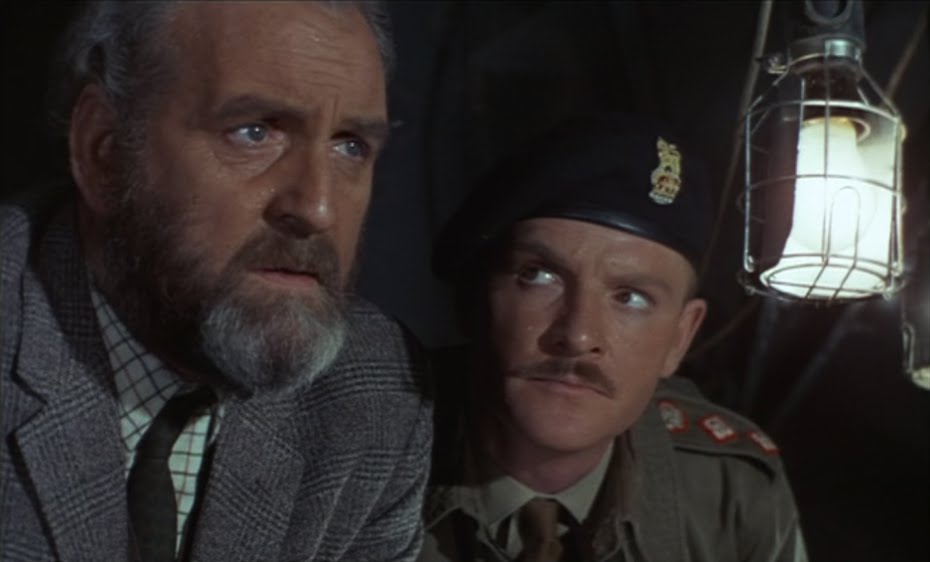
The plot has the extension to a London Underground line halted at Hobbs End station (John Carpenter used the name as homage in ‘In the Mouth of Madness’) when fossils are discovered. Dr Roney (James Donald) and his team of palaeontologists, including Barbara Judd (Barbara Shelley) work to recover as much as possible despite mounting pressure to get the civil engineering works underway again. When they happen upon something they believe to be an unexpected incendiary device from the war, the bomb disposal squad are deployed. Concerned that the object is formed from a substance that doesn’t correlate to any known German bomb, munitions expert Colonel Breen (Julian Glover) is called in. Breen has just got the nod from the corridors of power to take the reins at Quatermass’s rocket project, the military muscling in on scientific research and pissing the professor off no end in the process.

Tagging along while Breen conducts a reconnaissance, Quatermass bears witness to unusual phenomena at the site. As the bullish Breen goes about his business in clipped military fashion, Quatermass, Roney and Barbara uncover a history of unexplained sightings and superstitions based around Hobbs Lane (from Hob’s, an old English term for the devil). When the hull of the object – now revealed to be a craft – is breached, evidence of extraterrestrial life is recovered. Quatermass makes the find public, much to the approbation of the Prime Minister’s office. The government are quick to issue a rebuttal, preferring Breen’s theory of Nazi propaganda. The site is opened to public viewing, and by the time Quatermass puts the pieces together and realizes how dangerous the implications are, London is plunged into chaos.

Working from Kneale’s screenplay, director Roy Ward Baker builds towards the apocalyptic finale without a wasted line of dialogue of frame of film. ‘Quatermass and the Pit’ is one of the fastest paced Hammer productions I’ve seen. Even scenes consisting solely of expositional dialogue are delivered with palpable intensity. The script juggles superstition, religious hysteria, poltergeist activity, mind control and mob violence and bundles them together in an explanation which is still being used in tentpole sci-fi actioners to this day. (No spoilers, but imagine if the aliens in ‘Independence Day’ had been really cynical about it …)

Hammer’s first two Quatermass films were miscast cash-ins on the show’s popularity. The decade-delayed ‘Quatermass and the Pit’ – benefiting from a low-key directorial approach which makes the apocalyptic finale much more effective (and it’s worth mentioning how much apocalypse Baker gets for his limited budget), as well as a solid cast – is the real deal. The TV incarnation remains the best Quatermass outing (the character has also appeared in radio productions and novelizations), but this is a damn good take on the material.