Showing posts with label Robert Shaw. Show all posts

Friday, April 06, 2012

BOND-A-THON: From Russia With Love

During the latter stages of ‘From Russia With Love’, James Bond (Sean Connery) and defecting Russian cipher clerk Tatiana Romanova (Daniela Bianchi) are biding their time on a trans-European express train with a stolen decoding machine, waiting to disembark at the crucial moment to effect a strictly passport-free border crossing. Agents of SPECTRE, who have been using both of them as pawns in a meticulously constructed piece of espionage, attempt to prevent their escape and retrieve the machine.

A pick-up truck, parked across the tracks as if broken down, its bonnet propped open, stops the express. Bond anticipates the trickery. Dropping noiselessly off the train, he sneaks up on the SPECTRE agent on his blindside and slams the bonnet down on the guy’s hands before cold-cocking him with the butt of his Beretta. It’s all done with a ruthless efficiency. Earlier on, Bond slaps a distraught Tatiana – hard, really snapping her head back – to get information. Earlier still, he assists his opposite number in Istanbul in an unsanctioned revenge killing and tosses out a glib one-liner as the two of them stroll off.

For me, Connery in ‘From Russia With Love’ defines Bond. He’s basically a cold, ruthless bastard who employs a mixture of low cunning and unflinching brutality to achieve his ends. But it’s not for this reason that ‘From Russia With Love’ is my favourite Bond movie (yup, this retrospective is peaking two films in; thanks for joining me, folks, it’s been emotional). The film wins out for me because it’s what most of the Bond movies aren’t: a proper, straight-up, according-to-Hoyle espionage thriller.

That might not sound like I’m making much of a claim, but consider the basic Bond template: M calls 007 into his (or her, when we come to the Dame Judy Dench incarnation) office and lays down a few minutes of exposition: something naughty’s happening and the main suspect is a multi-billionaire industrialist/scientist/metallurgist/newspaper baron [delete as applicable]. Bond goes waltzing into the middle of said megalomaniac’s operation, announces himself as “Bond, James Bond” (whoops, there goes the cover), a bit of cat and mouse ensues, Bond gets laid, Bond gets captured, Bond frees himself, the bad guy’s secret base gets blown to shit.

Except for the getting laid bit …

… none of this malarkey happens in ‘From Russia With Love’. Which makes it the most un-Bond of the Bonds. And decidedly better for it. (Although in other respects, it establishes the pre-credits sequence, dancing girls in silhouette during the credits, a celebrity theme song – take a bow, Matt Monro – and Q department goodies as franchise tropes.)

What happens instead is that SPECTRE head honcho Ernst Stavro Bolfeld (Anthony Dawson – his face unseen and billed as “?” in the credits, presumably to detract from the fact he’d already appeared, and been dispatched, in the first Bond movie as Professor Dent) approves a plan by chess champion and all-round devious swine Kronsteen (Vladek Sheybal) to exploit Cold War tension between Britain and Russia, get their mitts on the much sought-after Lektor decoding machine, disgrace Bond and thereby enjoy a little payback for Dr No’s demise.

And what bait do you dangle in front of Britain’s top secret agent? That’ll be a pretty girl, then. Former Russian operations head Rosa Klebb (Lotte Lenya) – now working for SPECTRE – recruits Tatiana to seduce Bond. She also recruits Aryan psychopath Grant (Robert Shaw) to ensure Bond, Tatiana and the gadgetry don’t make it back to Britain.

Sent to Istanbul, when Tatiana is working at the Russian embassy, Bond makes contact with Turkish spymaster Kerim Bey (Pedro Armendariz, having a whale of a time playing as big a ladies’ man as 007). En route to the acquisition of the Lektor (was Thomas Harris a fan of the movie, I wonder?) – which, incidentally, is a Macguffin worthy of Hitchcock – there’s all manner of red-herrings, with everyone in Istanbul seemingly spying on everyone else, and a subplot regarding rivalry between gypsy tribes, incorporating a narratively redundant but leeringly lingered-upon bitch fight between two gypsy girls.

‘From Russia With Love’ was Ian Fleming’s fifth novel. While its predecessors had sold decently in the UK, he’d failed to crack the American market and, as he wrote to Raymond Chandler, he worried that he was running out of ideas. The book has a more experimental structure than the others, its first third dealing entirely with the plot against 007 and Bond himself not showing up for a good 100 pages. The last chapter intimates that Fleming was ready to call time. The final line is “Bond pivoted slowly on his heel and crashed headlong to the wine-red floor”.

All things considered, it’s an odd choice for a second instalment in what producers Saltzman and Broccoli were unambiguously developing into a franchise. (The closing credits teaser “The End … but not quite the end … James Bond will return in the next Ian Fleming thriller ‘Goldfinger’” is more than just a statement of intent; it’s an exercise in branding that your average Madison Avenue ad man would have been proud of.) They made damn sure, though, that the last scene of the film was nowhere near as dark as the novel’s.

As with ‘Dr No’, Richard Maibaum and Johanna Harwood collaborated on the adaptation, with Terence Young calling the shots. Series regulars Bernard Lee and Lois Maxwell return as M and Miss Moneypenny, while Desmond Llewellyn puts in his first appearance as Q. Eunice Gayson carries over her role as Sylvia Trench from ‘Dr No’, in the only intimation the franchise offers of a relationship outlasting the heat-of-the-moment frisson of Bond’s mission du jour.

Connery’s much more at home with the character this time around, and there’s none of the padding (excepting the gypsy girl smackdown) that punctuates ‘Dr No’. World domination silliness is given short shift. Genuinely suspenseful set pieces – Bond and Grant’s vicious hand-to-hand in a cramped train compartment; Bond’s duel with a helicopter; a speedboat chase – deliver more excitement than multiple explosions. Gadgets are minimal and used contextually instead of as the hi-tech deus ex machinas of the later films. In Bianchi’s Tatiana (albeit a dubbed and slightly stilted performance), we have a Bond girl who’s integral to the plot rather than just buxom set-dressing.

Best of all, though, the Bond of the novels gets the fullest filmic outing he’d have until Daniel Craig and Martin Campbell took the series back to its roots with ‘Casino Royale’. The polarity between character and actor that informed ‘Dr No’ seems harsher in ‘From Russia With Love’. Connery’s panther-like muscularity is more evident; his working-class tough-guy aura is never far away; and the suave, socially adroit façade of James Bond is never in more danger of being punctured than in his exchange with Grant after the latter (temporarily at least) has out-manoeuvred him.

“Red wine with fish,” Bond muses, remembering Grant’s restaurant car faux pas; “well, that should have told me something.” Voice as steely as his eyes, Grant contemptuously replies, “You may know the right wines, but you’re the one on your knees.”

As the youth of today would no doubt put it: PWNed, Mr Bond.


I originally reviewed ‘From Russia With Love’ in July 2008 as part of my Personal Faves project. Here’s the link. I’ve deliberately not referred to it in writing this article.

Saturday, April 04, 2009

Jaws

My thanks to Paul Rowe for the following article:


“The great fish moved silently through the night water, propelled by short sweeps of its crescent tail.”

Typing these opening words to his as yet untitled novel in 1973, Peter Benchley would have been unaware of the impact he was about to make on popular culture. A couple of years later, ‘Jaws’ the phenomenon was in full swing – and cinema would never be the same again.

Credited with being the first summer ‘event’ movie is, perhaps, a dubious honour, but ‘Jaws’, when considered as merely a piece of cinema, more than lives up to its legend.

A girl strips off her clothes and bounds gleefully to the sea in the opening sequence, and we are taken in with her. When the camera sinks below the surface, prompting the first bars of John Williams’ immortal score, we know what she doesn’t. But we are powerless to help. Don’t go in, we implore silently. Towards the end of her futile struggle, she chokes, “Oh, it hurts”, through a mouthful of foam and blood, and is taken down for the last time. At this point, we exhale, and realise we haven’t done so for some while.

From this, arguably one of the most memorable openings in cinema history, the tension rarely relents. One by one, we are introduced to the main players: Chief Brody (Roy Scheider), Hooper (Richard Dreyfuss) and Quint (a career best Robert Shaw). Brody’s fish out of water (if you’ll excuse the pun) city cop is perfectly pitched to conflict with Hooper, the wealthy shark expert from the Oceanographic Institute, who, in turn, is constantly baited by the domineering presence of old-school fisherman, Quint.

One of director Steven Spielberg’s achievements is in perfectly balancing the verbal interplay, resulting in the scenes of character development which bring relief between each action set-piece and prove as memorable as the shark attacks themselves. The script (credited to Carl Gottlieb, but in fact, somewhat of a joint venture) takes some of the plaudits, but ultimately it must be the director who receives acknowledgement for ensuring that, by the time the final hunt is on, these characters are as familiar to us as any cast member of a long running soap opera.

After a number of skilfully executed scenes of attack, public denial by the Mayor (Murray Hamilton) and his office, a handful of red herrings and – finally – chaos on the fourth of July, the three men set sail on Quint’s boat, the Orca, to hunt the shark. Spielberg’s masterstroke is to not allow the audience a sight of land again until the end credits, creating an environment of perfect claustrophobia in the most open location on earth.

Once the hunters have become the hunted, there’s nowhere for the Orca to hide and there’s no relief for the audience. The tension is cranked like woven steel fishing line. Man is pitted in a primeval struggle against an unthinking, relentless adversary; death itself, if you will. This machine-like predator will not be bargained with and will not see reason. If it catches you, you’re dead. The final reveal of the beast itself is delayed and perfectly timed, which offsets the film’s only true shortcoming: its modest and somewhat dated special effects.

The main players are not stereotypical movie heroes and are all the more human for that. Brody wants to be anywhere but on the sea and needs a bigger boat. Hooper believes technology will be his saviour. Quint takes it personally and is, as a result, perhaps the most cartoonish of all the characters; yet, ironically, he has the most human scene with his astonishingly haunting monologue on the fate of the USS Indianapolis.

Yellow barrels break the surface, heralding the next onslaught, whales call in the calm of night and Williams’ incessant score ebbs and flows, as the film builds to its frantic climax. Only then, as the survivors paddle to shore, are we allowed to relax. Now we can laugh and pretend we weren’t really that scared.

But we know, don’t we, that the next time we go in the water, a simple tune will float through our minds and we might just feel the need to look below the surface.

by Paul Rowe


Sunday, July 27, 2008

PERSONAL FAVES: From Russia With Love

The formula the franchise was built upon is virtually evident in the first Bond film, 'Dr No': exotic locations, glamorous women and a megalomaniacal villain with a fully kitted-out secret base.

The third instalment, 'Goldfinger', would truly establish the formula: exotic locations, glamorous women, a megalomaniacal villian with a fully kitted-out secret base and a shedload of funky gadgets.


Essentially then, the four Gs: guns, girls, gadgets and globetrotting. Plus the megalomaniacal villain lurking in his ever more gargantuan secret base (hollowed out volcanoes a speciality).


By the later episodes, it got so that Bond's profession (espionage) was almost an afterthought. Let's face, the man doesn't exactly go undercover; and unless blowing the bad guy's secret base to hell can be classed as clandestine activity, he doesn't do much spying either. The usual sequence of events boils down to: M tells Bond that something dodgy is afoot, normally tipping him off from outset as to who the bad guy is; Q gives Bond some funky gadgets; Bond walks into bad guy's favourite casino/golf club [delete as applicable] and announces himself as "Bond, James Bond" (told you he doesn't do undercover); Bond cleans out bad guy over the card table/roulette table/links [delete as applicable], pissing him right off; Bond dallies with a couple of beauties, at least one of whom is duplicitous; Bond gets caught by the bad guy, who invariably explains in great detail his plans for world domination before either (a) locking Bond in an easily escapable broom cupboard conveniently situated next to the armoury, or (b) suspends him over a pool of sharks/piranha [deleted as applicable], a low-burning night-light under the taut rope; Bond utilizes funky gadgets courtesy of Q branch, effects an escape, foils the bad guy's plans and blows the fully kitted-out secret base to smithereens.


'From Russia with Love' - the second and for my money the best of the Bonds - does things a bit differently.


There's no secret base. There's no megalomaniac seeking world domination; here we have a triumvirate of villains - the Machiavellian Blofeld, the spitefully cunning Rosa Klebb (Lotte Lenya) and the brutally efficient 'Red' Grant (Robert Shaw) - and their plan is twofold: the theft of a Russian decoder, and the disgrace and demise of Bond. In order to achieve the former, they manipulate Bond into acquiring it for them.


And how does one go about manipulating an agent of 007's calibre? Piece of cake - dangle a pretty girl in front of him. Step forward Tatiana Romanova (Daniella Bianchi); a beauty queen in real life, but not the typical Bond girl to be sure. She's just as much a victim of manipulation as Bond. Tatiana is pretty much the innocent victim in all of this, and Bianchi, though limited as an actress, certainly imbues the the character with a human element.


Thanks to all the intrigue, the intricacy of the plotting and the delightful idea that Bond - every inch the uber-mensch in all his other outings - is basically being fucked with from start to finish, 'From Russia with Love' feels like a proper espionage thriller. It has the cynical brilliance of a le Carre novel. Double-dealings abound. Betrayal lurks at every turn. Director Terence Young keeps the tension racked, most notably in the cat 'n' mouse Orient Express sequence, climaxing in a vicious bout of hand-to-hand combat between Bond and Grant (the means by which Grant gives himself away - ordering red wine with fish - remains a classic bit of Ian Fleming snobbery) - a powerhouse scene, jarringly shot and edited. The seeds of Bourne-style visceral action cinema are present here.


The Grant/Bond fight is only one of a number of striking set-pieces: the theft of the decoder and the attack on the gypsy camp are standouts. Likewise, the extended finale - Bond's duel with a helicopter ("I'd say one their aircraft was missing" - surely the only Bond one-liner to reference a Powell & Pressburger film), followed by a speedboat chase - generate tension and excitement without recourse to blowing up a fully kitted-out secret base. And let's not forget that nasty little coda featuring Rosa Klebb and the kind of footwear you can't get at Clarke's.


'From Russia with Love' is probably the only film in the series where you could have a protagonist other than Bond - you could slide George Smiley or Bernard Samson or one of Graham Greene's world-weary and morally compromised anti-heroes into the lead role - and it wouldn't harm the film at all, wouldn't detract from its status as a first rate 60s spy thriller. It's the most un-Bond of the Bond movies ... and, paradoxically, that's what makes it the best.


There's a Bond-fest going on over at my other blog, Guilty Pleasures; the first five Connery outings are under consideration in the first entry.

Tuesday, April 29, 2008

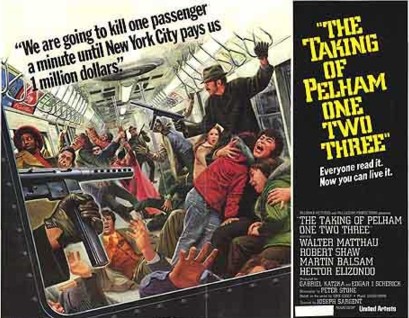
PERSONAL FAVES: The Taking of Pelham One Two Three

A comparison:

Tony Scott has made a lot of highly successful, glossy, superficial films ... and some notable ones, such as the sensuous and glossy vampire drama 'The Hunger', the energetic and profane (but still glossy) Tarantino-scripted 'True Romance', and the claustrophobically tense 'Crimson Tide', which isn't really glossy at all because it's set on a submarine and even Tony Scott would be hard pressed to make a submarine look glossy.

Joseph Sargent has made a bunch of stuff, predominantly for TV, that you've probably never heard of ... and 'The Taking of Pelham One Two Three'.
I mention this because Tony "more gloss than Dulux" Scott is currently remaking 'The Taking of Pelham One Two Three'*, a thriller about the hijacking of a New York subway train and the holding to ransom of its passengers. A few guesses about the remake:

It won't open with transit cop Zachery Garber grouchily escorting a group of Japanese visitors around the control centre, using their assumed lack of facility in the English language to be as sarcastic about his co-workers ("this is Lieutenant Petrone, on weekends he works for the Mafia") as he is about them ("this way, you monkeys"). This not being PC, like.

The hostages will actually have names, and not be bluntly referred to (and then only in the closing credits) as, variously, The Mother, The Hooker, The Pimp, The Old Man, The Alcoholic and The Homosexual. This not being PC, either.

The hijackers' ransom will be adjusted for inflation from the cool million demanded in the original.

The hijackers won't use colour-coded pseudonyms - Mr Blue, Mr Green, Mr Grey, Mr Brown - since this conceit is so ineffably associated in the popular movie-going consciousness with Tarantino's 'Reservoir Dogs', never mind that 'Pelham One Two Three' did it first.

I'll give Tony Scott the benefit of the doubt - the gloss of sarcasm earlier in this post notwithstanding - and wait till his 'Pelham' comes out (it's due next year) before I pontificate any further. For now, let's consider Joseph Sargent's 1974 original, adapted from the novel by John Godey - a film which has never quite achieved the status of classic, but which I think it richly deserves.

Opening with David Shire's poundingly unsubtle score - my partner, watching the film for the first time, wondered aloud whether she was in for a straight thriller or a spoof - Sargent wastes no time introducing his villains and establishing a milieu. This is New York in the 70s, as edgy and grimy as only American cinema of that decade could ever capture it. The subway is an unfriendly, offputting place; the people who travel it, a bustling amorphous mass. Into this environment - dressed similarly in long coats, hats, glasses and moustaches, carrying bulky parcels - come Mr Blue (Robert Shaw), Mr Green (Martin Balsam), Mr Grey (Hector Elizondo) and Mr Brown (Earl Hindman); the packages are opened; semi-automatic weapons appear; a pistol is pointed at the driver. Pelham One Two Three is taken.

Garber (Walter Matthau)'s comedy of embarrassments with the Japanese is soon eschewed in favour of incrementally ratched-up tension as Garber finds himself forced to liaise between the hijackers and the NYPD, themselves frantically awaiting approval from the Mayor's office to deliver the ransom. Mr Blue, coldly mercenary, stipulates an hour for delivery of the million, after which he promises to shoot one hostage per minute until his demands are met.

With the clock ticking and the Mayor (Lee Wallace) a bumbling incompetent, 'Pelham One Two Three' segues from hostage drama to race-against-time thriller. (This is one of the reasons I love the movie: it deftly avoids the inert, static nature of the hostage genre.) With approval - reluctantly - from City Hall to pay the ransom, Sargent then concentrates on the logistics of assembling one million dollars in used, non-sequentially numbered bank notes (as per Mr Blue's instructions) and the NYPD's attempt to transport it across town during wall-to-wall traffic. His attention to detail is as acute during these scenes as it was during the build-up to the hijack. Likewise the minutiae of the hijackers' plan to escape with the moolah.

And yet Sargent's attention to detail is never overly technical, nor does it slow things down. 'Pelham One Two Three' is a superbly paced film. Never mind that there aren't that many action scenes, the sheer sense of urgency propels the narrative. Performance-wise, an offbeat cast gels perfectly. Matthau brings just enough baggage from his more famous funnyman roles to make Garber a rumpled, sardonic, likeable character. Shaw is terse and no-nonsense as Blue. Balsam brings a nervous immediacy to the role of a former subway driver brought in by the hijackers for his technical knowledge. Elizondo commendably plays down what could have been an exercise in cliche as the almost obligatory loose cannon. Jerry Stiller (Ben's dad) is great value as the laconic Petrone.

Ultimately, there's just so much to like about 'Pelham One Two Three', not least the delightfully ironic coda wherein Garber and Petrone track down the remaining gang member. The final shot is priceless, and "Gesundheit" belongs in the pantheon of great last lines.


*Although I understand from IMDB that the title of Scott's version has been rendered 'The Taking of Pelham 123'. See what he did there?