Sunday, January 31, 2016
The Hateful Eight
In 1967, Roy Orbison starred in his one and only film: a lightweight and gimmicky western called ‘The Fastest Guitar Alive’. It wasn’t a successful endeavour for anyone concerned. Orbison wrote a passel of bland songs for the soundtrack, only one of which – ‘There Won’t Be Many Coming Home’ – had anything specific to say. The producers, concerned that it was too serious and not in keeping with the film’s lighthearted tone, removed it. Forty-eight years later, Orbison’s civil war ballad is restored to the soundtrack of a western. A Quentin Tarantino western. And if the producers of ‘The Fastest Guitar Alive’ thought it sounded too serious in that film, it comes off as downright flippant here. Tarantino’s use of the Orbison song is the final irony in a 70mm epic that spends three hours bristling with irony, righteous anger and the kind of wallowing self-indulgence that characterises its director's approach to filmmaking.
Now, regular readers of this irregularly updated blog (I tries, folks, I really does) will know that I’m a dyed-in-the-wool Tarantino fan. I can entirely appreciate why people don’t dig his work, and completely sympathise with those whom it renders decidedly uneasy. But, because of a number of interrelating vectors, from being blown away by ‘Reservoir Dogs’ at the impressionable age of twenty, to meeting the man himself two years later when he was guest of honour at the Broadway Cinema’s Shots in the Dark festival, the trajectory of my cinephilia has progressed in tandem with Tarantino’s career. He’s the only director whose entire filmography I’ve seen on the big screen.
So, yes: I likes me some Tarantino. I even like ‘Death Proof’. And I don't edge uneasily back from his work, convinced he’s a racist because his scripts use the N-word. No racist would gift such iconic parts to black actors. What I’m not sure about, however, is his attitude to women, and nowhere have I had such doubts than with ‘The Hateful Eight’. Reader, I’m going to come straight out with it: ‘The Hateful Eight’ is the first time I’ve come out of a Quentin Tarantino film not quite sure what to make of it.
It’s been about a week since I saw the film and the more I think about it, the more I’m tempted to narrow down my rationale to one of two options:
1) Tarantino, deciding that his usual critics will accuse him of racism anyway, structures a three-hour roadshow epic in such a way that his audience will be sent stumbling into the intermission in the immediate aftermath of an almost Shakespearian soliloquy, delivered in half-mocking-half-menacing fashion by Samuel L Jackson, the (ahem) thrust of which is the phrase “big black dingus”;
2) It’s a remake of ‘Reservoir Dogs’ disguised as a remake of John Carpenter’s ‘The Thing’ with Kurt Russell in the Kurt Russell role and a certain interchangeability between Jennifer Jason Leigh and Channing Tatum as regards the role of the thing.
Either way, it’s a film of two halves. The first documents the stormy stagecoach journey that brings bounty hunter John Ruth (Russell) and his shackled charge Daisy Domergue (Leigh) – the running joke about the mispronunciation of her surname is the script’s subtlest aspect – to Minnie’s Haberdashery en route to the town of Red Rock (aficionados of ‘Django Unchained’ won’t be surprised at the ‘Blazing Saddles’ homage). En route, Ruth reluctantly ends up giving a lift to fellow bounty hunter Major Marquis Warren (Jackson) and Red Rock’s sheriff-to-be Chris Mannix (Walton Goggins). Arriving at their stop, Ruth and Warren are suspicious that Minnie (Dana Gourrier) and her husband and business partner Sweet Dave (Gene Jones) are nowhere to be seen and the establishment has been left under the stewardship of taciturn Mexican Bob (Demian Bichir). Also at Minnie’s, seeking shelter from the storm, are dandy English hangman Oswaldo Mowbray (Tim Roth) – the proximity of the character’s name to notorious blackshirt Oswald Mosley cannot be coincidental – enigmatic cowboy Joe Gage (Michael Madsen) and doddery Confederate General Sandy Smithers (Bruce Dern). What follows is a series of variations on a theme, the theme being how downright fucking loathsome all of these individuals are in their own special way. Racism, snobbery, intransigence, intolerance and the deep social, political and geographical divisions created by the civil war all come to the fore. At one point, various parties suggest that the cabin itself be divided in two (I couldn’t help but think of the ‘Steptoe and Son’ episode where Albert and Harold reduce the family home to a microcosm of apartheid) as a temporary alternative to killing each other.
The second half is marked by at least two tonal shifts, the first of which is done to brilliant effect. The linear, classical storytelling of the first half goes out of the window, to be replaced with voiceover, flashbacks, shifting perspectives … basically, the whole non-linear playbook that Tarantino has delved into with zero restraint throughout his career. For approximately half an hour, ‘The Hateful Eight’ morphs into an Agatha Christie locked room mystery, with Warren in the Miss Marple role, if Miss Marple packed a pair of pistols and everyone in St Mary Mead used the word “nigger” like it was going out of style. This, for me, was easily the most focused part of the proceedings and I could happily have watched “Samuel L Jackson in a drawing room mystery with swearing and pistol whipping” for the rest of the movie; however Tarantino curtails this section with a short sharp shock of a rug pull, immediately seguing into an extended flashback that manages to be sweatily tense even though we all know, by this point, exactly how it’s going to play out.
Then we’re back to the present and the final act. Which is where the film seems to start juggling desperately – it’s a state of the nation piece; no wait, it’s an essay on how ideology deflates in the face of survivalism; no wait, it’s a variation on the theme of “my enemy’s enemy is my friend”; no wait, it’s a Corbucci checklist replete with amoral cynicism and violence against women; no wait, it’s an ugly ironic statement on how liberal hand-wringing for interracial tolerance is founded on the big self-delusion of the liberal hand-wringer wanting to feel better about themself – and never fully commits to a final statement. Maybe this is what Tarantino intended. Or maybe he just decided that America – and by extension the world – is fucked and the best we can do is laugh at the sheer absurdity of it while we pointlessly kill each other.
Whichever, this is Tarantino we’re talking about and the man couldn’t do existential despair if he binged on Bergman, Tarkovsky and Tarr for a year. And that’s what gives ‘The Hateful Eight’ its wilful perversity: never mind the unpleasant places it goes, Tarantino’s sheer exhilaration in the process of film-making is splattered across every frame like a valentine’s love heart made of blood squibs.
Wednesday, February 20, 2013
Django Unchained
Where the hell do you start with a review of ‘Django Unchained’?
Do you outright ’fess up that it’s not perfect, that there are some flaws, then shrug your shoulders during a paragraph break and spend the rest of the review blathering on about how much you enjoyed it anyway?
Do you start out by enthusing about the many things that Tarantino gets right, then slowly peel back a few critical layers, saving the nit-picking for last?
Do you mourn the untimely loss of Sally Menke, whose contribution to the cinema of Tarantino is thrown into acute context by the occasionally indecisive editing rhythms of ‘Django Unchained’ that you just know wouldn’t have been there if she’d been in the editing room?
What you don’t do is start throwing around words like “self-indulgent”, “homage” and “no original ideas”, because – damn it! – Tarantino’s is the cinema of the cineaste, a synthesis of all the movies that most of us will never get round to seeing, and there are plenty of us who wouldn’t have it any other way. Complaining about self-indulgence in a Tarantino film is like tutting over the horror in James Herbert novel. It’s kind of the fucking point.
And it’s for this reason that any and every Tarantino film births itself across the screen in the amniotic fluids of movie lore. Thus ‘Inglourious Basterds’ emerges as more than just a revisionist “bunch of guys on a mission” movie if you approach it with, say, some foreknowledge of the UFA protégés who fled Germany during the rise of Nazism. And ‘Django Unchained’ ticks a lot more boxes if you know your Sergio Leone from your Sergio Corbucci. The very title, and a cameo by Franco Nero, riff on Corbucci’s most celebrate spaghetti western.
While ‘Django Unchained’ is most firmly rooted in the spaghetti western tradition – it’s OTT, often nihilistically violent, and utterly divorced from the moral cadences of the more traditional American western – it has to be noted that whereas Tarantino adheres to the iconography of the genre, he doesn’t necessarily hold to its conventions. Granted, I’m all in favour of artists being unconventional, but the western is one of those genres that benefits from a more conventional aesthetic.
To use a sweeping – but, I hope, justified – generalisation, westerns tell essentially simple stories. Even films as thematically deep as Peckinpah’s ‘Ride the High Country’ and ‘The Wild Bunch’ or Eastwood’s ‘Unforgiven’ have simple narratives. The greatest westerns are distillations of theme and character: haiku in widescreen and with six-shooters. ‘Django Unchained’ is anything but narratively simple; anything but a distillation. The script is a circuitous affair that rambles into ever greater contrivances in order to thread a veritable posse of genre touchstones into something resembling an actual story.
These range from aforementioned spaghetti western maestros Leone and Corbucci to the blaxploitation ‘Nigger Charley’ films by way of Mel Brooks’s ‘Blazing Saddles’ and, uh, Richard Fleischer’s ‘Mandingo’. It’s this latter – a slice of overboiled Suth’un melodrama – that informs the second half of Tarantino’s film and calls for the largest quota of narrative convolutions. ‘Mandingo’ is a curious touchstone for Tarantino, since the film trades on the sweaty physical violence of bare-knuckle fighting correlated with the sweaty forbidden lure of interracial sex.
Central to ‘Mandingo’ is sex. Central to Tarantino’s ‘Mandingo’ homage is fighting. ‘Django Unchained’ is typical of all of Tarantino’s work in that it is a sexless work of cinema. For all that Django (Jamie Foxx)’s quest is to free his enslaved wife (Kerry Washington) from an outwardly charming but cruel and hypocritical plantation owner, every frame suggests the mindset of a director who is a hopeless (possibly unrequited) romantic – nowhere more explicitly than in the already divisive final scene – rather than the interactions of two characters who enjoy sexual intimacy.
On the plus side, though, ‘Django Unchained’ represents as well as anything in Tarantino’s filmography the two reasons I will always have time for him as a filmmaker: he cares – cares deeply – about dialogue and performance. The dialogue might not have the crackle and immediate quotability of ‘Reservoir Dogs’ or ‘Pulp Fiction’, but that’s only because Tarantino is writing in a different idiom. And when he’s writing for his big villain, Calvin Candie (Leonardo di Caprio), Tarantino fashions dialogue that captures the character’s suavity, venality and egoism and wraps it into a simultaneously seductive and repellent package. Di Caprio’s performance rises to the occasion. Elsewhere, Samuel L Jackson essays a complex and dangerous character in a turn that’s his best in years, while Christoph Waltz, as German dentist-turned-bounty-hunter Dr King Schulz, makes it two-for-two following his star-making turn in ‘Inglourious Basterds’. Foxx meanwhile is all moody cool, iconography in motion, his vengeful anti-hero growing in stature as the film progresses.
Best of all, the whole cast – including some left-of-field cameos (when was the last time you saw ‘Dukes of Hazard’ regular Tom Wopat in anything?) – are obviously in on the joke. Sure, ‘Django Unchained’ is wincingly violent in places, and Tarantino makes no bones that slavery was a fucking awful business, but there’s nothing to say that the heaviest and headiest subjects can’t be tackled provocatively and/or satirically. No pun intended, but I really can’t think of another way to put it: ‘Django Unchained’ works best as a black comedy.
Thursday, February 07, 2013
A tale of two controversies
In other words, if the next few paragraphs don’t seem like a fun night out at The Agitation of the Mind, please feel free to skip this entry and I’ll see you back here next week for the ‘Django Unchained’ review proper.
Spike Lee doesn’t like ‘Django Unchained’. Spike Lee doesn’t much like any Tarantino film, certainly since ‘Jackie Brown’. In fact, it’s pretty fair to say that Spike Lee doesn’t like Quentin Tarantino period. What riled Lee about ‘Jackie Brown’ was Tarantino’s wholesale use of what our PC and touchy-feely society dictates we should only refer to as “the N-word”. Lee felt that the degree to which it was used in a film written and directed by a white man was inappropriate. This argument is not without credence, but unfortunately it opens up a can of words as regards entitlement.
The rational let’s-all-be-grown-up-about-this approach should be that any artist should be able to tackle in subject in any manner which best serves the aesthetic imperative of the work. A film’s aesthetic can range from the utterly unrealistic flight of fantasy of, say, Powell and Pressburger’s ‘The Red Shoes’ to the unapologetically grim realism of Ken Loach’s ‘Ladybird Ladybird’. Both of these films use their aesthetic to make a statement; both succeed. ‘Jackie Brown’ is a crime film whose characters inhabit an economically depressed milieu with a specific ethic demographic. These characters are not going to address each other as if they’d just stepped out of a P.G. Wodehouse novel; they’re going to use the language of the street.
Tarantino attempted to address this element of his screenplay at the time ‘Jackie Brown’ was released, noting that he had used the n-i-g-g-a spelling and not n-i-g-g-e-r. This was perhaps a tad disingenuous given that the variant in spelling makes not one iota of difference to the pronunciation. This might have been the point at which his name got scratched from Spike Lee’s Christmas card list. It was par for the course, then, that Lee wouldn’t be appreciative of Tarantino making a film with about slavery. And not the kind of hand-wringing film that most white directors would turn in, full of liberal sentiments marinated in several gallons of white man’s guilt, but the kind of film that only Tarantino could make, full of gleefully over the top iconography, swathes of non-PC humour and the unique brand of day-glo anti-realism that has been his stock-in-trade since the comparative subtleties of ‘Jackie Brown’ went unrewarded at the box office. Which is to say, ‘Django Unchained’ is a movie movie.
We’re back to the whole “as long as the aesthetic serves the work” caveat, and I’m throwing open the comments section for that to get debated in. The main question is whether Tarantino, as a white director, had any right making a film about slavery. At which point, the question of logical extremes rears its exaggerated head. Where do you draw the line if you disallow Tarantino that right as an artist? Can only Jewish directors make films about the Holocaust? Do we call time on male novelists creating female protagonists? Should a documentarist making a feature about a musician desist if he or she cannot read music or play an instrument? Herzog’s ‘Into the Abyss’ – should the dude have gone out and whacked somebody before he sat down to talk to a convicted murderer?
The question leads ultimately to absurdity. Absurd, too, is the idea of Tarantino as a racist. What racist would repeatedly write iconic roles for black actors (Samuel L Jackson in ‘Pulp Fiction’, Pam Grier in ‘Jackie Brown’, Jamie Foxx in ‘Django Unchained’)? What racist would, in his choice of subject matter, his choice of soundtrack music and his pop culture references, continually demonstrate such a passion for black culture that, had he been alive during the period that his latest movie is set, he’d no doubt have been lynched as a “nigger lover”.
Naomi Wolf doesn’t like ‘Zero Dark Thirty’. In a piece in The Guardian, Wolf castigates Kathryn Bigelow for peddling propaganda in suggesting that “what your script blithely calls ‘the detainee programme’” (i.e. the wholesale torture, post-9/11 of anyone suspected of Al Qaeda involvement) yielded information that led directly to the location – and by extension the execution – of Osama bin Laden.
The most damning paragraph of Wolf’s article is worth quoting in full: “In a time of darkness in America, you are being feted by Hollywood, and hailed by major media. But to me, the path your career has now taken reminds of no one so much as that other female film pioneer who became, eventually, an apologist for evil: Leni Riefenstahl. Riefenstahl's 1935 ‘Triumph of the Will’, which glorified Nazi military power, was a massive hit in Germany. Riefenstahl was the first female film director to be hailed worldwide.”
Up to this point, it’s difficult to argue with Wolf’s article. She pulls apart the “based on eyewitness accounts” tag which opens the film, and draws comparison with Alex Gibney’s ‘Taxi to the Dark Side’ and Rory Kennedy’s ‘Ghosts of Abu Ghraib’ – both documentary films with sourced and verifiable content – as well as citing academically sound studies which demonstrate that torture is ineffective as a method of sourcing military/political intelligence, studies which “rebut the very premise of ‘Zero Dark Thirty’.”
But it’s with the Riefenstahl comparison that the article loses focus. It paints a picture of ‘Zero Dark Thirty’ as a film about crusading American intel operatives, God and morality on their side, doing whatever they have to do to get information. I was expecting something akin to Inspector Regan knocking a suspect about in your average episode of ‘The Sweeney’: we know the lairy little nonce has done it, we despise him for giving Jack Regan some lip, and if our favourite hard-boiled Flying Squad ’tec has to give him a slapping to get a confession, well the little bastard deserved it. Instead, the torture scenes in ‘Zero Dark Thirty’ – which commence almost immediately – are fucking awful to watch: a succession of beatings and humiliations that are squalid and inhuman.
Riefenstahl made Nazism look Wagnerian, depicting the architects of the Third Reich as almost god-like. Bigelow portrays the purveyors of the US response to terrorism as, essentially, a bunch of low-achievers harangued by their boss to “bring me people to kill”. The scene in question, all of them cowering as the bollocking is handed out, is reminiscent of Alec Baldwin’s “always be closing” speech in ‘Glengarry Glen Ross’ – it simultaneously communicates the pointlessness and the banal intensity of a bunch of small people being forced to up their game to secure a worthless result.
Oh, and the film makes no bones about how basically fucking illegal the whole bin Laden thing was. If ‘Zero Dark Thirty’ was intended, as Wolf implies, as a work of propaganda, it’s a total failure. Leni Riefenstahl would have laughed it out of the cinema. Goebbels would probably have had somebody shot.
Sunday, June 20, 2010
500th post
To celebrate, I’m opting for the lazy man’s guide to blogging and digging out (or at least linking back to) my ten favourite posts from the first age of Agitation. Original material will resume shortly.
1) Peckinpah as Prospero. I dedicated the whole of December ’09 to a celebration of Sam Peckinpah’s life and career, tying in with the 25th anniversary of his death. It proved the most well-received project I’ve undertaken on the blog and gave me the most satisfaction personally. I’m proud of every single article I posted during that month, but “Peckinpah as Prospero”, a distillation of the importance of Peckinpah’s cameo as Will the coffin-maker in ‘Pat Garrett and Billy the Kid’, stands out as the first (and thus far only) time I’ve abandoned the standard operating procedure of overall movie reviews and concentrated in specific detail on one crucial scene. This is the deepest I’ve ever engaged with a film.
3) Inglourious Basterds (a review in five chapters). The day Quentin Tarantino’s controversy-baiting war movie opened in the UK was my first wedding anniversary. We’d booked time off work; a restaurant table had been reserved. Ordinarily, I’d never have dreamed of dragging my better half to a war movie on such a day. But it was Quentin fuckin’ Tarantino! Luckily, Paula was more than receptive and loved the movie as much as I did. I knew then I’d married the right girl! I blogged a “first impressions” review that day and probably would have left it at that but for a fucktarded miss-the-point review in the New York Times that I just couldn’t leave unchallenged. The result, at 2,100 words, was the longest review I’d posted prior to the Peckinpah-fest getting underway.
4) Exorcist II: The Heretic. Last year, I dedicated a week to watching, researching and reviewing all five ‘Exorcist’ films. Since only one is a bona fide masterpiece, two are pretty decent (Blatty’s ‘Exorcist III’ and Schrader’s ‘Dominion’) and the other two are vile, heinous, filthy, poisoned, bilious, despicable and malicious acts of desecration upon cinema, this proved to be something of rollercoaster in terms of quality. It’s a tough call on which is the worst of the franchise, Boorman’s ‘Heretic’ or Harlin’s ‘Exorcist: the Beginning’. ‘Heretic’ probably wins out in terms of open-mouthed disbelief at just how bad it is – and how much pant-wettingly worse it gets. This review is far and away the most sarcastic piece of prose on the blog, challenged only by …
5) The Twlight Quartet: Romeo and Juliet, Bonnie and Clyde, Edward and Bella?!? The centerpiece of four articles I posted on consecutive days, royally ripping the piss out of Catherine Hardwicke’s fuck awful adaptation of Stephanie Meyer’s (allegedly; I haven’t read it) fuck-awful novel. It’s a review so snide that I interrupted myself parenthetically half way through to muse “I ought to abandon the mission statement of this blog and review more bad movies. I am just loving how much of a bitch I can be!”
6) Unforgiven. Clint Eastwood’s supreme work as actor and director. The best western since Sam Peckinpah passed on. This piece is the kind of straightforward appreciation I try to produce for Agitation as a matter of course.
7) The Prestige. I’ll be revisiting this one next month as part of the Christopher Nolan blog-a-thon being hosted by Bryce at Things That Don’t Suck between 11 and 18 July, but I’m still quite proud of my original piece on what remains one of my favourite films of the last decade. I’m most proud of the fact that I wrote a fairly in-depth review, discussing all of the reasons I love this tricksy and brilliantly constructed film, whilst delicately manoeuvring around the lacunae with nary a whisper of a plot spoiler. As I noted in the article, “to get into a really interesting discussion of the film … I'd have to give away an audacious, jaw-dropping triple-whammy ending (I've spoken to some people who think it's a double-whammy ending; it's entirely possible it's a quadruple-whammy ending - like much of the film, it's up to the viewer to figure it out) … and I want everyone who watches 'The Prestige' to be as blown away as I was by it.”
8) The Wages of Fear. Like ‘Where Eagles Dare’, ‘Unforgiven’ and ‘The Prestige’, this was written as part of the Personal Faves project. Mostly I talk about the films I’m considering in terms of the direction, the performances, the iconography, etc. – based, of course, entirely on my opinion; other times, I link my articles in to a personal recollection triggered by or involving the film. In other words, a lot of what I write is as much about me as it is about the movies. This is one of those rare pieces that is driven by the atmosphere of the film. Clouzot’s cynical thriller is as black-hearted as it is white-knuckle. I’d like to think this article captures why.
9) Grindhouse. Another article I owe to Stacie at Final Girl. For those of you not in the know, Stacie hosts a semi-regular film club. She selects a film, sets a date and the good and the great of the blogosphere contribute articles on said movie. In January ’09, she picked the Quentin Tarantino/Robert Rodriguez collaboration ‘Grindhouse’. One problem: ‘Grindhouse’ had never been released in the UK. Not in its intended format, anyway. The distributors saw fit to release and extended (almost two hour) cut of ‘Death Proof’; there was rumour that ‘Planet Terror’ would go direct to DVD. It eventually got a theatrical release, several months after ‘Death Proof’ had done the rounds. However, thanks to the Region 1 DVD of ‘Planet Terror’ and a bit of surfing for the spoof trailers on the net, I managed to create my own ‘Grindhouse’ experience. I would still dearly love a release on DVD of the film QT and RR intended.
10) The Day of the Jackal. Have you ever written a piece you’ve been inordinately pleased with? You’ve crafted some decent turns of phrase, struck a conversational tone, achieved a nice line in droll humour. You post it on your blog, feeling quite satisfied. Check back the next day for any comments. Check back again. And again. Absolutely bloody nothing. Granted, in the early days of this blog it was a big deal to get just one comment (whole swathes of posts went by without any response) and I didn’t start Agitation with the sole intention of getting lots of hits and being uber-popular. (I’m reminded of a cartoon I saw depicting a little kid sitting on the knee of a department store Santa; Santa asks what he’d like for Christmas; the kid replies, “I want an X-box and an iPod and fifty comments a day on my blog.”) But I digress. The point is: my ‘Day of the Jackal’ review, posted as part of last year’s Shots on the Blog crime festival, fits the old saw of all my articles being like my children; I love them all, even the unpopular ones that don’t fit in and get bullied by the other kids and stay in their room listening to heavy metal and reading back issues of “Guns ‘n’ Ammo”. Hell, I probably love those kind of articles even more and for precisely that reason.Sunday, August 23, 2009
Inglourious Basterds (a review in five chapters)
Once upon a time ... in the New York Times
There's a review of 'Inglourious Basterds' in the New York Times - an organ normally dependable for its film criticism - which not only misses the point by a country mile, but in its last line writes off the very concept of the anti-hero as a valid fictive creation. This is what reviewer Manohla Dargis has to say:
"The film's most egregrious failure [is] its giddy, at times gleeful embrace and narrative elevation of the seductive Nazi villain ... Unlike those in 'Schindler's List', Mr Tarantino's Nazis exist in an insistently fictional cinematic space where heroes and villains converge amid a welter of movie allusions ... 'Inglourious Basterds' is simply another testament to his movie love. The problem is that by making the star attraction of his latest film a most delightful Nazi, one whose smooth talk is presented as lovingly as his murderous violence, Mr Tarantino has polluted that love."
Firstly, 'Schindler's List' exists in a cinematic space every bit as "insistently fictional" as that of 'Inglourious Basterds' - it's in black and white; much of its visual style is non-naturalistic; ash from crematorium chimneys falls as gently and lovingly as snow - so the comparison doesn't hold water. Secondly, Dargis argues that Christoph Waltz's SS Colonel Hans Landa is the best thing about the film simply because he gives the best performance. Ralph Fiennes's is similarly the best performance in 'Schindler's List'; Dargis's argument is further weakened. Thirdly, why does a "gleeful embrace and narrative elevation" of a Nazi character perforce constitute a flaw in a film's aesthetic? I've always found Paul Scofield's erudite von Waldheim far more appealing than Burt Lancaster's monosyllabic Labiche in John Frankenheimer's 'The Train' - and this dynamic, if anything, makes the film even more interesting. (See also: 'Cross of Iron': German protagonist, excellent film. And where does Dargis's argument leave the "good German" in, say, Powell and Pressburger's '49th Parallel' or 'The Life and Death of Colonel Blimp'?) Fourthly, criticising Tarantino for creating his vision of cinema within a deliberately fictive space is as facile as slating a Bollywood film for being three hours long and containing a bunch of song and dance numbers. It's little more than an admission that Dargis doesn't like a certain style of film-making, only dressed up in the kind of cheap point-scoring that there should be no place for in the New York Times.
Also, Dargis seems to imply that premeditated empathy with a villainous character - ie. the writer and/or director specifically setting out to make an anti-hero not only palatable but laudable to the audience - is reprehensible. Excuse me? Some of the greatest characters in both classical literature and pop culture and at all points inbetween are anti-heroes. From Hamlet to Hannibal Lecter, from King Lear to Freddy Krueger. Everyone loves an anti-hero. It's the thrill of a character doing and saying the things we could never do or say - things, frankly, that we wouldn't want to do or say. It's the delightful frisson of a character whose moral disconnect imbues them with a fascinating unpredictability; a character who could quite literally do anything.

Chapter two:
Glorious basterds
And while I'm kicking against mainstream film critics, can I just say that I don't understand why so many critics still carp about violence in Tarantino's work. Sure, everything he's done contains scenes of violence, but I'd argue no more so than most tentpole summer blockbusters. While, say, your average Michael Bay film doesn't feature scalpings (how would Transformers scalp each other? "each one of you Autobots owes me one hundred Decepticon pistons ... and I want my pistons!") it buys wholly into an aesthetic of violence - explosions, shoot outs, cars flipping over and smashing into other cars at high speeds - which leaves you in no doubt that sheer, unmitigated destruction is Bay's raison d'etre. Tarantino, however, is more interested in the build up, the tension, the dialogue and character dynamics.
When action or violence happens in a Tarantino movie, it erupts suddenly and is over quickly. There is, per capita, very little onscreen violence in his work. The first chapter of 'Inglourious Basterds' is a clammily tense interrogation by Landa of a French farmer harbouring a Jewish family. It quickly becomes apparent that Landa knows full well the family are there and where they are hidden; he's simply toying with the man. The scene is intense and gripping, punctuated by an inspired mine's-bigger-than-yours visual joke, and what makes it work is not the thirty seconds of gunfire it culminates in but the twenty minutes of dialogue that build up to it. Landa arranging his pen and pot of ink on a table carries far more weight than the machine guns slung over his men's shoulders.
It follows, then, that any director who places more importance on words than action - and how refreshing is that in contemporary American cinema? - must needs be an actor's director. And this is where I still don't think Tarantino gets his dues. Love or loathe the deliberate movieness of his movies, the man gets fucking great performances from his actors. 'Pulp Fiction' made Samuel L Jackson and resurrected John Travolta. Pam Grier and Robert Forster in 'Jackie Brown' - we're talking about finest hours. Uma Thurman's never been as good outside Tarantino's cinema. And now in 'Inglourious Basterds' we have a bravura, multi-faceted performance from Christoph Waltz, vacillating between charm, cruelty and - daringly in the finale - a touch of high camp. It's full-throttle and hugely memorable. But so is Diane Kruger's irresistible diva-like turn as Brigitte von Hammersmarck, the dahling of the German film industry.
Melanie Laurent's character Shoshanna (the only survivor of Landa's first chapter massacre) is almost overwhelmed by Waltz and Kruger, but she's never less than the true main character of the film, and evinces a quiet determination underscored by a melancholic sense of vulnerability. That she understates just emphasises the importance of her character. Michael Fassbender comes within a plummy vowel of stealing the show as Lt Archie Hickox, a British officer despatched to assist the Basterds and make contact with Brigitte (a double agent) in a mission to assassinate the Nazi chiefs of staff. Bouncing off an audaciously cast Mike Myers (as fellow Brit, General Ed Fenech), Fassbender takes up the mantle of George Sanders and gives us a smooth, unpeturbable Brit (his staring-death-in-the-face speech about there being "a special place in hell reserved for people who waste good Scotch whisky" is priceless).
Elsewhere, as the Basterds, Brad Pitt is a scream as hillbilly platoon leader Lt Aldo Raine, drawling his cod-philosophical down-home dialogue with relish; Til Schweiger as the only German member of the outfit, officer-hating Hugo Stiglitz, gives a breakout performance comparable to Waltz's; B.J. Novak makes the most of a bit of comic relief when Landa taunts him that his nickname amongst German soldiers is "the Little Man"; and only Eli Roth seems ill-at-ease as baseball bat wielding Sgt Donowitz.

Chapter three:
European night in Tarantino-land
Because Tarantino's movies are movie movies, references to other films come thick and fast. Since the 'Kill Bill' opuses, his soundtracks have been culled from existing movie music. Character names reference favourite actors (Aldo Raine is a nod to Aldo Ray; Hugo Stiglitz to ... well, Hugo Stiglitz). Movie posters, characters talking about movies, and clips from movies are part of the fabric of a Tarantino film. Prior to 'Inglourious Basterds', he revealed a very '70s aesthetic, culminating in his and Robert Rodriguez's homage to the era of exploitation movie drive-in double bills, 'Grindhouse'.
'Inglourious Basterds' throws open the doors of Tarantino's movie love wider than ever before - and none of it, as Manohla Dargis would have you believe, is polluted. Tarantino - knowledgably and contextually - incorporates the work of Leni Riefenstahl, G.W. Pabst and Paul Martin. The latter's 'Gluckskinder', a loose 1936 remake of 'It Happened One Night', is referenced during the first meeting between Shoshanna, now running a cinema under an assumed identity, and Frederick Zoller (Daniel Bruhl), a Nazi sniper heralded as a hero of the nation. Smitten by Shoshanna, he wants her cinema to host the premiere of a propagandist film based on his exploits in which he plays himself.
Zoller proves one of the most slippery characters in the film, charming to the point of being self-effacing, almost sickened by the cinematic representation of his prowess as a marksman, yet still capable of ruthlessness and a threat to Shoshanna despite his feelings for her. Bruhl, impressive in everything I've seen him in since 'Good Bye Lenin!', does more good work here.
An interview with Tarantino at Sunset Gun goes into fascinating detail on the power Goebbels wielded in German film production during the Third Reich. Tarantino pertinently makes the point that many of the propaganda films produced (a staggering 800 titles during Goebbels' tenure) were comedies or historical epics. Parallels can be made, messages got across, without hammering the audience over the head in a blunt and obvious fashion. America and Britain made their fair share of propaganda films, too, many of them - including Powell and Pressburger's first eight collaborations - emerging as bona fide works of art.
Friday, August 21, 2009
Inglourious Basterds (first thoughts)
It's me and Paula's first wedding anniversary today, and what more romantic a way to mark the occasion that an afternoon showing of 'Inglourious Basterds', Quentin Tarantino's alternative, subversive, brutal and often funny as fuck war movie?(We're out for a meal shortly, so I've only got a few minutes to blog a quick hit-and-run immediate thoughts type review. Expect a more considered article in the next few days. Oh, and I know I said August was foreign movies month on The Agitation of the Mind, but half of 'Inglourious Basterds' is in French or German and subtitled, so it kind of counts.)
*Broadly speaking, "I need me eight men ... we're gonna kill Nazis" doesn't really constitute a mission. It's more like, you know, a mission statement.
Saturday, March 21, 2009
PERSONAL FAVES: From Dusk Till Dawn
There’s a scene in Alfonso Cuaròn’s ‘Y Tu Mamá También’ – a masterly paeon to homo-eroticism, political incorrectness and the older woman – in which the horny teenage protagonists, left to their own devices after their girlfriends jet off on an exchange holiday, pass the time by engaging in some wholesome outdoor activity. Such as lying on the diving boards of a deserted country club swimming pool, eyes closed, hands in their trousers, vigorously polishing the lighthouse as they fantasise about their favourite actresses. One of them invokes the name of that Mexican goddess in human form, Salma Hayek, and both are spurred on to greater feats of onanism.I’m willing to bet the gentlemen in question were thinking of the snake dance scene in ‘From Dusk Till Dawn’.
Directed by Robert Rodriguez from a script by Quentin Tarantino blah blah crims on the run blah blah kidnap a family and cross the border in their RV blah blah Titty Twister blah blah Cheech Marin’s hilarious and definitely NSFW “pussy” speech blah blah wait for their contact blah blah packed with bikers and mariachi musicians blah blah sudden lurch into horror film territory blah blah small group of survivors blah blah and did I mention that there’s this showstopping scene where Salma Hayek does a snake dance?
Sorry. I was eager to cut to the chase there. I’ll try to make amends by at least pretending to write a proper, considered article on the film. The key scene in ‘From Dusk Till Dawn’ occurs exactly at the halfway mark. Thus far, script and direction have kept audience sensibilities firmly within an immediately recognisable genre – the crime thriller. There has been shooting, explosions, hostage taking, kidnapping, the evasion of authorities and a tense border crossing. Then the protagonists – brothers in crime Seth and Ritchie (George Clooney and Quentin Tarantino), and hostage family Jacob (Harvey Keitel), Kate (Juliette Lewis) and Scott (Ernest Liu) – make an ill-advised stop at a lawless roadhouse.
It’s here that a Tex-Mex band are laying down some sleazy tunes while topless go-go dancers gyrate. (Last night I was writing about ‘The Insider’ and musing that “Mann conjures images that are haunting, sometimes surreal … and effortlessly poetic”; twenty-four hours down the line as it’s topless go-go dancers gyrating. God, I love blogging!) The lights go down, a hush falls over the rough-neck crowd. The leader of the mariachis announces the next act: the cryptically named Santanico Pandemonium. It’s Salma time!
Oh shit, I was trying to keep this reasonably intelligent. I was going to compare the scene to Rita Hayworth’s vampish burlesque number in ‘Gilda’ and Michelle Pfeiffer’s seductive rendition of “Makin’ Whoopee” in ‘The Fabulous Baker Boys’. I was going to highlight how the narrative is put on hold so the female protagonist can (literally) take centre stage, the piffling concerns of plot and dialogue held in stasis; subjugated to the heroine’s sensual self-expression. I was going to expand on this point and write about the destructive force of the uninhibited sexuality on display – how both ‘Gilda’ and ‘The Fabulous Baker Boys’ progress from these sequences into examinations of jealousy and fractured relationships. I was going to wind up this scholarly digression by demonstrating how ‘From Dusk Till Dawn’ takes things one step further: not only does the smouldering sexuality of Santanico’s dance herald destruction and filial separation (I was going to slip in a clever little parenthetical reference to the Baker boys being brothers as well), it also sends the film spinning off into a completely different narrative and a completely different genre as Santanico morphs into a vampire and one of the sexiest women ever to grace the big screen suddenly turns into something very fucking freaky.
But then I thought, why bother? Film is not analysis it is the agitation of the mind. And ‘From Dusk Till Dawn’ doesn’t invite analysis; it invites some mates round and lays on a pizza and a six-pack. It’s a B-movie to the nines and that’s how it should be enjoyed. It’s got gorgeous George being a badass. It’s got Harvey Keitel as a preacher who turns into a vampire-killing “mean mmmm-mmmm servant of God”. It’s got FX meister Tom Savini as a character called Sex Machine who’s got a six-shooter in a codpiece! It’s got Fred Williamson growling “I was in ’Nam.” It’s one hundred minutes of balls to the wall sick twisted fun, all wrapped up in a kick-ass soundtrack.
And it’s got Salma Hayek. Doing a snake dance.
(I may be sleeping on the couch tonight.)
Monday, January 05, 2009
THE FINAL GIRL FILM CLUB: Grindhouse
That’s how excited I was.
Tim at Antagony & Ecstacy reviewed it under the pullquote ‘The Movie I Was Put on This Earth to See’, and I was almost wetting myself.
And. Then. Something. Happened.
‘Grindhouse’ underperformed at the American box office. I started hearing dispiriting rumours: the film was being split in two for its European release; ‘Death Proof’ would come out first; there was no confirmed UK release date for ‘Planet Terror’. There was a big question mark over whether the spoof trailers would be released theatrically.
I. Was. Not. Happy.

I’ll admit it here and now: I was looking forward more to ‘Planet Terror’ than ‘Death Proof’, having been monstrously underwhelmed by ‘Kill Bill Vol. II’ (another Tarantino opus that got released in two parts, with a six month wait after the blistering first instalment with its iconic “House of Blue Leaves” set-piece).
Sure enough, the handful of lobby posters I’d seen for ‘Grindhouse’ quietly disappeared, to be replaced by ‘Death Proof’ posters. Frequent IMDb visits seemed to confirm that there was still no release date for ‘Planet Terror’. In the meantime, I’d tracked down the spoof trailers online and bookmarked them.
A week before ‘Death Proof’ opened, I got hold of ‘Planet Terror’ on Region 1 DVD, featuring the ‘Machete’ trailer (my personal favourite of the four spoofs). Me and Paula decided to have our own, cobbled together ‘Grindhouse’ experience: we watched ‘Planet Terror’ on DVD in the morning (including ‘Machete’), fired up the computer and watched the ‘Don’t’, ‘Thanksgiving’ and ‘Werewolf Women of the SS’ trailers, then went to the cinema and watched ‘Death Proof’ on the big screen in the afternoon.
It doesn’t quite equate to taking your seat in the cinema, watching two 90-minuters (each complete with ‘missing reel’) back to back, interspersed with the spoof trailers – ie. three and a half hours of moviegoing designed as an affectionate, often ironic but ultimately down and dirty throwback to the grubby joys of the exploitation B-movie double bill.
The point of those 70s double-bills was that you saw them in a cinema. Usually a dingy fleapit where the seats were dimpled with cigarette burns, smoke was still hanging in the air courtesy of the audience at the earlier screening, your shoes adhered to the floor thanks to a combination of melted ice cream, popcorn and spilled Ki-ora, and the films were interrupted at least a couple of times during the screening due to technical problems with the projector.
In order to recreate the experience, ‘Planet Terror’ and ‘Death Proof’ – the former more authentically – are scratched and distressed and jump about a lot, simulating hamfisted splicing, and in the case of ‘Planet Terror’ the film seems to bubble up and burn into white nothingness.
Seen on DVD, you think “hmmm, that’s quite a convincing effect”. Seen on a computer, the spoof trailers are quite obviously that: spoofs. You find yourself picking hairs. Both ‘Thanksgiving’ and ‘Werewolf Women of the SS’, as sleazily inspired as they are, are billed as “a film by Eli Roth” and “a film by Rob Zombie” respectively, the latter trumpeting a big star name (Nicolas Cage) – but no zero-budgeted exploitation flick would be thus advertised. Edgar Wright’s ‘Don’t’ hits the mark as acutely as ‘Machete’, though, delivering a minute’s worth of stalk ‘n’ slash highlights while the voiceover drones monotonously “Don’t … don’t … don’t … don’t.”
Still, all of these component parts were meant to be taken together, as a three and a half hour whole … and were meant to be seen at the cinema. Instead, we got expanded cuts of ‘Planet Terror’ and ‘Death Proof’, the former now clocking in 1 hour 45 minutes, and Tarantino’s opus pushing the two hour mark, again pushing the films another step away from their original aesthetic.

The damage done to both films is that you view them as separate entities, which leads to pointless exercises in critical approach whereby you try to reconcile the more authentic ‘look’ of ‘Planet Terror’ with the post-modern ironic playfulness of ‘Death Proof’ instead of thinking “zombie movie – cool; car chase movie – cool”. Or ruminating on the promise of the erotic given the plethora of eye candy (two quartets of heroines in ‘Death Proof’; cleavages a-go-go courtesy of Rose McGowan, Marley Shelton and Stacy Ferguson in ‘Planet Terror') and the non-inclusion of actual nudity (want topless women? the ‘Machete’ trailer’s the only place you’ll find ’em) and coming to the conclusion that an implied salaciousness : disappointment ratio is par for the course in exploitation movies and Rodriguez and Tarantino have played on this most effectively … when you should, of course, be thinking “wow, hot chicks”.
Tim comments, in his brilliantly written review, “the structural vulernability of Grindhouse makes it the same as those things it mimics, even while the very soul of Grindhouse is that, as a mimic, it is not the same thing. Therefore, the film becomes both thesis and antithesis”, and he’s absolutely right. To discuss structure is perhaps the most intelligent way to approach ‘Grindhouse’ critically. Otherwise, as just as valid, you can simply kick back with a big tub of popcorn, turn off your critical faculties and let your mind go “zombies, cool … wow, Rose McGowan’s a fox … machine gun leg … shoot-outs, cool … stuff blowing up … fast cars, cool … wow, Vanessa Ferlito’s a fox … Kurt Russell being a badass, cool … wow, how long’s this car chase gone on for? …” and so on and so forth.
They’ve been constructed deliberately – and a lot more cleverly than a first viewing might lead you to believe – but the component parts of ‘Grindhouse’ are quite simply a hymn to the gleeful pleasures of moviegoing in an age where hot chicks, fast cars, cheesy special effects and 90-minutes of low-budget mayhem were their own raison d’etre.
Comparing and contrasting the films is a redundant exercise. The distributors, by splitting ‘Grindhouse’ in two, have left the likes of your humble blogger here with no choice other than to do just that. I was even tempted to use this post as a prologue to articles on ‘Planet Terror’ and ‘Death Proof’ over the next two evenings.
But I won’t because I’m convinced that if I ever get to see ‘Grindhouse’ in the format Messrs Rodriguez and Tarantino intended me to, then I’ll have seen a masterpiece of post-modern throwback indulgent irony. Yup, I know those last four words seem like a quadrille of contradiction but I reckon the movie that underperformed in America and never made it to the UK has what it takes to synthesise them; and until ‘Grindhouse’ gets released in this country in its original format (preferably in a theatrical run), or until I can get my hands on a Region 1 DVD, it will have to remain the best movie I’ve almost seen.
Tuesday, April 29, 2008
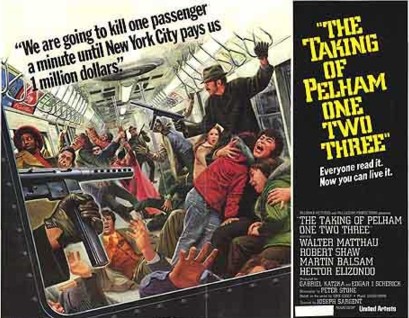
PERSONAL FAVES: The Taking of Pelham One Two Three
A comparison:*Although I understand from IMDB that the title of Scott's version has been rendered 'The Taking of Pelham 123'. See what he did there?