Saturday, March 14, 2015
Pat Garrett and Billy the Kid
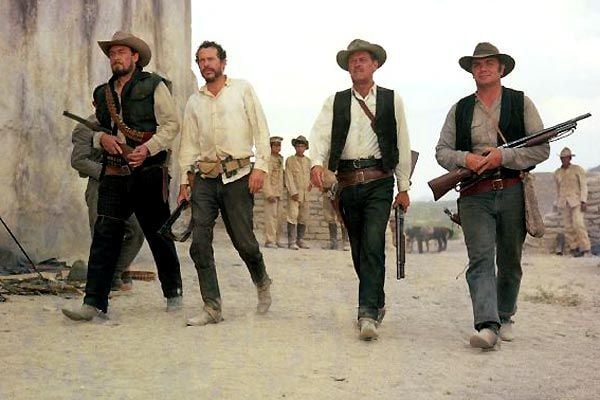
It’s difficult to write about ‘Pat Garrett and Billy the Kid’ without the retrospective fact that it was Sam Peckinpah’s last western throwing an almighty shadow over the proceedings. So much of it seems autumnal: Sheriff Baker (Slim Pickens)’s slow, agonising, strangely poetic death scene, scored to Bob Dylan’s ‘Knockin’ on Heaven’s Door’; Pat Garrett (James Coburn)’s foot-draggingly protracted odyssey in search of an outlaw he’d rather not apprehend, the already grizzled lawman seeming, in each successive scene, older and more weighed down not just with a sense of inevitability but a foreshadowing of how history will judge him; Billy (Kris Kristofferson)’s downward spiral from his myth-making act of showboating to an entire township during his escape from Lincoln County Jail to his dissipated solitary last bout of drinking as a dust storm swirls about him in the rundown enclave of Old Fort Sumner while Garrett’s odyssey draws inexorably towards its close.
So much of it seems tired: Garrett’s weary pauses between words (“the electorate … want you gone … out of the country”), each pause like a Harold Pinter play on Mogadon, entire worlds of reflection and self-accusation hanging on the ellipses; Baker reluctantly pinning his badge on as he goes to what will be his death; the sense of inevitability to the outcome of the duel between Alamosa Bill (Jack Elam) and Billy the Kid (both men cheat: the Kid cheats more effectively); the whiskery old forty-niner (Elisha Cook Jnr), whom Garrett’s de facto deputy John Poe (John Beck) mercilessly brutalises, reeling off a litany of things he’s tired of.
So much of it seems like a psychological self-portrait by its director: a meandering, woozy, often melancholy and sometimes frenziedly angry film that, in its most naked and agonising moments, turns against itself - pace Garrett catching himself in the mirror after shooting the Kid and turning his gun on his own reflection – in what almost seems like self-defeat.
And so much of it is pure Peckinpah. Sometimes organically so and in a good way: the children playing on a noose, much to the approbation of Bible-bashing deputy Bob Olinger (R.G. Armstrong), is reminiscent of the children giggling over the battalion of red ants that overrun the scorpion in the opening credits sequence of ‘The Wild Bunch’ (images of children bearing witness to the corruption of adulthood can be found in virtually every film Peckinpah directed). And sometimes in a forced, self-conscious manner: a minor character suddenly launching into ‘When the Roll is Called Up Yonder’ couldn’t telegraph the reference to ‘Ride the High Country’ more obviously if he’d worn a signboard; Garrett’s dalliance with a troupe of whores feels like it should occupy the same thematic territory as Pike Bishop (William Holden)’s moment of abject self-disgust towards the end of ‘The Wild Bunch’, but instead comes across as gratuitous and just plain absurd.
Perhaps one of the reasons why ‘Pat Garrett and Billy the Kid’ is both quintessentially a Peckinpah western and a sad (and slightly weird) leave-taking from the genre is the way it simultaneously corresponds to his grand overarching aesthetic (men outliving their times) and succumbs to pessimism in offering no magnificent rejection of, or rebellion against, it. In ‘Ride the High Country’, Steve Judd (Joel McCrea) and Gil Westrum (Randolph Scott) are ageing men, one trying to remain honourable, the other living on his wits and trusting to a younger counterpart, both of them challenged by a new and viciously amoral breed of desperados (personified by the Hammond brothers). In ‘The Wild Bunch’, Pike Bishop’s group of outlaws are overtaken by history in the early years of the twentieth century, the First World War visible on the horizon while the bunch are still trying to make “one big score” as if it’s still 1880. The eponymous saddle tramp in ‘The Ballad of Cable Hogue’ makes an unexpected grab at the brass ring with a roadhouse on a stagecoach route only for the internal combustion engine to show up and ruin everything for him on every conceivable level.
But whereas Hogue is offered a lyrical, even somewhat satirical, götterdammerung, and Bishop’s bunch – having weathered internal tensions that almost tear them apart – are finally reconciled and take their long walk to celluloid immortality functioning as a tight and cohesive unit, Pat and Billy are antagonists throughout, never mind what kinship they might have shared at some distant point in the past. Even Judd and Westrum – Pat and Billy’s closest analogue in Peckinpah’s filmography – present a startling contrast. Judd is upright and moral, wanting to “enter his house justified”; Garrett is an ill-tempered man of violence who screws around with hookers behind his wife’s back. Westrum’s villainy is rueful; the Kid’s cold-blooded. (Westrum would never dispatch a man with a bullet to the back as Billy does J.W. Bell.) And finally Judd and Westrum are reconciled – as purposefully as the bunch are reconciled – and when they stride out for the iconic finale they are undoubtedly heroic.
There is no heroism in ‘Pat Garrett and Billy the Kid’. None whatsoever.
The Kid outlives his time when Garrett becomes sheriff of Lincoln County. Garrett tries to change with the times but can’t reconcile himself to the choice he’s made. Unlike Peckinpah’s other western protagonists, neither of them take a stand against the changing times. The Kid seals his own fate in returning to Fort Sumner, a decision occasioned by a vengeful imperative that’s almost immediately abandoned; indeed, when Garrett catches up with him, the Kid has done nothing more than sit around and wait for his executioner. Garrett seals his when he summarily pisses off various authority/political figures – Holland (Jack Dodson) and Norris (John Davis Chandler), associates of Governor Wallace (Jason Robards); and cattle baron John Chisum (Barry Sullivan) – and inadvertently sows the seeds of his own destruction: a political conspiracy that will, two decades after the death of the Kid, result in Garrett’s own assassination.
The death of Sheriff Baker remains film’s most famous scene. It’s occasioned by a visit to Black Harris (L.Q. Jones), who greets Garrett and Baker with a fusillade of bullets and refuses to give up the Kid even when Garrett gets the drop on him. During the shoot-out, in a moment that’s damn near overshadowed by the poignancy of Baker’s demise, Harris tells Garret, “Us old boys oughtn’t be doing this to each other.”
Hum ‘Knockin’ on Heaven’s Door’ all you like, quote the “Times have changed”/”Times maybe, but no me” exchange till you’re blue in the face, but Black Harris’s jeering accusation summarises everything you need to know about ‘Pat Garrett and Billy the Kid’. Sam Peckinpah’s final western.
Saturday, August 31, 2013
Pat Garrett and Billy the Kid

There's probably an entire article that can be written about the opening credits sequence. Events in Las Cruces, 1909 (Poe's betrayal of Garrett) and Fort Sumner, 1881 (Garrett's reunion with the Kid a week before he takes the post of sheriff, ie. just prior to his betrayal of Billy) are intercut. When Garrett rides into Fort Sumner, he finds the Kid and his minions amusing themselves shooting the heads off a bunch of chickens buried up to their necks in the dirt. At Las Cruces, Poe's henchman mumbles something about checking a harness, instead pulling a rifle from a saddle roll; another gunman crawls through the sagebrush, ready to take up his position. The shots that follow cut between target practice and cold-blooded murder. Billy's men blast the heads of chickens; Poe's open fire on Garrett. Timeframes overlap. So does the soundtrack. "Damn near perfect," one of Billy's acolytes declares, apropos of a summarily despatched chicken ... but the words echo as Garrett takes a shot and slumps to the ground. Peckinpah's use of editing ramps up the emotional impact of the sequence: a potshot Billy takes at a chicken seems to travel through time and strike Garrett; purposefully aimed coups de grace by Poe's men result in the heads being blasted off helpless fowl.
Peckinpah's signature freeze frames are used as bluntly and brilliant as in 'The Wild Bunch'. As Garrett struggles to rise from the dusty ground only to sink back defeatedly, Peckinpah isolates the moment. He uses this image to accompany the film's title. He arrives at his "directed by" credit in equally iconoclastic fashion. The 1909 prologue documenting Garrett's death throes gives out the 1881 Fort Sumner sequence, and a very much alive - and younger (though still notably middle-aged) Garrett comes riding into town. Billy the gang don't notice him, so busy are they decimating the local feathered populace. Hopping off his horse, he hefts his rifle and, while Billy's still aiming, sights on a chicken and blows its head off. Billy's boys go diving for cover, panic written on their faces. Billy turns round, slowly and wryly, and greets his old friend with a grin. Some spiky banter ensues (it's clear some of the Kid's hangers-on aren't too happy to see Garrett), then the two of them head off to the bar for a couple of shots of whisky and the business at hand:
Billy: If that's what you're here for.
Garrett: The electorate want you gone. Out of the country.
Billy: Well, are they tellin' me or are they askin' me?.
Garrett: I'm askin' you. But in five days I'm makin' you, when I take over as sheriff of the county.

Oh yes, Garrett is the first (and last) of Peckinpah's western protagonists to break with the tradition of Steve Judd, Pike Bishop and co. and Cable Hogue. This is perhaps the most significant element of the dynamic/antagonism between Garrett and Billy - it's summed up during their conversation just after the opening credits:
Garrett: It feels like times have changed.
Billy: Times maybe, but not me.
Wallace: We're offering a reward of one thousand dollars for the Kid's capture. You can have five hundred now.
Garrett: Well, I aim to bring the Kid in. But until I do, you'd better take your five hundred dollars and shove it up your ass and set fire to it.
Peckinpah has more time for Deputies Bell (Matt Clark) and Ollinger (R.G. Armstrong), the latter completing the triumvirate of fanatical religious types the actor specialised in (following on from Knudsen in 'Ride the High Country' and Dahlstrom in 'Major Dundee'. Both are in the way when Billy liberates himself from Lincoln Country jail. Kristofferson's characterisation of Billy melds ruefulness and cold determination when he comes up against Bell. It's a different story with Ollinger. The two men have already entered into a spirited disagreement over spiritual matters, Ollinger committed to making sure Billy "gets with god" ("I'll take you for a walk across Hell on a spiderweb") and Billy responding to Ollinger's pious "On your knees" with a pithy "Kiss my ass". Billy's summary dispatching of Ollinger burns with the visceral and iconic intensity that fuelled Peckinpah's reputation as "Bloody Sam".
Peckinpah has more time for Sheriff Baker (Slim Pickens) and Black Harris (L.Q. Jones), whose exchange of fire after Garrett co-opts the former to help in smoking out the latter results in Baker's agonisingly slow passing, stumbling down to the river, gut-shot, and sitting by the slowly flowing waters, the silvery play of light on the surface, as his breathing grows shallower and the life ebbs out of him. At the same time terrible and utterly beautiful, it's one of the greatest scenes Peckinpah ever shot. Likewise the narratively pointless but poetically eloquent scene where Garrett, in a playful throwback to the outshooting-Billy-at-Fort-Sumner scene, accidentally provokes an exchange of fire with a passing raftsman, only for both men to pause, reflect and lower their guns at the critical moment. Both of these scenes are redolent of Peckinpah the humanitarian, Peckinpah the poet, Peckinpah the wounded romantic, desperately aching for a time that's changed and bitterly regretful of the forces that changed it. They give the lie to the cliche of Peckinpah as a purveyor of violence for its own sake.


'Pat Garrett and Billy the Kid' - given its troubled production, its director's tendency to drinking to insensation on set, the disservices done to it in editing, and its rejection of propulsive/exciting/urgent pacing typical of a chase narrative - ought to be a complete mess. And certainly there's a wonky, woozy, slightly off-kilter feel to the film. Watching it is like being punch-drunk. But it's also multi-layered, a film that repays repeated viewings. A film that worms its way under your skin and disseminates its genius slowly and subconsciously.
Sunday, December 20, 2009
Peckinpah as Prospero

Saturday, December 19, 2009
PERSONAL FAVES: Pat Garrett and Billy the Kid

Everything augered well: a director coming fresh from his biggest commercial success to date, returning to the western genre of his first five movies; a script by a young but brilliant writer (Rudy Wurlitzer) seemingly attuned to the zeitgeist; a story based around one of the best known and most mythical histories of the Old West; a cast of genre stalwarts including Chill Wills, Slim Pickens, L.Q. Jones, R.G. Armstrong and Jason Robards, headed up by screen legend James Coburn and folk hero Kris Kristofferson; and a soundtrack by heir apparent to Kristofferson Bob Dylan, the singer-songwriter debuting in a supporting role. What could go wrong?

Synopsis
Las Cruces, New Mexico, 1909. Ageing Sheriff Pat Garrett (James Coburn) is in dispute with landowner John Poe (John Beck) over a lease agreement. Garrett and Beck's association goes back to 1881 when Garrett tracked down his former friend and partner in crime Billy the Kid (Kris Kristofferson), but they've come to a parting of the ways. With Garrett old and embittered and publically critical of the Santa Fe Ring, Beck and his business partners consider him a liability - an embarrassing throwback to the old days - and are planning to assassinate him. In his last few moments alive, Garrett relives those infamous days and the terrible denouement that made him a sheriff and the Kid a legend.

Analysis
I've kept the synopsis short for two reasons: (i) 'Pat Garrett and Billy the Kid' is a simple story in the way that 'The Wild Bunch' is simple, ie. narratively (Peckinpah collaborator Gordon Carroll summarised the plot as "a man who doesn't want to run ... pursued by a man who doesn't want to catch him"); and (ii) this article's waltzing towards the 1,000 word mark and I haven't even started analysing the film yet.
Billy: If that's what you're here for.
Garrett: The electorate want you gone. Out of the country.
Billy: Well, are they tellin' me or are they askin' me?.
Garrett: I'm askin' you. But in five days I'm makin' you, when I take over as sheriff of the county.

Oh yes, Garrett is the first (and last) of Peckinpah's western protagonists to break with the tradition of Steve Judd, Pike Bishop and co. and Cable Hogue. This is perhaps the most significant element of the dynamic/antagonism between Garrett and Billy - it's summed up during their conversation just after the opening credits:
Garrett: It feels like times have changed.
Billy: Times maybe, but not me.
Garrett: Well, I aim to bring the Kid in. But until I do, you'd better take your five hundred dollars and shove it up your ass and set fire to it.


Peckinpah has more time for a coffin-maker named Will ... of whom more tomorrow. I've expended about 2,500 words already and I think that one short scene between Garrett and Will (who serves, variously, as conscience, ghost and alter ego) deserves an article of its own. For now, I'll just say that 'Pat Garrett and Billy the Kid' - given its troubled production, its director's tendency to drinking to insensation on set, the disservices done to it in editing, and its rejection of propulsive/exciting/urgent pacing typical of a chase narrative - ought to be a complete mess. And certainly there's a wonky, woozy, slightly off-kilter feel to the film. Watching it is like being punch-drunk. But it's also multi-layered, a film that repays repeated viewings. A film that worms its way under your skin and disseminates its genius slowly and subconsciously.
Friday, December 11, 2009
The Ballad of Cable Hogue

Opting for a complete change of pace after 'The Wild Bunch', Peckinpah threw himself enthusiastically into 'The Ballad of Cable Hogue'. It went overschedule and overbudget (which Peckinpah production didn't?) but on the whole the shoot progressed smoothly. The problems started when Peckinpah found out that producer Phil Feldman had acquiesced to the studio heads who wanted 'The Wild Bunch' cut down to a commercially preferably two hour running time. Peckinpah's reaction was one of vociferous outrage, even threatening legal action against Warner Brothers. The result was, in Stella Stevens's words, that the studio "didn't release 'Cable Hogue' - they flushed it."

Synopsis
Betrayed by his partners Bowen (Strother Martin) and Taggart (L.Q. Jones), disillusioned prospector Cable Hogue (Jason Robards) is left for dead in the desert. Miraculously, he finds water. Better still, he finds it slap bang on a stagecoach route between the towns of Gila and Dead Dog. Excavating a well, he sets up shop, charging 10 cents per drink of water. Along comes the Reverend Joshua Sloane (David Warner), Hogue's second customer. (Hogue shoots the first after he demonstrates a marked refusal to fork out the 10c.) The preacher reminds Hogue that there's such a thing as land rights. The determinedly anti-social Hogue "goes in among them" and heads into Dead Dog to register a claim. It's here he meets saloon girl Hildy (Stella Stevens), with whom he gradually forms a romantic relationship. Meanwhile, with a bank loan to fund the building of a way station around the watering hole (which Sloane has named Cable Springs) and a contract with the stagecoach line, he begins to develop a successful business. Although Hogue's feelings for Hildy are sincere (in stark contrast to Sloane's rampant lechery), ultimately he finds himself torn between Hildy's dreams of moving to San Francisco and his long-held grudge against Bowen and Taggart.

Analysis
The release of 'The Ballad of Cable Hogue', unattended by any whisper of publicity, can be interpreted in one of two ways: (a) the studio were taking their revenge on an outspoken and troublesome director; (b) the studio didn't know what the fuck they had on their hands and had even less idea of how to market it. For my money, it's a little bit of Column A and a little bit of Column B. Whether I'm right or wrong, it's easy to see how studio incomprehension contributed to its demise at the box office.
Hogue: There's a preacher out in my diggings. He'll tell you. You wouldn't doubt a man of the gospel, would you?
Cushing: Of course. That's the first man I'd doubt.
Hogue: Well, I'll be damned. Looks like I came to the right place after all.

Which brings us to the subject of religion, and 'The Ballad of Cable Hogue' makes another divergence from Peckinpah's other works. R.G. Armstrong was in four of Peckinpah's six westerns; in three of them - 'Ride the High Country', 'Major Dundee', 'Pat Garrett and Billy the Kid' - he plays, respectively, a lay preacher, an ordained preacher and a deputy who comes on like a preacher with a badge and a gun. All of these characters are God-fearing and convinced that everyone else should be fearing Him as well. In 'The Ballad of Cable Hogue', Armstrong plays the gruff stagecoach boss who never once pulls out a Bible, quotes chapter and verse or pistol-whips someone in the name of the Lord. No, sir, it's David Warner who's wearing the collar and preaching the word here, and that's because the Reverend Joshua Sloane is a preacher of a very different ilk from the standard issue R.G. Armstrong characterisation.

A few more credits, another verse or two, more split screen images depicting the continuing plight of our hero (the sun seems higher and brighter; his face is burned, his lips cracked), then he communes with the Almighty again: "Yesterday I told you I was thirsty and I thought you might turn up some water! Now if I've sinned, you just send me a drop or two and I won't do it no more. Whatever in the hell it was I did." A pause then, with a little more humility: "I mean that, Lord."

No more can be said here without compromising the ending. Let's just say that there's a reason that it's Hogue who truly finds God. Cable Hogue exemplifies - perhaps more fully than any other character in Peckinpah's filmography - one of the director's most enduring thematic concerns: that a world defined by machines is a godless place.
Monday, December 07, 2009
Major Dundee

Among the many admirers of 'Ride the High Country' was Charlton Heston. He and producer Jerry Bresler were developing a property provisionally entitled 'Then Came the Tiger' - a synopsis by Harry Julian Fink that had all the makings of a full-blooded cavalry epic - for Columbia. Heston and Bresler's previous collaboration, 'Diamond Head', had done solid business at the box office. Peckinpah didn't need asking twice when he was offered directing duties. Fink got the nod to write the script proper, Bresler talked up the production as a big-budget roadshow release, and Peckinpah headed to Mexio to scout locations. The first problem was the script: Fink's first draft was unfocussed and - crucially - unfinished. Oscar Saul and Peckinpah himself worked on it, but essentially the now retitled 'Major Dundee' started shooting without a finalised screenplay - never a good indicator for a film.
Synopsis
Transferred to the command of a prison garrison as part of a disciplinary measure, Major Amos Dundee (Charlton Heston) arrives at his new post to witness the aftermath of a raid on nearby homesteaders by marauding Apache warrior Sierra Charriba (Michael Pate). Already balking at a posting that takes him out of the theatre of conflict, Dundee goes renegade: he puts together a makeshift army of volunteers and prisoners. (Technically, many of the prisoners are volunteers given a choice of volunteer or be hanged.) He appoints his one-time friend and now sworn enemy Captain Benjamin Tyreen (Richard Harris) as his number two, and they set out to hunt Charriba down. An ambush during a river crossing costs lives and the loss of supplies. Dundee leads his men to a small Mexican town where the soldiers of a French garrison hold sway. Effectively liberating the villagers, Dundee is moved enough by their destitution to share with them the supplies looted from the garrison. He meets Teresa (Senta Berger), the Austrian widow of the town's doctor, and they begin a brief romantic relationship. The idyll is interrupted when Charriba's men stage another attack, and Dundee is forced into battle not only with the Apaches but a battalion of vengeful French troops.
Analysis
The Sony Home Entertainment DVD I'm basing this review on bills itself as "a restored masterpiece". The back cover blurb continues: "over 40 years after Sam Peckinpah's classic western was released, missing footage has been located and restored. The new scenes complete the electrifying depiction of an obsessive Union officer ..." etc, etc. Now, while there are many reasons to be thankful for this version - a much improved transfer; correct ratio; the removal of the fucking awful opening credits music by Mitch Miller's Sing-a-long Gang - claiming that an extra ten minutes or so "completes" the film when well over half an hour is still missing is stretching it a bit.

The second - and the best scene in the film - has one of Tyreen's men, O.W. Hadley (Oates), summarily tried after going AWOL. He pleads that he only went back to the Mexican village to see one of the women. Quizzed on the details (Dundee is cognizant, by this point, that the French have sacked the village in retribution), Hadley reveals himself as a liar. Dundee stands as judge, jury and if not executioner then certainly all too eager to give the command to the firing squad. Not that it gets to that point. Hadley pleads with Tyreen, asking if he's really going to stand by and let Dundee have him killed. "I'm obliged to, lad," Tyreen replies; "you should have remembered you belong to the major and not to me." Hadley, blinking with the realisation that he's reached the end of the line, faces up to it, addressing Dundee: "Hell, major, you're just doing what you've got to do. But damn your soul to hell for it, and God bless Robert E. Lee!" Even as he speaks Lee's name, Tyreen's pistol roars and Hadley pitches forward dead. In killing Hadley himself, Tyreen cheats Dundee of the satisfaction. He then swears to kill Dundee once Charriba "has been caught or destroyed".

Monday, April 14, 2008
"Ain't like it used to be" - the cinema of Sam Peckinpah
"I wasn't trying to make an epic. I was trying to tell a simple story about bad men in changing times."
That's how Sam Peckinpah described 'The Wild Bunch' (1969), his fourth film and arguably the fullest synthesis of his trademark themes and concerns. It begins with the titular outlaw gang, led by Pike Bishop (William Holden), executing a bank robbery disguised as soldiers. Bounty hunters, including Pike's former partner Deke Thornton (Robert Ryan) are lying in wait for them. Ryan has bargained his way out of jail and put his soul in hock to a railroad boss out to get the bunch.
Already the film is rich in compromised morality. The bunch shoot their way out, losing one of their members, and head for safety. When they come to divide their loot, they find that far from escaping with a hefty payroll they have risked their lives for a few sacks of washers.Crossing the border into Mexico, they form an uneasy alliance with debauched revolutionary General Mapache (Emilio Fernandez), agreeing to rob an army train and deliver to him a cache of guns and ammunition. Things are complicated by the presence of Commander Frederick Muhr ("of the Imperial German Army"); the year is 1913, Europe on the brink of war and the shadow creeping across America. A way of life - the freedom of the frontiers - is already beginning to disappear. Mapache tootles around the hacienda courtyard that constitutes his personal fiefdom in a motor car. "Damned ugly thing," one of the bunch mutters, the very concept of a horseless carriage an affront to him. And here we have the key themes of Peckinpah's work:
*Times change, yet Peckinpah's heroes - men of a certain era, men of a certain mindset - would rather die than change with them.
*Technology encroaches, its results only ever destructive.
During the opening sequence of 'Pat Garrett and Billy the Kid' (1973), newly elected Sheriff Pat Garrett (James Coburn) rides into Old Fort Sumner and, pardon the pun, lays down the law to his former partner William H Bonney, aka Billy the Kid (Kris Kristofferson):
Garrett: Times are changin', Billy. You want it straight?
Billy: If that's what you're here for.
Garrett: The electorate want you gone. Out of the country.
Billy: Well, are they tellin' me or are they askin' me?
Garrett: I'm askin' you. But in five days I'm makin' you, when I take over as sheriff of the county.
Billy: Sheriff Pat Garrett! Sold out to the Santa Fe Ring. How does it feel?
Garrett: It feels like times have changed.
Billy: Times, maybe, but not me.
A scant four years separate 'The Wild Bunch' and 'Pat Garrett and Billy the Kid'. In many ways they tread the same path: both are elegiac despite their moments of violence; both mourn the passing of the Old West. The tone is different, though. There is a defiance to 'The Wild Bunch', never mind the almost nihilistic futility of the bunch's final stand. Early in the film, Pike dismisses the inevitability of the bunch being pitted against superior numbers: "I wouldn't have it any other way." The way he says it, you know he means it. By the end, he proves it. The bunch are finally outnumbered not just by Mapache's private army but, in a thematic sense, by history itself. Their world changes - globally.
In 'Pat Garrett and Billy the Kid', social and political upheavals are more localised - the former outlaw Garrett earns his appointment as sheriff by hunting down Billy the Kid; lawyers and landowners pull the strings behind the scenes - and the effect is, if anything, even more devastating. There is a weariness, almost a sense of defeat, in every frame. The closest Garrett comes to an act of defiance is to reject an offer of $500 for an outright assassination of the Kid, snarling, "You can take that five hundred dollars and shove it up your ass and set fire to it."
'Pat Garrett and Billy the Kid' isn't as redolent as other Peckinpah films in images of modernity creeping into the milieu of the western - unlike 'Ride the High Country' and 'The Ballad of Cable Hogue', both of which, like 'The Wild Bunch', feature cars: one almost runs down Steve Judd (Joel McCrea) in the former, the other proves a lot more damaging to Cable Hogue (Sam Robards) in the latter - but it spells out the death of the west just as poignantly, most notably in the slow, painful death of Sheriff Baker (Slim Pickens), gut shot and stumbling down to the river as the acoustic version of Bob Dylan's 'Knockin' on Heaven's Door' plays on the soundtrack.
In 'The Ballad of Cable Hogue' (1970), the eponymous prospector, betrayed by his partners and left to die in the desert (chalk up another recurring theme: the amount of characters who end up pitted against men they used to ride with, a bitter contravention of Pike's code of honour that "when you side with a man you stay with him and if you can't do that you're like some animal - you're finished"), finds water as if by a miracle and not only survives but, having negotiated the bureaucratic necessities of filing a claim on the land and acquiring financial backing, opens a way station between two towns on a main stagecoach route. His dreams of romance with local good-time girl Hildy (Stella Stevens) are ruined by his obsession with revenge; his prosperity is threatened by - yes! - the arrival of the horseless carriage.
A decade beforehand, Peckinpah's second film (and his first bona fide masterpiece) 'Ride the High Country' (1961) provided a virtual blueprint for the rest of his career. His weather-beaten protagonists Steve Judd and Gil Westrum (Randolph Scott) are men in their twilight years, suspicious of bankers and businessmen and not at all impressed by the callous live-fast-die-young ethos of the younger generation ('Ride the High Country' was made in 1961, remember: the youth-of-today analogy is pretty clear). For all that Westrum, trying to lure his upright friend into a robbey, is a study in compromised morality, Judd strives always to do the right thing, to remain true to a rigid code of honour.
Westrum: Partner, you know what's on the back of a poor man when he dies? The clothes of pride. And they're not a bit warmer to him dead than they were when he was alive. Is that all you want, Steve?
Judd: All I want is to enter my house justified.
All I want is to enter my house justified. What a line! See the film just once and that line will haunt you years later. With Peckinpah, who (mostly uncredited) rewrote whole tranches of the screenplays he optioned, the dialogue is just as incisive as the images. There's a beautifully resonant line in 'The Wild Bunch', spoken by one of the elders at gang member Angel's village, the bunch hiding out there after the robbery-gone-wrong. Observing two of Bishop's most hard-bitten heavies innocently larking around with a couple of the village girls, he comments, "In our hearts we all want to be children again, even the worst of us. Perhaps the worst most of all."
Or how about the line that old man Sykes (Edmond O'Brien) comes out with at the end? Reflecting on an uncertain future, the times having changed beyond anything he can hold out against, he says wearily, "It ain't like it used to be, but it'll do."
An epitaph for changing times, the old ways betrayed and shot down by modernity. A ten-word summation of Peckinpah's over-riding theme as an artist, as a film-maker and as a man.