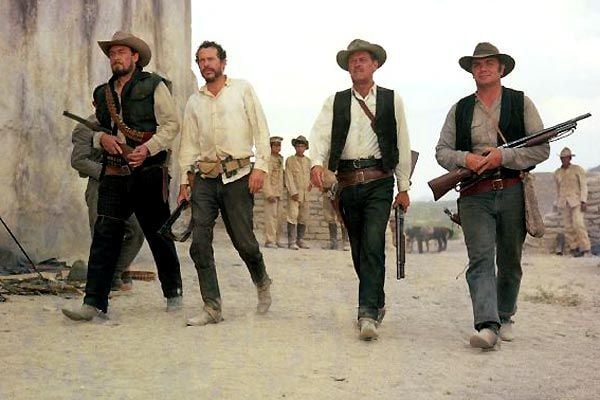
 Already the film is rich in compromised morality. The bunch shoot their way out, losing one of their members, and head for safety. When they come to divide their loot, they find that far from escaping with a hefty payroll they have risked their lives for a few sacks of washers.
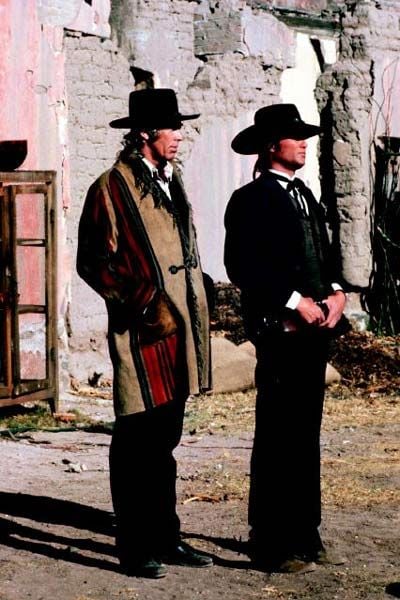 Garrett: Times are changin', Billy. You want it straight?
Billy: If that's what you're here for.
Garrett: The electorate want you gone. Out of the country.
Billy: Well, are they tellin' me or are they askin' me?
Garrett: I'm askin' you. But in five days I'm makin' you, when I take over as sheriff of the county.
Billy: Sheriff Pat Garrett! Sold out to the Santa Fe Ring. How does it feel?
Garrett: It feels like times have changed.
Billy: Times, maybe, but not me.
A scant four years separate 'The Wild Bunch' and 'Pat Garrett and Billy the Kid'. In many ways they tread the same path: both are elegiac despite their moments of violence; both mourn the passing of the Old West. The tone is different, though. There is a defiance to 'The Wild Bunch', never mind the almost nihilistic futility of the bunch's final stand. Early in the film, Pike dismisses the inevitability of the bunch being pitted against superior numbers: "I wouldn't have it any other way." The way he says it, you know he means it. By the end, he proves it. The bunch are finally outnumbered not just by Mapache's private army but, in a thematic sense, by history itself. Their world changes - globally.
In 'Pat Garrett and Billy the Kid', social and political upheavals are more localised - the former outlaw Garrett earns his appointment as sheriff by hunting down Billy the Kid; lawyers and landowners pull the strings behind the scenes - and the effect is, if anything, even more devastating. There is a weariness, almost a sense of defeat, in every frame. The closest Garrett comes to an act of defiance is to reject an offer of $500 for an outright assassination of the Kid, snarling, "You can take that five hundred dollars and shove it up your ass and set fire to it."
'Pat Garrett and Billy the Kid' isn't as redolent as other Peckinpah films in images of modernity creeping into the milieu of the western - unlike 'Ride the High Country' and 'The Ballad of Cable Hogue', both of which, like 'The Wild Bunch', feature cars: one almost runs down Steve Judd (Joel McCrea) in the former, the other proves a lot more damaging to Cable Hogue (Sam Robards) in the latter - but it spells out the death of the west just as poignantly, most notably in the slow, painful death of Sheriff Baker (Slim Pickens), gut shot and stumbling down to the river as the acoustic version of Bob Dylan's 'Knockin' on Heaven's Door' plays on the soundtrack.
 In 'The Ballad of Cable Hogue' (1970), the eponymous prospector, betrayed by his partners and left to die in the desert (chalk up another recurring theme: the amount of characters who end up pitted against men they used to ride with, a bitter contravention of Pike's code of honour that "when you side with a man you stay with him and if you can't do that you're like some animal - you're finished"), finds water as if by a miracle and not only survives but, having negotiated the bureaucratic necessities of filing a claim on the land and acquiring financial backing, opens a way station between two towns on a main stagecoach route. His dreams of romance with local good-time girl Hildy (Stella Stevens) are ruined by his obsession with revenge; his prosperity is threatened by - yes! - the arrival of the horseless carriage.
A decade beforehand, Peckinpah's second film (and his first bona fide masterpiece) 'Ride the High Country' (1961) provided a virtual blueprint for the rest of his career. His weather-beaten protagonists Steve Judd and Gil Westrum (Randolph Scott) are men in their twilight years, suspicious of bankers and businessmen and not at all impressed by the callous live-fast-die-young ethos of the younger generation ('Ride the High Country' was made in 1961, remember: the youth-of-today analogy is pretty clear). For all that Westrum, trying to lure his upright friend into a robbey, is a study in compromised morality, Judd strives always to do the right thing, to remain true to a rigid code of honour.
 Westrum: Partner, you know what's on the back of a poor man when he dies? The clothes of pride. And they're not a bit warmer to him dead than they were when he was alive. Is that all you want, Steve?
Judd: All I want is to enter my house justified.
All I want is to enter my house justified. What a line! See the film just once and that line will haunt you years later. With Peckinpah, who (mostly uncredited) rewrote whole tranches of the screenplays he optioned, the dialogue is just as incisive as the images. There's a beautifully resonant line in 'The Wild Bunch', spoken by one of the elders at gang member Angel's village, the bunch hiding out there after the robbery-gone-wrong. Observing two of Bishop's most hard-bitten heavies innocently larking around with a couple of the village girls, he comments, "In our hearts we all want to be children again, even the worst of us. Perhaps the worst most of all."
Or how about the line that old man Sykes (Edmond O'Brien) comes out with at the end? Reflecting on an uncertain future, the times having changed beyond anything he can hold out against, he says wearily, "It ain't like it used to be, but it'll do."
An epitaph for changing times, the old ways betrayed and shot down by modernity. A ten-word summation of Peckinpah's over-riding theme as an artist, as a film-maker and as a man.