Showing posts with label Suzy Kendall. Show all posts

Sunday, May 15, 2011

GIALLO SUNDAY: Spasmo


Umberto Lenzi’s psychological thriller starts with two effective rug-pulls. In the pre-credits scene, a young couple race down to the beach in the moonlight; stopping in the lee of a deserted beach house, they start making out. Lenzi’s camera frames the dangling feet of a hanged body behind them. A scream rings out as the girl turns and catches sight of it. The mood soured, they go to investigate. It’s a mannequin. An engine revs and a car roars off.

Post credits, Christian (Robert Hoffmann) and his on-off artist girlfriend Xenia (Maria Pia Conte) are walking along a beach when they spot a body lying face down. Xenia is horrified and hangs back; Christian goes to investigate. The body turns out to be very much alive; a victim of sunstroke who had momentarily passed out. She introduces herself as Barbara (Suzy Kendall) and Christian offers to fetch a flask of whisky from his car to help revive her. Barbara disappears, however, leaving behind an item by which Christian tracks her to a yacht owned by Barbara’s moneyed and much older boyfriend Alex (Mario Erpichini).

These sequences bookend two minutes of credits interspersed with rapid, disorientating cuts to a series of mannequins in macabre and sexualized tableaux. Their relevance is something that Lenzi doesn’t reveal until the very last scene; a nasty, morbid coda to an hour and a half of not-what-it-seems plotting.


Christian becomes obsessed with Barbara and poor old Xenia is unceremoniously sidelined. Gate-crashing a party at Alex’s yacht (or should that be “gangplank-crashing”?), Christian and Barbara lose no time in stealing away to a motel. Barbara insists that Christian shave off his distinctive beard before they get it on – a request that seems to have greater motive than simple comfort on Barbara’s part, particularly when Christian’s clean-shaven industrialist brother Fritz (Ivan Rassimov) comes into the picture – and while Christian is busying himself in the bathroom with scissors and electric razor, he is attacked by gun-toting thug Tatum (Adolfo Lastretti). During the struggle, the gun discharges and Christian is left with a body, his prints on the gun and Alex outside wanting Barbara back and Christian out of the picture.

Returning to the motel after a heated discussion with Barbara and Alex back at the yacht, Christian is disturbed to find the body missing. Meanwhile, more mannequins in death poses are turning up. Barbara flees Alex’s possessive influence and holes up with Christian in a holiday home she claims belongs to a friend of hers but is being occupied by the saturnine Malcolm (Guido Alberti) and his much younger consort Clorinda (Monica Monet). Christian comes to believe that he’s met Clorinda before and that she has something to do with his brother. As a plethora of unsettling events play out, Christian tries to hang on to his sanity while dealing with Alex’s benign influence and the possibility that the psychotic Tatum might not be dead after all.
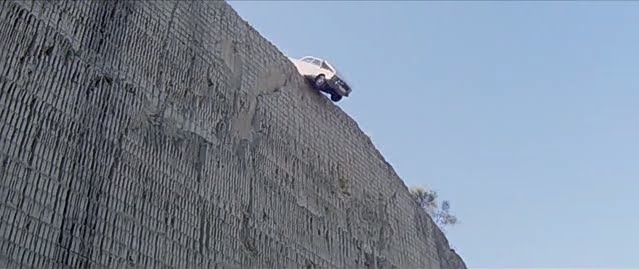


‘Spasmo’ – a compellingly blunt title – plays out as utterly baffling for its first hour. Nothing quite connects; there seems to be little or no logic to narrative developments. Character dynamics are curious. Who exactly is the catalyst for the weird shit that happens: Barbara or Christian? Why does the mysterious Malcolm take such an interest? What’s the deal with Clorinda and Christian’s brother?

Things start clicking into place after an assassination attempt that plays out unexpectedly, sending Christian on a desperate chase to piece the remaining clues together. Everything is explained by the end credits, but Lenzi seems hellbent – right up to the end – to monkey with audience expectations. His determinism in this respect is entirely commendable, although it does make ‘Spasmo’ something of a hard slog in places, certainly in the middle section where the accretion of elliptical and seemingly uncontextualized incidents threaten to become infuriating.

The final third of the film more than compensates, however. The performances are uniformly good, with Kendall in particular taking a character who could have been unbearably histrionic and instead honing the characterization beyond what the often utilitarian script gives her to work with. It’s stylishly shot by Guglielmo Mancori, who makes excellent use of locations varying from swanky yachts and beach houses to abandoned quarries and industrial works. And those mannequins – carrying on a giallo tradition established by Mario Bava’s ‘Blood and Black Lace’ – bring a creepy visual element that’s all their own.

Sunday, February 20, 2011

GIALLO SUNDAY: Torso

Although not as well-represented in gialli as black gloves, wickedly glinting knives, spiral staircases or bottles of J&B, the image of a broken or ritually dismembered doll is one of the most provocative images the genre has given us.

One pops up during the opening credits of Sergio Martino’s sleazy, brutal and red-herring ridden opus ‘Torso’. The doll is placed in a sexualized context. A whisper of chiffon is pulled from the curvaceous body of strikingly attractive blonde woman. She and another woman engage in a threesome (the gentleman who makes up the third party is unseen) as a Martino’s camera drifts out of the focus. Meanwhile, another camera clicks away. A doll sits between one of the women’s legs. Someone’s hand slides over the doll’s face. Their fingers put its eyes out.

So. Nudity, voyeurism (as well as a hint of blackmail, perhaps?) and fetishized imagery. All within the first two and half minutes. SeƱor Martino has your attention, yes? Just to make sure he retains it, the first murder comes less than ten minutes in, after our second bout of nudity as a couple make out in a Mini parked beneath an overpass. I suspect camera trickery was used, since the kind of languorous make-out session these two engage in is spatially impossible in a 1970s Mini unless you have both doors open and shove the gear lever in reverse.

Ahem. Moving swiftly on. They’re disturbed by a masked figure and the young gentleman makes the terminal mistake of giving chase. The young lady makes the equally inadvisable mistake of getting out of the car. The killer strikes. Once she’s dead, he really gets to work.

A note on the title. ‘Torso’ is pretty meaningless, notwithstanding the killer’s hacksaw technique in the latter stages of the proceedings. The original title is much more apposite: ‘I corpi presentano tracce di violenza carnale’. Which you don’t have to be a linguist to figure out means ‘the bodies showed signs of carnal violence’. And why? Because, as the killer puts it – and I’m giving nothing away here whatsoever – “they were all dolls, just stupid dolls made of flesh and blood”.

The overpass victim – Florence (Patrizia Adiutori) – was a classmate of Jane (Suzy Kendall) and Daniela (Tina Aumont), both of whom are studying art in Rome. Florence’s murder coincides with Daniela’s stalking by the spurned by persistent Stefano (Roberto Bisacco) and their friend Carol (Christina Airoldi) acting out of character. Then there’s a second murder. But fear not – Inspector Martino (Luciano De Ambrosis) is on the case and he’s tenaciously following up a lead.

Uh, actually, this being a giallo and coppers in gialli being as effectual as a bulletproof vest made out of rice paper, scratch that. Be afraid. Be very afraid. Daniela is. She’s seen something she thinks might be important and she’s initially convinced that it implicates Stefano. Jane uncovers evidence that she believes is to the contrary. Nonetheless, Daniela gets a whispered message warning her against talking to the police. Her nerves shredded, Daniela’s uncle (whose attentions towards her seem more voyeuristic than avuncular) suggests she repair to his villa in the country to rest and recuperate. A business trip prevents him from accompanying her, so Daniela invites Jane, along with Ursula (Carla Brait) and Katia (Angela Covello), who have their own motivations for sequestering themselves away in the back waters.

This turns out to be the biggest mistake since Florence decided to get out of the Mini and go looking for her boyfriend, rather than locking all the doors, firing up the ignition and getting the fuck out of Dodge.

The second half of the film follows the girls to the villa, where the rural idyll turns very sour very quickly. The local yokels take an unhealthy interest in them. Stalker-boy Stefano shows up. Jane sustains an injury that puts her at a disadvantage when the killer comes calling. The last half hour is a sustained cat-and-mouse sequence which sees Martino at his tension-ratcheting best.

And it’s because he handles the suspense and the shocks so well that ‘Torso’ emerges a damn fine giallo rather than the cheap sex ‘n’ violence exploitationer it was obviously conceived as. Sure, it oozes sleaze: the nudity is as copious as the slayings and Martino takes pains to render two of the victims in a state of undress at point of death, plus it deserves a special award for the most gratuitous J&B placement in the history of gialli

… (just in case Ms Brait’s elegant form is too distracting, it’s the ashtray), but ‘Torso’ is worlds removed from the clumsy wank-fodder of ‘Strip Nude for Your Killer’ or the grim misogyny of ‘The New York Ripper’. It’s effectively paced, makes good use of the kind of subjective prowling camerawork normally associated with Argento, and it’s slew of red-herrings and misdirections keep you guessing right up to the buttock-clenching finale.

This was the fifth of five consecutive gialli Martino made between 1971 and 1973, following ‘The Strange Vice of Mrs Wardh’, ‘The Case of the Scorpion’s Tail’, ‘All the Colours of the Dark’ and ‘Your Vice is a Locked Room and Only I Have the Key’. And that’s a hell of a good run by anyone’s standards.

Friday, January 11, 2008

The Bird with the Crystal Plumage

Expatriate writer Sam Dalmas (Tony Musante), spending his last few days in Rome before he returns to the States, is wandering back to his apartment one evening when his attention is drawn to the brightly-lit facade of an art gallery. The gallery is on two levels, its exhibits mostly sculptures - strange, twisted, threatening objects. On the upper level, a woman dressed in white is struggling with a black-clad figure. Sprinting across the road, Sam tries to gain entry, intent on helping her. A large sliding glass door, locked and immovable, stops him. While he struggles, the black-clad figure leaps down to the lower level, leaving the woman bleeding from a stab wound, and disappears through a rear exit ... though not before triggering a mechanism which closes a second glass door behind Sam. Trapped, and looking like a bizarre live-art addition to the galleries exhibits, Sam is helpless, impotent, unable to do anything but await the police's arrival and hope the woman doesn't expire in the meantime.

Unusually, the police arrive in a timely fashion ... then immediately revert to giallo type as they spectacularly fail to generate any leads. In fact, Inspector Morosini (Enrico Maria Salerno)'s only attempt at pro-active police work is to organise an identity parade for Sam's benefit, rounding up a group of usual suspects ("right, bring in the perverts"). Sam avers that he didn't see the attacker's face. All he can be sure about is that some aspect of what he witnessed doesn't seem right - but he just can't put his finger on it. A foiled attack on him on his way home, followed by threatening phone calls advising him to go back to America, do nothing to quell his curiosity and he begins his own investigation, much to the chagrin of his girlfriend Julia (Suzy Kendall). Sam ties in the attack at the gallery with a recent series of murders of young women which the police - surprise, surprise - have no suspects for.

Sam learns that one of the earlier victims worked at an antique shop. The proprietor tells him that she sold a macabre picture just before she was killed. Sam obtains a catalogue photo of the painting and eventually tracks down the artist, but he proves as unhelpful as he is eccentric and the trail goes cold. Then another clue falls into place and seems to lead Sam back to where he started. But there are still a few surprises in store for him ...

'The Bird with the Crystal Plumage' was Argento's first film and an immediate success. He followed it up very quickly with 'The Cat O'Nine Tails', establishing himself as a master of the giallo and inviting comparions to Hitchcock. Praise indeed! And yet 'TBWTCP' isn't without its flaws: Musante and Kendall turn in wooden performances, an early indicator of Argento's tendency to casting bland actors in lead roles (cf. James Franciscus in 'The Cat O'Nine Tails', Leigh McCluskey in 'Inferno'); the script, while clever in terms of structure and misdirection, is bogged down with clunky exposition; the attempts at comedy (an effeminate antique shop owner, a pimp with a speech impediment) are laboured and unfunny.

So why does Argento owe his career to it? Why is it still considered a classic of its kind? Why is it still being paid homage to (most recently by Quentin Tarantino in 'Death Proof')? The Hitchcock comparison provides an answer: like Argento, Hitch was never a director of actors ("actors are cattle" is one of his most cutting and oft-quoted homilies); his fame derives instead from bold, hugely memorable set-pieces, wrought with tension, which are perfectly geared to the visual potential of the medium. The crop dusting plane and the Mount Rushmore finale in 'North by Northwest', the shower scene in 'Psycho', [insert personal favourite here].

Same deal with Argento. At his best, he's capable of wringing every possible drop of tension from a scene then still making you jump when he delivers the pay-off. Visually, his films are full of striking compositions and often surreal colour schemes (although his recent work has, sadly, demonstrated a curbing of his excesses in this respect). Some stand-outs from 'TBWTCP': the iconic opening scene, the black-clad figure stark against the clinical white of the gallery, Sam trapped between the bright interior and the nocturnal street outside (the now discontinued Killing in Style has a perceptive article on this scene); a claustrophic cat-and-mouse sequence as a gunman stalks Sam through a bus depot, the closely parked buses forming a maze of sorts as Sam tries both to evade his antagonist and find a way out; Julia menaced as she waits for Sam to return from his meeting with the painter, desperately trying to escape the apartment through a back window as the front door begins to splinter under the killer's assault; Sam at a disadvantage, pinned beneath one of the sculptures at the art gallery as he finally realises who's behind it all.

Ultimately, if 'TBWTCP' isn't quite top-flight Argento it still stands as a statement of intent - a clear indication of the idiosyncratic style he would develop as a film-maker.