Showing posts with label Amy Adams. Show all posts

Wednesday, February 08, 2017

Nocturnal Animals


For anyone with a serious redhead fetish, ‘Nocturnal Animals’ – which features no less a quartet of world-class beauties of said hair colour than Amy Adams, Isla Fisher, Ellie Bamber and India Menuez – might well prove their ‘Citizen Kane’. (It also stars Andrea Riseborough, an equally not-troubled-by-the-ugly stick redhead, but buries her under a brunette frightwig.) For anyone else … hmmm, well …

‘Nocturnal Animals’ is a Tom Ford film. I know this because the opening credits are ushered in by the authorial statement “a Tom Ford film”. As are the closing credits. Seriously, the moment the final shot fades to black, there it is: “a Tom Ford film”. But let’s get back to the opening credits for a moment. As they crawl towards their interminable conclusion, overlaying slow motion shots of morbidly obese people dancing naked in slo-mo – a series of images that has no bearing on what follows and is never revisited – the last three are “produced by Tom Ford”, “screenplay by Tom Ford” and “directed by Tom Ford”.

Tom Ford has obviously never heard of the traditional “written, produced and directed by” credit. Or he has, but rejects it in favour of stamping his name on his product as omnipresently as possible. Tom Ford is also a fashion designer, and it might be that his fixation with labels extends to his new career as a director. ‘Nocturnal Animals’ is his second film and it should probably be legislated that you don’t get to say “a Your Name film” on your films until you’ve directed at least half a dozen of them and genuinely proved yourself as an auteur.

But, for better or for worse, ‘Nocturnal Animals’ (one of the worst titles I’ve come across since Nick Willing’s ‘Photographing Fairies’ back in 1997) is a Tom Ford film, so let’s take a few paragraphs to discuss what it has to offer in all its Tom Fordy Tom Fordiness.

Art gallery owner Susan Morrow (Adams) is twenty years divorced from non-career-focused wannabe writer Edward Sheffield (Jake Gyllenhaal), trapped in a loveless second marriage to smooth bastard, philanderer and also-ran businessman Hutton (Armie Hammer) and a distant mother to Samantha (Menuez). Her life is perfectly ordered, sterile and about two steps away from total implosion. One day, she receives a proof copy of a novel Edward has had accepted for publication (it looks more like an amateurishly bound MS rather than a set of galleys or a bound uncorrected proof, but hey ho) and which is dedicated to her.

The novel tells the story of regular guy teacher Tony Hastings, his wife Laura and their daughter India and how their family vacation turns into a nightmare after an encounter with a bunch of rednecks. Minor spoiled: Laura and India are sexually assaulted and murdered while Tony, more through his captors’ stupidity than any proactive decision on his part, escapes. Dead inside, he partners with unorthodox lawman Bobby Andes to track down the perpetrators and take revenge.

As Susan reads, she imagines Edward as Tony, and drops in place surrogates for herself and Samantha as Laura and India (Fisher and Bamber respectively). Also, she imagines the story in vicious and uncompromising detail. Andes is played in this film-of-the-novel-within-a-film by Michael Shannon and he’s the absolute motherlovin’ best thing in ‘Nocturnal Animals’ by a wide margin. Everyone else seems stilted and ill at ease, even down to Riseborough and Michael Sheen turning in caricatures in bit parts. The hillbillies – portrayed grubbily by Aaron Taylor-Johnson, Karl Glusman and Robert Aramayo – are no less clichéd.

I’ve read a broadsheet review which seriously tries to suggest that the filmed excerpts from the novel are comparable with Peckinpah. Bullshit! Peckinpah would have given the rednecks characters and rooted their motivation within a socio-economic framework, not to mention establishing a realistic dynamic as regards their interrelationships. But, y’know, Peckinpah could direct and that’s the difference.

Edward’s novel is about revenge, and in riffing on little details that force Susan to confront her memories, it is also an act of revenge in and of itself. As Susan’s carefully constructed rationales for her equally carefully constructed lifestyle begin to implode, she wanders through her gallery and is confronted by a painting she can’t even remember acquiring. Black paint on white canvas: the word “revenge”. At this point I wondered if Tom Ford was going to run round from behind the camera, flick a speck of non-existent dirt from his impeccable Tom Ford suit, point at the painting and enquire of the audience whether they were fully aware that this is a film about revenge. And then perhaps deliver a short lecture on how it’s also a film about how the hollow lives of upper-middle class entitled people who do each other emotional violence are thrown into sharp relief by the story of a life rendered hollow by an act of physical violence committed by the underclass.

Tom Ford’s obsession with the rednecks’ filthy lifestyles – right down to showing his audience a post-arse-wipe scrap of toilet paper (thanks, Tom) – is if anything more prurient than his love of lifestyle porn. Seamus McGarvey’s cinematography certainly emphasises this, exercising cool restraint as his camera prowls the art gallery or Susan’s clinically neat des res, then happily rubbing the viewer’s nose in degradation whenever the hillbillies are on screen. And can I say once again how fucking stereotypical these boys are? I half expected the end credits (“a Tom Ford film”) to refer to them as Bubba, JohnBoy and BillyBob Rapist.

‘Nocturnal Animals’ is undoubtedly well made. Thought went into every aspect of it. They way thought goes into films by Lars von Trier and Michael Haneke. And like those boys, for all the artfulness behind the enterprise, it’s difficult to shake the feeling that buttons are being pressed and controversy courted for its own sake. I’ve said before on these pages that von Trier and Haneke remind me of nine-year-olds who have just figured out that saying “fuck” in the playground gets a reaction and delight in proving that observation over and over again.

Tom Ford is playing from the same playbook – not to mention playing in the same sandbox – with ‘Nocturnal Animals’. He has a cast to die for, some incredibly talented collaborators behind the camera, none of which count for much in the face of his ego and what I can only suspect are a seething raft of issues that he’d be better off seeing a therapist about rather than inflicting on paying audiences.

Monday, April 11, 2016

Batman vs Superman: Dawn of Justice


‘Batman vs Superman: Dawn of Justice’ is no classic. Let’s be completely honest about that. It’s as flawed as ‘Man of Steel’ was. Some of it works and some of it doesn’t. The things that don’t work – in particular matters pertaining to Lex Luthor – are hugely awful. The things that do work – in particular matters pertaining to Diana Prince – are as iconic as any fanboy could wish for. The film is a mishmash, and narratively wonky. But does it deserve the outpouring of hatred that the critics have almost unanimously delivered? In my humble opinion, no.

Which isn’t to say that, having emerged from the cinema with a general feeling of I enjoyed that more than I thought I would, I’m going to fashion this review into not just an apologia for ‘B vs S’, but reappraise it as a misunderstood classic of the genre. No, sir. It would be remiss of any reviewer to gloss over the film’s problems, just as it’s lazy of the majority of them to join in the hurling of brickbats.

In the interests of objectivity and balance, let’s acknowledge the faults. First and foremost, the characterisation of Lex Luthor is terrible, partly because Jesse Eisenberg is miscast but mostly because the script (a) gives him some of the most thankless dialogue any actor could find himself saddled with, and – more problematically – (b) fails in establishing any credible motivation for his increasing sociopathic behaviour. And, no, his oft-repeated variations on a theme of man’s victory over God doesn’t really cut it since there’s no moment in his character arc that leads him to this mindset. In fact, he doesn’t even have a character arc. It’s as if the first script conference settled on Lex Luthor as villain based on the rationale that everyone knows he’s the villain anyway so let’s just wheel him onstage and give him villainous things to do and we won’t need to bother with any of that tedious exposition business.

Likewise, the titular Batman/Superman conflict is predicated on very little. Sure, there’s the effective opening sequence where the finale of ‘Man of Steel’ is restaged from Bruce Wayne (Ben Affleck)’s perspective as he navigates rubble-strewn and dust-choked streets in an attempt to facilitate his employees’ evacuation while Superman (Henry Cavill) and General Zod twat each other in an orgy of city-wide destruction and wait a fucking minute, since when exactly was Wayne Industries based in Metropolis? So, yeah, the ultimate superhero anti-hero, a man who was wreaked his fair share of havoc in order to take down bad guys, suddenly goes all antagonistic on Superman because he wreaked havoc in order to take down a bad guy. 

Meanwhile, Clark Kent pursues a media campaign against Batman for little other reason that it gets him off the sports desk. Though why he spends his time at the office getting all moody and embittered when he’s shacked up with the uber-foxy Lois Lane (Amy Adams) is anybody’s guess. Ditto why Lois continually puts her life in danger chasing down stories when she’s just as loved-up herself.

Finally: the flashbacks/dream sequences. They’re piss-poor, on both a conceptual and aesthetic level. Really, really piss-poor.

And if you took ‘B vs S’ on the 500 words above, the critical kicking would be easy to understand; in fact, you’d probably feel like grabbing a burning touch and allaying yourself with the village lynch-mob. But said course of behaviour would leave one blind to the pleasures of the film. To whit:

Ben Affleck as Batman. I’ll cop a guilty plea, right here and right now, to face-palming and groaning when I heard the news of Affleck’s casting. And by the same chalk I’ll hold my hands up and admit that I was wrong. Trudging through the metaphorical treacle of a script that can’t even establish a fundamentally plausible motivation for his character, Affleck nonetheless knocks it out of the park in his portrayal of a Batman who is middle-aged, world-weary and descending into an embittered psychosis. This is a not just a Batman who, prior to the titular stand-off, has to force himself through a masochistic training regime and build an armoured suit that it’s effortful even to walk in (in fact, there’s something about seeing the un-suited-up Bruce Wayne pounding at a truck tyre with a sledgehammer that presents an anti-iconography: the training montage actually strips a superhero down to a new personal low), but Affleck is just as acute in his characterisation of Bruce Wayne, showing a jaded multi-millionaire going through the motions of what society expects of him; even the playboy lifestyle and womanising seems forced, to the point where Alfred sneers at him that there’s little hope for a next generation. 

Subject of whom: Jeremy motherfuckin’ Irons. Hot on the heels of his fantastic turn in ‘High-Rise’, he reinvents Alfred to his own specifications within seconds of appearing onscreen. Retaining the Jeeves-like pragmatism of the character’s previous incarnations, Irons adds a level of barbed irascibility and the result is magnificent. In fact, I’d give Irons the Agitation of the Mind “man of the match” award if it weren’t for …

… Gal Gadot as Diana Prince/Wonder Woman. Introduced in oblique fashion, with much of her narrative arc and motivation remaining enigmatic for most of the running time, Gadot isn’t given much to do but look slinky and seductive as Prince and wield a sword in menacing fashion as Wonder Woman. Given the script’s total inability to treat a female character as anything other than a plot device, Gadot could easily have come adrift in the melee, her character mere eye-candy in the CGI-driven morass of the final act. But, by God, a former model who I wouldn’t have previously credited as having any claim to cinematic iconography doesn’t just make something out of nothing, she creates bona fide moments of mainstream cool.

Other plus points: Snyder’s commitment to a dark vision of the material – slammed by the critics for humourlessness – yields some genuinely striking moments: the film begins and ends with funerals (Snyder shoots funerals with the same quasi-pornographic delight that Argento at his best reserved for death scenes); Wayne’s contact with a Russian mobster takes place at a grungily ugly bare-knuckle boxing competition; Superman’s coercion into appearing at a congressional hearing is the culmination of a subplot about political showboating/careerism and is full-stopped by a hugely cynical punchline almost calculated to plug into contemporary America’s terrorism fear-factor. Snyder plays it equally dark and cynical in terms of classical allusions, throwing in Icarus, Parsifal and a painting in Luthor’s apartment that’s basically a combination of Gustav Dore and William Blake; there’s even a dream/hallucination sequence where Kevin Costner reappears as Clark Kent’s mortal step-father, staged in such a manner that short of inserting a title card reading “and my father on that sad height” the nod to Dylan Thomas couldn’t be more explicit.

And this is perhaps what ‘B vs S’ offers as an apologia for itself even in the face of its harshest critics. In an era where superhero movies – specifically those of the Marvel ilk – have come to define mainstream cinemagoing, Iron Man and Captain America might flirt around the edges of prescient storylines about the corrupting influence of power and the fear of the unknown, but you’re highly unlikely to stumble across a classical allusion or a debate on the very redundancy of heroism; whereas Snyder, carrying on the dialogue he established in ‘Man of Steel’, batters furiously and incessantly away at the very concept of the genre even as he embraces its most fetishistic excesses.

Sunday, January 29, 2012

Charlie Wilson's War

Posted as part of an intermittent series of espionage-related cinema leading up to the release of the new James Bond film ‘Skyfall’ later this year


How best to describe ‘Charlie Wilson’s War’? The “based on a true story” tag-line screams biopic, but it’s more like ‘Wag the Dog’ with a covert war instead of a stage-managed one, or ‘Rambo III’ with more in the way of strippers and hot tubs.


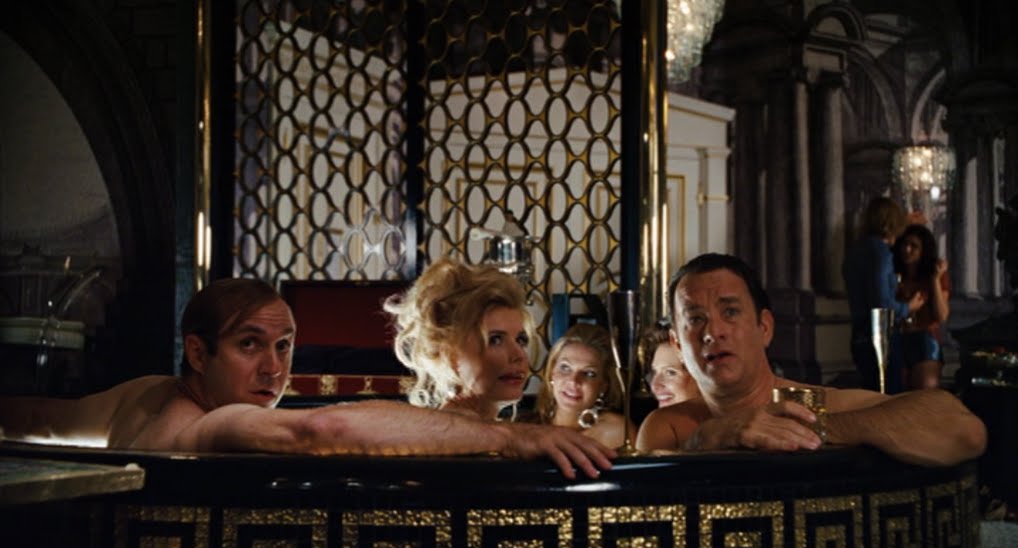
This is how we meet our … uh, let’s just go with “hero” and place all moral considerations in cold storage for 98 minutes. He’s the Charlie of the title (Tom Hanks), he’s a Texan congressman and his principle interests appear to be women, whisky and … actually, I think we got done with his interests at women and whisky. He’s hanging out in a penthouse apartment with some – not to be judgemental here, but let’s call it like it is – lowlifes. High-rolling lowlifes, but lowlifes all the same. His choice of company comes back to haunt him later.

It’s the 1980s, the Russkies are in Afghanistan and Wilson is swiftly coerced by hifalutin society lady Joanne Herring (Julia Roberts) to help the Afghanis out in the name of God and country and … well, mainly God. Which he proceeds to do, with the aid of disenfranchised CIA agent Gust Avrakotos (Philip Seymour Hoffman). Avrakotos is given an equally memorable introduction, effectively torpedo-ing his career prospects by telling his boss to go fuck himself and vandalising the fellow’s office into the bargain.


And while Mike Nichols’s film focuses on Wilson wheeling and dealing, and Avrakotos belligerently out to hammer the Red Menace, it’s fast, funny and scabrously satirical, Aaron Sorkin’s script zinging with the razoer-sharp dialogue for which he’s renowned. But all too often Nichols and Sorkin wear their hearts on their sleeves and the review-o-meter dips from “pretty good” to mediocre. Wilson’s transformation from political player to humanitarian never quite rings true. A visit to a refugee camp on the Pakistan/Afghanistan border wants to deliver the same howl of outrage as the last half of ‘The Constant Gardener’, but doesn’t make the grade. An apposite moment, here, to mention Stephen Goldblatt’s flat and utilitarian cinematography: he never fully integrates with any scene, visually parlaying the viewer into the thick of events. The film retains a slightly bland sheen throughout; you’re always aware that you’re watching a film, and that’s never a sign of success.

The cast is top-notch, though: Hanks and Roberts are clearly having big fun, while Hoffman doesn’t just steal scenes but walk away with the whole movie. Amy Adams, Emily Blunt, Rachel Nichols, Om Puri, Ken Stott, Peter Gerety and Ned Beatty all get their moment in front of the camera (even if, in some cases, it is only a moment: Blunt in particular is wasted).


A handful of set-pieces can hold themselves up to anything in Nichols’s distinguished (if, of late, somewhat hit-and-miss) filmography, particularly Wilson and Avrakotos’s first meeting, played out against the revelation that Wilson is being stalked by bad press and a possible subpoena due to the aforementioned lowlife company; it’s beautifully paced, laugh-out-loud funny, with enough entrances and exits to invite comparison with a Brian Rix farce.

And yet … and yet … ‘Charlie Wilson’s War’ never fully coheres. As a satire (how the Americans armed Afghanistan: a timely tale of ulterior motives and irresponsibility!), it pulls its punches. As a political drama, it’s a little too glib to deliver any real insight. As a thriller, it keeps its protagonists away from any element of danger, thereby failing to generate tension. As an exercise in mapping out the contours of conspiracy, it’s never convincingly labyrinthine enough.

All told, that first paragraph ‘Wag the Dog’ comparison arguably sums it up: like Barry Levinson’s film, made ten years earlier, it takes a terrific concept and a powerhouse cast, delivers some genuinely amusing moments but squanders so much potential through its inability to decide what it wants to be.

Saturday, August 20, 2011

Amy Adams


The immensely likeable Amy Adams - who embodies a winning combination of smouldering vamp and girl-next-door - is 37 today. A large glass is being raised at chez Agitation.