Showing posts with label Tom Hanks. Show all posts

Sunday, January 08, 2017

Sully


‘Sully’ is about many things: it’s about a cool-headed act of heroism executed under intense conditions and with no margin for error; it’s about how FAA investigators are basically witch-hunters but with corporate job titles; it’s about the different ways in which PTSD manifests; it’s about how a city claims heroes for itself; and most of all it’s about people doing their jobs.

Clint Eastwood’s direction acutely reflects this, to the point that even the villains of the piece – the soberly dressed men and women who do everything they can to prove an act of reckless endangerment on Chesley “Sully” Sullenberger (Tom Hanks)’s part – are just doing their job in the same way that Sully and co-pilot Jeff Skiles (Aaron Eckhart) were doing theirs, the Manhattan ferry operators who assist in getting the passengers ashore from the freezing waters of the Hudson were doing theirs, and the paramedics who tend to them were doing theirs.

There is very little in ‘Sully’ that isn’t about the minutiae of getting on with one’s job of work. Just as ‘Deepwater Horizon’ invested a sizeable chunk of its running time in explaining how an oil rig works and what the various people who work on it are individually responsible for, and only gets down to the big disaster movie set pieces once all the necessary exposition has been delivered, so ‘Sully’ spends more time with its eminently professional and quietly understated protagonists as they go about their day-to-day (albeit a day-to-day that involves smug people in suits trying to blame them for deep-sixing an aeroplane and never mind that they saved every single passenger) than it does in said plane when it finally puts down on the Hudson.

In fact, Eastwood almost teases the audience with several iterations of the water landing (as Sully coolly corrects an investigator who refers to it as a “crash”). We first see it as Sully’s nightmare in the immediate aftermath; then in part as Sully almost seems to doubt his own judgement during a conversation with his wife (an underused but still effective Laura Linney). It’s very late in the film before Eastwood shows the whole thing, and his aesthetic is austere and realistic. What many directors would stage as a cathartic, even rousing, set-piece is here a jolting and immersive piece of visceral filmmaking. Notwithstanding that everyone knows the outcome – everyone survived – Eastwood communicates the urgency of the forced landing, the against-the-clock necessity of getting everyone off the plane before it sank, and the hypothermia-inducing temperature of the river.

To reiterate: ‘Sully’ is a damned fine film when it concentrates on, and offers up an unsentimental hymn to, the importance of professionals doing their job and trusting their instincts. Its footing is less sure elsewhere, though. The vignettes that introduce a handful of the passengers are lazy to the point of stereotypical. A scene in a bar where an overly garrulous bartender and two drunks are so overwhelmed to meet Sully that their effusiveness embarrasses him is staged like a particularly unfunny outtake from ‘Cheers’. Two other nags: Eastwood’s commitment to an austere aesthetic bleeds the film of any visual distinction; and the editing is fussy and sometimes distracting.

What can’t be denied, though, is that ‘Sully’ communicates its key points simply and with clarity. Hanks and Eckhart do sterling work, both actors bringing lightly-worn gravitas to the roles, and playing off each other in a wry and ironic style. I’d even suggest that, in Tom Hanks’s refusal to make his characterisation of Chesley Sullenberger a performance, he gives the performance of his career.

Sunday, October 12, 2014

13 FOR HALLOWEEN #5: Toy Story of Terror


Woody (Tom Hanks) and the gang are passing the time during a cross-country drive. The trunk of a car can be a dark and claustrophobic place so they distract themselves by watching a horror movie on a laptop. Which is kind of like an ophidiophobe chilling out with ‘Snakes on a Plane’. And it doesn’t help that Mr Pricklepants (Timothy Dalton) – who really ought to be called Mr Smartypants – keeps talking over the film, giving a running commentary on horror movie tropes and how the narrative plays out. When a flat tyre strands them at a dreary and, more to the point, isolated motel, Mr Pricklepants is in his element, confidently predicting that before too much longer the group will be split up and “picked off one by one”.

Confidently and accurately.

‘Toy Story of Terror’ may only be a short, but it’s as rich in ideas, inventiveness and entertainment as any of its feature-length brethren. While presenting a mildly scary tale for kids, the litany of horror genre lore and specific movie references that it throws out ensure its no less entertaining for adults. Indeed, the unforced panache with which its homages are staged – be it a shower curtain placed centrally in a tense cat-and-mouse scene or Buzz Lightyear (Tim Allen) declaring “I’ll be right back” – is a delight. It even teases the knowing adult audience with the possibility of Jessie the Cowgirl (Joan Cusack) as final girl.


Speaking of whom, the film neatly keys into its predecessors, relying on Jessie’s backstory from ‘Toy Story 2’ to generate tension: her claustrophobia when she’s accidentally locked in a tool box in an early scene foreshadows her requirement to be sealed in a box during the denouement when she has to … Ah, but that would be telling. Moreover, the solidarity of the toys holding hands as they slide inexorably towards the furnace at the end of ‘Toy Story 3’ is subverted as the group are split up during the genuinely tense middle section. Likewise, a sequence of captivity and attempted escape also echoes that instalment.

How scary is it? Well, there’s nothing that reaches the clammy heights of the furnace set-piece, or even the evil playhouse that is Sid’s bedroom in ‘Toy Story’. Nor is there anything as squirmily tense as the airport sequence in ‘Toy Story 2’. But as a comedy-horror, it works brilliantly. It works because, like the absolute best of Pixar, it’s been made with care and wit and attention to detail. Director Angus MacLane, who co-wrote it with Pixar stalwart Andrew Stanton, understand the horror genre; they know when to spoof and when to scare.

Am I making it sound like ‘Toy Story Does Scream’? Then so be it, but with the caveat that ‘Toy Story of Terror’ is funnier, cleverer and more sophisticated than ‘Scream’ – and, at 21 minutes, mercifully shorter.

Sunday, January 29, 2012

Charlie Wilson's War

Posted as part of an intermittent series of espionage-related cinema leading up to the release of the new James Bond film ‘Skyfall’ later this year


How best to describe ‘Charlie Wilson’s War’? The “based on a true story” tag-line screams biopic, but it’s more like ‘Wag the Dog’ with a covert war instead of a stage-managed one, or ‘Rambo III’ with more in the way of strippers and hot tubs.


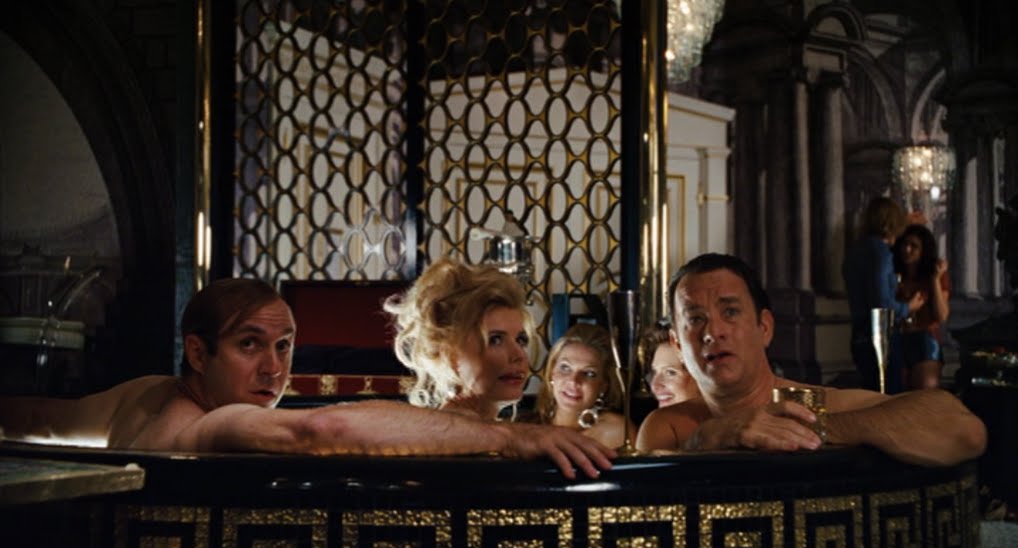
This is how we meet our … uh, let’s just go with “hero” and place all moral considerations in cold storage for 98 minutes. He’s the Charlie of the title (Tom Hanks), he’s a Texan congressman and his principle interests appear to be women, whisky and … actually, I think we got done with his interests at women and whisky. He’s hanging out in a penthouse apartment with some – not to be judgemental here, but let’s call it like it is – lowlifes. High-rolling lowlifes, but lowlifes all the same. His choice of company comes back to haunt him later.

It’s the 1980s, the Russkies are in Afghanistan and Wilson is swiftly coerced by hifalutin society lady Joanne Herring (Julia Roberts) to help the Afghanis out in the name of God and country and … well, mainly God. Which he proceeds to do, with the aid of disenfranchised CIA agent Gust Avrakotos (Philip Seymour Hoffman). Avrakotos is given an equally memorable introduction, effectively torpedo-ing his career prospects by telling his boss to go fuck himself and vandalising the fellow’s office into the bargain.


And while Mike Nichols’s film focuses on Wilson wheeling and dealing, and Avrakotos belligerently out to hammer the Red Menace, it’s fast, funny and scabrously satirical, Aaron Sorkin’s script zinging with the razoer-sharp dialogue for which he’s renowned. But all too often Nichols and Sorkin wear their hearts on their sleeves and the review-o-meter dips from “pretty good” to mediocre. Wilson’s transformation from political player to humanitarian never quite rings true. A visit to a refugee camp on the Pakistan/Afghanistan border wants to deliver the same howl of outrage as the last half of ‘The Constant Gardener’, but doesn’t make the grade. An apposite moment, here, to mention Stephen Goldblatt’s flat and utilitarian cinematography: he never fully integrates with any scene, visually parlaying the viewer into the thick of events. The film retains a slightly bland sheen throughout; you’re always aware that you’re watching a film, and that’s never a sign of success.

The cast is top-notch, though: Hanks and Roberts are clearly having big fun, while Hoffman doesn’t just steal scenes but walk away with the whole movie. Amy Adams, Emily Blunt, Rachel Nichols, Om Puri, Ken Stott, Peter Gerety and Ned Beatty all get their moment in front of the camera (even if, in some cases, it is only a moment: Blunt in particular is wasted).


A handful of set-pieces can hold themselves up to anything in Nichols’s distinguished (if, of late, somewhat hit-and-miss) filmography, particularly Wilson and Avrakotos’s first meeting, played out against the revelation that Wilson is being stalked by bad press and a possible subpoena due to the aforementioned lowlife company; it’s beautifully paced, laugh-out-loud funny, with enough entrances and exits to invite comparison with a Brian Rix farce.

And yet … and yet … ‘Charlie Wilson’s War’ never fully coheres. As a satire (how the Americans armed Afghanistan: a timely tale of ulterior motives and irresponsibility!), it pulls its punches. As a political drama, it’s a little too glib to deliver any real insight. As a thriller, it keeps its protagonists away from any element of danger, thereby failing to generate tension. As an exercise in mapping out the contours of conspiracy, it’s never convincingly labyrinthine enough.

All told, that first paragraph ‘Wag the Dog’ comparison arguably sums it up: like Barry Levinson’s film, made ten years earlier, it takes a terrific concept and a powerhouse cast, delivers some genuinely amusing moments but squanders so much potential through its inability to decide what it wants to be.

Thursday, August 25, 2011

Road to Perdition


I wrote about WTF Syndrome when I reviewed ‘Snatch’ a while back. WTF Syndrome is when you tell someone, usually very sheepishly, that you’ve never seen a certain film and their patented response is an incredulous “what the fuck?”

Usually, though, there’s a good reason why you’ve never seen the film in question. In my case, with ‘Snatch’, it was because I was influenced by a raft of reviews which painted it as just another iteration of ‘Lock, Stock and Two Smoking Barrels’ only on a bigger budget. Which it kind of is and kind of isn’t but is kind of missing the point.

(This, I hasten to add, was back in the day when I was influenced enough by the mainstream critics to make my viewing choices based on their say-so. This was also back in the day when I actually had disposable income and could have just gone to see anything and everything regardless. God, I could give the me of two decades ago a right slapping for not seeing more movies. And not buying a sports car. But I digress.)

When ‘Road to Perdition’ was released in 2002, expectation was high. Sam Mendes’s debut ‘American Beauty’ had cleaned up critically and commercially, bagging six Oscars. It was acute, acidic, brilliantly observed and littered with terrific performances, including a career best from Kevin Spacey. ‘Road to Perdition’ had a lot to live up to. Ads were everywhere. I lost count of the amount of times I sat through the trailer. It looked like a showreel for cinematographer Conrad L Hall. I didn’t know if I could take Tom Hanks seriously as a gangster. Early reviews suggested it wasn’t a patch on ‘American Beauty’. People whose judgement I trusted saw it and gave a shrug of the shoulders. I didn’t bother going to see it. Nor, for nine years, did I have the urge to rent the DVD or catch it on TV.


A couple of weeks ago, I was given a lend of the DVD. I sat down to watch it over the weekend, the mid-way stretch of an offbeat triple-bill that started with ‘Messiah of Evil’ and ended with ‘The French Sex Murders’. Comparatively speaking, ‘Road to Perdition’ boasts greater narrative coherence than the former and somewhat higher production values than the latter. And for the most part I enjoyed ‘Road to Perdition’ – it looks great, there are a triumvirate of excellent supporting performances from Paul Newman, Daniel Craig and Jude Law, and a rain-soaked set-piece towards the end is bleakly iconic – but watching it inbetween two B-movies threw something into sharp relief.

‘Road to Perdition’ is essentially a man-on-the-run narrative powered by the embittered heart of a revenge movie. Adapted from the graphic novel by Max Allan Collins, the material cries out for down-and-dirty B-movie treatment. The story is boilerplate: Michael Sullivan (Hanks), a mob enforcer who tries to keep his family separate from his working life, goes on a strong-arm job with his boss’s loose-cannon son Connor Rooney (Craig); Sullivan’s son (Tyler Hoechlin), curious as to what his old man does, sneaks along for the ride; Rooney goes apeshit at the job and blows someone away; Sullivan Jr witnesses it; Rooney goes over to chez Sullivan to whack the kid but ends up murdering the uninvolved members of the family. Sullivan and son go on the run. Connor’s father, ageing patriarch John Rooney (Newman), reluctantly enters into an agreement with fellow mobster Frank Nitti (Stanley Tucci) to shelter Connor and engage the services of photographer/hitman Harlan Maguire (Law).


At 90 minutes, fast and nasty, this could have been as cynically brilliant as Sam Mendes evidently wanted it to be. As it is, the running time is just shy of two hours. And it’s not like Mendes or scripter David Self need those 118 minutes to work on the characterization, since virtually every character is resolutely one-note. Sullivan is a professional enforcer who just happens to have a family. John Rooney is the creaky but charismatic head of the family. Connor is the wild card. Harlan is the stop-at-nothing psycho who enjoys his work a bit too much. There’s some gumph at the start about how Sullivan owes John so much and how John always thought of Sullivan as a son, but it’s never explained or explored. Quite why the schism between John and Connor came to pass is never explained or explored. The repercussions of Sullivan Jr surviving the massacre he inadvertently caused is never explored, except for one perfunctory scene where Sullivan angrily tells him it’s not his fault.

Ultimately, all ‘Road to Perdition’ is about is how Connor Rooney fucks over Michael Sullivan and how Michael Sullivan manoeuvres in order to (a) protect his son and (b) get revenge. And when Law is onscreen, all shark-like smile and twitchy menace, the film moves and grooves in an effectively nasty way. The rest of the time, though, everyone seems to be conscious that they’re working with an Oscar-winning filmmaker. Whole sequences have “prestige picture” and “Oscar clip” stamped all over them. The pace sometimes flags to the point of funereal. Thomas Newman’s score alternately drops to a hush and swells to a crescendo. ‘Road to Perdition’ is a depression-set gangster movie that is too concerned with straightening its tie, shining its shoes and practicing its speech for the awards ceremony when it ought to be liquored up on moonshine, grinning round a fat cigar and firing a tommy gun in the air from the running board of a Ford sedan.