Showing posts with label Dagmar Lassender. Show all posts

Friday, November 16, 2018

WINTER OF DISCONTENT: The Iguana with the Tongue of Fire


Riccardo Freda’s 1971 giallo location hops from London to Dublin to Switzerland, features a series of grisly murders and attempted murders using acid and straight razors, has as its protagonist an ex-cop with a violent streak brought in by his former boss when more conservative methods of investigation fail, and said individual belligerently uncovers a morass of blackmail, envy, corruption, venal snobbery and casual sex. Throw in the fact that it stars Dagmar Lassander – the frankly gorgeous star of minor genre classics ‘The Frightened Woman’ and ‘Forbidden Photos of a Lady Above Suspicion’ – and we’re talking giallo heaven, right?

Mmmmm, not quite.

It’s an odd one, is ‘The Iguana with the Tongue of Fire’. The title is reminiscent of Argento’s ‘The Bird with the Crystal Plumage’ and Sergio Martino’s ‘The Case of the Scorpion’s Tail’ – both prototypical gialli shot through with lurid set design, POV-heavy camera work and grand guignol set pieces. ‘Iguana’ offers none of these. Visually, it’s austere: the palette is subdued, the locations drab to say that the film is peopled with privileged ‘establishment’ types, and the staging blunt and realistic rather than baroque and stylised. Nor is there any of the bizarre psychological noodlings that explain the killer’s motives in many a giallo, just a sad commentary on class and entitlement.


The film starts with a young woman being murdered. Shortly afterwards, her body is discovered in the boot of a limousine belonging to Swiss ambassador Sobieski (Anton Diffring). His eccentric and alcoholic wife (Valentina Cortese) and his shifty chauffeur, who wears sunglasses round the clock – he claims conjunctivitis – are easily the most suspicious of those present … until, that is, Inspector Lawrence (Arthur O’Sullivan) turns up to make his enquiries and Sobieski, politely but firmly, refuses to cooperate by claiming diplomatic immunity, thereby hoisting himself to the top of the suspects list.

Lawrence responds by calling in John Norton (Luigi Pistilli), a man with a violent past and a not-exactly-peaceable present. Norton, as Lawrence intended, promptly makes waves. He makes waves by dint of getting into a protracted brawl with Sobieski’s security staff and by starting an affair with his daughter Helen (Lassander). Along the way, we learn why he got kicked off the force (think Sidney Lumet’s ‘The Offence’ boiled down into a thirty second flashback). He makes for grim company, does Norton – even his courtship of Helen is a sour, cynical piece of manipulation – and yet the sleaziest, most pugnacious aspects of his personality are held in check by his domestic situation, wherein three generations of Norton’s, the other two being his mother (Ruth Durley) and his daughter coexist under one roof in an atmosphere of good-natured frustration at each other’s foibles.


Early scenes of en famille Norton are played for comic relief: Mrs Norton’s habit of losing her spectacles is set up as a running joke; the young Miss Norton’s wise-beyond-her-years shtick is cute. But as Norton’s investigation takes him closer to the truth and the culprit, his family come to the killer’s attention and the Norton women find themselves in mortal peril for precisely these reasons.

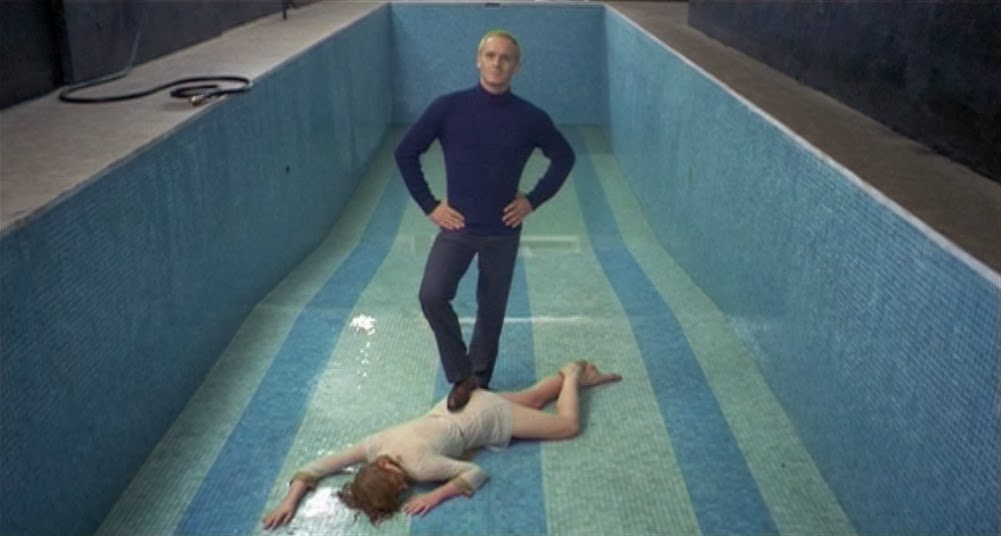
The narrative recalibration from Norton whittling down the suspects list by the simple expediency of provoking each of them into a reaction to the killer going after Norton’s family makes for a sudden tonal shift made particularly jarring since, for most of its first hour, ‘The Iguana with the Tongue of Fire’ is an austere and procedural-driven giallo. Sure, it has its lurid moments – the killer’s modus operandi is a vial of acid tossed in the victim’s face followed by a straight-razor to the throat: overkill, much? – but for the most part we follow Norton as he talks to, accuses and sometimes punches people. Subject of his two-fistedness, a bit of rough ‘n’ tumble is no bad thing in a crime movie, but the film boasts two hand-to-hand set pieces, the first of which is filmed entirely in the shadows of an unlit room and blocked and edited in such a way as to suggest that the budget didn’t stretch to professional stuntmen and the actors weren’t comfortable with doing their own stunts. I’m not saying that the scene plays out in visually incomprehensible fashion, but here’s a screengrab taken at random:


The other fisticuff-centric set piece – Norton’s mano-a-mano smackdown with the killer at the end of the home invasion sequence – is shot with prurient attention to detail. Ditto the travails of Mrs and Miss Norton prior to Norton’s not-quite-timely-enough intervention. The filmmakers’ leering enjoyment of this final stretch is palpable, and the shift in tone is as if a Fernando di Leo poliziotteschi had lurched uncomprehendingly into, say, the final reel of Lucio Fulci’s ‘Contraband’. (In the interests of fairness, I’m not sure how many of the film’s failings can be laid at Freda’s door: he was apparently so unhappy with the final product that he had his name removed from it: the director’s credit goes to “Willy Pareto”.)

If for no other reason, you could make a case that ‘The Iguana with the Tongue of Fire’ earns its giallo credentials purely by its title. Although you’d have to give more than a passing nod to the unapologetically tenuous bit of dialogue which explains the reference. But a giallo’s a giallo for a’ that and a’ that, and ‘The Iguana with the Tongue of Fire’ offers corruption in high places, seductive and possibly duplicitous women, blackmail, jealousy, family secrets, murder most foul and if the not standard issue incompetent coppers who are a mainstay of the genre, then at least one who has to resort to unprofessional methods to crack the case. It doesn’t however, have any of the visual flair, eyeball-watering set design or style-over-substance set-piece porn that Bava, Argento, Martino and their ilk established as a gaudily beautiful template for the genre.

I’ve often said in these Winter of Discontent reviews that the cardinal sin an exploitation movie can commit – the audience, after all, has been ready to forgive bargain basement production values, bad acting, shoddy writing and wonky direction – is to be boring. ‘The Iguana with a Tongue of Fire’ isn’t boring by any means, but it’s visually and stylistically bland – and for a giallo that’s just as bad. If not worse.

Tuesday, November 05, 2013

WINTER OF DISCONTENT: The Frightened Woman


A Rolls Royce glides at stately pace through the night. Gida (Lorenza Guerrieri), a call girl in a fur coat and a short skirt rubs, antiseptic cream onto the marks on her otherwise shapely legs. “You really hurt me this time,” she complains. She doesn’t complain when the unseen man next to her writes out a cheque. He takes a while doing it, the implication being there’s enough zeroes in front of the decimal point to make it worth her while. Then again, this is Italy in the late sixties, way before the Euro, when a million lira was worth about one pound sterling, so maybe she got stiffed. In both senses of the word.

Without pausing to consider the plausibility of a call girl who takes cheques, the film jumps forward a week and Gida’s refusing the same john another go around, pleading illness. She makes her excuses by phone; what’s happening onscreen tells another story.


Then we’re in the glacially appointed premises of a “philanthropic organisation” where a weasly minor executive with an eye patch (Varo Soleri) is getting the heavo-ho over an embezzlement case. He pleads with Dr Sayer (Philippe Leroy), a big wheel within the organisation, to put in a word for him with the board. Sayer refuses. The minor executive takes his leave, but not before vandalising a bit of corporate art and making off with some gold lettering.

Next up, journalist Maria (Dagmar Lassander) approaches Sayer about some material pertaining to a story he’s writing. They have a disagreement, but Sayer nonetheless invites her to visit him in private to collect the material. Bad move. Maria finds herself drugged and wakes up at Sayer’s bizarrely decorated weekend residence – general location: middle of nowhere – where he casually advises her to get used to the idea of being his slave, and before you can say ‘Fifty Shades of Kitsch’ a series of psycho-sexual games are played out against the backdrop of gaudily decorated living rooms, torture dens, indoor swimming pools and a huge art installation reminiscent of the work of the visually-challenged sculptor in Yasuzo Masumura’s ‘Blind Beast’, made the same year.


The first half of Piero Shivazappa’s delicious oddity plays out very much as a battle-of-wills two-hander with hints of torture porn; and while the film never gets quite as kinky or explicit as the subject matter would suggest, Shivazappa ratchets up some genuine erotic tension – assisted no end by the frankly gorgeous Lassander in a committed performance and Leroy projecting cold hard arrogance like it’s going out of style. Had this been the tone for the entire hour and a half, though, it would have made for a tedious and repetitive little exploitationer no matter how funky the set design or how all-over-the-place the musical cues.

‘The Frightened Woman’ may be many things, but it certainly isn’t tedious or repetitive. Shivazappa makes a sudden tonal shift in the second half to focus on a bizarre courtship of sorts. Watching Sayer go from Mr Ice Cool to Mr Trying To Be Cool is a demented spectacle which carries the film across a fair few stretches of what-the-fuckery. Gasp as Sayer and Maria make out in his car by a railway crossing! (The visual metaphor that tells us Sayer’s getting a BJ is priceless.)


Gawp as you realise his motor’s a Qandt Amphicar and they top off their drive in the country with a spell en bateau!


Marvel at how they ever found that castle-cum-restaurant!


Chortle at their embarrassment being caught like naughty schoolchildren in a dwarf’s bedroom!


Scratch your head at the cathartically satisfying but utterly incoherent twist ending! Seriously. A twist ending rendered more completely nonsensical in terms of its mechanics I have yet to see. There’s some business with a bottle of pills that holds water, but the rest of it – I don’t want to hove into spoiler territory, so let’s just say: wig, medical condition, photograph album – seems to have been pulled out of the drawer marked “no fucking way” and rubber stamped with “shut up, the audience won’t notice, they’ll be looking at Dagmar’s boobs”. It’s as if the denouement is so concerned with circularity – the Rolls Royce reappears, its ownership now in question, and there’s even a visual cue which makes an implication about our mono-ocular miscreant from the first scene, albeit one that’s impossible given the film’s timeframe – that the script created its own vortex which swallowed up logic, continuity and suspension of disbelief. The plot hole as black hole.

Sunday, March 13, 2011

GIALLO SUNDAY: Hatchet for the Honeymoon

The Italian title of Mario Bava’s all-purpose giallo/psychological mystery/tale of ghostly revenge is ‘Il rosso segno della follia’, which translates as ‘The Red Mark of Insanity’. It’s a more appropriate title, given that the film spends most of its hour and a half run time probing the broken mind of protagonist John Harrington (Stephen Forsyth). The better known English language title, while magnificently lurid, is glaringly inaccurate.

It’s a cleaver Harrington does his killing with, not a hatchet. Totally different implements. No hatchet misuse going on in this movie whatsoever, no siree.

What’s that? I’m a rotten bastard and a no-good review for throwing out that last paragraph without a spoiler alert? Au contraire: it’s not a spoiler. Bava reveals Harrington as the killer right from the off, and just as quickly establishes his motive. He’s murdering newly married women and each time he kills, another little piece of a buried childhood memory comes back to him. A childhood memory that may be at the root of his desire to kill.

Granted, this kind of locks him into a self-defeating pattern – and regular appointments with mental health professional would certainly have been a better way to resolve the problem – but, hey, you can dig why Harrington wants to get to the bottom of things. Getting this little issue sorted out would certainly allow him to focus his attentions more on other things, such as running his fashion house (shades of Bava’s earlier ‘Blood and Black Lace’) or trying to talk his shrewish wife Mildred (Laura Betti) into an amicable separation. Yup: John is experiencing a problem akin to that of Stefano in ‘The Designated Victim’, Marco in ‘Death Laid an Egg’ and Martin in ‘The Red Queen Kills Seven Times’: a wife he can’t get rid of who wields both the whip hand and the purse strings.

But whereas Stefano, Marco and Martin simply want rid of their wives in order to be with other women, Harrington – for all that he’s attracted to models Alice (Femi Benussi) and Helen (Dagmar Lassander) – wants to wrest back financial control of the company his mother left him. It’s his mother’s death, gradually revealed in flashback, that’s at the heart of Harrington’s childhood trauma. Mildred, older than Harrington and as sharp as a stern parent in the way she talks to him, seems to be a mother figure – that is, if you take your mother figures straight out of the Brothers Grimm. Moreover, Mildred’s first husband was called John and her cries of “John … John …” at a séance (a scene that prefigures a key moment in ‘The Night Evelyn Came out of the Grave’, made the following year) are eerily similar to Harrington’s dying mother calling out to him in the flashback sequences.

‘Hatchet [’s a fucking cleaver, all right?] for the Honeymoon’ is a slow-burn movie that, by and large, doesn’t peddle quite the same baroque stylizations and tense set-pieces as ‘Blood and Black Lace’, but it’s fascinating and eminently watchable for several reasons. Firstly, it sees Bava at his most Hitchcockian since ‘The Girl Who Knew Too Much’: the upfront revelation of the killer’s identity and the crafting of exquisitely tense moments despite this playing of the hand was something Hitch did par excellence (think ‘Shadow of a Doubt’ or ‘Frenzy’); the quasi-Oepidal confusions of the protagonist are a variation on Norman Bates’ mother fixation in ‘Psycho’; and a squirmly protracted scene involving a corpse on the stairwell, a reflective surface, the dripping of blood and a spectacularly ill-timed visited from dogged detective Inspector Russell (Jesus Puente) is played out with as much panache as anything in the maestro’s filmography.

Also, Bava plays with reality/perception/memory like a cardsharp shuffling a deck. Reflections, flashbacks, shadows, things seen and unseen. Watching ‘Generic Sharped-Bladed Instrument for the Honeymoon’, you’re never sure how much is real and how much in Harrington’s mind, particularly around the two-thirds mark when Harrington is haunted in manner that brings to mind a classic M.R. James ghost story. There’s also a beautifully handled transition early on when Bava cuts from a train – the scene of the first murder – thundering through the night to an obviously false shot of model train carriages. At first it seems as if Bava’s tried to get away with matching stock footage to a cheaply-effected close-up, then the director pulls back for the reveal: it’s a genuine model railway layout in Harrington’s old childhood bedroom, the first of two significant scenes which see the troubled Harrington surrounded by the things of childhood. It would take Argento’s masterpiece ‘Deep Red’ before the giallo depicted childhood mementoes in as fetishized and sinister a manner as Bava did here.

The English language title does ‘Il rosso segno della follia’ a disservice, perking anticipation for a sleazy and sexualized stalk ‘n’ slash opus. What Bava actually delivers is a well-thought-out, eye-on-the-ball piece of work that continually monkeys with your perceptions and expectations and proves as inarguably as ‘Blood and Black Lace’ or ‘A Bay of Blood’ just how important his contribution was to the genre.

Sunday, July 25, 2010

Forbidden Photos of a Woman Above Suspicion

Posted as part of Operation 101010
Category:
giallo / In category: 5 of 10 / Overall: 46 of 100


Despite a thematic connection with Sergio Martino’s ‘All the Colours of the Dark’ and Lucio Fulci’s ‘A Lizard in a Woman’s Skin’ in its depiction of a psychologically beleaguered heroine, Luciano Ercoli’s ‘Forbidden Photos of a Lady Above Suspicion’ is in some ways an atypical giallo. Mainly in the fact that there’s no killer, black gloved or otherwise. Accordingly, the body count is low: three deaths, one offscreen (which may or may not be a suicide), the other two during the climax when (MINOR SPOILER) the villains are offed.

What ‘Forbidden Photos’ does have, and he’s as nasty a piece of work as any antagonist the genre has to offer, is the unnamed blackmailer and sex offender (Simon Andreu) who targets trophy wife Minou (Dagmar Lassander) during her sojourn at a seaside resort while her industrialist husband Peter (Pier Paolo Capponi) is away on a business trip. Unnamed characters are the bane of the reviewer’s life, and I don’t fancy typing or even copy-and-pasting “the blackmailer and sex offender” repeatedly during the next few paragraphs, so let’s call him Bob.

Bob attacks Minou while she’s taking an evening constitutional along the shore; it’s not quite rape, but definitely a sexual assault. Before letting her go, he implies that her husband is a fraud and a murderer. Upon his return, Peter puts the matter in the hands of his friend Frank (Osvaldo Genazzini), a police commissioner, and reassures Minou that she’s safe now. His assurances are vapid and less than placatory; his mind is on a crucial business deal, and besides he half believes Minou’s dependency on tranquillizers is behind her story.

Indeed, the opening sequence, containing the only voiceover in the film (unreliable narration?), has Minou decide that the time has come to stop smoking and drinking and wean herself off the tranks. Her musings accompany a montage of her getting ready, as if for a night out, only for the sequence to end as she pours a drink, pops a pill and zones out on the sofa. That Ercoli cuts straight to Minou’s evening stroll along the beach suggests her encounter with Bob could well be a product of her addled mind.

Subsequent events, however, suggest otherwise. Minou and Peter meet their old friend Dominique (Susan Scott) at a nightclub – backstory: Dominique introduced Minou to Peter, with whom she had a thing way back when – who mentions a news story about a financier dying in mysterious circumstances. The police seem to think its suicide, but Minou – aware that Peter owed the financier a debt that could have scuppered his potentially profitable deal with a German consortium – has her doubts, particularly when she realises that the circumstances could have been engineered by technology Peter’s firm was working on.

Bob reappears and plays Minou a tape that seems to implicate Peter. She tries to buy him off, but he’s not interested in money. He torments Minou, instead, with mind games and sexual demands. But is Minou, her relationship with Peter in limbo and her curiosity secretly aroused by Dominique’s free-spirited lifestyle and collection of erotica, more attracted to Bob than scared of him? Certainly, Bob’s physical similarity to Peter hints at surrogacy. Likewise, the similarities between Minou and Dominique. Both are redheads, similar height and figure. Minou berates herself at one point for dressing like a housewife and opts for a more revealing décolletage – obviously patterning herself on Dominique who has the wardrobe of a Victoria’s secret model and the va-va-voom to go with it.

Ercoli and screenwriters Ernesto Gastaldi and May Velasco have so much fun dishing out red herrings and misdirections, as well as drawing multi-layered parallels between the principals, that payoff (though well-handled) seems a little pedestrian by comparison. Still, it offers the incidental pleasure, inimical to most gialli, of a hapless copper (here Commissioner Frank) having the whole thing spelled out for him by a secondary character.

Elsewhere, though, many gialli tropes are missing. There are no elaborate and grand guignol death scenes or rooftop chases; and although Allejandro Ulloa’s cinematography is eye-catching ‘Forbidden Photos’ lacks the off-kilter compositions and hyper-stylized imagery that characterizes the most famous examples of the genre. The performances are generally good – with Andreu a stand-out – and even if Lassender doesn’t quite hit the heights of Edwige Fenech in ‘All the Colours of the Dark’, she essays the woman in peril role competently enough.

It’s weird, really. For a giallo that sounds like it ought to disappoint on so many levels, ‘Forbidden Photos’ is never less than entertaining and a decent addition to the collection.