Showing posts with label Hilary Swank. Show all posts

Wednesday, September 06, 2017

Logan Lucky


It would be an easy and reductive way to start this review by observing that ‘Logan Lucky’ is the white trash B-side to Steven Soderbergh’s earlier heist movie ‘Ocean’s Eleven’.

Easy. And reductive. And not without a glimmer of truth. It would also be worth noting that ‘Logan Lucky’ enjoys the benefit of being an original piece of work rather than a remake (albeit one that surpasses its Rat Pack source material).

‘Logan Lucky’ is a film of two halves and myriad incidental pleasures. It’s not as taut or as impeccably constructed as ‘Ocean’s Eleven’, but it unfolds with the amiability of a shaggy dog story narrated by a consummate storyteller and it’s just as impressive in its casting. It is, in fact, enough of its own film that I ought to do the decent thing and knock off the ‘Ocean’s Eleven’ comparisons right here and now.

Yeah: let’s do that.

The basic set up of ‘Logan Lucky’ – though there’s a hell of a lot more going on than the merely narrative – is that Jimmy Logan (Channing Tatum), the elder scion of a family not known for having the vaguest hint of good luck shine on them, ropes siblings Clyde (Adam Driver) and Mellie (Riley Keogh) into a speedway robbery, a scheme that also compels him to recruit imprisoned safecracker Joe Bang (Daniel Craig) and his brothers Fish (Jack Quaid) and Sam (Brian Gleeson).

So why does an honest working stiff like Jimmy suddenly want to embrace a life of crime? Well, it’s partly because he’s been laid off from the very construction job that’s given him an intimate knowledge of the layout and financial workings of the speedway; partly because he’s parvenu ex-wife Bobbie-Jo (Katie Holmes) and her car-dealership-owning new husband Moody (David Denman) are about to move to another state, effectively severing Jimmy’s contact with his daughter Sadie (Farrah MacKenzie); and partly because robbing the shit out of a speedway during a NASCAR event is a big fuck you to obnoxious English racing impresario Max Chilblain (Seth MacFarlane), a wanker of the highest order who is first introduced flanked by an entourage and picking a fight with one-armed bartender Clyde. Clyde lost said arm on active service in the US army.

If that very very brief overview - one, I should add, that doesn’t even touch on Sadie’s beauty pageant obsession, Moody’s attempts to chat-up/sell a car to his sort-of sister-in-law, Jimmy’s potential romance with medical outreach worker Sylvia Harrison (Katherine Waterston), or the odd tonal shift in the last third when a heist movie suddenly becomes a police procedural – leaves you thinking that there’s more going on here than just good-ole-boys-rip-off-NASCAR, then you’re thinking as smart as … well, that’d be telling if I let on exactly whom the savviest character in the movie is.

I said earlier that ‘Logan Lucky’ is a shaggy dog story, and that’s certainly what it is first and foremost, as well as being the narrative and intellectual register in which it functions most effectively. But it’s also a study in defeated working class machismo (Jimmy was the high school quarterback destined for glory whose life actually came to nothing; Clyde went into the army in an attempt to live up to his brother’s stature and was left disabled in an explosion); the role that luck plays in how one’s life pans out (the film’s subtlest joke is the repeated denial that the Logans’ luck isn’t really cursed because Mellie’s done all right for herself: she’s a hairdresser); the social divisions created by simple earning potential (for all his business acumen, Moody is a serious trade-down for Bobbie-Jo from Jimmy); the wanton misuse of money (compare the outrageous concession stand prices at the speedway with Sylvia’s rueful commentary on how the outreach programme relies on donations); and the casually dismissive way that corporationism makes, breaks and resets the rules (the speedway management can’t determine exactly how much they lose, but sure seem happy with the insurance payout; Chilblain calls the shots over experienced drivers because his shitty energy drink pays for the race team).

I also said earlier that ‘Logan Lucky’ is a film of two halves: the first is basically a three act progression from Jimmy-gets-pushed-to-breaking-point to Jimmy-plans-the-job-and-puts-together-the-team to Jimmy-and-the-team-pull-off-the-heist, and every minute of it is an unalloyed joy; the second focuses on an FBI hardass Sarah Grayson (Hilary Swank) who tries to make sense of the case’s many weird elements and damn near puts it together. While this section is narratively valid – unlike ‘Ocean’s Eleven’, ‘Logan Lucky’ doesn’t have a Terry Benedict figure against whose oleaginous villainy even vault-cracking and multi-million theft is justified, therefore Grayson’s investigation is the mechanism by which the corporationalist shenanigans which turn victimhood into insurance-funded profit is laid bare – these scenes seem like they’ve wandered in from a different movie, and Swank’s performance seems oddly out of kilter with everyone else’s.

Steven Soderbergh’s always been something of an awkward bugger, never quite cohering to even his staunchest fans’ expectations, and it’s somehow fitting that such a luminary as Swank should emerge as the weakest link in one of his films. That said, everyone else is on form: Tatum and Driver form the best double act I’ve seen in ages (their use of “cauliflower” as a code word for Jimmy’s criminal endeavour is way funnier than it ought to be, particularly in the disgusted tone Driver uses to repeat the word, dragging it out as if it contained four times as many letters); Waterston shines in what’s basically a glorified cameo (her ‘bitch please’ look when Jimmy suggests that Sylvia is “an old lady name” is a joy to behold); Craig has more fun with a role than I’ve seen anywhere else in his filmography; and the Agitation Man of the Match Award is jointly awarded to Dwight Yoacham as a prissy prison governor beleaguered by the most hilarious prison riot ever, and Riley Keogh, who sashays through the film with insouciant cool, all haughty looks and witheringly flippant remarks.

‘Logan Lucky’ is about one degree short of a modern classic but offers so much that it’d be criminal to carp. That it shamelessly rips off ‘Two-Way Stretch’ for its most crucial subplot … aw, hell, I’m in a magnanimous mood. Full pardon granted!

Sunday, June 18, 2017

The Homesman


As a director, Tommy Lee Jones isn’t exactly prolific: four features in just over twenty years, two of them – ‘The Good Old Boys’ and ‘The Sunset Limited’ – for television. His big screen directorial debut was ‘The Three Burials of Melquiades Estrada’ (2005), a contemporary western concerned with revenge and redemption that has about it more than a touch of Peckinpah. It’s a damn good movie; close as all hell to being a modern classic.

‘The Homesman’ is a western set in the 1850s concerned with failure and redemption that has about it more than a touch of Michael Cimino. In both films, Jones acknowledges his influences and draws on them subtly and respectfully in the service of the story he’s telling. ‘The Homesman’ has the stateliness and the visual grandeur of Cimino circa ‘Heaven’s Gate’ – cinematographer Rodrigo Prieto is the film’s unsung hero – the better to contrast with the dour narrative and its unsettling accretion of detail.


The film opens with three women in a hardscrabble Nebraska township emerging from a particularly vicious winter having succumbed to mental illness. “Mad women”, as the townsfolk are quick to label them. The parson, Reverend Dowd (John Lithgow), arranges for their care to be given over to a preacher’s wife in Iowa and calls upon one of his flock to make the journey: an undertaking of several weeks. When farmer Vester Belknap (William Fichtner) – husband to the afflicted Theoline (Miranda Otto) – refuses to take part in a drawing of lots to determine who gets the job, spinster of the parish Mary Bee Cuddy (Hilary Swank) takes his place.

No prizes for guessing who ends up playing chauffeur to the disturbed women?

In addition to Theoline, Mary Bee’s charges number Arabella Sours (Grace Gummer) and Gro Svendson (Sonja Richter). I’ll not reveal that nature of their mental illness: an unflinchingly blunt sequence early in the film – fleshed out by a couple of flashbacks around the midway point – spells out their suffering. Mary Bee – brittle, pious, frustrated in her attempts to find a husband – isn’t the ideal candidate for the company of the demented. Early in the journey, the incessant wailing of one of her charges drives her to despair. The hard realities of the journey don’t sit well with her, and the arrangement she enters into with petty criminal George Briggs (Jones) to assist on the trail as recompense for saving him from hanging is also fraught; they’re opposites in gender, age, social standing, theological views and general outlook on life.


As the journey progresses, Jones – co-scripting as well as directing (film is based on a novel by Glendon Swarthout*) – maps the gradual thawing of their relationship, only for things to take a sharp and unexpected turn. Again: I’m remaining tight-lipped. Suffice it to say that the last third of ‘The Homesman’ plays out under the shadow of the event in question, giving it the feel of an extended coda … notwithstanding one scene of stone cold ruthless violence that is cathartic only to a point.

‘The Homesman’ is a fascinating piece of work, primarily because of its focus on mental illness. It’s a theme that wrong-foots you as a viewer, subverting what you expect from a western even as the production design, cinematography and music evoke the genre as classically as in anything by Ford, Cimino or Eastwood. Inasmuch as Jones can only portray his female cast in terms of the few social roles that the rampant patriarchy of frontier life afforded women, ‘The Homesman’ can also be considered a feminist western. Jones as director has great respect for the film’s treatment of its anti-heroines and even two scenes depicting the grubby realism of personal hygiene on a long trial are shot without recourse to exploitation.

Any film so strongly grounded in character succeeds or fails by its performances. Jones gives a minimalist, elegiac variation on a type of character he’s played several times before and can play to perfection. Except where Briggs is required to be the focal point for a scene’s dynamic, Jones he is careful to keep himself to the side – if not in the background – and cede the film to his co-stars. Swank is as brilliant as you’d expect: I don’t think anyone else could have played Mary Bee.


Otto, Gummer and Richter, notwithstanding that they barely have a word of dialogue between them, turn in genuinely affecting character work. Streep, in a five minute cameo, does her best work since Eastwood’s ‘Bridges of Madison County’. Hailee Steinfeld, popping up at the end to literally be nothing more than an indicator of Briggs’s capacity for good, suggests soulful depths to a character that is pretty much one-dimensional on the page.

Everything else about ‘The Homesman’ works beautifully and in concert. It is a stunningly well-made film, glacially paced as befits its narrative; a film of telling minutiae and elegantly nuanced grace notes; it is mature, intelligent and deserves to be seen by as wide an audience as possible. Which, sadly, it failed to find on the big screen. But that’s what DVD, streaming and on-demand are for. Seek this one out, engage with it on its own terms, go through what its characters experience. It’s transformative.


*Robert Rossen’s ‘The Came to Cordura’, Henry Levin’s ‘Where the Boys Are’, and Don Siegel’s autumnal classic ‘The Shootist’ are all based on Swarthout’s work.

Thursday, October 20, 2011

13 FOR HALLOWEEN #8: The Reaping


According to Exodus (chapters five to eleven inclusive) ten plagues were visited upon Egypt. The Egyptians assumed that God was a mite pissed off at them.

According to Katherine Winter (Hilary Swank), an erstwhile minister who now debunks religious phenomena, “In 1400 B.C., a group of nervous Egyptians saw the Nile turn red. But what they thought was blood was actually an algae bloom which killed the fish, which prior to that had been living off the eggs of frogs. Those uneaten eggs turned into record numbers of baby frogs who subsequently fled to the land and died. Their little rotting frog bodies attracted lice and flies. The lice carried the bluetongue virus, which killed 70% of Egypt’s livestock. The flies carried glanders, a bacterial infection which in humans causes boils. Soon afterwards, the Nile River Valley was hit with a three-day sandstorm otherwise known as the plague of darkness. During a sandstorm, intense heat can combine with an approaching cold front to create not only hail but also electrical storms which would have looked to the ancient Egyptians like fire from the sky. The subsequent wind would have blown the Ethiopian locust population off course and right into downtown Cairo. Hail is wet; locusts leave droppings. Spread both on grain, and you’ve got mycotoxins. Dinnertime in ancient Egypt meant the first-born child got the biggest portion which in this case meant he ate the most toxins, so he died. Ten plagues. Ten scientific explanations.”


Katherine has been asked by university colleague Doug (David Morrissey) to visit his hometown of Haven, a smiley and slightly-too-polite little place in the Louisiana Bible belt where an intolerant redneck mentality bubbles away just beneath the surface. It’s here that Loren (AnnaSophia Robb), the creepy daughter of a local outcast, is at the centre of a series of inexplicable events that are shaping up into a contemporary re-enactment of the plagues. Doug’s worried that Haven will invite the wrong kind of publicity and trusts to Katherine and her research assistant Ben (Idris Elba) to unearth a rational explanation.

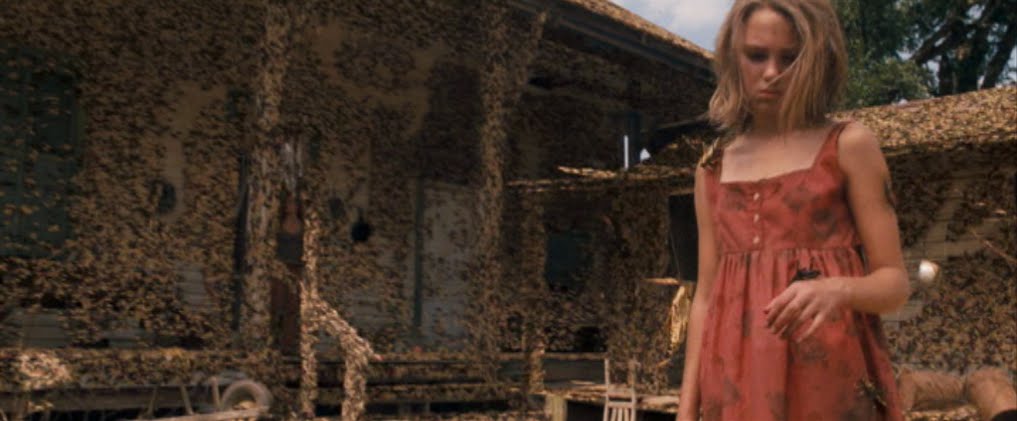
They arrive to a river whose waters have turned red. Lab result: blood. Ben witnesses a fall of frogs from the sky. Lice and flies attack a barbeque at the run-down colonial house where Doug is putting up Katherine and Ben, and where a mutual attraction is simmering away between Doug and Katherine. But before things can get too lovey-dovey, more plague-like activity is taking place, livestock keeling over and dying even though DNA samples indicate there’s nothing wrong with them. Katherine experiences strange dreams/hallucinations, as well as flashbacks to her disastrous experience as a minister in Africa, the fallout from which led her to turn her back on the church. Then there’s some spooky business involving her former mentor, Father Costigan (Stephen Rea), who comes to believe that Katherine is in danger.


Met with inexplicable indifference on its release, Stephen Hopkins’s ‘The Reaping’ is a gripping and atmospheric chiller that wrings maximum atmosphere from its small town setting (Haven has a David-Lynch-in-the-bayou kind of vibe) and benefits from a cluster of solid, understated performances. Swank plays Katherine as a skeptic with a margin for ambivalence, her logical and reasonable outlook skewed just enough by the vulnerability of her personal experience that she comes off as a rounded and sympathetic character rather than the Agent Scully clone she could easily have become in lesser hands. Rea’s hangdog look is employed effectively, his world-weary priest stumbling onto something cosmically bigger than he is equipped to deal with. Elba is also very good, conveying the calmness which belies Ben’s violent past; Elba plays what is essentially a character created for expositional purposes with a dignity that made me think of Morgan Freeman. I’ve seen little else of his work, but damn that needs rectifying!

Regarding AnnaSophia Robb: The Agitation of the Mind Award for Creepy Kid is in the mail. ’Nuff said.


Actor/writer brothers Carey and Chad Hayes deserve a mention for a screenplay that incorporates the ten plagues and Satanic cults without descending into abject cliché or hysteria and keeping things focused and slow-burn almost until the end. Which is where things almost – almost – tip over into parody. The plague is a well-effected and skin-crawling set-piece, only to be superseded by the fire from the sky part of things, which reminded me of nothing else than ‘The League of Gentlemen’s Apocalypse’. There were a few moments where I was thrown out of the film by the expectation of Papa Lazarou turning up and rasping “It’s my apocalypse now, Dave”. Or Hilary Briss agreeing a knock-down price for the dead cattle.

Fortunately, Hopkins is canny enough to not overplay his hand, and this sequence runs only as long as is necessary. The actual denouement is quieter and darker in its implications. Overall, ‘The Reaping’ works well. In the canon of supernatural-themed films which debate the existence, implications of and conflict between good and evil, most fixate on the chief players in the battle – the demon and the exorcist, the Satanist and the priest, the force of evil and the force of good. ‘The Reaping’, while paying its dues to the devil and the angels, never loses sight of the mortals caught in the middle.

Sunday, June 06, 2010

Million Dollar Baby

Posted as part of Operation 101010
Category: films with numbers in the title / In category: 3 of 10 / Overall: 38 of 100


Following his Oscar-winning masterwork ‘Unforgiven’ in 1992, Clint Eastwood spent the next decade alternating between by-the-numbers mainstream fare (‘Absolute Power’, ‘True Crime’, the fun for forgettable ‘Space Cowboys’) and more interesting projects (‘A Perfect World’, the uncharacteristic ‘Bridge of Madison County’, the uneven ‘Midnight in the Garden of Good and Evil’). None of them, however, quite hit the heights of ‘Unforgiven’, and by the time ‘Blood Work’ seeped onto cinema screens in 2002 it seemed like Eastwood was running out of steam.

Then, already in his 70s, Eastwood went hell for leather and produced, over the next eight years, an incredibly accomplished and impressive body of work: the unflinching Dennis Lehane adaption ‘Mystic River’, his first feature length documentary ‘Piano Blues’, the quadruple Oscar-winning ‘Million Dollar Baby’, the remarkably even-handed pair of war movies ‘Flags of Our Fathers’ and ‘Letters from Iwo Jima’, the somewhat over-amibitious ‘Changeling’ (perhaps the only Eastwood movie this decade that’s simply okay rather than anywhere between pretty goddamn good and freakin’ excellent), the powerhouse acting swansong ‘Gran Torino’ and the commendably old-school ‘Invictus’.

‘Million Dollar Baby’ is adapted from ‘Rope Burns’, a collection of short stories by F.X. Toole (the pen name of boxing trainer Jerry Boyd). It’s the story of people with broken lives trying to hold some semblance of dignity together while vying for a chance at the brass ring. Two of these people are old-timers: Frankie Dunn (Eastwood), a boxing manager and gym owner, and Eddie Dupris (Morgan Freeman), manager of said gym and a one-time prize fighter whose career went south.

Entering their lives like a whirlwind is Maggie Fitzgerald (Hilary Swank), scion of a white trash family, who waitresses in a greasy diner by day and pounds the bag by night. She wants to be a fighter; wants a title shot. And she wants Frankie to train her. Frankie’s not struck on the idea. When Maggie originally approaches him, Frankie’s first two questions are, “Do I owe you money?” and “Did I know your momma?” It’s not long before he quits asking questions and just takes to grunting that he doesn’t train girls.

Long story short, Frankie ends up training Maggie. He gets her a title shot. Paul Haggis’s script doesn’t contain any real surprises, but avoids cliché by focusing on Frankie and Eddie’s relationship (which seems to be founded on semi-good-natured bickering) as much as on the developing kinship between Frankie and Maggie. It’s established early on that Frankie’s estranged from his daughter. Maggie, scorned by her ungrateful family, is without a father figure (her dad died). It’s to Eastwood’s credit as director that none of the thuddingly obvious parallels that Haggis draws – or his thuddingly obvious lurch into tragedy for the final act – swamp the film with mawkish sentiment. It’s as if Eastwood took the script outside and set about it with a carpet beater (or maybe a baseball bat) until every bit of schmaltz had been knocked out of it.

That’s what I love about Eastwood as a filmmaker: there’s no false sentiment. Nothing phoney. His films – particularly in the latter stages of his directorial career – are shot through with wisdom and hard-won insight. They are stamped with the mark of experience.

‘Million Dollar Baby’ is a low-key and, by its final stretch, resolutely downbeat film. It is mostly a film of interiors: Frankie’s gym, Maggie’s dingy apartment, run-down diners, the backrooms of boxing halls, the boxing ring itself. Eastwood’s style is observational. The truest insights are in the smallest details. A ruefully amusing scene has Eddie, shoeless feet propped on the desk, earn Frankie’s disapprobation for having holes in his socks. Frankie offers him some cash up front to buy a new pair. Eddie pragmatically declines the offer: “I couldn’t swear it wouldn’t find its way to the track.” It’s a great moment: it tells you all you need to know about Eddie. Likewise, Frankie’s beat up old car and too-neat house tell you all you need to know about him.

Indeed, the only time the film slips into the obvious is the portrayal of Maggie’s family. Haggis’s script takes the easy option, painting them in one shade. But that’s the only quibble I have with ‘Million Dollar Baby’. For a film that won Eastwood Oscars for Best Picture and Best Director, a Best Actress gong for Hilary Swank and Best Supporting Actor for Morgan Freeman, it’s perhaps the least Oscar-baity film you’ll ever see.