Showing posts with label Studio Ghibli. Show all posts

Monday, September 14, 2015

From Up on Poppy Hill


Goro Miyazaki, son of Studio Ghibli founder Hayao, made his directorial debut in 2006 with ‘Tales from Earthsea’, an overly ambitious attempt to weave elements from the first four books of Ursula K. LeGuin’s ‘Earthsea’ saga into a single epic narrative. The result was intermittently awesome visually but a total clusterfuck as an exercise in storytelling. The world-building was confused and the characters ciphers. 

Mercifully, his second outing avoids all those mistakes. ‘From Up on Poppy Hill’ (2011) jettisons complex plotting in favour of character development – although, for its first half, this almost threatens to work to the film’s detriment. For a good 40 minutes, all that happens is some students at an academy protest the imminent closure and demolition of their clubhouse. Oh, and a very low-key romance develops between Umi (voiced by Masami Nagasawa) and Shun (Junichi Okada).

Then Miyazaki throws in an impediment to their nascent relationship so hefty that even Shun has the good grace to deem it as “something out a cheap melodrama”. I’ll leave this review spoiler-free; suffice it to say, it’s a plot device that’s been well-worked throughout the ages and is more in-keeping with histrionic psychological dramas than a U-rated nostalgic anime. Its resolution is no less creaky. None of which bodes well …

BUT …

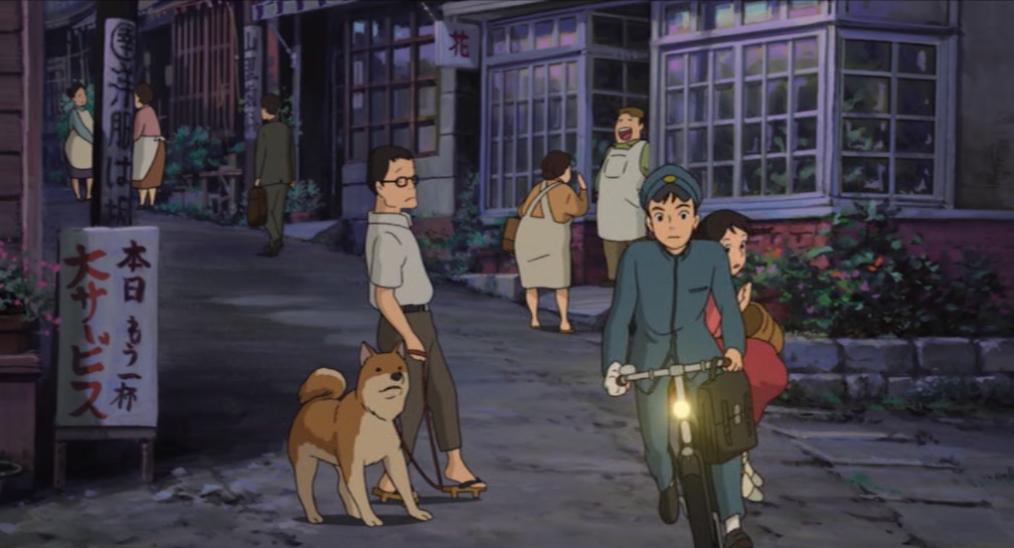
It’s just so utterly bloody gorgeous to look at. Even when nothing’s happening, as in the long opening sequence in which the minutiae of Umi’s day are observed in such detail you’d think Miyazaki was using a microscope instead of a set of storyboards, the evocation of a time and a place are effect with such visual beauty, in a such a glorious wash of colour, that it’s impossible not to be captivated.


Set in 1963 in a small harbour town, the film makes only one diversion from its self-contained and precisely defined locale for a sequence where Umi, Shun and their friend Shiro (Shunsuke Kazama) visit Tokyo. Miyazaki clearly relishes the juxtaposition, cramming his frames with imagery, energy and movement, bringing to life a metropolis gearing up for the 1964 Olympic Games. A similar sprightliness infuses the scenes of student life, particularly in wryly observed moment where two opposing factions snap from mutual animosity to well-oiled collusion in order to pull the wool over their tutors’ eyes.

The portrayal of Umi – her emotional vulnerability in sharp contrast to her can-do attitude and strong work ethic – suggests that Hayao Miyazaki’s career-long feminist sensibilities have been vouchsafed by his son. Tradition, responsibility and the innocence of childhood – also thematic staples of Hayao’s work – are also present here.

Various flashbacks to the war unravel the story that threatens to keep Umi and Shun apart, with a reference to the destruction of Nagasaki evoking Isao Takahata’s ‘Grave of the Fireflies’. The difference, of course, is that ‘Grave of the Fireflies’ didn’t offset its heart-wrenching account of the human cost of war with a rose-tinted, semi-comedic coming of age story.

And that’s the main flaw of ‘From Up on Poppy Hill’: its primary narrative is too insubstantial to carry the emotional weight of its subplot. I’m not sure, had the campaign to save the clubhouse been relegated to subplot material and the meddlings of fate in Umi and Shun’s past been the main focus, if the balance would have worked even then.


As it is, watching ‘From Up on Poppy Hill’ is to sit through a first half that simply requires you to appreciate some achingly beautiful images and then simultaneously wonder where the hell the big melodramatic humdinger came from and face-palm that anyone thought fit to include it in the first place. Without it, the film could have achieved the delightful, heartfelt simplicity and villain-free narrative of ‘My Neighbour Totoro’. Still, this is only Goro Miyazaki’s second feature, it’s a massive leap forward from his first, and (however the current production hiatus at Ghibli resolves) there is still time.

Friday, May 30, 2014

The Wind Rises


‘The Wind Rises’ is a fantasia on the magic – and dangers – of flight, a meditation on the weight of history, a statement on human fragility and the brief time we have together, and a fitting swansong for Studio Ghibli pioneer Hayao Miyazaki.

The operative word being “fantasia”. Miyazaki doesn’t attempt to forge a traditional biopic; indeed, what could be more fraught than trying to tell the life story of the guy who designed the Zero fighter. Even the film in its extant form has the long shadow of Pearl Harbor hanging over it.

Miyazaki’s protagonist is Jiro Horikoshi, but rather than draw from the designer’s own writings (he was a precise and eloquent diarist as well as penning the part-memoir part-technical book ‘Eagles of Mitsubushi: The Story of the Zero Fighter’), Miyazaki creates a fictionalised history inspired, in part, by Tatsuo Hori’s short story ‘The Wind Has Risen’. The title of this, and by truncation the film, owes to a quote from Paul Valery that opens the movie: “The wind is rising. We must try to live.” These lines are quoted several times during the film’s often leisurely 126 minutes.

For all that much of Horikoshi’s life is jettisoned, altered or completely fabricated – for instance, he had a brother, not the sister bent on becoming a doctor who is one of the film’s more important secondary characters; while the business about his wife’s illness and the sanatorium she’s sent to is straight out of Hori’s fictional work – Miyazaki wholly embraces a documented fact about Horikoshi’s life that might otherwise have languished as a piece of trivia: Horikoshi was a vivid dreamer, and he particularly dreamed of aircraft of his own design.

It’s hardly surprising that Miyazaki seizes on this concept from the off, introducing Horikoshi as a boy pouring over European magazines then taking to the skies in the first of several flamboyant and hyper-stylized dream sequences that leave you in no doubt that the director of ‘Porco Rosso’, ‘Laputa: Castle in the Sky’ and ‘Kiki’s Delivery Service’ is at the controls. Horikoshi’s dreams bring him into preternatural contact with Italian aviation guru Count Caproni – presumably Giovanni Battista Caproni, although it has been suggested that the character also stands in for Miyazaki himself – who serves as a mentor.

The Horikoshi/Caproni relationship not only allows for more delightful fantasias on flight, landscape and the purity of striving for a dream; it foreshadows the eventual bastardisation of Horikoshi’s aeronautical ideals. Caproni is variously depicted as designing a huge passenger aircraft that barely leaves the ground on its maiden flight before shattering apart, and building a far more successfully designed bomber for the Italian airforce. In a scene filled with gleeful hi-jinks, he takes scores of the neighbourhood children for a joyride in the bomber before he delivers it.

As Horikoshi matures from boy to student to designer to husband, he never develops Caproni’s rambunctious personality – he’s a quiet and somewhat introverted character – but he shares Caproni’s idealism (“aircraft are a beautiful dreamer” the Italian remarks, more than once) even if the nature of his vocation means that one’s national air force are more often than not one’s client. If Horikoshi remains something of a blank canvas throughout the film, it’s because he serves as a receptacle for so much of what has underpinned Miyazaki’s aesthetic as a filmmaker throughout his entire career.

Some friends have ruefully expressed a mild disappointment, saying they’d hoped Miyazaki would have returned to the magical mise-en-scene of ‘Spirited Away’ or ‘Howl’s Moving Castle’ for his last go-around. Personally, I find it entirely fitting that a world-class animator in the autumn of his career should bow out with a profound and dignified consideration of history, humanity, war and idealism – and do so entirely on his own terms.

Sunday, September 01, 2013

Hayao Miyazaki


So, Hayao Miyazaki has announced that he will no longer write and direct feature length animated films. At 72, the man’s certainly entitled to enjoy his retirement. But I can’t help thinking that animation will be so much poorer as an art form now he is withdrawing from the world stage.

Miyazaki’s filmography includes work for television, short features, and scripting and production duties, not to mention aesthetic guidance/input, on just about everything that bears the Studio Ghibli imprimatur.

He’s directed eleven features (links to where reviews exist on this blog) represent a stunningly coherent and visually imaginative body of work:

The Castle of Cagliostro

Nausicaa of the Valley of the Wind

Laputa, Castle in the Sky

My Neighbour Totoro (go here for image gallery)

Kiki’s Delivery Service (go here for image gallery)

Porco Rosso

Princess Mononoke

Spirited Away

Howl’s Moving Castle

Ponyo

The Wind Rises

Saturday, October 09, 2010

Visual Poetry: Kiki's Delivery Service


Kiki's Delivery Service

Posted as part of Operation 101010
Category: anime / In category: 10 of 10 / Overall: 97 of 100


How often have you seen a poster – usually for a children’s film, usually animated – which trumpets the movie as “magical”? How often has the epithet really only applied because magic (such as the ability, say, to fly) is the theme of said film? It’s one of those lazy descriptions that makes the ad man’s job so cynically easy.

Ladies and gentlemen, may I present Hayao Miyazaki’s warm, lovable and wholly life affirming animated classic ‘Kiki’s Delivery Service’, a film which not only proves itself that rarest of beasts – a work ostensibly for children (and, moreover, ostensibly for 13 year old girls) which genuinely is magical – but roots its sense of the magical firmly in the practicalities and responsibilities of everyday life.

Miyazaki’s work has always tended towards a strong feminist sensibility and here Kiki, a 13 year old witch-in-training who is obliged to spend a year away from home in the furtherance of her special powers, is cut from the same cloth as Sen in ‘Spirited Away’ and Satsuki in ‘My Neighbour Totoro’. All, for different reasons, find themselves far from home and move towards maturity through the necessity of a strong work ethic and the acceptance of their responsibility to others. The genius of Miyazaki is that none of this is forced down with sugar-coated insistence as would be the case in many a Hollywood production, but incorporated seamlessly into the narrative.

The other tenets of Miyazaki’s filmography are environmentalism and the love of flight. ‘Kiki’s Delivery Service’ just misses out on being the exemplar of Miyazaki’s ongoing themes and concerns by having very little in the way of an environmental subtext (claiming a scene involving a migratory group of wild geese as such would be pushing it a bit!); however, it rivals even ‘Porco Rosso’ in its big-hearted love of all things avionic.


Whereas the porcine hero of that derring-do action extravaganza pilots a seaplane, Kiki follows the time-honoured tradition of witches everywhere and reaches for the sky on a broomstick. It’s once she’s left home for her year away that she realizes she doesn’t really have a magical specialty beyond her (admittedly rather erratic) broomstick riding skills. After a misadventure that sees Kiki and her talking cat Gigi (the coolest and most laconic talking cat in cinema) stowing away on a goods train hobo-stylee, they arrive at a coastal town and try to fit in. The locals, though, are mainly sceptical.

Eventually, Kiki meets sympathetic bakery owner Osono who takes her in and gives her a job. Kiki, for whom self-deprecation is something of a tendency, considers the ability to fly the basic minimum for a witch-in-training and is kicking herself that she seems to have no other talents. Osono, however, recognizes that she has stumbled on an excellent and very motivated delivery girl. Kiki takes to the role with relish and quickly becomes self-sufficient.

That synopsis pretty much sums up the narrative developments of the first hour, and even though Miyazaki throws in a subplot about Kiki’s hesitant romance with teenage aviation fan Tombo which sets up a rescue mission involving a doomed dirigible for the edge-of-the-seat denouement, there’s not much in the way of plot. Instead, Miyazaki weaves a beautifully imagined series of vignettes detailing Kiki’s newfound friendship with an artist, her doubts and crises of confidence as she convinces herself she’ll always be an outsider, and her mixed feelings about Tombo (juxtaposed in witty fashion with Gigi’s feline romance with a neighbourhood cat), the latter exacerbated by an encroaching sense of homesickness.


With only the last reel plot development of Kiki’s sudden loss of powers providing any degree of conflict or drama (will she regain her capacity to fly in order to rescue Tombo when a freak accident afflicts the dirigible?), the film unfolds quite leisurely through its earlier stages. For the most part, the humour is light-hearted and good-natured (particularly an extended scene in which Gigi, doubling as a stuffed toy, is aided in his escape from a potential new owner by his supposed natural enemy, a dog) and Kiki’s adventures entertainingly episodic.

The final sequence goes for something deeper but without sacrificing the feelgood aesthetic that permeates the entire film. ‘Kiki’s Delivery Service’ is one of Studio Ghibli’s most purely enjoyable productions. It’s about growing up, gaining independence, and finding friendship and love. It’s about doubt, experience and determination. It’s as light as a soufflĂ© and as deep as the human heart. It contains everything I love about Studio Ghibli.

Friday, September 24, 2010

Grave of the Fireflies

Posted as part of Operation 101010
Category: anime / In category: 6 of 10 / Overall: 77 of 100


Tim at Antagony & Ecstasy undertook a complete retrospective of Studio Ghibli earlier this year. Click here for his review of ‘Grave of the Fireflies’. It describes an almost identical emotional response to the film as that which I had. It does so more eloquently than I could hope to.

Read Tim’s review, then – if you feel there’s anything more that needs to be said – pop back here and read my thoughts.

As a recent convert to anime, I’ve already experienced what long-term anime fans must have put up with for years on end to the point at which they’re probably ready to throttle the next person who says it to them. The scenario: you’re talking to someone who’s never seen an anime. They’re not entirely sure what the word even means. You elucidate. You mention some of your favourite titles. You pick something by way of recommendation that is easily accessible: a good anime starter kit (I normally tip a nod to ‘Kiki’s Delivery Service’ or ‘Spirited Away’, the non-anime aficionado at least standing a chance of having heard of the latter due to the Oscar). They listen politely, a frown slowly sketching its way across their brow. You finish talking. They give you a sideways glance, pause for a moment as if debating whether to give voice to it or not, then say, “But they’re, like, cartoons right?”

I now have a response to this. I will simply lend my copy of ‘Grave of the Fireflies’ to anyone who says that, or any variation of it, from now on. When they return it, I’ll ask whether they cried. Anyone who says no is either clinically dead or a liar.

A brief digression: I never used to cry much at films. Even as a kid, seeing ‘E.T.’ at the age of seven or eight, sitting in an auditorium full of children of a similar age all of whom had been reduced to lumps of blubbering jelly, I remained resolutely dry-eyed. ‘Titanic’? I felt like crying – but only at the waste of five quid and three hours of my life I’d never have again. I didn’t even blub at the end of ‘Toy Story 3’. But … I fucking blubbed ten minutes into ‘Up’, oh hell yeah. Big style at the end of ‘Shadowlands’; I remember exiting the Showcase, stumbling across the car park and sitting in my car for a good ten minutes before I was in an appropriate state to drive. The “it’s not your fault” scene in ‘Good Will Hunting’? Pass the Kleenex. ‘It’s a Wonderful Life’ – first scene and last scene, every damn time.

It’s a funny thing. Some movies just hit me. Others try to and I resent that their directors are so blatantly trying to manipulate me. One of the great masters of emotional manipulation – to such a degree, in my opinion, that it borders on emotional pornography – is Steven Spielberg. I didn’t cry at ‘Schindler’s List’. In fact I got annoyed at it.

Which means I can’t take the easy route and call ‘Grave of the Fireflies’ the ‘Schindler’s List’ of anime. To do so would be a disservice. Apart from a late-in-the-game use of Amelita Galli-Curci’s syrupy rendition of ‘There’s No Place Like Home’ on the soundtrack (this in a film whose protagonists’ home is destroyed about five minutes in), writer/director Isao Takahata doesn’t put a foot wrong or try to sugar-coat the grimness of his material with a coating of sentimentality.

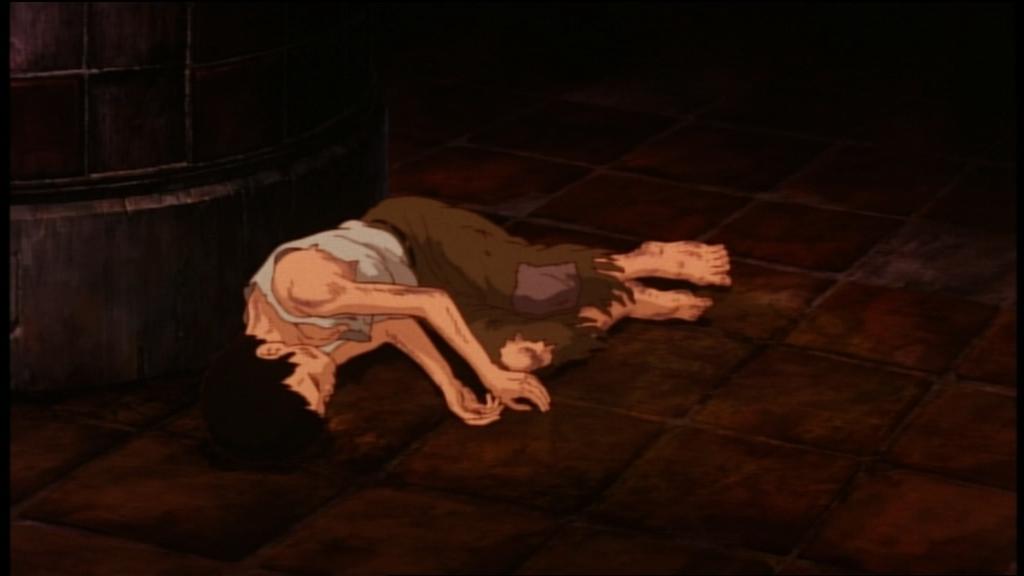
This isn’t to say, however, that he doesn’t find moments of genuine beauty, poignancy and humanity amidst the suffering. How much suffering? Well, the story starts with teenage Seito and his younger sister Sesuko surviving an air raid over rural Japan that destroys their home. Finding their way to a makeshift hospital in the grounds of a school, Seito discovers his mother, hideously injured and almost mummified in bandages. He’s old enough and savvy enough to know that she stands no chance of recovery, but elects not to tell Sesuko.

Fetching up at the home of their aunt, a staunch patriot who berates Seito for not “serving his country” (never mind that Seito’s father is an admiral in the navy) and whose snide, petty judgementalism finally drives Seito and Sesuko out of her house and into the woods where they establish a makeshift home in an old shelter that no-one else uses and do their best to fend for themselves.

‘Grave of the Fireflies’ – and if you’re wondering about the significance of the title, it’s explained in a scene which is truly heartbreaking – can best be described as being about the resilience (not the triumph, it’s too honest a movie to fob you off with that) of the human spirit. It’s about how – in the midst of conflict, uncertainty and sudden death – a slender thread of humanity can spin itself out even as hunger and deprivation deplete the body and hope threatens to ebb from the soul.

I really don’t want to say too much about this film. I don’t want to describe its narrative beyond the broad strokes I’ve already given. I don’t want to discuss how poignant the framing device is. I don’t want to reveal why it’ll break your heart, open your tear ducts and leave you feeling like you’ve been through everything its painfully young heroes endure – just that it will.

‘Grave of the Fireflies’ is a work of terrible beauty, as quietly poetic as it is overwhelmingly intense. It is at once a celebration and a lament, a hymn and a howl of outrage. It treats its material more effectively and with more emotional responsibility than most live action films of a similar ilk. I still have many more anime titles to discover, explore and appreciate, but I’m already confident that this will prove itself one of the most important.

Thursday, March 04, 2010

Ponyo

Posted as part of Operation 101010
Category: anime / In category: 3 of 10 / Overall: 17 of 100


‘Ponyo’ is a deceptive film. The story – an instantly recognisable take on Hans Christian Andersen’s ‘The Little Mermaid’ – is straightforward and unencumbered by subplots or a proliferation of supporting characters Ă  la ‘Spirited Away’ or ‘Howl’s Moving Castle’; and yet Miyazaki communicates as much about the wide-eyed joyful innocence of childhood as he did in ‘My Neighbour Totoro’, as much about the environment and mankind’s often destructive relationship to it as he did in ‘Nausicaa of the Valley of the Wind’, and as much about responsibility and the work ethnic never mind the youthfulness of the protagonist as he did in ‘Kiki’s Delivery Service’.

By the same token, ‘Ponyo’ seems to have the simplest visuals of any Studio Ghibli production. As Tim has pointed out in his absolutely spot-on review at Antagony & Ecstasy, “The gentle look of the film, halfway between watercolors and colored pencils, gives ‘Ponyo’ the certain air of an illustrated storybook.” Tim develops this observation to note that ‘Ponyo’ has the effect of rendering any adults in the audience – and there were a few at the mid-afternoon screening I attended – “to a more infantile state”. Again, absolutely true. Even I stopped being a grumpy old sod for an hour and three quarters (well, except when I wasn’t entertaining murderous thoughts about the little bastards in the front row who wouldn’t stop talking; not to mention the parents/guardians with them who obviously didn’t give a crap*) and simply ended up staring at the screen in bliss and gratitude.

Why bliss? Because ‘Ponyo’ is a dreamily beautiful fable, flawless in its conception, and feelgood in a way that American cinema can seldom do without tipping over into emotional manipulation. The story is simple, but arguably all the more heartfelt for being simple. The characters are immensely appealing (even though I didn’t have the option of seeing this in a subtitled cut and had to put up with Miley Cyrus’s younger sister and an equally prepubescent member of the Jonas clan squeakily providing vocals for Ponyo and Sosuke), the undersea world is riotous blaze of life and colour, and the story’s one and only turn into darker territory (matters relating to a storm which threatens to flood an entire community) is done so excitingly that I doubt even the youngest viewer would find it too scary.

Why gratitude? Because in an age where the majority of child-friendly animated films are CGI, Studio Ghibli continue to produce old school 2D animation with a zest and imagination that makes you wonder why anyone would want to boot up a computer when they could simply draw. And in ‘Ponyo’, they have taken story so sweet and unpretentious – so slight – that it could easily have been risible, and made of it instead a work of art.


*My fault for attending a matinee screening during half term week, I guess.

Saturday, February 06, 2010

My Neighbour Totoro

Posted as part of Operation 101010
Category: anime / In category: 1 of 10 / Overall: 9 of 100


If I’d seen ‘My Neighbour Totoro’ two years ago when I drew up the Personal Faves list (with its caveat of two films per director maximum) I would have included it in a heartbeat. As it is, I selected ‘Spirited Away’ and ‘Howl’s Moving Castle’ to represent Miyazaki’s oeuvre.

The more I’ve explored the Studio Ghibli output (mainly at my wife’s urging: ’twas she who introduced me to anime), the more I’ve come to regret including ‘Howl’s Moving Castle’ on the PF list. Sure, it’s a great film – and one of the few Ghiblis to benefit from its dubbed English language soundtrack, mainly thanks to Billy Crystal’s best work in ages as the voice of the fire demon Calcifer – but I’ve come to realise that I much prefer ‘Porco Rosso’ and ‘Kiki’s Delivery Service’ to ‘Howl’s Moving Castle’. And based on just one viewing, I have no hesitation in ranking ‘My Neighbour Totoro’ as one of the jewels in Studio Ghibli’s crown.

My only reservation over Miyazaki’s work has been a tendency, in just a very few films, to over-earnestness that threatens to render tone and pace sluggish even as the visuals soar. A very minor quibble, though, particularly when those visuals are just so damn gorgeous.

‘My Neighbour Totoro’ is Miyazaki’s gentlest, simplest, most lyrical film. The plot hardly matters (but just for the record: pre-teen Satsuki and her four-year-old sister Mei move to the country with their father while their mother recuperates in hospital; Mei meets the spirits of the forest; said spirits come to the rescue when Mei gets lost after an argument with Satsuki; the end) – what is important is the detail, the evocation of childhood and the countryside, and the life-affirming reconciliatory final sequence.

Mei’s first encounter with the otherworldly comes in the form of the soot gremlins (these li’l fellas …

… whom you may recognize from ‘Spirited Away’) who occupy the nooks and crannies and rafters of the family’s bath-house. They flee whenever Mei comes near them. Determined to sneak up on them, she inadvertently discovers the existence of other creatures. These guys, to be exact:


Like the soot gremlins, they beat a hasty retreat. Mei laughingly pursues them through the forest. The forest deepens; trees seem closer together; branches interlace. But none of this scares Mei or detracts from her innocent delight in discovering the creatures and chasing playfully after them. Emerging into a clearing, she encounters Totoro.

One of the most lovable aspects of ‘My Neighbour Totoro’ is how completely it celebrates childhood. Satsuki and Mei’s father is good-natured and attentive; he loves his children but isn’t over-protective. When Mei talks about Totoro, he doesn’t dismiss her claims as the product of her imagination but tells her she was lucky to have met one of the spirits of the forest. He also instills in his daughters an appreciation (and respect) for the natural world. Environmentalism is a key theme in Miyazaki’s work, but whereas films like ‘Nausicaa of the Valley of the Wind’ and ‘Princess Mononoke’ are intense and challenging in the way they make their point, ‘My Neighbour Totoro’ incorporates the theme in a very genial and lyrical manner.

Mei’s innocence, exuberance and delight in the smallest of things is mirrored by Totoro himself. A lovely scene has Satsuki and Mei waiting for their father at a bus stop. Mei, tired from a long day, has had a piggy-back ride from Satsuki and is falling asleep even as she clings to her sister. Despite a heavy rain, Satsuki uncomplainingly waits at the stop. From beneath her umbrella, held low so that it covers both herself and Mei, she sees someone take up position next to them. Someone large, furry and with claws. As Mei did before her, Satsuki makes the acquaintance of Totoro. The creature (I was about to type “monster”, but a less monstrous ten-foot clawed being I can’t imagine; even Sully from ‘Monsters Inc’ is edgier than this guy) has a leaf on his head, from which the pooling raindrops plop onto his nose. This would probably annoy most of us. Totoro seems to like it. Satsuki passes Totoro a spare umbrella and mimes to him how to use it. Totoro gets the picture and hoists it above his head. The leaf/raindrops/nose scenario is consequently curtailed, much to Totoro’s puzzlement. The rain patters on the umbrella. The noise perks his senses. Then a much larger, denser drop of water detaches itself from an overhanging tree branch and impacts on Totoro’s umbrella with a thud. He’s delighted. It happens again. Totoro emits a joyous roar, throws out an arm and leaps into the air. He comes back down heavily and a cascade of pooled rainwater showers down from the leaves. The commotion wakes Mei, who grins in delight that Totoro has joined them.

It’s a simple – almost wistful – scene, devoid of narrative purpose but rich in detail (Miyazaki lingers on the single light that sheds a dim yellow light into the rainswept night; on the pools of rainwater; on a frog that wryly observes Totoro from the other side of the road) and eloquently nuanced with only barest of dialogue. It concludes in abrupt burst of energy as Totoro’s bus arrives. The bus is a cat. Yes, you read that right. No, I didn’t make it up. I have the screengrab to prove it.

Totoro and the cat-bus rally around Satsuki when an unparalleled argument between the sisters, exacerbated by concerns that their mother has suffered a potentially life-threatening relapse, sees Mei disappear into the countryside, trying to walk to the hospital. While this sequence might seem like the only real dramatic incident in the film, it’s actually the culmination of several downplayed but poignantly observed moments that demonstrate how Satsuki is on the cusp of adolescence, particularly in her slowly developing friendship with a boy from a neighbouring household, while Mei remains a wide-eyed and effusive child, fascinated by the world around her and all the magic and mystery it holds.

It is Miyazaki’s refusal to overstate this aspect (much as he refuses to over-sentimentalize the almost obligatory happy ending) that makes ‘My Neighbour Totoro’ the purest, warmest and most immediately likeable of his films.