Sunday, September 26, 2010

Dead Snow

Posted as part of Operation 101010
Category: Eurovisions (Norway) / In category: 8 of 10 / Overall: 81 of 100


With neighbouring Sweden quick to declare neutrality, Norway suffered the brunt of Nazi oppression as brutally as any other occupied country. The Norwegian Resistance remain one of World War II’s least celebrated underground movements, certainly in terms of cinematic representation. I can think of only two: Sunday afternoon favourite ‘Heroes of Telemark’ (an overly Hollywoodized account of the sabotage of a heavy water plant) and ‘Max Manus’ (aka ‘Man of War’), which I’ve not seen but apparently stirred up controversy in Norway, some reviewers accusing it of glorifying Resistance acts which resulted in harsh reprisals against Norwegian citizens.

One day, someone will make the definitive Norwegian Resistance movie. A movie that celebrates the heroism of the underground fighters and is honest about the hardships they endured. A movie that is brave enough to tackle the moral complexities and grey areas of the subject and doesn’t just simply paint the German characters as a batch of straight-out-of-central-casting rent-a-Hun type.

In the meantime, though, there’s ‘Dead Snow’.

Which is about Nazi zombies. In Norway.
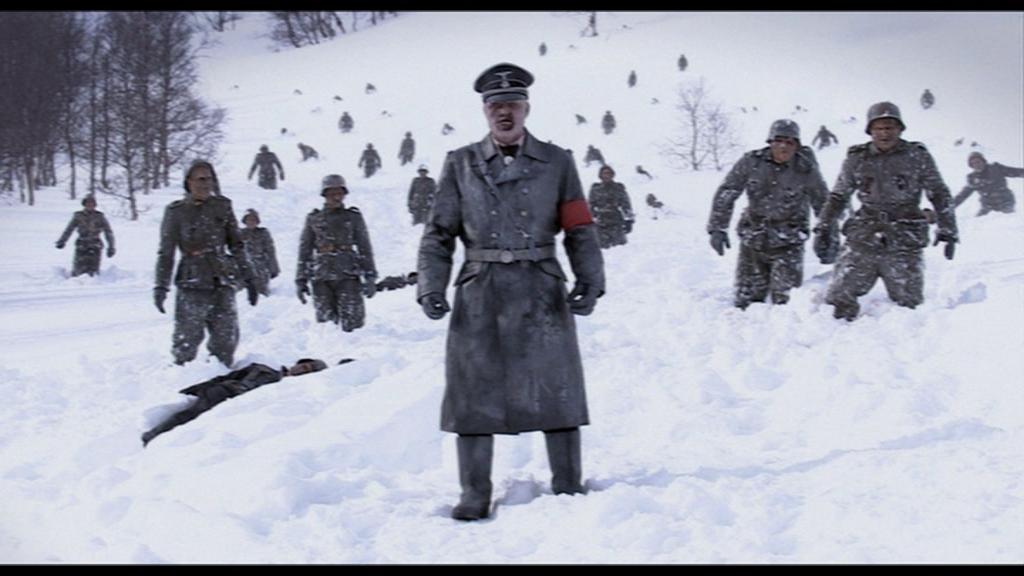
It’s a strange quirk of cinema that there are more Nazi zombie movies than there are movies about the Norwegian Resistance. It’s perhaps less surprising that most of them are truly dreadful. Jean Rollin’s ‘Zombie Lake’ – whose production values were so bargain basement it should have been retitled ‘Swimming Pool of the Zombies’ – springs to mind.

‘Dead Snow’ is easily the best Nazi zombie movie I’ve seen. That in itself isn’t saying much. Although it’s entertaining, properly gory, often darkly funny and all done in the worst possible taste (the shithouse sex scene with the finger-sucking: eeeeeeeewww), it’s hard to escape the feeling that you’ve seen it all before.

Let’s take a whistlestop tour through the delights of ‘Dead Snow’ with parenthetical observations where similar tropes have previously been employed: a group of students (pick your favourite 80s stalk ‘n’ slash franchise) repair to a remote cabin in the wilds (let’s just go with ‘Cabin Fever’ and leave it at that, the article will get too long otherwise) for the purposes of drinking, shagging (pick your favourite 80s stalk ‘n’ slash franchise) and extreme sports (‘High Lane’). During the first evening there, a vaguely creepy old guy turns up and tells them of the horror that happened there many years ago (‘The Fog’).

The students discover some hidden treasure which is connected with the macabre events (‘The Fog’) and decide to divvy it up. Bad decision. In short order, several of their number are decimated by zombies (anything with ‘Dead’ in the title) while the others try to barricade the cabin against the flesh-eating hordes (‘Night of the Living Dead’) who turn out to be an undead Nazi platoon (‘Zombie Lake’, ‘Shock Waves’). When an attempt to fight them off goes tits up and the survivors almost immolate themselves in an accidental fire (‘Night of the Living Dead’), they decide to make a run for it.


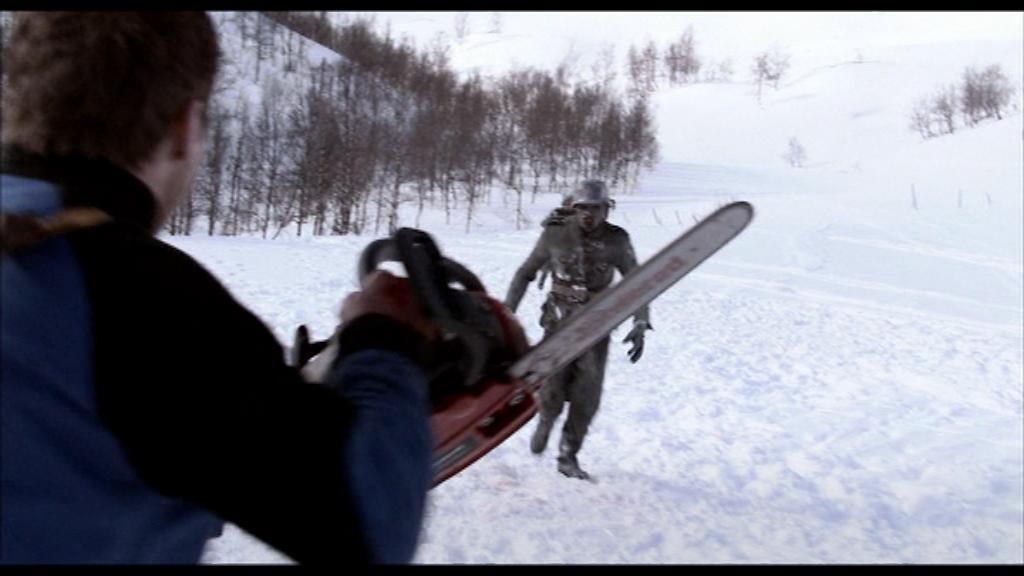
There’s more: two characters take on a bunch of zombies using some things they find in a shed (‘Shaun of the Dead’); a second wave of zombies appear towards the end, rising from beneath the ground, decomposing hands reaching upwards (‘Carrie’); a scene of gruesome black comedy is wrought from someone’s intestines spilling out (‘Dog Soldiers’); likewise from a makeshift chainsaw arm amputation (‘Evil Dead 2’); there’s some derring-do off a precipitous ledge (‘Where Eagles Dare’); and a character tries to assuage the zombies, late in the game, by giving the gold back (‘The Fog’ again).

‘Dead Snow’ doesn’t have a single original idea. And while this is forgivable in many films – particularly trashily entertaining horrors – much of the fun in recycling tropes and trading in clichés and stereotypes comes from how imaginatively filmmakers can subvert or satirize them. The only subversiveness going on in ‘Dead Snow’ is that – for a Norwegian film – it happily lets loose the Nazi horror on the fjords all over again and cheerfully watches its hapless protagonists get killed off by them.

The biggest disappointment, though, not just with ‘Dead Snow’ but with the small handful of other Nazi zombie titles I’ve seen, is that it takes an awesome concept – Nazi zombies!! fuckin’ zombies who are Nazis!!! – and does absolutely nothing with it. At the end of the day, it’s just the same zombie movie you’ve seen before, whether it was made it Pittsburgh or London, except the zombies are wearing uniforms. Maybe one day someone will make the definitive Nazi zombie movie, where the threat becomes so widespread that a band of desperate citizens form an underground resistance movement …

The Double Life of Veronique

Posted as part of Operation 101010
Category: Eurovisions (Poland) / In category: 7 of 10 / Overall: 80 of 100


Made just prior to his swansong ‘Three Colours’ trilogy, Krzysztof Kieslowski’s ‘The Double Life of Veronique’ is an autumnal work: elliptical, enigmatic and sublimely beautiful. The film won the International Critic’s Jury Prize for Best Film at Cannes, as well as Best Actress for Irene Jacob – to whom the epithet “enigmatic and sublimely beautiful” also applies.

Opening with vignettes depicting two identical young girls – one Polish, one French – experiencing a small moment of childhood wonder, Kieslowski spends the next half hour charting the life of the Polish girl, Veronika, now in her mid twenties, as she progresses from talented music student to trained soprano about to make her professional debut. Then the unexpected happens and, in France, Veronique’s love-making with her well-meaning but bland boyfriend is interrupted as a feeling of intense melancholy afflicts her.

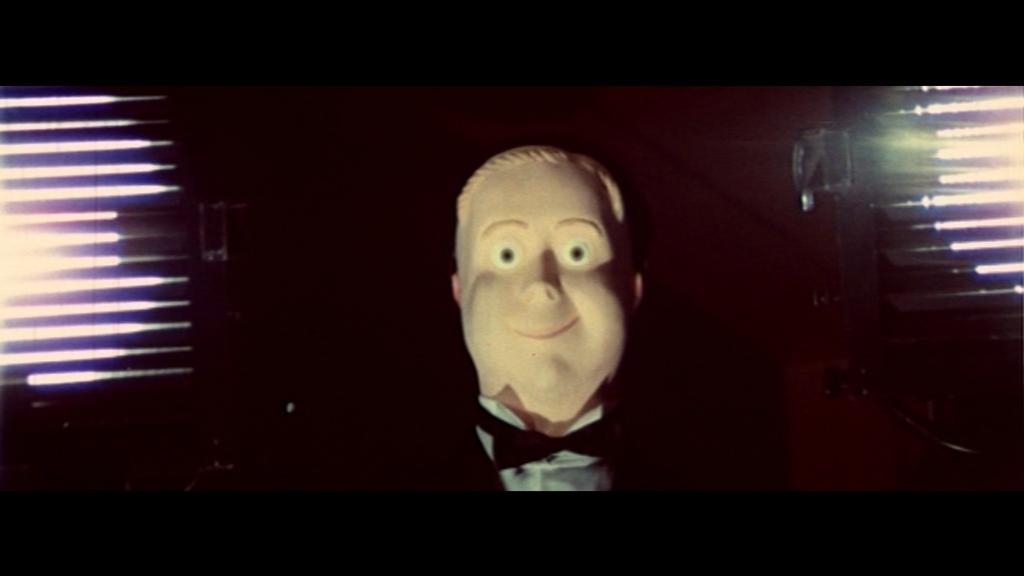
Veronique, also a singer, decides to abandon her vocation. She ekes out a living as a music teacher. One day, classes finish early and the kids are entertained by a marionette show. The puppeteer, also a children’s author with ambitions of writing “a novel, a real book”, catches Veronique’s eye. Later, she receives cryptic gifts in the mail and finds herself inexplicably drawn to this quiet, intense stranger.

As the title intimates, ‘The Double Life of Veronique’ is about duality. About mirrored lives. Kieslowski subtly integrates this theme into the fabric of the film. His heroines are often captured in reflection: in mirrors, or in the windows of trains, buses or shops. Elsewhere, images, perceptions and POVs are refracted or distorted: through lenses, through marbles, through stained glass.

Parallels exist through incidents in Veronika and Veronique’s lives. Both have a childhood injury. Both have close relationships with their doting fathers. Both bear witness to old women struggling through the day (a reminder, perhaps, of their absent mothers?). Veronika worries about the legal matters her elderly aunt is consulting a lawyer about; Veronique agrees to lie in court to expedite a friend’s divorce proceedings.

Kieslowski never forces these points of comparison. Nor does he provide any explanation of what connects Veronika and Veronique – although a momentary glance as a tourist coach passes through Krakow provides Veronika with the knowledge that she has a double – but leaves it up to the viewer to tease out the connections and interrelationships from the web of ambiguity, suggestion and poetic images that he weaves with the elegance and assurance of a mature and accomplished artist.

European double bill

Two very different European films coming up today, yet both - in their own way - touching on concerns of national identity, cultural differences and the mysterious psychological imports which define the individual.

Oh, who the fuck am I kidding? One's a Kieslowski film that pretty much ticks all the art movie boxes, and the other's got Nazi zombies in it.

Stay tuned ...

Saturday, September 25, 2010

Ludwig

Posted as part of Operation 101010
Category: biopics / In category: 5 of 10 / Overall: 79 of 100


For anyone who’s not familiar with it, ‘Ludwig’ is Luchino Visconti’s epic account of the eccentric life and mysterious death of King Ludwig II of Bavaria. It stars, in the title role, that monarch of the two-by-four timber yard school of acting, Helmut Berger. It’s glacially paced. Whole scenes play out as dialogue-heavy tableaux. It runs nearly four hours.

Even by Visconti’s standards, it’s a long haul. In the time it would take to watch ‘Death in Venice’ (two hours five minutes), Ludwig has just got started building the elaborate fairytale castles that would bankrupt his kingdom. By the time the sweeping saga that is ‘The Leopard’ (two hours forty minutes*) would be ending, Ludwig hasn’t even got round to his little homo-erotic interlude in a log cabin with a bunch of strapping young men, some of whom engage in a little knee-slapping morris dancing (I am not making this up). There’s still his removal from the throne, incarceration and unexplained death to come.

Nonetheless ‘Ludwig’ exerts a strange fascination. It’s as if, in Visconti’s obsession with painting the screen with the tiniest of historical details, a form of hypnosis is taking place. “Painting” is an apposite description. Visconti and his cinematographer Armando Nannuzzi treat each frame of celluloid as a Rennaissance artist would a vast canvas. Even at its most static, ‘Ludwig’ is a work of exceptional visual beauty.

It’s a shame, though, that so much of the film is static. As Visconti proved with ‘Death in Venice’, made a year before ‘Ludwig’ in 1971, the movement of a character through a milieu that defines or destroys them (as in von Aschenbach’s melancholy peregrinations through Venice) can say so much more than screeds of expository dialogue. There is a superb, wordless sequence in ‘Ludwig’ following the resignation of a member of the monarch’s cabinet over the grotesque misspending on the ornate, ostentatious and unoccupied castles. The individual in question fires off a report to Ludwig’s cousin, Empress Elisabeth of Austria (Romy Schneider), before he steps down. Elisabeth, perturbed, decides to visit one of the castles for herself. A beautiful, somewhat imperious woman, bedecked in finery and attended by a lady-in-waiting, she is dwarfed by the opulence of Ludwig’s chosen style of architecture; rendered almost insignificant by the grand baroque folly of room after cavernous room. Her reaction slowly ebbs from childish delight to a wordless realization of the extent of her cousin’s obsession.


Romy Schneider offers arguably the most memorable performance in the film, even though she was initially reluctant to participate. She had already played Elisabeth between 1955 and 1957 in Ernst Marischka’s trilogy ‘Sissi’, ‘Sissi: The Young Empress’ and ‘Sissi: The Fateful Years of an Empress’ – if you’ve never seen them, or the single-film English-dubbed edit ‘Forever My Love’, then imagine a chocolate box morphing into several reels of film and you’re halfway there – and struggled to prove herself a serious actress as a result. Fortunately, Visconti persuaded her and the result is a flintier and more penetrating interpretation of Elisabeth, the luminous Schneider reclaiming in fine style the role that almost typecast her.

Hers is not the only commendable performance. Gert Frobe (of ‘Goldfinger’ fame) does fine work as Father Hoffmann, the priest who tries to inspire Ludwig to lead his people rather than succumb to his own personal predilections. Trevor Howard is excellent as Wagner, likewise Silvana Mangano as Cosima von Bulow (later to be Mrs Wagner). Visconti includes – with no narrative reason but reveling in the sheer loveliness of the moment – Wagner’s Christmas gift of the newly composed ‘Siegfried-Idyll’ to Cosima, musicians lining the stairs and hallway of their house to serenade her as she emerges from her boudoir.

Berger’s performance might have proved the film’s Achille’s heel, but while his line readings are sometimes the stuff of amateur dramatics, he embodies Ludwig’s emotional anguish, sexual ambiguity and mental fragility to surprisingly impressive effect.

Overall, ‘Ludwig’ contains much of what usually leaves me cold about biopics, including its superannuated running time. In the hands of a journeyman director and without the stellar supporting performances, ‘Ludwig’ would be a drag. As it is, it demands enough from the viewer that you can’t just watch it casually. Visconti is one of those deeply committed, profoundly intelligent directors for whom the medium is an art form; his work sorts out the cineastes from the film fans.


*I’m basing this on the UK release most commonly shown on British TV. To the best of my knowledge, there are at least half a dozen versions of ‘The Leopard’ of vastly different running times. Visconti’s original cut clocked in at three hours and twenty five minutes – which is still shorter than ‘Ludwig’.

The Place Promised in Our Early Days

Posted as part of Operation 101010
Category: anime / In category: 7 of 10 / Overall: 78 of 100


Following his acclaimed short film ‘Voices of a Distant Star’ in 2002, Makoto Shinkai released his debut feature ‘The Place Promised in Our Early Days’ two years later. Picking up Best Animated Film at the Mainichi Film Awards and a Technical Excellence Award at the Tokyo International Anime Fair, the buzz was enough to earn him the sobriquet “the new Miyazaki”.

I almost feel sorry for him. You don’t inherit a mantle like that without having to brace yourself against an inevitable backlash. Imagine being called the new Scorsese, the new Cartier-Bresson, the new Iain Banks, the new [insert name of favourite artist in any medium] … you’re being asked to fill some pretty big shoes, as well as being freighted with the weight of an unreasonable expectation.

So how does ‘The Place Promised in Our Early Days’ measure up? Well, there’s a hint of Miyazaki in Shinkai’s obvious love of flight. There’s even, in the broadest strokes, an evocation of Miyazaki’s environmental concerns (although in Shinkai’s film the threat to the planet comes from something very different than the ravages mankind is inflicting on it). None of Miyazaki’s feminist sensibilities are in evidence, even though the heroine plays a major part. Another point of departure is Shinkai’s leaning towards sci-fi tropes whereas Miyazaki tends to embrace a more outright fantasy-based milieu.

There’s enough evidence, then, to make the comparison, but just as much to argue for an appraisal of Shinkai as an artist in his own right. And, with the caveat that the narrative doesn’t quite benefit from as much attention as the aesthetics and the structure is a tad fussy, it has to be said that ‘The Place Promised in Our Early Days’ is an assured, impressive and often achingly beautiful film.


Shinkai spends the first twenty minutes or so establishing the location, the characters and the backdrop of increasingly fraught international politics against which the rest of the film will play out. The setting is a divided Japan. The border between the Union and the Alliance (their political differences and the history and extent of the schism are somewhat foggy) falls near the Hokkaido (now renamed Eko) province. Our two protagonists, soon to be equally divided, are Hiroki and Takuya. Precociously talented students, they are obsessed with a nearby tower on the Union side: needle thin and seeming to reach the clouds, its purpose is a mystery. Hiroki and Takuya combine their technical knowledge, resources and funds and attempt to build a light aircraft which will carry them to the tower.

Given the natural order of things, you can’t be that age, that inseparable and that fixated on a project like building your own plane without a girl coming between you. Cue sensitive, violin-playing Sayuri who kindles romantic feelings in Hiroki but seems to form a platonic attachment to both of them. The boys get part-time work for a defence contractor whose business is increasing as political tensions mount. The US, frustrated in their attempts to inspect the mysterious tower, applies increasing pressure.

Thus far, Shinkai paints a poignant and slightly melancholy portrait of young adulthood poised on the loss of innocence and gives his protagonists the space to develop. Suddenly, though, the story leaps ahead three years and without a whisper of exposition we’re plunged into Takuya’s new lifestyle working as a military researcher trying to establish the role of the tower in the integration of a parallel universe into our world, matter from the parallel universe gradually expanding to “overwrite” the Earth. This sci-fi element is so abruptly incorporated that you almost seem to be watching a different film.

Meanwhile, Hiroki has moved to Tokyo to complete his education. Armed patrols are on the streets, tanks and materiel being moved on trains. Despondent and alone, he dreams of Saruyi. Then he discovers that, soon after he and Takuya parted company – leaving the aircraft unfinished – Sayuri fell into a coma which is in some way connected with the tower and the parallel universe; she is now being kept under observation at a military facility. Meanwhile Okabe, the boys’ old boss at the munitions factory, has joined an underground movement who plan to destroy the tower.


After the lethargically paced, character-driven first twenty minutes, it’s as if the narrative engages warp drive. The story breathlessly races from Eko to Toyko and back again, by way Sayuri’s dream world. The tone veers from downbeat romantic drama to high-concept sci-fi to resistance-themed war movie a la ‘Heroes of Telemark’. The climax, as the boys’ finally completed aircraft circles the tower on a life-or-death, everything-in-the-balance mission, comes on like ‘Porco Rosso’ reimagined by Douglas Sirk.

In many a movie, this degree of aesthetic schizophrenia would prove insurmountable. Yet somehow – somehow – Shinkai brings it all together. There are flaws, but overall the filmmakers’ vision is so persuasive and the quality of the animation so breathtakingly gorgeous that it doesn’t seem to matter. ‘The Place Promised in Our Early Days’ is a film to revisit, not for the characters or the story, but just to gaze at.

SOMETHING FOR THE WEEKEND: Barbara Bouchet in Don't Torture a Duckling


Friday, September 24, 2010

Normal service is resumed

After a fortnight of hijacking friends' computers, I am finally solvent again, my debt to T-Mobile has been settled and once again I have internet access at home.

Which means that my hit-and-run reviewing schedule designed to complete Operation 101010 by 10.10.10 is looking more or less feasible. Stay tuned for a cavalcade of posts over the next fortnight.

Stay tuned, as well, for the resumption of all things sultry, slinky and seductive as Something For The Weekend makes its triumphant return, a little after midnight, with the downright delectable Miss B— … ah, but that would be telling.

See you on the wrong side of the witching hour …

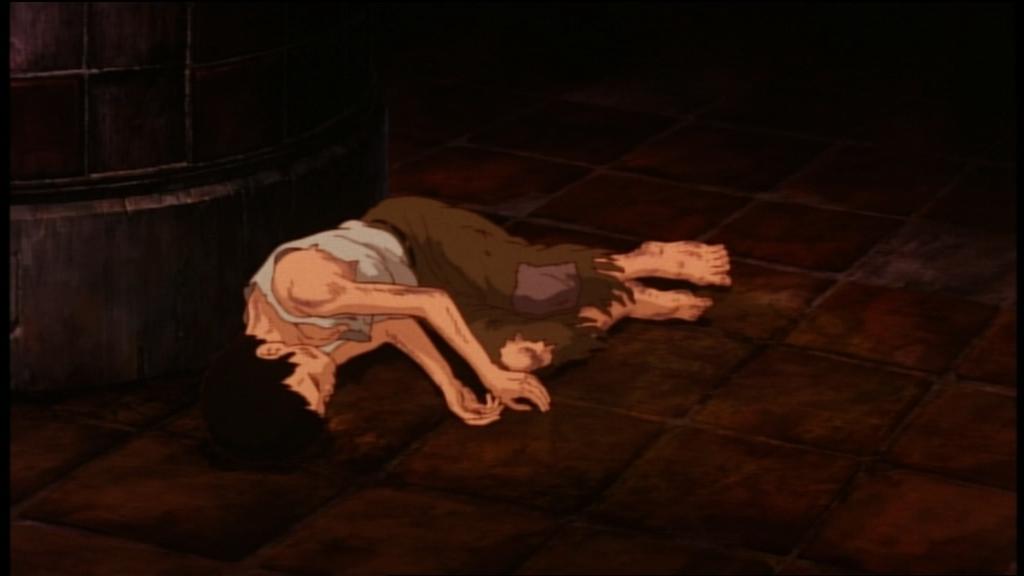
Grave of the Fireflies

Posted as part of Operation 101010
Category: anime / In category: 6 of 10 / Overall: 77 of 100


Tim at Antagony & Ecstasy undertook a complete retrospective of Studio Ghibli earlier this year. Click here for his review of ‘Grave of the Fireflies’. It describes an almost identical emotional response to the film as that which I had. It does so more eloquently than I could hope to.

Read Tim’s review, then – if you feel there’s anything more that needs to be said – pop back here and read my thoughts.

As a recent convert to anime, I’ve already experienced what long-term anime fans must have put up with for years on end to the point at which they’re probably ready to throttle the next person who says it to them. The scenario: you’re talking to someone who’s never seen an anime. They’re not entirely sure what the word even means. You elucidate. You mention some of your favourite titles. You pick something by way of recommendation that is easily accessible: a good anime starter kit (I normally tip a nod to ‘Kiki’s Delivery Service’ or ‘Spirited Away’, the non-anime aficionado at least standing a chance of having heard of the latter due to the Oscar). They listen politely, a frown slowly sketching its way across their brow. You finish talking. They give you a sideways glance, pause for a moment as if debating whether to give voice to it or not, then say, “But they’re, like, cartoons right?”

I now have a response to this. I will simply lend my copy of ‘Grave of the Fireflies’ to anyone who says that, or any variation of it, from now on. When they return it, I’ll ask whether they cried. Anyone who says no is either clinically dead or a liar.

A brief digression: I never used to cry much at films. Even as a kid, seeing ‘E.T.’ at the age of seven or eight, sitting in an auditorium full of children of a similar age all of whom had been reduced to lumps of blubbering jelly, I remained resolutely dry-eyed. ‘Titanic’? I felt like crying – but only at the waste of five quid and three hours of my life I’d never have again. I didn’t even blub at the end of ‘Toy Story 3’. But … I fucking blubbed ten minutes into ‘Up’, oh hell yeah. Big style at the end of ‘Shadowlands’; I remember exiting the Showcase, stumbling across the car park and sitting in my car for a good ten minutes before I was in an appropriate state to drive. The “it’s not your fault” scene in ‘Good Will Hunting’? Pass the Kleenex. ‘It’s a Wonderful Life’ – first scene and last scene, every damn time.

It’s a funny thing. Some movies just hit me. Others try to and I resent that their directors are so blatantly trying to manipulate me. One of the great masters of emotional manipulation – to such a degree, in my opinion, that it borders on emotional pornography – is Steven Spielberg. I didn’t cry at ‘Schindler’s List’. In fact I got annoyed at it.

Which means I can’t take the easy route and call ‘Grave of the Fireflies’ the ‘Schindler’s List’ of anime. To do so would be a disservice. Apart from a late-in-the-game use of Amelita Galli-Curci’s syrupy rendition of ‘There’s No Place Like Home’ on the soundtrack (this in a film whose protagonists’ home is destroyed about five minutes in), writer/director Isao Takahata doesn’t put a foot wrong or try to sugar-coat the grimness of his material with a coating of sentimentality.

This isn’t to say, however, that he doesn’t find moments of genuine beauty, poignancy and humanity amidst the suffering. How much suffering? Well, the story starts with teenage Seito and his younger sister Sesuko surviving an air raid over rural Japan that destroys their home. Finding their way to a makeshift hospital in the grounds of a school, Seito discovers his mother, hideously injured and almost mummified in bandages. He’s old enough and savvy enough to know that she stands no chance of recovery, but elects not to tell Sesuko.

Fetching up at the home of their aunt, a staunch patriot who berates Seito for not “serving his country” (never mind that Seito’s father is an admiral in the navy) and whose snide, petty judgementalism finally drives Seito and Sesuko out of her house and into the woods where they establish a makeshift home in an old shelter that no-one else uses and do their best to fend for themselves.

‘Grave of the Fireflies’ – and if you’re wondering about the significance of the title, it’s explained in a scene which is truly heartbreaking – can best be described as being about the resilience (not the triumph, it’s too honest a movie to fob you off with that) of the human spirit. It’s about how – in the midst of conflict, uncertainty and sudden death – a slender thread of humanity can spin itself out even as hunger and deprivation deplete the body and hope threatens to ebb from the soul.

I really don’t want to say too much about this film. I don’t want to describe its narrative beyond the broad strokes I’ve already given. I don’t want to discuss how poignant the framing device is. I don’t want to reveal why it’ll break your heart, open your tear ducts and leave you feeling like you’ve been through everything its painfully young heroes endure – just that it will.

‘Grave of the Fireflies’ is a work of terrible beauty, as quietly poetic as it is overwhelmingly intense. It is at once a celebration and a lament, a hymn and a howl of outrage. It treats its material more effectively and with more emotional responsibility than most live action films of a similar ilk. I still have many more anime titles to discover, explore and appreciate, but I’m already confident that this will prove itself one of the most important.

Wednesday, September 22, 2010

Four Flies on Grey Velvet

Posted as part of Operation 101010
Category: gialli / In category: 9 of 10 / Overall: 76 of 100


The third of Dario Argento’s so called "animal trilogy", ‘Four Flies on Grey Velvet’ has virtually bugger all to do with its predecessors except for sharing a bit of wonky science with ‘Cat o’ Nine Tails’. Even calling it the "animal trilogy" is a misnomer: ‘The Bird with the Crystal Plumage’ and ‘Four Flies on Grey Velvet’ reference birds and insects respectively, while a line of Karl Malden’s dialogue pinpoints the title of ‘Cat o’ Nine Tails’ as "the old naval whip".

The divergence of ‘Four Flies on Grey Velvet’ from Argento’s first two films is important. In ‘The Bird with the Crystal Plumage’, Sam Dalmas (Tony Musante) is powerless to prevent a murder and haunted by the certainty that he saw something important, some clue, something he can’t quite put his finger on. In ‘Cat o’ Nine Tails’, Franco Arno (Karl Malden) overhears someone talking about blackmail – and possibly murder – but Franco is blind and, unable to identify them, relies on the assistance of reporter Carlo Giordani (James Franciscus).

Dalmas and Arno are bystanders who turn amateur sleuth when they find themselves in the wrong place at the wrong time and the police prove incompetent. Such tropes are staples of gialli. Roberto Tobias (Michael Brandon) in ‘Four Flies on Grey Velvet’, however, doesn’t conform to the archetype. As Maitland McDonagh puts in it ‘Broken Mirrors, Broken Minds’, "he’s a transitional protagonist who bridges the gap between the relative innocents – Dalmas, Arno, Giordani – and the relatively guilty – Marc Daly in ‘Deep Red’ and, most spectacularly, Peter Neal in ‘Tenebrae’."

Also, ‘Four Flies on Grey Velvet’ is that rare example of a giallo where the police – incompetent or not – are entirely absent. Tobias has good reason not to turn to them. The drummer in a pretty average rock band, Tobias gets the feeling he’s being followed. In short order, he goes from paranoid to just plain annoyed. Turning the tables by following the follower, Tobias confronts the man in a deserted theatre. A knife is pulled. They struggle. The man plunges from the stage. As Tobias, confused and scared, stands holding the bloody knife, the beam of a stage light hits him and a masked figure in one of the balconies raises a camera and snaps a series of incriminating pictures.


Pictures which turn up in the mail. Pictures which are left at Tobias’s house after a party. It’s as if, he confides to his drop-out friend Godfrey (Bud Spencer), he’s being blackmailed. Yet there are no demands for money. When his tormentor breaks into the drummer’s house one night and gets the drop on him, Tobias intuits a darker motive: the masked man wants to kill him. Here ‘Four Flies on Grey Velvet’ makes another departure from the giallo rulebook: Tobias doesn’t play amateur sleuth in order to unravel the mystery; nor is he left to puzzle the meaning of an important but hitherto overlooked clue. The only thing Tobias fixates on is a recurring dream about someone getting beheaded.

Godfrey (God for short) recommends a private eye, the camp and generally incompetent Arrosio (Jean-Pierre Marielle), a man who has yet to solve a single case but is convinced that, by the law of averages, he’s bound to solve this one. It’s Arrosio who does all of the sleuthing in ‘Four Flies on Grey Velvet’, and he only enters the proceedings round about the halfway mark. So what does Tobias do during all of this? He sends his highly strung wife Nina (Mimsy Farmer) away, dallies with her foxy cousin Dalia (Francine Racette), ignores all suggestions that he leave town or tell the police everything and, finally, sits it out in his apartment, gun in hand, waiting for his nemesis to turn up.

All told, Tobias is a pretty shabby hero, and the people who surround him are no less so. His relationship with Nina is falling apart. He seems distant from his bandmates. His only real friends are vagrants. His housekeeper figures out early on who’s behind the mask but rather than take the information to Tobias or to the police enacts a blackmail scam which brutally backfires. Neither Tobias’s victim or his assailant are what they seem. Gender concepts are skewered. An element of troilism both sexual and psychological is at work.

‘Four Flies on Grey Velvet’ is one of Argento’s least seen works, thanks to its long-standing unavailability. I first saw it as a horrible, washed-out, panned-and-scanned pirate video. A few years ago I stumped up for a German DVD on import; the assemblage was a complete version, but taken from two sources which accounted for intermittent blips in quality. It’s dark and murky film even in a decent print, with arguably its creepiest sequence – the housekeeper waiting for the blackmail money in a gradually emptying public park as dusk draws on – played out as a symphony of shadows.

Many of the key scenes take place at night or in low-lit places – the confrontation in the theatre; Tobias menaced in his own home; Dalia hiding from an unseen intruder; Tobias’s stand-off with the killer; the abrupt and ironic coda on which the film closes – with only Tobias’s recurring dream of the beheading providing a hard glare of light.

Even the occasional touches of humour are cynical and nasty: Tobias surreptitiously meeting Godfrey at an undertakers’ convention; Arrosio, the butt of homophobic stereotyping from the outset, finally cracking a case when it’s too late to savour his victory; the Tobias’s dream/killer’s fate juxtaposition which ladles on the tombstone humour with a gravedigger’s shovel. McDonagh’s right – Tobias provides a link from the beleaguered heroes of the first two films to the compromised and complicit protagonists of Argento’s later work – but in its concept and structure (if not quite achieving the same bravura aestheric) ‘Four Flies on Grey Velvet’ is every bit as cynical and gut-wrenching as ‘Deep Red’ or ‘Tenebrae’.

Tuesday, September 21, 2010

It Happened One Night

Posted as part of Operation 101010
Category: comedies / In category: 9 of 10 / Overall: 75 of 100


Frank Capra’s 1934 Oscar-grabber (four gongs: Best Picture, Best Director, Best Actor, Best Actress) pretty much sets the standard for romantic comedies. It’s also a pretty good road movie. Made now, and with the main characters and narrative tropes intact – mismatched couple; bullish rich father; truculent newspaper editor; gabby wiseass with an angle to play; poor little rich girl culture clash set-pieces; a running joke about sleeping arrangements; a final obstacle that almost puts the kibosh on the burgeoning romance; a runaway bride denouement – the content would seem clichéd, but that’s only because Capra marshals his material with such aplomb, creating a sparky and quick-witted classic, that Hollywood has spent seven and a half decades tirelessly cribbing from it.

Do I need to recap the plot? Probably not, but this’d be a damn short review otherwise so here goes. Socialite Ellie Andrews (Claudette Colbert) escapes house arrest – or rather yacht arrest – and goes on the run from her father (Walter Connolly) who is aghast at her impulsive marriage to the ridiculously named King Westley (Jameson Thomas) and is determined to keep her under lock and key while his lawyers have the union nullified. While Andrews hires private detectives and manipulates the media in order to find his daughter, Ellie meets rumpled and recently fired journalist Peter Warnes (Clark Gable). When Peter finds out who Ellie is, he sees her as his meal ticket back into a job: the inside story on a media brouhaha that – during their four days on the road – sweeps America. Ellie, bristling at Peter’s commonness, nonetheless realises she needs him to get to New York and Westley.

Capra, intuitive enough to know that between Robert Riskin’s script (from a story by Samuel Hopkins Adams) and his stars’ chemistry he didn’t need to impose any directorial stylisations on the proceedings, keeps things moving along at a fair pace but otherwise lets the zinging dialogue and the Gable/Colbert double act speak for itself.

The road movie element of ‘It Happened One Night’ has a real sense of movement and distance being covered, whether by bus (until a washed out bridge halts progress), hitch-hiking, wading barefoot across rivers or the rickety and undependable progress of a less-than-legally acquired jalopy ("How did you get the car?" "I traded him a black eye for and left him tied to a tree").

The romantic comedy element consists almost entirely of Ellie and Peter bickering, usually about their differences in perception, experience and social background. The techniques of hitching; the art of dunking doughnuts in coffee; whose father gave the best piggyback ride when they were kids – there’s nothing these two won’t argue about. And the more absurd their disagreements, the funnier.

Capra has fun puncturing Peter’s salt of the earth/man of the people persona: he calls Ellie "brat" for most of the movie and talks himself up as Mr Capable, but half the time he’s lovably incompetent (check out the classic hitch-hiking scene where Peter works through a repertoire of thumbing to avail and Ellie stops her car on her first attempt by flashing an expanse of bare leg) while elsewhere, despite his veil of cynicism, he’s a perfect gentleman. His warning off of the predatory Shapeley (Roscoe Karns), who has also recognised Ellie and figures he can make some easy money, is one of many inspired set-pieces and an early indicator that his own motivations are starting to crumble under a genuine protectiveness towards Ellie.

Examples of Capra’s trademark feelgood aesthetic abound – Ellie giving their remaining money to a distraught young boy; a rousing singalong which unites the disparate passengers on a long and tedious bus journey; Ellie’s father coming through for her in fine style at the end – yet ‘It Happened One Night’ isn’t as swamped in sentimentality as many of his other films. There’s a bit of bite and attitude to it. Some of the social mores and colloquialisms are dated, but it remains remarkably fresh and energetic; 76 years down the line, there’s still a swagger in its step and a glint in its eye.

Monday, September 20, 2010

The Stendahl Syndrome

Posted as part of Operation 101010 (and to coincide with Asia Argento's 35th birthday)
Category:
gialli / In category: 8 of 10 / Overall: 74 of 100


The opening scene in Dario Argento’s ‘Phenomena’ has a young teenage girl left behind on a school trip and murdered by an unseen killer. Her face is smashed through a glass window. She’s decapitated and her head plunges into a river and is carried along by the raging current. The schoolgirl is played by Fiore Argento, the director’s daughter.

The opening scene in ‘The Stendahl Syndrome has Detective Anna Manni attend the Uffizi Gallery in Florence where, afflicted by the titular psychological condition, she suffers a fainting spell, falls and catches her mouth on the corner of a marble plinth, blood spattering across the cool floor of the gallery. The policewoman is played by Asia Argento, the director’s other daughter.

All things considered, Fiore got the better deal. As ‘The Stendahl Syndrome’ progresses, Anna is targeted by Alfredo Grossi (Thomas Kretschmann), a serial rapist who has just started adding murder to his repertoire. He’s present at the gallery, where he steals her gun and finds out where she lives while she’s unconscious. Shortly afterwards, she’s attacked in her home and sexually assaulted. Passing out, she regains consciousness in Alfredo’s car where he’s busy assaulting another woman, who he casually murders in front of Anna. She escapes and, at the behest of the police psychologist, returns to her home town to recuperate. Alfredo follows her and, despite a round-the-clock guard posted by the local constabulary, stages an abduction. More rape follows.

What the fuck was going through Argento’s head when he cast his then 20-year old daughter in this role is not something I want to think about. What it must have been like on set boggles the mind. What kind of direction did Argento give Kretschmann, for Christ’s sake? “Okay, Thomas, in this scene you’ll be raping Asia for about five minutes, she’ll roll back her head as if she’s about to pass out, so you’ll slap her a couple of times to keep her awake, then you’ll take a razor blade out of your mouth and we’ll get to the really good part of the scene. Did I mention I’m her father, by the way?”

It’s this aspect – dude directs his daughter getting psychologically tormented and brutally raped for the first half of the film – that gives me such a hard time with ‘The Stendahl Syndrome’. Any other actress (um, except Fiore Argento of course) and the gruelling scenes between Alfredo and Anna would still be as provocative and uncomfortable; as it is, they’re provocative and uncomfortable for the wrong reason: an almost incestuous, meta-textual reason that takes you out of the narrative and the characters’ lives and reminds you that you’re watching a film.

Anything that throws you out of a film or a book by reminding you that you’re experiencing a piece of fiction that has been manufactured is by its own definition a serious flaw. If you’re subsequently unable to re-engage with that film or book on the same level, then it’s a flaw that characterises the work as a failure. So is ‘The Stendahl Syndrome’ a flawed work or a failure?

Personally, despite my reservations about Argento’s casting decisions, I’d be hesitant to deem it a failure. Although I stand by my assertion, made elsewhere on this blog, that ‘Phenomena’ remains the last great Argento film – ‘Phenomena’ caps a run of at least half a dozen truly great movies whereas ‘The Stendahl Syndrome’ follows the moderate disappointments of ‘Two Evil Eyes’ and ‘Trauma’ and preceeding everything from the fuck-awful ‘Phantom of the Opera’ to the bargain basement ‘Mother of Tears’ – it can’t be denied that‘The Stendahl Syndrome’ takes some interesting turns, benefits from committed and passionate performances from its leads, and has the distinction of being the last truly visually accomplished work on Argento’s CV.

It’s the very concept that allows Argento to go crazy in some of the early scenes. Stendahl syndrome – named after the novelist (best known for ‘The Scarlet and the Black’) – also known as hyperkulturemia results in the sufferer undergoing psychosomatic symptoms in the presence of works of art or overwhelming natural beauty. Argento opens the film with a wordless seven-minute sequence that tracks Anna’s journey to and around the Uffizi Gallery, generating a sense of the off-kilter right from the outset. Inside, visceral and sometimes grotesque Renaissance canvases and sculptures seem to overwhelm her. As she loses consciousness, Argento depicts her plunging into one of the paintings. Later, in one of the film’s best moments, a fully conscious Anna finds herself drawn to – and then into – a huge canvas depicting a waterfall (the location becomes meaningful as events take a darker turn).


If nothing in the second half of the film matches the bravura of these moments (indeed, Anna seems to overcome the Stendahl Syndrome), Argento makes the bold decision to change horses in midstream and turn a psychosexual cat-and-mouse thriller into a study in aftermath. A shade after the hour mark, he delivers a scene most directors would have saved for the climax, then has Anna slowly try to reintegrate into a normal life following her trauma at Alfredo’s hands. She changes her appearance, undergoes a series of brittle appointments with her psychologist, and tentatively begins a relationship with a sensitive young art student. Then she thinks she sees Alfredo on a crowded street.

Between Anna’s transformation from brunette to blonde and the directorial sleight of hand surrounding a late-in-the-game murder, the Hitchcockian parallels are explicit. Anyone who’s been paying attention will see where Argento’s going with the denouement long before a riverbank revelation leaves the film with only one possible outcome. While no more downbeat than the ending to, say, ‘Deep Red’ or ‘Tenebrae’, it’s emotionally downbeat whereas those films are viscerally downbeat. Nonetheless, Argento plays fair with the ending and doesn’t try to sweeten it with any false notes of reassurance.