Monday, October 04, 2010

Resident Evil: Degeneration

Posted as part of Operation 101010
Category: anime / In category: 9 of 10 / Overall: 90 of 100


Does ‘Resident Evil: Degeneration’ count as an anime? I don’t know, but I’m on the home stretch of Operation 101010 and I figure ‘Degeneration’ ticks three boxes worthy of inclusion: it’s a Japanese production, it’s animated (albeit from motion capture) and it’s a fuckload better than the Paul W.S. Anderson live-action instalments in the franchise.

Full disclosure: I’m not a gamer and my only exposure to ‘Resident Evil’ has been the aforementioned affronts to the filmmaker’s art. The first movie was just about serviceable and at least had a convincing action heroine in Milla Jovovich. The second had a couple of halfway decent set-pieces but offered little other justification for its existence. The third was a patchwork quilt of borrowings from other (better) movies, enlivened only by the addition to the cast of Ali Larter as Claire Redfield.

It’s Claire Redfield, rather than Jovivich’s Alice, who is the central character in ‘Degeneration’. The story picks up seven years on from the Racoon City outbreak, finally contained after the military nuked the place, and Claire has just arrived at Harvardville airport. There, she notices the presence of political protestor Curtis Miller, a campaigner demanding the government release the truth about Racoon City, but thinks no more of it. Then an airliner crashes into the main airport building, a horde of zombies spill out of it and chaos ensues.

Claire finds herself holed up with corpulent Senator Ron Davies, a man who knows more about this new outbreak than he’s letting on. Their escape from the airport – a tense and excitingly staged sequence that occupies most of the first third of the movie – is enabled by Claire’s fellow Racoon City survivor Leon S. Kennedy and SWAT team member Angela Miller … who happens to be Curtis’s younger sister. And with Curtis the number one suspect and a deadline engendered by terrorist threats fast approaching, these mismatched allies are forced to work together as it soon becomes apparent that no-one else is to be trusted.

With a plot that plays like a throwaway episode of ‘The X Files’ pumped full of steroids and populated by zombies, more action per square inch than the whole of Anderson’s offerings put together and a script that values exposition and pacing above quality of dialogue, ‘Resident Evil: Degeneration’ is formulaic but value-for-money entertainment. The animation is variable, the characters generally well rendered facially but often awkward in their body movements, whereas vehicles, hardware, buildings, backgrounds, gore and explosions are vivid in their detail. The vocal cast sleepwalk their way through line readings, however. Unsurprisingly, I guess, given how clunky the script is.

Still, if you a fan of zombies, military/political/pharmaceutical conspiracies (here represented by WilPharma, the new corporate bad guy in town after the downfall of the Umbrella Corporation), snivelling Machiavellian types in suits getting what’s coming to them, and kick-ass chicks with guns doling out zombie-killing, conspiracy-exposing justice, then ‘Resident Evil: Degeneration’ has guilty pleasure written all over it.

Sunday, October 03, 2010

Cold Fever

Posted as part of Operation 101010
Category: Eurovisions (Iceland) / In category: 10 of 10 / Overall: 89 of 100


Hirata (Masatoshi Nagase) is holding down a soulless corporate job in Tokyo, wasting his evenings watching trashy TV in his shoebox apartment and counting down the days till his golfing holiday in Hawaii. Then his grandfather reminds him of his filial obligation to conduct a ritual of remembrance at the place of this parents’ death.

His parents died in Iceland.

On arrival, he is immediately shepherded onto a coach which takes him, not to Reykjavik as per his itinerary, but to a spa called the Blue Lagoon. It’s the first – and certainly least surreal – of a series of misadventures which take Hirata across Iceland to the remote riverside spot where his parents met their untimely end. His trip from the Blue Lagoon to Reykjavik is made courtesy of a taxi driver who makes a detour to participate in a farmyard nativity, and a lift in a Scania truck whose payload appears to be a male voice choir.


On his first night in Reykjavik, Hirata meets a woman who tells him they have a strong psychic connection and proceeds to sell him her car, insisting that it has the right “aura” for a cross-country trip. Personally, I’ve never driven a Citroen DS so I can’t speak for its karmic qualities, but our first glimpse of it doesn’t bode well.

Against his better judgement, Hirata buys the car and sets out on an epic drive armed with a map he can barely read while the Citroen’s radio malfunctions almost immediately, sticking on the most annoying radio station in Iceland. Freezing from the cold, acutely conscious of the language barrier (Iceland’s almost nationwide second language is English, of which Hirata speaks only a little), his journey is variously helped and hindered by Laura (Laura Hughes), an English woman who “collects” funerals; Jack (Fisher Stevens) and Jill (Lili Taylor), a bickering American couple who use sock puppets to talk to each other when their rows reach a certain point; a strange Icelandic girl who may be a ghost and who can scream at a banshee-like pitch capable of shattering ice caps; a hotel full of Icelandic cowboys participating in a ram competition (yes, that’s right: a competition to determine who has the best male sheep); and Siggi (Gísli Halldórsson), a hard-drinking pragmatist who helps Hirata to complete his journey, the final stages undertaken by horse and an on-foot crossing of a distinctly unsafe bridge.


Made a few years before ‘The Straight Story’, Fridrik Thor Fridriksson’s quirky road movie has a similar good-natured quirkiness to David Lynch’s odyssey-by-tractor masterpiece. Hirata is a sanguine and likeable hero (even his occasional badly-aimed kick at the recalcitrant Citroen is comedic rather than petulant). He’s an affable everyman, an innocent abroad, a stranger in a strange land. And Fridriksson’s Iceland is definitely strange. There’s also a hint of Jim Jarmusch, probably in the influence of Jim Stark, producer of several Jarmusch movies, who co-wrote the screenplay.

Ari Kristinsson’s cinematography is a marvel, capturing the stark natural beauty of Iceland, an aesthetic Fridriksson reinforces by having the opening Tokyo scenes shot in 1:33 ratio in fairly tight and clustered compositions, then expanding the screen to 2:35 as Hirata’s flight descends over Iceland and the vast landscape which will define his journey stretches out in snowy solitude beneath him. It’s a breathtaking moment, brilliantly executed, and the film becomes stranger and visually more beautiful as it progresses.

The final sequence, Siggi’s selfless assistance bringing Hirata to the river, is profound, low-key and sensitively done. It’s the point at which ‘Cold Fever’ becomes more than just another entertainingly quirky indie film, and achieves something spiritual and meaningful.

The Doors

Posted as part of Operation 101010
Category: biopics / In category: 7 of 10 / Overall: 88 of 100


This isn’t exactly breaking news, but I’ll say it anyway: Oliver Stone is not a subtle director.

Oliver Stone is cinema’s answer to a coke fiend, maniacally shooting from every possible angle, darting around, camera in hand, trying to capture a spirit dancing or the world on fire; a dreamer possessed by the Tasmanian Devil, powering chaotically through each film, madness exploding around him, his camera whirring away. Riding the high into the editing room, crazily sculpting masses of footage into epic and cathartic renderings, despatches from the path of excess.

Sometimes excess becomes self-indulgence and the experience is akin to turning up at a Rammstein concert fucked out of your brains on peyote and standing right in front of the lighting rig yelling “mein herz brennt” even though they finished playing that one half an hour ago and now they’re rumbling through that really scary one about the cannibal dude.

Other times – ‘Nixon’ springs to mind – you get the impression that Stone seems to be holding back and you can’t help wishing he’d throw in a scene where Tricky Dicky drops acid and fills the missing 18 minutes of tape with a expletive-laden stream of consciousness about flying armadillos on suicide missions against China while chugging from a bottle of Wild Turkey and watching go-go dancers gyrate around the Oval Office.

And then there are times when Stone’s full-throttle, bludgeoningly unsubtle style finds itself perfectly in tune with his subject matter. Which brings us to ‘The Doors’. I was 19 when ‘The Doors’ came out. I didn’t really know their music beyond “Light My Fire” and “Break on Through”. I went to see the film because I’d enjoyed ‘Born on the Fourth of July’. When it ended, I went straight to a record shop and bought the OST. In short order, I acquired all of The Doors’ albums (and, thanks the presence of ‘Heroin’ on the soundtrack, all of the Velvet Underground’s) as well as a couple of biographies of Jim Morrison, John Densmore’s autobiography ‘Riders on the Storm’ and a collection of Morrison’s poetry.

In the unlikely event of Oliver Stone ever stumbling across this review: gracias, amigo.

‘The Doors’ is exactly the kind of movie you should first encounter in your late teens. It’s got sex, drugs and rock ‘n’ roll (or in this case, acid rock). It’s loud and dazzling and it flips a big fat raised middle finger in the face of authority. It idolizes every example of its protagonist’s bad boy behaviour. It considers excessive drinking, abusive behaviour and the odd bit of dabbling in black magic a perfectly acceptable way to get your kicks before the whole shithouse goes up in flames (to quote one of Morrison’s more piquant rationalizations). It buys into every myth about Morrison’s life and revels in them. It tells you that the ’60s were better than today because the music was cooler, the chicks were hotter and the drugs got you higher.

And it doesn’t really matter if that was the case or not; you’re along for the ride and it’s quite possible you’ll be riding the snake, breaking on through and hearing the scream of the butterfly. I have no idea how accurate Stone’s portrayal of the ’60s is – I didn’t turn up until 1972 – but I strongly suspect it’s an impressionistic version of the time. No complaints: as a wise man once said, when the truth becomes the legend, print the legend.

Val Kilmer, as Morrison, gives a career best, nailing the man’s charisma, nonchalance and rebellious swagger; his vocals match the original recordings almost exactly. Kyle Maclachlan, Frank Whaley and Kevin Dillon – as Ray Manzarek, Robbie Krieger and John Densmore respectively – all do sterling work, and certainly look the part. Meg Ryan acts dopey and confused in the thankless and underwritten role of Morrison’s longtime girlfriend Pamela Courson. Elsewhere, Crispin Glover’s take on Andy Warhol borders on parody, Christina Fulton makes for an icily voluptuous Nico, and Kathleen Quinlan makes one hell of an impression as Patricia Kenneally. (Incidentally, Kenneally herself cameos in the film, as does Densmore.)


Stone shoots the whole thing with demonic energy, creating a restless symphony of continual sound, movement and sensory experience. Sometimes it’s like a bad trip and you wonder if a quick detour to the methadone clinic might be in order. Sometimes it’s a real blast and you kind of wish you were there, doing whatever hellish cocktail of liquor and proscribed substances that passed for the normal calorific intake of Morrison & co and maybe getting lucky with some hippie chick group with a commitment to free love and a disinclination to wearing a bra. In other words, ‘The Doors’ is your own personal time machine to a ’60s you never had.

Saturday, October 02, 2010

The Cove

Posted as part of Operation 101010
Category: documentaries / In category: 10 of 10 / Overall: 87 of 100


There are some real annoyances about not having much money at the moment. It means I have to stick with the cheapest package from my DVD rental club (2 titles per month), additions to the collection haven’t been as plentiful as I’d like and cinema-going has dropped to an all-time low. It also means that I don’t have the wherewithal to, say, hop on a plane to Japan, catch a train to the coastal community of Taiji, buy a baseball bat and pound the everloving shit out of the first fisherman I come across.

Whoa! I hear you say. What’s with Neil the psycho boy? Why the anti-fisherman diatribe? It’s not like you’ve never had a fish ‘n’ chip supper before!

Ah, well. The fishermen of Taiji do things a little bit differently. They’re not after cod, haddock, plaice or anything else you’d dip in batter and deep fry. No, these boys are after dolphins. A dolphin’s main sensory function is sonic. So when the dolphin run passes Taiji between September and March, the boats come out, metal poles are lowered into the water and our non-RSPCA approved fisherfolk bang on them with hammers. This panics the dolphins, who are then driven towards shore and corralled off by huge nets in a cove hidden from view of the mainland.

Dolphin trainers from aquaria (is that the plural of aquarium?) turn up and take the pick of the bunch, a live dolphin selling for up to $150,000. What happens to dolphins who don’t make the cut for Seaworld is pretty fucking unpleasant.

‘The Cove’ is about one man’s crusade to take these motherfuckers down. A man driven by guilt and tirelessly working to reverse the very thing he was once complicit in. Which kind of makes it sound like kick-ass thriller with a maverick anti-hero straight out of the Screenwriting 101 character motivation module.

Meet Ric O’Barry, our man of the moment. In the 1960s, O’Barry captured and trained the five female bottlenose dolphins who collectively played Flipper in the absurdly popular TV show. The whole Seaworld, dolphin acrobatics, swimming with dolphins, aww-aren’t-they-cute, let’s all whistle and clap and holler and cheer (not a good environment for a dolphin, sonically speaking) followed in short order. A multi-million dollar dolphin industry came into being.

O’Barry’s epiphany came the day Cathy, one of the Flipper quintet, committed suicide. You read that right. A dolphin is capable of voluntarily ending its own life. O’Barry abandoned the capture and training of dolphins and has since worked tireless to free captive dolphins, to campaign for them and to raise public consciousness. He has been arrested countless times (when director Louie Psihoyos queries how many times he’s been nicked, O’Barry’s reply of “This year?” is answer enough) and banned from attending IWC (International Whaling Committee) conferences.

Responding to O’Barry’s campaign against the Taiji fishermen – and seeing how a peaceful protest lead by surfers (including celebrity animal rights campaigners Hayden Panettiere and Isabel Lucas) was disrupted heavy-handedly and culminated in arrest and deportation – Psihoyos, the co-founder of the Oceanic Protection Society, realizes that a more dramatic and clandestine approach is required to expose the slaughter. He puts together a team of experts, including freedivers, technical wizards adept at rigging up hidden cameras and a mate with military experience (useful when you’re basically pulling black ops style missions). What follows is so urgent and intense you could easily forget you’re watching a documentary. ‘The Cove’ is more nerve-wracking than most mainstream thrillers.

O’Barry, Psihoyos and their team are followed and harassed. O’Barry is the subject of constant police scrutiny. The two occasions they infiltrate the cove to plant audio visual equipment are against-the-clock missions, outwitting guards and the authorities. The footage they get as a result is horrifying.

With Japan continually battling against the IWC’s anti-whaling stance and buying the support of smaller countries (shame on you, Domenica, Antigua and St Lucia) to influence voting, O’Barry bucks the IWC ban and crashes a conference as he goes public with the footage.

The film ends with a handful of small victories (various public officials being removed from office as a result of the exposé), however the slaughter is still ongoing. O’Barry is committed to continuing the fight. Psihoyos ends the film with a call for support. He has mine. Go to these sites for more information:

Finally, a selection of unpleasant images from the footage secretly captured in the cove. The colour of the water tells you all you need to know.


Hayden Panettiere - respect!

‘The Cove’ touches peripherally on Hayden Panetteire’s involvement in the peaceful protest against the Taiji slaughter in 2007. There’s more information in these YouTube videos and it’s clear the actress cares deeply about the issue.

Here’s a link to a PETA website page about Hayden Panettiere’s activism where you can also sign an online petition against the Taiji slaughter.

SOMETHING FOR THE WEEKEND: Mira Sorvino in Summer of Sam


Friday, October 01, 2010

Millennium Actress

Posted as part of Operation 101010
Category: anime / In category: 8 of 10 / Overall: 86 of 100


When I heard the sad news of Satoshi Kon’s death in August, I must admit that I knew of him more by reputation than any familiarity with his work. At the earliest available opportunity (ie. soon after payday), I bought the DVD of ‘Millennium Actress’.

Watching it this evening, a world of wonders opened to me. And I want to weep in frustration that the man who gifted them was taken at the age of 46, having had the chance to make only half a dozen features.

‘Millennium Actress’ begins with independent filmmaker Genya Tachibana and his much put-upon cameraman Kyouji tracking down reclusive septuagenarian film star Chiyoko Fujiwara. It has been thirty years since she last appeared on screen, controversially disappearing from the set of her last movie (a sci-fi production) after an earthquake hits the studio and she almost dies.

Now, as Tachibana puts it in the portentous voiceover to his documentary, “the bulldozers have succeeded where years of earthquakes failed” and the studio is being levelled. It’s a very different Japan and it soon becomes obvious that the still elegant Chiyoko, surprisingly agreeing to be interviewed by Tachibana, has been more at home with her memories than the march of time.

So powerful are her memories that Tachibana and Kyouji are literally drawn into them. Thus ‘Millennium Actress’, taking a huge metaphysical leap less than quarter of an hour into its slender 83-minute running time, becomes an animated film about the making of a documentary about an actress whose recollections of three decades of Japanese cinema overwhelms the contemporary filmmakers to the point where the find themselves documenting not just a woman sharing her recollections but the actual recollections themselves, Tachibana and Kyouji – the latter dutifully lugging his camera through every gallery of Chiyoko’s memory – integrating into her past life and interacting with the people who shaped that life, the people she loved and the people who failed her.

Is your head buzzing yet? By rights, ‘Millennium Actress’ ought to provoke chronic confusion. It’s not just metaphysical, it’s meta-textual. Ton plays around with concepts of memory, fantasy, reality and fiction to a startling degree. Chiyoro’s real life, particularly her ceaseless quest to find a man she helped evade capture by the authorities (an artist and a political dissenter), is mirrored by the travails of her characters in a series of different films. Scenes from her life, particularly her troubled relationship with arrogant director Otaki, suddenly halt mid-scene and Kon’s camera pulls back to reveal she’s on a film set. Minor incidents and images recur both onstage and off. Ton orchestrates the ambiguities with such ease and confidence that the sheer complexity of the film – potentially its Achilles heel – actually becomes its strongest element.

In other words: if Alain Resnais had directed an anime, this would be it.


A little over an hour into the film, Ton takes his narrative and visual conjuration to a whole new level, unleashing a sequence so dazzlingly conceived and flawlessly executed, a wild juxtaposition of images filling the screen with eye-popping beauty, that ‘Millennium Actress’ achieves a kind of transcendence. It communicates a breathless and almost impossibly poignant commentary on the strength and fragility of love and hope. It is a glimpse into the imagination of a unique artist. The medium is poorer for his loss.


(i.m. Satoshi Kon, 12 October 1963 - 24 August 2010)

Thursday, September 30, 2010

Fuck

Posted as part of Operation 101010
Category: documentaries / In category: 9 of 10 / Overall: 85 of 100


How to tell if people have too much free time on their hands: they make models constructed entirely of matchsticks; they can recite painstakingly memorized screeds of useless information; they write letters of complaint, usually to do with the disgraceful, decadent, wouldn’t-have-happened-in-my-day standards of film, TV and music. They count the expletives in movies.

Seriously: when was the last time you had a pad and pencil on your knee during a Scorsese DVD marathon, keeping score? You’d wear the pencil sharpener out during ‘Casino’!

‘Casino’, according to this page on Wikipedia, has 435 uses of the word fuck or a derivative thereof, leaving its perfume-mouthed-by-comparison precursor ‘Goodfellas’ lagging way behind with 300 and ‘The Boondock Saints’, a film by this reckoning so clean in its dialogue it could be programmed for children’s TV, even further behind with 239. ‘Bad Santa’ ain’t so bad at all with just 173, while ‘The Blair Witch Project’ has 154, most of them apropos of losing the fucking map. ‘In Bruges’ uses fuck a paltry 126 times, but wins out in the cunt stakes. ‘Swingers’ only just scrapes the three figures, proving that being the money don’t mean shit when it comes to saying fuck.

But, dear readers, the fuck-laden swear-fest that is ‘Casino’ is by no means the sweariest film of all time. In fact, it’s number three on the Wikepedia list. Number two is Gary Oldman’s chuckle-free directorial debut ‘Nil By Mouth’ with 470 fucks, but since it’s Ray Winstone who says most of them it’s actually pronounced “faack”, not that I’ve got a problem with that, not at all, this is Ray faackin’ Winstone and he can pronounce fuck any faackin’ way he faackin’ wants. Innit?

Number one with a bullet, though, is Steve Anderson’s documentary ‘Fuck’, a film that uses the word fuck so many times, it’s even in the title. Fuck, it is the title! ‘Fuck’ uses fuck 824 times. That’s a fuckload.

Anderson’s film, while stylistically bland (a succession of talking heads against a black backdrop punctuated by occasional bits of animation), engages in a genial way with its subject. The contributors basically fall into one of two camps: pro-fuck or anti-fuck. The pro-fuck brigade include porn stars Ron Jeremy and Tera Patrick, who talk a lot more sense than the self-appointed moralists in the other camp, gonzo journalist-cum-demented-prophet Hunter S. Thompson, and comedians Bill Maher, Drew Carey, Janeane Garofalo and the Big Yin himself Billy Connolly (without whom no documentary on swearing would be complete). Here’s Connolly on the universality of the expression “fuck off”:

“ ‘Fuck off’. It’s such a lovely pair of words. And it’s international. I don't care where you are - if somebody’s fucking with your bags in Lhasa Airport in Tibet and he’s got a shaven head and saffron clothes on and you say ‘Hey, fuck off’, he knows exactly what you mean. Exactly! He will fuck off. Off he will fuck.”

The anti-fuck faction includes conservative statesman Alan Keyes (the words “conservative” and “statesman” should tip you off), self-styled “Miss Manners” Judith Martin (a woman who looks like Mrs Bates resurrected and given a bad haircut), and whiter-than-white 50’s poster boy Pat Boone (and when I say whiter-than-white, that’s just his teeth!) who advocates without a trace element of irony that swearing is indicative of sub-literacy and that there’s no reason to tell someone to go fuck themselves when you could just as easily invite them to “impregnate yourself on the way to the door”.

Stop and think about that for a moment. What Boone is essentially saying is that it’s perfectly fine to reach a point where you no longer wish to debate intelligently with someone, where you reach for an insult, a kiss-off or a term of offence, where you make the decision to put together a sentence designed to show your contempt for the other person, to leave them stung and offended … and that it’s okay to do this just as long as you don’t use the word fuck. To my way of thinking, that’s the stuff of hypocrisy and moral cowardice. And besides, if everybody stopped saying “go fuck yourself” and started saying “go impregnate yourself” instead, “impregnate” would eventually take on the force and offensiveness of “fuck”. Why? Because they’re both words. Fuck, screw and shag have the same colloquial meaning. The only difference is that some arbitrator of moral decency decided, seemingly at random, that fuck was deeply and unutterably offensive while the other two were merely slang. They’re all just words, put together with the building blocks of letters. The only power they have is the power we give them.

Neither for nor against, expert witnesses Geoffrey Nunberg and Rheinhold Aman (both linguists) provide important testimony. Aman is the unsung hero of the film, discussing the etymology of vulgarity with academic gusto (on the myth that fuck is an acronym for Fornication Under Command of the King: “that’s 100% bullshit”) and even widening the remit to the non-verbal usage of fuck. Here’s Aman on what it truly means to flip someone the bird:

“This gesture … means ‘I’m going to fuck you in the ass’, which literally means ‘I’m going to make a woman out of you’.”

(Tomorrow, when that asshole in the 4x4 cuts you up as you’re driving to work and you give him the finger, that’s what you’re telling him. Fucking awesome!)

If I wanted to be critical, I could say that Anderson gives the pro-fuck fellas and the neutrals a fairer hearing than the anti-cuss-word camp, but to be honest the moralists make asses of themselves quite effectively enough without Anderson needing to resort to cheap editing tricks. It’s never as one-sided as ‘Religulous’, though, and Anderson is wise enough not to get hung up on a “to swear or not to swear” debate. ‘Fuck’ goes on to consider the word historically, its place in the changing social and political tides of the 70s, its use by protestors, its increasing proliferation in movies and music (did you know that NWA’s ‘Fuck Tha Police’ prompted the FBI to write to the band denouncing their music, the first time the Bureau has publically taken a stance on a creative work?), and the issue of censorship. Particularly in America. Particularly the FCC. This organization has the power to fine broadcasters up to $325,000 per incidence of obscenity. As the film approaches its end credits, Anderson notes that there have been over 800 uses of fuck in ‘Fuck’, meaning that if it were aired on public television and fined per incidence, the total fine would be in the region of $260,000,000. (By way of comparison, there are 48 fucks in this article which means that if it were read out on a public broadcast station in America, they’d be hit with a fine of over fifteen and a half million dollars.)

Anderson really comes out of the pro-fuck closet here, choosing this note to end the film on and Steve Earle’s magnificently rallying ‘F the CC’ (chorus: “fuck the FCC / fuck the FBI / fuck the CIA / living in the motherfucking USA”) as his end-credits ride-out. And it’s hard not to raise a glass at the fact that this 93-minute film achieves a celebration of two so frequently overlooked things: common sense and freedom of speech.

After all, it’s just a word.

Wednesday, September 29, 2010

North Face

Posted as part of Operation 101010
Category: Eurovisions (Germany) / In category: 9 of 10 / Overall: 84 of 100


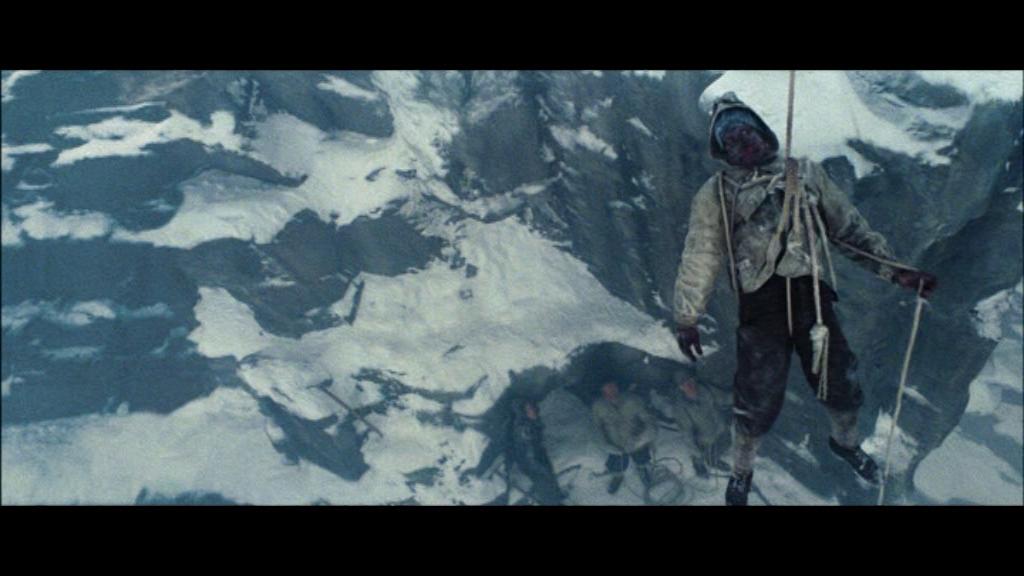
As part of my month-long Clint Eastwood fest in May I reviewed ‘The Eiger Sanction’, concluding that “for all of its earlier deficiencies, the last half hour is jaw-droppingly impressive, every frame of it shot for real. No matte backgrounds, no studio mock-ups, no compositing or special effects or trick photography. Bruce Surtees, Eastwood’s regular lensman, captures the vertiginous dangers of the Eiger, his camera appraising the treacherous slopes with an all-too-believable wariness … ‘The Eiger Sanction’ is solely about visual spectacle. And when Eastwood breaks out the pitons and the guide rope and starts climbing, the film delivers.”

I hadn’t seen ‘North Face’ when I wrote that.

The climbing sequences in ‘The Eiger Sanction’ are still pretty impressive but sweet Jesus, ‘North Face’ takes it to another level. It’s like watching ‘Cop’, a perfectly good James Ellroy adaptation with James Woods on form and a memorably blunt ending, then sliding ‘L.A. Confidential’ into the DVD player.

My interest in ‘North Face’ was piqued when I discovered that director Philipp Stölzl had made the video for Rammstein’s 1998 cover of Depeche Mode’s ‘Stripped’ – a video, compromising footage from Leni Riefenstahl’s ‘Olympus’, that was banned following accusations that it was little more than Nazi propaganda. I’d always interpreted Stölzl’s aesthetic choices as an ironic commentary on the nature of propaganda and the manipulation of the image, particularly in the way the lyric “let me hear you make decisions / without your televisions” is married to incredibly heavy-handed fascistic imagery.

Fast-forward a decade and here’s Stölzl making a film about an attempt to conquer the north face of the Eiger under the edict of the Führer. Interesting, I thought; a man once accused of Nazi propaganda making a film with a backdrop of, well, Nazi propaganda. I missed ‘North Face’ on the big screen (it played for a couple of nights at a local arthouse cinema), but picked up the DVD for £4 last week. Best £4 I’ve spent in ages!

The only character in the film who has any vaguely National Socialist leanings is newspaperman Henry Arau (Ulrich Tukur) and that’s mainly because he’s just received instructions from the press office that he needs to run a big feature on the triumph of Aryan fortitude yada yada yada in conquering the north face of the Eiger because this will be seen as an exemplar of the indefatigable German athlete yada yada yada yeah whatever at the forthcoming Olympic games.

Arau, conscious that the news of Karl Mehringer and Max Sedlmayer’s fatal attempt at finding a route to the summit, is still a part of the public consciousness (their bodies, at this point, have not been recovered) latches onto his secretary Luise Fellner (Johanna Wokalek)’s recollections of growing up in Berchtesgaden with talented climbers Toni Kurz (Benno Fürmann) and Andreas Hinterstoisser (Florian Lukas). Arau, encouraging Luise’s ambitions towards photojournalism, despatches her to seek out Kurz and Hinterstoisser (currently serving in the army) and sound them out on whether they’re ready to tackle the Eiger for the greater glory of the Fatherland.

Ah, this’ll be where the Stölzl propaganda controversy comes marching in, then? Not so. Stölzl cuts to a chocolate box scene of Alpine perfection, all brightly painted buildings and cozy chalets. Nazi troops are marching in precise formation in front of a barracks. But before you can hum two bars of ‘Deutschland, Deutschland über alles’, Stölzl cuts to our heroes, on latrine duty, scrubbing out the piss-stained channel of a urinal. Their punishment, apparently, for ignoring curfew to go off for a bit of extra-curricular mountain climbing. Not that it deters them. Next pass they get, they’re off again. Cycling out of the barracks, the sentries snap the Nazi salute and chorus “Heil Hitler”; Kurz and Hinterstoisser chorus “Auf wiedersehen” by way of response.

Propaganda? None here, freunde.

Although Kurz and Hinterstoisser agreed, after some prevarication on Kurz’s part, to undertake the attempt on the Eiger, they do it for themselves not for the Party. They even quit the army in order to do so. From this point on, the Nazi propaganda background is purely that: background. As soon as our heroes start to scale the north face, all considerations of politics, history and national identity are firmly backgrounded while a tense and vertiginous drama of man vs. the elements – which segues into a drama of desperate survival when the elements very quickly prove the victor in said contest – unfolds, Stölzl documenting every harrowing moment with chilling realism.

Moreover, he reduces Arau’s sloganeering to so many pathetically empty words, cutting from Kurz and Hinterstoisser’s ordeal on the Eiger, to a bow-tied and verbose Arau holding court in the restaurant of the plush hotel he and Luise are booked into. Wine flows and fine meals are consumed, the contrast with the climbers’ meager rations as harsh and immediate as a slap in the face.

Stölzl is absolutely in control of his material. He structures the film effectively, the cuts back to the hotel always demonstrating a purpose – whether a juxtaposition or a subtle reminder, during Arau’s conversations with a pensive Austrian businessman, that events are playing out as Nazi Germany maneuvers Austria into annexation – and the battle for survival on the mountain depicted without recourse to histrionics or false heroics; depicted, authentically, as an ordeal.

Tuesday, September 28, 2010

Sally Menke

Actor/director relationships are often celebrated. Director/editor relationships less so. But would Scorsese’s films be quite so unique, so immediate, without the contribution of Thelma Schoonmaker? Or Tarantino’s without Sally Menke?

In the saddest newest since Natasha Richardson’s death, it’s been reported that Sally Menke was found dead today in Beachwood Canyon, California where she had been hiking. Cause of death has yet to be confirmed.

Sally Menke edited all of Tarantino’s movies. She was 56.

There’s a poignant tribute on the Film Experience Blog which expresses all the sentiments I’m feeling at the moment.

Wilde

Posted as part of Operation 101010
Category: biopics / In category: 6 of 10 / Overall: 83 of 100

Brian Gilbert’s handsomely produced biopic of poet, novelist, playwright, wit, raconteur and all-round genius Oscar Wilde has a lot going for it. The period recreation is convincing without ever suffocating the viewer in the manner of, say, a BBC Sunday night costume drama. The script, by Julian Mitchell from Richard Ellman’s biography, is literate and witty. The performances are excellent across the board, with Stephen Fry perfectly cast in the title role. If anyone deserves the sobriquet “an Oscar Wilde for our times”, it is probably Stephen Fry.

With one caveat (and it’s an unfortunately significant one), I enjoyed ‘Wilde’ very much. And yet it falls prey to the inherent problem of virtually all biopics: it is, by its very nature, episodic. Opening in 1882 with Wilde fetching up in Colorado as part of his grand tour (Gilbert plays the opening credits sequence, in terms of its imagery and music, like a western), the film then packs the incidents of almost two decades into less than two hours.

Thus, in short order, Wilde returns to Britain, marries Constance Lloyd (Jennifer Ehle), makes his mark in society, fathers two children, meets Robbie Ross (Michael Sheen), has his first homosexual experience, writes ‘The Picture of Dorian Gray’, enjoys huge success with ‘Lady Windermere’s Fan’, meets Lord Alfred “Bosie” Douglas (Jude Law) and the two of them embark on a rocky and ultimately destructive relationship.

This is the point at which the film’s pace slows and, for a while, it becomes something of a two-hander, scene after scene depicting Wilde’s almost hopeless infatuation in the face of Bosie’s increasingly callous and selfish behaviour. Their relationship is tempestuous (seriously, these guys were more on-off than Marilyn Manson and Evan Rachel Wood) and Bosie’s mood swings are exacerbated by the influence of his father, the Marquess of Queensbury (Tom Wilkinson), a bullish no-son-of-mine type who decries Wilde as a pervert.

When Bosie’s brother (also gay) commits suicide rather than face his father’s wrath, Bosie seizes the opportunity of the Marquess making defamatory comments about Wilde in writing to convince Wilde to launch a libel action. Ross begs him not to but Wilde, committed to stand up against the hypocrisies of society, goes ahead. Minor problem: the defamatory comment in question (“posing sodomite”) is, although hateful, not without basis in fact. Therefore Wilde is forced to perjure himself. With the defence ready to call rent boys with whom Wilde had dallied, Wilde drops the prosecution against Queensbury, leaving himself (a) bankrupt after being obliged to settle the defendant’s legal fees and (b) facing charges from the Crown of gross indecency.


The sheer god-awfulness of British society’s attitudes to homosexuality at that time (and, from the experience of some of my gay friends, it seems to be an inculcated prejudice that’s still a long way from being eradicated) are effectively highlighted. Fry’s performance is exemplary, infusing Wilde with a dignity and a vulnerability beneath the flamboyance and flippant witticisms.

A basic knowledge of Oscar Wilde’s life and work, while not essential to an appreciation of Gilbert’s film, helps contextualise the references and quotes as well as clarifying the chronology. Although I’m confused as to when the film actually ends. The final scenes (SPOILER ALERT) are of Wilde visiting Constance’s grave; Wilde reminiscing with Ross; and Wilde, having travelled abroad, reuniting (albeit briefly) with Bosie. Yet Wilde and Bosie’s final period of time together was in 1897 whereas Constance died in 1898. An earlier scene has Constance visit Wilde in gaol (old spelling used by way of homage to his epic poem ‘The Ballad of Reading Gaol’ – my favourite work by Oscar Wilde) and assure him she won’t divorce him and that he can return to his family as long as he never sees Bosie again. Later, Wilde tells Ross that now he’s lost his wife and is disallowed to see his children, he may as well see Bosie again. (SPOILERS END)

It grates that the filmmakers, after demonstrating so much commitment to their subject, blithely fuck with historical accuracy for no other reason I can discern than creating a Hollywood-style “happy” ending with Wilde and Bosie locked in each other’s embrace. Oscar Wilde was a literary genius, but like anyone of great creative capacity he was a flawed and deeply complex individual. ‘Wilde’ is almost a great movie, but misses out on greatness because, in the final analysis, it avoids its subject’s complexities and tries to iron out the flaws by sanctifying him.

Monday, September 27, 2010

10 Things I Hate About You

Posted as part of Operation 101010
Category: films with numbers in the title / In category: 9 of 10 / Overall: 82 of 100


Kicking off in the mid-90s with ‘Clueless’, there was a short-lived trend for literary adaptations updated to a modern high-school setting (‘Clueless’ was based on Jane Austen’s ‘Emma’). The whole thing fizzled out in 2001 with ‘O’, an oh-so-serious attempt at ‘Othello’ centred around a high school basketball team. (Although I guess you could argue Rian Johnson’s ‘Brick’, not a specific adaptation but an homage to the tradition of hard-boiled private eye fiction, as the last – and certainly the best – entry in the cycle.)

‘10 Things I Hate About You’, made in 1999, updates Shakespeare’s ‘The Taming of the Shrew’ although its title and its pivotal (if cringingly embarrassing) scene refer to an inversion of Sonnet 141. The basic set-up is: Cameron (Joseph Gordon-Levitt) is the new kid at Padua High School, immediately smitten with Ivy League princess Bianca Stratford (Larisa Oleynik) despite his new buddy Michael (David Krumholtz)’s advice that he doesn’t stand a chance. Cameron and Bianca seem to hit it off, but there are two obstacles: one is narcissistic jock Joey (Andrew Keegan), keen on bedding Bianca himself, and the other is Bianca’s father Walter (Larry Miller). You see, Walt’s a gynaecologist (“up to my elbows in placenta all day long”) and many of his clients are teenage girls. Hence he’s a teensy-weensy bit over-protective.

Walter: This morning I delivered a set of twins to a fifteen year old girl. You know what she said to me?
Bianca: “I’m a crack whore who should have made my skeazy boyfriend wear a condom”?
Walter: Close, but no. She said “I should have listened to my father”.
Bianca: She did not.
Walter: Well, that’s what she would have said if she hadn’t been so doped up.

Walter doesn’t worry so much about his elder daughter Kat (Julia Stiles), mainly because she’s a proto-feminist agitator more concerned with reading Sylvia Plath, arguing the toss with teachers and basically encapsulating herself in the kind of don’t-fuck-with-me vibe that could easily create seismic activity. As evidenced by Kat’s little chat with school counsellor Ms Perky (a scene-stealing Allison Janney):

Ms Perky: I hear you were terrorizing Mr Morgan’s class again.
Kat: Expressing my opinion is not a terrorist action.
Ms Perky: The way you expressed your opinion to Bobby Ridgeway? By the way, his testicle retrieval operation went quite well in case you’re interested.
Kat: I still maintain that he kicked himself in the balls.

Given Kat’s least-likely-to status in the dating game (let alone the possibility of getting knocked up), Walter declares that Bianca can only start dating when Kat does. Thus it is that Cameron and Michael set out to find someone brave or foolhardy enough to put the moves on Kat. When all of their potential candidates bottle out (one of them citing that he’d only date Kat “if we were the last two people on earth and there were no sheep left”), they set their sights on mysterious bad-boy and downright anti-social type Patrick Verona (Heath Ledger) only to realise they going to have to pay him. So they manipulate Joey, exploiting his designs on Bianca, into ponying up the moolah.

‘10 Things I Hate About You’ remains arguably more faithful to its source material than ‘Clueless’ or ‘O’, navigating a maze of narrative contrivances thanks to an irreverent script and good performances from its cast. Joseph Gordon-Levitt and Heath Ledger both demonstrate why they later graduated to working for Christopher Nolan, Julia Stiles does sparky and attitudinous like no-one else (seriously, you wouldn’t spill her pint), Larisa Oleynik pulls off an amusing combination of girl-next-door and ditzy blonde, Larry Miller is a hoot (particularly when he tries to communicate with Bianca in what he imagines his her argot: “I'm down, I've got the 411, and you are not going out and getting jiggy with some boy, I don't care how dope his ride is”) and Allison Janney all but waltzes off with the film as the school counselor who really can’t be bothered with the kids and just wants to finish writing her erotic novel.

For the most part, the humour is a tad saltier than your average high school comedy, pace the scene where Ms Perky berates Patrick for exposing himself in the cafeteria. He responds that he was only “joking with the lunch lady. It was a bratwurst.” Ms Perky coolly arches an eyelid: “A bratwurst. Aren’t we the optimist?”

Unfortunately, things ebb towards the end. Patrick turns out to be a mostly okay dude, Kat bonds with her sister, Walter comes through for his daughters, etc, etc, ad nausem. ‘10 Things I Hate About You’ falls victim to too many formulaic and utterly predictable moments in its third act; and while it remains a cut above the likes of ‘A Cinderella Story’ or ‘Wild Child’, this late-in-the-game quality control dip means that it doesn’t quite get the same grades as ‘Heathers’ or ‘Mean Girls’ in the all-too-small pantheon of genuinely good high school movies.