Tuesday, October 02, 2012
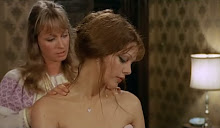
13 FOR HALLOWEEN #1: Tenebrae
“When you have eliminated the impossible, what remains – however improbable – must be the truth.” This quote, from Conan Doyle’s ‘The Hound of the Baskervilles’, is central to the construction of Dario Argento’s fiendishly brilliant ‘Tenebrae’.
Having scored a big hit first time out with his debut ‘The Bird with the Crystal Plumage’ – and followed it up in fine style with ‘Cat o’ Nine Tails’ and ‘Four Flies on Grey Velvet’ – Argento pretty much defined the giallo with the magisterial masterclass in mind-fuckery ‘Deep Red’. That was in 1975, when the genre was peaking. Seven years later, the giallo was on the wane but that didn’t stop Argento delivering his second flat-out classic of the form.
‘Tenebrae’ follows American thriller writer Peter Neal (Anthony Franciosa) as he embarks on a publicity tour in Rome. The whirlwind round of interviews and TV appearances has been organised by his European agent, an expatriate fellow American by the name of Bullmer (John Saxon). Secretary Anne (Daria Nicolodi) and Bullmer’s protégé Gianni (Christian Borromeo) round out his entourage.
He’s barely arrived when detectives Germani (Giuliano Gemma) and Altieri (Carola Stagnaro) turn up in his hotel room wondering if he knows anything about Elsa Manni (Ania Pieroni) – a kleptomaniac first glimpsed swiping a paperback copy of Neal’s latest novel – who has recently been murdered by a black-gloved killer wielding a straight-razor. Neal, understandably since this is his first time in Rome, had never met the lady. Nor can he explain why the killer had stuffed torn out pages of his novel in her mouth.
Neal soon receives an anonymous letter in cut-out newsprint quoting a line from his book. Germani warns him to be vigilant and report any further threatening correspondence. Further killings occur, including a savage attack on loose-living same sex couple Marion (Mirella Banti) and Tilda (Mirella d’Angelo). Anne thinks she spots Neal’s possessive and mentally unstable ex-wife Jane (Veronica Laria) driving past the hotel. Gianni alternates between eagerly assisting Neal (his idol) in his own unofficial investigating and lusting after hotelier’s daughter Maria (Lara Wendel). Maria, meanwhile, endures a series of escalating misfortunes after an argument with her actual boyfriend and the ministrations of a psychotic dog end with her seeking refuge in the house of a murderer.
‘Tenebrae’ befuddles, bamboozles and wrong-foots the viewer from the outset. It boasts more red herrings than a Communist fishery. Even the title misleads. “Tenebrae” is Latin for “shadows” or “darkness” (as well as being the title of Peter Neal’s latest opus), yet much of the film is shot in a cold hard light that allows neither for shadows nor places to hide. Indeed, an image of something very briefly hidden and then shockingly revealed is crucial to the bravura denouement.
The protagonist is challenged as much as the audience, mainly by TV pundit Christiano Berti (John Steiner), a man whose antagony towards Neal’s fiction seems to border on the obsessive. But even before Berti gets in on the act, the first reporter who interviews Neal – someone he is acquainted with and considers sympathetic – suddenly challenges him: “ ‘Tenebrae’ is a sexist novel. Why do you despise women so much? Women as victims, ciphers. The male heroes with their hairy macho bullshit!” Absent the macho male heroes – most of Argento’s male leads, from the edgy Sam Dalmas in ‘The Bird with the Crystal Plumage’ to the outright nervous Marc Daly in ‘Deep Red’ are more petrified than pro-active – and the accusation is one that has often been made against Argento himself, particularly in light of this controversy-baiting statement of principles: “I like women, especially beautiful ones. If they have a good face and figure, I would much prefer to watch them being murdered than an ugly girl or man. I certainly don`t have to justify myself to anyone about this. I don`t care what anyone thinks or reads into it. I have often had journalists walk out of interviews when I say what I feel about this subject.” And indeed Argento gives us a world-class selection of women-in-peril in ‘Tenebrae’ …
… as well as creating an air of sexual ambiguity by casting transsexual Eva Robins as a seductive and vengeful femme fatale in an enigmatic and fetishistic flashback whose import is not revealed in full until very late in the day.
Pay close attention to his/her red shoes. There’s a learned paper to be written on the parallels between Dario Argento and Powell & Pressburger. The touchstones are more apparent than you might think.
As with all gialli, style is everything; and ‘Tenebrae’ creates an architectural style that is dislocated, borderline surreal and utterly unique. Although it’s established from the opening scenes that the film takes place in Rome, Argento creates a Rome that is as far removed from the Eternal City of Fellini and myriad other filmmakers, a Rome that repudiates landmarks and tourist hives. A city of stark avenues, unexpected open spaces and sprawling post-modern buildings in which Argento creates some of his most memorable set-pieces, from Elsa’s flight from a rapacious vagrant only to find herself in greater danger the moment she think she’s found sanctuary to a three-minute build-up to a murder committed in plain sight that is worthy of Hitchcock. The stand-out, though, is the justly celebrated two-and-a-half minute Louma crane sequence in which the camera prowls the exterior of Marion and Tilda’s house, occasionally probing through the windows to track their movements. Scored to the thunderous and jarring music of Goblin, it’s a symphony of voyeurism and subjective excess. It exists purely for the technical achievement of pulling it off in the first place, it breaks all the rules of perspective and POV, and it’s absolutely gorgeously fucking brilliant.
The script slyly works in references to several of Argento’s previous works, including a fake death à la ‘The Bird with the Crystal Plumage’ and a conceptual homage to ‘Deep Red’ that I’d like to discuss at great length but won’t because I’d really hate to ruin the film for anyone reading this who has yet to have the experience of discovering ‘Tenebrae’ for themselves. All I’ll say is that where ‘Deep Red’ ends with a bloody but reflective shot, the implications of which are left to worm their way into the viewer’s subconscious, ‘Tenebrae’ gives us a traumatized survivor screaming and screaming and screaming even as the screen fades to black and Goblin tries to drown them out.
Monday, October 01, 2012
All hail the Pumpkin King
Greetings. The spookiest month of the year is upon us once again, and that means two things: (i) you’ll be descending upon by brethren with paring knives and ghost-face stencils, and (ii) 13 For Halloween will be getting under way very very soon on The Agitation of the Mind.
That’s very very soon as in tomorrow.
Our horrible host, the frightful Fulwood, will be fulminating fetidly on a baker’s dozen of maudlin and macabre movies. Just to get you in the mood, here’s a hint of the tricks and treats that await you:
And now we’ve got the unpleasantries out of the way, would you care to join me under the moonlight as we waltz our way towards All Hallow’s Eve?
(Ahem, Pumpkin King? Quit hacking my blog. I do the purple prose around here – end of!)
Sunday, September 30, 2012
BOND-A-THON: Die Another Day
I’m only guessing, but I reckon the first script conference for ‘Die Another Day’ went something like this.
The writers: Okay, here’s the deal. It all went a bit OTT in ‘The World is Not Enough’, so what we want to do is really scale things back. Shit-can the gadgets, ditch the one-liners, keep it real.
The producers: Sounds good. Did you get the memo about the invisible car, by the way?
The writers: Uh, I think we missed that. But, hey, what we propose is this: subvert the audiences’ expectations. Have a gritty, down ‘n’ dirty pre-credits set piece that ends with Bond being captured. Totally pull the rug out from under the viewers.
The producers: Cool. Great attention-grabber. Can you work in the invisible car by the half way mark?
The writers: Uh, the emphasis is supposed to be on Bond living on his wits. We want to keep the gadgets to a minimum.
The producers: Absolutely. Invisible car, watch that shoots a laser. That’s two by our reckoning. Oh, and you know what else would be really cool? An ice palace!
There are a lot of things wrong with ‘Die Another Day’, not least that it acronymizes as ‘DAD’, but the thing I have the most problem with is the god-damn stupid motherfucking invisible car. When I watched ‘Die Another Day’ for the purposes of this review, I played the DVD through the laptop, headphones on, rather than insult the TV with it; and on several occasions Mrs F had to break off her RPG and ask me to rant a little quieter and make with less profanity. By the end of the movie, her astute observation was: “Anyone would think you had issues with the invisible car.”
And you know what, dear reader? I do. The invisible car is a god-damn stupid motherfucking concept on many levels, the most obvious being that it brings to mind Wonder Woman’s invisible plane. You know, the one that looked like this:
Keep that image in mind. Now here’s 007 (Pierce Brosnan) in his invisible car:
To my mind there are only three differences: (i) ‘Wonder Woman’ was made nearly thirty years before ‘Die Another Day’; (ii) ‘Wonder Woman’ had a notably smaller budget than ‘Die Another Day’; and (iii) despite her epic cleavage, Wonder Woman looks considerably less of a tit than Bond in a straightforward comparison of these two images.
Yes, I have issues with the car.
I also have issues with the shitty CGI in the scene where toffee-nosed uber-villain Gustav Graves (Toby Stephens) cuts loose with a giant laser, melting vast swathes of tundra as Bond dangles off an ice cliff. Bond escapes this combined fiery-watery fate by surfing his way to freedom. These are some choice examples of the images the paying audience is fobbed off with:
What makes it worse it that ‘Die Another Day’ opens with a surfing scene that’s dramatic, atmospheric and kicks off one of the absolute best pre-credits sequences in the entire Bond canon. I’m tempted to call it ‘The World is Not Enough’ Syndrome, except ‘TWiNE’ gives us a world-class pre-credits sequence then nosedives into redundancy, like a priapic sybarite suddenly experiencing brewer’s droop. ‘Die Another Day’ gives us a frankly pretty damn impressive first three quarters of an hour: Bond’s hovercraft duel with Korean warlord Colonel Moon (Will Yun Lee) and subsequent capture – awesome! Bond’s torture, imprisonment and exchange for the terrorist Zao (Rick Yune) – awesome! Bond’s less-than-victorious return to MI6, the revelation that he’s been implicated in a terrorist outrage and M (Judi Dench)’s fears that he’s been brainwashed (a nod to the opening chapters of the novel ‘The Man with the Golden Gun’) – awesome! Bond breaking ranks from MI6 and going renegade in order to clear his name – awesome! Bond hooking up with American operative Jinx (Halle Berry) as he pursues his own agenda without sanction or back-up – awesome!
I remember sitting in Nottingham’s Showcase Cinema ten years ago, rubbing my hands in gleeful delight as the first third of ‘Die Another Day’ played out, convinced that even the trademark Brosnan pout wasn’t a drawback and that I was watching the most pared-down, focused and hard-edged Bond since Connery was sipping the martinis.
And. Then. It. All. Went. Wrong.
No: it didn’t just go wrong. It went disastrous. It went cataclysmic.
How bad? Well, I think I’ve already mentioned the invisible motherfucking car and shit-awful surfing scene. In addition, there’s the horribly conceived ice palace – the most obviously studio-bound bit of tundra since John Sturges’s production designer painted the floor white and arranged some bits of polystyrene at strategic angles for ‘Ice Station Zebra’ in 1968. There’s a tediously contrived fistfight between the randomly shifting patterns of some laser beams. There’s a cluster of dreadful performances, from John Cleese as the new Q (he was introduced as Desmond Llewellyn’s protégé in the previous film but wasn’t as egregiously annoying as he is here) to Toby Stephens who doesn’t so much chew the scenery as go ‘Man vs Food’ on its ass, while Michael Madsen mopes around in the background, mumbling and waiting for the cheque to clear. There’s a denouement that made me die a little bit inside to watch.
And there are endless – endless – references to other Bond movies. ‘Die Another Day’ was released forty years after ‘Dr No’ and was the twentieth film in the franchise. As such, it was obviously deemed a sterling idea to reconfigure the script as a join-the-dots exercise in homage. Thus we have: Jinx emerging from the sea in a Honey Ryder style bikini right down to the knife belt and a reappearance by the Duke of Wellington portrait (‘Dr No’); Rosa Klebb’s shoe inexplicably showing up in Q’s lab and a potential blackmailer filming Bond in a clinch from behind a two-way mirror (‘From Russia with Love’); Jinx almost eviscerated by a laser, an ejector seat fired from Bond’s Aston Martin and a fight in a depressurising plane (‘Goldfinger’); the old jet pack in Q’s lab, an oxygen mouthpiece used by Bond in a diving scene and a clinic wherein a villain’s appearance is changed (‘Thunderball’); a disused section of the underground commandeered as a secret service base (‘You Only Live Twice’); Bond temporarily buried under an avalanche (‘On Her Majesty’s Secret Service’); diamonds used to finance a satellite with destructive capabilities (‘Diamonds Are Forever’); Bond using a big American handgun at one point (‘Live and Let Die’); M maintaining and office on board a ship and a satellite that can harness solar rays (‘The Man with the Golden Gun’); a union jack parachute and a similarity in design between the ice palace and Stromberg’s undersea lair (‘The Spy Who Loved Me’); a sword fight through an opulent building in which a fuckload of expensive things are inordinately trashed (‘Moonraker’); the theme song artiste (Madonna) appearing onscreen for the only time since Sheena Easton (‘For Your Eyes Only’) and actually graduating to a speaking part here; the crocodile submersible and mini-jet in Q’s office (‘Octopussy’); Bond surfing in the Antarctic (‘A View to a Kill’); Bond as sniper and a protracted fight in a transport plane, vehicles being jettisoned out of its rear cargo hatch (‘The Living Daylights’); and Bond going rogue after M rescinds his Double-O status (‘Licence to Kill’). Recyclings from Brosnan’s previous outings include a falling chandelier that kills an antagonist – reminiscent of the metal sectioning that similarly finishes off a bad guy in ‘GoldenEye’ – as well as a timer being set for three minutes; the replication of the car park chase in ‘Tomorrow Never Dies’ around the different levels of the ice palace; and the sprinkler system that activates after Jinx booby-traps the clinic in Cuba, akin to the aftermath of the bomb attack on MI6 headquarters in ‘The World is Not Enough’. Additionally, the gadget-laden watch Q issues Bond with is described as “your twentieth, I believe”.
Some of these homages are, to be fair, quite neatly done and – ironically – the best of them has nothing to do with the movie franchise (the character name Colonel Moon, an inversion of ‘Colonel Sun’, the first Bond continuation novel after Fleming’s death). Mostly, however, they are as subtle as Oddjob lobbing his steel-lined bowler hat at a statue. Cumulatively, they leave you feeling bludgeoned by the filmmakers’ commitment to self-congratulation over aesthetic development; their determination to rake over past glories rather than striving to create a new classic. We’d have to wait four years for that.
Saturday, September 29, 2012
Mylène Demongeot
Happy 77th birthday to Mylène Demongeot, in the seventh decade of her career and still working. A large glass is being raised at chez Agitation.
Friday, September 28, 2012
Herbert Lom
From 'Hell Drivers' to 'The Ladykillers' to being the real comic genius in the 'Pink Panther' films, Herbert Lom will be sadly missed as a character actor, comic actor and irreplaceable cinematic talent.
i.m. Herbert Lom, 11 September 1917 - 27 September 2012
Tuesday, September 25, 2012
Helen Mirren
Helen Mirren as this year's recipient of the European Achievement in World Cinema award?
I'll drink to that!
Sunday, September 23, 2012
The Killer
In honour of John Woo's 66th birthday, a re-post of my review of his seminal HK action movie 'The Killer'.
Ostensibly, the ingredients of John Woo’s seminal “heroic bloodshed” opus ‘The Killer’ make it sound like a cinematic cocktail (or, more appropriately, a cinematic Molotov cocktail):
Take one existentially iconic hitman a la Jean-Pierre Melville, a dash of Sirkian melodrama (preferably the ‘Magnificent Obsession’ vintage), a double measure of visual imagery from early Scorsese, and a liberal helping of Peckinpahesque slo-mo. Add white doves. Blend.
Which would constitute a pretty accurate and unprecedentedly short (65 word) review, the only addition to which would be a handful of kick-ass screen shots, were it not for the fact that Woo transcends every borrowing, every homage, every lovingly crafted frame of reference and creates something that is stylistically and emotionally his own.
Or, to put it another way, Woo does what very few other directors have ever done with such a degree of success (I can think only of Tarantino offhand): he synthesises his influences so completely that while the end product is beholden on virtually every level – narratively, aesthetically, everything else that ends in “–ly” – to a plethora of other, earlier works, it nonetheless pulls together these diverse strands in a manner that either goes beyond or in a completely different direction to those selfsame influences.
In ‘Le Samourai’, Melville doesn’t have Alain Delon cauterize an exit wound by tamping gunpowder over it and applying a lighted cigarette. In ‘The Wild Bunch’, Peckinpah doesn’t stage the bunch’s climactic shoot-out with Mapache’s army against a backdrop of religious imagery, flickering candles and white doves. And, yes, Melville and Peckinpah don’t make these aesthetic choices for a reason. But Woo does. And that’s kind of the point in and of itself.
The simplest (and least critically valid) summation is that Woo doesn’t certain things – particularly with regard to his use of slow motion, freeze frames and dissolves – because they fucking look cool as fuck. Which they do. And if you can shoot an action scene that’s as balletic, iconic, dynamic and hyper-kinetic as a John Woo action scene, then screw it, you’ve earned the right to do that kind of thing for its own sake and to hell with anything deeper like thematic content, characterisation and moral imperatives.
Woo, however, does things not just because they fucking look cool as fuck but because they contribute to the thematic content of his work, because they define and develop the characterisation, and because he is concerned with the moral imperatives of honour, guilt and redemption. Then, and only then, does the fact that they fucking look cool as fuck come into play.


Let’s revisit that phrase “moral imperative”. Sometimes it’s the directors whose work appears most violent, or attracts the most controversy, who prove themselves as having the more demonstrable morality: it’s true of Sam Peckinpah, true of Michael Haneke, true of John Woo. Haneke’s approach is one of cool, detached cerebralism; his aesthetic rigidly formalist. Woo, like Peckinpah, is a more emotionally involved filmmaker. He is acutely conscious of the way men interact and the codes that bind or divide them. He understands the mindset of the outcast, the criminal, the (conventionally speaking) bad guy. He sees the wounded and compromised humanity in them. Sometimes it’s a defeated sense of humanity; sometimes it’s retrievable.
‘The Killer’ is about a thoughtful and ultra-professional hitman, Ah Jong (Chow Yun Fat) who accidentally blinds nightclub singer Jenny (Sally Yeh) during a hit that turns into a fully-fledged gun battle. During the aftermath, rather than go to ground, he undertakes the proverbial one last job in order to raise money for the cornea transplant that could restore Jenny’s sight, despite the fact that maverick cop Inspector Ying (Danny Lee) is on his trail and unaware that his former paymasters are about to double cross him.
It sounds generic, clichéd and predictable. In Woo’s hands, it’s a dementedly excessive but savagely beautiful and often ludicrously funny work of art.
Take one existentially iconic hitman a la Jean-Pierre Melville, a dash of Sirkian melodrama (preferably the ‘Magnificent Obsession’ vintage), a double measure of visual imagery from early Scorsese, and a liberal helping of Peckinpahesque slo-mo. Add white doves. Blend.
Which would constitute a pretty accurate and unprecedentedly short (65 word) review, the only addition to which would be a handful of kick-ass screen shots, were it not for the fact that Woo transcends every borrowing, every homage, every lovingly crafted frame of reference and creates something that is stylistically and emotionally his own.
Or, to put it another way, Woo does what very few other directors have ever done with such a degree of success (I can think only of Tarantino offhand): he synthesises his influences so completely that while the end product is beholden on virtually every level – narratively, aesthetically, everything else that ends in “–ly” – to a plethora of other, earlier works, it nonetheless pulls together these diverse strands in a manner that either goes beyond or in a completely different direction to those selfsame influences.
The simplest (and least critically valid) summation is that Woo doesn’t certain things – particularly with regard to his use of slow motion, freeze frames and dissolves – because they fucking look cool as fuck. Which they do. And if you can shoot an action scene that’s as balletic, iconic, dynamic and hyper-kinetic as a John Woo action scene, then screw it, you’ve earned the right to do that kind of thing for its own sake and to hell with anything deeper like thematic content, characterisation and moral imperatives.
Woo, however, does things not just because they fucking look cool as fuck but because they contribute to the thematic content of his work, because they define and develop the characterisation, and because he is concerned with the moral imperatives of honour, guilt and redemption. Then, and only then, does the fact that they fucking look cool as fuck come into play.
It sounds generic, clichéd and predictable. In Woo’s hands, it’s a dementedly excessive but savagely beautiful and often ludicrously funny work of art.
Thursday, September 20, 2012
BOND-A-THON: The World is Not Enough
And yet ‘TWiNE’ isn’t awesome. ‘TWiNE’ in fact describes a plunging arc from promising to tedious to several increasingly stygian levels of awful, culminating in a pun that you can see coming from the moment the actual Bond girl, Dr Christmas Jones (Denise Richards) is introduced. You see, the filmmakers were jerking your chain with Sophie Marceau and it’s Denise Richards in a tank top, a pair of shorts and a petulant expression – kind of like an extremely poor man’s Lara Croft – who gets to run around with 007 and save the world. Dr Christmas Jones is a nuclear physicist, by the way. Played by Denise Richards. Forgive me if I’m labouring the point, but they fucking cast Denise Richards as a nuclear fucking physicist called Dr Christmas fucking Jones.
Oh, yeah. And they gave Michael Apted the directing gig. Apart from ‘Coal Miner’s Daughter’, ‘Gorillas in the Mist’ and some good character-based TV work, much of Apted’s output has been curiously pedestrian and there is nothing on his CV to mark him out as an action director.
Anyone watching the film for the first time, however, would think from the opening sequence that they were in for a treat. At nearly quarter of an hour, it’s the longest pre-credits sequence in the franchise and rather than being its own for-the-sake-of-it mini-movie it sets the stage for the story proper. In its depiction of an incendiary device triggered inside the MI6 headquarters, it establishes a theme of attack from within that recurs through the film. And it culminates in a speedboat chase along the Thames. Which, as it progresses, treads a thin line between cool and stupid, but that was always the appeal of the Bondian pre-credits sequence. ‘TWiNE’ strikes the right balance and, as Garbage’s theme song – not as memorable as Tina Turner’s ‘GoldenEye’ but a vast improvement on Sheryl Crow’s ‘Tomorrow Never Dies’ – kicks in, there’s no doubt that you’ve just sat through a kick-ass, supremely entertaining opener.
The bizarre thing is, the film desperately wants to be entertaining. The script kicks out what must be per capita the most puns in any Bond movie. Quizzed by nuclear physicist Jones on the nature of his relationship with another woman: “We’re strictly plutonic.” Asked by a voluptuous accountant if he’d like to check her figures: “I’m sure they’re perfectly rounded.” On a Q branch prototype that disguises a flamethrower as a set of bagpipes: “I suppose we all have to pay the piper some time” (Q goes a pun too far by replying “oh, pipe down, 007”). Whilst sliding on a pair of sunglasses while some upgraded gadgets are being demonstrated: “New specs, Q?” Things hit rock bottom when Bond offs a crooked head of security and takes his place on what turns out to be a mission to appropriate a warhead. “Where’s the other guy?” someone challenges him. Bond’s reply: “He was buried with work.” As a one-liner, it’s neither elegant or funny. It’s not apposite, since the dead guy isn’t shown being interred. And Brosnan’s delivery is horribly forced. In its own small way, it’s incredibly emblematic of ‘The Word is Not Enough’.
The plot, which doesn’t so much unravel as twist itself into a series of ugly knots, doesn’t help matters. SPOILER ALERT. Bond recovers a large quantity of cash being laundered by Swiss banker Lachaise (Patrick Malahide); the moolah is returned to rightful owner, industrialist Robert King (David Calder) – a pal of M (Judi Dench). It’s booby-trapped, however, and the resulting explosion kills King. Bond pursues the assassin and is injured. At King’s funeral, Bond meets King’s daughter Elektra (Marceau), who vows to continue his work in building an oil pipeline across Azerbaijan. Bond looks into Elektra’s background and discovers she was the victim of a kidnapping plot by international terrorist Renard (Carlyle) but escaped his clutches. M, it turns out, had advised King to withhold paying the ransom while she investigated. Bond realises that, converted from American dollars to pounds sterling, the laundered money he recovered (i.e. the booby-trap he inadvertently delivered) corresponds to the ransom amount. He takes it as a message and concludes that Renard was behind the attack on King. M despatches him to act as personal bodyguard to Elektra. By circuitous means, Bond realises that she was the instrument of her own father’s death and has faked various attacks against herself and her company, including an aerial attack by paragliders and the destruction of a length of her own pipeline. Bond suspects Stockholm Syndrome and fears that she’s in league with Renard. He’s proved correct, except that it’s Elektra who’s controlling Renard, not vice versa. A bullet lodged in his brain, the wound inoperable and the shell slowly moving through the medulla oblongata, Renard is essentially a dead man, and happily throwing away the last slivers of his life in carrying out Elektra’s plan: to destroy Istanbul (the point at which the three pipelines in competition to Elektra’s converge) and thus facilitate Elektra’s supremacy as supplier of oil to the west. The means of Istanbul’s removal from the map: plutonium from a stolen warhead introduced into the reactor of a hijacked nuclear submarine. As a sort of bonus, Elektra also plans M’s death as vengeance for not rescuing her from Renard (which seems something of a redundant point given that she’s turned him into her own personal Euro-psycho-puppet).
Am I the only person who sees options (a) and (b) as doable but expensive, while option (c) is basically stupid, riddled with the potential for failure, and financially ruinous. I mean, seriously, how the fuck much does it cost to bankroll the theft of a warhead and a nuclear motherfucking submarine? (SPOILERS END.)
I’ve struggled with ‘TWiNE’ writing this review: excepting the speedboat chase, I can find little or no reason not to rank it firmly alongside previous franchise low points ‘The Man with the Golden Gun’, ‘Moonraker’ and ‘A View to a Kill’. Actually, being fair, I can find two reasons: (i) it’s the final Bond movie to give us the marvellously wintry interplay between Bond and Q (at least as played by Desmond Llewellyn; the character returns in ‘Skyfall’ in the person of Ben Wishaw); and (ii) I know that’s it’s followed by ‘Die Another Day’ and the sins of ‘The World is Not Enough’ suddenly take on a forgivable hue in the knowledge of what’s to come.
Monday, September 17, 2012
Dinah Sheridan
Happy 92nd birthday to Dinah Sheridan, a classic English rose and star of the evergreen 'Genevieve'.
They say the eyes are the windows to the soul, and the portrait above proves the saying right in scintillating style.
Sunday, September 16, 2012
Jennifer Tilly
Happy 54th to Jennifer Tilly.
In addition to her acting work, she's an accomplished poker player. Hardly surprising. Lay down a pair like that, and anyone would fold!
Wednesday, September 12, 2012
The filth of things to come ...
It's probably not escaped your attention, dear readers, that there's been bugger all happening on The Agitation of the Mind so far this month beyond the Bond-a-thon and some cheesecake shots. Oh yeah, and Paul Giamatti movie just so I can maintain a pretense of respectability.
And I need to ask your forbearance because there's not going to be much else going on during September bar more of the same.
But there is a reason. I'm currently immersing myself into the kind of movies my parents never late me stay up and watch when I was a kid and my wife despairs of me staying up and watching now I'm an adult. With October just around the corner, it'll soon be time for 13 For Halloween and I'm just finalizing the running order for what has become one of my favourite annual extravaganzas on the blog. We'll be kicking off with one of Argento's finest, but beyond that my lips are sealed.
Then we'll be plunging straight into the sea of cinematic sleaze that is the Winter of Discontent, a fetid film-fest of rapacity, repulsiveness and reprehensibility. It'll take up the whole of November and December, ushering in the chills of winter and giving the season of goodwill a right royal seeing to. Again, candidates for inclusion are still being sieved through and settled on, but a handful of reviews have already been written. Here's a sneak peek at some of the depraved delicacies that await you as the nights draw in and the darkness descends:
Monday, September 10, 2012
BOND-A-THON: Tomorrow Never Dies
Not that producers Barbara Broccoli and Michael G. Wilson weren’t under enough pressure as it was to recreate the success of ‘GoldenEye’ at the box office, but when MGM head honcho Kirk Kerkorian decided that he wanted the next Bond movie to open coterminous with their public stock flotation, the race was on to get ‘Tomorrow Never Dies’ into production. Bruce Feirstein, who had contributed to the ‘GoldenEye’ script wrote a screenplay inspired by his background in journalism. With Martin Campbell passing on directing two Bond films back-to-back, Roger Spottiswoode was offered the gig. Spottiswoode brought in any number of other writers to work on it. With the script still not finalized as shooting began, Feirstein (to whom sole writing credit was finally given) was brought back on board for a final rewrite.
I can only assume that this too-many-cooks approach accounts for a couple of dreadfully contrived scenes, borrowings from previous Bond movies and the regressive portrayal of the villain as a power-crazed egomaniac who thrives on monologues. Media baron Elliott Carver delivers at least three monologues during the less-than-two-hour duration (‘TND’ is the shortest Bond movie in three decades), a tendency to verbiage that recalls Blofeld. But the differences are crucial: Blofeld’s nefarious schemes are aimed at world domination – Carver is out to sell more newspapers and get some exclusive broadcasting rights; Blofeld was variously played by Anthony Dawson, Donald Pleasance, Telly Savalas and Charles Gray, all of whom provided a sinister, threatening or otherwise dangerous characterization; Carver is played by Jonathan Pryce who, quite frankly, doesn’t.
One final thought on the disappointing villainy issue before we move on: Anthony Hopkins was offered the role of Carver, but passed. Imagine: Hopkins, post-Lecter, in full on scenery-chewing mode as a Bond villain. That would have been fun to watch.
Because, by and large, ‘Tomorrow Never Dies’ is low on fun. For a franchise built on wholly unrealistic narratives, newspaper-baron-starts-shooting-war-in-order-to-report-it arguably represents the most ludicrous story ever to come out of an Eon Productions script conference. I mean, come on, Carver, at least do it properly and hold the world to ransom! And yet every frame of the film strives for a serious tone, Roger Elswit shooting everything in a dull and muted palette. The man’s a master, no doubt – he’s Paul Thomas Anderson’s go-to guy, fer Chrissake – but he’s not a good fit for a Bond movie, where the aesthetic needs to be bigger, bolder and more sweeping than your average actioner.
It’s ironic, too, that such a determinedly po-faced work boasts some really stupid moments, such as the over-egged scene between Bond and Kaufman when the latter, briefly, has Bond at a disadvantage (the script’s contrivance to restore things to Bond’s favour, is risible) or Bond driving his car by remote control from the back seat at irresponsible speeds through a multi-storey car park. And on the subject of automotive action, between ‘GoldenEye’ and this film, it’s pretty fucking sad to see 007 only driving his Aston Martin during routine work and having to rely on a BMW for the chases and the gadgets. Keep it British, Q old chap.
In terms of Bond girls, ‘TND’ showcases the series at its best and worst. Michelle Yeoh as martial arts operative Wai Lin is a kick-ass action heroine in her own right, easily Bond’s equal, and not at all impressed by his louche, sardonic attitude. On the other hand, Teri Hatcher is wasted in a thankless role which adheres to the casual misogyny of Bond of the ’70s, ie. glamour girl who dallies with Bond, imparts some useful information and promptly gets killed off.
Other things annoy: much is made, early on, of Bond’s facility with languages – mainly to facilitate a gag about Bond being a “cunning linguist” – yet there are two teeth-grating moments that demonstrate the opposite. One has Bond at a car rental agency in Hamburg and all Brosnan has to do is deliver the line “mein bureau hat ein auto reserviert”; he stumbles over it so badly I’m amazed nobody thought to redub in post-production. The second sees Bond faced with Chinese characters on a keyboard, whereupon he gives up and lets Wai Lin do the typing. Oh Bond of “I took a first in oriental languages at Cambridge” in ‘You Only Live Twice’, where are ye?
Action-wise, we get a solid pre-credits sequence that, while only tenuously connected to the actual narrative, nonetheless establishes a conflict between M (Judi Dench) and death-or-glory naval chief Admiral Roebuck (Geoffrey Palmer) that informs Bond’s extremely time-bound mission later on, introduces a satellite tracking thingy-ma-jig that falls into Carver’s hand, and delivers a lot of shooting and explosions. Which is always a good thing in a Bond movie. Elsewhere, there’s a full-throttle motorbike/helicopter chase through the streets (and buildings) of Bangkok. It’s the film’s only real high point.
Other set pieces are less effective. An attack on a British naval vessel suffers in comparison with similar scenes in ‘The Spy Who Loved Me’ and ‘For Your Eyes Only’. The climactic confrontation between Bond and Carver occurs on a stealth ship, the design and narrative purpose of which recall Stromberg’s floating submarine base; however, ‘TND’ delivers a smaller and much less exciting payoff. I remember that a review in Empire magazine referred to it being less a high octane thriller than “medium octane”, and that line sums up ‘Tomorrow Never Dies’ perfectly. And the curious thing is why. At nearly double the budget of ‘GoldenEye’ (which you’d swear was the more expensive production based on what’s up there on the screen), ‘TND’ doesn’t give you much bang for its hundred and ten million bucks.
Friday, September 07, 2012
Evan Rachel Wood
Happy 25th to Evan Rachel Wood ... which reminds me, it's long past due for a review of the gleefully politically incorrect 'Pretty Persuasion' here on The Agitation of the Mind.
Wednesday, September 05, 2012
Carice van Houten
Happy 36th birthday to Carice van Houten, whose unforgettable performance in 'Black Book' earned her a 'something for the weekend' gallery on Agitation of the Mind a couple of years ago.
Monday, September 03, 2012
Barney's Version
Famous quote from Anton Chekhov: “If in the first
act you have hung a pistol on the wall, then in the following one it should be
fired.” In ‘Barney’s Version’, Richard J. Lewis’s accomplished adaptation of
Mordecai Richler’s novel, the titular protagonist (Paul Giamatti) is given a
pistol as a wedding present from his ex-cop father Izzy (Dustin Hoffman). It
gets fired somewhere before the halfway mark, but the outcome is shrouded in an
enigma that permeates the remainder of the film.
Lewis
introduces us to Barney Panofsky (there’s an unforced joke – more an occasional
joke than a running joke – where various characters pronounce it “porn-ofsky”)
in late middle age: the successful chairman of a TV production company, he
drinks and smokes too much, snaps at his employees, makes nuisance phone calls
to his ex-wife and indulges in petty acts against her new husband, such as
subscribing him to a gay porn magazine (delivery address: the guy’s office) and
signing him up to an Al-Qaeda website.
It’s
clear, then, that we’re in anti-hero territory from the off, and when Barney’s
life is laid out in a muck-raking book by Detective O’Hearne (an almost
unrecognizable Mark Addy) – the now retired cop who failed to pin a murder
charge on him thirty years before – the question of whether Barney is actually
guilty hangs heavily over the first act. Angrily perusing the book, Barney’s
memories return him to Rome in the 1970s where he’s palling around with an
artistic crowd and encouraging wannabe writer buddy Boogie (Scott Speedman) to
finish his long-gestating novel.
Back
in the present, however, Barney develops a degenerative disorder which afflicts
his memory. As the flashbacks unfold through two continents and three marriages
– to the free-spirited but mentally unstable Clara Charnofsky (Rachelle
Lefevre), the hyperkinetic Jewish American princess referred to only as The
Second Mrs P (Minnie Driver) and the eventual love of his life Miriam Grant
(Rosamund Pike) – Lewis plies us with the cinematic equivalent of the unreliable
narrator, right down a split second lacuna that full stops a sequence involving
Barney, Boogie, a lake house, copious quantities of alcohol and that
aforementioned hand gun.
Anchored by a typically lugubrious Giamatti
performance – after ‘American Splendour’, he was always going to be indie
cinema’s go-to guy for this kind of role – ‘Barney’s Version’ boasts a whole
bunch of hella good actors turning in excellent work. Pike is as good as she’s
ever been, providing the emotional heart of the movie. Driver is hilarious and
steals every scene she’s in. I’ve seen Lefevre in little else beyond the
‘Twilight’ franchise and her work her puts that dreck firmly
in its place. Speedman is better than the ‘Underworld’ flicks might have
suggested. Hoffman is the best he’s been since ‘Perfume: Story of a Murderer’,
obviously having a great time with his character and the movie benefiting
immeasurably.
Lewis’s directorial style is unobstrusive; he trusts
to Michael Konyves’s script and the talents of his cast to hold the viewer’s
interest, and again the movie benefits. Not, one suspects, that he lacked for
advice or mentorship on set: look out for cameos from directors Atom Egoyan,
David Cronenberg and Ted Kotcheff, better company than the hacks Barney employs
to make his daytime soap opera. Barney’s company is called Totally Useless
Productions, by the way; the exact opposite can be said of this film.
Subscribe to:
Posts (Atom)