Thursday, November 26, 2009

PERSONAL FAVES: The Dam Busters


In his sixty year career as director, Michael Anderson has chalked up over 40 features for cinema and television. He has a proven track record as a director of war films, sci-fi and espionage. His filmography includes 'Operation Crossbow', 'The Quiller Memorandum', 'Logan's Run' - commercially successful in their day and, to a greater or lesser degree, still reasonably popular. On the flip side, we have 'Doc Savage: Man of Steel' and 'Orca: Killer Whale' (succinctly: semi-colons in the title = avoid).

A decade into his career he made his one bona fide classic, a strong contender for the title of finest British war movie ever made: 'The Dam Busters'.

So how come 'The Dam Busters' is so good when the rest of his work runs from the acceptably entertaining to the ploddingly routine by way of the completely forgettable ('Second Time Lucky', anyone)?

Three reasons, I think:

1) A thoughtful and clear-sighted screenplay by R.C. Sherriff, drawing on Paul Brickhill's eponymous book and Guy Gibson's memoir 'Enemy Coast Ahead', which follows the story from development and trialling of Barnes Wallis's revolutionary bouncing bomb through the formation of 617 Squadron and their legendary bombing run - incurring heavy casualties - on the Ruhr dams.

2) Eric Coates' timeless 'Dam Busters March' - a work not actually written for the film (Coates was no aficionado of composing for the cinema and generally turned down commissions for film work) but, by coincidence, completed as an exercise in an Elgarian march and given its title just days before the film's producers prevailed upon him to contribute to the score.

3) The story has everything that even the most over-heated script writer's imagination could dream of - a new, unorthodox weapon; a visionary scientist up against committees and bureaucrats; an elite unit put together for the purpose of a top secret mission; a desparate bombing run involving low-level night flying, heavily fortified enemy targets and an objective that could shorten the war - with the added benefit that it happens to be true*.


Or rather, the curious synergy of these three elements. Curious because the Boy's Own thrilleramics that even a cursory checklist of the film's narrative components (point 3) seems to promise is held firmly in check throughout - and often entirely negated by - the refusal of Marshall's script to indulge in obvious melodrama or gung-ho tub-thumping (point 1) and the emotive admixture of resilience and melancholy that imbues Coates's music (point 2). To describe 'The Dam Busters' in terms of the stiff-upper-lip Britishness specific to that time (a film from the mid-50s looking back to events of the mid-40s) would be a little too obvious, as well as verging on cliche. And yet there is about it a quietness, a calmness - even (especially) in the scenes of the Lancaster bombers holding steady at just 60 feet above the surface of the dams, flak peppering the sky around them, the bomber aimer's voice intoning "Steady ... steady" with almost preternatural detachment - that for all its understatement is redolent with the courage, the spirit, the heroism of the men it portrays.


'The Dam Busters' shares with 'Appointment in London' the depiction of flyers for whom hazardous missions, anti-aircraft fire and the prospect, every time they took off, that this mission could be their last were quite simply the accepted facets of a night's work. These were men for whom the extremes of aerial warfare were just a job. The last scene, between Gibson (Kenneth More), just back from the mission, and Wallis (Michael Redgrave), distraught at the squadron's losses, is a perfect example. When Wallis opines that if he knew how many men would be lost he would never have "started this", the pragmatic Gibson recommends that he see the base's medic for a sleeping pill and try to get some rest. Wallis enquires if Gibson is going to call it a day. A shake of the head, despite the long night and devastating mission he has just endured. "I've got some letters to write," Gibson says. More's delivery nails the pragmatism, the normality of it. No big emotional speech, no watery eyes or wavering voice. Instead, a realistic acceptance underpinned by a steely resolve that the job has to be done.


Or, to put it more succinctly, 'The Dam Busters' is refreshingly free of heroics while remaining, indubitably, a film about heroes.


*The film takes commendably few liberties with historical fact, and those it does are mainly in regard to Wallis's struggles to convince the top brass of the practicality of the bouncing bomb.

Tuesday, November 24, 2009

HAMMER GLAMOUR: Valerie Leon

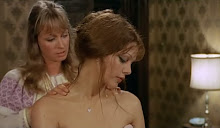
Kimberley at Cinebeats is hosting a Hammer Glamour week, 24th to 30th November. Which is the only excuse I needed to post some archetypally 60s/70s cheesecake shots of the knee-weakeningly gorgeous Valerie Leon ...


... as well as a more recent picture that proves she still has that inimitable touch of glamour.


Valerie Leon's onscreen career was - perhaps unfairly - defined by her physical charms: a couple of 'Carry On' films, a handful of interchangeable sex comedies, eye candy in two Bond movies ('The Spy Who Loved Me' and the non-Broccoli-produced 'Never Say Never Again'), plenty of television work and those memorable Hai Karate aftershave adverts in the 70s which probably accounted for half of that decade's pubescent males buying the stuff by the gallon and going round smelling like a Turkish brothel.

'Blood From the Mummy's Tomb' gave Valerie Leon her one bona fide leading role, but the production was troubled. Peter Cushing, originally cast in a major role, had to bow out after his wife was diagnosed as seriously ill. Andrew Keir replaced him, but Cushing's absence is palpable. Director Seth Holt died during the shoot; the film was completed under the guidance of Michael Carreras. It's an atmospheric piece and Valerie Leon is striking and seductive; however, the film has an uneven tone that reflects these tragedies, and is remembered chiefly as something of a curio.

After a couple of decades out of the limelight, Valerie Leon appeared in Sylvie Bolioli's well-received short film 'Gas' (based on an early Hitchcock story that never made it to the screen). Valerie Leon's website is definitely worth a visit, and demonstrates (if any proof were needed) the longevity of her continued appeal.

Friday, November 20, 2009

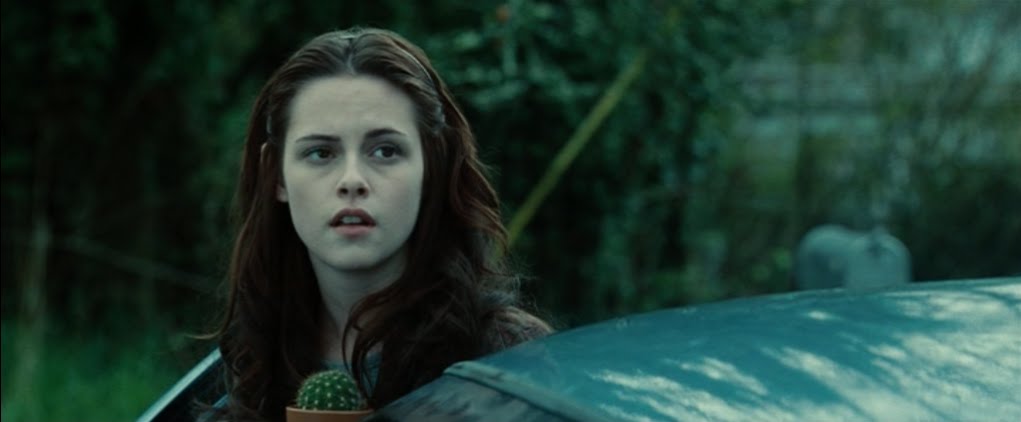
The Twilight Quartet: Romeo and Juliet, Bonnie and Clyde, Edward and Bella?!?


Just your average boy-meets-girl-boy-turns-out-to-be-vampire-girl-just-wants-to-jump-his-deathly-white-bones story, really.

Meet Bella Swan. She's just moved out from the low-rent dive that her ten-gallon-hat-wearing white trash mom shares with the stud-muffin new boyfriend. She relocates to a rainy mid-western town populated by old people and big rigs hauling lumber (think Twin Peaks with a frontal lobotomy) to be with her dad. Swan senior is town sheriff and sports a 'tache that would be sniggeringly reminiscent of the Village People if he didn't have the habit of snapping his shotgun shut like there was still a chance for him in a Peckinpah movie. Daughter of Swan is a twitchy, scowly type who gives the impression of having sucked on a lemon for the duration of pre-production; that, or she's read the script all the way through and is balking at the dreadful dialogue it'll be her thankless task to utter.

Can I just say, to start with, Bella Swan?!? Even Victorian romantics with a contractual obligation to write three volume novels would have stopped short of calling their heroine Bella frickin' Swan.

Meet Edward Cullen. He's got bigger hair than most of the gals in the cast, a forehead you could use as a chopping board, and a marked disinclination to getting a suntan. Although that doesn't stop him from sashaying around during daylight hours. He just can't stand in direct sunlight, that's all. Otherwise he'll "reveal his true self" and sparkle a bit. I swear I am not making this up. 'Twilight' is a vampire film where the worst thing that happens to a vampire when they get hit by a ray of sunlight is they fucking sparkle a bit. What. The. Fuck? Also, there's a scene where some vampires besiege a victim in his boathouse (excuuuse me? running water, anyone?). Novelist, screenwriter and director finally get done raping the mythology after throwing in a narratively pointless piece of padding where Edward's vampire family cook a meal. An Italian meal. Oh, you did have to go there with the garlic, didn't you, motherfuckers?


Seriously, has nobody who was involved in this precociously presumptious and piss-poor production ever read 'Dracula'? Or 'I Am Legend'? Or 'Salem's Lot'? At the very least, they could have got down with a few Hammer titles. Christopher Lee as Dracula - he's a vampire. Max Schrek in F.W. Murnau's 'Nosferatu' or Klaus Kinski in Werner Herzog's remake - those bad boys are vampires. Robert Pattison as Edward Cullen in 'Twilight' - I don't know what in the name of Bram Stoker he is, but he ain't no vampire I ever heard of. Robert Pattison as Edward Cullen in 'Twilight' is more like the non-threatening lead singer of an asexually asinine boy band who's tried to goth up a la Robert Smith out of The Cure in an attempt to appeal to a more mature audience. An attempt that has all the miserable desperation of Miley Cirus taking the role of Mimi in a production of 'La Traviata'.

(Damn, I ought to abandon the mission statement of this blog and review more bad movies. I am just loving how much of a bitch I can be!)

Oh, and while I'm on the subject, can I just say: Edward Cullen?!? There's a fish-and-potatoes Scottish broth called cullen skink. If I were a lesser blogger, I'd toss in a grubbily gratuitous cullen skank quip about now. (Ooops, I just did.) But still: Edward frickin' Cullen.

Incidentally: Edward / Ed Wood. Anyone? ... Anyone? ... Bueller?

Sorry. I digress. There's something about 'Twilight' that encourages digression. I wish a tape recorder had been rolling while me and Paula watched it; they could have re-released the DVD with my commentary as a special feature. C'mon, which would you rather listen to - Catherine Hardwicke, Robert Pattison and Kristen Stewart waltzing through a scene-by-scene exercise in self-congratulation; or Mr Agitation of the Mind ripping the piss and laughing it up for two hours?

Where was I? Oh yeah, Bella gets some interest as the new girl in town (God knows why, she's got all the personality of a tombstone), principally from a geeky dude who edits the school paper (his chat up line: "I'm on the paper, baby, and you're front page news") and a hunky but self-conscious guy called Jacob (Taylor Lautner) who may or may not be a werewolf. Oh, shit, I just gave away the plot of the sequel. Anyway, Bella is intrigued by Edward's tireless attempts to push her away and not get involved. He has his reasons. Said reasons are being a "vegetarian" vampire. This means he drinks animal blood instead of human blood. I can only assume that actual vegetarians (whose motivation is chiefly the non-consumption of animals) are in the habit of administering a good hard slap every time they see Robert Pattison, Stephanie Meyer or Catherine Hardwicke on the street. In which case: yay! go, salad-munchers, go!

Sorry, I digress again. Where was I? Oh yeah, try as he might to resist it, Edward is inextricably drawn to Bella. He expresses himself with agonised poetic longing. "I don't have the strength to stay away from you anymore" and "you're my own personal brand of heroin" have now joined "I'm not happy with the fenestration" from 'Intersection' and "I chipped my tooth on a quaalude" from 'Showgirls' as amongst the worst examples of the scriptwriter's art ever to make the final cut.

Before you know it, the awkward obstacle of Edward's vampirism has been addressed and resolved (Edward: "I've killed people"; Bella "It doesn't matter"*) and they're deeply and miserably in love, doing all the things that teenagers in love the world over are renowned for doing.

Except shagging.

'Twilight' is perhaps the weirdest film I've ever seen. With its hormonally charged adolescent leads, lustfully lingering looks, heavily heaving bosoms and soulfully sappy dialogue, it's got all the makings of a panting and priapic piece of poontang pumping pornography. (Note to self: okay, that's enough of the Hush-Hush alliterative style. Seriously.) It is, in fact, pornography without the porn. They barely even hold hands. Their first kiss is so halting, hesitant and drawn out that I was willing the cartoon crustaceans out of 'The Little Mermaid' to pop up and give it a couple of verses of "Kiss the Girl" just to give Eddie boy a push in the right direction.

At this juncture - ie. before the will to live finally drains from me and I cursorily abandon this review, upload it as it stands and go do something infinitely more life-affirming (watching paint dry, tuning in to a party political broadcast, reading a Dan Brown novel and cleaning the oven are all presenting themselves as viable options) - it's worth noting that Pattison and Stewart have. Absolutely. No. Chemistry.

Whatsover.


Their scenes together are painful to watch. Director Catherine Hardwicke tries to compensate by drawing your attention anywhere but to Edward and Bella. They're in a forest - her camera swoops through the trees and spirals through a canopy of branches. They're at Edward's family's designer house - her camera probes every corner of Jeff Kobel's architecture. They're playing baseball in a field (no, really) - the camera lights on three antagonistic vampires who turn up out of nowhere to start some shit. This happens about three quarters of the way through the movie, as if someone suddenly reminded the production team that, actually, there's supposed to be some dramatic tension ... and a villain ... and something that vaguely resembles a storyline. So - apropos of sweet FA and with no provenance, development or context - Bella and Edward and his family go on the run while a "stalker" ... well ... stalks them. Then Edward and the stalker have a big fight. Edward wins and gets to be Bella's date at the prom. So that's all right, then.

There's a twist ending that's as obvious as a Reader's Digest prize draw notification that requires you to buy something before you qualify; a bit part player who's had three lines in the whole movie pulls off a last-moment bit of scene-stealing that makes Pattison and Stewart look totally redundant; then a segue to black and white heralds the closing credits. Finally, the ordeal is over, the terror is terminated, the deathly dullness is done, and the facile, fucked-up fungoo is finished. (Note to self: no kidding, enough of the Hush-Hush verbiage already!)

'Twilight' teems with wretched writing, debased direction, appalling acting and cranky camerawork. It's routinely random and unintentionally uproarious. It notches up non-sequiturs and depilorates dramatic tension. It aims for mediocrity and misses. It's the best film Ed Wood never made.


*Not that I'm suggesting the girl's easy, but - shit! - when this kind of thing doesn't bother you ...

Thursday, November 19, 2009

The Twilight Quartet: Twi-Hard Confidential

(with apologies to James Ellroy)

'New Moon' posters perniciously proliferate. Heart-throb head shots hang from hoardings. Brooding bloodsuckers emblazon bus stops. The emo undead encroach on commercial breaks, inveigle the internet, gaze glassy-eyed from glossy magazines. I'm implicity ignoring and tenaciously tuning out the abject adverts. I'm soft-pedalling on Stephanie Meyer's sell-out saga and getting justifiably juiced on James Ellroy's latest lump of locquacious literature.

But my defences are down, my attention absent, and the cool clinical clampdown that categorically colludes in the quality control of my aesthetic affectations has been cold-cocked and duplicitously declared out for the count. It happens before I can batten down the hatches, occurs before I can offer an alternative. "You know," my wife says, "I'm almost tempted to watch 'Twilight' just to see what all the fuss is about."

It happens fast but it's flagrantly my fault. I should have stamped down on the surreptitious suggestion. Niftily nixed it and nipped it in the bud. I should have instantly instigated an injunction and imperviously impailed the irredeemable idea. I should have expedited an excoriating 'Exorcist' emulation, hepped up on holy water and crucifix-crazy: "I cast you out, pasty-faced, big-haired vampire boy. The power of the film critic compels you, the power of the film critic compels you ..."

But I don't. I'm enmeshed in Ellroy's exhaustive epic, addicted to alliterative appellations and acerbic action, nobbled by nihilistic narrative. Next thing I know there's a damnable disc disappearing doom-laden in the DVD player and I find myself focusing fearfully on the forlorn film falsely fulminated upon as fantastic and fabulous by its fixated and fanatical fanbase. I'm wilfully and woefully watching the torturous and twisted 'Twilight' - me, the man who blazingly begun this blog as a bombastic bastion behoven to bigging-up big screen brilliance and movie magnificence, who tantalisingly titled it after hep-cat Herzog's words of wisdom, who swore sincerely to steer clear of moribund mundanity and mass-market mediocrity.

I'm suffering for my art and bleeding for my blog. I'm psyched on cynicism and hellishly haemophiliac. I'm fatalistically factoring in four days of seditiously sarcastic reviews and contemptuous commentary. I'm ready to dance with the devil and tangle with the Twi-hards. Remember, dear readers, you heard it here first - off the record, on the QT and so frickin' hush-hush it's unbelievable.

Tuesday, November 17, 2009

Well, actually ...

Writing in this month's Sight & Sound, Geoff Andrew lambasts the widely held conception that Michael Haneke's work is that of "some kind of sadistic, didactic provocateur". Andrew states:

Such charges are as misguided as the claim that his films are 'cold' ... Besides the obvious consideration that facile equations of tone, form and content should be avoided, one need only look at the films themselves to note the inadequacy of these criticisms.

While I'm not really bothered that Andrew's take on Haneke diverges from mine (you need only look at the deliberate moments of studied controversy in his films - random example: the protagonist of 'The Piano Teacher' sniffing a tissue someone has, ahem, wiped off on at a peepshow - to note that actually, yes, he is a provocateur), it worries me that a professional (ie. paid for it) film critic writing in a prestige publication should dismiss "equations of tone, form and content" as "facile".

Tone, form and content are the essential components from which a film's aesthetic derives. A film's aesthetic (ie. its capacity to function on an artistic, intellectual and/or emotional level) is the key to understanding, appreciating or writing about it in an objective and intelligent manner.

Monday, November 16, 2009

TARKOVSKY RETROSPECTIVE: Tempo di Viaggio & Directed by Andrei Tarkovsky

Andrei Tarkovsky made just seven full-length features in twenty-four years, mostly in the most unimaginably compromised circumstances and with gaps of up to seven years between films, so you can imagine how enthusiastically he must have seized upon the opportunity to make 'Tempo di Viaggio'. Produced for Italian television while he was working on the script for 'Nostalgia' with Tonino Guerra, it ostensibly records their journey to find suitable locations as well as documenting their working relationship and Tarkovsky's musings on film and art in general.


I won't knock him for simply wanting to get back behind the camera and film. What I will say, though, is that 'Tempo di Viaggio' - as beautiful as some of the images it contains are - is little more than a very well-produced, slighty pretentious home movie. It's basically 'Andrei and Tonino Do Italy' with Guerra reciting some dubious poetry, Tarkovsky discoursing more on other filmmakers than his own work, and the whole enterprise becoming a series of increasingly wordless and extended takes which ultimately look beautiful but say very little about the creative and collaborative processes or the themes and considerations of 'Nostalgia' itself.


The only scene that has any frisson is utterly bizarre. Guerra and Tarkovsky visit a villa which the former has earmarked as a possible location. Guerra recounts with some excitement a legend about a noblewoman who lived there and the series of romantic/tragic events that led to her commissioning a marble floor decorated to suggest a scattering of petals. Like a kid at the entrance to Disneyland, Guerra is almost agitatedly eager to see this ornate feature. When the owners' representative, an oleaginous but diplomatic type, regrets that the proper arrangements have not been made for them to tour the interior, Guerra promptly throws his toys out of the pram. Even Tarkovksy - who, as the next documentary under consideration demonstrates, wasn't adverse to throwing his teddy in the air either - looks shocked and urges the writer to calm down.


The creative process is more thoroughly explored in Michal Leszczylowski's 'Directed by Andrei Tarkovsky', an assemblage of footage shot by Arne Carlsson, assistant cameraman on 'The Sacrifice', during the production of that film and fleshed out with interviews with Tarkovsky's widow and readings (by Brian Cox) from the director's book 'Sculpting in Time'. There are fascinating scenes of Tarkovsky dealing with a multi-national (ergo multi-lingual) cast - we're talking about a Russian director making a film in Sweden with a cast including Swedish, French and British actors - and the one person who impresses most, for her patience and sense of calm, is Tarkovsky's translator. The director himself comes across as fussy and obsessed with minor details, yet often frustratingly vague in his direction of actors.


Tarkovksy sometimes seems undisciplined, dithering over an onset instruction or hesitant as to where to place his actors within the mise en scene (all things, to my thinking, that should have been tied down in pre-production and rehearsal) and even repositioning stones in a brief coastline scene. An hilarious moment has him demand that a tree be removed because the blossom is the wrong colour - for a scene he shoots in sepia! The dramatic crux of the documentary, however, centres on the climactic burning of a house, a six minute scene documenting the protagonist's perceived descent into madness playing out in front of the conflagration. Tarkovksy evinces little control of events, a couple of pyrotechnic effects don't work, and to top it all the camera jams, necessitating the rebuilding of the house within days. Second time around, Tarkovsky plays safe and shoots it with two cameras. It's a tense finale to an otherwise overly reverent documentary and it's priceless to hear the otherwise highly cerebral and locquacious Tarkovsky resorting to calling someone a "motherfucker" when things go wrong.

Saturday, November 14, 2009

TARKOVSKY RETROSPECTIVE: The Sacrifice

Sweden. The present. Alexander (Erland Josephson), an actor who retired from the stage after excelling in Shakespeare's 'Richard II' and Dostoyevsky's 'The Idiot', gathers his family and friends at his luxurious country home for his birthday celebrations. The occasion is interrupted by a TV newscast announcing that nuclear war is imminent. By his own admission, at the start of the film, not the most religious individual, Alexander finds himself not only praying but offering God a bargain: avert the holocaust and he'll give up everything he has, his family and home, and take a vow of silence.

Next day, everything is as it was before and Alexander has to keep his end of the deal.

These quotes are spattered over the cover of my DVD copy of 'The Sacrifice':

"A work of genius" - The Times

"A classic ... No one in the cinema at present can compete with Tarkovsky on this level" - Derek Malcolm in The Guardian

"Towering ... One of the great films of Western Europe" - Alexander Walker, Evening Standard

Now, far be it from me to question the words of such established film critics as Messrs Malcolm and Walker (and I've been trying to find away of hedging the issue and coming up with 800 non-committal words), but I have to go with my gut instinct. There's a reason I titled this blog after Werner Herzog's words of wisdom. That reason was to get away from arty-farty, up-its-own-arse film writing and simply celebrate the medium. I've not always managed to adhere to that, and I probably shouldn't be writing about 'The Sacrifice' now because the next few paragraphs are going to fly in the face of my mission statement. That's the danger of a retrospective, I guess.

"Film is not analysis, it is the agitation of the mind." I know this is only my opinion and there are people out there who will consider me a godless heathen for saying this (and they'd be right on the first count and pretty damn close on the second), but as far as I'm concerned the only thing 'The Sacrifice' agitates is my patience.

And already I'm undermining myself: "it's boring" is the argot of the school yard and as far removed from a legitimate critical statement as a politician is from integrity. And yet I can't get away from the fact that, in capturing my gut reaction to the film on first viewing and my more considered evaluation second time round, it's the best catch-all description I can come up with.

Nor is it made any easier for me to say having discovered such awe-struck love for Tarkovsky's previous film 'Nostalgia', whose final scene left me gaping slack-jawed at the screen for a good quarter of an hour after the film ended. Following 'Nostalgia', I really wanted 'The Sacrifice' to be a profound and inspirational encapsulation of Tarkovsky's entire moral and spiritual philosophy as a filmmaker. What I resolutely didn't want it to be was dull, turgid, interminable and a test of the patience.

On paper, it sounds like it has all the elements: a celebration interrupted by the certainty of death; the agonising hours which follow; a man of little or no religious belief arriving at what must be a life-changing decision to get on his knees and pray; a quite literal long dark night of the soul as daylight fades and no-one knows if they will see the dawn; the faint hopes of the new day arriving; the miracle of deliverance; Alexander's awful, wrenching decision to do as he promised. This, no doubt about it, is the stuff of real, sinewy drama. Astoundingly, confusingly, frustratingly, Tarkovsky either doesn't engage with these elements, or completely drops the ball.

Firstly, the concept of imminent death intruding on a celebration sets up an immediate juxtaposition, a dynamic; only Tarkovsky presents us with the least celebratory birthday party ever committed to film. None of the supposed celebrants are happy. They're all coolly aloof and cerebrally cynical. Where's the drama in them facing death if none of them are tangibly alive anyway?

Secondly, there's how they respond to the news. I'm not sure how I'd react to only having hours left to live, but I hope I would demonstrate neither the wailing histrionics or the po-faced stoicism that seems to be the either/or choice for Tarkovsky's characters. Nobody says "Screw it, let's drink the good wine. Alexander, you got any decent cigars, mate?" No-one turns to their nearest and dearest and simply holds them close. Personally, I'm betting the majority of people would rather die with a belly full of good food, head buzzing with the pleasant sense of inebriation. That or in the arms of the person they love.

(Mention deserves to be made of 'The Simpsons' season two episode "One Fish, Two Fish, Blowfish, Bluefish", which posits that Homer has a single day left to live. He determines to flip Mr Burns off, listen to Lisa play saxophone, have a beer with the boys and be intimate with Marge. To my way of thinking, this emerges as an infinitely more realistic response to imminent death than 'The Sacrifice'.)

Thirdly, Tarkovsky greets the new dawn and the aversion of global annihilation not with the profound spirituality that conjured the unutterably moving final shot of 'Nostalgia' but with a ploddingly awful scene in which Otto the postman visits Alexander all in a fluster and tells him he can save mankind by going to see his servant girl Maria and "lying with her" (and he doesn't mean they tell untruths together, either). For what probably only lasts about five minutes - but seems like 'Satantango' and 'Shoah' on a double-bill - Alexander repeatedly asks "who?" (even though the script has only identified one Maria during the entire film) instead of the burning question: "why?" Why does Alexander need to do the wild thing with a servant girl (hasn't he already struck his bargain with God)? Why does Otto know that this is the singular course of action that no-one but Alexander can possibly undertake? Does Alexander just assume that Otto has become God's messenger (why use burning bushes when He can send messages through the postman)?

As much as I tried to engage with it - on both viewings - 'The Sacrifice' lost me at this point.

Alexander's sacrifice itself, albeit the only point where the film breaks ground from underlit drawing rooms and flat coastland and actually gets visual*, exacerbates the sense of the ludicrous. While the raging image of Alexander's flame-wreathed house is an undeniably powerful one, Tarkovsky relegates it to the background while Alexander runs around dementedly in front of it, stumblingly pursued by his family and by the two orderlies who accompany the ambulance which turns up to cart him off to an asylum. The ambulance, it should be noted, turns up within minutes of the blaze starting (by comparison, the scene ends without even a distant siren announcing the impending arrival of the fire brigade) and without any of Alexander's kith or kin placing a phone call or signing any committal papers.

Suspension of disbelief? Oh, puh-leeze. It'd never happen in Springfield.


*If for no other reason, 'The Sacrifice' fails as the single visually uninteresting film by a director whose talent, elsewhere, for creating striking, startling, challenging images remains largely unchallenged in the medium. What makes it worse is that 'The Sacrifice' was lensed by Bergman's DoP of choice, Sven Nyqvist, a man for whom light and shadow was ordinarily second nature.

Wednesday, November 11, 2009

TARKOVSKY RETROSPECTIVE: Nostalgia


Italy. The present. Russian poet Andrei Gorchakov (Oleg Yankovskiy) is travelling with his translator Eugenia (Domiziana Giordano) while he researches a book on the life of a famous composer. Their relationship is tense and Gorchakov is haunted by thoughts of his wife and memories of his childhood back in Russia.

At a spa town, Gorchakov meets Domenico (Erland Josephson), a mystic who has experienced visions and is infamous for having locked his family away in preparation for the end of the world. A kinship is evident between Gorchakov and Domenico, and the mystic tasks Gorchakov to complete a symbolic act.

Readying to leave Italy – the act (to cross the drained spa with a candle which must be kept alight) not completed – Gorchakov is contacted by Eugenia who alerts him that Domenico, in an almost euphoric state, is preaching to crowds in Rome. When Domenico concludes an intense sermon on brotherhood and the necessity to strive for something better with an act of self-immolation, Gorchakov returns to the spa town to keep his promise.


‘Nostalgia’ is the one Tarkovsky film I’ve almost dreaded writing about. How does one discuss Domenico’s fiery departure from the film without making it sound unbearably melodramatic? How to describe the mise-en-scene and elliptic accretion of imagery which finds majestic synthesis in the very last shot without haring off into the realms of purple prose and pretentious parlance? How to communicate the sustained emotional power of an eight and a half minute take in which a man makes several slow shuffling attempts to cross an empty pool without a candle going out?

What makes ‘Nostalgia’ even harder to write about – as a fully paid-up atheist – is how deeply, profoundly religious it is. Even more so, arguably, than ‘The Sacrifice’ with its bargain-with-God premise. Gorchakov’s appointment with the pool and the candle goes beyond metaphor, beyond symbolism. By the end of those painful, interminable eight and a half minutes, the pool and the candle have become his own personal stations of the cross.

Then Tarkovsky throws in that indescribable, awe-inspiring final shot, the camera pulling slowly back from a fairly ordinary image, one already located in Gorchakov’s memories and referenced earlier in the film; the camera pulls back and a reflection in a pond (as in all of Tarkovsky’s work, water provides a wellspring of images*) suggests that there is a bigger picture, a larger element, something beyond the merely nostalgic or pastoral; slowly, gradually the camera pulls back until the whole astonishing image is revealed.

And even then the full import isn’t immediate. The visual bravura initially overwhelms; invokes comparison with the metaphysical imagery which closes ‘Solaris’. The combined emotional, intellectual and – damn it – spiritual meaning of the image gradually radiates from Tarkovsky’s mind, via the screen, and into the viewer’s.

Yes, I know, that comes across as hyperbolic and downright sloppy writing. But I can honestly find no other way of describing the cumulative power of ‘Nostalgia’. It is the cinematic equivalent of a religious experience.


*Sorry. Serious article; bad pun.

Monday, November 09, 2009

More thoughts on Stalker

When I wrote yesterday's post, I think I was hung up maybe a little too much on the comparison between book and film, how 'Stalker' (for me) is a stripping away of all the genre tropes from the Strugatskys' novel 'Roadside Picnic'.

Also, the enigmatic qualities of the film appealed to me so strongly that I resisted analysing or probing the film. But as with even the most slippery and ambiguous works of art, there are doorways - or even just hairline cracks - that allow a way in; that allow for a reading, an interpretation, an understanding.

I didn't strive for these things in my review, content to let the mysteries of 'Stalker' swirl around me.

Francisco Gonzalez discussed 'Stalker' as the inaugural review on his blog The Film Connoisseur (a brave and inspired choice of film to kick off a new blog with), and he left a comment on my article which proved a thought-provoking take on the film. I thought it was too good a piece of writing to remain hidden in the comments section, and with Francisco's kind permission, it is printed below:

The way I saw it, the whole film was a metaphor for religion. The Stalker serves as the religious preacher, looking for new members - in this case the two people he is guiding through "the zone".

The Zone to me is religion. The film was an exploration of why people need it, why its there, and why should it be there? Do we really need it to survive? And should it be blown to smithereens? Eliminated forever from society?

All this revealed through the conversations that the characters have, and it's intriguing that one is a writer, one is a philosopher and one is a mathematician.

That last scene, where they are looking at "the room", I guess the room means something different to each of them, one wants to blow it up, the other thinks we need it. Kind of like in 'Solaris' where they were thinking of blowing up the whole place with bombs, I believe it was?

Also, the last shot with the little kid being "different", I thought there was some telekinesis involved there, demonstrating that it's in the future generation's hands to change things...with the power of their minds. That's how I saw it, youth, future generations can move things, change them, including problems that plague our society right now. But then again, maybe it was just the vibrations from the train that was passing by? Or was it? I loved that ambiguity there!

It seems Tarkovsky enjoyed playing with these themes, which in my opinion he also played with in 'Solaris'. The planet that makes people see things...

Francisco's review of 'Stalker' can be read here; it's a good and insightful piece.

Sunday, November 08, 2009

TARKOVSKY RETROSPECTIVE: Stalker


Russia. The not-too-distant future. The Zone, an area of land devastated by a meteorite, has yielded unearthly artefacts. The authorities have sealed it off. Armed guards provide sentry duty. Rumour has it that somewhere in The Zone is a place called The Room. Here, it is said, a person's deepest, innermost wish is granted.

The Stalker (Alexander Kaidanovksy) accepts a commission to guide two clients - the Writer (Anatoli Solonitsyn) and the Professor (Nikolai Grinko) - into The Zone, much to the chagrin of his wife (Alisa Freidlich), who reminds him that his forays into The Zone are illegal, have already cost him time in prison and that their daughter, nicknamed Monkey, is a "mutant" because of him. The implication is that a child of a Stalker is "different".

Nonetheless, the Stalker leads the Writer and the Professor into The Zone, narrowly escaping death at the hands of the trigger-happy border guards. Once in, the Stalker insists they follow his instructions to the letter and not deviate from his directions. Despite continual warnings as to the dangers which await them, The Zone seems benign. The Writer eventually begins to question the Stalker's expertise.

As they near The Room, the Stalker offers the cautionary tale of his mentor, who entered The Room, became rich within days and hanged himself a week later. The Professor reveals he is in possession of an explosive device and intends to destroy The Room. The Stalker tries to wrest it from him, but the Writer intercedes. The Professor, though, is unable to go through with it and the three men depart The Zone.

Writing in Sight & Sound, Jan Dawson described ‘Stalker’ as "one of the cinema’s most searingly pessimistic visions".

Fair dues. But ‘Stalker’ is also – certainly in its extended first reel set-piece wherein the Stalker and his clients play cat ‘n’ mouse with the border guards through the dark streets of a ruined township prior to entering The Zone – tense, suspenseful and pacy. Never mind that Boris and Arkady Strugatsky’s source novel ‘Roadside Picnic’ is firmly bracketed in the sci-fi genre, Tarkovsky here seems to be channelling film noir. A really perverse strand of thought currently uncoiling in the back of my mind is speculating on an alternative cinematic reality where Tarkovsky made hard-bitten, cynical, Jim Thompson style thrillers … and coming to the conclusion that he’d probably have been bloody good at it.

For all the thrilleramics of this early sequence, though, ‘Stalker’ is definitely a product of Tarkovsky’s post-‘Mirror’ aesthetic, where narrative is all but abandoned. As in the four films that precede it, the external is a pathway to the internal, his characters’ journey through desolate landscapes mirroring their journey towards the deepest, innermost part of themselves.

Perhaps the idea of The Room as an X-ray machine for the psyche – revealing the human condition at the dark point where the id and the ego struggle perpetually – was what drew Tarkovsky to the Strugatskys novel. Certainly, Tarkovsky considered ‘Solaris’ flawed in that it was all too clearly a science fiction film and his aim was to create cinema without genre.

It’s no surprise then, that his take on ‘Roadside Picnic’ is less an adaptation that a stripping away: gone are the overt indicators that The Zone is the product of an alien civilisation (some of the characters in ‘Stalker’ think that it is, but Tarkovsky never defines The Zone’s origins); gone are the ‘effects’ that populate the novel and leave the reader in no doubt that something unearthly is happening (the Stalker continually warns the Writer and the Professor that The Zone "plays tricks" but we see no evidence of this); gone is the book’s denouement where The Room is breached and a better world wished for. Tarkovsky leaves his protagonists sitting outside The Room, then cuts to an ambiguous coda which never entirely establishes whether they entered it or not.


Ambiguity permeates every frame, every scene, every character. Is the Stalker a survivalist/outlaw (in the novel he is) or an idiot savant – a holy fool, even? What exactly are the Writer and the Professor’s motives for seeking The Room ? Sure, the Writer tosses out the old chestnut about inspiration, but a pre-Zone monologue establishes him as a die-hard cynical who has no faith or belief left in anything; his character does not fit this dreamy idea of inspiration as a stand-in for the continual hard work and honing of craftsmanship that writing is actually about. The Professor’s motives are seemingly revealed towards the end, but why does he desist?

Indeed, the big question of ‘Stalker’ is: what are the three of them thinking about as they sit outside The Room, the camera slowly pulling back and stranding them in a landscape of their own uncertainties as a sudden rainfall washes across them?

Paradoxically – given that I found ‘Mirror’ "too insubstantial in its construct and enigmatic in tone" – ‘Stalker’ grips and intrigues me precisely because it’s enigmatic; because it keeps its mysteries and resolutions offscreen; and because its low-key denouement, with a hint of the genuinely otherworldly and its few seconds of Beethoven’s 9th Symphony, suggests (as ambiguously and elusively as anything else in this bleakly beautiful film) some small possibility of hope.

Thursday, November 05, 2009

Man on Wire

Thanks to my friend Viv Apple for the following piece:


The introductory scenes of ‘Man on Wire’ felt as tense as any spy movie; the preparations being carried out filmed with an atmosphere as edgy as any gangster yarn. But this was real. By the time it reached the main titles and the building site that was to become the twin towers, we had no doubts about the film’s reality.

Intercut with shots of the towers being slowly assembled are scenes of Philippe Petit’s childhood, and how he first discovered his dream of the twin towers by seeing a photo of the proposed structures in a dentist’s waiting room. From then on he forgot his toothache and devoted himself to the achievement of his ambition: tight-rope walking across between the tops of the south and north towers. It’s easy to see why he has been labelled by some as mad or an egomaniac, but Philippe is a passionate Frenchman, and whereas this phrase normally brings to mind an ardent lover, in this case his passion has been concentrated on achieving more and more daring feats of tight-rope walking - with the ultimate goal in mind of conquering the highest buildings in New York. Mad he is not, but he is clearly eccentric, for who else (even a Frenchman) would go around routinely riding a unicycle?

At the age of 20 he also became obsessed with Annie, who soon fell for him and was drawn into his dream. Together they worked on the dream - she initially following him on the wire (now that’s what I call true love!). This back story, interwoven with shots of the growing towers, took on a surreal quality, no doubt helped by the sensitive background score by Michael Nyman.

Annie recalls with a quieter passion Philippe’s first daring stunt of walking across the highest points of Notre Dame de Paris. Whilst he was calmly stepping along his wire she went onto the interior where there was a gathering of distinguished clergy, and announced what was happening above them. Jean-Francois, an accomplice, had said that the walk was ‘against the law but not wicked or mean’ - and sure enough the police and people in the street below gazed at Philippe in wonder, not disapprobation.


The Sydney Harbour Bridge was a tougher challenge, but by this time his confidence made it seem entirely natural and earned him the same reaction of amazed wonder from the crowd - and the police. The quality of the photography in these scenes, as in the whole film, emphasises the beauty of what was happening. It seemed to me quite amazing that in a documentary shot over a period of more than thirty years, each part of the story melds seamlessly with the next, holding the tension, and the attention, perfectly together.

In 1974, Philippe went to see the twin towers in New York. When Annie saw the pictures she was fearful, but Philippe could see workmen still there, finishing off, so now was the time to do it. He had to get tons of equipment into the south tower, and found an insider, Barry, an Englishman, to help. They made ‘official’ passes with which to gain access to the lifts, and gradually managed to get everything up to the required positions.

The final, climactic part of this true story is filled with the same tension of the first part, but with added excitement as Philippe draws closer to his dream. To see him holding his 26ft pole, balancing on a ¾ inch wire against a clear blue sky, was a truly beautiful sight. And to share in the relief and triumph felt by him, Annie and all his followers at the end was an emotional moment. This film will surely help to counteract other less happy thoughts associated with the twin towers.

by Viv Apple

Monday, November 02, 2009

Coming attractions / the backseat blogger

I'm taking a bit of a backseat this month to concentrate on preparing material for December's month-long tribute to Sam Peckinpah.


I'll be posting the last few articles in the Tarkovsky retrospective, catching up with a couple of titles from the personal faves list and hosting a handful of guest articles. November might be a thinner month than usual, but I'll try to put at least two new pieces of material on The Agitation of the Mind each week.

Do bare with me. December will be full-on, full-blooded and worth the wait.

Saturday, October 31, 2009

The horror movie: new golden age or fangs for the memory?

Thanks to my good friend Paul Rowe for the following article.


Okay. For those of you who aren’t horror fans, get that index finger going and scroll down to the next article. Because none of the following will be of interest to you. At all. But I would like those of you who are - those of you who can name the film that started it all and how old you were when you first watched it and what pattern was printed on your pyjamas – to ask yourself the following question: what is it I love about horror movies? For those with a real love of horror will undoubtedly begin your lists with words like, ‘atmosphere’ and ‘tension’. Yes; good effects help, as does a solid script and decent cast, but it’s the feeling that makes it really happen. Visuals are important of course, primarily the sets; foreboding castles perched on an outcropping in the Carpathians, twisted trees that appear to float above ground level because of an eddying ground-mist. Shock tactics if well deployed can be successful, but easily over-used. Every time the audience is made to jump – prompting laughter – the tension is broken, so this tactic can only be utilised a couple of times if the overall atmosphere is to be maintained throughout the film.

I’m not preaching and this isn’t a thesis – you all know this.

So; if we all know it, why doesn’t Hollywood? Why, at a time when even the most low-budget shoot has production values that the movie-brats of the seventies could have only dreamed of, does every director shoot horror movies as fucking action comedies!?!?

Sorry. Forgive me. But really. Stephen Sommers is the devil. ‘The Mummy’ as Indiana Jones? Karloff would have been getting his bandages all twisted spinning in his sarcophagus. And the concept of Michael Bay having his own production stable churning out remakes of many of the most famous chillers of the last twenty or thirty years would be hilarious if it weren’t so depressing. The naivety being demonstrated is unfathomable. What made ‘The Texas Chain Saw Massacre’ and ‘Halloween’ so memorable was the lack of gloss, the immediacy, the feeling that they were shot at the scene on the hand-held camera of a passer by. Watching these films, you can’t really imagine a film crew and lighting rigs and actors working from scripts (the fact that so many of the actors were poor doesn’t matter). Michael Bay does big, stupid, syrupy action films, and then for some bizarre reason obtains the rights to a handful of low-budget independent horror classics and produces them as big, stupid, syrupy action films.

Has the youth of today really got such a short attention span that they need a stabbing, a naked pair of breasts or an explosion every five minutes to keep them interested? Maybe so, maybe they have. Maybe it’s us – the old horror traditionalists – who are naïve. Maybe it’s all business and to hell with creating great films that can be enjoyed for generations.

I had my hopes briefly raised when I learned that the upcoming remake of ‘The Wolf Man’ was to be set in Victorian England (predating the contemporary set 1941 version) and would remain faithful to much of George Waggner’s original. Benicio Del Toro as Larry Talbot? I licked my lips. I’ve since learned the director is Joe Johnston. Joe-‘Jurassic Park 3’-‘Honey I Shrunk the Kids’-Johnston. ‘The Wolf Man’ as family-friendly actioner anyone? Er … no; no thanks. Even with Andrew Kevin Walker, who came over all gothic for ‘Se7en’ and ‘Sleepy Hollow’, having contributed the screenplay, things don’t bode well.


Let’s look at the facts: Best ‘Dracula’ adaptation? F. W. Murnau’s ‘Nosferatu’ (1922) or Todd Browning’s ‘Dracula’ (1931). Best ‘Frankenstein’? James Whale’s 1931 version. Karl Freund gave us the definitive ‘Mummy’ in 1932 and the aforementioned 1941 ‘Wolf Man’ remains arguably the best werewolf movie (with a respectful nod to John Landis’s ‘An American Werewolf in London’). See the pattern? Steady pacing, classic themes, iconic monsters and all simply dripping in atmosphere. Watch ‘The Creature from the Black Lagoon’ again. Scary? No, not today it’s not. But wonderfully effective, despite the man-in-costume-that’s-so-tight-he-can’t-bend-his-arms-or-legs-creature, with a lovely sense of claustrophobia and many memorable scenes (you’ll wonder how many times a young Steven Spielberg watched the film for inspiration whilst on the set of ‘Jaws’).

So again; is there no one out there with the courage to make an old-fashioned character driven, straight-faced horror movie? William Friedkin didn’t deem it necessary to throw in a few jokes or a scene or two of slapstick in ‘The Exorcist’, did he? Kubrick managed to successfully adapt ‘The Shining’ without changing the cast into a group of teenagers who’d broken into The Overlook Hotel to smoke dope and boing each other.

So, come on then; ten great, non-comic horror films aimed at adults since ‘The Shining’? Bet you can’t do it. I can’t. ‘The Evil Dead’? Undeniably great, but tongue-in cheek. ‘Near Dark’? More cool than scary. ‘28 Days / Weeks Later’? Convincing end of the world feel these two, you’re glad to put the lights on after they’ve finished and look outside to make sure everything’s still normal. What about the 1982 version of ‘The Thing’, which was a brilliant exercise in paranoia and suspense directed by John Carpenter who - like Landis - seemingly decided that directing half a dozen cracking movies was enough and that all of his future output would be consistently shite. We’ve relied on the Far East for serious chills over the past decade with ‘The Ring’, ‘The Grudge’, ‘The Eye’ etc, but even these titles are quickly becoming generic and tired. Europe? Tomas Alfredson’s ‘Let the Right One In’ can not only claim best horror film of last year, but must feature in the top three or four of any genre.


A few gems aside though, it’s been slim pickings out there.

Right; what about those faithful literary horror adaptations of the nineties? Both Coppola’s ‘Bram Stoker’s Dracula’ and Branagh’s ‘Mary Shelley’s Frankenstein’ (Jesus, what’s with the name checking?) were worthy but dull romantic costume dramas, not horror films.

So please. Somebody. Please. Somebody please make a great horror film.

Joe Johnston?

Maybe. You never know.

But don’t bet on it.

by Paul Rowe