Monday, December 07, 2009

Major Dundee

"You were whipped, major. Burying your dead isn't going to change that."


Background
Among the many admirers of 'Ride the High Country' was Charlton Heston. He and producer Jerry Bresler were developing a property provisionally entitled 'Then Came the Tiger' - a synopsis by Harry Julian Fink that had all the makings of a full-blooded cavalry epic - for Columbia. Heston and Bresler's previous collaboration, 'Diamond Head', had done solid business at the box office. Peckinpah didn't need asking twice when he was offered directing duties. Fink got the nod to write the script proper, Bresler talked up the production as a big-budget roadshow release, and Peckinpah headed to Mexio to scout locations. The first problem was the script: Fink's first draft was unfocussed and - crucially - unfinished. Oscar Saul and Peckinpah himself worked on it, but essentially the now retitled 'Major Dundee' started shooting without a finalised screenplay - never a good indicator for a film.

Then, with principal photography well underway and half of Peckinpah's cast and crew stricken with illness, the money men at Columbia decided to slash budget and schedule. The epic destined for a roadshow release was now downgraded to a two-hour western. Peckinpah, unimpressed by Bresler's subservience to the studio, completely ignored his paymasters' edict to cut scenes, use fewer set-ups and expose less film. He continued to shoot every bit of footage he needed to make the film as he envisaged it. 'Major Dundee' went massively overbudget and behind schedule. In post-production, the studio took Peckinpah's two hour fifty minute original cut out of his hands, hacked it down by a third, had actor Michael J Anderson record a truly horrible narration which sloppily papers over plot holes and gaps in the chronology, and saddled it with an equally appalling score.

Between his very public criticism of Bresler and Columbia and his removal from his next project, 'The Cincinnati Kid', Peckinpah became a pariah within the industy. Four years in the wilderness followed, before he came storming back, all blood and thunder and very much unbowed, with his masterpiece 'The Wild Bunch'.


Synopsis
Transferred to the command of a prison garrison as part of a disciplinary measure, Major Amos Dundee (Charlton Heston) arrives at his new post to witness the aftermath of a raid on nearby homesteaders by marauding Apache warrior Sierra Charriba (Michael Pate). Already balking at a posting that takes him out of the theatre of conflict, Dundee goes renegade: he puts together a makeshift army of volunteers and prisoners. (Technically, many of the prisoners are volunteers given a choice of volunteer or be hanged.) He appoints his one-time friend and now sworn enemy Captain Benjamin Tyreen (Richard Harris) as his number two, and they set out to hunt Charriba down. An ambush during a river crossing costs lives and the loss of supplies. Dundee leads his men to a small Mexican town where the soldiers of a French garrison hold sway. Effectively liberating the villagers, Dundee is moved enough by their destitution to share with them the supplies looted from the garrison. He meets Teresa (Senta Berger), the Austrian widow of the town's doctor, and they begin a brief romantic relationship. The idyll is interrupted when Charriba's men stage another attack, and Dundee is forced into battle not only with the Apaches but a battalion of vengeful French troops.


Analysis
The Sony Home Entertainment DVD I'm basing this review on bills itself as "a restored masterpiece". The back cover blurb continues: "over 40 years after Sam Peckinpah's classic western was released, missing footage has been located and restored. The new scenes complete the electrifying depiction of an obsessive Union officer ..." etc, etc. Now, while there are many reasons to be thankful for this version - a much improved transfer; correct ratio; the removal of the fucking awful opening credits music by Mitch Miller's Sing-a-long Gang - claiming that an extra ten minutes or so "completes" the film when well over half an hour is still missing is stretching it a bit.

'Major Dundee' will forever remain a frustrating viewing experience, for two reasons. Number one: Richard Harris declared the original cut to be the best film he'd ever appeared in (this from a man who already had indisputable classics 'This Sporting Life' and 'Red Desert' under his belt!). Number two: Peckinpah had the opportunity to restore it to his original vision ... and declined!! Five years on from the debacle, with 'The Wild Bunch' in the can and 'The Ballad of Cable Hogue' in production, Peckinpah was still publically berating Columbia for their desecration of 'Major Dundee' and describing the original cut as still his best film. Columbia called his bluff and offered him the chance to re-edit and re-release it. Citing his involvement with other projects, Peckinpah replied that he didn't have the time. David Weddle, in his indispensible biography, postulates that the film was "more useful as a lost masterpiece than a rediscovered failure".

So what of the two hours and ten minutes that remain? The first half, certainly, is taut and compelling filmmaking. Dundee's hell-raising address to the prisoners; the countdown to Tyreen's hanging, curtailed only when he volunteers; the departure from the garrison, tensions already rising; the attack on the French fort; the execution of a deserter on the trail - memorable scenes, all. Two in particular are worthy of comparison to anything on Peckinpah's CV. The first has the Confederates launch into a lusty rendition of 'Dixie' as the rag-tag ad hoc battalion rides out from the garrison. Affronted, the Confederates strike up with 'The Battle Hymn of the American Republic'. As the two groups try to drown each other out, the small (and evidently politically unaffiliated) cluster of men bringing up the rear shrug their shoulders and start belting out 'Clementine'. It's one of Peckinpah's occasional, brilliantly observed comedic moments (like the passing of the whisky bottle, Warren Oates finally getting a go at it only when it's empty, in 'The Wild Bunch' or the supposedly under-attack stagecoach later revealed as a playful re-enacted by an Apache raiding party in 'The Deadly Companions').


The second - and the best scene in the film - has one of Tyreen's men, O.W. Hadley (Oates), summarily tried after going AWOL. He pleads that he only went back to the Mexican village to see one of the women. Quizzed on the details (Dundee is cognizant, by this point, that the French have sacked the village in retribution), Hadley reveals himself as a liar. Dundee stands as judge, jury and if not executioner then certainly all too eager to give the command to the firing squad. Not that it gets to that point. Hadley pleads with Tyreen, asking if he's really going to stand by and let Dundee have him killed. "I'm obliged to, lad," Tyreen replies; "you should have remembered you belong to the major and not to me." Hadley, blinking with the realisation that he's reached the end of the line, faces up to it, addressing Dundee: "Hell, major, you're just doing what you've got to do. But damn your soul to hell for it, and God bless Robert E. Lee!" Even as he speaks Lee's name, Tyreen's pistol roars and Hadley pitches forward dead. In killing Hadley himself, Tyreen cheats Dundee of the satisfaction. He then swears to kill Dundee once Charriba "has been caught or destroyed".

Sadly, things go south after this. Dundee's liaison with Teresa slows the film down. Gaps in the narrative become more prominent and the voiceover more tenuous. 'Major Dundee' becomes, in its last hour, episodic, fragmented, unfocused. A sequence that was presumably longer (and more coherent) in Peckinpah's original cut has Dundee, recovering from wounds sustained during a surprise attack, debase himself with a whore (at the cost of his relationship with Teresa) in a fly-blown Mexican town. Coming on like a dry run for Pike, Dutch and the Gorch brothers' collective moment of self-loathing in 'The Wild Bunch', what works as visceral psychological portraiture in 'The Wild Bunch' just seems out of place in 'Major Dundee'. Dundee's debasement is apropos of nothing, nor does it prefigure the cathartic self-destruction of Pike and co.; Dundee simply rejoins the battalion and snaps back into grizzled, macho leader of men mode.


The denouement is unsatisfying, too. The long-awaited showdown with Charriba is unengaging and over quickly. The subsequent battle with the French troops is a hell of a lot more exciting, but it's still just the resolution of a subplot. The whole film builds towards the destruction of Charriba, and - whether this is due to the script never fully cohering, Peckinpah muffing the sequence (hardly likely given his facility for extended, actionful set pieces) or clumsy fingers in the editing room when the only criteria was reduction of the running time to two hours - it's a case of not with a bang but a whimper.

Elsewhere, however, Peckinpah proves himself as an actor's director. Charlton Heston, as can be expected, plays Charlton Heston, but everyone else is superb. Harris, working with Peckinpah for the first and only time, has a field day with Tyreen. The supporting cast solidifies the Peckinpah Irregulars: Warren Oates, L.Q. Jones, R.G. Armstrong and John Davis Chandler return from 'Ride the High Country', while James Coburn, Ben Johnson, Slim Pickens, Dub Taylor and Aurora Clavel fill out the ranks. Even the much put-upon Senta Berger (her performance critically mauled, even though she does a decent salvage job from very thin material) would reappear, twelve years later, in 'Cross of Iron'. Armstrong kicks ass in the name of the Lord (doling out a retributive beating to one of Tyreen's men guilty of racially harrassing one of the battalion's black contingent) and Pickens, cruelly underused, gets an iconic moment when he reels into Dundee's office, drunk as a lord, and announces "If you want an injun-fightin', mule-packin', whisky-drinkin' volunteer, sir, well by God you've got one." It's tempting to imagine that the full version of 'Major Dundee' brings these colourful secondary characters out of the background and gives them life - a damn sight more life than Heston's misery-guts protagonist.

Peckinpah month: links & resources #2


Thanks to Troy Olson at Elusive As Robert Denby for drawing my attention to an overview of Peckinpah’s career at The High Hat with links to some incredibly well-written articles covering most of Peckinpah’s output.

Thanks also to J.D. at Radiator Heaven for tipping me the nod to an excellent article on ‘Bring Me the Head of Alfredo Garcia’ at Technicolor Dreams. (UPDATE: another mention for Radiator Heaven's J.D., who has just posted an in-depth write-up on ‘Alfredo Garcia’.)

There’s more love for ‘Alfredo Garcia’ in The Guardian online, where John Patterson heralds it as a true original and Peckinpah’s masterpiece, while David Thomson attempts a deconstruction in Sight & Sound.

The Guardian online also features a contemplative piece by Rick Moody, who questions Peckinpah’s reputation as a director of violence and argues his case as a realist filmmaker.

John Hodson, in Film Journal, proves himself as passionate an aficionado of Peckinpah’s work as anybody I’ve read. His piece is titled “A Peckinpah idolator writes” and it pretty much nails everything that makes me love Sam’s work wholeheartedly.

Sunday, December 06, 2009

Sam Peckinpah's maverick moments


‘Ride the High Country’. Keen to establish a certain dynamic between John Davis Chandler, James Drury, L.Q. Jones, John Anderson and Warren Oates – the actors playing the Hammond brothers – Peckinpah instructs them to shun the rest of the cast and eat, drink and brawl together. The desired effect is achieved and Peckinpah re-uses the technique a decade later on ‘Straw Dogs’; the drunken brawling results in T.P. McKenna breaking his arm.


‘Major Dundee’. It’s the magic hour, the light is perfect and Peckinpah is crouched next to his DoP, lining up a crane shot. It’s a simple take: Heston, mounted, leads his cavalry down a hillside at a trot. Halfway down, Peckinpah calls "Cut" and roundly damns Heston for leading the horses down too slowly. According to David Weddle’s biography, the exchange goes something like this:

Peckinpah: That was shit. Jesus Christ, you came down too slow.
Heston: You told me to bring them down at a trot.
Peckinpah: The fuck I did, you goddamn liar.

Incensed at this slur on his good name, Heston – kitted out in full cavalry regalia – pulls his sword, spurs his horse and goes charging at Peckinpah. Director and DoP unite in cranking the crane out of the reach of Heston’s sabre as quickly as possible, sphincter muscles doubtless clenching tight as the cold steel arcs through the evening air beneath the seat of their pants.


‘The Wild Bunch’. The effects guy is pretty happy with the blood squibs he’s rigged up on some mannequins in the backlot. He invites Peckinpah to take a look. Peckinpah obliges. The blood squibs go off, leaving little blobs of red on the clothes the mannequins are dressed in. Peckinpah tells the effects guy that’s not the effect he wants. What effect does he want? Peckinpah unlocks the trunk of his car, pulls out a shotgun and pumps several rounds into the mannequins, blowing them halfway to hell. That effect, he says.


‘Straw Dogs’. Peckinpah’s quite fond of "Butterfly Mornings", the love song in ‘The Ballad of Cable Hogue’ (made the previous year), and he decides to teach Ken Hutchison the words. While they’re blind drunk. In a storm. At Land’s End. At four in the morning. The production is shut down while Peckinpah recovers from pneumonia and producer Daniel Melnick holds out against the film’s star, Dustin Hoffman, who wants Peckinpah fired and replaced by Peter Yates, a man presumably not given over to impromptu vocal performances in the middle of a gale.


‘The Getaway’. Chalo Gonzalez, uncle to Peckinpah’s second wife, Begonia Palacios, is quoted in the Weddle biography as recalling that when he picked Sam up for the morning’s filming, his hands shook. A couple of vodka and tonics gets them steady again. Thereafter, Peckinpah observes with rigid discipline a no-drinking-till-5pm ethic. Sort of:

Peckinpah: Bring me a drink.
Gonzalez: Sam, it’s not five o’clock.
Peckinpah: What time is it in New York?
Gonzalez: Five thirty.
Peckinpah: Then bring me a goddamn drink.

(I feel that I should take a few moments here to back off from the levity of this piece and provide some context vis-a-vis Peckinpah’s use of alcohol. Or I could just link to a great article by Rich English over at Modern Drunkard and echo his conclusion that "the drugs ruined Sam Peckinpah, not the hooch". Cheers.)


‘Pat Garrett and Billy the Kid’. With the money-men at MGM penny-pinching from the start, Peckinpah’s request that an engineer be part of the crew in case the dusty Mexico locations prove detrimental to the cameras is nixed. As a result, a damaged flange goes unnoticed. Because the exposed film is being shipped to a processing plant, developed and shipped back, there’s a week’s delay between shooting a scene and viewing it in rushes. Settling back to watch the first set of rushes – still unaware at this point of the flange problem – Peckinpah becomes rather irate at the fact that shot after shot is out of focus. Berating his cameramen for what he perceives as their ineptitude, he strides across to the screen, unzips and urinates on it. As Gordon Dawson (quoted in Weddle) noted with admirable succinctness, "every night we watched dailies with this S-shaped piss stain on the screen."

‘Pat Garrett and Billy the Kid’ (again). Realising that reports of his on-set drinking are filtering back to Tinseltown, Peckinpah splurges for a full-page ad in the Hollywood Reporter to set the record straight. It has a picture of him on a hospital gurney, an IV lead attached to his arm which in turn is hooked up to a bottle of Johnny Walker. The caption reads "With reference to the rumours that on numerous occasions Sam Peckinpah has been carried off the set, taken with drink. This is to inform you that these rumours are totally unfounded. However, there have been some mornings ..."

Saturday, December 05, 2009

Ride the High Country

"Let's meet 'em head on, halfway, just like always."


Background
The disappointment of 'The Deadly Companions' didn't stop Peckinpah from being offered another directing gig very quickly. 'Guns in the Afternoon' was a long, rambling script by N.B. Stone. This time round, Peckinpah was permitted to take a shot at rewriting it. He cut out the cliches, rewrote the majority of the dialogue, gave the story real depth and moral density, and changed the title. With western movie legends Joel McCrea and Randolph Scott on board, an excellent supporting cast, and ace lensman Lucien Ballard as cinematographer, 'Ride the High Country' emerged as Peckinpah's first fully articulated artistic statement as a film-maker. Nonetheless, he spent such an inordinate amount of tim editing the film, that the studio had him locked out of the editing room and finished the job quickly. 'Ride the High Country' then suffered the ignominy of being released on the first half of a double-bill with plodding historical effort 'The Tartars'. Critical response proved the studio wrong: 'Ride the High Country' garnered superlative reviews and picked up a slew of film festival awards - the Silver Leaf in Sweden, the Silver Goddess in Mexico, the Paris Critics' Award and the Grand Prix in Belgium.


Synopsis
Ageing ex-lawman Steve Judd (Joel McCrea) takes a job guarding shipments of gold being transported to the bank from the mining town of Coarsegold. He ropes in his former partner Gil Westrum (Randolph Scott) and cocky young gunslinger Heck Longtree (Ron Starr) as back-up. Gil and Heck plot to steal the shipment, but Gil is agitated at the thought of double-crossing Steve and subtly tries to sound him out as to his integrity. Overnighting at a farm owned by preacher Joshua Knudsen (R.G. Armstrong), Heck takes a shine to Knudsen's headstrong daughter Elsa (Mariette Hartley) but is rebuffed. Mariette, against her father's wishes, intends to marry Billy Hammond (James Drury), one of five brothers working a claim in Coarsegold. The phrase "white trash" could have been specifically invented for these boys. When Billy incapacitates himself on the wedding night, his brothers crowd into the bridal suite figuring on consummating the marriage on his behalf. Steve, Gil and Heck intervene and Elsa leaves with them. Gil fails to appeal to Steve's baser instincts and he and Heck put their plan into action. Meanwhile, the Hammond brothers are on their trail and things come to a head at Knudsen's farm.


Analysis
With 'Ride the High Country', Sam Peckinpah made his first bona fide masterpiece. As a stand-alone film, it's lovingly crafted, graced with excellent performances, and deeply nostalgic without ever sacrificing the realities of the moral conundrums and physical dangers facing its world-weary protagonists. Viewed as an integral part of Peckinpah's filmography, it represents a quantum leap from 'The Deadly Companions' and practically serves as a blueprint for the remainder of his directorial career.

Within the first five minutes, Steve Judd has been identified as an old-timer (the quintessential Peckinpah protagonist is an older man) and almost run over by the unexpected intrusion of a motor car along the rutted street of a frontier town (cars as the harbingers of unwanted and destructive technological progress reappear in 'The Wild Bunch' and 'The Ballad of Cable Hogue'). Judd watches two young boys being dragged away from the sight of a gyrating belly-dancer (children bearing witness to the crudities and violence of the adult world provide a recurring motif - beginning with Kit's ill-fated son in 'The Deadly Companions'). Later, discussing the terms of his contract with the bank manager, he's told "the days of the forty-niners are past and the days of the steady businessman are here" (big business replacing - indeed, literally fencing off - the freedom of the open range is savagely critiqued in 'Pat Garrett and Billy the Kid').

Cast-wise, the seeds of Peckinpah's most creative actor/director relationships are present. The nucleus of what you might call the Peckinpah Irregulars - Warren Oates, John Davis Chandler, L.Q, Jones - are present and correct, while R.G. Armstrong essays the first of three theologically motivated characters he'd play for Peckinpah (Knudsen would be followed by the Reverend Dahlstrom in 'Major Dundee' and Deputy Ollinger in 'Pat Garrett and Billy the Kid'), all of them unhinged to some degree or other.

Knudsen's protective/jealous behaviour towards Elsa (he strikes her when she questions his authority) is her catalyst to run away from home and betrothe herself to Billy Hammond. Steve and Gil reluctantly allow her to ride with them. Arriving in Coarsegold, Heck sees Elsa to the Hammonds' camp where he is mocked and driven away by the brothers. Knudsen's earlier comment - "that mining town is a sinkhole of depravity" - is borne out. It's a rough and squalid place peopled by the boozing, brawling likes of the Hammonds. Social activities centre on a brothel whose garish and obese madame, Kate (Jenie Jackson) is more obviously in charge of things than the pathetically drunken Judge Tolliver (Edgar Buchanan). Elsa starts regretting her decision immediately. Still, she goes through with the wedding. The ceremonies are conducted at the brothel. Kate appoints herself maid of honour. Four tired and bored looking whores act as her flower girls.


If Coarsegold is Elsa's purgatory, then the inner demons that Gil and Heck come to wrestle with during the course of the film travel with them on the trail. The gold collected (there's nowhere near the amount the bank anticipated), Elsa rescued from a fate worse than Billy Hammond (ie. his brothers), and Judge Tolliver menaced by Gil in order to beat the ministrations of a miners' court appointed to try Elsa's case, Steve leads his companions on the long trek back to town. Gil, banking on convincing Steve to join him and Heck in making off with the gold, admits defeat after a conversation where he lampoons his old friend for being a poor man wearing "the clothes of pride" and Steve responds, "I want to enter my house justified."

This is one of the most famous and resonant lines in Peckinpah's filmography, establishing Steve's rigid code of ethics and effectively contrasting the simple beliefs of a man of honour (Steve) with the sanctimonious rhetoric of Knudsen. It would be the easy way out, critically, to look at Knudsen and Dahlstrom and Ollinger, not to mention the god-fearing townsfolk who run Hildy out of town in 'The Ballad of Cable Hogue' or get caught in the crossfire in 'The Wild Bunch', and declare that Peckinpah was anti-religion. But the issue, as with much of subject matter in his films, is a lot more complex and a lot less simple than that. A conversation between Elsa and Steve serves as a rueful encapsulation of Peckinpah's aesthetic of grey areas, compromised morality and the tendency of the things in life to not be as they should:

Elsa: My father says there's only right and wrong, good and evil. Nothing inbetween. But it's not as simple as that, is it?
Steve: No, it isn't. It should be. But it isn't.


Shades of grey in the relationship between Gil and Heck, the younger man all cocky and big-talking at the start, but Gil's influence gradually being replaced by Steve's. "That old man is about half rough," Heck muses begrudgingly after Steve teaches him a lesson for treating Elsa disrespectfully. Later, when the Hammond wedding party is whooping it up at Kate's place and Heck looks utterly wretched and broken, it's Steve who offers the words of comfort and buys him a drink, not Gil. Shades of grey, too, in Peckinpah's depiction of the Hammonds: disreputable and no respecters of women's rights they might be, there's some far-removed, tobacco-stained, bastard version of Steve's code of ethics to which they are somehow, inexplicably, beholden. When they have Steve and Gil pinned down, and Steve invites them to "finish this thing out in the open", the elder Hammond suggests they "catch 'em when they raise up", Billy immediately rounds on him, affronted, and demands "Ain't you got no sense of family honour?"

'Ride the High Country' is a 90-minute western which the studio treated as a B-movie. It's astoundingly complex, flawlessly executed and remains one of the jewels in Peckinpah's crown.

Friday, December 04, 2009

Peckinpah on the small screen

The Rifleman

'The Rifleman' ran from 1958 to 1963 and chronicled the adventures of Lucas McCain (Chuck Connors). Although a spin-off from "The Sharpshooter", a one-off episode of 'Dick Powell's Zane Grey Theatre' written by Sam Peckinpah, and although Peckinpah was the creative driving force behind the first season, the producers only retained him as a story consultant and there was soon a parting of ways. This owed to a (predictable) difference of opinion between Peckinpah and the producers as to the direction they envisaged the show taking. Peckinpah wanted to develop the character of Lucas's son Mark (Johnny Crawford), subsequent seasons charting his growth towards manhood, the series gradually edging into darker, grittier territory as Mark matures and the scales fall from his eyes and he witnesses the realities of life.

If Peckinpah had had his way, the five-year run of 'The Rifleman' might have played out as a cohesive rites-of-passage story plotted against a profound and emotionally honest character arc. The producers, concerned with ratings and sponsorship and advertising, wanted something more suited to family viewing.

A total of 168 'Rifleman' episodes were produced, with a staggering 40 comprising the first season alone. A complete and comprehensive episode guide can be found here. The episodes Peckinpah was directly involved in are as follows (first appearances of actors later cast in the films noted where appropriate):

"The Sharpshooter" (writer) - a slightly re-edited version of the earlier 'Zane Grey Theatre' episode.

"Home Ranch" (writer).

"The Marshal" (writer/director) - featuring Warren Oates, R.G. Armstrong and James Drury.

"The Boarding House" (writer/director) - featuring Katy Jurado.

"The Money Gun" (co-writer/director).

"The Baby Sitter" (co-writer/director) - Peckinpah's only season two contribution.

Other series writers included N.B. Stone (whose screenplay 'Guns in the Afternoon' Peckinpah would significantly overhaul for 'Ride the High Country') and Harry Julian Fink (whose 'And Then Came the Tiger' was the genesis for 'Major Dundee'). Appearing in non-Peckinpah episodes, but destined to work with the director a little further down the line, were Dennis Hopper, Edgar Buchanan, James Coburn (in an episode entitled "The High Country"), L.Q. Jones and John Davis Chandler. Other directors who worked on the show included Arthur Hiller, Richard Donner, James Clavell and Ted Post; season three episode "The Assault" was directed by Ida Lupino, who Peckinpah later cast in 'Junior Bonner'.


The Westerner

'The Westerner' ran for only one season, comprising 13 episodes, between September and December 1960. Again, it developed from a one-off 'Zane Grey Theatre' episode, "Trouble at Tres Cruces". The, ahem, "hero" Dave Blassingame (Brian Keith) was a world-weary saddletramp, a man with a marked predisposition to being in the wrong place at the wrong time. Peckinpah went for a more authentic aesthetic than he had been permitted on 'The Rifleman', incorporating story elements such as mob violence, prostitution, attempted rape, alcoholism and anti-heroism. Blassingame makes mistakes, hesitates at the crucial moment. Kind of like a frontier version of 'The Sweeney', full of moral ambiguity and endings that weren't afraid to be untidy and challenging to the audience, 'The Westerner' was something audiences hadn't seen before - and probably weren't prepared for, hence the non-appearance of subsequent seasons. Peckinpah's contributions:

"Jeff" (co-writer/director) - featuring Warren Oates and marking Peckinpah's first collaboration with director of photography Lucien Ballard.

"School Day" (co-writer) - featuring R.G. Armstrong and Dub Taylor.

"Brown" (director).

"Mrs Kennedy" (co-writer).

"The Courting of Libby" (director).

"The Old Man" (writer).

"Hand on the Gun" (director).

"The Painting" (director).

Peckinpah Irregulars Katy Jurado and Slim Pickens make appearances in non-Peckinpah episodes. Other directors included Andre de Toth, Elliot Silverstein and Ted Post.


Noon Wine

Peckinpah was rescued from his spell in the wilderness, following the box office failure of 'Major Dundee' and his firing from 'The Cincinnati Kid', by producer Daniel Melnick. Melnick approached him to adapt and direct Katherine Anne Porter's short novel 'Noon Wine' for the 'ABC Stage 67' drama series. Its critical success, earning Peckinpah Writers' and Directors' Guild nominations, set him on the path back to film directing - and 'The Wild Bunch'.

'Noon Wine' is the only one of Peckinpah's features I haven't seen, by dint of it being basically unavailable. In his biography of Peckinpah, published in 1994, David Weddle highlighted the problem: "By the mid-1970s ABC had destroyed all the master tapes for the 'Stage 67' series to make room for storage space in its vaults ... Today it's possible to see mint-condition copies of the show, in colour, in only three places: the Library of Congress in Washington, DC, the Museum of Broadcasting in New York City, and Jason Robards' house in Connecticut." (Since Robards' death in 2000, I wonder what's happened to that third copy.)

Robards starred alongside OIivia de Havilland, Per Oscarsson, Ben Johnson and L.Q. Jones. Evocative analyses of the production are offered in Weddle and Seydor's books, neither of which I can read without gnashing my teeth that 'Noon Wine' isn't available on video or DVD. There's also a lovely piece on Moon in the Gutter, Jeremy describing 'Noon Wine' as "Peckinpah's forgotten masterpiece".

Thursday, December 03, 2009

The Deadly Companions

"You don't know me well enough to hate me."


Background
When Brian Keith, star of Peckinpah's ground-breaking TV series 'The Westerner', was offered the lead role in 'The Deadly Companions' by producer Charles B. Fitzsimons, he accepted on the condition that Peckinpah be attached to the project as director. FitzSimons proved the first in a career-long coterie of producers with whom Peckinpah would clash. FitzSimons had cast his sister, Maureen O'Hara, as the romantic lead, and refused to let Peckinpah give her direction. He also insisted on final say regarding set-ups and vetoed Peckinpah's suggestion that the script was based on gimmicks and badly needed rewriting. Quite why FitzSimons didn't just direct the film himself is a mystery. Still, for all the compromises, 'The Deadly Companions' marked Peckinpah's move from the small screen to Cinemascope, so let's saddle up and see how auspicious or otherwise his much-maligned debut is.


Synopsis
Yellowleg (Brian Keith) has spent years tracking down Turk (Chill Wills), the Confederate soldier who tried to take his scalp on a battlefield. Still conscious of the scars, Yellowleg refuses to take off his hat. Finding Turk on the verge of being hanged for a card cheat, Yellowleg rescues him and decides to bide his time before settling the score. In doing so, he finds himself riding along with Turk and his partner Billy (Steve Cochran) as they head to the town of Gila to pull off a bank robbery. They're not the only gang with designs on making an unscheduled withdrawal and in the ensuing exchange of shots, the son of local saloon hostess Kit (Maureen O'Hara) is mortally wounded. Kit, a pariah with the other townswomen who see her as no better than a whore and believe her son was born out of wedlock, determines to transport the boy's coffin over hostile, Apache-ridden territory to the ghost town of Serengo, where her husband is buried, and lay him to rest there. Overcome with guilt, Yellowleg accompanies her (to her initial chagrin). Turk and Billy tag along - Turk for no reason that makes any real sense, Billy with the intent of forcing himself on Kit. Yellowleg defends her honour and sends Billy packing. Turk soon departs, as well. Kit's feelings towards Yellowleg soften, but they still have a vindictive Apache warrior and the reappearance of Yellowleg's nemesis to contend with.


Analysis
When Peckinpah didn't like a script, a project or the source material thereof, he made no bones about it. He famously referred to Robert Ludlum's novel 'The Osterman Weekend' (the basis of his final film) as "a fifth-rate piece of shit" and declared that it was all he could do to give it some life. You could say exactly the same of 'The Deadly Companions', A.S. Fleischman's adaptation of his own novel.That the protagonist is called Yellowleg (after the army stripe on his trousers) is indication enough that the script deals in cyphers, not characters. Turk's name is no less gimmicky: it's short for Turkey, on account of the feather-like outfit he wears. Billy is the wiseacre faux tough guy straight out of central casting in a costume that borders on camp (I kept thinking about The Cat in his Riviera Kid persona in the 'Red Dwarf' episode "Horsemen of the Apocalypse"). The same tendency to cliche informs the film's narrative structure: Yellowleg's aim is affected by an old war wound (cliche alert!), resulting in the stray bullet that kills Kit's son - which is, in itself, nothing more than a crassly cynical plot device to send Yellowleg and Kit out into the desert together. It goes without saying, then, that the romantic subplot is cringe-worthy, particularly in its insistence that the audience accept that Kit, after much antagony towards Yellowleg ("you don't know me well enough to hate me," he retorts in the film's only memorable line), suddenly feels love for him - the man who, accidently or not, caused her child's death. Did I use the word "crass" a few sentences ago? Make that crass plus VAT. I've read that 'The Deadly Companions' impresses visually and shows Peckinpah's confident employment of Cinemascope and natural eye for compositions. Unfortunately, I watched it on the Weston-Wegram DVD release, a truly freakin' awful print that looks like a transfer from an old VHS copy taped off a badly-tuned TV that got fed through a meat grinder before being used as a doormat by the Coldstream Guards after a 50-mile route march through extremely muddy terrain. The colour depletion is so bad during the nocturnal scenes that it's borderline black-and-white. It's panned and scanned, too, which royally fucks any evidence of compositional brilliance.


The performances vary: Keith and Wills are good. Cochran isn't bad given how little he has to work with. O'Hara is terrible. Gone, the fiesty likeability she brought to so many other roles. In its place, an inconsistent vacillation between the sullen and the histrionic. Which is a damn shame, since Kit is the only potentially interesting character that Fleishman's leaden prose even begins to conjure. Oh, and the saccharine ballad she contributes to the opening and closing credits is just as irksome.

All told, 'The Deadly Companions' has little to commend it. The film would be remembered solely as Peckinpah's first and otherwise dismissed as a routine western with a patchwork script and cardboard cut-out characters ... except for three scenes which, in hindsight, prove quintessentially Peckinpahesque and suggest Fitzsimons had let his guard drop (or sloped off for an extended comfort break) and ol' Sam had quickly taken advantage of the opportunity. The first is one of those barbed satirical moments that pepper much of the director's work. Arriving at Gila, Yellowleg and co. head straight for the saloon: it's nicely positioned so they can case out the bank, and they can slake their thirst. Briefly anyway. One shot of whisky later, the bartender's calling time and covering up the tastefully rendered nude painting behind the bar as the local preacher swans in and sets about declaiming the word of the Lord in the erstwhile house of vice. Kit attends the service and bristles at the barely-concealed outrage of her fellow parishioners; apparently they're unhappy that a saloon girl is present at a church service held in a saloon. Here we have the seeds of Knudsen's religious mania in 'Ride the High Country' and the sanctimonious citizenry who beleaguer Hildy in 'The Ballad of Cable Hogue'.


The second has Yellowleg and Kit witness what they think is an attack by Apaches on a stagecoach. Keeping out of sight and stealthily drawing nearer, they discover that the stage is one that has already been captured and stripped bare of fixings and luggage. The "passengers" are Apaches dressed in appropriated westerners clothes. They are drinking and whooping it up in a bizarre ritual that is both celebration of a successful robbery and re-enactment of same. Peckinpah's staging is brilliant, revealing elements of the scene by degrees in keeping with Yellowleg and Kit's perception as they get closer and closer to the action. As Paul Seydor points out in his book 'The Western Films: A Reconsideration', one of Peckinpah's directorial abilities was to "expand the scale and enrich the texture of his films, often introducing dizzyingly discordant elements, without breaking the continuity or violating the tone" - the stagecoach sequence is the first exegesis of this.

Finally, there is a scene where Yellowleg recounts to Kit the story of "a friend of mine" who spent five years tracking down a man he wanted to kill; only, when he found his enemy, to experience emptiness instead of catharsis - his five-year odyssey of hatred and animosity complete, he had nothing left to live for. (It becomes quickly and blatantly obvious that Yellowleg is talking about himself, but the scene loses no power for its metaphorical obviousness.) Peckinpah's direction of Keith achieves a regretful world-weariness that immediately establishes him as a precursor of Steve Judd, Pike Bishop and Pat Garrett - the first of Peckinpah's definitive, almost philosophical anti-heroes: a man who's outlived his time, looking back at the scarred life and bad decisions that have brought him this far and made him who he is.

Wednesday, December 02, 2009

"The days are closing fast": a biographical overview of Sam Peckinpah


I.

David Samuel Peckinpah was born on 21 February 1925. He was named David after his father. Even in childhood, though, family and friends knew him as "D Sam". Later, it was just plain Sam.

His father was lawyer who believed in God, discipline and the absolute letter of the law. His mother was highly-strung, complaining of nerves and headaches and taking to her bed at the first sign of any challenge to her matriarchy. The tension between his parents was something he drew on in his depiction of fractured marriages in 'Noon Wine' and 'Straw Dogs'.

Peckinpah's brother, Denny, did the expected thing and followed their father into legal practice. Sam wanted none of it. "I felt like an outsider," he reflected in adulthood, "and I started to question them. I guess I'm still questioning them." Dubious at the early expression of his son's artistic and sensitive leanings, David took Sam out on hunting trips. It became a tradition for the menfolk of the Peckinpah household: Sam, Denny, David and Sam's maternal grandfather, Denver Church. It's easy to see, here, the genesis of Peckinpah's contradictory personality - well-read, intelligent, sensitive, romantic and yet infused with an unapologetically rugged and masculine ethos steeped in the wilderness, the trail and a rifle in one's hands - and equally easy to see David's motivation: like many men of a certain generation, he was hellbent on making his son a man.

He might have had cause to wonder if he'd pushed him a little too far in that direction when, just short of his eighteenth birthday, Sam joined the Marines. His basic training at Parris Island was not too dissimilar from 'Full Metal Jacket', a psychological breaking down of the greenhorns' personalities and a remolding of those individual into a unit. Editor Lou Lombardo noted, on the set of 'The Wild Bunch', that William Holden's performance was basically an assimilation of Peckinpah's own personality into the character of Pike Bishop and that Holden was "running the Bunch just like Sam was running the movie". Pike Bishop is hard-bitten, ice-cold when he needs to be and a man singularly lacking in bullshit or the ability to compromise. He is a tough and resolute leader of men. Some people go into the military and it becomes their life. For Peckinpah, it was the first step on the road to becoming a director.

He served in China in 1945. It was soon after VJ Day and Peckinpah's unit were helping to supervise the disarmament and repatriation of Japanese soldiers stationed in China. Although Peckinpah didn't see conflict, he witnessed the aftermath - another trait evidenced in his films. Consider the extended codas to the opening and closing shoot-outs in 'The Wild Bunch'. Many directors would have just filmed the action; Peckinpah lingers just as powerfully on the bloody and pitiful cost of it.

Returning home in 1946, he enrolled at college - not, as his father still hoped, to study law - and soon made the switch from a history course to drama studies. That catalyst was a woman named Marie Selland, who became Peckinpah's first wife. She was studying acting and because of her Peckinpah became fascinated by the process. He had little interest in acting himself; it was directing that enervated him. It was here he learned how to work with and motivate actors, how to delve into the psychology of the character and build and sustain a performance.Leaving Fresno State College, and with the birth of their first child, he was compelled to find work. Accepting a position of director-in-residence at a small repertory theatre, his stint there set the pattern for his career in cinema: a pattern of conflict with the powers that be. The management wanted a safe, audience-friendly programme of light comedy and populist musicals. Peckinpah was more interested in powerhouse dramas by Tennessee Williams and William Saroyan. Between this and the spatial limitations of the stage, Peckinpah soon realised that theatre was the wrong medium for him - he needed the largest stage possible: the big screen.


II.

Peckinpah took a circuitious route to his first gig directing a movie. In 1951 he took a low-paying job at a Los Angeles TV station as a stagehand. Shortly afterwards he was hired as "dialogue director" on Don Siegel's film 'Riot in Cell Block 11', an appointment largely inveigled by his brother Denny who had a local politico pull strings on Sam's behalf. (With this in mind, Peckinpah's outraged depiction of corruption and political/business machinations in 'Pat Garrett and Billy the Kid' takes on a peppery irony.)

Siegel became a mentor to Peckinpah, encouraging what he recognised as a ferocious talent in the younger man. At the twilight of both of their careers, Siegel calling the shots on a lame Bette Midler comedy called 'Jinxed' and Peckinpah persona non grata in the industry because of his cocaine binges and periods of incapacity on 'Convoy', it was Siegel who hired Peckinpah when no-one else would, as second unit director. Peckinpah got it together, did some solid work and as a result got to do another film, 'The Osterman Weekend'. Granted, there's not much to be said for 'The Osterman Weekend', but without it his last film would have been 'Convoy' and this month-long appreciation of Peckinpah would perforce have ended on a fucking depressing note!

His first real writing job came on Siegel's 'Invasion of the Body Snatchers', where he was asked to redraft the script. This led to work on a couple of westerns by Jacques Tourneur, including 'Wichita' starring future 'Ride the High Country' headliner Joel McCrea. So far Peckinpah had reworked other writers' scripts, and in doing so demonstrated an inate understanding of internal dynamics, structure and dramatic tension. The next step was to create his own material. He got the chance when Siegel was offered a position on the embryonic TV show 'Gunsmoke'. Although Siegel politely declined (over concerns that moving from movies to television would be perceived within the industry as a step backwards), he recommended Peckinpah.In the first two years of 'Gunsmoke' airing to impressive viewing figures, eleven of Peckinpah's original scripts were shot. He also sold one-off scripts to other westerner shows like 'Boots and Saddles', 'Broken Arrow' (on which he got the opportunity to direct one of his own scripts), and 'Dick Powell's Zane Grey Theatre'. An episode of the latter, "The Sharpshooter", proved so popular that a spin-off series was developed: 'The Rifleman'. I won't go into any greater detail here: I'll be looking at Peckinpah's work for the small screen in a future article, including his follow-up show 'The Westerner', which led to him being offered directing duties on 'The Deadly Companions'. Likewise, the behind-the-scenes power struggles and compromises that defined the films will be incorporated as background to the reviews.


III.

Sam and Marie's marriage ended in 1960. There can be no doubt that alcohol played its part. Peckinpah had demonstrated workaholic tendencies as early on as his rep theatre days, putting in ever-longer hours and engaging deeper and deeper with the material so that the productions assumed complete centrality to his life, even to the detriment of his family. Drinking went with the territory. So did mood swings.

Peckinpah met Begonia Palacios on the set of 'Major Dundee'. She became his second wife. As well as his third and fourth. All couples fall out at some time or other, before reconciling their differences. Sam and Begonia, too, only on a more extreme scale: they fell out, got divorced, made up, and remarried. Shortly before the overture from Seven Arts and Warner Brothers that rescued him the post-'Major Dundee' wilderness years and led to 'The Wild Bunch' (see the 'Wild Bunch' review later this month for fuller details), they separated. As David Weddle notes in his biography, "they would have sporadic reunions in the years that followed - intensely passionate, but short in duration". Nonetheless, the marriage was never subject to dissolution or annulment, and it was Begonia, along with Peckinpah's sister Fern Lea, who was with him when he died. When Begonia herself passed away in 2000, at her instruction her ashes were scattered at the Malibu beach where Sam's remains had been cast to the waves sixteen years before.


IV.

Any biographical overview of Sam Peckinpah - particularly one as thinly sketched in as this, which leaves the details of the films themselves to be discussed in other articles - will have an unavoidable tang of melancholy, a chronology that seems hellbent on plotting itself as a downward arc.

Peckinpah's drinking was a constant in his life. So was pissing off studios and producers. Controversy attended him in perpetuity, but it was not always matched by box office returns. Warners did little to publicize 'The Ballad of Cable Hogue' after their post-'Wild Bunch' war of words with Peckinpah (Stella Stevens said of 'Hogue' that "the studio didn't release it - they flushed it") and it bombed. 'Pat Garrett and Billy the Kid', released in a thoroughly compromised and badly edited version, the celluloid victim of Peckinpah's vendetta with MGM head honcho James Aubrey, bombed. Ditto 'Bring Me the Head of Alfredo Garcia', a film that inspired revulsion in its erstwhile audience and reviewers - a film that, despite a slow accretion of admirers over the decades, has still yet to have its day (but it will; after all, nobody loses all the time). Ditto 'Cross of Iron', even though Orson Welles acclaimed it as one of the greatest anti-war films ever made.

If Peckinpah's drinking was an addiction, then so was directing. Increasingly fearful that each flop would signal his last chance at making another movie, he took to accepting impersonal projects - commercial; dumbed down - only to nurture a festering sense of frustration when he wasn't permitted to rework the scripts or develop the material into something more interesting. 'The Getaway' was made in good faith and bears enough of Peckinpah's hallmarks to raise it above the level of most films of its ilk (indeed, it's one of the best straight-up action thrillers of the '70s), but 'The Killer Elite' made just a few years later, is the product of a man desperate just to keep working. It was on this film that Peckinpah was introduced to his final great addiction: cocaine.

Peckinpah had one last great movie in him - 'Cross of Iron' - but it cost him dear. He sunk $90,000 of his own money into the production just to complete it. Box office returns were mediocre. If 'The Killer Elite' was done for the sake of making another movie, 'Convoy' was done purely for the money. A no-brainer in the vein of 'Smokey and the Bandit', adapted from and country & western novelty song, it was the highest earning film of Peckinpah's career. Never mind that he brought it in 11 days over schedule and $5 million overbudget, its huge success should have put him back in the game. However, he'd spent much of the shoot wasted on booze and coke while - according to Katy Haber (Peckinpah's partner at the time) as quoted in Weddle's biography - she and several others, including James Coburn who wanted to move behind the camera and was acting as second unit director, helmed various scenes in his absence. Once more, he was persona non grata in Tinseltown.

Five years passed between 'Convoy' and 'The Osterman Weekend' - Peckinpah's longest spell between films. The Robert Ludlum adaptation did little to rescue his reputation. Peckinpah himself grumbled, after the shoot finished, that he'd just made his first exploitation film. He went on to make a couple of videos for Julian Lennon - "Valotte" and "Too Late for Goodbyes" - and, despite his pariah status and a reputation that was now pretty much at its lowest ebb, was nonetheless being mooted as director on 'The Shotgunners', an original screenplay by a certain horror writer named Stephen King. Production was curtailed by Sam Peckinpah's death, on 28th December 1984, of a heart attack.

Peckinpah month: links & resources #1


Evil Dead Zombie over at Things That Don’t Suck helped kick off Peckinpah month in fine style yesterday with an excellent article on ‘Ride the High Country’. He follows that up today with an appraisal of Peckinpah’s massively compromised third film, ‘Major Dundee’. Taken out of Peckinpah’s hands by the studio and shorn of about 45 minutes, it’s a frustrating but often impressive viewing experience. Go here for the article, which perceptively highlights both the flaws and flashes of genius.

Michaël Parent at Le Mot du Cinephiliaque has contributed a piece, in French and English, on ‘The Wild Bunch’ in which he pinpoints how this landmark western broke with the John Ford-style romanticism of the genre and yet remains a deeply nostalgic work.

Thanks for these articles, guys.

Today’s entry on The Agitation of the Mind (it’ll be online in a couple of hours) is a biographical overview. It’s a thumbnail sketch, really, and I’m saving a lot of behind-the-scenes details on the films for the reviews themselves. There’s a more in depth bio written by Gabrielle Murray over at Senses of Cinema which is well worth reading.

Elsewhere on the net, Peckinpah’s page on They Shoot Pictures, Don’t They? comes complete with a shedload of links.

Tuesday, December 01, 2009

"Start the ball": Peckinpah month on The Agitation of the Mind

The 28th December marks the twenty-fifth anniversary of the legendary director's death and in commemoration I'm devoting the whole of this month to a celebration of Peckinpah's life and work. Tomorrow, I'll be presenting a brief biographical overview, then a consideration of his work for the small screen. It was Peckinpah's association with actor Brian Keith on the groundbreaking TV show 'The Westerner' that led to his big screen debut, 'The Deadly Companions'. The film was compromised by the interference of its producer, something that set the pattern for the rest of Peckinpah's career.

There'll be reviews of each of his fourteen feature films, a whistlestop tour of unrealised Peckinpah projects, a "greatest hits" run-down of his most maverick on-set moments, a veritable lexicon of quintessential quotations (some from the films, some from the man himself), a perusal of available literature on Peckinpah, and an evaluation of his legacy and the controversies that still surround him.

In the meantime, to whet the appetite, a quick keyword search of Peckinpah's name on some of my favourite blogs has turned up a wealth of material already out there. I'll be adding links and resources throughout the month, but the following are a good start:

Tim at Antagony & Ecstacy appraises 'Pat Garrett and Billy the Kid' in his eloquent article 'How Civilized Men Behave'.

There's more on 'Pat and Billy' at Goodfella's Movie Blog in an equally essential article which evokes the haunting qualities of the film beautifully.

Classic Maiden cites 'Ride the High Country' as one of her top ten favourite westerns.

'Revisiting Sam Peckinpah's Convoy' sees Dennis at Sergio Leone & The Infield Fly Rule ponder the appeal of Peckinpah's penultimate project, a C&W scored melange of big rigs, dirty cops and indecipherable CB-speak.

J.D. at Radiator Heaven - a supporter of this project from when I first announced it back in August - muses on the career of frequent Peckinpah collaborator Warren Oates.

There's another handful of Oates (sorry: bad pun) over at The Phantom Country: a review of Susan Compo's biography, and an awesome review of Peckinpah's weirdest movie which boasts probably the best pullquote in the history of blogging: 'Bring Me the Head of Alfredo Garcia: male virility as phantom presence in Peckinpah's wounded, insane sort of masterpiece'.

Sam Wilson reviews Sam Peckinpah over at Mondo 70: his piece on 'Cross of Iron' is objective and well-considered.

The irrepressible Jeremy at Moon in the Gutter writes about "Peckinpah's forgotten masterpiece", the made-for-TV adaptation of Katherine Anne Porter's 'Noon Wine'. He also provides visual appreciations of 'The Ballad of Cable Hogue' and 'Bring Me the Head of Alfredo Garcia'.

And there's my first musings on Peckinpah's work on this blog: 'Ain't Like It Used To Be - The Cinema of Sam Peckinpah', originally written in April 2008 for Film at 11's American cinema blog-a-thon.

Meanwhile, the first direct contribution to the Peckinpah tribute comes courtesy of that magnificently titled blog Things That Don't Suck: an eloquent and passionate appraisal of 'Ride the High Country'.

Monday, November 30, 2009

The British Also Made Film Noir

Thanks to my friend and colleague Peter Andrews for this excellent, in-depth article.

There is an assumption that film noir is a uniquely American phenomenon of the 1940’s and 1950’s, but similar content and stylistic elements exist in some British films of the same period. ‘Brighton Rock’ and ‘The Third Man’ are key examples.

For the purpose of this article, noir is defined both as a style and subject matter. While the content is not as unified as in Westerns, for example, noir generally focuses on the criminal. However, they are not traditional detective stories where solving crime provides the primary plot, instead the films focus on the processes of crime; physical and, more importantly, psychological. In addition, films noir are possessed of a distinctive visual style, drawing heavily on expressionistic art and cinema of the 1920s and 30s. Almost as unique as the lighting, is the disjointed timing used in some noirs, where there are numerous flashbacks or past-tense first person narration. Noir is also easily categorised by its dialogue, which is drawn heavily from the hard-boiled school of authors like Dashiell Hammet, James Cain and Raymond Chandler.

There are almost as many problems categorising a film as “British Noir” as there are defining the genre itself; there are many films that have British actors and a British director but are funded with American money, and made to American production codes, especially true of Hitchcock’s noir-thrillers such as ‘Suspicion’ (1941). Indeed, while ‘The Third Man’ features an American producer (David O. Selznick) and an American actor (Joseph Cotten) it still remains distinctively British because of the European setting, the source material (a screenplay by Grahame Greene) and director Carol Reed. Almost everything about ‘Brighton’ Rock is British, from the source material (also by Greene), through to the actors and the locations and is therefore easily classifiable as a British noir.

‘The Third Man’ contains both the style and themes of more general film noir, but the plot does not focus on criminal psychology to the same extent as many American films despite the rather mournful monologue of the racketeer that opens the film. This means that the film could be viewed more as a traditional detective film, as the primary plot in the film is the amateur detective solving the apparent murder of Harry Lime (Orson Welles). But the film is a marriage of film noir and this traditional genre because the film takes a decidedly different path when one finds out that Lime is alive, and the focus shifts to on an ongoing process of crime and the psychology of the three main characters, more akin to a generic noir film. However, because of this confusion, the film is more significant for its noir style, with heavy use of the techniques mentioned earlier.

Many of the first scenes are shot in daylight, with little in the way of low-key lighting. This is not isolated in terms of the genre; with films ‘Mildred Pierce’ (1945) and ‘Scarlet Street’ (1945) having similar lighting throughout portions of the film which contain primarily melodrama, whereas the noir elements coincide with psychological repercussions of crime. In ‘The Third Man’ it is when his suspicions over Harry Lime’s ‘death’ dominate Holly Martins (Joseph Cotton) that the film noir elements appear. For instance, when Holly is first informed by the porter that Harry was killed and hints that the road accident was not entirely accidental; the scene is shot in a classic German Expressionistic style.


While not as dimly lit as in many noir films, the odd angle used by the cinematographer Robert Krasker using the repetitious architecture of the stairs for an effect that makes it difficult to perceive depth, bearing a resemblance to a flat-perspective modernist painting. It is characteristic of film noir that the shadow of the character is much more significant and dominating than the character themselves.

Later on, when Holly’s suspicions are realised, and just after Harry is revealed, the film takes these elements to their extremes, best shown in the following shot;

The exaggerated shadows here are the only representation of the antagonist on screen, and disconcerting angles lend to an atmosphere of confusion and mistrust on the part of the audience. The increased use of Expressionist techniques in moments of high-drama and paranoia are commonly used in film noir, from both Britain and America.

The use of shadows in this way is strongly influenced by the German Expressionist style. The following comparison of ‘Nosferatu’, ‘Stranger on the Third Floor’ (1940) and ‘Suspicion’ show the style being used in very similar ways to create a sense of foreboding and fear in both American and British film as well as the classic Expressionist style.


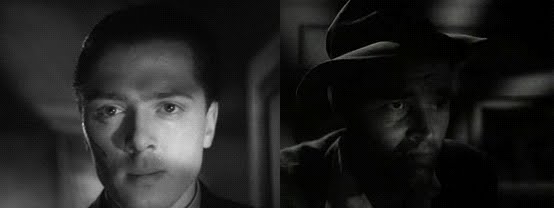
The visual noir elements in ‘Brighton Rock’ seem to be less self-consciously expressionistic than ‘The Third Man’ and so the film fits into the British noir canon through its emphasis on crime, rather than its stylistics. However, it does have many shots that are characteristic of the noir style, as is shown in the following comparison;


The first image is of Pinkie Brown (Richard Attenborough) from ‘Brighton Rock’, and the second is Al Roberts (Tom Neal) from the opening scene of ‘Detour’ (1945). In the latter film, the shadowed face and lit eyes is accompanied by a soliloquy where the protagonist recounts his guilt. In the former, Pinkie is about to push his previously trusted associate from the landing to his death. However, despite the differences in setting and character, the low-key lighting brings the viewers attention to the determined and melancholic eyes. In ‘Brighton Rock’, the link between areas of high tension in the plot and an increase in film noir style is less apparent than ‘The Third Man’; although the film’s climax on the pier is fittingly more noir in style than the rest of the film.

Another stylistic element of film noir is the dialogue, which is derived from hard-boiled detective stories. While this is less prevalent in British film noir, similar lines of dialogue are still evident throughout ‘The Third Man’ often containing the same witty and sarcastic tone that characterises the appearances of characters such as Philip Marlowe in the ‘Big Sleep’;

“Not much to tell...I’m 38, I went to college. I can still speak English, when the job demands it...I used to work for the District Attorney’s office...I was fired for insubordination. I always seemed to rate pretty highly on that.”
(Philip Marlowe [Humphrey Bogart], ‘The Big Sleep’, 1946)

“I’m just a hack who drinks too much and falls in love with pretty girls.”
(Holly Martins [Joseph Cotton], ‘The Third Man’, 1949).

However, it is important to say that British films are not characterised by this hard-boiled dialogue, with many films that broadly fit the category of British film noir do not contain this style of wit, whereas most American noirs seem to.

It is interesting to note that neither of the films focussed on here contain flashbacks, distorted timelines or first person narration in the way that many American film noirs do to provide a sense of overwhelming and fatalistic nihilism. They do exist in British dark cinema, for instance in Alfred Hitchcock’s ‘Rebecca’ (1940), a film with many noir elements, is introduced by a first-person narration of the ruins of a stately home, the force behind the plot is a long dead woman and the film ends with the house fire apparent from the initial narration, which in conjunction does add a portion of the fatalism that is abound in American film noir. However, again, this does not occur in the majority of the British noirs.

As well as similarities in style, the primary content of British noir is the focus on criminal psychology, as in American noir, with comparisons drawn between ‘Brighton Rock’ and ‘Force of Evil’ (1948). Indeed, the opening sequences of these films are similar in tone, with the general above board dealings in Wall Street described in ‘Force of Evil’ and the resort town of Brighton shown in the British film; but both go on to describe the underbelly of racketeering that are apparently prevalent in each environment.

However, despite the description of racketeering, the focus is not on the crimes committed by the criminals, but instead on the focus of the psychological repercussions of the crime on both innocent parties and the criminals themselves. ‘Brighton Rock’ charts the decline in mental state of the young upstart gangster Pinkie, who seems to remain coolly callous under all circumstances but is, in reality, largely afraid and insecure, whereas ‘Force of Evil’ concentrates the corruption and accompanying guilt of ruthless lawyer, Joe Morse (John Garfield).

Pinkie’s insecurity is surreal and intense, bordering on madness, and is reminiscent of the guilt that haunts Chris Cross (Edward G. Robinson) in ‘Scarlet Street’ (1945). In that film, the phrase “I love you Johnny” repeats over and over in his head, while everything in Cross’ bare apartment begins to look sinister and images flash across the screen. In that film, Chris murders when his vibrancy and masculinity is questioned. Conversely, Pinkie is a murderous thug in an attempt to appear both older and more masculine. Pinkie assumes the world is constantly judging and laughing at him; when his gang are joking together the camera quickly cuts to a close-up of a doll’s face, while the laughing carries on and Pinkie is visibly disturbed; threatening Cubitt (Nigel Stock) to reassert his masculinity. When Pinkie talks to Rose (Carol Marsh) there is a baby wailing in the background which lends a sinister surrealism to the scene, where the aggressive talk of Pinkie is juxtaposed against this infant; dramatically showing the depth of his feelings of inadequacy.

Tensions such as this are common within film noir, and are the focus of much of the academic literature written about the genre. It is commonly suggested that film noir is a darkened reflection of the anxieties surrounding its themes in a 1940s and 50’s America that no longer had the comfort of Depression and war propaganda; and the same is true of Britain, where the darkness that was evident in earlier films that are harder to characterise as noir is increased as the war ended and concerns over how individuals and society will function after such turmoil.

For instance, ‘In a Lonely Place’ (1950) is a film that is, technically, about a girl being killed and the suspicion placed at washed-up screenwriter Dix Steele’s (Humphrey Bogart) door. However, as the crime element is so small it is usually read as a film that deals with the post-war preoccupation with masculinity and the failure of relationships. Some interpretations view the film as dealing with the returning serviceman and his inability to find a place within American society; citing Dix’s often violent temperament. Tension over the war is evident in the ‘The Third Man’ in which the character ‘Baron’ Kurtz (Ernst Deutsch) states that Harry Lime did “things that were unthinkable before the war”, and that these actions are common in the divided and occupied Vienna. This deals with the inability of a whole community to adjust to a life without war. The bombed out houses throughout the film will be reminiscent of any of the British towns ruined in the war and the implications of crime developing from unstable post-war situations seems like it would resonate with the British public in this time.

Other tensions surround the role of masculinity in modern capitalist society where increasingly their independence is not valued in careers. In American film noir, we see this in ‘Force Of Evil’ where the older brother – a self-made criminal entrepreneur – is effectively forced into a larger racket and he winds up dead for not complying with the corporation. ‘Brighton Rock’ contains Pinkie’s little gang being forced into self destruction by trying to muscle in on an area controlled by a more established and bourgeois gang. Both films can, therefore, correctly be interpreted as an anti-corporate message that explores the fears of the powerless individual inside a faceless, established group. The spectre of the corporation is not as great in the British psyche, but the Wall Street crash of 1929 had affected all free markets and Greene – the original author of the novel Brighton Rock in 1938 – wanted to offer the “sensational action that would provoke anxieties appropriate to the Depression”. By his ineffective and immature nature, Pinkie is emasculated by this larger gang and – by implication – corporations.

The seeming failure of the traditional relationship is also brought into stark relief in both American and British noir, as is evident in ‘In A Lonely Place’ and ‘The Third Man’. In both cases, the relationship offers the possibility of a happy life far beyond of the instability of the post-war environment, but in both cases the relationship fails to materialise. In ‘The Third Man’, in a scene that would in any other genre lead to a happy ending, Holly Martins waits for Anna Schmidt (Alida Valli) to appear, but in the dysfunctional world of film noir, he is snubbed and she walks off leaving both to continue on with no hope of a happy relationship. ‘In A Lonely Place’, however, culminates in the fight of the lovers who are not meant to be together – a lack of trust tearing them apart – and Dix leaving his apartment. The implication in both films is that in the modern world, the classic fairytale ending becomes less and less likely. In ‘Brighton Rock’, Pinkie and Rose’s marriage is a mockery of the term, where Pinkie uses his boyish good looks to attract Rose solely to stop her giving evidence – by doing so, Pinkie assumes the role associated with the femme fatale in American film noir – and then proceeds to deride and abuse her throughout the rest of the film, even convincing her to commit suicide.

However, the subject of race is curiously absent from British films noir, with none of the British films described here having any character of a racial minority. It is an interesting cultural difference that where the reliable but stereotypical African-American that occasionally appears in the American film noir and dark cinema such as Sam (Dooley Wilson) in ‘Casablanca’ (1940) and Lottie (Butterfly McQueen) in ‘Mildred Pierce’ is replaced in British film noir by the stereotyped honest working class person, such as Sergeant Paine (Bernard Lee) in ‘The Third Man’ or Ethel (Heather Angel) in ‘Suspicion’.

In conclusion, it is apparent that the same stylistic influences played upon both British and American crime films in the 1940s and 1950s. That is not to say they are without differences in style but they are most definitively films noir because of the visual style and focus on crime. Also the anxieties that fuelled the move towards the dark style seem to resonate with the British films as well, although race is less important in the British case. It seems logical therefore, that the two should be treated as part of the same cinematic movement, rather than describe film noir as an exclusively American phenomenon.


by Peter Andrews

Resources

Chartier, Jean-Paul, 1946, “Americans Also Make Noir Films” in Silver & Ursini (eds.), 1996, Film Noir Reader pp. 20-23, New York: Limelight Editions.

Naremore, James, 1998, More Than Night: Film Noir and Its Contexts, University of California Press.

Mellen, Joan, 1994, “Film Noir”, in Crowdus & Asner (eds.) The Political Companion to American Film, pp 137-144, Lake View Press.

Polan, Dana, 1993, In A Lonely Place, British film Institute Publishing.

Silver, Alain and Ward, Elizabeth, 1992, Film Noir: An Encyclopaedic Reference To The American Style, Overlook Press.

Schrader, Paul, 1972, “Notes on Film Noir” in Silver & Ursini (eds.), 1996, Film Noir Reader pp. 53-63, New York: Limelight Editions.