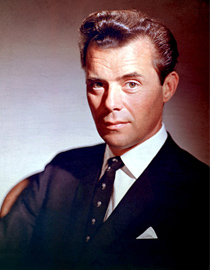
In his biography of Dirk Bogarde, John Coldstream infers that the actor’s disinterest in ‘The Singer Not the Song’, his last outing for the Rank Organisation, led to his deliberately camp performance, a factor crucial to the film’s failure.Saturday, September 27, 2008
The Singer Not the Song
In his biography of Dirk Bogarde, John Coldstream infers that the actor’s disinterest in ‘The Singer Not the Song’, his last outing for the Rank Organisation, led to his deliberately camp performance, a factor crucial to the film’s failure.Friday, September 26, 2008
The Night Porter
Only during really bad thunderstorms would I remember Belsen, and the girl, shorn head covered in scabs, face cracked with running sores from which she carelessly waved away the April flies, who grabbed my hand and stumbled with me along the sandy tracks amongst the filth … - Dirk Bogarde, ‘Snakes and Ladders’, chapter 3.
In April … we came to Belsen and the first concentration camp: a hideous ‘liberation’ this time which erased forever the erroneous idea we had that ‘Jerry is really just the same as us’. No way was he. - ‘Backcloth’, chapter 4.
In Vught Camp, or perhaps in Belsen, I can’t remember exactly which now (both were as terrible) I had wandered through huts piled high with the relics of human life: hair in mounds, higher than myself, from shaven heads. - ‘An Orderly Man’, chapter 9.
This latter passage is perhaps the most contentious in Bogarde’s memoirs, since he discusses the atrocities in the context of 'The Night Porter', easily the most controversial film in which he appeared.
Ironically, its genesis was in a visit the director, Liliana Cavani, made to Dachau for a documentary. Witnessing a well-dressed woman laying a wreath not to any of the victims but to the Nazi officer with whom she’d had a sexual relationship whilst an inmate, Cavani began to wonder what would happen if the officer had survived and they met again after the war.
Accordingly, ‘The Night Porter’ begins in 1957, former concentration camp commandant Max (Bogarde) holding down the titular job at the Hotel zum Oper, a fading remnant of Viennese society. He attends periodic reunions with comrades from the war at which they hold mock trials for each other. These serve two purposes: a cathartic 'defence', allowing them to reassert their loyalty to the Third Reich, and a weeding out of actual evidence or witnesses against them - such evidence swiftly disappears ... as do witnesses.
As Max's 'trial' approaches, he starts to get cold feet. His fellow officer Klaus (Philippe Leroy), the self-appointed "devil's advocate" in these proceedings, takes the whole thing very seriously. When Max states that he just wants to live a quiet, unassuming life ("like a church-mouse"), Klaus assumes Max has something to hide and decides to have him watched and followed.
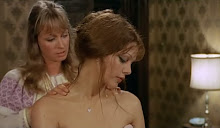
It turns out that Max does have something to hide: the latest guest at the Hotel zum Oper, Lucia (Charlotte Rampling), wife of a world famous conductor in town to premiere a new production of Mozart’s Die Zauberflote*. Flashbacks weave through the fabric of Max's day-to-day life, revealing their earlier association: Lucia the submissive to Max’s sexual sadism, the whole perverse affair played out under the shadow of the swastika. In the film’s most provocative image, seized upon for the poster artwork, he exerts his sexual control by having her perform a torch song for the benefit of the other officers dressed only in trousers, braces, a pair of leather gloves and a Nazi cap. Costume has seldom been used in film to make such a darkly erotic statement.
This middle section of the film is Cavani's greatest achievement, the past and present interconnecting so fluidly; overlapping. As the Fifties-set sequence segues into a resumption of their relationship, this time with Lucia participating "of my own free will", things threaten to tip into melodrama. Lucia’s husband harries the Austrian authorities to investigate her disappearance; Max’s fellow Nazis get hot under the collar about the attention his indiscretions could draw to them. They stake out his apartment, preventing food or supplies from reaching him and Lucia. As Morgan Freeman puts it in 'Seven', "this ain't gonna have a happy ending" ...
To put it mildly, ‘The Night Porter’ upset quite a few people on its release and is still a cinematic hot potato now. My mother, one of staunchest Dirk Bogarde fans alive (her zeal for him in his matinee idol days is a good indication of how popular the man was - kind of the di Caprio of post-war British cinema), says of 'The Night Porter', "I didn't like him so much when he started making those kind of films."
The agitation of the mind? Just a bit! Cavani turns in a challenging and complex study of attraction, exploitation and twisted sexual dependence. She is aided by the searing performances of her two stars. Bogarde is disturbingly credible, his characterisation an extension of the ambitious, amoral Nazi sympathiser he had played four years earlier in Visconti’s ‘The Damned’.
But as compelling as Bogarde is, though, ‘The Night Porter’ is Charlotte Rampling’s film all the way**. Fearlessly putting herself through an emotional wringer from which most performers would recoil, she delivers a tour de force of acting. If you think, say, Emily Watson's performance in 'Breaking the Waves' or Nicole Kidman's in 'Dogville' are brave (and they are), then check out 'The Night Porter' - Rampling defines what a brave performance truly is.
*Its satirical treatment of Masonic secrecy notwithstanding, Die Zauberflote (The Magic Flute) is Mozart's most accessible opera, boasting some of his loveliest arias. Cavani turns it into a symphony of horrors, the way Kubrick did with Beethoven's Ninth in 'A Clockwork Orange'.
**Bogarde and Rampling became close friends after 'The Damned'. Bogarde only agreed to 'The Night Porter' so long as Rampling was cast as Lucia. His novel 'Voices in the Garden' is dedicated to Charlotte Rampling and her then-husband Jean-Michel Jarre.
Thursday, September 25, 2008
Introducing the Second Annual Dirk-Fest
Wednesday, September 17, 2008
Savage Grace
So we turned our attention to the Screen Room – officially the smallest cinema in the world (it’s as cosy and intimate as watched a professionally projected movie in your living room; their concessions stand even offers coffee and cake). They were showing ‘Savage Grace’. Beyond the fact that it starred the always-watchable Julianne Moore and was based on a true story, none of us knew much about the film.
So it was that we toddled off to see ‘Savage Grace’. Since Viv had cooked for us, I did the honourable thing, pulled out my ‘Pulp Fiction’-stylee BAD MOTHERFUCKER wallet, and stumped up for the tickets.
Early scenes were low-key and talky; the film opened out cinematically in its middle section (it’s structured in six ‘chapters’ covering different periods of time and geographical locations as its protagonists waltz through four decades of dysfunctionalism), then returned to dull interiors in its closing stages. It was waspishly scripted, powerfully acted and anaemically directed. There wasn’t a single character you could motivate yourself actually to give a damn about.
But, in parts, it proved curiously gripping. And then. About an hour and a half in …
SPOILER ALERT
… emotionally unstable socialite Barbara Baekeland (Moore), crosses the line in terms of maternal affection with her sexually confused son Tony (Eddie Redmayne) and some Oedipal shenanigans ensue. When sonny-boy informs mommy-dearest that, ahem, he didn’t reach completion, she finishes the job with a bit of the old five-fingered widow.
SPOILERS END
Imagine the three of us sitting there: Viv was staring at the screen in shocked silence, Paula’s head was in her hands and I’d suddenly taken a profound interest in my shoelaces.
A little later, after …
BUGGER ME, IT’S ANOTHER SPOILER ALERT
… sonny-boy stabs mommy-dearest with a kitchen knife during an argument then makes two phone calls, one for an ambulance, one to order a Chinese (the meal arrives before the ambulance: I have got to get the number of that takeaway!) …
SPOILERS END
… we wandered out into a particularly rainy night and compared notes. “That’s an hour and a half of my life I won’t have again,” Paula opined. My opinion was that ‘Savage Grace’ should have been a French or Italian movie from the 70s, subtitled and angst-y, the kind of movie you could tut over as you left the cinema, shaking your head and coming out with something like “Honestly, those Europeans …”
Viv’s final word was succinct and priceless. “You know what it says on your wallet,” she said; “well, now you’ve actually seen one.”
Sunday, September 14, 2008
Tremors
But before any of these, before ‘Black Sheep’ or ‘Dog Soldiers’, before ‘Eight Legged Freaks’, there was ‘Tremors’. And ‘Tremors’ did it better than any of its successors. And definitely better than any of its sequels.
Let’s draw a discreet veil over its sequels. And its prequel.
‘Tremors’ is a knowing, playful, but – when it matters – impressively suspenseful throwback to the “creature features” of the 1950s. It boasts a smart script with plentiful sharp dialogue (“we use forward planning – that way we don’t have to do anything right now”), a terrific double act in Kevin Bacon and Fred Ward, an effectively offbeat supporting role for C&W megastar Reba McEntire (who also provides the toe-tapping end credits song) as a gun-toting survivalist, and pacy direction from Ron Underwood that makes the best use of the Nevada setting.
The film opens with casual labourers Earl (Ward) and Valentine (Bacon) vowing to leave the small town of Perfection (a place that could be described as ‘backwater’ except that it’s a desert) when their situation – by dint of a succession of shitty jobs, quite literally in the case of a nasty encounter with a septic tank – becomes untenable. Only fate is working against them. Within the first quarter of the film, they make three attempts to leave the facetiously named Perfection, but are forced to turn back each time, Valentine opining the occurrence of divine intervention when a rockfall proves the last straw.
Already the movie is whole lot better than it has any right to be, because of the economy with which Underwood establishes his protagonists, their razor-sharp repartee and – more so – because Earl and Valentine are Everyman personified. Anyone who has held down a crap job, bemoaned their lot in life and/or wished for something better will recognise in them kindred spirits. The fact that things proceed to get a whole lot worse, thanks entirely to the ministrations of a bunch of subterranean monsters, just seems perfectly in keeping with Earl and Valentine’s talent for misfortune.
Ah, the monsters. I don’t know why – it probably says something about the weird workings of my mind – but I can’t help thinking that if the spice worms from ‘Dune’ hung out with the hillbillies from ‘Deliverance’, necked a little moonshine and spent a few generations breeding with their sisters, the big ugly wormy things in ‘Tremors’ are pretty much what the result would be. Their grotesqueness is almost comical, and this epitomises ‘Tremors’ nicely.
The film is tense in the right places (the worms’ attack on a couple out camping is a brilliantly sustained set piece) and gooey in the right places (don’t watch it over dinner), with a sardonic sense of dark humour overarching the whole thing. It set Underwood up to direct ‘City Slickers’ the following year, though sadly he’s done nothing of note since, and it still remains arguably the best film of its kind.
Tuesday, September 09, 2008
PERSONAL FAVES: Seven Days to Noon
Willingdon is wanted by the police. His letter to the Prime Minister (Ronald Adam), demanding Britain’s immediate cessation of atomic weapons manufacture is bad enough. That he has been part of the very research team dedicated to creating them is worse. The really unforgivable sin, however, is his appropriation of the one of the devices – which he intends to detonate in Greater London, destroying a twelve-mile radius of the capital, if the PM doesn’t publicly commit to disarmament.
CID bod Inspect Folland (Andre Morrell) finds himself heading up the manhunt. Folland enlists the help of Willingdon’s research assistant, Hugh Cross (Steve Lane) – a man already professionally compromised through his relationship with Willingdon’s daughter Ann (Sheila Manahan) – but their efforts bear little fruit. A brief sighting of the professor ends in his escape. A call from his suspicious landlady (a terrific Joan Hickson, a TV star in later life headlining the ‘Miss Marple’ adaptations) results in a heavy-handed police presence: Willingdon quietly slips away and finds lodgings with faded middle-aged ‘showgirl’ Goldie (Olive Sloane).
With the clock ticking and police activity yielding nothing (a search of a bathhouse, a walrus-moustached overweight man blustering impotently, waspishly satirises the opening sequence of Powell & Pressburger’s ‘The Life and Death of Colonel Blimp’), the military are called in. Plans for the evacuation of London are put into action. Two railway workers paste destination numbers onto carriages – “Remember last time we did this?” one of them asks. “It was Dunkirk.”
Dunkirk is referenced more than once in the film. Wartime imagery is everywhere (the Powell & Pressburger send-up is apposite: this is an England far removed from the bucolic idylls of The Archers; an England, in fact, which is as dangerous as any other country that has access to atomic weaponry): soldiers search a deserted city, going house-to-house; Willingdon shelters in an abandoned church, a sign outside soliciting donations towards its rebuilding (‘BLITZED TEN YEARS AGO’); a looter is gunned down without a word of warning; a station platform stands empty apart from a sign reading ‘ALL ANIMALS TO BE LEFT HERE’ and, beneath it, a menagerie of now-ownerless pets, mewling and whining and barking as they pace their cages.
‘Seven Days to Noon’ was made in 1950.
Let me repeat that. ‘Seven Days to Noon’ – with its anti-atomic weaponry message, its scenes of evacuation, its threat to the nation’s capital, its unheroic soldiers (one paws through someone’s underwear drawer, stealing a pair of knickers; another raids a wine cellar; all complain about their duty to king and country) – was made just five years after the end of the war.
I can only imagine what it would have been like to see the film on its original release – particularly at a cinema in London. I imagine it was like having a couple of hundred volts applied to a still open wound (bomb sites would scar London for two decades after Nazi Germany’s surrender), the too-real nightmares of only a few years ago howling back at you from the cinema screen.
John and Roy Boulting’s film is perhaps the riskiest choice in a career which pretty much baited controversy. ‘Brighton Rock’, only John’s second film as director, was film noir writ as brutal and unflinchingly as anything America produced; their string of acerbic satires – ‘Private’s Progress’, ‘Lucky Jim’, ‘I’m All Right Jack’ (to the best of my knowledge, the only film to make a villain of the fork lift truck) and ‘Heavens Above’ – stick it to the military, academia, trade unionism and the church respectively.
In the pantheon of great partnerships from the golden age of British film-making, Powell & Pressburger melded a nostalgic Home Counties mindset with a distinctly European aesthetic (sometimes successfully, sometimes awkwardly), while Launder & Gilliat sneaked a sly subversiveness under the radar of populist entertainment. The Boulting Brothers, however, squared off against the realities of post-war life in a less-than-Great Britain. Mostly, they used the comforting buffer of (albeit razor-sharp) comedy. In ‘Seven Days to Noon’ – a film without heroes or villains – the gloves came off: not only were they were serious, not only did they ask some big questions, but they created a bloody good thriller that – despite its occasionally dated moments – comes across, and does so emphatically with repeated viewings, as years ahead of its time.
Friday, September 05, 2008
Loafing oafs in all-night chemists ...
It seems like sacrilege, but the director and writer Rowan Joffé tells Mandrake that he is to remake John Boulting's classic film Brighton Rock with an emphasis on knife crime.
"With the recent spate of stabbings, Graham Greene's tale about a murderous 17-year-old clearly still has something to tell us about the world we live in," he says.
Joffé, the son of Roland Joffé, who directed The Killing Fields, is seeking the blessing of Lord Attenborough, who starred as the gang leader Pinky in the 1947 film.
"I will be showing him a finished version of the script," he says. "Fingers crossed he will be supportive – his praise would mean a hell of a lot."
Excuse me? “With an emphasis on knife crime?” And what exactly did Pinky use in the original, a fucking pencil sharpener?
Thursday, September 04, 2008
Summer of the superhero (2): Hellboy II and The Dark Knight
One was masterful, one disappointing. Let’s get the disappointment out of the way first.
Oh, that it had have been! The original ‘Hellboy’ was a delight: it came out of nowhere, unheralded, the brainchild of Guillermo del Toro, a man who had made a career out of alternating highly personal Spanish-language films (‘Cronos’ – what a debut!) with generic Hollywood productions … a ‘one for you, one for me’ arrangement that seemed to serve him well. Only with ‘Hellboy’, it was more a case of ‘one for me while I pretend it’s one for you’. Studio film-making shot through with a style all of his own. And I dug it big time.
I dug ‘Pan’s Labyrinth’ a whole lot more – it’s on the personal faves list and I’m itching for it to get pulled out of the hat (a certain revisionist Boulting Brothers classic is next on the list) – and was in a state of almost pant-wetting excitement at the prospect of a ‘Hellboy’ sequel.
Ordinarily, this would be the point where I’d come out with an eminently sarcastic paragraph consisting of a single sentence where every component word is full stopped, just to ram the message home as bluntly as possible. Something like:
But. It. All. Went. Wrong.
I can’t quite bring myself to grind the axe so viciously with ‘Hellboy II’, though. Whatever its deficiencies (see next few paragraphs), it is nothing less than visually magnificent. The troll market sequence is a standout, likewise an extended sequence involving a forest elemental; although seemingly vindictive to begin with, once defeated by Hellboy, it dies the most poetic of all movie deaths, turning a grimy city sidewalk into a pastoral glade. Likewise, del Toro’s take on the angel of death: a deliciously ambivalent creation on every level.
Del Toro’s imagination gets free rein when it comes to the creatures and visuals, and he exploits it in to the full. Oh, that the same degree of imagination, of artistic flair had been lavished on the script. For the script is the albatross around the film’s neck, the millstone forcing it to shuffle when it should sprint, leap, fly …
The original succeeded because of its script, its direction and its cast. All elements lined up and clicked into place. The sequel fails because it takes the intelligent characterisations of its predecessor and dumbs them down. Remember the lovelorn Hellboy (Ron Perlman), worshipping Liz Sherman (Selma Blair) from afar, taking advance on matters of the heart from a nine-year-old kid? A wonderful, perfectly played scene. In the sequel, Hellboy and Liz are a couple and their constant bickering is on par with the last, desperately unfunny, series of ‘Men Behaving Badly’.
Or how about Manning (Jeffrey Tambor), Hellboy’s nominal departmental nemesis: originally a stuffed shirt who later proves his mettle and earns Hellboy’s grudging respect. Here, he’s reduced to a stuttering imbecile paraded in front of the audience for cheap laughs. Liz Sherman’s erstwhile edgy, unpredictable heroine is recast as a doe-eyed sap. Doug Jones as Abe Sapien – a cool, intelligent foil to Hellboy first time round, is forced into a lapdog-like romantic subplot and saddled with dimestore motivation purely to drive the plot forward in the final act.
Yeah, ‘Hellboy II’ is a glory to behold imagery-wise, but its nothing short of a betrayal of everything that made the first film so priceless.
I’m aware that I’ve just spent about 600 words bemoaning ‘Hellboy II’ and I could easily knock out twice that many praising ‘The Dark Knight’ to the heavens, but before this posting gets too long, and too reliant upon strings of fanboy-grasped adjectives, I’ll just pick out just four aspects of the film at random and hopefully, if there’s anyone within a hundred miles of a cinema who hasn’t seen it yet, said individual will log off this blog and head for the multiplex in question PDQ:
1) Heath Ledger as The Joker. Christ, I feel his loss so badly watching this film. The Joker is quite simply his greatest performance. It telegraphs the career he would – should – have gone on to. Like Malcolm McDowell in ‘A Clockwork Orange’, Ledger tears down the screen, eradicates the boundary between actor and audience, and makes every fucking one of us complicit in his gouts of inspired mayhem.
2) Christian Bale as Batman. Going deeper and darker into Bruce Wayne’s psyche, his balls-to-the-wall acting style creating an even more emphatic schism between the two personalities, Bale takes a comic book (anti) hero and turns him into a mainstream Hamlet. I can’t think of any other blockbusting, studio produced summer event movie that delves with such Shakespeare fearlessness into the compromised morality of its ostensible hero.
3) The supporting cast: Michael Caine, making it a quadruple-whammy after ‘Batman Begins’, ‘Children of Men’ and ‘The Prestige’, doing some of the best work of his career; Morgan Freeman, the Mister Cool of cinema, who – as Antagony & Ecstacy has pointed out – claims the single best line of the film; Gary Oldman, building on the rugged humanity of Lieutenant Gordon in the first film, here developing the character to heights of almost tragic intensity; and Aaron Eckhart as Harvey Dent/Two Face, the only complaint about whom is that, with The Joker taking centre stage, he doesn’t survive to become the antagonist of a third instalment – Eckhart’s performance would easily have driven another movie.
4) The co-writer and director, Christopher Nolan, who, six films into his career has yet to deliver a film that is less than fascinating, and half of whose filmography – in my opinion – constitutes bona fide masterpieces. For what he’s done so far: slainte, Mr Nolan. For what he has the potential to go on to do: I can’t fucking wait!
*To qualify this remark, two of the US critics’ best films of ’07 – ‘No Country for Old Men’ and ‘There Will Be Blood’ – didn’t open in the UK till January and February of this year respectively.
Monday, September 01, 2008
An ideal husband
We honeymooned in Scotland, staying in an idyllic little village called Drumnadrochit, on the shores of Loch Ness. If you're ever in the vicinity, I highly recommend an evening meal at Fiddler's restaurant, followed by a sampling from their exquisite collection of single malts.
Subject of which, distilleries were visited, drams partaken of, and bottles procured. We are now officially skint, but there are some things money can't buy.
One of the things it can, however, is the Cineworld Unlimited card, and I must confess I've not been putting mine to proper use. I've seen exactly one film on the big screen in the last fortnight - of which more next posting - and barely more than that on the small screen.
But I'm back, and the financial imperative of spending a good few weeks watching the pennies means that plenty of DVD viewing is on the cards, the Bond-fest over at Guilty Pleasures will resume, and I'll be catching up on a few of the personal faves here on The Agitation of the Mind.
It's good to be back.
(For the record, that's confetti on my head, not bird poo. Honest.)
Sunday, August 17, 2008
Impending nuptials
Well, Ian Fleming I am not. I'm getting married on Thursday and it's all I've been able to think about for the past couple of weeks. And even though Paula's sister Jodie and my best friend Lesley pretty much appointed themselves as wedding planners and have seen to all the major arrangements, there have still been any number of things demanding my attention. Accordingly, my cinema-going and DVD-watching have nose-dived, as evidenced in the lack of recent material on Agitation of the Mind and Guilty Pleasures. For which, my apologies.
Apologies, too, for the arid desert of unblogged space that it will continue to be for the next fortnight (we're honeymooning in Scotland for a week after the wedding).
But, like the indestructible 007, The Agitation of the Mind will return.
Wednesday, August 06, 2008
Bubba Ho-Tep
Tuesday, August 05, 2008
Man on Wire
Asking for my ticket at Cineworld, I mistakenly called the film 'Man on a Wire'. Twenty minutes of adverts and trailers later, the BBFC certificate appeared on screen, rendering the title as 'Man on Wire'. Hmmm, a bit ungrammatical, I thought; wonder if it's a mistake. The opening credits, however, confirmed it.Saturday, August 02, 2008
WALL-E
A week ago, as we exited 'WALL-E', Paula asked me, "Would you say that's Pixar's best yet?"Sunday, July 27, 2008
PERSONAL FAVES: From Russia With Love
The formula the franchise was built upon is virtually evident in the first Bond film, 'Dr No': exotic locations, glamorous women and a megalomaniacal villain with a fully kitted-out secret base.The third instalment, 'Goldfinger', would truly establish the formula: exotic locations, glamorous women, a megalomaniacal villian with a fully kitted-out secret base and a shedload of funky gadgets.
Essentially then, the four Gs: guns, girls, gadgets and globetrotting. Plus the megalomaniacal villain lurking in his ever more gargantuan secret base (hollowed out volcanoes a speciality).
By the later episodes, it got so that Bond's profession (espionage) was almost an afterthought. Let's face, the man doesn't exactly go undercover; and unless blowing the bad guy's secret base to hell can be classed as clandestine activity, he doesn't do much spying either. The usual sequence of events boils down to: M tells Bond that something dodgy is afoot, normally tipping him off from outset as to who the bad guy is; Q gives Bond some funky gadgets; Bond walks into bad guy's favourite casino/golf club [delete as applicable] and announces himself as "Bond, James Bond" (told you he doesn't do undercover); Bond cleans out bad guy over the card table/roulette table/links [delete as applicable], pissing him right off; Bond dallies with a couple of beauties, at least one of whom is duplicitous; Bond gets caught by the bad guy, who invariably explains in great detail his plans for world domination before either (a) locking Bond in an easily escapable broom cupboard conveniently situated next to the armoury, or (b) suspends him over a pool of sharks/piranha [deleted as applicable], a low-burning night-light under the taut rope; Bond utilizes funky gadgets courtesy of Q branch, effects an escape, foils the bad guy's plans and blows the fully kitted-out secret base to smithereens.
'From Russia with Love' - the second and for my money the best of the Bonds - does things a bit differently.
There's no secret base. There's no megalomaniac seeking world domination; here we have a triumvirate of villains - the Machiavellian Blofeld, the spitefully cunning Rosa Klebb (Lotte Lenya) and the brutally efficient 'Red' Grant (Robert Shaw) - and their plan is twofold: the theft of a Russian decoder, and the disgrace and demise of Bond. In order to achieve the former, they manipulate Bond into acquiring it for them.
And how does one go about manipulating an agent of 007's calibre? Piece of cake - dangle a pretty girl in front of him. Step forward Tatiana Romanova (Daniella Bianchi); a beauty queen in real life, but not the typical Bond girl to be sure. She's just as much a victim of manipulation as Bond. Tatiana is pretty much the innocent victim in all of this, and Bianchi, though limited as an actress, certainly imbues the the character with a human element.
Thanks to all the intrigue, the intricacy of the plotting and the delightful idea that Bond - every inch the uber-mensch in all his other outings - is basically being fucked with from start to finish, 'From Russia with Love' feels like a proper espionage thriller. It has the cynical brilliance of a le Carre novel. Double-dealings abound. Betrayal lurks at every turn. Director Terence Young keeps the tension racked, most notably in the cat 'n' mouse Orient Express sequence, climaxing in a vicious bout of hand-to-hand combat between Bond and Grant (the means by which Grant gives himself away - ordering red wine with fish - remains a classic bit of Ian Fleming snobbery) - a powerhouse scene, jarringly shot and edited. The seeds of Bourne-style visceral action cinema are present here.
The Grant/Bond fight is only one of a number of striking set-pieces: the theft of the decoder and the attack on the gypsy camp are standouts. Likewise, the extended finale - Bond's duel with a helicopter ("I'd say one their aircraft was missing" - surely the only Bond one-liner to reference a Powell & Pressburger film), followed by a speedboat chase - generate tension and excitement without recourse to blowing up a fully kitted-out secret base. And let's not forget that nasty little coda featuring Rosa Klebb and the kind of footwear you can't get at Clarke's.
'From Russia with Love' is probably the only film in the series where you could have a protagonist other than Bond - you could slide George Smiley or Bernard Samson or one of Graham Greene's world-weary and morally compromised anti-heroes into the lead role - and it wouldn't harm the film at all, wouldn't detract from its status as a first rate 60s spy thriller. It's the most un-Bond of the Bond movies ... and, paradoxically, that's what makes it the best.
There's a Bond-fest going on over at my other blog, Guilty Pleasures; the first five Connery outings are under consideration in the first entry.
Tuesday, July 22, 2008
Normal service will be resumed
Medication has been prescribed, there are plenty of films begging to be watched and, hopefully within the next week, The Agitation of the Mind will return.
Monday, July 14, 2008
The Happening
Nah, can't leave it.
Tuesday, July 08, 2008
Lady in the Water
Before we hear from the prosecuting counsel, a brief opening statement:
Ladies and gentlemen of the jury, 'Lady in the Water' is a feature film written, produced and directed by M. Night Shyamalan. It concerns the discovery of a narf (a type of water nymph) named Story (played by Bryce Dallas Howard) in the communal swimming pool of an apartment complex called The Cove whose janitor, Cleveland Heap (Paul Giamatti), has slid into the anonymity of his dead-end job while he deals with the aftermath of a personal tragedy. Story's job is to locate "the Vessel", a writer whose work will bring about positive social change but at the cost of his own life, and inspire him to persist in his work. Others, including "the Healer" and "the Guild", will play their part in assisting Story's safe return once she has found the Vessel. Her task, however, is endangered by scrunts*, vicious beasts which blend, chameleon-like, into the long grasses surrounding the complex. Cleveland, motivated by the tragedy in his past, elects to help Story, but first has to determine which of the The Cove's residents fulfill the roles of Vessel, Guild and Healer .
Right, then. Case for the prosecution:
1) Shyamalan casts himself as the Vessel. This is essentially a Christ-like role and is therefore indicative of gross egomania on Shyamalan's part.
2) One of The Cove's residents, Harry Farber (Bob Balaban) is a movie critic and Shyamalan takes pains to paint him as a prissy, pedantic and humourless individual. This is indicative of contempt on Shyamalan's part for gentlemen of said profession, and sour grapes over negative reviews of 'The Village'.
3) The film is burdened with an incomprehensible narrative.
The prosecution calls the following expert witnesses:
Antagony & Ecstasy, who has testified that M. Night Shyamalan is an affront to art.
Brandon Fibbs testifies that it is Shyamalan's first misstep as a film-maker.
Kevin Koehler at Pretentious Musings discusses evidence that this is a director's love letter to himself.
Case for the defence:
Your honour, ladies and gentlemen of the jury, I do not have a case to make for 'Lady in the Water' as a lost masterpiece, an overlooked gem, or a classic-in-waiting that is begging for re-evaluation. The film, as its creator has insisted all along, is a fairy tale. I refer to Mr. Shyamalan as the film's "creator" with good reason. As writer, producer and director on all of his projects - as a man who has yet to helm an adaptation or direct someone else's script - he personifies perhaps more than any other mainstream American director the auteur. This, I believe, exacerbates the severity of the first charge levelled against him.
Before turning to the three main areas of the prosecution's case, let us briefly consider the film's subject matter. We have already established that 'Lady in the Water' is a fairy tale; it is a mistake, however, to consider the milieu (the action never moves outside of the apartment complex) as the real world into which the fairy tale elements (quite literally) surface. 'Lady in the Water' is not realistic and is not meant to be realistic. It is a movie full of movie characters; I believe that such subtext as exists here is a send-up, by Mr. Shyamalan, on film-making and film theory, an irreverent and satirical deconstruction of established narrative tropes and structural requirements.
As regards the charges against the defendant:
1) Shyamalan as messiah/egomaniac. Given that Mr. Shyamalan had demonstrated, from 'The Sixth Sense' up to and including 'Lady in the Water', a commendable talent for drawing notable performances from first-rate casts, and given that there has never been a shortage of highly talented actors who want to work with him, he could easily have cast someone other than himself as the Vessel. Why did he choose not to? Moreover, Mr. Shyamalan has always come across, in both on-camera and print interviews, as articulate, perceptive and intelligent. Surely he would have had some inkling of the controversy that this self-casting decision would result in. And yet, ladies and gentlemen, he cast himself. Why? It is my considered opinion that Mr. Shyamalan's role in his own film is a satire on the auteur theory, and both an acknowledgement and refutation of any criticism that, as an auteur, he risks isolationism in his approach to film-making.
Furthermore, he is not the only director to cast himself in a showy and narratively important role. We call Mel Gibson, director and star of 'Braveheart' (a role which allows him to progress from romantic lead to action hero to martyr); Orson Welles in 'Touch of Evil' (seldom has a director filled the screen so completely with himself; and what of Marlene Dietrich's breathy "He was some kind of a man" epitaph?); or how about Woody Allen, star of a good couple of dozen of his own films - would Allen's nebbish protagonist copping off with a radiant Diane Keaton in 'Manhattan' be dismissed as wish-fulfillment if it weren't for their brief real-life relationship?
And doesn't the whole issue of director as actor depend on whether their performance is any good or not? Shyamalan is a low-key but quietly charismatic actor. Now look at, say, Quentin Tarantino's flashy, motormouth appearances in his own work - as Jimmie in 'Pulp Fiction' or the bartender in 'Death Proof'. A small but worthwhile consideration, I think.
2) The movie critic character. It is easy to see why Bob Balaban's portrayal of Harry Farber is something of a red rag to a bull. But pause should be given to consider a couple of points. Firstly, Balaban is terrific. He takes a potentially one-note role and turns it into a tour de force of deadpan comedy. A lot of things get overlooked in critical treatments of 'Lady in the Water': just how good Balaban is, is one of them. Secondly, Harry is not just a movie critic, he's a movie character. Ultimately - and again, this simple fact is often conveniently overlooked - 'Lady in the Water' is a movie movie. Let's establish a quick definition.
Tarantino once said something to the effect that while 'Reservoir Dogs' and 'Pulp Fiction' were movies, the 'Kill Bill' duology (is that the right word? did I just make it up? whatever) were movie movies; that if the characters from 'Dogs' or 'Pulp' decided to go and see a movie, then 'Kill Bill' was the kind of movie they'd go and see. 'Kill Bill', therefore, is a movie that exists solely within the perameters of movie logic, where a vengeful woman can take a samurai sword aboard a plane as hand luggage, where the aesthetic can bend elastically to Eastern cinema and the whole "heroic bloodshed" subgenre or to the expansive vistas of the spaghetti western purely at the film-maker's whim. Shifts from colour to black-and-white are acceptable, as well as non-linear chronologies, hyper-stylisations and basically an entire bag of cinematic tricks. And Tarantino is feted for it. What do we make of this, ladies and gentlemen? It seems that Tarantino is permitted to make movie movies while Shyamalan isn't.
'Lady in the Water' is a movie movie. Harry is there to highlight this - cueing Cleveland's gradual understanding of the narrative he's found himself complicit in - as well as sending the whole thing up. Harry reminds us, right up to his stand-out final face-off with a scrunt - that this is just a movie.
3) Incomprehensible narrative. Or is it? It's an offbeat narrative, sure, but - hey! - Shyamalan's telling an offbeat story. And, once more, he's doing so in a deconstructive manner. He takes traditional narrative requirements and turns them upside down. For instance: a character is called up to decipher something; the resulting message gives the protagonist another piece of information, therefore the plot advances. In, say, 'Raiders of the Lost Ark', Harrison Ford directs a beam of sunlight onto some arcane markings on a dusty stone floor; in 'The Da Vinci Code', Tom Hanks blathers on about the Fibonacci sequence and gets his head round a couple of infantile riddles. How the codes/clues/messages are worked out is unimportant: these scenes are about (a) making the hero look cool because they figured it out, and (b) moving the film's narrative from point A to point B. So when, in 'Lady in the Water', a little kid divines a hidden message in the colours of a cupboard full of cereal boxes, not only is it no less arbitrary than in either of those other films, but Shyamalan is actually admitting, satirically, how arbitrary such narrative devices truly are. This brings us back to the fact that it's just a movie. It does what a lot of movies do - and has no more complex a narrative than most movies - it just does these things in a deliberately deconstructed manner.
But doesn't all of this make 'Lady in the Water' an exercise in anti-film-making? Maybe so. But I must admit, having recently watched it for the third time, that I find 'Lady in the Water' a relatively entertaining film. It's not without its flaws - there is too much of the hushed, portentous dialogue that stymies 'Signs' and 'The Village'; there is a directorial heavy-handedness in dealing with 'meaningful' themes; the healing scene just plain doesn't work - but it has its share of pleasures, not least a terrific cast obviously having fun with their movie movie characters. Christopher Doyle's cinematography nails the slightly off-kilter atmosphere crucial to the non-realistic movieness of the film. After the solemnity of his earlier films, the playfulness of 'Lady in the Water' is a pleasant change; and - best of all given the flogging-a-dead-horse inclusion of it in 'The Village' - there's no frickin' twist ending.
Finally, ladies and gentlemen of the jury, here, at random, are a few mainstream films I've seen in the two years since 'Lady in the Water' opened, all of which, I think you'll agree, are egregiously bad examples of film-making: 'Next', 'Ultraviolet', the aforementioned 'Da Vinci Code' and the piss-awful 'Wicker Man' remake, none of which I'd waste my time on with a second viewing. And yet Lee Tamahori, Kurt Wimmer, Ron Howard and Neil LaBute received none of the vitriol that was directed at Shymalan for 'Lady in the Water'.
Ladies and gentlemen of the jury, the decision is yours. But I for one do not believe that 'Lady in the Water' deserves the hate. It's just a movie.
*And depending on your knowledge of low-brow colloquialisms, you might raise an eyelid at how ill-chosen the name is.
Saturday, July 05, 2008
The Village
An hour and three quarters later, as I wrote in my maiden post as a blogger, I stumbled out of the cinema mumbling vehemently. I felt that I had to get on my soapbox and sound off.
That soapbox was MovieBuff, my first blog. And here I am, four years later, in my third incarnation on the blogosphere, revisiting one of the most disappointing, dispiriting experiences I've had a in movie theatre (perhaps only rivalled by 'The Departed', Scorsese's flabby, tired, by-the-numbers desecration of the taut Asian thriller 'Infernal Affairs', and - yes - 'The Happening'). But let's remain in the past for a moment. Here's the rest of the article I wrote on 'The Village':
I will not spoil the film for those who have not seen it. The obligatory twist ending will remain under wraps (one clue: ten minutes in, a snippet of dialogue betrays a specifically modern context). Suffice it to say that the final quarter of the film turns everything that has gone before on its head, revealing more than an hour's worth of sumptuous and beautifully acted film-making as little more than obfuscation; a cheap parlour trick.
It doesn't help that trailers and advertising site the film firmly in the horror genre. Nothing could be further from the truth. The first full appearance of the creatures in the woods (or the creature, singular; only one of them actually shows up) provoked disdainful giggles from most of the audience. The revelation as to their identity elicited groans.
M Night Shyamalan is too intelligent a director, too consummate a craftsman, for 'The Village' to be dismissed as a bad film. Nonetheless, this hasn't prevented me from wanting to wallop him and ask for my money back. There are many good things on display: the quality of acting is uniformly high, the cinematography gorgeous and the music atmospheric (the acclaimed American violinist Hilary Hahn features prominently on the soundtrack). The frustrating thing is that these elements are bound up in the first three-quarters of the film; once Shyamalan reveals his hand, the audience is forced to dismiss all of these things as a con job. In short, the payoff kills the movie stone dead.
All that remains is the poignant and bravura performance by Bryce Dallas Howard (daughter of director and former 'Happy Days' alumnus Ron Howard). Her star-making turn can only be compared to seeing Kate Winslet for the first time in 'Heavenly Creatures'.
Ms Howard's glittering career starts here. Sadly, so does the M Night Shyamalan backlash.
Fast forward to a couple of hours ago. I'd made the decision from the outset to rewatch all of Shyamalan's films in order. It was, I felt, the only way objectively to assess the man's career to date. Between me and Paula's respective DVD collections, we had all of his films ... except 'The Village'. And I wasn't going to shell out for a copy, even a cheapie off eBay. I asked around and finally a colleague gave me a lend.
I squared up to it. I had a bottle of wine to hand. I consoled myself that there was a big pile of ironing to be done while I was watching it, so at least the evening wouldn't be wasted. I told a deep breath and slid the DVD into the player.
"Cannot read disc."
You're never supposed to use the deus ex machina in fiction. It's a nice little added bonus, then, when one happens in real life.
One day, I'm sure, I'll see 'The Village' again. If, on that day, I realise that I was wrong all along and it's a masterpiece awaiting rediscovery, then I'll revisit the Shyamalan-a-thon and publically admit it.
Thursday, July 03, 2008
Signs
Watch 'Signs'.
For all that Shyamalan wrote himself a role in which he functions as MacGuffin, messiah and hero by default in 'Lady in the Water' - or, as Tim at Antagony & Ecstacy puts it "cast himself as Christ" - a case can be made for that film as satirical comedy. My reading of 'Lady in the Water' has always tended to the film as anti-film, a deliberate subversion/parody of structure, narrative and film theory ... so why not go the whole hog and indulge/mock the egocentricity inherent in the auteur theory of film-making?
But this is a discussion for two posts in the future ... and can't you tell that I really can't be bothered to write about 'Signs'?
The more I think about it, I realise this Shyamalan-a-thon delineates, like Jacobean tragedy, into three acts:
Act One: Shyamalan as the next big thing ('The Sixth Sense', 'Unbreakable')
Act Two: in which a sense of disappointment emerges ('Signs', 'The Village')
Act Three: the torch-bearing mob demand our beleagured hero's head on a film canister ('Lady in the Water', 'The Happening')
It's almost scary, how cleanly - clinically, even - a six-film career bends to the three downward points of this critical arc. But having said that, I'm quite looking forward to my role as Ye Olde Critick in Act Three, mainly because I don't believe that one of these particular films quite deserves the hate while the other isn't quite hated enough.
And yes, I'm prevaricating again. Because I don't want to write about 'Signs'. Even 'The Village' is freighted with a certain significance, given that it prompted my earliest efforts in blogging. But that's a story for the next post. Right now I'm going to get 'Signs' out of the way. Over and done with. Filed, archived, boxed up and -
Oh, for fuck's sake, Neil, just write about the movie already!
Okay: 'Signs' is about a preacher, Graham Hess (Mel Gibson), who loses his faith after his wife is killed in a car crash (driver: M. Night in his obligatory cameo role ... makes his Christ-like role in 'Lady in the Water' even more ironic, given that he's pretty much playing the devil, or at least one of his minions, here); and about how God gets said preacher back on the home team by having aliens invade earth, wreak havoc and almost kill his son.
Now, a drama about the loss of faith or the reaffirmation thereof is one thing (even though I'm an atheist, I don't deny the dramatic potential of such material); but not when it's a flashback to the agonisingly slow and lachrymose death of Hess's wife that gives him the clue he needs to defeat the alien*; not when the means to defeat the alien is laboriously set up in any number of earlier scenes and is as arbitrary as the invaders' death by the common cold in H.G. Wells's 'War of the Worlds' ... shit, if you're going to come up with patently stupid ways to kill martians, at least go wild like Tim Burton did in 'Mars Attacks' and have their heads explode at the sound of Slim Whitman records - at least be funny!
And in some of its earlier scenes, 'Signs' almost succeeds in becoming (an intended) comedy: Joaquin Phoenix in particular, as Hess's brother Merrill, a could-have-been baseball star now merrily idling his life away, provides some fantastic moments. And speaking of Phoenix's performance, 'Signs' again demonstrates Shyamalan's facility with actors: Gibson does probably his best work, while Rory Culkin and Abigail Breslin are a million miles away from the standard annoyingly-cute-kids-who-you-secretly-wish-would-die-horribly so beloved of Hollywood. Breslin already shines, four years before her astounding portrayal of the beauty paegant obsessed young girl in 'Little Miss Sunshine'.
Too, the film looks good. DoP Tak Fujimoto exploits the rural setting to impressive visual effect. In the director's chair, Shyamalan crafts several tense set-pieces (his Hitchcockian ability to create suspense has yet to be deployed to its fullest: I'd love to see what he'd make of a thriller or a murder mystery). His decision to keep the aliens offscreen as much as possible pays dividends: early glimpses come courtesy of shaky hand-held camcorder footage; even the final, full appearance of the vengeful alien is staged so that it is mostly seen in reflection.
'Signs' had a lot of potential to be a bloody good film. It damn near makes it in several places.
And yet ... and yet ...
The humour dries up and is replaced with hushed, "meaningful" dialogue; the uber-talky mid-section locks away all the carefully orchestrated tension from earlier in the film and concentrates, instead, on a cinematic equivalent of navel-gazing; the self-important reverence of the finale - and specifically of the final shot - leaves me feeling that the film-makers have purposefully denied the audience enough emotional or cerebral room to engage with this film should they, like me, be of the opinion that there is no god.
*I use the singular because the vanguard of the alien invasion has buggered off back wherever they came from at this point and just one grey-skinned Roswell-boy remains - this renegade is out for revenge given that the preacher chopped his fingers off in an earlier scene (I guess it says "forgive thy neighbour" not "forgive thy cosmic visitor", but still: such behaviour from a former man of the cloth!)
Wednesday, July 02, 2008
Interrupting the Shyamalan-a-thon ...
But, still … interrupting the Shyamalan-a-thon:
Kudos to the BBC for last night’s ‘Imagine’ documentary on Werner Herzog. A joy to see Alan Yentob, who frequently puts himself at the centre of the programme (he all but elbowed the – admittedly reclusive – Japanese novelist Haruki Murakami out of the picture in last week’s programme), getting put in his place by the great director. “As a German living in Hollywood – ” Yentob begins, only for Herzog to correct him on two counts: he’s Bavarian and he lives in LA, not Hollywood. There is a difference.
The documentary itself was a bit scattershot, trying to reference too many of Herzog’s films (he’s made over 50) during its 60-minute running time; nonetheless, a through-line emerged of Herzog as a chronicler of the extreme, be it extreme conditions of filming (‘Aguirre: the Wrath of God’, ‘Fitzcarraldo’) or extreme personalities (Timothy Treadwell in ‘Grizzly Man’; Klaus Kinski in every film he made for Herzog); a man whose themes, concerns and images resonate down a four-decade filmography; a man attuned to the physicality and landscapes of the locations he shoots.
The payoff was fantastic, Herzog recounting a legendary incident during the filming of ‘Aguirre’: with ten days of principle photography remaning, Kinski, in one of his archetypal bouts of mania, had packed his belongings and was ready to zoom off in a speedboat. Herzog assured him he’d be shot before he reached the first bend in the river.
Dispelling the myth that he’d spent the film directing Kinski from behind a shotgun, Herzog recalled, “I didn’t have a gun in my hand when I told him this, but he knew I meant it.” (Incidentally, Herzog speaks in a very precise manner, his tone of voice always reasoned and calm; there is not a trace of hyperbole about him.)
Yentob, briefly speechless, responded, “And you seem like a gentle man.”
“I was very gentle with Kinski,” Herzog replied, “I gave him a choice. I would not have shot him without giving him a choice.”
Wunderbar! A large glass of Riesling was raised to Herr Herzog at chez Fulwood last night.