‘The Ward’ – John Carpenter’s return to the big screen after nine years and the nadir of ‘Ghosts of Mars’ – suffers from two things: one minor and one that couldn’t really be helped. The minor problem is the inclusion of a cheap last-minute scare so arbitrarily incorporated that the film ends not with the shiver but a groan. The other is that is came out the same year as ‘Shutter Island’ and a year before ‘Sucker Punch’. Conceptually and in terms of their narrative third act, these three films inevitably get pigeonholed together. And whereas ‘Shutter Island’ had the big budget and the epic sweep, and ‘Sucker Punch’ five girls in short skirts and an epic sweep, ‘The Ward’ kind of gets forgotten. That Scorsese’s and Snyder’s films proved divisive and engendered screeds of internet debate, while Carpenter’s plays extremely fair and doesn’t delve into histrionics, pushed it further towards the sidelines.
Personally, ‘The Ward’ is my favourite of the three. If ‘Shutter Island’ is a sweeping symphony and ‘Sucker Punch’ a triple gatefold prog-rock concept album, then ‘The Ward’ is a three-minute punk single: raw, blunt, unpretentious and stripped of anything it doesn’t need.
In a short, creepy pre-credits sequence, the inmate of a psychiatric institute is seen cowering from something stalking the corridors outside her cell. Next thing it’s in her cell and it’s goodnight Vienna. The credits themselves are an artful concoction of sepia images – all with an asylum/disturbed psyche/mental illness theme – fragmenting as if made of glass. That’s your first clue, right there.
Then we’re off good and proper, as a police car belts along a country road – a title card tells us it’s 1966 – while a girl hides in the woods, watching nervously as it passes. Meet Kristen (Amber Heard); the next thing she does, after a quick sprint through the trees, is burn down a farmhouse. There’s a mixture of terror and exhilaration in her eyes as she watches the conflagration, and can I say right here and now, for the record, what a freakin’ terrific actress Amber Heard is.

While the building is still burning, the aforementioned police car comes sweeping up and Kristen kicks and struggles to minimal avail as she’s bundled in the back seat and cuffed. Swap the cruiser for an ambulance and Carpenter gets rid of the whole slow-grinding process of the legal system with a single cut as Kristen arrives at the North Bend Psychiatric Hospital under the care of Dr Stringer (Jared Harris) and under the suspicious and ever-watchful eyes of Nurse Lundt (Susanna Burney, channelling more than a soupçon of Louise Fletcher) and gruff porter Roy (D.R. Anderson).
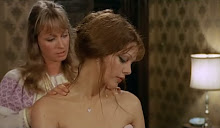
She quickly meets her fellow inmates: the moody Emily (Mamie Gummer), artistic but delusional Iris (Lyndsy Fonseca), narcissistic Sarah (Danielle Panabaker), and childlike, frightened Zoey (Laura-Leigh). She’s assigned to a cell occupied by Tammy, of whom the others are unwilling to speak, and soon discovers two things. One, Stringer is an advocate of experimental therapy; two, the institute appears to be haunted. And Kristen strongly suspects that the other girls know more than they’re telling. Then the disappearances begin …

‘The Ward’ plays its string out for a good chunk of its fairly short (84 minute) running time, Carpenter building tension as effectively as anywhere else in his filmography. Everything coheres to convince you this is a straight-up horror movie, including a grotesque and somewhat J-horror inspired ghost girl who perpetrates some pretty nasty acts. With its scenes of electro-shock treatment taken to the extreme and the kind of eyeball trauma normally reserved for a Lucio Fulci production – not to mention a sequence of flashbacks which culminate in a pretty unambiguous inference of paedophilia – ‘The Ward’ trawls the very rim of its 15-rating.
But Carpenter plays fair with the twist, seeding pertinent information throughout and delivering the big reveal with the minimum of expositional dialogue. Harris has the appropriate gravitas as Stringer to make the scene work, and Heard delivers a convincing vacillation between raw anger and shocked disbelief. I’ll say it again: Heard is fantastic. In fact, kudos to the whole cast: Gummer, Fonesca, Panabaker and Laura-Leigh give it their all, while Anderson finds a recognisably human quality in a character that could easily have come over as a sleazeball or a thug. There’s a wonderful little scene where he’s stuck with the repairwork following an escape attempt by Kristen, his labours interrupted by the flirtatious Sarah, and the look on his face and the weariness in his voice totally sell Roy as a wage-slave with a thankless job who really appreciate it if everyone would just piss off and leave him alone.
Yaron Orbach’s cinematography recalls the glory days of Dean Cundey’s collaborations with Carpenter’s. Mark Kilian’s score is also reminiscent of Carpenter’s stripped-down, atmospheric work as composer. And yet – maybe because it trades on generically obvious heavy-handed foley work and by-now-cliched ghost-girl visuals rather than breaking new ground – ‘The Ward’ doesn’t quite measure up the old-school Carpenter. And maybe this, as well as the reasons mentioned in the first paragraph, accounts for the indifferent box office response. Nonetheless, with lesser fare pulling in the punters, it was just criminal that ‘The Ward’ did such poor business.
Even allowing for the four years between ‘Ghosts of Mars’ and his superior episodes of the TV show ‘Masters of Horror’, and then another four years between those works and ‘The Ward’, Carpenter seems to have relapsed into inactivity. I really hope ‘The Ward’ doesn’t prove to be his swansong but if that
is the case, then he’s bowing out on his best feature-length film since ‘They Live’. (Mr Carpenter, in the unlikely event that you’re reading this, I’d like to keep doing 13 For Halloween on this blog for a good many years to come, and I’ve reviewed an awful lot of your filmography already. More films would be greatly appreciated.)