Showing posts with label Carroll Baker. Show all posts

Sunday, September 04, 2011

GIALLO SUNDAY: Knife of Ice


Umberto Lenzi’s 1972 giallo is an exercise in slow-burn and sleight of hand. Opening with some graphic (and most likely unfaked) bullfighting footage, Lenzi follows the opening credits with this quote: “Fear is a knife of ice which penetrates the senses down to the depth of conscience,” attributed to Edgar Allan Poe. The scene switches immediately to a railway station where Martha Caldwell (Carroll Baker) flinches every time a train passes.

We discover, in short order, that Martha is mute, the cause of her affliction was witnessing the death of her parents in a derailment at a young age, and that she is at the station to meet her cousin Jenny (Ida Galli, appearing under her Evelyn Stewart pseudonym), a soprano just back from a tour. Her physician, Dr Laurent (Alan Scott), is delighted at this positive step and still holds out hope of Martha regaining her voice.

Martha and Jenny are driven back to their uncle Ralph (George Rigaud)’s villa, an idyllic place except for the fact that it overlooks a cemetery. Their driver is the shifty and monosyllabic Marcos (Eduardo Fajardo). Ralph’s other staff are housekeeper Annie Britten (Silvia Monelli) and maid Rosalie (Olga Gherardi). At the villa, prior to a birthday party for the pre-pubescent Christina (Maria-Rosa Rodriguez), the daughter of a friend of the family, Jenny gives Ralph a gift of some books on the occult, a subject of which he seems to have specialist knowledge.


Lenzi takes his time establishing the protagonists and their interrelationships. Almost the first half hour is given over to character study: Martha’s troubled state of mind, her therapeutic love of painting and her friendship with Christina; Jenny’s relationship with Martha (Jenny features prominently in Martha’s recurring flashbacks to the bullfight depicted in the opening scene); Ralph’s interest in the esoteric, his heart condition and his dependence on medication; Dr Laurent’s omnipresence in the household (is he being overly solicitous to Martha, or is there an ulterior motive?); and the ‘Upstairs, Downstairs’-style goings on amongst the staff.

Just when you’d be forgiven for wondering what anything has to do with anything, the first murder occurs. And while ‘Knife of Ice’ certainly plays on the accepted iconography …


… it unfolds in notably bloodless fashion. For anyone who knows Lenzi solely by reputation – i.e. as the purveyor of such violent fare as ‘Almost Human’, ‘Cannibal Ferox’ and ‘Eaten Alive’ – ‘Knife of Ice’ will come as an eye-opener, with as much attention paid to characterization and pacing as there is to the elegant widescreen cinematography, and with a wordless central performance that must rank as Carroll Baker’s best.

The staid pacing is pepped up by some excellent set-pieces, including two fog-bound scenes that Lenzi milks for optimum tension. The lacunae necessary for the final act revelation are niftily scattered throughout the narrative. The eagle-eyed and congenitally suspicious will probably twig who the killer is, but the big reveal comes at the end of a cat-and-mouse sequence that only serves to sow further doubts.


Three corpses in, Inspector Duran (Franco Fantasia) assumes protagonist duties. Not your average giallo cop (i.e. he’s actually competent), Duran’s presence galvanizes the second half of the film, and the manhunt that ensues when the suspicion shifts to a drug-addicted Satanist sees the cemetery location used to excellent effect. But this digression – and it’s hardly a spoiler to say so – leads to a “wrong man” switcheroo comparable to that of ‘The Strange Vice of Mrs Wardh’ and suddenly Martha finds herself again at risk.

‘Knife of Ice’ demands patience in its early stretches, but plays fair with its lacunae, and sprinkles in enough clues (however elusively) to justify its final act rug-pull. It’s not quite as stylish or baroque as many gialli, but it’s quietly compelling and confidently directed.

Sunday, May 01, 2011

GIALLO SUNDAY: A Quiet Place to Kill

Apologies for the minimal visual content in today’s Giallo Sunday offering; the streaming copy I watched froze just before the end credits and I’d only seen fit to take one screengrab. Nonetheless, it features a bottle of J&B, so at least there’s one giallo trope present and correct.


Umberto Lenzi’s output is prodigious and entirely genre-based: polizia, gialli, war movies, horrors. His string of gialli from the late 60s to the mid-70s are of a uniform standard – glossy, sexy, cynical – and provide something of a headache for the film historian.

For example: Lenzi’s 1969 giallo ‘Orgasmo’ (not to be confused with his later ‘Spasmo’) starring Carroll Baker as an American heiress who gets involved with a European couple only for sexual tension and murderous passions to come to the surface was retitled ‘Paranoia’ for the American market. A year and three films later (told you his output was prodigious) Lenzi made a giallo called ‘Paranoia’, which again starred Carroll Baker again as an American heiress again becoming embroiled in sexual tension and murderous passions after again getting involved with a European couple, which – to avoid (or maybe generate) confusion – was retitled ‘A Quiet Place to Kill’ for the American market. Lenzi’s next film, starring Ray Lovelock and a jailbait Ornella Muti, was called ‘An Ideal Place to Kill’, and therefore retitled for the English speaking market ‘Oasis of Fear’ a.k.a. ‘Dirty Pictures’.

For the purposes of this review, I’ll go with ‘A Quiet Place to Kill’ as a title. That or, ‘The One Where Carroll Baker Plays a Racing Driver’. Or maybe not; that makes it sound too much like an episode of ‘Friends’.

Anyway, Carroll Baker plays Helen, a racing driver who, recuperating after a crash, is invited to spend some time at the coastal villa of her ex-husband Maurice (Jean Sorel). Arriving, she discovers the invitation came from Maurice’s new wife Constanze (Anna Proclemer). Constanze has twigged to something that Helen also found out the hard way – to whit, Maurice is a good-looking, smooth-talking love rat who leeches off rich women – and is looking for a partner in crime to help her dispose of Maurice and make it look like an accident.

The film plays out against a sunny backdrop of louche, amoral privilege, where characters wander around in elegant fashions, yachting, diving, playing tennis, drinking champagne or cocktails or (hey, let’s not forget who the sponsor is!) J&B, lounging by the pool, shooting each other baleful looks, and engaging in the odd bit of hate-fucking.

So: glamorous people, glamorous locations, copious amounts of nudity and a general air of moneyed cynicism. Oh yeah, and a murder plot. Let’s not forget the murder plot. Do I need to tell you that it doesn’t entirely go to plan? Do I need to mention that a rogue element enters the proceedings – in the shape of Constanze’s headstrong teenage daughter Susan (Marina Coffa). Or that there are possible witnesses to a certain, compromised event? Or that an authority figure – in this case public prosecutor Albert Duchamps (Luis Davila) – is sniffing around, convinced that there are inconsistencies.

The second half of ‘A Quiet Place to Kill’ inhabits the kind of territory best described in Patricia Highsmith’s ‘The Talented Mr Ripley’: you know what’s happened, why it happened, who did it and how they potentially screwed up, and the tension is generated by watching them scurry around like rats trying to lie, obfuscate and side-step their way free of the consequences. Lenzi throws in a final act curveball that explodes the character dynamics and steers things in an even more reprehensibly cynical direction.

There may not be any likeable characters here, but there’s plenty to enjoy: Baker is luminously gorgeous and spends much of the film in various states of undress; Sorel plays the good-looking bastard to a tee; Guglielmo Mancori’s widescreen cinematography is eye-catching; the lounge jazz soundtrack is, as ever in this genre, hilariously inappropriate; and the twists of the last few minutes are as serpentine as the hair-pin bends one of the characters makes a tyre-squealing escape attempt along in the tense finale.

Tuesday, April 20, 2010

Baba Yaga

Posted as part of Operation 101010
Catgeory: gialli / In category: 4 of 10 / Overall: 25 of 100

Corrado Farina’s ‘Baba Yaga’ is one of those films I’d been vaguely aware of without knowing anything much about it. I came across it having fed “giallo” into the search facility while updating my rental list recently. But is it a giallo? The first time I ever wrote about gialli on this blog, I prefaced the review with a brief checklist: a guide to recognising your giallo. It tapped out at ten items:

1. Black gloves. The must-have fashion accessory for the killer-about-town.

2. An amateur sleuth, in the wrong place at the wrong time, who decides to launch their own investigation after witnessing a murder or attempted murder.

3. Totally ineffectual police officers.

4. Extended, operatic death scenes which present as a hybrid of the traditional whodunit and the visceral stalk ‘n’ slash flick.

5. Staircases, often spiral. Likewise, killers and victims alike tend to plunge from high places or down elevator shafts.

6. J&B. Product placement as blatant as Aston Martins in Bond movies.

7. Famous mainstream actors at the start or later on in their careers.

8. Gratuitous nudity. (Well, black gloves and bottles of J&B can only generate so many ticket sales.)

9. Edwige Fenech.

10. Distinctive titles, often featuring an animal (‘Don’t Torture a Duckling’), a colour (‘Deep Red’), a number (‘Five Dolls for an August Moon’), or sometimes a combination of all three (‘Four Flies on Grey Velvet’).

Add to this an occasional tendency to incorporate supernatural elements, and let’s run ‘Baba Yaga’ against the checklist. It scores a big fat no on points 1, 5, 9 and 10. Point 2 is a maybe – the main character, adrift in a welter of weird shit, latches onto a hitherto overlooked detail (a quintessential giallo trope) which helps her unravel things. Likewise point 3 – some cops turn up at the end and do precisely fuck all, but their abortive attempts at sleuthing are never established in counterpoint to the amateur detective’s efforts as in the best gialli.

Point 4, half and half – there are some extended, operative (hell, positively grand guignol) dream sequences that presage a couple of swiftly portrayed, almost throwaway death scenes.

As for the rest of them: point 6 (didn’t notice, and the supremely authoritative Atrocity Nights J&B in the movies page doesn’t list ‘Baba Yaga’, so I’m guessing not); point 7 (check: Carroll Baker); and point 8 (very little nudity per se, but sleaze aplenty).

So it’s a very shallow case for ‘Baba Yaga’ as a giallo. But fuck it, it’s my blog and I’ve still got 75 movies to get through to finish this Operation 101010 project so I’m taking the minority view and deciding to allow it.

The film centres around photographer Valentina (Isabelle de Funes). When we first meet her she’s attending some kind of weird performance theatre piece in a graveyard. The police break it up and she adjourns to a society party. Later she hangs out with some sexy Marxists who talk up revolution. In the course of the film she gets involved with director Arno Treves (George Eastman); one moment he’s making a documentary attacking capitalists, the next he’s shooting a commercial for washing powder. The politics of ‘Baba Yaga’ are, to put it mildly, slightly confused.
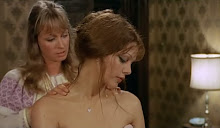
Treves’s washing powder commercial, incidentally, is horribly racist. It anthropomorphosises a black man in a black suit as a stain and a white man in a white suit as the detergent. Whether Farina meant this ironically, I’m not sure. But it’s something of a slap in the face to the viewer. It doesn’t help, either, that an air of homophobia permeates ‘Baba Yaga’, in the shape of its eponymous anti-heroine.

Baba Yaga is a witch and a lesbian. Farina seems to have less of an issue with the whole witch aspect. Long story short: B.Y. almost runs Valentina over as she walks home from the society party, offers her a lift, and tells her they were destined to meet. She takes a clip from Valentina’s garter and promises to drop by to see her the next day. Valentina flees to her apartment where she has the first of several surreal dreams that, depending on how your look at it, (a) tap into her sexual repression, (b) feature fetishistic use of German uniforms (from both wars), (c) make no fucking sense, or (d) all of the above.

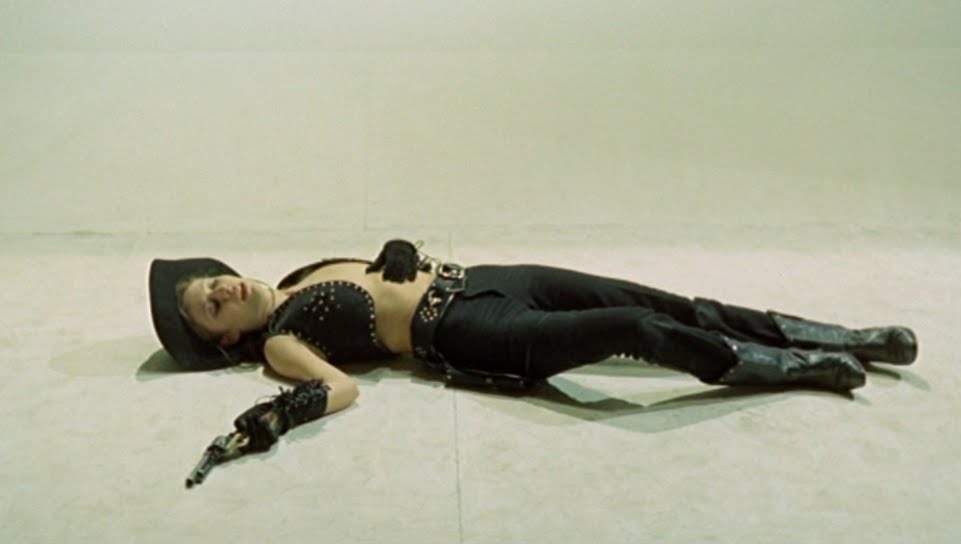
B.Y. comes calling, as promised, the next day and puts a spell on Valentina’s camera. Doing an erotic shoot with a model dressed in a revealing cowgirl outfit, the poor unfortunate collapses as if shot by the very replica pistol she’s holding.

Later, Valentina photographs a protestor at a demonstration and the guy drops dead. Valentina hits upon a self-evident solution: use a different camera. This doesn’t, however, stop her from visiting B.Y. on the pretext of using her decrepit old house as a backdrop to a photoshoot. B.Y. gives her a doll called Annette. The doll is done up in bondage gear.

At another erotic shoot, the model is stabbed during a power cut and later dies. Valentina and Treves develop the film from the possessed camera and the resultant pictures indicate that Annette (Ely Galleani) has come to life and offed said model.

(I am not making this up.)

Annette appears to Valentina, almost seduces her, then departs.

A phone call summons her to chez B.Y. Now completely under the witch’s spell, she goes. After ten minutes’ worth of kink (bondage, whipping and a quick grope), Treves turns up to save her from the proverbial fate worse than death.

Which is where I have issues with the film. Farina obviously revels in the faux sapphic imagery and yet comes across as puritanical in his denunciation of Baba Yaga as a manipulative and evil seductress. However, all of the dream sequences seem to indicate that Valentina is drawn to B.Y. I can’t help thinking that a more interesting (and certainly more erotic) film could have been wrought from the concept of Baba Yaga as Valentina’s liberator. Likewise, I’m also stumped as to why the supposedly omnipotent B.Y. wastes so much time and effort on the androgynous and unresponsive Valentina when she has the voluptuous and sexed-up Annette at her disposal. Without wishing to veer into the realms of chauvinism, laddishness and objectification, let me put it this way – Valentina or Annette, your choice:

Ahem. Moving swiftly on:

‘Baba Yaga’ is homophobic, racist and deeply confused in roughly equal measures. And it’s probably not even a giallo. The Shameless DVD release that I watched purports to be Farina’s final cut, restored from the butchering the erstwhile distributors enforced upon it. I’ve never seen said bastardised version, but if the director’s cut is this schizophrenic, I’d hate to imagine how fucked up the theatrical release was.