Showing posts with label George Clooney. Show all posts
Saturday, March 26, 2016
Hail, Caesar!
I was toying with the idea of structuring this review around my reading of ‘Hail, Caesar’ as ‘Barton Fink’ meets the gospels, but that would involve identifying Judas’s stand in and therein lies a major spoiler. Let’s just say that an oft-referenced but never seen studio boss is the Coen Brothers’ absent God, Scarlett Johannsen is the Virgin Mary and studio “fixer” Eddie Mannix (Josh Brolin) is Everyman and the film itself a chronicle of his long dark night of the soul.
Or you could possibly make a case for Mannix as Jesus, particularly in terms of his temptation, but I prefer the idea of naïve cowboy star Hobie Doyle (Aiden Ehrenrecih) as Christ, which would seem to work in context of his deliverance of Baird Whitlock (George Clooney) – a man who falls among, if not thieves, then writers … and communist writers, to boot.
Either way, the film starts with an image of Christ on the cross and ends with a purposefully hackneyed pan up to the firmament, so we’re definitely in religious territory. Mannix has his most soulful conversations in a confessional, and grabs prayer beads and silently implores the Almighty for guidance at his moment of greatest uncertainty. Granted, outside of his faith he happily slaps around anyone whose peccadilloes might bring the studio into disrepute, complicitly pays off kidnappers and deals with rival sibling gossip columnists (Tilda Swinton) with the aplomb of Machiavelli, but at heart he’s still Everyman, his path is a difficult one and his decisions don’t come easily.
Religion has always bubbled away in the background in the Coens’ filmography, be it John Goodman’s pseudo-Satan and the corridors of a fleapit hotel as an entryway to hell in ‘Barton Fink’, or the mass baptism in ‘O Brother, Where Art Thou?’, but it wasn’t until ‘A Simple Man’ that the theological truly shouldered its way to the forefront. ‘Hail, Caesar’ offers a scene of four religious spokesmen trading ecumenical verbal bitch-slappings that manages to say more about religion than ‘A Simple Man’ does in its entire running time.
Or I could be misconstruing things entirely and ‘Hail, Caesar’ is nothing more than an excuse for Joel and Ethan to restage some of their favourite scenes and genre tropes from the golden age of Hollywood. God knows, they certainly stuff enough of their own back catalogue into the blender. The obvious points of reference are ‘Barton Fink’ and ‘The Big Lebowski’: such narrative as ‘Hail, Caesar’ scrapes together (the film happily introduces all manner of characters, situations, subplots and symbolism only to completely forget them again) is basically a conflation of those two earlier films. But plenty of other moments from the Coen back catalogue are included.
It would, in fact, be very easy to write off ‘Hail, Caesar’ as the Coens doing sloppy, second-rate Coen copyism, but that misses out on how entertaining the whole big stupid shaggy dog story is. How entertaining and how intelligent. Weaving McCarthyism, socio-political debate, economics, faith, doubt, moral elasticity and spiritual angst into the fabric of its (un)reality, the Coens’ script is an exercise in Big Concepts played out against a deliberately superficial backdrop. Oh, and it’s laugh out loud funny for a good 80% of its running time.
A plot synopsis would be a self-defeating exercise, so I’m not going there. Analysis of individual performances? All over the place, from Clooney being spectacularly in on the joke and owning every scene he’s in, to Brolin effectively anchoring the film without actually doing anything he hasn’t done a dozen times already, to Jonah Hill in a cameo that proves that once you’ve worked for Scorsese you can blag your way into any prestige production, to complete unknown Ehrenreich basically writing himself a cheque for his entire Hollywood career in one magnificently conceptualised performance. An extended scene where Ehrenreich’s total rube and Ralph Fiennes’s snootily sophisticated director play off each other is pure delight on a level the Coens haven’t delivered in a good few years.
It’s a profoundly deep film and utterly throwaway at one and the same time. It’s about a lot of things and adds up to something slightly less than sweet fuck all. There’s a scene of the communist writers at rest, two of them demurely completing a jigsaw together, only the last piece doesn’t fit. That’s the whole film, right there.
Wednesday, February 26, 2014
The Monuments Men
George Clooney’s canon of dependable, solidly crafted films as director gets another entry with ‘The Monuments Men’. It’s been greeted by an almost consensus critical opinion: plodding pace, under-developed characters, turgid voiceover.
I’d love to post a contrary review and herald the film as a misunderstood classic – indeed, this review proceeds from my opinion that it’s decidedly better than most people are giving it credit for – but it has to be admitted from the outset: ‘The Monuments Men’ is flawed. The main problem is the script, which veers between smartarse caper movie and big dramatic statement on the value of art over life.
Or to put it another way, Clooney and co-writer Grant Heslov can’t decide if they want to remake ‘Kelly’s Heroes’ or ‘The Train’.
That much-levelled criticism re: the characters holds. Less than halfway through, I’d given up trying to remember their names or whatever tiny daub of backstory they’d been given. They were simply The Snobbish One (Bob Balaban), The Gregarious One (John Goodman), The Wry But Melancholy One (Bill Murray), The One Speaks Bad French (Matt Damon), The Two One Who’s Actually French (Jean Dujardin), The One Who’s Awfully British What Ho! (Hugh Bonneville) and The One Who’s George (Clooney).
There’s also Cate Blanchett, whose French accent vacillates from borderline acceptable to ‘Allo! Allo!’
At the heart of the film is one hell of an inspiring true story, and when the script focuses on the logistics of tracking down and recovering stolen artworks, often from behind enemy lines and with little or no support, Clooney responds well as actor and director. There’s a particularly effective upswing in terms of urgency and tension in the second half when, following the German surrender, what should have been a more relaxed endeavour is suddenly complicated by the Russian Army’s rigorously mobilised Trophy Brigade, out to forcibly claim as much art as possible and ship it off to the motherland. The race to recover Michelangelo’s Madonna and Child is both a genuine edge-of-the-seat sequence and the script’s finest explication of the importance of art.
Elsewhere, cringe-worthy moments abound: not least a Christmas message received by one of the team which is intercut with a young soldier dying in a hospital tent (imagine if Spielberg had made ‘M*A*S*H’ instead of Altman: yes, that schmaltzy).
At its best, though, ‘The Monuments Men’ is a well-crafted mainstream production. There’s enough genuine commitment to the subject matter to mark it out as more than just a vanity project or a chance for Clooney to gift half a dozen roles to his buddies. The production design is excellent. Clooney suggests an epic, battle-scarred backdrop and sets up an effective counterpoint between the aftermath of wartime conflict and the timeless cultural importance of the works his heroes recovered.
Monday, March 12, 2012
The Men Who Stare at Goats
Posted as part of an intermittent series of espionage-related cinema leading up to the release of the new James Bond film ‘Skyfall’ later this year

I’d had it on good authority that ‘The Men Who Stare at Goats’ was a POS. Despite this, I neglected to delete it from my rental list. So when it turned up last week, my rationale was something like this: aww, hell, it stars George Clooney, Ewan McGregor, Jeff Bridges and Kevin Spacey, and at a pinch I can feature it as part of my intermittent series of espionage-related cinema, surely it’s worth a watch.
Readers, I watched it.
POS is perhaps a tad harsh – there are a couple of bona fide laugh out loud moments – but to watch Grant Heslov’s film is ultimately to watch a terrific cast squander themselves as a brilliant concept is simply frittered away.
For this reason, we won’t dwell on it too long. Synopsis time: journo Bob Wilton (McGregor) does a human interest piece on bonkers ex-soldier Gus Lacey (Stephen Root) who reminisces about his time with Lyn Cassady (Clooney) in a psychic military unit led by quasi-hippie Bill Django (Bridges). Initially sceptical, Wilton files the story then heads to Iraq to prove himself as a front-line reporter after the breakdown of his marriage. It’s here he bumps into Cassady, who recounts the story of Django’s unit as the pair head across country so Cassady can complete some mysterious mission.

Herein my first problem with the film. Point of view and lead character duties skip from Wilton to Cassady to Django with such skittish abandon that I couldn’t get a handle on whether Heslov and scripter Peter Straughan were being arbitrary, indecisive, or full-on going for an anti-narrative. The tone, too, veers from genuinely amusing to trying-too-hard to actually-quite-mean-spirited, seemingly on a whim.
Round at the halfway mark, the film coheres into the Wilton and Cassady road show, but it’s delivered all its satirical barbs by this point and only one inspired but narratively redundant scene involving Robert Patrick as the head of a US security who gets into a firefight with a different US security force which he happily blames on the Iraqis emerges as memorable. The firefight, incidentally, is over superiority in a queue at a petrol station.
Based on a non-fiction work by Jon Ronson, and opening with the irresistible credit “more of this is true than you would believe”, ‘The Men Who Stare at Goats’ starts out knee-deep in potential but never fully gets to grips with the off-the-wall political satire the concept demands. Instead we get a smorgasbord of contrived and often unfunny in-jokes, mostly referencing the casts’ previous work. McGregor seems to have been cast purely as the butt of the joke every time one of the psychic irregulars refers to himself as a Jedi warrior.
Heslov, making his feature debut, doesn’t stamp a strong enough visual or satirical signature on the material, particularly when the finale cries out for the demented visual flair of a David Lynch or an Alejandro Jodorowsky. What Heslov manages is ninety minutes of moderate amusement, when Ronson’s book could easily have lit the fuse on a two-hour delirious headfuck.

I’d had it on good authority that ‘The Men Who Stare at Goats’ was a POS. Despite this, I neglected to delete it from my rental list. So when it turned up last week, my rationale was something like this: aww, hell, it stars George Clooney, Ewan McGregor, Jeff Bridges and Kevin Spacey, and at a pinch I can feature it as part of my intermittent series of espionage-related cinema, surely it’s worth a watch.
Readers, I watched it.
POS is perhaps a tad harsh – there are a couple of bona fide laugh out loud moments – but to watch Grant Heslov’s film is ultimately to watch a terrific cast squander themselves as a brilliant concept is simply frittered away.
For this reason, we won’t dwell on it too long. Synopsis time: journo Bob Wilton (McGregor) does a human interest piece on bonkers ex-soldier Gus Lacey (Stephen Root) who reminisces about his time with Lyn Cassady (Clooney) in a psychic military unit led by quasi-hippie Bill Django (Bridges). Initially sceptical, Wilton files the story then heads to Iraq to prove himself as a front-line reporter after the breakdown of his marriage. It’s here he bumps into Cassady, who recounts the story of Django’s unit as the pair head across country so Cassady can complete some mysterious mission.

Herein my first problem with the film. Point of view and lead character duties skip from Wilton to Cassady to Django with such skittish abandon that I couldn’t get a handle on whether Heslov and scripter Peter Straughan were being arbitrary, indecisive, or full-on going for an anti-narrative. The tone, too, veers from genuinely amusing to trying-too-hard to actually-quite-mean-spirited, seemingly on a whim.
Round at the halfway mark, the film coheres into the Wilton and Cassady road show, but it’s delivered all its satirical barbs by this point and only one inspired but narratively redundant scene involving Robert Patrick as the head of a US security who gets into a firefight with a different US security force which he happily blames on the Iraqis emerges as memorable. The firefight, incidentally, is over superiority in a queue at a petrol station.
Based on a non-fiction work by Jon Ronson, and opening with the irresistible credit “more of this is true than you would believe”, ‘The Men Who Stare at Goats’ starts out knee-deep in potential but never fully gets to grips with the off-the-wall political satire the concept demands. Instead we get a smorgasbord of contrived and often unfunny in-jokes, mostly referencing the casts’ previous work. McGregor seems to have been cast purely as the butt of the joke every time one of the psychic irregulars refers to himself as a Jedi warrior.
Heslov, making his feature debut, doesn’t stamp a strong enough visual or satirical signature on the material, particularly when the finale cries out for the demented visual flair of a David Lynch or an Alejandro Jodorowsky. What Heslov manages is ninety minutes of moderate amusement, when Ronson’s book could easily have lit the fuse on a two-hour delirious headfuck.
Labels:
Ewan McGregor,
George Clooney,
Grant Heslov,
Jeff Bridges,
Kevin Spacey
Friday, May 06, 2011
George Clooney
Wednesday, February 03, 2010
Intolerable Cruelty
Posted as part of Operation 101010
Category: comedies / In category: 1 of 10 / Overall: 7 of 100

It would be easy to dismiss ‘Intolerable Cruelty’ as Coen Brothers lite. A frothy mainstream diversion, oodles better than the misconceived ‘Ladykillers’ remake, but still an exercise in treading water prior to their storming comeback with ‘No Country for Old Men’.
I enjoyed ‘Intolerable Cruelty’ first time I saw it, picked it up for a song on DVD a couple of years ago and I tend to treat it as movie comfort food. Crap day at work? Tired? Feeling a bit low? Need something with a couple of laugh-out-loud moments and George Clooney being smooth; a no-brainer that, by dint of its zingy 1940s screwball-comedy style dialogue and the effervescence of its leads, still manages to evince a bit of class? Look no further.
Bunging it on recently (crap day at work; muscles aching from a frozen shoulder), my wife observed, "Actually, this film’s pretty fucked up when you think about it."
And yes, beneath its day-glo audience-friendly sheen, ‘Intolerable Cruelty’ is a slap in the face to love, relationships and the sanctity of marriage. It’s a comedy about infidelity, divorce and deceit, the plot mechanics concerned with the financial ruination of one partner to the betterment of the other.

Clooney’s Miles Massey is a divorce lawyer and the president of the fictitious National Organisation of Matrimonial Attorneys, Nationwide (corporate slogan: "let N.O.M.A.N. put asunder …"). He’s bored with his success; bored with the trappings of his wealth. He wants a challenge, a struggle, an adversary. Cynicism is already writ large: our hero is shallower than a politician’s promise of the eve of election; he’s freakin’ lawyer, for Christ’s sake; and his idea of fulfilment is to prove his superiority all over again – moreover, at someone else’s expense.
(Parenthetically, Miles Massey can be reckoned as the first of Clooney’s morally compromised corporate professionals, followed by the title character in ‘Michael Clayton’ ["fixer" for a law firm] and Ryan Bingham in ‘Up in the Air’ [a downsizing specialist]. All are unlikeable by very definition of what they do for a living. Clooney’s old school movie star appeal – he has that suave but slightly self-deprecating Cary Grant thing down pat – goes a hell of a way towards making these characters palatable.)
"At someone else’s expense" is pretty much the defining theme of ‘Intolerable Cruelty’. Miles gains his edge and wins cases by employing the services of private investigation/B&E merchant Gus Petch (Cedric the Entertainer) in the not-always-legal acquisition of evidence; he also leaves the dirty work of acting upon Petch’s findings to right hand man Wrigley (Paul Adelstein), the risk of disbarment thus becoming Wrigley’s and not his.
Money motivates: Miles’s adversary/romantic foil Marilyn Rexroth is an out-and-out gold-digger who views the investment of a few years in a loveless marriage with an older man chosen for his dupability as a step towards financial independence. It’s as much a testament to Catherine Zeta Jones’s breezy screen persona as it is to Clooney’s smoothness that you’re not put off by the characters. Marilyn takes advice from ersatz mother figure Sarah Sorkin (Julia Duffy), a past master in remunerative divorces notwithstanding that she has ended up alone in a vast and lifeless mansion with "only a peptic ulcer to keep her warm at night".
Miles is also mentored by an older figure: senior partner Herb Meyerson (Tom Aldredge). In a film where the humour is predicated upon non-sequiturs ("Kirschner was in Kentucky!"), buffoonery ("I’m gonna nail yo’ ass!") and the impishly perverse, Herb Meyerson is more in keeping with the half-comic/half-threatening grotesques from earlier entries in the Coens’ filmography, such as the salesmen played by John Goodman in ‘Barton Fink’ and ‘O, Brother Where Art Thou?’ or Jon Polito’s mardy-arse gangster in ‘Miller’s Crossing’. Herb dwells in semi-darkness on the top floor, hooked up to who knows what kind of machines, kept alive – one imagines – purely by his grasping need to generate profits. And when his number one attorney faces financial ruin and the reputation of the firm is under threat, Herb’s reaction is unequivocal: "I’m going to talk to you about the goddamn law. We serve the law. We honour the law. And sometimes, counsellor, we obey the law. This is not one of those times."

Which is how Miles and Wrigley end up in a back-room business meeting with asthmatic and intellectually challenged hitman Wheezy Joe (Irwin Keyes) …


‘Intolerable Cruelty’ is second-rate Coens, but it’s easy to imagine that if Penny Marshall or Nora Ephron had been at the helm it would have been hailed as a slyly subversive comment on rom-com conventions. It’s one of those cases of the director(s) defining the work: by the Coens’ previous standards the cynicism is sunny, the cruelty tolerable.
Category: comedies / In category: 1 of 10 / Overall: 7 of 100

It would be easy to dismiss ‘Intolerable Cruelty’ as Coen Brothers lite. A frothy mainstream diversion, oodles better than the misconceived ‘Ladykillers’ remake, but still an exercise in treading water prior to their storming comeback with ‘No Country for Old Men’.
I enjoyed ‘Intolerable Cruelty’ first time I saw it, picked it up for a song on DVD a couple of years ago and I tend to treat it as movie comfort food. Crap day at work? Tired? Feeling a bit low? Need something with a couple of laugh-out-loud moments and George Clooney being smooth; a no-brainer that, by dint of its zingy 1940s screwball-comedy style dialogue and the effervescence of its leads, still manages to evince a bit of class? Look no further.
Bunging it on recently (crap day at work; muscles aching from a frozen shoulder), my wife observed, "Actually, this film’s pretty fucked up when you think about it."
And yes, beneath its day-glo audience-friendly sheen, ‘Intolerable Cruelty’ is a slap in the face to love, relationships and the sanctity of marriage. It’s a comedy about infidelity, divorce and deceit, the plot mechanics concerned with the financial ruination of one partner to the betterment of the other.

Clooney’s Miles Massey is a divorce lawyer and the president of the fictitious National Organisation of Matrimonial Attorneys, Nationwide (corporate slogan: "let N.O.M.A.N. put asunder …"). He’s bored with his success; bored with the trappings of his wealth. He wants a challenge, a struggle, an adversary. Cynicism is already writ large: our hero is shallower than a politician’s promise of the eve of election; he’s freakin’ lawyer, for Christ’s sake; and his idea of fulfilment is to prove his superiority all over again – moreover, at someone else’s expense.
(Parenthetically, Miles Massey can be reckoned as the first of Clooney’s morally compromised corporate professionals, followed by the title character in ‘Michael Clayton’ ["fixer" for a law firm] and Ryan Bingham in ‘Up in the Air’ [a downsizing specialist]. All are unlikeable by very definition of what they do for a living. Clooney’s old school movie star appeal – he has that suave but slightly self-deprecating Cary Grant thing down pat – goes a hell of a way towards making these characters palatable.)
"At someone else’s expense" is pretty much the defining theme of ‘Intolerable Cruelty’. Miles gains his edge and wins cases by employing the services of private investigation/B&E merchant Gus Petch (Cedric the Entertainer) in the not-always-legal acquisition of evidence; he also leaves the dirty work of acting upon Petch’s findings to right hand man Wrigley (Paul Adelstein), the risk of disbarment thus becoming Wrigley’s and not his.
Money motivates: Miles’s adversary/romantic foil Marilyn Rexroth is an out-and-out gold-digger who views the investment of a few years in a loveless marriage with an older man chosen for his dupability as a step towards financial independence. It’s as much a testament to Catherine Zeta Jones’s breezy screen persona as it is to Clooney’s smoothness that you’re not put off by the characters. Marilyn takes advice from ersatz mother figure Sarah Sorkin (Julia Duffy), a past master in remunerative divorces notwithstanding that she has ended up alone in a vast and lifeless mansion with "only a peptic ulcer to keep her warm at night".
Miles is also mentored by an older figure: senior partner Herb Meyerson (Tom Aldredge). In a film where the humour is predicated upon non-sequiturs ("Kirschner was in Kentucky!"), buffoonery ("I’m gonna nail yo’ ass!") and the impishly perverse, Herb Meyerson is more in keeping with the half-comic/half-threatening grotesques from earlier entries in the Coens’ filmography, such as the salesmen played by John Goodman in ‘Barton Fink’ and ‘O, Brother Where Art Thou?’ or Jon Polito’s mardy-arse gangster in ‘Miller’s Crossing’. Herb dwells in semi-darkness on the top floor, hooked up to who knows what kind of machines, kept alive – one imagines – purely by his grasping need to generate profits. And when his number one attorney faces financial ruin and the reputation of the firm is under threat, Herb’s reaction is unequivocal: "I’m going to talk to you about the goddamn law. We serve the law. We honour the law. And sometimes, counsellor, we obey the law. This is not one of those times."

Which is how Miles and Wrigley end up in a back-room business meeting with asthmatic and intellectually challenged hitman Wheezy Joe (Irwin Keyes) …
So: love is a business decision, marriage a quick trip to the Wee Kirk on the Heather (wedding music: ‘Bridge Over Troubled Waters’, arranged for solo bagpipe), divorce a Las Vegas-style pay-out, and if all else fails there’s always Wheezy Joe and a slapstick finale where an impending assassination plays out funnier and a lot more good natured than any of the scenes relating to matters of the wallet heart.


‘Intolerable Cruelty’ is second-rate Coens, but it’s easy to imagine that if Penny Marshall or Nora Ephron had been at the helm it would have been hailed as a slyly subversive comment on rom-com conventions. It’s one of those cases of the director(s) defining the work: by the Coens’ previous standards the cynicism is sunny, the cruelty tolerable.
Saturday, March 21, 2009
PERSONAL FAVES: From Dusk Till Dawn
There’s a scene in Alfonso Cuaròn’s ‘Y Tu Mamá También’ – a masterly paeon to homo-eroticism, political incorrectness and the older woman – in which the horny teenage protagonists, left to their own devices after their girlfriends jet off on an exchange holiday, pass the time by engaging in some wholesome outdoor activity. Such as lying on the diving boards of a deserted country club swimming pool, eyes closed, hands in their trousers, vigorously polishing the lighthouse as they fantasise about their favourite actresses. One of them invokes the name of that Mexican goddess in human form, Salma Hayek, and both are spurred on to greater feats of onanism.I’m willing to bet the gentlemen in question were thinking of the snake dance scene in ‘From Dusk Till Dawn’.
Directed by Robert Rodriguez from a script by Quentin Tarantino blah blah crims on the run blah blah kidnap a family and cross the border in their RV blah blah Titty Twister blah blah Cheech Marin’s hilarious and definitely NSFW “pussy” speech blah blah wait for their contact blah blah packed with bikers and mariachi musicians blah blah sudden lurch into horror film territory blah blah small group of survivors blah blah and did I mention that there’s this showstopping scene where Salma Hayek does a snake dance?
Sorry. I was eager to cut to the chase there. I’ll try to make amends by at least pretending to write a proper, considered article on the film. The key scene in ‘From Dusk Till Dawn’ occurs exactly at the halfway mark. Thus far, script and direction have kept audience sensibilities firmly within an immediately recognisable genre – the crime thriller. There has been shooting, explosions, hostage taking, kidnapping, the evasion of authorities and a tense border crossing. Then the protagonists – brothers in crime Seth and Ritchie (George Clooney and Quentin Tarantino), and hostage family Jacob (Harvey Keitel), Kate (Juliette Lewis) and Scott (Ernest Liu) – make an ill-advised stop at a lawless roadhouse.
It’s here that a Tex-Mex band are laying down some sleazy tunes while topless go-go dancers gyrate. (Last night I was writing about ‘The Insider’ and musing that “Mann conjures images that are haunting, sometimes surreal … and effortlessly poetic”; twenty-four hours down the line as it’s topless go-go dancers gyrating. God, I love blogging!) The lights go down, a hush falls over the rough-neck crowd. The leader of the mariachis announces the next act: the cryptically named Santanico Pandemonium. It’s Salma time!
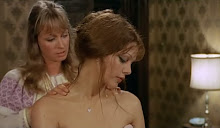
Oh shit, I was trying to keep this reasonably intelligent. I was going to compare the scene to Rita Hayworth’s vampish burlesque number in ‘Gilda’ and Michelle Pfeiffer’s seductive rendition of “Makin’ Whoopee” in ‘The Fabulous Baker Boys’. I was going to highlight how the narrative is put on hold so the female protagonist can (literally) take centre stage, the piffling concerns of plot and dialogue held in stasis; subjugated to the heroine’s sensual self-expression. I was going to expand on this point and write about the destructive force of the uninhibited sexuality on display – how both ‘Gilda’ and ‘The Fabulous Baker Boys’ progress from these sequences into examinations of jealousy and fractured relationships. I was going to wind up this scholarly digression by demonstrating how ‘From Dusk Till Dawn’ takes things one step further: not only does the smouldering sexuality of Santanico’s dance herald destruction and filial separation (I was going to slip in a clever little parenthetical reference to the Baker boys being brothers as well), it also sends the film spinning off into a completely different narrative and a completely different genre as Santanico morphs into a vampire and one of the sexiest women ever to grace the big screen suddenly turns into something very fucking freaky.
But then I thought, why bother? Film is not analysis it is the agitation of the mind. And ‘From Dusk Till Dawn’ doesn’t invite analysis; it invites some mates round and lays on a pizza and a six-pack. It’s a B-movie to the nines and that’s how it should be enjoyed. It’s got gorgeous George being a badass. It’s got Harvey Keitel as a preacher who turns into a vampire-killing “mean mmmm-mmmm servant of God”. It’s got FX meister Tom Savini as a character called Sex Machine who’s got a six-shooter in a codpiece! It’s got Fred Williamson growling “I was in ’Nam.” It’s one hundred minutes of balls to the wall sick twisted fun, all wrapped up in a kick-ass soundtrack.
And it’s got Salma Hayek. Doing a snake dance.
(I may be sleeping on the couch tonight.)
Monday, December 22, 2008
PERSONAL FAVES: Ocean's 11
When Steven Soderbergh made ‘Ocean’s 11’ in 2001, he was on a roll. After nearly a decade in the wilderness following his acclaimed debut ‘sex, lies and videotape’, he’d come storming back with uber-cool Elmore Leonard adaptation ‘Out of Sight’ in 1998, followed in rapid succession by ‘The Limey’ (still criminally underrated), ‘Erin Brockovich’ (a potential courtroom yawnfest that Soderbergh somehow made compelling*) and the multi-layered Oscar-winning ‘Traffic’.Now I love all of those films, and it can be argued (quite easily it the case of, say, ‘Traffic) that all of them have more depth, more interest, more idiosyncracies – hell, just plain more to write about – than ‘Ocean’s 11’. In fact it wouldn’t be difficult to make a case for ‘Ocean’s 11’ as an incredibly entertaining but ultimately generic remake, file it under “style over substance” and move on.
But I would pick ‘Ocean’s 11’ over its stable mates any day. Several reasons.
It’s a pitch-perfect example of pure mainstream entertainment. You don’t need to think about it too much. You can kick back with a bowl of popcorn, crack a beer, relax and let 100 minutes of cool wash effortlessly over you. There’s plenty of films that fulfil the “pure entertainment” remit – most of them, in fact – but precious few that still manage to be supremely well-made and not insult the intelligence.
It improves on the original immeasurably. Lewis Milestone’s 1960 film was a ‘Rififi’-style crime caper teaming the Rat Pack with Sixties stalwarts Angie Dickinson, Richard Conte, Cesar Romero, Akim Tamiroff and Henry Silva; a classic in the making … or would have been had Milestone been able to shoot the film he wanted.
Sinatra and co. all had big room gigs at Vegas during the shooting and this, rather than the film, became their principle focus. Then there was the partying. We’re talking about the Rat Pack, after all. In Vegas. Analogy: imagine you’ve cast Richard Burton, Oliver Reed, Peter O’Toole and Richard Harris in a movie shot around a brewery. How much usable footage do you think you’d get in the car each day of shooting?
Between his stars not turning up on set, and throwing out the script in favour of jokey ad-libbing when they did, the first ‘Ocean’s 11’ lost its chance at greatness. It’s still good fun, but a shroud of “what if” hangs over it.
Soderbergh, however, didn’t have such problems. The script for his version – by Ted Griffin – was tight as a snare drum (the reason there are no deleted scenes on the DVD is that everything slid together so perfectly: nothing about the script was redundant) and zinged with cool dialogue. The cast is top-notch: George Clooney**, Brad Pitt, Andy Garcia (doing his best work in ages), Elliott Gould (ditto), Carl Reiner and Julia Roberts (the “introducing Julia Roberts” credit at the end is priceless). The second tier shine: Bernie Mac, Casey Affleck, Scott Caan and Eddie Jemison hold their own against the big names.
Music, cinematography, production design, editing (want a masterclass on how to use a segue? watch this film) … everything melds smoothly and seamlessly.
I’ve used the word three times already, and it’s a tool of both the stoner and the lazy writer, but there really is no other way of describing ‘Ocean’s 11’: it’s cool.
Suavely, stylishly, seriously cool.
*As well as getting a career-best performance from Julia Roberts.
** ‘Ocean’s 11’ was the second of his six – so far – actor/director collaborations with Soderbergh.
Thursday, October 30, 2008
All Hallows Eve
Hallowe’en tomorrow, and it’s looking set to be an appropriately cold and frosty night. Nonetheless, the little darlings will doubtless be out and about, done up as witches and wizards, ghosts and goblins, vampires and vegetables (I’m guessing pumpkins count as a vegetable … anything to keep the alliteration going). Kids ringing doorbells, singing out “Trick or treat”, racing happily off with handfuls of sweets and chocolate …Well, maybe in other neighbourhoods. Round here it’ll be a gang of hoodies wanting money. So the gate will be chained, noises outside ignored, the lights dimmed and we’ll settle down to our own Hallowe’en celebrations:
There will be alcohol (red wine, natch, served in the wineglasses decorated with pewter representations of the grim reaper … a present a few years ago from my aunt*).
There will be nibbles.
There will be a DVD triple-bill. A cheapie plastic witches cauldron has been acquired (along with some glow-in-the-dark plastic bats and an illuminated plastic pumpkin) into which we have placed folded-up squares of paper bearing the titles of all the films in our collection apposite to the occasion. Including spoofy stuff like ‘Slither’ and ‘Eight Legged Freaks’, and is-it-or-isn’t-it hybrids like ‘From Dusk Till Dawn’: is it a crime caper? is it a vampire flick? is it spoof? (answer: who cares, it’s got George Clooney, Harvey Keitel and Salma Hayek doing a snake dance in string bikini …).
Three titles will be drawn at random and watched back-to-back. I’ll be logging on just before midnight with a witches’ brew of a posting.
*You can’t get further from the twin-set and weak-cups-of-tea cliché of a maiden aunt than my Auntie Carole: her taste in films is even more esoteric than mine, she loves horror novels, and thinks Ozzy Osbourne is cool.
Subscribe to:
Posts (Atom)


