Of all the gialli I’ve seen, Antonio Margheriti’s 1973 slab of gothic has one of the most wonderfully eclectic casts. Have you ever wanted to see Serge Gainsbourg as a highlands police inspector dubbed with a really bad Scottish accent? Then this is the movie for you!
In addition to Gainsbourg, we have Jane Birkin (the absence of “Je T’Aime...Moi Non Plus” from the soundtrack is a positive disappointment), Hiram Keller (‘Fellini-Satyricon’), Doris Kunstmann (Eva Braun in Ennio di Concini’s ‘Hitler: the Last Ten Days’), Francoise Christophe (Princess Daniloff in the 1947 film version of ‘Fantômas’), Dana Ghia (a giallo stalwart with appearances in ‘Smile Before Death’, ‘My Dear Killer’ and ‘The Bloodstained Butterfly’) and Anton Diffring (typecast as a German military type in everything from ‘The Sea Shall Not Have Them’ to ‘Where Eagles Dare’ and the TV series ‘Winds of War’).
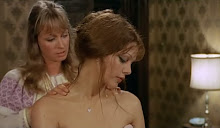
Diffring gets a break from the Nazi uniform here, playing Dr Franz, consort to the hifalutin Lady Mary MacCrieff (Christophe) who’s hellbent on retaining the ancestral castle despite the exorbitant upkeep, the isolated locale and the medical attention required by her eccentric (and possibly delusive) son James (Keller). James, a socially inept and attention seeking young man who inexplicably morphs into romantic hero halfway through, keeps a pet gorilla and paints nude portraits of his, ahem, French teacher Suzanne (Kunstmann). Suzanne has been engaged by Dr Franz to seduce James and get herself impregnated with an heir; when it becomes clear that James’s only interest in seeing Suzanne au naturel is the opportunity to complete another canvas, Franz enjoys himself with Suzanne instead.

The family’s evidently depleted spiritual needs are catered to by Father Robertson (Venantino Venantini), but Mary is more concerned about her financial needs and proceeds to hit up her sister Alicia (Ghia), recently loaded courtesy of an inheritance, for a loan. Alicia, who would rather Mary sell the castle, moved to London and have James properly looked after, outright refuses to sink any capital into old pile, creating a frosty atmosphere between the sisters.
Into this environment comes Alicia’s daughter Corringa (Birkin), a free spirit recently expelled from convent school. James takes a fancy to her (the avaricious Mary instantly equates a potential match as a fast-track to Alicia’s inheritance), as does the bi-sexual Suzanne. Murder, mistrust and sexual duplicity ensues, with the eponymous cat slinking around as portent to a series of swiftly executed killings (a rare example of a giallo not dwelling fetishistically on its death scenes).
For a while, you’d be forgiven for pegging the moggy as number one suspect (perhaps in league with the gorilla, the simian being better suited to the asphyxiation killing); the fat, waddling, lazy-eyed feline is on the scene for every murder and its alibi is non-existent. It even manages an escape from a sealed tomb after Mary has it interred with the deceased as punishment for disrupting a funeral. Which is a tad harsh.

The fate of – well, that would be telling, but let’s just say the second victim (and the first character to die onscreen) – keys into a local superstition and steers ‘Seven Deaths in the Cat’s Eye’ into the quasi-supernatural territory of ‘The Night Evelyn Came Out of the Grave’ or ‘The Red Queen Kills Seven Times’ (what is it about giallo titles and the number seven, by the way?) before the final act revelation confirms the machinations of considerably more earthly motives.
Margheriti takes a slow-burn approach, setting his characters against each other and keeping the tensions at a nice simmer for the first half before cutting loose with the first of the murders. Carlo Carlini’s widescreen cinematography provides some excellent and atmospheric compositions and Riz Ortolani’s score is magnificently overcooked. There are some good, disorientating moments, particularly Corringa’s arrival at the castle where an almost subliminal series of cuts to the watching gorilla left me bemused and slightly unsettled. Architecturally, the castle never convinces as Scottish, nor does the geography in the film’s few exteriors. Likewise, the dubbing is hysterically bad, the work of bored voiceover actors doing comedy Scottish accents. In this respect, ‘Seven Deaths in the Cat’s Eye’ hoves very very close to being more ‘Goon Show’ than Argento. Still, after the slow-burn first half, it whips itself into an eccentric and entertaining frenzy.