Bong Joon-ho’s Korean box office triumph ‘The Host’ is, in many ways, a god-damn frickin’ awesome monster movie. Not least because of its monster. That might sound like a disingenuous statement, but let’s be honest here: how many monster movies are crucially let down by their monster? How many monster movies function most effectively when the monster remains in the dark, only for the tension to dissipate the moment said beastie is revealed? ‘The Host’ teases us with shadowy glimpses of its monster for the first, oh, ten minutes – its form hinted at by dark shapes under water – then magnificently and unapologetically hoists it onto dry land in an extended and genuinely bowel-loosening sequence where it erupts from a river and lays waste to everything in sight. Up to this point, Joon-ho’s film demonstrates a mastery of economical storytelling, sketching out protagonists and familial tensions and almost immediately sending its scaly antagonist crashing in amongst them.
Ah, but beware the film that delivers up the best of itself with one hour fifty minutes still to unspool.
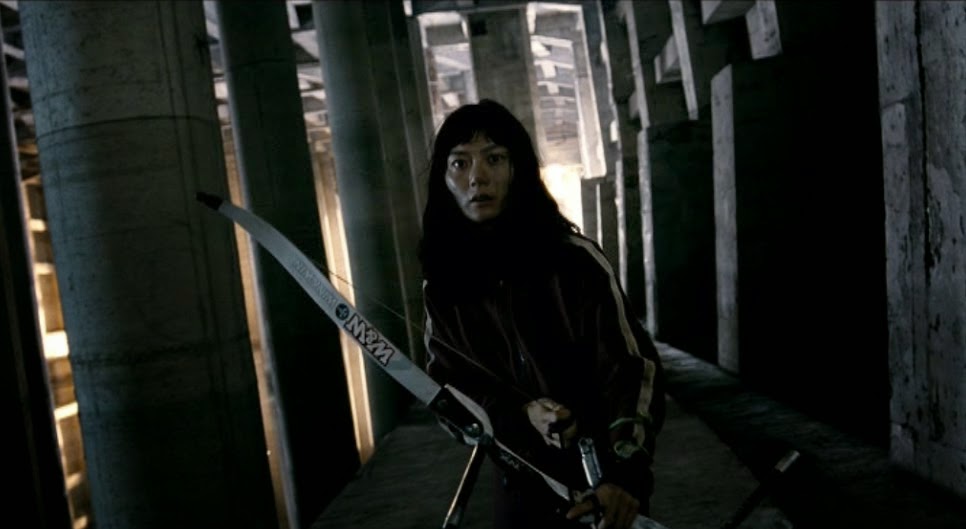
Here’s the basic premise: old-timer Hee-bong (Byun Hee-bong) runs a riverbank fast food stall, aided by his dimwitted and clumsy son Gang-du (Song Kang-ho) and Gang-du’s daughter Hyun-seo (Go Ah-Sung). Hee-bong’s other son is an unemployed college graduate, Nam-il (Park Hae-il). His daughter Nam-joo (Bae Doona) is an Olympic-standard archer who, as the film opens, defaults to bronze medal due to her habit of hesitating at the crucial moment. When the creature terrorizes the riverbank, only Gang-du is on hand to save Hyun-seo, but he trips at a crucial moment and, disorientated, grabs what he thinks is his daughter’s hand; by the time he realises he’s saved a complete stranger (albeit to her actual father’s gratitude), the creature has carried Hyun-seo off to its lair.

Gang-du has already been established as an imbecile, inveterately clumsy and a total failure. As the film progresses, virtually his every attempt to do something heroic (during the initial attack, he is one of only two people who attempt a fight back against the monster) not only backfires but sometimes costs an innocent life. The old saw about not being able to do right for doing wrong seems like a punchline the gods have written with Gang-du’s entire life being the set up.
‘The Host’, ladies and gentlemen, is comedy-horror. Horror of the most fetid and tactile variety. Comedy of cruellest hue. I’ve seen mean-spirited exploitation shockers that have put their characters through more charitable narratives than ‘The Host’. Seriously: ‘The House on the Edge of the Park’ is ‘Jackanory’ compared to this motherfucker.
You see, it’s not just Gang-du who is incompetent: Hee-bong is ripped off by a gang of tricksters who promise a means of rescuing his granddaughter; Nam-joo’s would-be iconic face-off against the monster is bluntly curtailed (same reason she got the bronze instead of the gold); Nam-il’s attempts to succeed where Gang-du has failed are thwarted at virtually every turn; Hee-bong’s moment of old-school heroism ends in abject failure; and even Hyun-seo’s make-do survivalism in the monster’s lair works its way to a subversive conclusion. I repeat: this is meant to be a comedy.
And not only is the comedy often sociopathically unfunny, it’s inconsistent. The failings and thwartings of Hee-bong’s brood suddenly morph into focused teamwork and slo-mo iconography which feel more like a sop to the audience-battering of the previous two hours than anything arrived at by narrative honesty. Moreover, a subplot which seems to be gearing up towards a shattering commentary on the tendency of political showboating to make things worse, not to mention the exacerbation resulting from American military intervention, is swiftly curtailed in favour of an effects-heavy finale.
It’s easy to overlook the faults of ‘The Host’ because its monster is so effective. Synthesizing the scaly hugeness of Godzilla, the double-mouthed razor-toothed gynaephobia of H.R. Giger’s ‘Alien’, and a weird, high-tensile, tail-like protuberance by which it can swing across the underside of bridges. Every time it appears onscreen, the effect is both hypnotic and slightly repellent. Whatever the film’s failings, ‘The Host’ can parade its monster as one of the greatest cinema has given us.
The failings, though, are in its human element. The satire chickens out, deflecting away from American interventionism and taking cheap shots at, for the most part, a mentally subnormal and patently scared individual. The narrative rewards hard-won heroism with cynical punchlines. The film spends two hours putting characters and audience alike through the wringer, continually promising them a specific denouement then pulling the rug; playing God with outcomes; and finally bowing out on an ending that it hasn’t earned and doesn’t deserve.