Showing posts with label Mimsy Farmer. Show all posts
Tuesday, October 18, 2016
13 FOR HALLOWEEN #6: Autopsy (a.k.a. Sunspots)
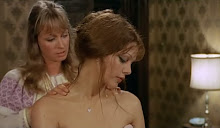
Armando Crispino’s ‘Autopsy’ is a film of two halves. In the first half, a wave of suicides sweeps Rome, somehow connected to solar activity. Overworked pathology intern Simona (Mimsy Farmer) labours on her thesis about staged suicides as a cover for homicide, icily rebuffs the advances of lecherous colleague Ivo (Ernesto Colli) and lecherous boyfriend-in-waiting Riccardo (Ray Lovelock), and is intrigued by her mysterious neighbour Betty Lenox (Gaby Wagner) who seems to be hiding a secret. Simona is also tormented by visions of the dead rising up from the morgue for a big ol’ undead orgy. When Betty turns up on a mortuary slab, Simona is thrown together with Betty’s brother Paul Lenox (Barry Primus), a former racing driver turned Catholic priest with the mother of all guilt complexes and some serious anger management issues.
To recap: aloof but sexy pathologist and nutjob priest team up to investigate suicides caused by the motherfucking sun! This is ‘Autopsy’ at its best, firing on all cylinders and gloriously demented. It lasts about twenty minutes.
The second half devolves into a generic mystery that manages to be both labyrinthine in its contrivances and utterly boilerplate in execution. Basically, Simona discovers – as if nobody could have guessed given the nature of her thesis – that Betty was murdered under the guise of her death being a suicide. This established, we hear no more of heatwave-related by-one’s-own-hand demises, nor is Simona troubled by any further visions of corpses doing the nasty. All of the good, lurid stuff that makes the first twenty minutes move and groove and tick all the right boxes is cursorily junked in favour of Nancy Drew Meets Father Dowling With A Restraining Order.
The mystery plays out in bloodless fashion as suspects ranging from Simona’s playboy father Gianni (Massimo Serato) to his current squeeze Danielle (Angela Goodwin) by way of the creepy caretaker (Leonardo Severino) in Simona’s apartment complex all take their turn to traipse in front of the camera, behave suspiciously for a while then bugger off again. Or get offed just to prove they were red herrings. There are a lot of red herrings in ‘Autopsy’ and rather than add to the suspense, they try the patience. Round about the hour mark, the whole thing had got so needlessly complex, without a single decent set-piece or stylish directorial flourish, that my interest waned. It didn’t help, either, that character interactions quickly devolve to the level of telenovella melodrama.
Ultimately, ‘Autopsy’ can’t decide what it wants to be. It starts off with a bizarro concept and a grab-bag of horror-specific imagery, then its tries to be a giallo but without any of the visual panache or narrative urgency that are the hallmarks of the best of that genre, before ending up as a mainstream-audience-friendly romantic thriller with a vertiginous finale that wants to ape Hitchcock. Oh, and just in case the audience start getting bored, it throws in a fair bit of nudity without ever trying to generate the frisson of eroticism.
Still, it’s got that splendid opening section and Farmer and Primus play off each well. In an alternative universe, though, there’s a cut of ‘Autopsy’ that makes good on these things, Simona and Father Lenox hurtling elliptically through the swelteringly surreal landscape of a Rome heat-seared into mania – a sort of ‘Footprints on the Moon’ but with the sun.
Labels:
Armando Crispino,
Barry Primus,
Gaby Wagner,
giallo,
Mimsy Farmer,
Ray Lovelock
Wednesday, September 22, 2010
Four Flies on Grey Velvet
Posted as part of Operation 101010
Category: gialli / In category: 9 of 10 / Overall: 76 of 100
The third of Dario Argento’s so called "animal trilogy", ‘Four Flies on Grey Velvet’ has virtually bugger all to do with its predecessors except for sharing a bit of wonky science with ‘Cat o’ Nine Tails’. Even calling it the "animal trilogy" is a misnomer: ‘The Bird with the Crystal Plumage’ and ‘Four Flies on Grey Velvet’ reference birds and insects respectively, while a line of Karl Malden’s dialogue pinpoints the title of ‘Cat o’ Nine Tails’ as "the old naval whip".
The divergence of ‘Four Flies on Grey Velvet’ from Argento’s first two films is important. In ‘The Bird with the Crystal Plumage’, Sam Dalmas (Tony Musante) is powerless to prevent a murder and haunted by the certainty that he saw something important, some clue, something he can’t quite put his finger on. In ‘Cat o’ Nine Tails’, Franco Arno (Karl Malden) overhears someone talking about blackmail – and possibly murder – but Franco is blind and, unable to identify them, relies on the assistance of reporter Carlo Giordani (James Franciscus).
Dalmas and Arno are bystanders who turn amateur sleuth when they find themselves in the wrong place at the wrong time and the police prove incompetent. Such tropes are staples of gialli. Roberto Tobias (Michael Brandon) in ‘Four Flies on Grey Velvet’, however, doesn’t conform to the archetype. As Maitland McDonagh puts in it ‘Broken Mirrors, Broken Minds’, "he’s a transitional protagonist who bridges the gap between the relative innocents – Dalmas, Arno, Giordani – and the relatively guilty – Marc Daly in ‘Deep Red’ and, most spectacularly, Peter Neal in ‘Tenebrae’."
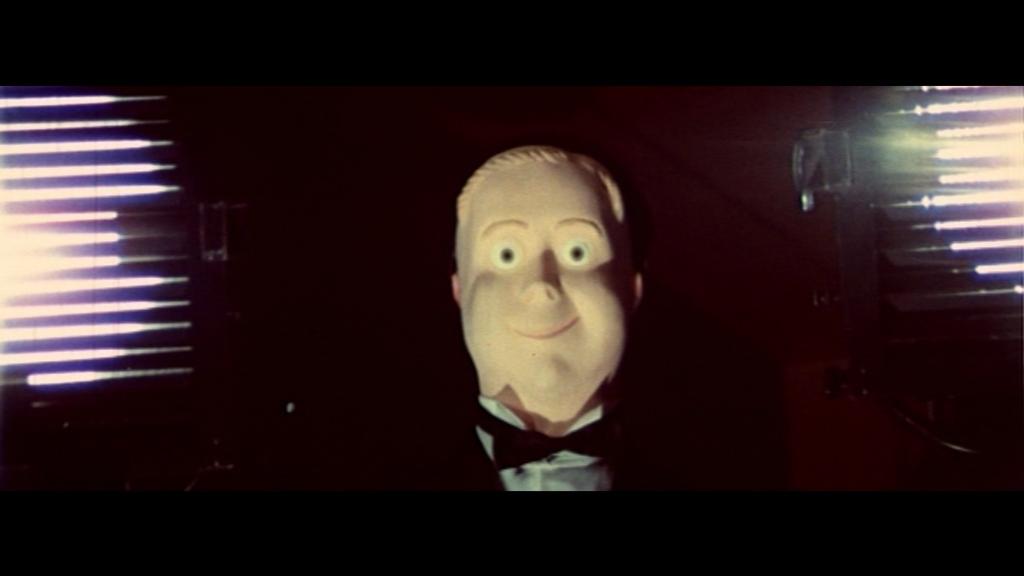
Also, ‘Four Flies on Grey Velvet’ is that rare example of a giallo where the police – incompetent or not – are entirely absent. Tobias has good reason not to turn to them. The drummer in a pretty average rock band, Tobias gets the feeling he’s being followed. In short order, he goes from paranoid to just plain annoyed. Turning the tables by following the follower, Tobias confronts the man in a deserted theatre. A knife is pulled. They struggle. The man plunges from the stage. As Tobias, confused and scared, stands holding the bloody knife, the beam of a stage light hits him and a masked figure in one of the balconies raises a camera and snaps a series of incriminating pictures.


Pictures which turn up in the mail. Pictures which are left at Tobias’s house after a party. It’s as if, he confides to his drop-out friend Godfrey (Bud Spencer), he’s being blackmailed. Yet there are no demands for money. When his tormentor breaks into the drummer’s house one night and gets the drop on him, Tobias intuits a darker motive: the masked man wants to kill him. Here ‘Four Flies on Grey Velvet’ makes another departure from the giallo rulebook: Tobias doesn’t play amateur sleuth in order to unravel the mystery; nor is he left to puzzle the meaning of an important but hitherto overlooked clue. The only thing Tobias fixates on is a recurring dream about someone getting beheaded.
Godfrey (God for short) recommends a private eye, the camp and generally incompetent Arrosio (Jean-Pierre Marielle), a man who has yet to solve a single case but is convinced that, by the law of averages, he’s bound to solve this one. It’s Arrosio who does all of the sleuthing in ‘Four Flies on Grey Velvet’, and he only enters the proceedings round about the halfway mark. So what does Tobias do during all of this? He sends his highly strung wife Nina (Mimsy Farmer) away, dallies with her foxy cousin Dalia (Francine Racette), ignores all suggestions that he leave town or tell the police everything and, finally, sits it out in his apartment, gun in hand, waiting for his nemesis to turn up.
All told, Tobias is a pretty shabby hero, and the people who surround him are no less so. His relationship with Nina is falling apart. He seems distant from his bandmates. His only real friends are vagrants. His housekeeper figures out early on who’s behind the mask but rather than take the information to Tobias or to the police enacts a blackmail scam which brutally backfires. Neither Tobias’s victim or his assailant are what they seem. Gender concepts are skewered. An element of troilism both sexual and psychological is at work.
‘Four Flies on Grey Velvet’ is one of Argento’s least seen works, thanks to its long-standing unavailability. I first saw it as a horrible, washed-out, panned-and-scanned pirate video. A few years ago I stumped up for a German DVD on import; the assemblage was a complete version, but taken from two sources which accounted for intermittent blips in quality. It’s dark and murky film even in a decent print, with arguably its creepiest sequence – the housekeeper waiting for the blackmail money in a gradually emptying public park as dusk draws on – played out as a symphony of shadows.
Many of the key scenes take place at night or in low-lit places – the confrontation in the theatre; Tobias menaced in his own home; Dalia hiding from an unseen intruder; Tobias’s stand-off with the killer; the abrupt and ironic coda on which the film closes – with only Tobias’s recurring dream of the beheading providing a hard glare of light.
Even the occasional touches of humour are cynical and nasty: Tobias surreptitiously meeting Godfrey at an undertakers’ convention; Arrosio, the butt of homophobic stereotyping from the outset, finally cracking a case when it’s too late to savour his victory; the Tobias’s dream/killer’s fate juxtaposition which ladles on the tombstone humour with a gravedigger’s shovel. McDonagh’s right – Tobias provides a link from the beleaguered heroes of the first two films to the compromised and complicit protagonists of Argento’s later work – but in its concept and structure (if not quite achieving the same bravura aestheric) ‘Four Flies on Grey Velvet’ is every bit as cynical and gut-wrenching as ‘Deep Red’ or ‘Tenebrae’.
Category: gialli / In category: 9 of 10 / Overall: 76 of 100
The divergence of ‘Four Flies on Grey Velvet’ from Argento’s first two films is important. In ‘The Bird with the Crystal Plumage’, Sam Dalmas (Tony Musante) is powerless to prevent a murder and haunted by the certainty that he saw something important, some clue, something he can’t quite put his finger on. In ‘Cat o’ Nine Tails’, Franco Arno (Karl Malden) overhears someone talking about blackmail – and possibly murder – but Franco is blind and, unable to identify them, relies on the assistance of reporter Carlo Giordani (James Franciscus).
Dalmas and Arno are bystanders who turn amateur sleuth when they find themselves in the wrong place at the wrong time and the police prove incompetent. Such tropes are staples of gialli. Roberto Tobias (Michael Brandon) in ‘Four Flies on Grey Velvet’, however, doesn’t conform to the archetype. As Maitland McDonagh puts in it ‘Broken Mirrors, Broken Minds’, "he’s a transitional protagonist who bridges the gap between the relative innocents – Dalmas, Arno, Giordani – and the relatively guilty – Marc Daly in ‘Deep Red’ and, most spectacularly, Peter Neal in ‘Tenebrae’."
Also, ‘Four Flies on Grey Velvet’ is that rare example of a giallo where the police – incompetent or not – are entirely absent. Tobias has good reason not to turn to them. The drummer in a pretty average rock band, Tobias gets the feeling he’s being followed. In short order, he goes from paranoid to just plain annoyed. Turning the tables by following the follower, Tobias confronts the man in a deserted theatre. A knife is pulled. They struggle. The man plunges from the stage. As Tobias, confused and scared, stands holding the bloody knife, the beam of a stage light hits him and a masked figure in one of the balconies raises a camera and snaps a series of incriminating pictures.
All told, Tobias is a pretty shabby hero, and the people who surround him are no less so. His relationship with Nina is falling apart. He seems distant from his bandmates. His only real friends are vagrants. His housekeeper figures out early on who’s behind the mask but rather than take the information to Tobias or to the police enacts a blackmail scam which brutally backfires. Neither Tobias’s victim or his assailant are what they seem. Gender concepts are skewered. An element of troilism both sexual and psychological is at work.
‘Four Flies on Grey Velvet’ is one of Argento’s least seen works, thanks to its long-standing unavailability. I first saw it as a horrible, washed-out, panned-and-scanned pirate video. A few years ago I stumped up for a German DVD on import; the assemblage was a complete version, but taken from two sources which accounted for intermittent blips in quality. It’s dark and murky film even in a decent print, with arguably its creepiest sequence – the housekeeper waiting for the blackmail money in a gradually emptying public park as dusk draws on – played out as a symphony of shadows.
Even the occasional touches of humour are cynical and nasty: Tobias surreptitiously meeting Godfrey at an undertakers’ convention; Arrosio, the butt of homophobic stereotyping from the outset, finally cracking a case when it’s too late to savour his victory; the Tobias’s dream/killer’s fate juxtaposition which ladles on the tombstone humour with a gravedigger’s shovel. McDonagh’s right – Tobias provides a link from the beleaguered heroes of the first two films to the compromised and complicit protagonists of Argento’s later work – but in its concept and structure (if not quite achieving the same bravura aestheric) ‘Four Flies on Grey Velvet’ is every bit as cynical and gut-wrenching as ‘Deep Red’ or ‘Tenebrae’.
Subscribe to:
Posts (Atom)