Showing posts with label Tomas Milian. Show all posts
Thursday, November 15, 2012
WINTER OF DISCONTENT: Almost Human
The aficionado of trash movies gets used to his or her viewing fare of choice going by various aliases (pop quiz: how many alternative titles for Mario Bava’s ‘Reazione a catena’ can you name?), or being lumbered with English language titles that have sweet f.a. to do with the indigenous original. Example: you can tell that Sergio Martino’s ‘I corpi presentato tracce di violenza carnale’ doesn’t literally translate as ‘Torso’ based purely on the difference of the amount of words in the title.
Which brings us to Umberto Lenzi’s ‘Milano odia: la polizia non puo sparare’. In English, and man is it one unwieldy motherfunster of a title: ‘Milan Hates: The Police Cannot Shoot’. A single line of dialogue in the very last scene offers context, but the title seems to have been settled on purely to suggest a connection to Sergio Martino’s ‘Milano trema: la polizia vuole giustizia’ (‘Milan Trembles: The Police Want Justice’) made the year before and itself a nod to Fernando di Leo’s ‘Milano calibro 9’. Because, hey, Italian exploitation cinema is nothing if not derivative.
It was released in the English speaking territories as ‘Almost Human’, a punchier title albeit one that’s utterly meaningless. If it’s supposed to refer to antagonist Guilio Sacchi (Tomas Milian), epic fail – the dude’s nowhere freakin’ near human. If it’s a nod to Commissioner Grandi (Henry Silva), the harried cop trying to prove Sacchi’s part in a kidnapping that has spiralled into a miasma of violence, then a better title might have been ‘All too Human’ since he’s strictured by rules, regulations, superiors and burden of proof.
Which makes ‘Almost Human’ sound like the Italian ‘Dirty Harry’, a prospect to set trash fans salivating when taken in conjunction with the presence of Henry Silva, he of the thousand yard stare that instantly communicates an inclination to challenge the mortality of the recipient of said stare. And there’s a slim case to be made for the comparison come the closing scenes. However, the focus remains on nervy, edgy, twitchy criminal Sacchi throughout. In other words: if this is ‘Dirty Harry al’ Italiana’, then it’s a fucked-up re-edit that gives Scorpio most of the screen time.
We first meet Sacchi in a tyre-squealing five minute opening sequence where he’s acting as getaway driver for a gang of bank-robbers. Approached by a cop threatening a ticket because he’s in contravention of a parking restriction, he panics. Net result: the bank job goes south, a child is kidnapped, the high speed pursuit ensues, they’re lucky to get away, and Sacchi takes a beating from his disaffected partners in crime. Later, ameliorating the humiliation with a skinful of liquor, he turns up on his on-off girlfriend Iona (Anita Strindberg)’s door demanding sex and money. He’s a regular charmer, our Sacchi.
Iona works for billionaire businessman Porrino (Guido Alberti) – that’s billionaire as in lira, by the way; dude’s probably worth about ten grand in dollars and the price of a second-hand car in pounds sterling – and when Sacchi learns that Porrino has a daughter, Marilu (Laura Belli), an only child, he hatches a kidnapping plot and ropes in loser friends Vittorio (Gino Santercole) and Carmine (Ray Lovelock).
From the outset, the script paints Sacchi as an asshole incarnate, a small man with a big ego and a loud mouth, and Milian positively embraces this characterisation. He takes risks when he doesn’t need to, kills when there are less psychotic options available, and creates dissent between Vittorio and Carmine. The kidnapping itself is a complete mess, Sacchi hopped up on amphetamines which he insists Carmine also takes; the snatch ends with Marilu’s boyfriend dead and the girl herself begging for sanctuary at the house of some well-to-do socialites, a situation that escalates into home invasion as Sacchi and his buddies pursue her.
This sequence is easily the film’s most exploitative moment, and seems to set things up for a juxtaposition of Sacchi’s scheme going tits up while Grandi’s dogged investigation brings him ever closer. Then Ernesto Gastaldi’s script hares off into Ripley territory as Sacchi races to establish an alibi, even if means allaying himself again with his erstwhile associates (another slapping around proves to be part of the deal). The ensuing cat and mouse shenanigans between Sacchi and Grandi detract from the human drama of the kidnapping on the one hand and the procedural elements of the investigation on the other. It gives ‘Almost Human’ a very different vibe and, particularly after its welter of car chases and casual violence, slows it down quite a bit.
There’s also a sense of the perfunctory, notably in the way supporting characters are tossed aside as soon as Lenzi and Gastaldi lose interest in them. The denouement, too, is somewhat by rote, although it does showcase Henry Silva in a magnificently badass image. Welcome to your month as an Agitation of the Mind banner icon, sir.
Sunday, February 06, 2011
GIALLO SUNDAY: The Designated Victim
It’s a hard life for Stefano Argenti (Tomas Milian). His company’s doing well and he’s got a nice little weekend in Venice lined up with his fashion model mistress Fabienne (Katia Christine). What a shame that his brittle wife Luisa (Marisa Bartoli) won’t let him sell the shares – worth millions – that are in her name. What a shame that he won’t be able to use said moolah to run off to Venezuela with Fabienne. Poor Stefano. What’s a cold-hearted selfish bastard to do?Well, he starts by heading off for that weekend break with Fabienne anyway, even though she seems to be enjoying it more than he is.

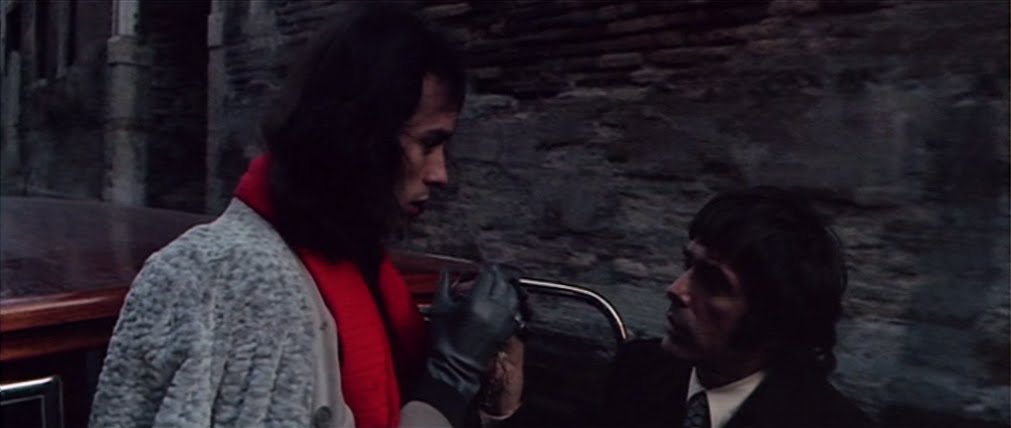
It’s here that they meet the enigmatic Count Matteo Tiepolo (Pierre Clementi). You can tell he’s enigmatic because he wears the kind of suits that wouldn’t look out of place on Dirk Bogarde’s von Aschenbach in ‘Death in Venice’ but twins them with long overcoats draped over his shoulders like a gangster and grey leather gloves. He also has a haircut that makes him look like a prototype for Russell Brand.

Here, though, the similarity ends since he neither launches into stand-up comedy routines or pursues pneumatic raven-haired pop singers; instead, he takes rather a shine to Stefano and they flit around each while the homo-erotic subtext heats up to a steady simmer. Then they get down to business. Umm, actually I could have phrased that better. Let me clarify: by “get down to business”, I don’t mean they leave Fabienne at the Rialto, go find a room and break out lube. By “get down to business”, I mean talk murder. Two murders, in fact. Matteo proposes that he murder Stefano’s wife and Stefano do away with Matteo’s brother.
You have? Only with a tennis pro and the reciprocal hit being on the other guy’s dear old ma, not his brother?
You’re dead right. We’re in unofficial remake territory, and Maurizio Lucidi’s ‘The Designated Victim’ is basically Hitchcock’s ‘Strangers on a Train’ relocated to Venice. Hitch’s film was a slightly less sexually ambiguous adaptation of a novel by Patricia Highsmith, whose best known work, ‘The Talented Mr Ripley’, was set in Venice. And indeed, the mid-section of Lucidi’s film, wherein Stefano tries to extricate himself from the suspicions of the tenacious Commissario Finzi (Luigi Caselleto) following Luisa’s death (as well as ensuring that nothing leads back to Matteo, who has the goods on him), recalls the increasingly labyrinthine construction of half-truths, outright lies and tenuous evasions the titular Ripley spends half of Highsmith’s novel telling.
I’d like to think that Lucidi was deliberately playing on the audience’s familiarity with Highsmith’s works and Hitchcock’s ‘Strangers on a Train’, hitting the expected narrative beats during the set-up and Matteo’s murder of Luisa, only for things to spiral off during the second half, slowly to begin with, then faster and faster as Matteo deftly manoeuvres Stefano into an untenable position while Finzi gets closer and closer to the truth. The ending, though, is the real rug-pull and I’m saying no more about it.
‘The Designated Victim’ is a more formal giallo than most – relatively bloodless and with little sleaze. Spiral staircases, rooftop shenanigans and lurid set-design are on hand, though, to offset the absence of J&B and incompetent cops. Finzi is up there with Stanley Baker’s Inspector Corvin in Lucio Fulci’s ‘A Lizard in a Woman’s Skin’ as one of the giallo’s few genuinely competent, pro-active and intelligent law enforcement types.

It boasts solid acting performances from all of the leads (even if Katia Christine isn’t given a whole lot to work with as the simpering Fabienne). Milian – no stranger to gialli with excellent turns in Fulci’s ‘Perversion Story’ and ‘Don’t Torture a Duckling’ – brings solid acting credentials, as does Clementi, best known for his brooding turn as Marcel in ‘Belle de Jour’. (Outside of their genre work, Milian and Clementi have between them worked with Visconti, Bunuel, Antonioni, Pasolini, Liliana Cavani, Spielberg, Soderbergh, Dennis Hopper and Oliver Stone.)
Luis Bacalov’s score is haunting and melancholy, his recycling of motifs by classical composers seeming appropriate in the Venice setting rather than derivative. Aldo Tonti’s cinematography delivers some striking images, even if it doesn’t achieve the whacked out brilliance or spatial dislocations of the best gialli.


What lets the film down, unfortunately, is how pedestrian Lucidi’s direction is. Watching ‘The Designated Victim’ is like listening to a technically proficient pianist tackle a Beethoven sonata: they’re playing the notes and not making any mistakes, but there’s no life, no passion and magnificent sense of risk in the performance.
Monday, October 19, 2009
Don't Torture a Duckling
Posted as part of the Hugo Stiglitz Makes Movies Italian horror movie blog-a-thon.
'Don't Torture a Duckling' opens with a striking shot of a multi-lane highway curving through hilly terrain, huge concrete stanchions rising from the valley floor. On a ridge overlooking the highway, Magiara (Florinda Balkan) - considered a witch by the good people of nearby township Accendura - scratches at the topsoil with gnarled hands, digging deeper, shifting lumps of dark earth. A child's skeleton is revealed. Modernity and ancient superstition; wide open vistas and hidden secrets. Lucio Fulci's classic 1972 giallo - arguably his most interesting work as a director - starts as it means to go on.

And the longer it goes on - Fulci plays much of the slender 102 minute running time slow burn - the darker it gets.

So far so exploitative (there is no further nudity in the film, though Bouchet's costumes emphasise how much of a tease her character is). But it's not just thrown in for the sake of it. Firstly, it mirrors the earlier scene (Michele and his cronies as voyeurs). Secondly, coupled with subsequent scenes where Patrizia interacts - sometimes provocatively, sometimes domineeringly - with local children, it marks her out as a suspect when the three boys, in very short order, turn up dead.


By dint of these depersonalisations, the town of Accendura emerges as the main character. And a pretty seedy character it is, cloaked hypocritically by its lip service to the Catholic church. Progressive priest Don Alberto (Marc Porel) reaches out to the Accendura's children, communicating via soccer instead of sermons, but the adults mumble their way through his services (and, in some of the most affecting scenes, funerals), bristling with barely concealed animosity towards Magiara and her sometime lover, hermit/mystic Francesco (Georges Wilson). The old ways - orthodox religion and witchcraft - infect the townspeople, bringing parochialism, mistrust and hatred of outsiders to the fore.
'Don't Torture a Duckling' opens with a striking shot of a multi-lane highway curving through hilly terrain, huge concrete stanchions rising from the valley floor. On a ridge overlooking the highway, Magiara (Florinda Balkan) - considered a witch by the good people of nearby township Accendura - scratches at the topsoil with gnarled hands, digging deeper, shifting lumps of dark earth. A child's skeleton is revealed. Modernity and ancient superstition; wide open vistas and hidden secrets. Lucio Fulci's classic 1972 giallo - arguably his most interesting work as a director - starts as it means to go on.

And the longer it goes on - Fulci plays much of the slender 102 minute running time slow burn - the darker it gets.
The next scene has three boys excitedly note the arrival, in a beat up old car, of two ladies of questionable virtue who promptly take a pair of rock ugly locals into a ramshackle lean-to for a bit of the old in-out in-out. Village idiot Giuseppe (Vito Passeri) attempts a spot of voyeurism but is informed by one of the less-than-happy hookers that if he wants to watch he has to pay. Evidently Giuseppe's a bit strapped for cash so he goes scuttling round the other side to see if he can get another glimpse. It's here that the three boys disturb him, mocking him for a peeping tom. Which is rather hypocritical given their motives.
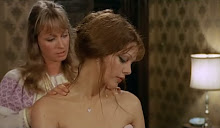
One of the boys, Michele, is next seen assisting his mother, maid to poor little rich girl Patrizia (Barbara Bouchet) who is drying out from a drug problem at her millionaire father's ostentacious house on the outskirts of town. All '60s architecture and trendily sterile decor, it's a marked comparison to the clustered dwellings, narrow streets and poverty-striken lives that make up Accendura. The way Patrizia lives her life is in similarly pronounced contrast. When Michele is sent by his mother to take a drink up to Patrizia, he finds her naked on a tanning bed. Rather than throw on a robe or shoo him out, she delightedly teases the boy before perfunctorily dismissing him.

So far so exploitative (there is no further nudity in the film, though Bouchet's costumes emphasise how much of a tease her character is). But it's not just thrown in for the sake of it. Firstly, it mirrors the earlier scene (Michele and his cronies as voyeurs). Secondly, coupled with subsequent scenes where Patrizia interacts - sometimes provocatively, sometimes domineeringly - with local children, it marks her out as a suspect when the three boys, in very short order, turn up dead.
It's only the presence of a more distrusted, more reviled suspect - witch/madwoman/social pariah Magiara - that presumably keeps the townsfolk's vigilante attentions from Patrizia.
Fulci does a number of intriguing things with what could otherwise have been a fairly formulaic procedural in which suspicion shifts from one character to another like a game of pass-the-parcel. To begin with, he keeps the film free of a protagonist for almost the first hour. Patrizia is introduced very early on but is swiftly backgrounded, cropping up to make the occasional dubious night-time drive or find herself blithely floating around very close to the scene of the latest atrocity. Inscrutable journalist Martinelli (Tomas Milian) cables a few reports from the scene, rubs up the Police Commissioner (Virgilo Gazzalo) the wrong way and similarly isn't given much to do till way after the halfway mark. The Commissioner himself - a typical giallo authority figure: big on voicing self-evident gouts of exposition but fuck all use at actually solving the crime - gets a fair bit of screen time, as do the interchangeable local police under his command, but he's definitely not the hero type. Or even the anti-hero type. 'Don't Torture a Duckling' - its title a compromise from 'Don't Torture Donald Duck' (for some strange reason, the Disney corporation took offence), after the distinctive child's toy that provides a big final-reel clue - isn't big on heroes.


By dint of these depersonalisations, the town of Accendura emerges as the main character. And a pretty seedy character it is, cloaked hypocritically by its lip service to the Catholic church. Progressive priest Don Alberto (Marc Porel) reaches out to the Accendura's children, communicating via soccer instead of sermons, but the adults mumble their way through his services (and, in some of the most affecting scenes, funerals), bristling with barely concealed animosity towards Magiara and her sometime lover, hermit/mystic Francesco (Georges Wilson). The old ways - orthodox religion and witchcraft - infect the townspeople, bringing parochialism, mistrust and hatred of outsiders to the fore.
It's not till the last third - possibly as late as the last quarter - that Fulci settles on Patrizia and Martinelli as the main characters. By this time, Magiara's confession of black magic has been rubbished by the authorities who, in an edgy scene where the understanding remains unspoken, turn her loose to the less-than-tender mercies of the mob. The officer who gives the evidence which puts her elsewhere at the time of the first murder, is rebuked by his superior ("a little truth goes a long way in this town") in a shockingly brazen display of buck-passing.
Keeping that opening shot of the highway in the background except for one crucial scene (no spoilers, but you'll wince at the ignorance of the motorists) - and with a helicopter buzzing over an area of woodland patrolled by search parties the only other intrusion of the contemporary - Fulci taps into the wilderness, the rugged unforgiving mountainscape and the inextricable bonds of superstition and insularity that cultivate the dark hearts of Accendura's denizens. Sergio d'Offizi's masterful widescreen cinematography fully exploits the uneven steps and narrow streets of the town, as well as the crumbling cemetery and vertiginous hill paths outside of it; Riz Ortolani's score segues from lilting to perky to downright fucking scary, a crashing motif at the most brutal moments reminiscent of Goblin's work for Argento; and Fulci tops his previous giallo outing, the disorientingly brilliant 'A Lizard in a Woman's Skin', keeping the tension at a steady simmer before ramping up the heat and steering the denouement into the finally revealed villain's heart of darkness.
Labels:
Barbara Bouchet,
Florinda Bolkan,
giallo,
Lucio Fulci,
Tomas Milian
Subscribe to:
Posts (Atom)