Showing posts with label video nasty. Show all posts

Monday, December 30, 2013

WINTER OF DISCONTENT: The Witch Who Came from the Sea


Greetings, friends. We find ourselves at the last of this year’s Winter of Discontent offerings. Real life got in the way this year and I didn’t cover as many films as I’d have liked. We tap out at 18 films this time round. I’ll try to do better in 2014 – honest! Still, let’s go out with a bang and dredge up a thorny little number from the video nasties list.

I’ve seen quite a few of the 72 titles on said list – 39 were successfully prosecuted for obscenity, the others were guilty by association – and many of them have led me to a sad but inescapable conclusion: membership of the video nasties club doesn’t necessarily make a film nasty. In fact, a lot of them – ‘The Mardi Gras Massacre’ and ‘Anthrophagus: The Beast’ spring immediately to mind – are downright boring.

Of course, there are bona fide works of visceral nastiness to be found – a big round of applause, if you please, for ‘Cannibal Holocaust’: your flight attendant will be able to provide you with sick buckets – as well as a couple of items that flirt around the edges of the art-house camp, and one – Andrzej Zulawski’s ‘Possession’ – that belongs in said camp entirely.


But we’re here tonight, dear readers, to consider a film that strives to do something provocative and intelligent with its material while leaving one foot planted firmly, obstinately and defiantly in exploitation territory. ‘The Witch Who Came from the Sea’ is a curious work, directed by Matt Cimber, a man whose filmography tells its own story (‘Africanus Sexualis’, ‘Lady Cocoa’, ‘Alias Big Cherry’ and the Pia Zadora vehicle ‘Butterfly’), starring former Oscar nominee Millie Perkins as a sexually disturbed multiple murderess and written by her husband Robert Thom.

Thom was the writer of such lurid fare as ‘The Legend of Lylah Clare’, ‘Angel, Angel, Down We Go’, ‘Bloody Mama’ and ‘Death Race 2000’. Subtlety, we can immediate infer, was not one of his hallmarks. Perkins, too, is something of an eccentric talent. She made her debut in 1959 in the title role of George Stevens’s ‘The Diary of Anne Frank’ and picked up her Oscar nom in the process. TV work and small roles in the likes of ‘Ensign Pulver’ and ‘The Shooting’ occupied her for a decade or so. In 1974, she made an impression in Monte Hellman’s ever-so-slightly controversial ‘Cockfighter’, then two years later torn demonically into the lead role of ‘The Witch Who Came from the Sea’.

Which is where we came in.


It’s easy to see why ‘The Witch Who Came from the Sea’ fell foul of the curtain-twitching guardians of the UK’s collective morality: a clearer correlation between sex and violence – in fact, an interweaving of sex and violence – you’d be hard pressed to imagine. And if the sight of a bare-ass naked Molly (Perkins) cutting loose with a straight razor on an equally bare-ass naked male victim isn’t enough, try juxtaposing that kind of imagery with flashbacks that leave you in no doubt that a pre-pubescent Molly was sexually abuse by her corpulent, gloating, wet-lipped father.

Did that last sentence induce a bit of uncomfortable squirming? To watch the film is to squirm uncomfortably for an hour and twenty-eight minutes. There’s something “off” about ‘The Witch Who Came from the Sea’ from the start: the opening scene has Molly chaperoning her pre-teen nephews Tod and Tripoli at beach; one sibling has the other buried to his neck in sand while Molly gazes out across the light-fragmented waves and drones on dreamily about their sea captain grandfather, lost somewhere out there on the ocean and a fine man beloved of all.

And even before we learn that said individual was a slovenly pederast beloved of absolutely no-one, there’s something here that seems wrong. There’s a washed-out disconnectedness to the cinematography (by John Carpenter’s go-to guy Dean Cundey; a weirdness to the sound design; a woozy disjointedness to the editing. Images appear in negative, saturated with artificial colour.


The performances are all pitched at a slightly non-naturalistic level, from Perkins’s vacillations between wide-eyed child-like naivety to raging she-devil, to Vanessa Brown’s mounting hysteria as Molly’s sister Cathy, to Lonny Chapman’s grizzled scenery-chewing as Long John, owner to the nautical themed bar where Molly works. All of these actors, and the characters they inhabit, exist within the same fictive space and interact as if they’ve known each other for years, but there’s something about the way they play off each other – or maybe the way they don’t – that doesn’t quite gel. And I can’t for the life of me figure out whether Cimber achieved this deliberately or whether it was a happy accident. Happy because the all-pervading sense of “off-ness” is what gives ‘The Witch Who Came from the Sea’ its curious power.

What is undoubtedly purposeful – Thom’s screenplay fixates on it to an unsubtle yet entirely effective degree – is the film’s commentary on contemporary lives lived according to and in the shadow of the false promises and images of television. Molly is obsessed with TV, and the dividing line between men she can have a functional sexual relationship with (Long John) and those she vents her fury on is whether they are real or products of television. Two big set pieces – one running almost ten minutes – put Molly in almost fantasy-based situations with people she has seen and effused over on the small screen and it becomes swiftly apparent that they are no more real to her for suddenly being corporeal.


Naturally, a flashback to the young Molly’s horribly ruined life with her father culminates in a scene where a TV set is destroyed. Molly’s adult life, then, has been spent arranging the past into a fiction and hammering it into the tightly compacted and easily turned-off emotive space the size of a portable black & white TV.

Many of the video nasties, for all their blood-gouting, innard-spilling brutality, key into the gothic terrors of yesteryear – the mythic figure of the sasquatch in ‘Night of the Demon’, ritual sacrifices to a pagan idol in ‘The Mardi Gras Massacre’, the so-called savages of ‘Cannibal Holocaust’, the folkloric idea of a vengeful killer back from the dead in any number of slashers – but the nature of the nastiness in ‘The Witch Who Came from the Sea’, and the tropes and visual metaphors by which Molly’s descent into madness is mapped out, are strikingly contemporary.

Thursday, November 08, 2012

WINTER OF DISCONTENT: Night Warning


Once upon a time (i.e. the late 1960s) Mom and Pop leave li’l Billy in the care of his aunt Cheryl (Susan Tyrrell) before heading off on a long car journey. The kid’s screaming his head off, and with what happens in the next 90 minutes it’s almost as if he knew what’s coming. As Mom and Pop drive off, Cheryl turns away, obscuring Billy from view and smiling a knowing smile. Director William Asher freeze-frames the moment. It’s the first indication that something isn’t quite right.

We rejoin Mom and Pop far enough into their car journey that they’re navigating a twisty mountain round. Mom’s looking at snapshots of li’l Billy and cooing over how cute he is. Pop’s opining that he’s missing the li’l guy already. Hands up everyone who’s already marked these mawkish sentimentalists out as our first victims. You’re absolutely right. Pop begins the mountain road descent, tamps the brakes and … whaddaya know? … they don’t work. He reacts in the time-honoured tradition of characters in movies who find their brakes non-functional: he drives faster and steers wildly.

Allow me to pause for a rant. The implication is obvious (and is confirmed later in the movie): Cheryl wants Billy all for herself. Therefore the brakes have been sabotaged. Therefore Cheryl must have cut through the brake lines before her sister and brother-in-law left. So, rant the first: are we honestly supposed to believe that Mom and Pop have travelled far enough to arrive at a fucking mountain pass without once having to use the brakes? No stop signs, no intersections, no requirement to slow down because of volume of traffic or someone pulling out in front of them? Suburban house to mountain pass without ever needing to brake?

Allow me to indulge in another rant. Why do characters in movies who discover they’ve got no brakes always respond by mashing the accelerator pedal to the floor and jerking the steering wheel side to side? Why not, y’know, pop the motherfucker in neutral and yank the handbrake? Sure, you’re going to knacker the sychromesh, you’re looking at an insurance write-off and you’re probably going to suffer a little whiplash into the bargain, but – hey! – the chances of survival are infinitely better.

However, back to Mom and Pop on their own personal highway to hell, and Pop decides to go with the drive faster/steer wildly option and damned if the family saloon doesn’t go into the back of a logging truck with ten foot of tree-trunk overhanging. Said lumber goes through the windscreen and pulverises Pop. Mom gets hers when what’s left of the saloon goes over a cliff and plunges into a river whereby it explodes. Cars generally explode if an impact triggers a detonation of the fuel tank. This particular car has already been submerged in water.

So, I’m five minutes into ‘Night Warning’ – also known as ‘Butcher, Baker, Nightmare Maker’, just plain ‘Nightmare Maker’ and ‘The Evil Protégé’, none of which have a lot of bearing on the film itself – and nearly 500 words’ worth of ranting is marching through my head. Then we flip forward 14 years and it’s the early 80s. Yup; we’re in a cinematic landscape of high school, tight tee-shirts and dodgy perms. And that’s the guys. Li’l Billy is now 17-year-old Billy (Jimmy McNichol) – he’s living with aunt Cheryl, pinning his hopes on a basketball scholarship and dating wholesome girl-next-door type Julie (Julia Duffy).


Cheryl isn’t too keen on any of this. “College is for rich kids and people with brains,” she tells him discouragingly: “you wouldn’t fit in there.” The real trouble starts on Billy’s birthday. Having refused to let Billy bring Julie home as his date for his birthday meal (“I’ll be your date,” she coos ickily), Cheryl packs him off to school and stays in to await the arrival of the TV repairman. If you think this scenario sounds like it belongs in a cheap porno, then wait till you get a load of Cheryl’s cringe-making seduction technique. The TV repairman declines her advances and gets a kitchen knife in his back by way of remonstration. Billy walks in on a scene of carnage.

Less than half an hour in the proceedings, and the potential narrative developments are manifold: we could have Billy coerced into corpse disposal and the movie play out in cat ‘n’ mouse as he tries to extricate himself from Cheryl’s control while her domineering behaviour threatens to become murderous once again; we could have Billy’s fragile emotions lead him down a dark path where he becomes the killer in order to safeguard his aunt from prosecution (a concept that would justify the ‘Evil Protégé’ alternative title). Both of these options would certainly play up to the heavily implied incest theme. Or we could go the “Billy is imprisoned by Cheryl while Julie, suspecting something is afoot, sets herself up for final girl duties when she decides to investigate” route. Or we could jump forward another 14 years (although this would have made ‘Night Warning’ essentially sci-fi) and explore the thirty-something Billy’s life as he struggles to keep the past in the past and that skeleton of aunt Cheryl walled up in the cellar.

Instead, Asher and his three scripters – Steve Breimer, Alan Jay Glueckman and the wonderfully named Boon Collins – have a couple of neighbours barge in (rant number three: why the fuck don’t movie characters who are faced with unexpected corpse disposal requirement lock their front doors first?), the police are called and Detective Joe Carlson (Bo Svenson) immediately smells a rat. With Cheryl having sustained no bruising and none of her clothes ripped, he doesn’t buy her rape attempt/self-defence story. And with the first witnesses at the scene putting the murder weapon in Billy’s hands, he begins to wonder what the real story is.


Ordinarily – for the slasher film is a great respecter of stereotypes – Carlson would be the tenacious cop who, for all his instincts, is always one step behind as the bodies pile up. Ordinarily. But not here. Carlson is out and out obnoxious, a detective who questions suspects by repeatedly yelling at them, calling them liars and asking impertinent questions about their sexuality. Pace the latter, he’s a homophobe of the highest order. And when he does some digging and discovers that the TV repairman was gay and in a relationship with Tom Landers (Steve Eastin) – Billy’s basketball coach – his bigotry breaks ground and creates havoc.
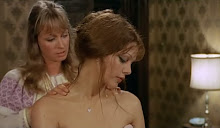
And it’s here, against all odds, that ‘Night Warning’ – otherwise a blandly-directed and often lazily scripted piece of work – manages to be interesting. With its obvious genre trappings and its ooooh-isn’t-this-controversial incest subtext, the film suddenly (if only temporarily) side-steps overt melodrama in the form of the clearly demented Cheryl and instead mines a squirmily unpleasant seam of social horror from Carlson’s attitudes and behaviour.

Initially given over lambasting Billy with questions like “It doesn’t make a whole lotta sense for a fag to be raping your aunt, does it?”, and later shown to pull a gun on a (notably Hispanic) suspect, the filmmakers seem to set Carlson on course to becoming the most loathsome (and potentially dangerous) character in the movie; a character whose venality stems not from insanity, dark secrets from the past or quasi-supernatural influences but a social prejudice that is still depressingly prevalent. Hints of misogyny and xenophobia shore-up Carlson’s gay-bashing mindset. And this guy carries a gun and badge!

Carlson’s crusade against Billy and Landers – misreading their relationship as two sides of a gay love triangle – occupies the middle third, with Cheryl’s machinations weaving in and out of the narrative in the background (her milk-and-cookies approach to scuppering Billy’s basketball scholarship attempt is as malicious as it is subtle), until everyone involved in the production suddenly seems to remember that Cheryl’s supposed to be the villain of the piece. At which point Tyrrell – always one of Hollywood’s more eccentric talents – ramps up her performance from wannabe milf …


… to outright loony …


… while the screenplay piles up the final act excesses like melodrama’s going out of style. Lurching from hidden corpse to dark familial secrets revealed to secondary character trapped in House of Psycho to final girl running through the woods shenanigans to despatched villain coming back one more time to nutcase cop getting the wrong idea to an end credits “what happened next” crawl that’s as ludicrous as it is abrupt, ‘Night Warning’ spirals off into increasingly contrived histrionics as if hellbent on holding back an actual conclusion ... as … long … as … possible.

It’s easy to see why it ended up on the DPP’s video nasties list in the UK in the 80s (albeit as a peripheral title rather than one of the 39 that were actually prosecuted under the Obscene Publications Act), but it’s so over-the-top that the only elements of the film liable to truly offend are the atrocious sound editing (particularly in the final act thunderstorm that seems to come and go depending on whether someone’s about to get offed) and the demented intensity of Tyrrell’s performance.

Friday, November 19, 2010

WINTER OF DISCONTENT : Cannibal Holocaust (part three: the clue’s in the title)

There is a long and sometimes confusing tradition in Italian exploitation movie distribution to random acts of retitling. Therefore, Mario Bava’s ‘Reazione a Catena’ (which roughly translates as “chain of events”) was variously marketed as ‘Blood Bath’, ‘A Bay of Blood’, ‘Ecology of a Crime’, ‘The Antecedent’, ‘Twitch of the Death Nerve’ and ‘Last House on the Left Part II’, this latter being foisted on it for no other discernible reason than to pull in some business on the back of Wes Craven’s grindhouse classic.

Such was not the case with ‘Cannibal Holocaust’. Which is a shame. It would be convenient to make a claim that the English language release resulted in its blatantly provocative title. But unfortunately ‘Cannibal Holocaust’ never started out as, say, ‘Quattro Americani in territorio pericoloso’, leading some dollar-bottom-line obsessed distributor to muse that ‘Four Americans in Dangerous Territory’ was a dead loss on marquees and posters so why not call it ‘Cannibal Holocaust’ instead.

The fact is, ‘Cannibal Holocaust’ was ‘Cannibal Holocaust’ from the beginning.

The title is a great snarling “fuck you” to the viewer’s sensibilities before a single frame of jungle has appeared on screen, let alone anyone tucking into a helping of longpig. Let’s break it down into its component parts.

Cannibal. Holocaust.

Cannibal as in person that eats human flesh … and let’s face it, alongside sleeping with your sister, getting all Catholic priest over a choirboy or listening to fucking Jedward and Vanilla fucking Ice piss all over the Queen classic ‘Under Pressure’, is there anything more taboo or socially transgressive than going supersize on a McPerson Burger with all the trimmings?

Holocaust as in … Yeah, this is where the controversy starts. Cambridge Online defines holocaust as “a very large amount of destruction, especially by fire or heat, or the killing of very large numbers of people”, but I defy anyone to read or hear the word without thinking of the Nazis and the Final Solution.

Now, this isn’t to say that a film with a blunt title can’t be subtle in its execution (for all I know ‘Sorority Pink’ might be a sensitive coming of age drama and not the Nina Hartley/Porsche Lynn hardcore shagfest that IMDb tells me it is). But, really, when you call your film ‘Cannibal Holocaust’, you’re not really leaving yourself any room to cry foul the moment controversy comes hurtling your way. Quite the opposite: you’re making a statement of intent.

So the question is: does ‘Cannibal Holocaust’ have any merit beyond its already inarguable reputation as one of the most controversial films of all time?

Well, since I’m 400 words into my third fucking article of the week about it, my vote is yes. ‘Cannibal Holocaust’ achieves exactly what Deodato set out to achieve: it blurs the line between supposedly savage and supposedly civilized behaviour; it blurs the line between media and viewer and finds complicity on both sides; and it does these things so persuasively that every frame, every incident, indeed the whole construct of the thing, is designed to have already answered the question Monroe asks in the closing scene. Who are the real savages?

We are.

But just because the film achieves its ends, doesn’t mean it isn’t flawed. ‘Cannibal Holocaust’ was always going to be a poisoned chalice. It’s the kind of film that can only prove its point by becoming a victim of its own argument. I said in the first part of this review that Deodato was hoist by his own petard in contractually obliging his cast to disappear from sight. The film likewise: in protesting the media and their role in the proliferation of (and by dint of over-exposure, the cheapening of) horrific images of man’s inhumanity to man, ‘Cannibal Holocaust’ needs must be ugly, repulsive, mean-spirited and provocative.

It succeeds. Too well. It succeeds to the point where its infamy has almost become its raison d’etre. Try finding a DVD copy that doesn’t trumpet how many countries it’s been banned in; how many years it’s been unavailable. It’s become a byword for exploitation. It’s the poster boy for the whole ridiculous video nasties phenomenon. (And isn’t it depressing that a term coined in the early 1980s by something as parochial as the British tabloid press is still part of the film reviewer’s cultural frame of reference?)

But here’s another area where ‘Cannibal Holocaust’ succeeds: it presupposes the “found footage” subgenre which burst unexpectedly into the mainstream with ‘The Blair Witch Project’ and was milked in contrived and shameless fashion in ‘Cloverfield’; which generated real scares in ‘[REC]’ and ‘Paranormal Activity’; and remains the visual and narrative aesthetic du jour for a new generation of low-budget filmmakers.

‘Cannibal Holocaust’ gets under people’s skin for all the wrong reasons. Maybe there will be a time when it gets under their skin for the same reason ‘Blair Witch’ and ‘Paranormal Activity’ did. Or maybe its reputation just casts too big a shadow.

I’m not sure whether Werner Herzog would thank me for name-checking him in a review of ‘Cannibal Holocaust’, but the Bavarian maverick/genius once said “The images that surround us today are worn out … The biggest danger, in my opinion is television because to a certain degree it ruins our vision and makes us very sad and lonesome. Our grandchildren will blame us for not having tossed hand-grenades into TV stations because of commercials. Television kills our imagination and what we end up with are worn-out images because of the inability of too many people to seek out fresh ones.” This sentiment is one of the reasons I revere Herzog. With very few exceptions (‘The Prisoner’ – the original version, not the execrable remake – ‘The Sweeney’, ‘Family Guy’, a handful of other shows) , I fucking hate TV. And I hate with a vengeance the banal, intellectually retarded, aesthetically stillborn culture of reality TV. ‘Big Brother’, ‘The X Factor’, ‘My Super Stuck-Up Sixteen’, ‘I’m a Non-Entity, Get Me Some Publicity’ – vacuous crap, the lot of it.

Take the Agitation test: watch half an hour of advert-riddled, celebrity-smeared TV then stick ‘Cannibal Holocaust’ on and feel it hit you. (As Francisco at The Film Connoisseur put it in a comment on yesterday’s article, “it’s a film that causes a reaction … if the film doesn’t move you, you’re a freaking rock.”) ‘Cannibal Holocaust’ is a hand-grenade from a time before political correctness, infomercials or internet sex tapes. Yes, it’s fucking nasty, but we’re spoon-fed way too much pabulum that’s filtered down through committees to be guaranteed safe and inoffensive; in a world that’s increasingly corporatized and homogenized, I’d like to think that ‘Cannibal Holocaust’ is ready to pounce, rabid and snarling, on a whole new audience. It’s one hell of a wake-up call.

Thursday, November 18, 2010

WINTER OF DISCONTENT : Cannibal Holocaust (part two: how not to make friends and influence people)

Is there anybody who doesn’t know the basic storyline of ‘Cannibal Holocaust’? I saw it for the first time last week, and yet at any point prior to that I could have given you an accurate synopsis and a fairly inclusive list of the nasty shit that happens.

‘Cannibal Holocaust’ is one of those films you’ve read a thousand articles about in magazines and online, seen grainy clips of, or had the gory details gleefully recounted to you by a friend or colleague who saw it on home video back the 80s just before it got banned. It’s a film you’re weirdly familiar with even if you’ve never seen it. In fact, I’d take a guess that it’s this sense of there being nothing to discover about the film – coupled with its reputation as A-Number 1 gross-out material – that keeps a lot of people from watching it.

In other words, please feel free to skip the next few paragraphs if you think I’m covering old ground.

‘Cannibal Holocaust’ starts with a news report about a team of documentary filmmakers who have gone missing in the Amazonian rainforest. The reporter interviews anthropologist Harold Monroe (Robert Kerman), who is about to join a search party.

In the Amazon, native guides Chaco (Salvatore Basile) and Miguel lead Monroe to a village occupied by the Yacumo tribe. Overcoming initial hostility, they learn that the film crew had passed through en route to an area of jungle notorious as something of a no-man’s-land between the warring Yanomamo and Shamatari tribes, both cannibals*. Following the trail, Chaco and Miguel intercede in a Shamatari attack, resulting in an invitation to the Yanomamo village. Here, Monroe finds a totem made of the missing documentary team’s bones and their (unopened) cans of film. Monroe trades a tape recorder for the film cans and flies back to America.

The TV production company who backed the documentary project are keen to exploit the story and a live interview with Monroe is followed by the announcement that an exclusive documentary will be aired in a week’s time incorporating the recovered footage. Pressured to present the documentary, Monroe insists on working with a team of editors to review the film. One of the editors fills Monroe in on the documentary crew’s modus operandi.

If Monroe is the hero of the film for the first half, let’s meet our villains; we’ll be spending the second half of ‘Cannibal Holocaust’ with them and it ain’t gonna be pretty. We’ve got director Alan Yates (Carl Gabriel Yorke), script consultant (and Alan’s girlfriend) Faye Daniels (Francesca Ciardi) and two cameramen: Jack Anders (Perry Pirkanen) and Mark Tomaso (Luca Barbareschi).

Monroe is warned that Yates was committed to a visceral aesthetic and wasn’t above staging violent incidents to give his documentaries more impact. Monroe interviews colleagues, friends and family of Yates and co. and starts to put together a very dubious picture of them. His suspicions are confirmed when he begins to view the footage. The death of Yates’s guide by snakebite is gloatingly filmed. Every bit of narration that Yates delivers is blatantly insincere. When he encounters the eviscerated remains of a victim of cannibalism, Anders has to remind him to stop smiling because he’s on camera; Yates puts on a serious face and delivers a deeply hypocritical screed about how shocked he is.

Soon enough, the infamous Alan Yates staged footage technique is revealed. Arriving at the Yacumo settlement, Yates, Anders and Tomaso round up a group of tribespeople at gunpoint, herd them into a bamboo hut and set fire to it. Yates’s idea is to pass off the scene as a massacre by the Yanomamo. Monroe and the editing team, already perturbed at what they’ve seen, are sickened by this revelation. Worse is to come: Yates, Anders and Tomaso gang-rape a Yanomamo girl. In one of the film’s most damning moments, Faye’s sole protestation is that they’re wasting film – they’ll never be able to use it in the documentary!

Monroe calls the TV execs in to view the footage. They watch the last reel – depicting the Yanomamos’ violent revenge on Yates, Anders and Tomaso and rape of Faye – after which the head honcho rises shakily from his seat and instructs the technician in the screening room to ensure that the film is burned. As Monroe leaves the studio, he ruminates on who the real savages are.

Reading back over that 550 word plot synopsis, I’ve probably sold ‘Cannibal Holocaust’ short in terms of how graphically unpleasant it is. The flesh-eating scenes (which account for surprisingly little screen time) are nowhere near the worst of it. The animal deaths, discussed in yesterday’s post, are much worse. But even then, they’re mostly over with pretty quickly. The snake and the spider are despatched with a couple of machete blows. The monkey’s skull is chopped clean open. The pig is killed with one gunshot. Most of it’s in medium or long shot. The turtle is the only poor bastard creature whose demise is lingered on, and even then it’s not the death that’s protracted but the gutting, cooking and eating of it. Visually, this is probably the worst the film has to offer. This scene is one of the few things in cinema I’ve had to turn my eyes away from (other examples being the coprophilia in ‘Salo, or the 120 Days of Sodom’ and a certain scene which I really don’t want to describe in ‘A Serbian Film’).

Emotionally, the worst of the film is the sexual violence. I’ve cited two instances of gang-rape (neither, it has to be said, glamorized, glorified or eroticized in any way; there’s no doubt that Deodato fully intended to portray the act as ugly and brutal), but there’s another instance, early in the film, where Monroe’s guides caution him to keep quiet and not intervene when they come across a Yacumo tribesman ritually punishing his wife for adultery. The ritual involves a crudely fashioned dildo wielded like a weapon.

I get it: Deodato is showing us the cultural differences by which white men label indigenous tribespeople “savages” before flipping the point of comparison on its head and demonstrating the savagery inherent in the supposedly civilized man. This is why the first half of the film plays out from Monroe’s POV and the second from Yates’s (with plentiful cuts back to Monroe in the editing suite who winces and grimaces and expresses disapprobation on out behalf). I get it. I’d have got it just as effectively, just as powerfully, without three dispiritingly protracted instances of women dragged screaming through the mud and brutalized.

The depiction of rape sums up the film itself. It’s meant to shock, it’s meant to be unpleasant, and it’s meant to inspire feelings of revulsion in the viewer. Deodato’s intention was to address the proliferation of violent images in the media and question the media’s culpability in the dissemination of these images. In his own words:

“There were a lot of terrorist problems in Italy at that time with the Red Brigade – you saw it on TV on the news, along with wars from around the world. Even my son was upset at some of the things on the news. And it inspired me to do a film in the style of journalists at the time. So I did a film about journalists who go to find out what’s going on in the world and then disappear.” (Quoted in a Total Sci-Fi Online interview.)

Which is fair enough, but Deodato wants to have his human remains and eat it. In criticizing the media for their “if it bleeds, it leads” mentality, he plays right into the hands of media moralists who seek to blame violent movies for society’s ills. There’s a fine line between slapping viewers in the face with horrific imagery for the purpose of shocking them out of complacency, and rubbing their noses in it lingering on violent act, one visceral image, after another.

Moreover, Deodato loses any middle ground in which the audience might question where reportage leaves off and moral considerations come into play by doing everything possible to demonize Yates and his team. Yes, I know that Yates’s villainy is kind of the point – his “civilized” savagery shown in counterpoint to the cultural and ritualized “savagery” of the natives – but Deodato doesn’t allow the audience to make up their own minds. Yates and his mates are so outright loathsome that their eventual slaughter by the Yanomamo isn’t so much cathartic as a fucking relief. Simply put, you’re just glad you don’t have to spend any more time in the company of these assholes.

‘Cannibal Holocaust’ is gripping, bloody, often quite artfully made and its impact and notoriety are undeniable. But is it a good film or not? Has its still discernible influence rendered it more important in retrospect? Is there any merit to it? I’ll be trying to marshal my thoughts into some concluding paragraphs tomorrow.


*In actuality, they practise a highly ritualized form of endocannibalism (go here for an in-depth if pretentiously written article on the subject) but are not cannibals in the way Deodato portrays.

Wednesday, November 17, 2010

WINTER OF DISCONTENT : Cannibal Holocaust (part one: animals were harmed during the making of this picture)

Apologies for the lack of screenshots. I neglected to take any while I was watching the film and I don’t feel like reacquainting myself with it just yet.

It’s one thing to announce in a fanfare of self-publicity that you’re devoting six weeks on your blog to all things exploitative. Yeah, you’ve got stockpile of gialli to go at. Sure, you can use ‘Shortbus’ as a jumping off point to consider the, ahem, insertion of unsimulated sexual activity into an otherwise non-porno flick. It’s as easy as pie to take the piss out of something as bog-awful as ‘Fight for Your Life’. You can pride yourself on watching ‘Thriller – A Cruel Picture’ without needing to break halfway through for a trip to the nearest decontamination plant.

You can line up a slew of scurrilous titles – look out for ‘Rope and Skin’, ‘The Candy Snatchers’ (thanks, Bryce!), ‘The House on Straw Hill’ and ‘Gator Bait’ next week – and happily wallow in a mudpool of cinematic filth.

But it don’t mean a thing if it ain’t got that swing them cannibals.

And if you’re going to kit yourself out with a sick bag and some anti-malarial pills and head into the green inferno, then you may as well accept the inevitable and square up to the most infamous cannibal movie – if not the most infamous movie – of all time: Ruggero Deodato’s ‘Cannibal Holocaust’.

This movie didn’t just upset the BBFC and the DPP. It upset fucking everyone. When Deodato’s friend and fellow director Sergio Leone wrote “what a movie … the second part is a masterpiece of cinematographic realism, but everything seems so real that I think you will get in trouble with all the world”, he had no idea how prescient this remark was.

Less than a fortnight after ‘Cannibal Holocaust’ premiered in Milan in 1980, prints were seized by the authorities and Deodato arrested. The charge? That he’d killed the four actors playing the missing documentarians as well as an indigenous actress who is shown impaled on a pole in one of the film’s most notorious images. In a hoist-by-one’s-own-petard twist, Deodato had insisted that his cast sign clauses denying them appearances in any media for a year following the film’s release; an obvious publicity stunt to play up the missing people/found footage aspect. Deodato produced the very much alive actors before the court and successfully demonstrated how the special effects had been achieved. The murder charges were dropped, but he was still convicted of obscenity and received a four-month suspended sentence. The court also banned the film, a decision it took Deodato three years to get overturned.

The obscenity prosecution owed to the unstaged animal deaths. Which is where this review gets thorny. The animal deaths in ‘Cannibal Holocaust’ are kind of like the hardcore inserts in ‘Thriller – A Cruel Picture’. Whatever level you discuss these two films on, whichever angle you come at them from, there’s no getting away from it. No avoiding it. ‘Cannibal Holocaust’ contains real animal deaths and ‘Thriller – A Cruel Picture’ contains hardcore pornographic footage. It’s up to the viewer to determine their own moral and critical standpoint.

It’s the easiest thing in the world to say “harrumph, animals were killed in front of the camera, disgusting behaviour, I wash my hands of this film”. An easy response, a justified response, and a completely self-defeating response. Unless you’re a vegetarian, every time you sit down to a meal you are complicit in the death of an animal. (I’m not a vegetarian by the way: I subscribe to Dennis Leary’s observation that “eggplant tastes like eggplant but meat tastes like murder and murder tastes pretty fucking good”.) So how come I can happily tuck into a chicken casserole, a rump steak, a pan-fried salmon or a rack of ribs but feel physically sick when I see a turtle being killed, gutted, cooked and eaten on camera in ‘Cannibal Holocaust’? Is it because I don’t see how the chicken meets its end? In fact, the turtle that ran afoul of Deodato and his crew probably had a better life – free and in the wilds right up till that final moment – than the chicken that was doubtlessly bred, lived and died in the miserable conditions of a battery farm, a chicken that existed solely to become the main ingredient in my casserole.

Then there’s the fact that ‘Cannibal Holocaust’ was a cheaply made Italian exploitation film released in 1980 – ie. not the kind of production monitored by the American Humane Association. This isn’t a justification, it’s a statement of fact. Pick any cannibal movie by an Italian director from the 70s or 80s and unsimulated animal deaths are virtually guaranteed. You can throw the argument wider: check out any number of Hollywood productions (particularly westerns) pre-mandatory AHA supervision. I wouldn’t change a frame of either of them, and certainly never call for them to be banned, but the chickens at the start of Peckinpah’s ‘Pat Garrett and Billy the Kid’ and the lizard whose slo-mo demise opens ‘The Ballad of Cable Hogue’ – they got the same deal as Deodato’s turtle.

Now consider the BBFC’s decision to pass ‘Cannibal Holocaust’ with an 18-certificate following almost six minutes’ worth of cuts. Including the turtle evisceration sequence in its entirety, as well as the deaths of a snake, a spider, a monkey and pig. Does the film become a less thorny, more easily watchable work in this version? The answer has to be no: the turtle, the pig, the snake, the spider and not one but two monkeys still died (the superannuation of monkey murder was so that Deodato could get a reverse shot); cutting these scenes and pretending that the film is now significantly less contentious is at best an exercise in denial. As is a question I’ve seen posted on a forum: “How can I see ‘Cannibal Holocaust’ without the animal deaths?” Talk about a machine-washable morality! If the only way someone can rationalize approaching ‘Cannibal Holocaust’ is without these scenes, particularly if the issue of animal deaths is completely abhorrent to them, then surely they should be boycotting the film in any version as a matter of principle.

There’s a time and a place for debating the artistic, aesthetic or intellectual merit (or otherwise) of ‘Cannibal Holocaust’, and I’ll dip a toe into those waters in the final part of this review, but it should be mentioned that all-too-often the requirement is placed on the individual to separate the artist from the art. Many of the great directors have been control freaks and bullies. Most of the great conductors: tyrants. Most of the great writers: depressives and alcoholics. Most of the great musicians: junkies. Do we stop watching ‘A Clockwork Orange’ because of what Kubrick put Malcolm McDowell through? Do we consign ‘Der Ring des Nibelungen’ to the scrapheap because Wagner was an anti-semite? Do we refuse to listen to a world-class recording of it because the conductor was once a member of the National Socialist Party?

Ultimately, it’s a matter of personal aesthetics. I approached ‘Cannibal Holocaust’ for two reasons: (i) to make up my own mind; and (ii) a sense of half-prurient half-academic curiosity. Could this movie really be as shocking, brutal and controversial as its reputation would have it?

Join me tomorrow and we’ll take a murky trek through that green inferno.