Monday, October 22, 2012

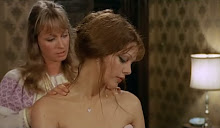
13 FOR HALLOWEEN #9: Thirst


Kate Davis (Chantal Contouri) awakes in a coffin and starts screaming her head off. Further investigation determines she’s in a gloomy cellar. It’s all very gothic. She ascends some rickety wooden steps, but the door at the head of them is locked. In voiceover, someone warns that this type of “conditioning” could damage her sanity. Someone else responds that she’s already very different to the “subject” they were observing a week ago.

Flashback said week: Kate is living a normal if rather privileged life as a successful businesswoman in an affluent Australian suburb. She’s dating Derek (Rod Mullinar), who’s an architect the same way that Richard Gere in ‘Intersection’ is an architect. One day she discovers a milk carton in her fridge that contains blood, not milk. Next thing, she’s drugged and kidnapped. She wakes up at a remote establishment known as “The Farm”, run by a mysterious organisation known as “The Brotherhood”. The Farm is filled with docile types who, it turns out, have been chosen for their healthy constitution and are being “milked” (i.e. exsanguinated).
 

The Brotherhood’s hierarchy – Mrs Barker (Shirley Cameron) and Dr Fraser (David Hemmings) – are at loggerheads and a power struggle is clearly in process. Kate is essentially kept prisoner, and yet held in fearful regard by the “donors”. It transpires that she’s descended from Elizabeth Bathory and as such has been chosen to merge her bloodline with that of the aristocratic Mr Hodge (Max Phipps) and therefore create something of a vampire super-race. Kate isn’t entirely enamoured of this scenario, resists Dr Fraser’s programme of conditioning and tries to fight back against the matronly Mrs Barker. Consequently Mrs Barker eschews Dr Fraser’s softly-softly approach and subjects Kate to harsher treatment. Drugged, Kate wakes up screaming in a coffin and, hey everybody, this is where we came in.

Right, then: any guesses as to how much of the film the business above accounts for. Three quarters of an hour? An hour? Longer?

Seventeen minutes.


‘Thirst’ – directed by Rod Hardy, most of whose work is for the small screen – almost trips over itself rushing to play its hand. Plenty of filmmakers would have kept the Bathory reveal under wraps for at lease half of the running time; likewise the revelation of what happens to the so-called donors in the generically monikered “processing plant”. Hardy, working from a screenplay by John Pinkney, seems to want all the cards on the table – narrative, exposition and imagery – so he can get stuck into the centrepiece, a bizarro 20-minute let’s-fuck-with-the-heroine’s-mind sequence that comes on like the brainwashing scene from ‘The Parallax View’ crossed with one of the more psychedelic episodes of ‘The Prisoner’ (in fact, The Farm resembles The Village in some respects).

During the course of these 20 minutes, we have dream sequences that bleed into each other, the manipulation of Kate’s memories, and a finale involving a room tilting and tearing itself apart as if Merrin and Pazuzu were duking it out over the soul of some pre-pubescent girl. Cracks open in walls, doors are battered to within an inch of their frames, books fly off shelves, chandeliers plunge from the ceiling, heavy furniture goes skidding across the floor, a candlestick turns into a glowing chunk of hot metal, plaster dust covers everything and at the end of it, Kate huddled in a corner terrified, a tankard of warm fresh somehow appears next to her.


There are two things that would normally bother me in all of this. The suggestion, since Hardy cuts to Mrs Barker studying video footage of Kate’s psychological disintegration, is that The Brotherhood have created a false room and rigged it with a variety of devices to simulate a supernatural assault; such a room would need to be contained in a larger space and supported by hydraulic arms to in order create the illusion of the room tilting and also to facilitate the damage to the walls etc. Yet (a) a fucking tankard of blood appears from nowhere without a drop being spilled; and (b) the final shot of the sequence has a collapsed curtain reveal a view of the grounds from a bay window, confirming that the room is an integral part of the building’s architecture.

So why don’t these two mise-en-scene cheats bother me? Because, by this point, ‘Thirst’ had jettisoned all pretensions to form, structure, logic and coherence. The film, simply, becomes a fever dream in the way of ‘Suspiria’, only with a blood farm instead of a ballet school, and does so very early on in the proceedings. Weirdness permeates. The film trades in almost amusingly incongruous images: a smiling hostess leads some visiting blood-drinkers through a tour of the processing plant – one of them raises a camera and clicks a snapshot like a tourist in the Vatican; members of The Brotherhood greet each other with their pinkie fingers upraised for all the world like a bunch of tea-sipping Noel Coward characters; a technician walks through a lab with a crate of blood-filled bottles, like a milkman with an extra order for Vlad the Impaler’s house. 

There’s a punch-drunk atmosphere to ‘Thirst’ which works beautifully in its favour, leeching away the otherwise distracting deficiencies of Contouri’s performance (standard MO: eyes roll, head wobbles, lower lip quivers) and the script’s leaden dialogue. Thus what could have been a tedious movie, endlessly circling in a slow waltz with its one single idea, emerges as a cult oddity that bleeds into your subconscious and is guaranteed to make you think twice before you reach for a carton of milk.

Saturday, October 20, 2012

BOND-A-THON: Quantum of Solace


‘Casino Royale’ maintained fidelity to its source novel in many ways, not least in presenting Bond’s card table duel with underworld accountant Le Chiffre as his first mission following his promotion to Double-O status. I wonder if, for even the briefest moment, the producers considered reapproaching the other novels, this time in sequence, and reconfiguring them for a contemporary audience. Just as ‘Casino Royale’ replicated the mechanics and setting of Fleming’s novel but with a framing narrative centered around terrorism and high-level financial chicanery, did anyone consider the possibility of ‘Live and Let Die’ with Mr Big revealed as the man behind Le Chiffre (there isn’t a single Bond novel where “SMERSH” can’t easily be recast as “shadowy terrorist organization”) and Solitaire’s gift of prognostication an enigmatic and possibly genuine preternatural talent rather than the silly plot device of the Roger Moore film; or ‘Moonraker’ as a properly earth-bound adaptation but focusing on drones and stealth technology rather than Drax’s phallocentric rocket; ‘Diamonds Are Forever’ without the oil rig and concentrating on the greed/death/emptiness of riches subtext of the novel and with Tiffany Case as a proper romantic heroine despite her personal agenda – a sort of Vesper Lynd but without the coercion; or ‘From Russia With Love’ brought up to date with the Russian Mafia and prostitution rings; ‘Dr No’ as an acidly satirical comment on environmentalism (something the film under consideration today tries to achieve) with the guano mine retained but its claw-handed villain striving for a source of clean energy only with a dirty use in mind; or ‘Goldfinger’ played out against the worsening global financial crisis; ‘Thunderball’ updated in any way you see fit – as long as there are weapons of mass destruction, the basic plot remains timely; ‘The Spy Who Loved Me’ with the events of the last half of the novel compressed into a punchily effective pre- and immediately post-credits bit of action, the hoods at the motel setting Bond on the trail of a more high-ranking villain; a less lachrymose adaptation of ‘On Her Majesty’s Secret Service’ with subliminal messaging as a tool of media control instead of the daft hypnosis/sabotaged crops malarkey of both the novel and the Lazenby film; and perhaps collapsing ‘You Only Live Twice’ (retaining Dr Shatterhand’s grotesque and disturbing garden of death) and ‘The Man with the Golden Gun’ (retaining the brainwashing, M’s dichotomy and the redemptive suicide mission) into a single taut, angry and challenging narrative?

I’m guessing nobody did, but fuck me it would have been one hell of a direction to go with the newly revivified franchise!


This is what the producers did instead: in mid-2006, with ‘Casino Royale’ in post-production, the powers that be an EON Productions decided the follow-up would be a linear sequel, thus building on the Bond-Vesper relationship and channeling the theme of betrayal into a hard-as-nails revenge thriller. The story was based on an original idea by producer Michael G. Wilson and shifted the focus of the villain/nemesis from terrorist funds (the plot dynamic of 'Casino Royale') to environmentalism and water supplies. Roger Michell was approached to direct but with no script available refused to commit. ‘Casino Royale’ scripters Neal Purvis and Robert Wade (Paul Haggis did some work on the denouement) were re-engaged to work up Wilson's concept. With ‘Casino Royale’ proving a commercial and critical success, the heat was on to get its still-untitled successor into production. The impending writers' strike further redacted the production schedule. Purvis and Wade essentially wrote the first draft under the gun. Forster came on board as director, citing that although he wasn’t a Bond fan he’d been impressed enough by ‘Casino Royale’ to agree. Nonetheless, he felt that film was overlong and wanted ‘Quantum of Solace’ - the title now having publically been confirmed, although having bugger all to do with the eponymous Fleming short story - to be shorter, tighter and faster. Forster, Wilson and Haggis heavily reworked Purvis and Wade’s script. Anyone sensing a too many cooks/spoiled broth ratio here? It gets worse: during filming, Forster engaged Joshua Zetumer (a writer of spec scripts who, at this point, had yet to see any of his work put into production) to undertake rewrites on a day-to-day basis depending on however Forster and the actors’ ideas on any given scene may have changed. A casualty of this approach was that Felix Leiter (Jeffrey Wright) had his timely and intriguing subplot reduced, a damned shame given that Wright's performance in ‘Casino Royale’ revivified Leiter in much the same way as Craig made the character of Bond his own.

The result of all this malarkey is that ‘Quantum of Solace’ is a complete mishmash. It weighs in with some intriguing concepts and possibly the most overt political imperative of any Bond movie. It flirts with exploring the Bond/M relationship in greater detail, but never quite finds a dynamic. It gives us the first Bond girl – Camille (Olga Kurylenko) whose relationship with 007 isn’t defined sexually – but arbitrarily throws Bond into bed with fellow spook Agent Fields (Gemma Arterton) only to kill her off in a manner that explicitly homages Shirley Eaton’s demise in ‘Goldfinger’, thus reminding us how casually disposable the franchise’s attitude to women is. It gives us a sequence of dusty, dirty, grubby and determinedly unromantic locations, as if Forster wanted to declare with every frame a commitment to moving away from the fantasy and lifestyle porn of the previous films, but renders each location title card in drastically different, almost comedic, lettering so that the film is riddled with establishing shots that look like something out of a spoof film.


But the worst problem with ‘Quantum of Solace’ is its action scenes. This is a James Bond film, y’all, so action scenes are kind of important. Forster makes the monumentally awful decision to steer it into Jason Bourne territory, but whereas the Paul Greengrass contributions to that franchise are shot through with pounding, hyper-kinetic action scenes, ‘Quantum of Solace’ just looks like it’s been edited by a speed-freak who’s been washing down amphetamines with quadruple espressos. Either that or the editing is a 102-minute exercise in trying to disguise Forster’s lack of facility in staging action. Whatever salvageable grace notes ‘Quantum of Solace’ might offer in other respects, it nosedives towards Shitsville every time it delivers an action scene.

It also makes the fundamental mistake of throwing the majority of its actions scenes at the viewer in the first half before struggling to marshal a mélange of disparate elements into something approach a plot as the hour-mark approaches. After which the pace slows to the point of tedium. 102 minutes – the shortest Bond movie – and yet its last 40 minutes are truly interminable. Approaching ‘Quantum of Solace’ for this review – it was only the second time I’ve watched the film – I wondered if it would improve (a) on a second viewing, and (b) shortly after watching ‘Casino Royale’ (my rationale: appraise the two films as a unified whole and see if the narrative peregrinations of the latter get ironed out). But I’m left with no change of opinion from when I originally reviewed it over two years ago. And exactly the same thing happened while I was watching it: round about the halfway mark, boredom set in and I simply didn’t give a crap what happened.


Martin Campbell, directing ‘Casino Royale’, was savvy enough to know which elements of the franchise still worked and which needed pruning back or doing away with entirely. Forster simply shitcans everything that makes a Bond movie a Bond movie. Somebody should have given him the Bourne reboot instead and enticed Campbell to continue the story he’d so brilliantly envisage in ‘Casino Royale’.

Only one thing emerges as solid gold in ‘Quantum of Solace’: Daniel Craig’s total commitment to his personification of Bond and his innate ability to take the character seriously. I ended my original review with the observation that “it’s a given … that James Bond will return. This time around, though, I have no expectations.” Since then, and with each of the various trailers and publicity stills I’ve seen, I have developed expectations. Said expectations have evolved from tentative anticipation to borderline pant-wetting excitement. ‘Skyfall’ doesn’t have to do much more than be edited properly and have a coherent script to emerge as infinitely better than its predecessor. But, please EON, please please please, after a four year wait and with only a finite amount of times the now 44-year old Craig can reprise the role, please let ‘Skyfall’ be awesome.

Friday, October 19, 2012

Me and Arthur Seaton


When the Sillitoe Committee won a prestigious Arts Council/BBC grant earlier this year to develop a mobile phone app providing a tour of Alan Sillitoe’s Nottingham, based on five key locations in the novel ‘Saturday Night and Sunday Morning’, part of the remit was to build an online repository of material around this theme for the BBC’s flagship arts website The Space.

Being the cheeky boggers we are, we decided to resurrect Arthur Seaton and have him pass comment, in properly sardonic style, on The Space content. Arthur being Arthur, he says what he thinks and pulls no punches. The mobile phone app is launched a week tomorrow – Saturday 27 October – as part of Sillitoe Day 2012, a day-long event at the Nottingham Contemporary.

With content on The Space reaching its conclusion, Arthur – voiced by Jason Williamson (that’s him on the right, the guy whose pint you wouldn’t spill), lead singer of the Sleaford Mods – gives a rebellious overview of the project so far.

The piece was scripted by myself and James K Walker and Jason freakin’ nails it. Seriously, I want this guy to record every piece of prose I write from now on! Go here to listen and explore some of the other stuff on The Space.

Go here to listen to the Sleaford Mods at their attitudinous best on Soundcloud.

And go here to book tickets for Sillitoe Day. Jason’s performance will be broadcast, there’ll be talks, film screenings and a parade of Nottingham’s finest, including Derrick Buttress, Ann Featherstone, Al Needham, Frank Abbot, Michael Eaton and screenwriter William Ivory in conversation with yours truly.

Sylvia Kristel


i.m. Sylvia Kristel, 28 September 1952 - 17 October 2012

Thursday, October 18, 2012

13 FOR HALLOWEEN #8: Homecoming


Just as Dario Argento and John Carpenter enjoyed something of a renaissance with their work for ‘Masters of Horror’ after, respectively, a period of creative asininity and a period of inactivity, so too Joe Dante delivered something pretty damn good after working fairly consistently in TV but not producing anything of note. Like Argento and Carpenter, Dante directed two episodes of the series. His season one offering, ‘Homecoming’, was one of the show’s high points.

At once a zombie film, a morality tale and a political satire – kind of like ‘Day of the Dead’ meets ‘Bob Roberts’ based on a treatment by the Brothers Grimm – it’s sharply scripted, deftly directed and studs its often hilariously funny narrative with occasional and genuinely poignant grace notes.

Our protagonist is David Murch (Jon Tenney), a political publicist trying to whip up some patriotic fervour as the incumbent and avowedly pro-military president fights a re-election campaign. POTUS – such as Murch breathlessly refers to the prez on every possible occasion – is never named, but seems to be an amalgam of Clinton and Bush the younger. During a live TV debate with a woman who’s lost her son in an overseas campaign, Murch corpses on air as he remembers his long-dead brother, himself a vet. He struggles to recover, assuring the grieving mother that “I wish I could bring them all back”.


Murch thinks he’s blow his credibility, but the president is delighted and starts using the phrase in speeches. All of sudden Murch is the Capital Hill golden boy and attracts power-hungry pundit Jane Cleaver (Thea Gill), who sees him as her ticket into the administrative inner sanctum. Opinion polls are up and the re-election looks like it’s in the bag. Then something unexpected happens: soldiers who were killed in action start coming back from the dead. And they want to vote.

The political satire boils down to one joke, casually sustained: what if the people you’d really fucked off – the people who’d died on your watch – could still punch that ballot paper? It’s bolstered by two good performances. Tenney portrays Murch as human Teflon, a man wedded to his mobile phone and thinking more moves ahead that your average chess champion. Visiting a cemetery with his elderly mother, he tries to be deferential by not answering his perpetually bleating phone; the look on his face as he virtually has to force himself not to reach for it like a gunslinger going for his pistol is priceless. Gill plays Cleaver as a comic-book Machiavellian seductress, va-va-voom and a brutal lack of sentiment bundled together in a short skirt and a pair of killer heels.

The zombies – keep an eye out for the names on the headstones when they claw they way out of their graves – are perhaps the cleanest, least maggoty bunch of the undead that pop culture has given us. There’s a wonderful scene where a young man, his life obviously thrown away in a pointless conflagration before it had really begun, plunders into a pizza parlour. The owner and his wife sit him down – he reminds them of their son, also overseas – and begin the slow process of communicating with him. He presents no threat to them, and vice versa. The family dog sidles up to him, also aware there’s no danger, and is duly fussed. It’s a lovely moment, unforced and not overly-sentimentalised. And quite apposite for a film where the only danger from a zombie infestation is to the politicians they can turf out of office.

Tuesday, October 16, 2012

Sillitoe Day (featuring yours truly)


Next Saturday – October 27th – I’m appearing at the Nottingham Contemporary as part of Sillitoe Day 2012, a day-long celebration of the life, work and inspiration of Alan Sillitoe. I’ll be reading from and discussing his novel ‘The Open Door’, which has just been republished in a beautiful new edition; and I’ll also be in conversation with screenwriting legend William Ivory (‘Common as Muck’, ‘The Sins’, ‘Made in Dagenham’).

Also appearing: Derrick Buttress, Michael Eaton, Al Needham, Ann Featherstone, Pete Davis and James Walker. Plus a screening of Sam Derby-Cooper’s short film ‘Mimic’, adapted from Alan’s psychologically challenging short story, the launch of the Sillitoe Trail mobile phone app, and much more. Tickets are £15 for the whole event, available through the Nottingham Contemporary website. The price includes a limited edition book specially produced to accompany the app.

More information on the Alan Sillitoe website, or follow the Alan Sillitoe Page on Facebook. 


Monday, October 15, 2012

13 FOR HALLOWEEN #7: The X-Files: I Want to Believe


Seasons 1 – 4, I was a major ‘X-Files’ fan. This was back in the days when I used to watch TV. Back in the days when there was something on beyond so-called reality shows. ‘The X-Files’ was a reason to stay in instead of going to the pub or the cinema. It was worth taking the phone off the hook for. It was something you talked about at work the next day.

Season 5, it started going downhill. The mythology episodes became increasing dour and convoluted, to the point where it seemed like the writers were painting themselves into a corner. For a show that was at its best trading on sardonic humour and maintaining a deadpan aspect whilst treading a thin line between genuinely scary and ooops-there-goes-my-suspension-of-disbelief, it committed the cardinal sin of taking itself too seriously.

The first big-screen spin-off, the horribly titled ‘X-Files: Fight the Future’ appeared in 1998, a bridge between the fifth and sixth seasons. I’d pretty much tuned out of the series at that point, but trudged dutifully off to the cinema expecting little and getting even less in return. I’ve still not seen the last few seasons, including the Mulder-less ninth and final series which I have it on good authority is a case of not with a bang but a WTF.

One thing drew me to the decade-delayed second film (the title ‘X-Files: I Want to Believe’ only marginally better): Billy Connolly. That he could convince in a dramatic role was never in doubt – ‘Mrs Brown’ and ‘The Man Who Sued God’ were proof positive. But Billy Connolly as a paedophile priest with psychic abilities! At what point in the pre-production meetings did his name come up as a casting possibility and what were they thinking?

Whenever and whatever, it was inspired! With David Duchovny curiously enervated in his belated return to the role of Mulder and Gillian Anderson, while still on form and every inch the Scully of the series, relegated offscreen for large swathes of the second half, it’s Connolly who defines ‘I Want to Believe’. As the disgraced Father Joseph Crissman, Connolly is a revelation, his performance low-key but bristling with edginess and a sense of sullied enigma.


The film opens with Scully as a practising doctor at a hospital run by a Christian administration, which automatically opens up a debate on science vs faith. Approached by FBI agents Drummy (Xzibit) and Whitney (Amanda Peet) who are keen to benefit from Mulder’s work in cases involving psychic phenomena, Scully reluctantly persuades Mulder to re-enter the fold. Although equally reluctant initially, Mulder’s interest in the case soon reaches the obsessive heights of old.

It’s a strange beast, is ‘I Want to Believe’. Absent anything to do with aliens, it puts an “x” in the box (pardon the pun) of most of the show’s thematic concerns – the unexplained vs rationalism, the nature of belief (in this case both religious and non-religious), and the barely tolerated maverick’s place with a protocol-ridden organisation – and yet it seems so unlike an ‘X-Files’ story that if you changed the protagonists’ names and cut maybe a dozen lines of backstory-specific dialogue, you’d have a stand-alone piece of work that would function perfectly well on its own merits. This alone accounts for the critical head-scratching and lacklustre box office that greeted its release. That winning combination I mentioned earlier, the key to which was sardonic humour? ‘I Want to Believe’ is almost entirely devoid of humour (the exception being a couple of monumentally politically incorrect comments from Mulder apropos of Crissman’s kiddy-fiddling); with its snowy vistas, its glum and claustrophobic interiors, and its determination to meet thorny and existential concerns head-on, this is ‘The X-Files’ as if directed by Ingmar Bergman.


The usual Mulder/Scully belief/rationalism debate is fragmented by Crissman. Mulder is inexplicably drawn to him, perhaps viewing him as a last chance to prove to his still sceptical former paymasters the truth of his convictions; or perhaps recognising in Crissman a guilt and self-loathing that mirrors Mulder’s lifelong state of mind stemming from his inability to save his sister. Scully on the other hand is utterly repulsed by Crissman. Yet Crissman’s “visions”, which lead the FBI agents to a series of grisly discoveries, proved geographically accurate if frustratingly vague in other respects. There’s enough that’s tangible to fire Mulder’s beliefs and enough vagary to shore up Scully’s pragmatism. Until, that is, Crissman makes an off-handed comment to Scully which resonates in her dispute with the hospital’s administration over whether to continue treatment on a young boy whose chances of survival are minimal.

The film shifts between Crissman/Mulder, Scully/her patient, and a narrative strand involving stem cell research and illegal organ harvesting that coheres these various aspects. In its final act, ‘I Want to Believe’ strays into ‘Hostel’-lite territory, complete with eastern European villains straight out of central casting. At this point Crissman fades into the background as comprehensively as Scully did earlier, and the nature of his involvement – mystic or fraud, unforgivable pederast or redeemed visionary? – is never fully settled upon. But of course it wouldn’t be; this is an X-File after all, and while the truth might well be out there, concrete proof is considerably harder to come by. The difference is: what’s dark and disturbing about this X-File derives from the recesses of human psyche rather than aliens or the unexplained.

Sunday, October 14, 2012

13 FOR HALLOWEEN #6: Spellbinder


So, upwardly mobile lawyer Jeff (Tim Daly) has just been shooting some hoops with his yuppie chums – if nothing else sticks with you about ‘Spellbinder’, you will remember it as a film of the 80s – and wanders out to the car park nursing a serious pain in his back that’s been exacerbated by a tumble on the basketball court. He’s yakking to best bud Derek (Rick Rossovich), bemoaning a break-up with his latest girlfriend, when they notice a sinister looking dude in an ankle length leather jacket, Aldys (Anthony Crivello) beating up on a gorgeous redhead. They intervene, Derek taking a cut to the hand when Aldys pulls a switchblade. Jeff seemingly gets the better end of the deal when he offers to drive the girl – Miranda (Kelly Preston) – home. He seemingly gets the even better end of the deal when Miranda tells him she has no home to go to, and he valiantly offers her the comforts of his bachelor pad.


On their first night together, Miranda performs a spell which takes Jeff’s back pain away. It doesn’t seem to occur to him to query exactly how she’s able to do this, but seeing how she’s topless at the time you can understand why the guy might have been a tad distracted. Next day she cleans his house top to bottom and waits for him to get home wearing one of his shirts and not much else. If ‘Spellbinder’ hadn’t been both written and directed by women – Tracy Tormé and Janet Greek respectively – I’d have written it off as the clunkiest of male fantasies. Actually, if the film functions on any level beyond ‘cheesy 80s horror flick for people who don’t like horror flicks’, it’s as a commentary on the gullibility of the male of the species. ‘Spellbinder, or: How Thinking Through Your Penis Isn’t a Good Idea When Witchcraft is Involved’.


Y’see, Miranda is a witch. The palmistry and preternatural connection with Jeff’s dog and cat don’t tip him off either, and he has to wait till around the fifty minute mark, after all kinds of weird things have happened and various of Aldys’s minions have warned him “we want her back”, before Miranda breaks out the expositional monologue. A witch, moreover, who is on the run from her coven. Of which Aldys is the leader. Since when covens were ruled by men, I’m not sure … and wouldn’t that, y’know, make him a warlock not a witch? But, hey ho, the script isn’t too bothered with the finer details. And besides, Miranda disappears during the middle third just so that Jeff can report her missing and team up with Lieutenant Lee (Cary-Hiroyuki Tagawa), an LA detective who spends all his time obsessing about devil worshippers without ever getting the piss taken by his brother offices or hauled into the captain’s office and told to concentrate on real police work.


‘Spellbinder’ really isn’t a very good film. It’s a comment on the 80s that we have rich-as-Croesus lawyer as our hero and we’re supposed to feel sorry for him when of all a sudden he’s not getting sex on tap from an impossibly gorgeous redhead anymore. Hard life, innit? On top of this, we have some of the unscariest antagonists the genre has to offer. Seriously, in a straight-up fight, Aldys’s coven would get trashed by the Lost Boys. Hell, they’d probably get trashed by Count Duckula. There’s a fight scene notable for its appalling martial arts choreography, Miranda casting a protection spell that consists of five random words in Latin, a potentially awesome subplot involving a paranoid survivalist that’s utterly wasted, and an ending that’s not just predictable but lifts the whole “to which you have come of your own free will” aesthetic of ‘The Wicker Man’ wholesale.


‘Spellbinder’ never fully embraces its genre. Nor, with the first half hour hinting at the softcore noodlings of, say, Jag Mundhra or Zalman King, does it deliver as a piece of erotica. Still, its leading lady justifies the film’s title if nothing else.

Saturday, October 13, 2012

Kelly Preston


Happy 50th to Kelly Preston. 'Spellbinder' as tomorrow's 13 For Halloween offering? Oh, all right then!

Friday, October 12, 2012

Fifty Shades of Earl Grey


[With 13 For Halloween ongoing and the Winter of Discontent lurking around the corner next month to take this blog into some appropriately dark and nasty territory, here’s a satirical piece of short fiction, offered purely for the laughs.]


It is a truth universally acknowledged that a nascent writer in possession of a manuscript must be in want of an audience.

Thus it was that Miss Steele attended high tea at the Bennets’ and, without request or encouragement, gave a reading from her work-in-progress. High tea was a Tuesday afternoon ritual at the Bennets’ and before Miss Steele’s oration was half over, those foregathered began to entertain the not unrealistic fear that the weekend would be nigh upon them before she concluded.

To the great relief of all, fortune declared that this was not to be the case and Miss Steele gathered up the pages of her manuscript, performed a dainty curtsy and, pleading a prior engagement, disengaged herself with a cheery, “See you next Tuesday.”

The likelihood of her reappearance at the Bennets’ on this date was hotly contested following her departure. It was a matter of no great secrecy in the village that Miss Steele had been enjoying the attentions of a certain Mr Grey, a man of independent means and esoteric interests; a man who, despite his social standing and impeccable fashion sense, was rumoured to be something of a blackguard. Therefore it was suspected by all that Miss Steele’s narrative was a thinly fictionalised account of their folie à deux. Speculation was immediate that Miss Steele’s “prior engagement” was of an amorous nature.

Scandalous possibilities dominated the conversation and, when these were exhausted and more tea had been provided, discussion turned to the qualities – or otherwise – of Miss Steele’s prose. Elizabeth called upon Mary to hold forth.

“I’m mindful of the old maxim that if one has nothing good to say, one should be silent,” Mary offered.

“But, dear sister,” Elizabeth exclaimed, “you are the most widely-read and intuitive of us all. Please give us your opinion.”

Mary stirred her tea, took a thoughtful sip, and set her cup back upon its saucer. “I think,” she said at length, “that there is a breathless immediacy to it which never quite obscures the almost childish simplicity of the writing.”

“Simplicity?” said Kitty. “Your intelligence must far exceed mine, Mary. I do declare, I was quite confused by much of Miss Steele’s tale.”

“Truly?” asked Lydia. “I myself was quite captivated by it. What parts of it perplexed you?”

“To begin with,” Kitty enumerated, “I could not fathom how Mr Grey’s fortune was arrived at. Miss Steele seems to establish him as a man of business – something in the City involving acquisitions and paperwork – yet the manifold references to his erections suggest a career in the building trade. I cannot imagine a common labourer holding as much sway over a young lady’s affections.”

“Perhaps,” ventured Jane, the fifth and hitherto silent Bennet sister, “his company provides the wherewithal to those in the building trade.”

“Ah, a financier!” said Kitty. “That would make sense. It certainly explains Mr Grey’s preoccupation with contracts.” She raised her cup, then lowered it again as a frown ruffled the delicate skin of her forehead. “But there is much about the contract that baffles me. Why, pray tell, is the agreement between Mr Grey and Miss Steele. Surely she is too well-bred to toil with bricks and mortar on one of his building sites.”

“It was my understanding,” Mary explained, “that Mr Grey wished to contract Miss Steele for the provision of personal services. A secretarial role, dear Kitty. Have no fear, our Miss Steele is in no danger of getting her hands dirty.”

A polite titter ran around the room, each of the sisters trilling their contribution. Except Kitty, whose brow furrowed ever deeper. “On the subject of hands,” she persisted, “what is meant by Miss Steele’s disinclination towards fisting? I recall no contextual remarks which identify Mr Grey as a devotee of the pugilistic arts.”

“I can only assume it is a term generic to the building trade,” Mary replied. “Mr Grey would no doubt have picked it up from the labourers during a visit to site. Miss Steele was perhaps concerned that he might take it upon himself to engage in a spot of fisting with the bricklayers, perhaps in order to set an example to them. She would be right to regard such activity with consternation.”

Kitty nodded as if in understanding, but a hint of bemusement remained in her expression.

“I quite appreciate your perplexity, Kitty,” Mary continued. “Miss Steele does herself no favours with her misspellings and mispronunciations. The several uses of ‘anal’ had me quite concerned until I realised that, apropos of Mr Grey’s contract, she simply meant ‘annul’. Likewise the confusion of ‘cunnilingus’ for ‘linguist’.”

“I must confess, I am unfamiliar with either term,” Elizabeth admitted.

“Linguistics,” said Mary, “is the study of languages.”

“And of what,” asked Kitty, “is cunnilingus the study?”

“I am afraid the answer to that is beyond my expertise.”

“Whatever it is,” Lydia declared, “it’s certainly a tongue-twister!”

“But what of this ‘fellatio’? Miss Steele uses the term more than once.”

“An attempt at literary merit,” Mary sniffed. “She strives for artistic relevance by invoking a character from Shakespeare, but once more her ignorance betrays her. ’Tis Horatio she means, not fellatio.” She took a sip of tea and pulled a face. “Dear sisters, our refreshments appear to have cooled even more quickly than my tolerance for Miss Steele’s witterings. I propose we adjourn, the better to enjoy more rewarding pursuits.”

“I agree,” said Elizabeth, glancing at Jane who nodded her assent.

“I, too,” said Kitty. “I shall endeavour to seek out more easily comprehensible reading material.”

“I’d rather like to invite Miss Steele back,” Lydia said airily. Unbeknownst to the others, she had asked the authoress to place her on subscription list to receive forthcoming instalments. “I believe her work has a soupçon of potential.”

“Oh, Lydia!” Mary expostulated. “Surely not!”

Her sister nodded. “More than a soupcon, in fact. It wouldn’t surprise me if this devilish Mr Grey fellow didn’t have enough in him for a three-volume novel.”

Thursday, October 11, 2012

13 FOR HALLOWEEN #5: Pro-Life


John Carpenter’s ‘Cigarette Burns’, a one-hour movie made as part of the ‘Masters of Horror’ TV series, was one of my faves from last year’s 13 For Halloween watch-list, so I figured his other contribution to the series would make a good pick for this year.

While it doesn’t boast the killer hook of ‘Cigarette Burns’, nor has it wormed its way into my mind quite so insidiously, the same combination of writers (Drew McWeeny and Scott Swan) and director still makes for an entertaining slab of small-screen scaremongering.

An opening montage of soft light falling through a canopy of branches suggests a peaceful evocation of rural American. A quick cut to a young girl running through the forest, fearful and glancing behind her, suggests otherwise. Running out onto a nearby road, she’s almost hit by Alex (Mark Feuerstein) and Kim (Emmanuelle Vaugier) who are en route to their workplace, an out-of-town abortion clinic. Persuading her to accompany them so they can check her over, Alex and Kim discover that not only is she pregnant but whatever’s gestating is doing so at an abnormally rapid rate.

They also discover that she’s Angelique Burcell (Caitlin Wachs), the fifteen year old daughter of Dwayne Burcell (Ron Perlman), a local fundamentalist Christian redneck with a beef against the clinic who’s already under a court order to stay away from the facility. Pursuing Angelique there, Dwayne and his three equally redneck sons lay siege to the place. Meanwhile, Angelique recounts the strange circumstances surrounding the conception and begs Alex and Kim to kill the inhuman life inside her.


The key thematic concern in Carpenter’s filmography has always been the behaviour of characters under siege, either from without (‘Assault on Precinct 13’, ‘Prince of Darkness’) or within (‘The Thing’, ‘The Ward’), or by inexplicable events/supernatural forces (‘The Fog’, ‘In the Mouth of Madness’). ‘Pro-Life’ ticks the boxes across the board: Dwayne and his boys provide the threat from without, Angelique is attacked from within, and what she’s carrying threatens everyone.

McWeeny and Swan’s script is taut and delivers two particularly icky set-pieces, one during which the ideological differences between Dwayne and Dr Kiefer are demonstrated in gruelling terms, the other an ultrasound that brings to mind the defibrillation scene in ‘The Thing’. The fundamentalism aspect, established from the very outset (i.e. the title) as the motivational dynamic, is neatly subverted as the film progresses, firstly in the concept of a character called Angelique pregnant with something demonic, and secondly in the implication that someone who hears voices isn’t necessarily being directed by a higher power. 

Performance-wise, Feuerstein and Vaugier don’t have much to do but look befuddled, while Wachs is sympathetic but underused as the beleaguered Angelique. Ron Perlman, his physicality alone enough to provide the requisite degree of danger, gives the film its frisson, playing Dwayne not as a scenery-chewing psychotic (although he does some pretty unsavoury things) but as a man utterly convinced that he’s doing the right thing.


‘Pro-Life’ fumbles the ball a tad in its denouement, rolling out a rather rubbery monster, but it’s a minor quibble. Carpenter’s milked the tension and the fun’s been had by this point anyway. Did I say “fun”? Sure did. It shouldn’t be, mind – we are, after all, talking about a fucked up little morality tale about abortion, religious fundamentalism and gun ownership – but there’s a sardonic and excoriating sense of humour behind it all that makes ‘Pro-Life’ more than worth an hour of the horror aficionado’s time.

Wednesday, October 10, 2012

BOND-A-THON: Casino Royale


Looking back over Pierce Brosnan’s tenure in the tux, it’s clear that the franchise was on shaky ground in just his second outing, while ‘The World is Not Enough’ and ‘Die Another Day’ rammed the saga thoroughly into the doldrums. Something drastic was needed to get this back on course.

And here I needs must use a word I freakin’ hate: reboot.

‘Casino Royale’ takes the most drastic of all approaches in reinvigorating Bond. Not only does it give us a new actor in the role, not only does it have a pre-credits sequence that’s less than four minutes long and shot in black-and-motherhumping-white, not only do the opening credits feature not a single gyrating naked woman in silhouette … but ‘Casino Royale’ completely ignores the twenty films that proceed it, establishes a new timeline and gives us Bond at the start of his career. Just as ‘Casino Royale’ was Bond #1 in the order of the books, ‘Casino Royale’ wipes the slate clean and introduces itself as Bond #1 Version 2.0. If that makes any sense.

But director Martin Campbell (scoring two for two in the director’s chair – he was the driving force behind everything that worked about ‘GoldenEye’) and writers Neal Purvis, Robert Wade and Paul Haggis are smart enough not to try to reinvent the wheel. Thus, the film retains the fast cars, high stakes gambling, prickling Bond/M relationship and sumptuous lifestyle porn that are the hallmarks of any halfway decent 007 outing. And it jettisons the dead weight that had dragged the series down: there’s no Q (sound the Hallelujah Chorus – John Cleese was a fucking insult to the memory of Desmond Llewellyn), no Moneypenny (Samantha Bond had started to make the role her own, but the scripts were fast becoming an insult to the character), no ludicrous gadgets, no monologue-loving uber-villians with a world domination agenda, and best of all no stupid one-liners. The film is, to use a fairly obvious one-liner myself, a Royale without cheese.


With only one minor character, a Swiss banker, edging towards caricature, ‘Casino Royale’ is played dead straight. In the prologue, we see Bond (Daniel Craig) earning his Double-O status by undertaking two kills. The first is messy bit of business. The second sees him well on his way to becoming the mono-emotional assassin of Fleming’s novels: a “blunt instrument” as M (Judi Dench) puts it. We also see him, as his attempt to bankrupt accountant-to-terrorism Le Chiffre (Mads Mikkelsen) over the card table looks set to end in disaster, lose his cool. He makes rash decisions; becomes a victim of his own ego; almost fucks up the mission. Bond is challenged from all sides: by his unexpected romantic reawakening as spiky banter with treasury official Vesper Lynd (Eva Green) thaws into genuine affection; by Vesper’s refusal to be impressed with his outwardly brash demeanour; by M’s outrage at his heavy-handed tactics (a brilliantly executed action scene ending with an embassy stand-off sees Bond provoke a diplomatic incident); and, finally, by his own emotions. For arguably the only time since ‘From Russia With Love’, what we have here is a thinking man’s Bond movie. And by God it’s all the better for treating its audience as adults.

Going into ‘Casino Royale’ knowing that it’s a reasonably faithful adaptation of the book (or rather the middle third is: the first hour is entirely invented, ditto a Venice-set finale), it would have been understandable for aficionados to lay a small bet that the filmmaker’s wouldn’t go there with either the torture scene or the brutal final line (“the bitch is dead”). They’d have lost. Torture’s a big thing in Fleming’s novels: Bond takes a lot of pain, and usually in gratuitously extended sequences, in just about every book. The tendency is less evident in the films: there’s the “soften him up” moment from ‘Dr No’ and the keel-hauling scene in ‘For Your Eyes Only’, while Leiter gets ill-used in spectacularly gory fashion in ‘License to Kill’. ‘Casino Royale’ goes all the way with the patented Fleming nastiness, however, as a vengeful Le Chiffre, Bond at his mercy, goes to work in a manner guaranteed to induce wincing in anyone who owns a pair of testicles.


Misogyny is also a big thing in the Fleming bibliography, and indeed the film gives us a harsh delivery of a harsh line; it also throws in, as the inestimable Tim of Antagony & Ecstasy would describe in his own Bond marathon, the secondary Bond girl who ends up end – here the gorgeous but luckless Solange (Caterina Murino), dispatched offscreen by the bad mo’fo’s Le Chiffre is finagling funds for after Bond casually dallies with her then disappears in pursuit of bigger fish. However, the world of 2006 into which the film erupted was a different place, with different attitudes, to the world of 1953 into which the novel crept out (the Bond novels, it should be noted, were by no means an immediate success), and Campbell’s redresses the balance in a manner that ‘GoldenEye’ tried to but never quite succeeded in.

This is a good place to give Dame Judi Dench some serious kudos. She’d already made the role her own (no disrespect to Bernard Lee, but I rather think her M will be remembered as the definitive), but here the character’s importance is expanded and deepened. M’s relationship with Bond – a springboard for terse, almost argumentative scenes in the Brosnan films – actually gets explored here. There’s even room for some wintry humour. After causing chaos at the embassy, Bond visits M’s apartment. Without, one hastens to add, an invitation.

M: How the hell did you find out where I live?
Bond: The same way I found out your name. I always thought M was a randomly assigned initial. I had no idea it stood for –
M: Utter one more syllable and I’ll have you killed.


Speaking of humour, ‘Casino Royale’ acknowledges its imperative as an origin story by establishing how Bond took ownership of his Aston Martin (a card game, would you believe it?) and having him give a waiter specific instructions as to how he likes his vodka martinis, not in an attempt at sophistication, but as a stalling tactic at the card table when things are starting to not go his way. Later, ordering another after it looks like he’s ballsed things up good and proper, he responds to the barman’s “Shaken or stirred?” with a waspish “Does it look like I give a damn?”

Kudos, also, to Eva Green, a glamorous and talented actress playing a Bond girl who’s essential to the narrative and with whom Bond has a genuine and plausible chemistry. She’s not a sex object, not a damsel in distress, and quite definitely not a bimbo. Her scenes have depth and her performance is nicely pitched. Elsewhere, Jeffrey Wright easily slips on the laconic persona of Felix Leiter; Mikkelsen is gimlet-like and sinister as Le Chiffre without ever becoming a cipher; Ivana Milicevic ramps up the glamour quotient as Le Chiffre’s much put-upon girlfriend Valenka; and Giancarlo Giannini (best known for playing beleaguered cops in ‘The Black Belly of the Tarantula’ and ‘Hannibal’) is wry and likeable as Bond’s ally (or is he?) Rene Mathis.

And then we have Daniel Craig. When his casting was first announced, the internet was awash with outcry. “The death of 007”, one dissenter posted. “The name’s Bland – James Bland”, whimpered the Daily Mail. A website called danielcraigisnotbond.com was launched – inexplicably it’s still online, though I guess it’s not getting many hits these days. In short, Craig was not a popular choice.

Then the film came out. And a fuckload of people tucked in their napkins, broke out the condiments and ate their words.


If the blunt, hard-hitting pre-credits business didn’t establish him as the new Bond effectively enough, the film then delivers a full-throttle and often vertiginous free-running scene culminating in the aforementioned embassy impasse. It’s nine minutes of jolting, exhilarating action, showcasing Craig as a resourceful, athletic and frankly downright ruthless incarnation of Bond. If the first 15 minutes of ‘Casino Royale’ don’t make you nod, raise a vodka martini to the screen and happily admit “yup, Daniel Craig is James Bond”, then there’s probably no hope for you.

This brings me to another canny thing about ‘Casino Royale’. It delivers several barnstorming action/chase scenes in its first hour, establishing a contemporary narrative around terrorism and corrupt financial shenanigans in order to bring Fleming’s original story into the modern world, then has the unruffled self-confidence to stage a huge chunk of its running time around a bunch of people sitting around a card table and a man and a woman gradually falling for each other. Campbell proves himself a smart enough director to know that the pounding intensity of Act One is enough to present Craig as Bond fully formed – and the amazing thing about his performance is how economically and immediately he settles upon a characterization of 007 – after which the audience’s investment in the character is a guarantee of their continued interest through a long running time (two hours twenty minutes), entire swathes of which are devoid of conventional action movie tropes.

As I said before, a 007 movie for adults. And, in my personal pantheon of all things Bondian, second only to ‘From Russia With Love’ as the outright best of ’em.

Tuesday, October 09, 2012

13 FOR HALLOWEEN #4: ParaNorman


This one almost wasn’t on my radar. Or, at the very least, had been relegated to “add to rental queue” status. Peak time cinema tickets being so stupidly pricey that me and Mrs F going to see a film on the big screen is currently pricier than actually buying the damn thing on DVD a few months later or, if it’s in 3D, actually buying the damn thing on DVD and still having change for a bottle of wine, I don’t tend to go to the cinema much nowadays. It has to be something good. Something I really hopped up for. Something that’s an absolute must-see.

I’m still smarting over the money I spent on ‘Prometheus’, and all I can say is ‘Skyfall’ had better be a billion-fold improvement on ‘Quantum of Solace’.

But I digress. Last week, driving home from work, traffic was solid. Having spent half an hour getting nowhere fast, I doubled back and tried another route. Bad move. If anything, the gridlock was even worse. We inched slowly along the boulevard, a sign directing us to the access road to the Showcase multiplex. Mrs F suggested: “Wanna go to the cinema?” We parked up, hoofed in, and asked for a ticket for whatever was showing in the next ten minutes.

Hence: ‘ParaNorman’.

The plot, in brief, concerns Norman (voiced by Kodi Smit-McPhee), a young kid who’s bullied at school and despaired of by his parents on account of his ability to communicate with the dead, and the thankless duty, passed onto him by his eccentric uncle, of placating an angry spirit who threatens to return from the dead each year on the anniversary of her execution as a witch. A duty he’s unable to complete thanks to the ministrations of snivelling bully Alvin (Christopher Mintz-Plasse), the ramifications of which are immediate: the dead rise from their graves and all hell breaks loose.

At an early stage in the proceedings, there’s an extended scene where Norman tries to wrest free a book gripped in the rigor mortis ridden hands of a corpse. Slapstick humour and tombstone humour combine in what is genuinely funny and icky in equal measure. And even as I was laughing, I was acutely aware that a bunch of kids – very small ones – were sitting a few rows behind me.

I thought of those kids (interestingly, they didn’t make much noise during the movie – and that includes laughing) during several John Carpenter references that niftily worked in. Went over their heads, I reckon. And I thought of them again towards the end of the film. Norman is faced with the spirit of the executed witch – she’s an eleven year-old girl. Just a kid, like Norman. A kid cursed with the ability to speak to the dead. Like Norman. And just as Norman is bullied, she was executed. Directors Chris Butler and Sam Fell depict the girl’s spirit as literally incandescent with rage. Norman’s attempts to ameliorate her anger make for a tense scene.

‘ParaNorman’ is essentially about the vulnerability of children and the stupidity of adults. Mob mentality and an inability to listen are the hallmarks of virtually all of the adult characters. There’s a telling scene in which the townsfolk set on a group of zombies – in a reversal of ‘Night of the Living Dead’ and pretty much every other zombie film you can think of, it ends with the zombies barricaded inside a building and the living clamouring to get in. But these zombies are freighted with guilt and want to make amends rather than terrorizing the living. Again, ‘ParaNorman’ goes into deeper and more poignant territory than I was expecting.

Of course, there’s an honourable tradition of animated films ostensibly aimed at the kiddie market being better and more intelligent than most mainstream adult-centric fare. But ‘ParaNorman’ strikes me as being a little darker, a little more thought-provoking than the norm. It certainly has one of the most put-upon protagonists of any children’s film I’ve seen – poor old Norman gets the shit end of the stick right up until the end when his unwanted gift finally allows him to emerge as the hero of the day. That’s another tradition of animated kiddie fare: the happy ending. In ‘ParaNorman’ it’s hard-earned and all the more welcome as a result.

Sunday, October 07, 2012

The Story of the Dirty Thirty


Leicester’s self-described “cultural quarter” houses Curve, an architecturally startling theatre that dominates from both street level and skyline, and the Phoenix Centre, an independent cinema and arts establishment worthy of comparison with Nottingham’s Broadway Cinema.

The Phoenix played host, on Friday evening, to the premiere of Len Holden and Brian Langtry’s documentary ‘The Story of the Dirty Thirty’. It was an evening of music, film and literature (indeed, the event was organised as part of the Everybody’s Reading Festival), featuring contributions by the Red Leicester Choir (their name emblematic of their politics rather than their choice of dairy products), David Bell and Darren Moore, one of the members of the Dirty Thirty.

Bell, upon whose powerhouse book ‘The Dirty Thirty – Heroes of the Miners’ Strike’ the documentary is based, gave a poignant introduction. A long-time chronicler of Leicestershire life and history, this particular title was published on his 70th birthday; he sent a copy to singer/songwriter/activist Alun Parry, who penned a song inspired by the Dirty Thirty; the song is featured to great effect in Holden and Langtry’s film. As Bell put it, apropos of a 135 page volume birthing an anthem and a documentary film, “as a writer, it doesn’t get any better”.

So who were the Dirty Thirty? We need to go back to the 1984/85 miners’ strike, to the bleak days of Thatcherism and a government using every dirty trick in the book to break the power of the unions. With the controversial appointment of Ian McGregor, a man whose very family had a history of strikebreaking, as head of the NCB (National Coal Board), and the stock-piling of coal reserves against pit closures where seams were far from exhausted, Margaret Thatcher essentially provoked a strike and stage-managed it under the spotlight of the media to turn public opinion against trade unionism.


Strike action ensued and was emphatic. But it wasn’t fully consolidated. Miners in the Midlands, for whom conditions were generally better than in most other areas, continued to work. This paragraph pains me to write as a son of Nottingham, and pains me even more to write as the grandson of a miner, Harry Fulwood – born in the last days of the 1800s – who worked down Annesley pit and was out in the 1926 strike and did what was right. My grandfather died before the 84/85 strike and never got to see how many Midlanders scabbed.

To play Devil’s Advocate – and it really is the work of the Devil, since first principles state that you never cross a picket line – many of the Midlands miners were on the cusp of redundancy after 20 or 30 years, their pits destined to close anyway. Redundancy packages that would have paid off their mortgages and funded their children’s educations. Redundancies that would have been nullified if they joined a picket line. Men, in other words, who were blackmailed into scabbing.

Out of more than 2,000 miners in the Leicestershire coalfields, a little over 30 joined the strike: 19 from Bagworth pit, including Malcolm “Benny” Pinnegar, the leader of the group, and the others from Elliston, Whitwick and South Leicester pits. One worker alone from South Leicester – Johnny Gamble – joined the strike. A brave and lonely decision, and every time I hear somebody being referred to as “having balls”, Gamble’s example is the bar I set in terms of evaluation.

The Dirty Thirty took their name from a critic, an anti-unionist who phoned Radio Leicester to join in a debate about the strike. Asked what he thought about the minority of striking miners in Leicestershire, he picked up on their paucity of numbers and dubbed them the Dirty Thirty. He did them a bigger favour than he could possibly imagine. Like the Suffragettes and the Old Contemptibles, they seized what was intended as a pejorative and recast it as a mission statement.


Holden and Langtry’s film, clocking in at no more than an hour, is a low-budget (I suspect a no-budget) production that is all the more impressive for not being bankrolled, not benefiting from tip-top production facilities, not having a kick-ass distribution deal lined up, and not slotting neatly in line with current political thinking and media-friendly editorialising. Essentially, Holden and Langtry approached the project in terms of producing a social document, of preserving the actions of those prepared to stand against what they saw as reprehensible (contextual interjection: the Dirty Thirty and their families went without pay, or local union approved strike pay, for the duration of the strike), and of raising public consciousness in a political environment where the incumbent government is demonstrably in hock to the destructive values of Thatcherism.

As a social document, the film is incredibly timely. Malcolm Pinnegar died in April of this year, just months after his scenes in ‘The Story of the Dirty Thirty’ were filmed. With other members growing old or having moved away, there is a strong sense of Holden and Langtry back-pedalling to amass as much documentary evidence as possible. The contributions by Mick “Richo” Richmond, Darren Moore and support group organiser Jane Bruton are equally as important.

As documentarians, Holden and Langtry remain commendably clear-sighted. Apart from one moment in the closing voiceover, the tone never tips over into polemic. The participants are shown as people rather than activists. The political imperative is reined in; instead we have the story of a small group of everyday men and women – a nod here to the miners’ wives support groups – who made a choice, stood for their principles, and never backed down.


Small details are telling: Richmond wipes away tears when he recalls speaking, albeit reluctantly, at a rally. The fact that he was applauded overwhelms him. Kay Smith, part of a miners’ wives organisation, recalls a theatrical production that depicted the struggle. She’s overwhelmed that a trained actress portrayed her. Nearly thirty years later, these ordinary men and women who became extraordinary by dint of the battle they fought, still evince a humility and good grace.

David Bell has said that, in interviewing the Dirty Thirty, they refuse to consider themselves heroes. Bell’s book, Parry’s song and Holden and Langtry’s film - a low-budget and lo-fi piece of work that nonetheless has a whole lot of heart – prove otherwise.

Saturday, October 06, 2012

13 FOR HALLOWEEN #3: Vanishing on 7th Street


With a blink-and-you-missed-it theatrical release in America and a muted afterlife on DVD, Brad Anderson’s follow up to ‘Session 9’, ‘The Machinist’ and ‘Transsiberian’ certainly lived up to the key word of its title. In a certain respect, it’s easy to see why: it would have been overshadowed by earlier, bigger-budgeted films with similar apocalyptic themes – ‘The Happening’ and ‘Knowing’ spring immediately to mind – and would have struggled to find an audience not already alienated by those aforementioned efforts.

‘Vanishing on 7th Street’ is a better movie conceptually, aesthetically and intellectually than ‘The Happening’ or ‘Knowing’, but lacks the compulsive car-crash awfulness of the former and the sweeping let’s-destroy-the-world-to-the-strains-of-Beethoven grandeur of the latter. It’s also riddled with lacunae (deliberately), shot through with a gaping plot hole (although there is, albeit metaphorical, the hint of an explanation) and makes a final act swerve from creepy-as-hell horror movie to balls-to-the-wall religious allegory.

It’s a film that wants to make its audience think for themselves as much as it wants them to jump at shadows. It wants to unnerve you and crank up the suspense and get on down with an early John Carpenter siege aesthetic. It also wants to throw out some big questions and God and mankind and the unexplained. It wants you to drop your popcorn at the big scare scenes and borrow some Dostoyevsky from the library on the way home. Oh, and it wants to do all of this while parading itself under a title that sounds like a film noir.


To be sure, Anderson and scriptwriter Anthony Jaswinski want to have their cake and eat it, but as a wise individual once put it, “a man’s reach should exceed his grasp, or what’s a heaven for?” By the final stages, it becomes unavoidably apparent that Anderson and Jaswinski have exceeded their grasp, but what they were stretching out for – the more-than-a-hint-of-it that makes it to the screen – is impressive enough that it would take a harsher critic than me to rule the film a failure.

The main touchstones of ‘Vanishing on 7th Street’ are, respectively, primal and mythical. There’s the age-old fear of the dark. And there’s the enigma, still not entirely satisfactorily explained, of the mass disappearance of settlers from the Roanoke Colony in the seventeenth century. Projectionist Paul (John Leguizamo) reads an account of the disappearance at the beginning of the film, killing time between switching reels in the cinema he works at. A power cut plunges everywhere but his booth into darkness (he’s using a torch); seconds later, the cinema is empty, nothing left of its patrons except the clothes they were wearing, now pooled in untidy heaps on or around their seats.

Physiotherapist Rosemary (Thandie Newton) encounters a similar phenomenon; stepping outside the hospital for a smoke, the guttering flame of her cigarette lighter is the only illumination when the lights go out. She stumbles back inside to find the building deserted except for one man on an operating table, his stomach cut open, suffering from massive trauma. Understandably so.

TV reporter Luke (Hayden Christensen) awakes surrounded by candles, lit in anticipation of a romantic dalliance with his girlfriend the previous evening. He wanders through apartment; the TV doesn’t work, neither does his mobile. Heading out into the street, he finds the city deserted.


Anderson spends just enough time establishing his trio of protagonists, then leaps forward 72 hours. The rules have suddenly, and without much in the way of exposition, been established: the sun is rising later in the day and setting earlier; the city is virtually empty of life; things come out of the shadows – sometimes looking like the silhouettes of large and threatening people, sometimes looking like faces and sometimes resembling nothing so much as tendrils – and encloak everything not immediately contained by the penumbra cast by a source of light.

72 hours and Luke in particular has morphed into a full-on survivalist, roaming the city for torches and batteries, checking every abandoned vehicle he comes across to see if it will start. He has one aim: get out of the city. He purses this aim selfishly, refusing help to others. Until, that is, he fetches up at a bar on 7th Street where the electricity is still on thanks to a back-up generator. Here he meets James (Jacob Latimore), a desperately scared young lad hoping against hope that his mother will return. Presently Rosemary and Paul also fetch up at the bar, and the film settles in for its middle third. Things get talky, with tranches of dialogue given over to trying to find a rationale for what is happening. This is redundant, since a fear of the dark is universal. Moreover, the shadow-things are infinitely creepier for not being explained.

Ultimately, though, the script eschews explanation and wrong-foots the audience with a ‘Dawn of the Dead’ (Snyder version) style escape attempt before delivering its allegorical conclusion. The “reboot” concept (there’s a reason I referenced ‘Knowing’ at the start of this review) leaves the film mired in some heavy-handed and often quite awkward religious imagery, and by the time the two surviving characters literally ride off into what could well be a world-enshadowing sunset it’s hard not to wish that ‘Vanishing on 7th Street’ had stuck with its original tenebrous premise and gone the horror movie route right to the end.

Thursday, October 04, 2012

13 FOR HALLOWEEN #2: The Awakening


From its opening scenes, something about ‘The Awakening’ bugged me. It didn’t take long to put my finger on it. The film is set in the 1920s (its big thematic preoccupation is the aftermath of the Great War) but the attitudes and mannerisms of many of the characters didn’t seem coterminous with that period of time. In the main it’s little things, but cumulatively there are so many of them that it becomes an annoyance. And that’s without taking into account massive flubs like a reference to a school being in Cumbria (the district didn’t come into existence until 1974). 

Still, there was enough in Rebecca Hall’s taut performance and the slow-burn chills of the first act for me to sideline these misgivings. Hall plays Florence Cathcart, an author who specialises in debunking the paranormal (in the opening scene, she assists the police in exposing a medium’s fraudulence). Still grieving a sweetheart lost in the war, she represses her emotions by rigid commitment to her work. Accepting an assignment to investigate a haunting at a boy’s preparatory school – re: the kids’ dialogue, would “ghost hunter” and “scab” have been in a middle class 10-year-old boy’s vocabulary in the early 1920s? – she finds her belief in science and rationalism sorely tested.

Despite the anachronisms, director Nick Murphy – who co-wrote with Stephen Volk – does some interesting things, particularly in portraying the school masters as something of a dysfunctional survivors club. Factoring in Florence’s emotional scars and the contrapuntal character of a groundsman who faked disability to evade the draft, ‘The Awakening’ flirts with the concept of survivor’s guilt. Later, Murphy seems to be hinting that the title is a reference to his heroine’s emotional awakening after years of self-repression and reaches a point where the paranormal aspects could viably and contextually have served as an extended metaphor for this theme and where the actual danger comes from the psyche rather than the spirit world.


And had this been the case, ‘The Awakening’ could have been a damn good movie. But Murphy swerves away from this potential conclusion, almost as if he’s realised that he’s making a scary movie, goddamn it, and the audience are going to get all the creepy shit he can throw at them.

Not that there’s anything wrong with creepy shit – hell, this is the inaugural review in my third annual 13 for Halloween retrospective – but every bit of creepy shit ‘The Awakening’ has to offer is derivative. This is the other thing about the film that bugged me. There’s a roughly three minute sequence where Florence prowls the deserted corridors of the school that happily plagiarises ‘The Orphanage’, ‘Deep Red’ and ‘Sainte-Ange’. And not in a good Tarantino-esque homage/assimilation kind of way. Murphy’s borrowings are more along the lines of “I’m gonna rip off some foreign movies and keep my fingers crossed that the majority of moviegoers are put off by subtitles and won’t have seen them”.

I’m prepared to bet that, in the case of ‘Sainte-Ange’ he was also counting on the obscurity value. ‘The Awakening’ doesn’t just steal from Pascal Laugier’s debut; it fucking ram-raids it! ‘The Awakening’ makes wholesale appropriations: it’s set in a school; a major set piece has the children leaving with only a handful of characters remaining including a creepy matron; there’s wan, brunette heroine who slowly unravels due to a combination of supernatural occurrences and a trauma in her recent past; the aftermath of conflict (First World War here, WWII in Laugier’s film) is crucial to the story. Beyond this thematic checklist, it’s the imagery that’s so strikingly similar. Watch the two films back to back and you’d think that large sections of ‘The Awakening’ were a re-edit of ‘Saint-Ange’.


For the defence: ‘The Awakening’ boasts well nuanced performances from Hall, Dominic West and Imelda Staunton. That the latter, whose performances are often OTT – even in such acclaimed fare as Mike Leigh’s ‘Vera Drake’ – does restrained and controlled work here is testament to Murphy’s skills as an actor’s director. Eduard Grau’s cinematography achieves the feeling of a sepia photograph in a film shot in colour (Grau also lensed ‘A Single Man’ and ‘Buried’, both of which depend, albeit very differently, on a specific visual approach). And there are some genuinely effective moments, most notably Florence’s discovery of a doll’s house containing tableaux of everything she’s just experienced in the preceding moments. It’s a kicker of a scene: audacious, chilling, perfectly executed. It’s a tantalising glimpse of what ‘The Awakening’ could have been.