Monday, December 17, 2012

WINTER OF DISCONTENT: Les Demoniaques

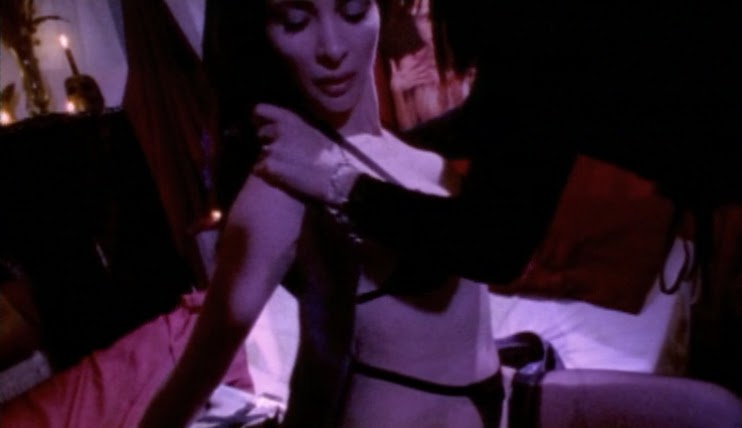
Against a backdrop of flames brightening a shoreline by night, their faces superimposed as if in oval picture frames, Jean Rollin introduces us to the dramatis personae of ‘Les Demoniaques’. It would be appallingly cutesy if the flames weren’t the burning wreck of a ship and the characters in question a villainous bunch of wreckers. Meet the Captain (John Rico):


And meet the Captain’s lady, Tina (Joelle Coeur) – although “lady” might be pushing it a bit:


Rounding out this crude and cruel crew are Bosco (Willy Braque) and Paul (Paul Bisciglia). Voiceover sketches in a power struggle between the Captain and Bosco while casting aspersions on Paul’s loyalty. Quite to what purpose I have no idea, since none of this is ever revisited.

The story – I’m using the word loosely since, as ever in the Rollin filmography, narrative counts for sweet f.a. – starts on that same dark shoreline as the wreckers haul some washed-up chests onto the beach and go through their contents. There’s no glimpse of a sinking ship, but then again budgets aren’t a staple of Rollin’s work either. Everything’s going swimmingly (drowningly?) and the Captain’s trading off some jewelry for sexual favours from Tina …


… when the night is pierced by cries for help, and out of the sea come two orphan girls. Anyone with Jean Rollin scorecard in front of them can tick off “beach” and “two orphan girls” immediately and get their pen ready for “gratuitous nudity” and “ridiculously protracted sex scene” in just a minute. Anyway, these two waifs (they’re not named, spend the virtually the whole film mute, and it’s chiefly thanks to IMDb that I can identify them as being played by Lieva Lone and Patricia Hermenier) don’t get any help from the wreckers whatsoever. Quite the contrary. They’re raped and left for dead, an ordeal that get’s Tina so hot under the collar that she peels off her duds, dances naked on a promontory and has awkward looking sex with the Captain on a rock.


This venal business occupies almost twenty minutes. Then we cut to a tavern at which El Captaino and his less-than-merry bunch are drinking, carousing with saloon girls, and generally blowing their ill-gotten gains. Louise (Louise Dhour), the madame of this establishment, baits the Captain with knowledge of his activities. He denies being a wrecker, but starts experiencing hallucinations of the dead girls.


Louise has the gift of second sight and intuits that something preternatural is going to happen. Eventually – and I do mean eventually: the tavern sequence drags on almost as long as the first scene – a terrified local runs in and announces that the dead are walking the streets. Guessing that what he’s seen is the pale and injured orphans who weren’t quite as left-for-dead as they thought, the wreckers set out to hunt them down and finish the job.

After a tense bit of cat and mouse amongst the wrecks of old ships that line the beach (easily the film’s best sequence, Rollin’s camera painting with shadows), the girls escape to some ruins on the outskirts of town which are said to be haunted; the reputation is enough to dissuade the Captain from pursuing, even though Tina, crazed with bloodlust, is well up for tackling the girls on her own.

We’re at the halfway mark now and ‘Les Demoniaques’ is about to go full-tilt into WTF territory. Still got that Jean Rollin scorecard handy? We’re about to tick off “ruined abbey”, “dark ritual (involving nudity)” and “outright surrealism”. The girls arrive at the ruins where they’re met by a strange woman dressed as a clown (Mireille Dargent) …


… who seems to live at the abbey with a guy who dresses a priest (albeit a somewhat new age-y one) and another guy who’s locked in a cell (the ruins are barely standing, but hey there’s perfectly secure cell) and can only be freed, apparently, by someone coming to him of their own accord. It seems to help if said someone is female. And naked. IMDb pegs these gentlemen as, respectively, the exorcist (Ben Zimet) and the devil (Miletic Zivomir). Specious descriptions at best.

The girls, seeking vengeance, agree to a ritual in which the devil transfers his powers to them. This involves having sex among the ruins …


… and only lasts till dawn. The powers, that is, not the sex. Although the devil probably has the stamina for it. Anyway, the girls make a right hash of their revenge and as dawn approaches the wreckers, unaware that they are soon to meet their own fate, have one last but extremely nasty surprise left in store for them.

As the 800 odd words above indicate, ‘Les Demoniaques’ has more of a plot than your average Rollin film, and the imagery (for the most part) works in the service of said plot. As opposed to many other Rollin films where ethereal women – often vampires, mostly naked – wander round old houses and other women (unclothed, natch) pop out of grandfather clocks and there’s generally no reason for any of it beyond (a) it looks cool and (b) it pads out the running time. Not that ‘Les Demoniaques’ doesn’t have its longueurs, certainly in the first half.

Nonetheless, this lip service to storytelling makes this one of the most entertaining of Rollin’s output, despite the grim commitment to being resolutely downbeat that characterizes the last twenty minutes or so. As ever, atmosphere is everything and there are some genuinely haunting moments. Also as is Rollin’s wont, these moments sit cheek-by-jowl with rampant what-the-fuckery. And that’s what makes his work infinitely watchable. That and the naked ladies.

Thursday, December 13, 2012

WINTER OF DISCONTENT: Red State


In which Kevin Smith pulls the rug out from under his audience’s feet. And then the floorboards. And then the foundations. And then what you were kind of hoping was some semblance of solid ground. ‘Red State’, in short, is a film that sets out to fuck with you.

It fucks with you via its title and the way it’s advertised. ‘Red State’. The DVD cover art shows an attractive young woman clutching a fuck-off big semi-automatic rifle. Hmmmm, political thriller, you might well think. Patty Hearst type shenanigans, mayhap. Something of a change of pace for Smith.

Then you slide the DVD in and the film gets ready for its first rug-pull.

We’re in small town America and three high-school losers are looking to get laid via the internet. Our testosterone-addled triumvirate – Jarod (Kyle Gallner), Travis (Michael Angarano) and Billy-Ray (Nicholas Braun) – have hooked up with trailer park milf Sara (Melissa Leo), but when they fetch up at her trailer it’s not the older woman fantasy made flesh that they get but a mickey finn in their beer and they wake up bound and caged and at the mercy of bigoted preacher Abin Cooper (Michael Parks). Cooper has some very intractable ideas about sin and how to deal with sinners. Shooting them in the head seems to be a favourite. And he really has a beef about sins involving carnality.


Hmmmmm, you think, torture porn mise en scene ahoy. What we have here is a horror movie that takes some satirical broadsides at fundamentalist Christianity.

At which point another rug pull occurs as ATF agent Joseph Keenan (John Goodman) and his right hand man ASAC Brooks (Kevin Pollak) enter the picture. Keenan’s politically motivated boss has given the order, following an altercation with local law enforcement officers at Cooper’s compound that leaves a deputy dead, to go in with all guns blazing. And just in case there’s any negative publicity or hesitation over the order, Keenan and his men are instructed to regard Cooper and co. not as First Amendment protected citizens practising their right to freedom of religion but as a dangerous terrorist cell every man jack of whom should be shot on site. And by “every man jack”, that means the women and children who are also gathered at the compound.


Right, got it, you say to yourself. Took a while, but what Smith’s doing here is laying down an early John Carpenter siege movie vibe, making a scathing comment about America’s obsession with gun culture and getting into a debate on post-9/11 political heavy-handedness. You might also, at this point, resign yourself to the fact that Jay and Silent Bob aren’t going to be showing up in this one.

Then … well, whaddaya fuckin’ know … there’s another dang rug-pull. And all of a sudden we’re into some very weird territory. How weird? Imagine the conceptual ending of ‘Breaking the Waves’ spliced into a John Woo stylee shoot-out. Or ‘The Rapture’ if Sam Peckinpah had got hold of the script and decided that what all this metaphysical god-boy stuff needed to kick it up a notch was plenty of spent cartridges.


This particular rug-pull happens a smidgin before the hour mark; and for all that the end credits start rolling at one hour seventeen minutes, the Kevster has a couple more “fuck yous” to narrative consistency and thematic considerations before we get to check out who the head chef or accounting manager were.

In fact, it’s not till those selfsame credits that Smith finally plays his hand. The cast are divided into three camps, dependant on what their character represents: sex, religion or politics. It speaks for itself: as a cross-section of America, if not of humanity in general, most people are motivated by at least one of them. And a hell of a lot of people do some seriously fucking dumbass things as a result.
Tuesday, December 11, 2012

WINTER OF DISCONTENT: Who Can Kill a Child?


Narciso Ibanez Serrador’s controversial and disturbing 1976 offering is also known as ‘Death is Child’s Play’ and ‘Island of the Damned’ – the latter quite apposite since there’s more than a touch of ‘Village of the Damned’ in the film’s aesthetic. In fact, I’d be tempted to describe it as the juvenile delinquent offspring of ‘Village of the Damned’ and ‘Island of Death’, except that Nico Mastorakis’s slab of venality wasn’t released until a year after Serrador’s infinitely better movie.

Besides, the original title – a literal translation from ‘¿Quién puede matar a un niño?’ – is the most fitting. It sounds rhetorical at first but, as English tourists Tom (Lewis Fiander) and his heavily pregnant wife Evelyn (Prunella Ransome) encounter ever more disturbing behaviour among the children of an isolated island off the Spanish coast, it’s revealed as the reluctantly arrived at answer to an equally disturbing question, i.e. how the horrific events they uncover could have happened.

As regards the why … well, that’s what makes the film so disconcerting.


‘Who Can Kill a Child?’ opens with an eight-minute sequence during which blood-red credits in scrawly handwriting play out over stock footage of the atrocities of Auschwitz, starvation in Pakistan, children dying in Korea, and that shockingly unforgettable image of Vietnam: the girl running naked and crying down the middle of a road. In measured voiceover, these human rights violations are described in the context of their cost in children’s lives. The voiceover is intermittently interrupted by children’s voices singing a wordless babyish song then breaking off to giggle. It’s an unsettling opening, not least for being so protracted. It had me wondering if Serrador wasn’t being somewhat questionable in his aesthetic. But at that point, I was merely expecting a cheap exploitation movie.

The archive footage is immediately superseded by the image of a crowded beach; corpulent adults, pudgy children and lithe adolescents merge into a crush of holidaymakers concern only about their tan or their swim. The contrast couldn’t be greater. The camera follows a child into the water. A body is floating face down. Turned over, it’s a woman, a huge discoloured bruise on her face. Tom and Evelyn quit the beach as the ambulance turns up. Later, walking through the resort at night, every bar packed to standing room only and a seedy atmosphere prevalent, they decide to hire a boat and cross to a small island where they can enjoy some peace and quiet. Bad move.

On the boat, Evelyn notes that the noises from the mainland have faded away, but she can’t hear a single thing from the island – it’s as if it’s deserted. Tying up at the small harbour, a few children watch them. Going inland, the streets, houses, cafes, bars and hotels are empty. The very lack of sound seems almost discordant. The heat is oppressive. Evelyn feels unwell. Tom becomes increasingly edgy. Prowling a shop for food, he doesn’t notice a corpse stretched out behind a stack of goods. Weird little incidents occur. Evelyn’s encounter with a pre-teenage girl is creepy in a way it’s hard to define. Indeed, much of the first half relies entirely on the emptiness of the locale and the not-quite-right expressions on the children’s faces to create an unsettling atmosphere. When Serrador plays his first card and shows the children doing something that is at once utterly reprehensible and nothing more than a game, it’s over 50 minutes into the film. Slow-burn is an understatement. There are, in fact, a myriad of minutiae which seem, on first viewing, like padding … but which take on a deeper significance by the end of the film.


Tom and Evelyn encounter only a few other adults on the island: an old man who is quickly incapacitated by the children’s vicious ministrations; a middle-aged man who begins to recount the strange happenings but is lured away from the couple’s company by the appearance of his tearful daughter (the strength of his paternal feelings proves his downfall); a fellow vacationer who Tom tries to save, the operative word being “tries” and a two generations of a coast-dwelling family whose own children suddenly become infected by whatever madness has claimed their contemporaries just by making eye contact.

This particular scene, with its suggestion of telepathy or hypnosis, introduces a supernatural element that pulls against the opening credits’ intimation that the children have, as one, turn against the adult world out of a sense of betrayal. This hint of an explanation is introduced much earlier when Tom recounts to Evelyn the episode in Fellini’s ‘La Dolce Vita’ where Steiner (Alain Cuny) kills himself and his two children, speculating that he did it to spare them an intolerable future as they grew up.

Another interpretation – and I can’t claim credit; I came across it on an IMDb message board – focuses on Evelyn’s meeting with the young girl. She introduces herself as “Lourdes”, and since she’s the only one of the children who is given a name, we can only assume it’s for a reason. Lourdes being the spa town in France visited by pilgrims hoping for a vision of the Virgin Mary, the implication is that the children’s behaviour has been influenced (or they’re outright being controlled) by a higher power. I’ve not Juan Jose Plans’s novel – I don’t even know if it exists in an English translation – but I’m informed that it contains a scene where some sort of dust falls from the heavens by way of precipitation.

Serrador wisely allows it to remain an enigma, planting clues and symbols but keeping the narrative free of exposition. As a result, ‘Who Can Kill a Child?’ plays out like a waking nightmare, the more so because you can never quite shake your mind free of those first eight minutes. They eat into your subconscious while the rest of the movie unremittingly twists its barbed hooks in the pit of your stomach.

Sunday, December 09, 2012

WINTER OF DISCONTENT: Rise of the Footsoldier


There’s a certain aspect of the British mindset that gets all sentimental over criminality. There are those who profess a nostalgia for the Krays, chiefly based on the observation that they loved their mam, gawd bless ’em. Peter Medak’s 1990 film of their lives falls into this trap. Ditto David Green’s ‘Buster’, starring Phil Collins as Buster Edwards, one of the Great Train Robbers, a film that plays out as a light romantic comedy and conveniently omits the coshing of train driver Jack Mills and the track-side attack on David Whitby. 

Julian Gilbey’s ‘Rise of the Footsoldier’ – an energetic account of the life and crimes of Clayton Leach, on whose autobiography ‘Muscle’ the film is based – doesn’t fall victim to Medak’s myth-making or Green’s wholescale hagiography, but remains curiously unsatisfying, not least because of its slavish adherence to a three act structure which necessitates the almost complete sidelining of its anti-hero for the last third.

It’s easy to see why Gilbey, co-scripting with his brother William, opted for this structure, though. On paper, the story cleanly delineates across three decades: the 70s, in which Leach (Ricci Harnett) makes a name for himself as a member of the I.C.F. (the Inter City Firm, an organized group of football hooligans so named because they took InterCity trains to matches rather than the more traditional buses); the 80s, in which Leach develops and underworld career and starts coining it on the rave scene; and the 90s, in which associates Tony Tucker (Terry Stone) and Pat Tate (Craig Fairbrass) start spiraling out of control and fucking things up for everyone else and things come to a bloody end down a rutted farm track in Rettendon.


And things start out effectively enough as Gilbey plunges the viewer headfirst in an almost nauseatingly visceral evocation of 70s football hooliganism. Everything that Lexi Alexander’s ‘Green Street’ tried so hard to be in its interminable 109 minutes, ‘Rise of the Footsoldier’ wipes the floor with in its first 20. It’s a roundhouse swing of visceral take-no-prisoners filmmaking, easily the most unflinching depiction of the subject since Philip Davis’s ‘I.D.’, and if the credits had rolled on ‘Rise of the Footsoldier’ as a twenty minute short I’d probably be calling it a masterpiece.

Unfortunately, Act One sets the bar too high. Nothing that follows remotely lives up to it. In fact, Act Two is a complete inversion. If Gilbey’s portrayal of football related violence is brutish and all-too-convincing, then his take on 80s rave culture is just plain ridiculous. The music, the fashions and his filmic suggestion of how E effects the user are howlingly wide of the mark. It’s a relief when Leach graduates from doorman duties to providing protection to local dealers and hooks up with Tucker. The clichés still come thick and fast – particularly in the dialogue, which never rises above the “yew faakin’ cahnt” standard beloved of so many recent British crime flicks – but at least there’s a bit more at stake and the pace benefits as a result. Nothing benefits the film’s treatment of women, though, where every female character is reduced to slapper, stripper, pothead or mistreated wife.


Then Act Three comes lumbering on as Leach finds himself on the periphery of a heroin deal that goes south and some very hardcore Turks bring the pain. So of his crew get hurt, but Tucker dissuades Leach from going to war. It’s at this point that the narrative begins to derail. Though never lacking for drama – be it a ‘Rashomon’ style replaying of the Rettendon hit as various possible perpetrators are put in the frame, or Pat Tate going off on one over a pizza order in a scene that would be funny if it weren’t so brutal – the final stretch of ‘Rise of the Footsoldier’ never recovers from leaving its anti-hero on said periphery.

Put simply, there’s no sense of Leach’s position in the underworld during all of this, of what he was doing behind the scenes. He just disappears for long stretches while Tucker and Tate get mixed up in any number of dodgy schemes, bring down too much attention, and finally keep their rendezvous with some heavy firepower down a farm track in the dead of winter. ‘Rise of the Footsoldier’ – the first hour earns the title. But it’s more like ‘Footsoldier on the Sidelines’ by the time the final whistle blows.

Friday, December 07, 2012

If you're gonna blog, blog - don't talk!

The very lovely Emily Browning is 24 today. Eli Wallach is 97. So guess who gets the pictorial tribute?

That's right.

Fuckin' Tuco!


Thursday, December 06, 2012

Cracking Swedish sex symbol, Grommit!

Wallace and Grommit creator Nick Park is 54 today. Christina Lindberg is 62. Guess who gets the pictorial tribute?

That's right.

The Agitation of the Mind: surfing the net for cheesecake shots since 2007.


Wednesday, December 05, 2012

WINTER OF DISCONTENT: Harry Brown


Generally speaking, revenge/vigilante titles are films of two halves. Extended first act: protagonist gets pushed till he can’t take it anymore, either by nasty shit getting vented on the people they love, or nasty shit raining down on them directly. Shorter but incredibly graphic second act: definitive cessation of protagonist taking it any more, turning of tables, antagonists get their arses handed to them on a plate. Or plates.

There are no surprises in the set-up or narrative execution of ‘Harry Brown’. Absent the presence of an A-list star in the title role and you could be watching a 1970s grindhouse flick. Substitute Michael Caine for Charles Bronson, chavs for pimps and a council estate for some brownstone tenements and ‘Harry Brown’ is basically ‘Death Wish’. Only with that crucial scene-setting first act directed by Ken Loach.

Hence a first hour that goes something like this: Harry gets up in the morning, joints creaking and moving slowy; Harry caresses the unrumpled side of the bed that his wife used to sleep on; Harry makes a cup of tea and some toast in the most depressing kitchenette ever to be captured on celluloid; Harry makes his way warily through the estate he lives in; Harry hesitates on taking the underpass on account of the hoodies foregathered there; Harry goes the long way round, gawd knows that his aching old bones could do without the diversion; Harry visits his wife in hospital, hers the only occupied bed in an otherwise sterile and empty ward (yeah right: Mrs Harry is expiring on the NHS and spare beds are a fucking fantasy, my friends!); Harry has a lonely pint in a drab pub; Harry has a second, slightly less lonely pint with his mate Len (David Bradley) and they play chess, two old codgers, forgotten and alone; Harry goes home to his spartan and glumly decorated flat.

Depressed yet? You soon will be.

Harry’s wife dies, then Len tells him that he’s terrified of the kids on the estate and that he’s packing a bayonet for protection. Harry, who it turns out is an ex-Marine (check out his regimental photograph: if that’s not a production still from ‘A Bridge Too Far’, I’ll eat my beret), urges Len not to do anything foolish; to go to the police. Len scornfully retorts that he has and they’ve done nothing. Len returns home only for the chavvy little bastards in question to try to burn his flat down. Next up, DI Alice Frampton (Emily Mortimer) and DS Terry Hicock (Charlie Creed-Mills) turn up at Harry’s door to tell him that Len expired after a run in with the youths he suspected of the arson.

Frampton and Hicock pull in some local youths – ringleader: Noel Winters (Ben Drew a.k.a. rapper Plan B) – but when it becomes evident that Len was carrying an offensive weapon, they look set on getting away with it.


Here endeth the Ken Loach bit.

Harry sets up surveillance in Len’s burned out flat, discovering that he had a direct view of the drug deals, beatings and knee-tremblers that constitute an average day in the life of the underpass. He identifies Noel pretty quickly. Gets a line on the rest of the gang. Recognises a drug/arms dealer from his local. Tails him back to his business premises. Enquiries after the acquisition of some weaponry.

It’s at this point – an extended sequence in which Harry visits twitchy dealer Stretch (Sean Harris) and his cowed henchman Kenny (Joseph Gilgun) and morphs from fish out of water to stone cold avenger – that ‘Harry Brown’ happily pulls the plug on the hour of determinedly squalid social realism that’s preceded it and goes sprinting off, gun in hand and spouting heavy-handed soliloquies, in the direction of ClicheVille.

Not that much of the first half has been subtle (Len’s funeral is a particular nauseating example of emotional pornography, the camera following a cavalcade of hearses bedecked with flowers only for the cortege to disappear offscreen and reveal Len’s grave with only Harry and presiding priest in attendance), but the second half positively revels in audience-bludgeoning.

Smack! Faakin’ thick-necked chavs gettin’ in yer face, innit?

Wallop! Faakin’ guns n drugs n pimpin’ bitches out, gertcha?

Boot! Right wing fascist bastard coppers who’s as bent as the crims, guv’nor!

Slap! Put that faakin’ remote control down, yew cahnt!

And so it rolls. Director Daniel Barber is probably still singing hosannahs that Michael Caine signed on the dotted line. Without him, ‘Harry Brown’ would be all kinds of piss-awful. But when you get Harry giving one of Noel’s underlings the kind of working over in order to extract information that Batman doles out to the Joker in the interrogation scene in ‘The Dark Knight’, the result is electrifying. If Harry’s “you failed to maintain your weapon” speech, with its discourse on a formative experience from the character’s military service, recalls Alfred’s “some men just want to watch the world burn” monologue in Nolan’s epic, the Harry-beats-it-out-of-a-thug sequence plays out like Bruce Wayne’s taken a vacation and given Alfred a by-your-leave to get medieval on whoever.


Unfortunately, the comparison soon diminishes. Much of Harry’s vengeful rampage, notwithstanding how gratifying it is to watch a pension age Michael Caine give the youth of today one in the yarbles, suffers from a reality disconnection. His infirmity only ever kicks in when the script demands it, and a man in his seventies who (the early scenes hint) is arthritic and suffering (as latter scenes state unambiguously) from emphysema, nonetheless spends the mid section of the film hoofing it from shoot out to shoot out, pausing only to give a hoodie young enough to be his great-grandson a comprehensive whipping without even breaking a sweat. He’s a military man, a crack-shot, one step ahead of his antagonists the whole time, yet he makes an elementarily stupid decision in the finale, again purely because the script demands it. The chavs are so clichéd, they make the youths in ‘Attack the Block’ seem like finely nuanced creations of the screenwriter’s art. Mortimer’s idealistic Detective Inspector is incredibly badly written and Mortimer’s performance – sad to say, because she’s been awesome in everything else I’ve seen her in – is utterly unconvincing.

As regards Drew/Plan B, the guy’s birth name is Benjamin Paul Balance-Drew. Wooooo, urban rebel with the double-barrelled surname. At least he doesn’t hold his gun sideways like so many fake tough guys. I’ll give him that.

So, yeah. ‘Harry Brown’. A grim, humourless, clichéd and derivative movie. But one that got real fucking lucky in its leading man.

Monday, December 03, 2012

WINTER OF DISCONTENT: Q


Everyone gets naked and shags a lot
in Laurent Bouhnik’s ‘Q’, a film where
the camera lingers on bush and cock

and privacy clearly doesn’t matter a jot.
(Someone tell the DoP it’s impolite to stare!)
Everyone gets naked and shags a lot

and you’re cajoled into thinking it’s a sort
of empty pleasure/bankrupt economy metaphor:
the camera lingers on bush and cock

with the dispassion of a grey accountant
obsessed with figures, who tries not to care
that he never gets naked or shags a lot.

It’s a mistake to think this is porn; it’s not.
Just to prove something arty’s going on here,
the camera lingers on bush and cock

while everyone spouts pretentious rot,
because this is art-house – world cinema, y’hear:
everyone gets naked and shags a lot
and the camera lingers on bush and cock.


NSFW ‘Q’ image gallery after the jump.

Saturday, December 01, 2012

Emily Mortimer


Happy 41st birthday to Emily Mortimer - who I would describe as a classic English rose, except the archetypal English rose isn't supposed to be so damn smouldering hot. Look out for the lady herself in a Winter of Discontent offering next week.

Thursday, November 29, 2012

WINTER OF DISCONTENT: The Nun and the Devil


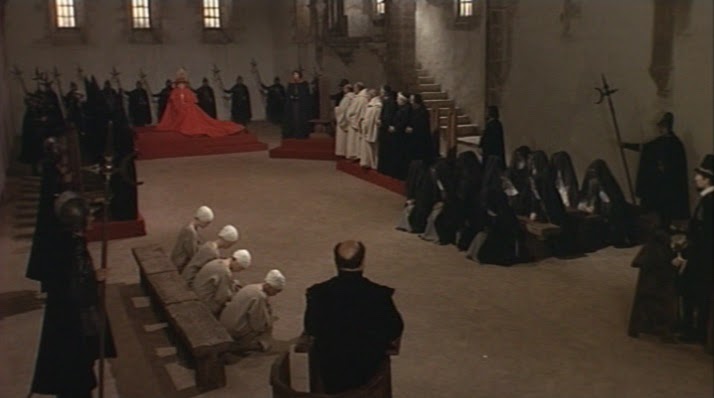
When the Mother Superior at the convent of Sant’Archangelo pegs it, the Roman Catholic equivalent of a bitch-fight kicks off as various parties vie for vacancy. The elderly Lavinia (Maria Cumani Quasimodo … yes, really) uses her age to pull rank and pretty much appoints herself Acting Mother Superior. Sister Carmela (Claudia Gravy … again, genuine surname) covets the position as lustfully as she covets the body of Pietro (Duilio Del Prete) who sneaks into the convent at night for a bit of the old in-out-in-out. Meanwhile, Mother Julia (Anne Heywood) gets her Machiavellian funk on good and proper, enlisting the help of well-connected nobleman Don Carlos (Pier Paolo Capponi) in petitioning Rome on her behalf. Don Carlos, however, has an ulterior motive in that the new Mother Superior will have the ear of Cardinal d’Arezzo (Claudio Gora) regarding the appointment of governor to a foreign territory rich in ore and minerals. Don Carlos has a fiscal interest in said assets. He also has an interest – lascivious, this time – in Mother Julia’s niece Isabella (Ornella Muti), newly arrived at the convent as a novice. While Don Carlos plots to coerce Mother Julia into pimping out Isabella as part of the powerplay, fellow novice Agnes (Muriel Catala) worries that Isabella will replace her in Mother Julia’s affections. Meanwhile, the walking case of sexual hysteria that is Sister Chiara (Martine Brochard) is already jealous that Mother Julia favours Agnes and not her, while Isabella yearns for her earnest but low-born sweetheart Fernando (Gianluigi Chirizzi), out of whose arms she was vouchsafed into the supposed safety of the convent.

So: Borgia-like corruption and power struggles, illicit love affairs, barely suppressed lesbian urges, backstabbing, bitchery and general ungodliness in the house of the lord. Starring world-class Eurovixens Muti and Brochard and former Miss Great Britain Heywood. Nunsploitation heaven, right?

Ladies and gentlemen, lechers and hairy-palmed pervs, it is my sad duty to report that ‘The Nun and the Devil’ is quite a tedious little number. Yes, you read that right. Director Domenico Paollela manages to make a nunsploitation movie – surely one of the most illicitly titillating of sexploitation subgenres – boring. A nunsploitation movie, I might add, that is rife with sexual hysteria, sexual rivalry, power games and politicking; a nunsploitation movie that fires off some pretty resounding broadsides against the Catholic church; a nunsploitation movie, for Chrissakes, that features Ornella freakin’ Muti – Ornella Muti, the kind of woman who could not only make a bishop kick a hole in a stained-glass window but set fire to the pulpit as well. And it’s boring.


There should have been an inquest, with expert testimony from every exploitation director working in Europe in the 1970s, to determine how this happened. Just like there’s an inquest – i.e. an inquisition (of the capital “i” variety) – in the second half of the film. There is, perhaps, just enough of the truly nasty in the final stretches of ‘The Nun and the Devil’ to get Paollela off the charge of cinematic ennui. As Cardinal d’Arezzo’s crusading right-hand-man Carafo (Luc Merenda) descends on Sant’Archangelo to investigate accusations of corruption and immorality, Paollela cuts loose with a sequence that intercuts courtroom drama speechifying with scenes of torture that generally require the nuns on the receiving end to be naked.

It all ends with Julia delivering an impassioned speech accusing her accusers – Heywood goes all out – but there’s a definite tang of “too little too late”. Too many longueurs in the lead up to the nasty stuff, and even the nastiest of the nasty can seem like a desperate scrabble for the audience’s attention.

Tuesday, November 27, 2012

WINTER OF DISCONTENT: Razor Blade Smile


“Fuck Bram Stoker.” Thus quoth vampire/hitwoman Lilith Silver (Eileen Daly) early on in Jake West’s sex, goths ‘n’ guns horror comedy. Statement of intent? Fuck, yeah! Here’s another of Lilith’s trenchant voiceover homilies: “I bet you think you know all about vampires, don’t you? You know fuck all!”

The vampires in ‘Razor Blade Smile’ drink blood because they have to, not because they particularly enjoy it: Lilith can identify a blood type like a connoisseur sampling a single malt (she spits out some Type A negative, dismissing it as “too iron-y” … oh, the irony). The vampires in ‘Razor Blade Smile’ hold down day jobs. Granted, Lilith’s is assassin which automatically makes her cooler than the rest of us wageslaves. The vampires in ‘Razor Blade Smile’ can function in the daylight so long as they wear shades.


They don’t sparkle, either.

I almost wish ‘Razor Blade Smile’ had been made in 2008 not 1998; it would function as the biggest “fuck you” to the ‘Twilight’ saga ever. Put Lilith up against Stephanie Meyers’ milquetoast characters and Edward would get his deathly white arse handed to him on a bloodstained plate while Bella would most likely be inducted into the joys of Sapphic vampirism.


*Your host excuses himself. Takes cold shower.*

Made for about £20,000, it was a serious contender for the lowest budget British movie ever to enjoy a cinema release … until Marc Price’s no-budget zombie flick ‘Colin’ shuffled off with that particular accolade by dint of being made for £19,955 less. Still, the difference in production values is palpable, not least for ‘Razor Blade Smile’ being shot on celluloid. Indeed, West shoots for the moon, throwing in a black and white period set prologue, a Bond-style opening credits sequence, some snazzy time-lapse vistas of nocturnal London, a psychedelic dream sequence and all manner of sex violence, shoot-outs and swordplay as if he had a few million at his disposal. Put it this way, and let’s joyously invoke Werner Herzog’s philosophy that a filmmaker shouldn’t worry about money (“start making the film and the money will follow you into the street like a dog”), Tommy Wiseau’s ‘The Room’ was made for something in the region of $6million and looks like a home movie shot at a group therapy session while ‘Razor Blade Smile’ was made for next to nothing and looks like a motion picture.

The plot almost doesn’t matter (although it plays out straight-faced for most of the running time, ‘Razor Blade Smile’ is a comedy and its final scene is essentially the punchline) but just so we can tick the appropriate box, here goes: stone-cold hits, Sapphic shenanigans, corrupt cops, nemeses from the distant past, and the Illuminati. Intrigued as to how these elements knit together? Don’t even bother trying to second-guess; just watch the motherfucker and wallow in slack-jawed disbelief at the WTF-ness of it.


If West’s directorial style is a visual exegesis of Browning’s maxim that “a man’s reach should exceed his grasp”, then his leading lady tears into the material in similar fashion. Subtlety doesn’t exist as far as this movie is concerned. Eileen Daly, though incredibly versatile in many disciplines (actress, poet, musician), has generally been consigned to erotic features, and although ‘Razor Blade Smile’ requires her to shed clothing on a fairly regular basis it also gives her a chance to seize a lead role and run with it, and the lady gives it her all. By turns vampish, vicious and snarlingly sarcastic, she makes Lilith her own.

Friday, November 23, 2012

WINTER OF DISCONTENT: City of the Living Dead


The first of three horror movies Lucio Fulci made with Catriona MacCall in a two-year period, and something of a stepping stone to his flat-out masterpiece ‘The Beyond’, ‘City of the Living Dead’ is atmospheric, incoherent and tries to con you that is has something to do with H.P. Lovecraft.

Like the two films that immediately followed it, the premise is basically: hero and heroine stumble upon piece of real estate that turns out to be one of the gateways to hell, a metric fuckton of weird and nasty shit ensues. In ‘The Beyond’, it’s a decrepit Louisiana hotel. In ‘The House by the Cemetery’, it’s the eponymous Freudstein residence. In ‘City of the Living Dead’, it’s an entire cemetery in the small town of Dunwich.


Naming a town Dunwich in any film, let alone a horror flick, is tantamount to the director pedalling around in front of the camera on a unicycle playing the ‘Witches’ Sabbath’ movement from ‘La Symphonie Fantastique’ on a mouth organ, while a big flashing neon sign slung around his neck blinks out, in blood reds and necrotic greens, the message “YO, MOTHERFUCKERS, IT’S CTHULU TIME”.

Only Fulci proceeds to do absolutely nothing Lovecraftian. There’s an appropriately claustrophobic buried alive moment that recalls Poe; some vicious treatment is doled out to a mistrusted outsider that evokes Fulci’s own ‘Don’t Torture a Duckling’; various characters find themselves holed up in confined locations (bars, funeral homes, cemeteries) a la John Carpenter’s besieged-by-supernatural-forces aesthetic; and there are zombies aplenty, reminiscent of any number of Italian horror movies from the same period. But absolutely bog all to do with the Cthulu mythos.


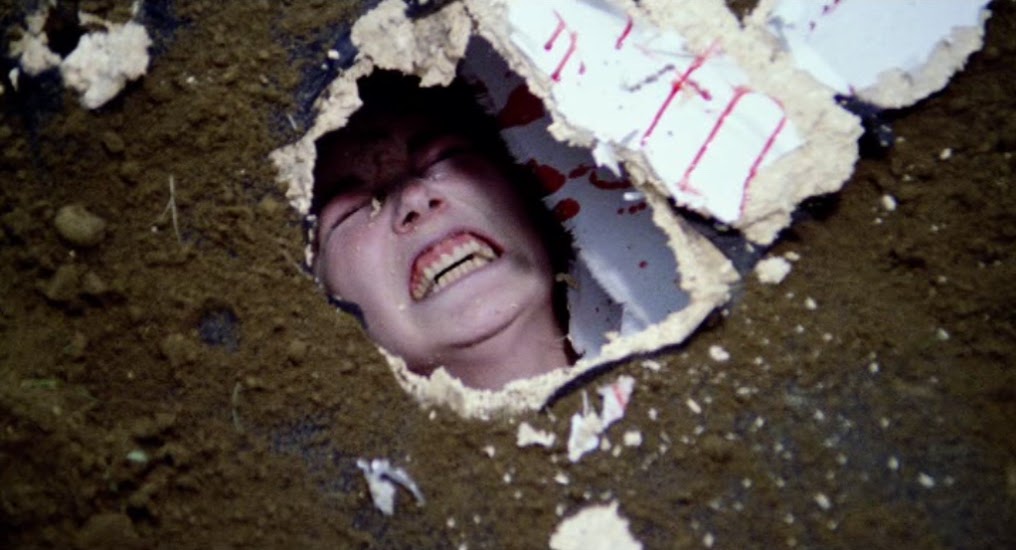
Here’s what we do have: a priest hangs himself from a tree in Dunwich cemetery which causes Mary (MacColl), a medium in New York, to have a fit and seemingly expire during a séance. The case attracts the attention of journalist Peter (Christopher George), who becomes even more intrigued after he attends Mary’s burial, realises she isn’t dead, rescues her from interment, and hears her story about the gates of hell opening as a result of the priest’s suicide. Meanwhile, in Dunwich, highly-strung artist Sandra (Janet Agren) turns to psychiatrist Gerry (Carlo De Mejo) to try to make sense of the disturbing visions which are tearing away at her sanity. Together, they discover that the unreal exists, the dead are coming back to life, the townspeople are turning against each other – and particularly against mentally ill teenager Bob (Giovanni Lombardo Radice) – and that the key to it all lies in the catacombs beneath the cemetery.

If the morse code operator in the back of your mind is repeatedly sending out the call sign whisky tango foxtrot at this point, don’t panic – you’re just experiencing narrative according to Lucio Fulci. Which is to say “what is this concept ‘narrative’? to hell with it! I’ll just string a bunch of weird and gruesome scenes together as I see fit.” My best advice is, relax and go with the flow. Keep calm and get eaten.