Monday, November 10, 2014

WINTER OF DISCONTENT: Women in Fury


Exactly how sleazy is ‘Women in Fury’?

Well, to begin with, it’s a women in prison film. You check your sense of aesthetics in at the door when you watch a women in prison film. And probably take a shower afterwards. A cold one.

Secondly, it’s directed by Michele Massimo Tarantini, whose CV includes schoolgirl sleaze opus ‘The Teasers’, the Edwige Fenech sex comedy ‘Policewoman’ trilogy (its middle instalment is subtly titled ‘Policewoman on the Porno Squad’; granted the indigenous title translates more as “vice squad” but still …), and the magnificently named sex ‘n’ jungle quickie ‘Massacre in Dinosaur Valley’ (which, in case anyone should mistake it for a ‘10,000 Years BC’ knock-off, was quickly retitled ‘Cannibal Holocaust 2’).

Thirdly, it features oodles of nudity.

’Kay, I’ll go make a cup of coffee while y’all scour the internet for it.


Everyone back? Good-o! Shall we do the plot synopsis thing? Jolly good! ‘Women in Fury’, which tries to con the viewer that it’s based on a true story, documents the misadventures of Angela Duvall (Suzane Carvalho), whom we first meet at the centre of a media frenzy as she’s found guilty of murder, hustled out of the courtroom and bundled into the back of a van that looks less an official security vehicle than something the production designer managed to borrow from a particularly mobile window cleaner the day before shooting.

While she’s en route to the kind of women’s prison where the uniforms consist of tied-off torso-revealing shirts with only two buttons, a word on the nature of her crime. Angela’s murdered a drug dealer, and instead of the legal system considering that she’s saved them a job, you’d think she was a former sports star charged with shooting his supermodel girlfriend for all the attention the verdict draws. (Sorry. Was that too soon?)

Anyway, it turns out Angela’s innocent. ’Twas her loser dope-fiend brother done the deed, but Angela fraternally takes the rap for him. Bad move, Angie; baaaad move!


The prison is ruled over by the absurdly named Captain Bonifacio (Leonardo Jose), who leaves the day-to-day running of the penitentiary to the obligatory predatory lesbian chief warden (Rosanna Ghessa), and doesn’t really involve himself in anything unless there’s a prison break and then it’s guns, watercannons and helicopters a-go-go as he and his men … But I’m getting ahead of myself. There’s fifty minutes’ worth of prison life – with all the cat-fights, shower scenes and lesbianism that said milieu entails – before we get to the break-out.

Angela’s slung in a cell with Joanna (Gloria Cristal) and Paola (Marli Mendes) who respond to the warden’s overtures to Angela by whipping Angela with wet towels and proving their superiority in the time honoured tradition of soft-core girl-girl action. As bad as she’s treated at their hands, Angela’s saved from Joanna’s potentially homicidal intentions by the sympathetic-but-built-like-a-tank Denise (Zeni Pereira). It’s refreshing in this kind of movie that the butch black prisoner is something of a guardian angel rather than an aggressor. However, that’s the only remotely subversive element to ‘Women in Fury’. And Denise remains unable to intervene when the warden (I can’t recall the character being gifted with a name) finally gets Angela in her clutches for what is surely the ne plus ultra of sadistic sapphic prison warden scenes.


While all of this seedy business is going on, a subplot plods away in the background, slowing the pace and padding out the running time. It involves good-natured prison physician Dr Cuna (Henri Pagnoncelli) and his attempts to investigate the events surrounding Angela’s incarceration. This eventually leads him to her brother. Dr Cuna implores him to come forward and tell the true story, thus securing Angela’s release. The lad responds to this altogether reasonable request, and to his sister’s act of selflessness, by not giving a flying fuck.

With a confession from kid bro out of the question and Dr Cuna on Captain Bonifacio’s shit-list, things are looking pretty dismal for our beleaguered heroine. Then the prison break occurs and ‘Women in Fury’ shifts into action movie mode. Now, the escape attempt could have been a brilliantly sustained exercise in suspense, with the pressure cooker tensions and sexual rivalry of the prison spilling out into the steamy and dangerous territory of the jungle. And to be fair, the script does flirt with said possibilities on a couple of occasions. But Tarantini seems intent on making ‘First Blood’ but with half-naked women, and it soon becomes face-palming obvious that his facility as an action director is about on par with Sam Peckinpah as a director of light romantic comedy.

And so the last half hour desperately throws in gunfights, chases, helicopters, jeeps exploding and a desperate final stand in an old church. And does none of it even adequately. The last ten minutes in particular are an exercise in abject tedium. A coda suggests that Angela suffered amnesia as a result of the trauma, regressed to a childlike state and is happier as a result. Which, given that most of the other participants have been decimated long before the closing credits, makes you wonder whose testimony this so-called true story was based on. There’s a lesson here: if you’re making a sleazy women-in-prison film, at least be honest about it.

Friday, November 07, 2014

WINTER OF DISCONTENT: Vampire Ecstasy


Before we get bogged down by such trifling considerations as plot, characterisation and aesthetics, let’s score ‘Vampire Ecstasy’ on the exploitation-o-meter. For those unfamiliar with this intricate mathematical matrix – i.e. everyone reading this, since I’ve just made it up – it works out a film’s exploitation quotient based on its title, subject matter, the track record of its director and cast, grading it against reasonable audience expectation to arrive at a score out of ten where one is basically your average BBC1 Jane Austen adaptation, and ten is something you really ought to be ashamed of yourself for watching.

‘Vampire Ecstasy’ also goes by the titles ‘The Devil’s Plaything’, ‘The Veil of Blood’ and ‘Curse of the Black Sisters’ (which makes it sound like a blaxploitation hybrid where there isn’t a single face on screen that’s not whiter than something very white that just graduated from the Academy of Pallid). But let’s just stick with ‘Vampire Ecstasy’ because that suggests – neatly seguing into both the subject matter and audience expectation parts of the equation – vampirism and eroticism. Moving swiftly on …


The film was directed by Joe Sarno, who only ever made sex flicks. Seriously, the dude has 122 credits as director according to IMDb, from 1961 to 2004. These include early works ‘Lash of Lust’ and ‘Sin, You Sinners’ (gotta love alliteration), onanism classics ‘The Seduction of Inga’, ‘Abigail Lesley is Back in Town’ and ‘Laura’s Toys’, and late-in-the-game quickies, notable only for their punning titles, ‘Panting at the Opera’ and ‘Screw the Right Thing’.

Quick re-encapsulation: Sarno spent forty years making over a hundred skin flicks. That’s another box ticked.

‘Vampire Ecstasy’ stars Marie Forsa (‘Confessions of a Sex Kitten’, ‘Flossie’, ‘Justine and Juliette’, ‘Broken Butterfly’), Ulrike Butz (‘Sex at the Olympics’, ‘Secrets of Sweet Sixteen’, ‘Confessions of a Teenage Virgin’ … though what a virgin has to confess I’m not sure), Flavia Keyt (‘Deep End’, ‘Hungry for Sex’, ‘Practice Makes Perfect’) and Claudia Fielers (‘White Slavers’, ‘Emanuelle Meets the Wife Swappers’, ‘Swedish Playgirls’). Let’s face it, no-one attended the audition under the impression that they were making a serious drama.


Audience expectation therefore could reasonably include bloodletting, nudity, sex rituals, lesbian canoodling and really bad faux German accents.

Feeding all of this into the computer, we get a resounding 10 on the exploitation-o-meter. Now let’s go into a little more detail as regards how we got there. ‘Vampire Ecstasy’ opens with nearly ten minutes of a blood ritual which also includes copious quantities of nudity, girl-girl fondling and a dildo roughly the same size and shape as a lava lamp. The ringleader of this cold-shower-inducing business is Wanda (Nadia Henkowa, the closest the film has to a proper actor); her acolytes include the aforementioned Fielers, a popular adult performer in Germany in the 1970s who committed suicide at just 23.


The next scenes actually feature clothed performers: sisters Monika (Butz) and Helga (Forsa) arrive at the creepy Bavarian castle at which, it is revealed, Wanda is ostensibly the housekeeper. They are accompanied by Helga’s friend and lover Iris (Keyt), who very quickly transfers her Sapphic affections to Monika. (Need I point out the ‘Vampire Ecstasy’ is somewhat regressive in terms of its sexual politics?) Monika and Helga have been drawn to the castle by the promise of a lucrative inheritance. No sooner are they installed, than Dr Julia Malenkow (Anke Syring) and her brother and research assistance Peter (Nico Wolf) seek shelter at the castle following a car accident. They turn up in the middle of a storm without a single piece of luggage and yet Julia sports half a dozen different outfits during the 72 hours that the film’s timeline covers. But then again this is a film in which a doctor checks someone’s heartbeat by listened to the right side of their chest so, y’know, fuck accuracy.

Anyhows, what it all boils down to is that long ago there was a sexy as all hell female vampire who was burned at the stake by a crowd of vengeful villagers who were too thick to pound a stake through her heart first. Wanda is the leader of a cult who have just been waiting for a blood descendant of said female vampire to act as the vessel for their mistress’s soul and – bit of a longshot, this – a descendant of one of the torch-wielding villagers to act as victim.


Well, whaddaya know? It’s only the doe-eyed Monika (the unfortunately named Butz looks, at one and the same time, like butter wouldn’t melt in her mouth and priests would kick holes in stained glass windows just to hold a door open for her) who turns out to be vampire chick version 2.0). And as for the descendant of one of the lynch mob … no, surely not? Not Dr Julia, who’s currently working on a thesis on folklore and the supernatural and who haemorrhages exposition at a wink from her director. Actually, folks, yes: the very same. Julia, whom Monika wants to see haemorrhage something else entirely.

How the mechanics of the plot works out is thus: Wanda and co. conduct nocturnal sex rituals to the accompaniment of interminable bongo music. The bongos drive the castle’s visitors to distraction – at first, I thought, because they were so fucking annoying – but it turns out that bongos act like aural pheromones and the next thing you know Helga is nakedly offering herself to the cult. The cult then use Helga to seduce Peter in order to undermine Julia. Julia meanwhile has any number of tense conversations with Wanda and brandishes a crucifix made of garlic (for all its multiplicity of alternative titles, Sarno missed a trick not calling it ‘Cross of Garlic’) whenever she feels threatened (i.e. most of the second half¬ of the film). Iris is next to find herself under the influence of Wanda. Monika holds out briefly but is increasingly drawn to a portrait of her vampiric predecessor. When she eventually turns, the results are spectacular and pretty soon it’s only Dr Julia who’s holding out against numerically superior and sexually provocative numbers. And Wanda is holding a cynical card: she’s divined the improper relationship between Julia and her brother and uses it for leverage.


‘Vampire Ecstasy’ drips with sex. Straight, lesbian, incestuous, sex as ritual, sex as power, sex as death … you name it. Sarno throws in softcore (although he pushes the boundaries more than once) writhings at every possible moment, and never mind plot or characterisation. Peter’s burgeoning relationship with Helga doesn’t so much describe a narrative arc as lurch from being in the same room to making out in the stables. The horses seem rather perturbed. Helga’s transition to the dark side has her inexplicably turn up naked in one the serving girls’ rooms and, oh hell, Sarno just wanted some more girl-girl shenanigans and bollocks to whether any of this made sense.

And one would be forgiven, despite the exploitation-o-meter full marks, to write ‘Vampire Ecstasy’ off as mere hand-shandy fodder. Only it occasionally – occasionally – breaks free of its dirty-mac-brigade target audience and gets a genuinely gothic groove on (I’ll gloss over the ending which demonstrates a total non-understanding of vampire lore) and uses the sultry atmosphere it’s created to good effect. It’s the only Sarno film I’ve seen thus far (though don’t rule out his return later on during this year’s Winter of Discontent) but on this basis I’m not sure why Radley Metzer got the thinking-man’s-pornographer reputation while Sarno has been chiefly remembered as a hack.

Wednesday, November 05, 2014

WINTER OF DISCONTENT: Waves of Lust


A word on the title: Ruggero Deodato’s ‘Una Ondata di Piacere’ actually translates as ‘A Wave of Pleasure’, however the most common English-language title is the pluralized-for-no-reason ‘Waves of Lust’. So we’ll go with that. In all honesty, I prefer ‘Una Ondata di Piacere’ and when my wife asked what I was watching, that’s the title I used because it sounded nicely poetic and I didn’t have to ’fess up to it being a tawdry little thriller where Silvia Dionisio and Elizabeth Turner get naked a lot.

Off you go, then. The rest of the review will be waiting when you’ve finished noodling on Amazon or Netflicks.

So, where were we? Oh yes. There are two ways of looking at ‘Waves of Lust’, and either could serve as a capsule review in its own right.

1. It’s Polanski’s ‘Knife in the Water’ done as a porno.

2. It’s an 88-minute advert for J&B.


Granted, J&B and ’70s Italian cinema have an inseparable relationship and it’s virtually impossible to watch a giallo, a cannibal movie or a sex comedy without a bottle flaunting its distinctive yellow label in the background, but ‘Waves of Lust’ takes things to a new level. Deodato’s camera lingers on bottle after bottle of the stuff almost as fetishistically as it caresses the fleshly delights of its leading ladies or the trim lines of the yacht on which most of the action takes place. And then, just as the sexual tensions which have simmered away throughout the movie come to a head, Deodato throws in a scene where Dionisio lies naked on a sun deck while John Steiner slurps J&B from her navel.

‘Waves of Lust’ isn’t a particularly great movie, but damned if it doesn’t leave you feeling like a shot of whisky. Even bad whisky.


Here’s the basic plot – and believe me, it’s basic: young couple Barbara (Dionisio) and Ilem (Al Civer) are holidaying at a coastal resort when they encounter Giorgio (Steiner) and Silvia (Turner). Giorgio is a boorish industrialist who treats Silvia like a slave and his workers like cattle; his treatment of a fellow (if significantly less successful) businessman who appeals to him for backing is so contemptuous that the fellow commits suicide. This doesn’t bother Giorgio in the slightest. He’s more interested on getting Barbara on his yacht, and if that means suffering Ilem’s company then so be it.

Thus the first 18 minutes. The rest of the piece takes place almost entirely at sea and proceeds as a four-hander. An antagonism between Giorgio and Ilem has already been established, Giorgio regarding the younger man as déclassé. Ilem, meanwhile, needles Giorgio about his drinking and winds him up by plucking drinks, cigarettes and even food from his hand and consuming them himself without so much as a by-your-leave. Predictably, Silvia takes a shine to Ilem. Barbara almost demonstrates an interest in Silvia. Giorgio just wants to have his wicked little way with Barbara.


Discount any homoerotic tension between Giorgio and Ilem (a ’70s sexploitationer directed by Ruggero Deodato was never going to get that subversive), and there are only so many combinations of attraction, alliance and betrayal that the script can contrive and ‘Waves of Lust’ spends an often tedious hour working its way through them. There’s some interesting business regarding a painting and the psychological effect it has on Giorgio, but on the whole the narrative is boilerplate.

With the thrilleramics muted and no real individual directorial style on display – ‘Waves of Lust’ consists of nice shots of coastline, swish yachts, blue sky and sparkling water – interest in the movie stands or falls on its eroticism. And in Dionisio – to whom he was briefly married – Deodato has a seductive siren of the highest order. Lithe, confident and not remotely assailed by the ugly stick, Dionisio vibes a casually mocking sexuality that makes it easy to see why the hard-nosed Giorgio becomes so captivated and why Ilem is on edge the whole time. Turner also does a decent job of Silvia’s character arc from doormat to femme fatale, even if the script cynically refuses her deliverance.


Ultimately, though, ‘Waves of Lust’ teases with plentiful nudity (a Silvia Dionisio nudity drinking game will probably see you undergoing a stomach pump before the end credits roll) but short changes on actual sex scenes. The long-promised Silvia-Ilem consummation ends just as Barbara decides to join in.

Nor is there much in the way of suspense, while the inevitable violence of the finale is clumsily staged and offers neither shock nor catharsis. It’s watchable enough, and Dionisio doesn’t disappoint as the main attraction, but in the pantheon of sex-yachts-and-one-upmanship films, it doesn’t have the acute class-conscious underpinnings of ‘Knife in the Water’ or the delirious sleaziness and demented denouement of Ottavio Alessi’s ‘Top Sensation’, though it would probably play well in the bottom half of a double bill with the latter. Hmmm, now there’s an idea.

Monday, November 03, 2014

WINTER OF DISCONTENT: The Black Gestapo


Director Lee Frost has so many notorious exploitationers on his CV that I could have easily made this year’s Winter of Discontent solely a Frost retrospective and ticked the boxes marked mondo, blaxploitation, Nazisploitation, bikesploitation, hicksploitation, home invasion, soft porn, actual porn (under the pseudonym Leoni Valentino) and torture porn from way back before the term was even in currency, most notably the period sexploitationer ‘Poor Cecily’ which features a 20-minute dungeon sequence.

But perhaps the most infamous film he put his name to was ‘The Black Gestapo’. Now, the key to any good exploitationer is its title: that’s what gets the punters through the door. However, there are some titles which almost warn you away from the product. Here at Agitation, though, we heed no such warnings.

Despite an opening credits sequence which depicts the actual Gestapo, and even Hitler himself, the images fading into negative so that the white Aryan faces become black (yes: they went there), the film is set in Watts in the 1970s. General Ahmed (Rod Perry) leads the People’s Army, a socially-motivated group funded by philanthropic contributions, or “black helping black with white money” as the script unsubtly puts it. One of Ahmed’s pet project is Dr Lisk (Rai Tasco)’s detox clinic, where he tries to rehabilitate addicts who have been leeched of cash and dignity by the mob pushers and enforcers who have a strangehold on the community. The fact that Ahmed’s ex-girlfriend Marsha (Angela Brent) works as a nurse at the clinic and he wants to get back with her is purely coincidental. Like it doesn’t even factor.


Ahmed’s second-in-command Colonel Kojah (Charles Robinson) sees the People’s Army as an Army and is continually frustrated that Ahmed runs the outfit like a boy scout troop. When Marsha is assaulted by a couple of mob goons, who also beat up the People’s Army volunteers who try to intercede, Kojah convinces Ahmed to let him train up a protection squad. Ahmed is dubious but reluctantly agrees, specifying that Kojah can have six men and that they are only to defend, never attack. Before you can say “power corrupts and absolute power corrupts absolutely”, Kojah is conducting a turf war against the mob, shaking down the very citizens he’s supposed to be protecting and funding his own personal army. Acquiring a tasty piece of real estate out of town – the kind of pad that has a tennis court and a swimming pool – Kojah ups the number of recruits and makes over the tennis court as a parade ground. And the swimming pool? That’ll be the main feature of the “officers only” section of the compound, thank you very much.

So the title’s a metaphor, then? How one element of an army can be a law unto itself? Well, yes … until about the halfway mark when Kojah decides to redesign the uniforms and starts strutting around in quasi-SS clobber while brainwashed recruits make with a closed fist version of the Nazi salute. Yes: they went there.


Had Frost and co-writer Wes Bishop wanted to, they could have fashioned ‘The Black Gestapo’ into a meditation on where lines are drawn and how easy it is to cross them: at what point does a militia become an oppressor, or vigilantism tip over into criminality?

But why would they want to do that? This is an exploitationer, folks; violence and nudity is what counts! And Frost serves up both in ample quantities (and I do mean ample with regards to the latter, particularly with Uschi Digard filling out the role of Kojah’s moll). The violence is rough and ready, with the mob guys happily slapping hookers around and beating down on anyone whose skin colour is even a colour of pantone numbers darker than their own. Not that Kojah and his jackbooted cronies lose any time in upping the ante: a white rapist is castrated; bagmen are shot, kicked, bludgeoned and thrown out of windows. A mob enforcer is run off the road and his car torched while he’s still inside. Later, when Ahmed gets the low-down on what Kojah’s been up to, it’s explosions, gunfire and hand-to-hand a-go-go as the former liberal reformed morphs into a one-man army and storms his former comrade’s stronghold.

Which leads us to a couple of problems. Ahmed is ostensibly the hero of the piece (or as close to a hero as a film this nasty-minded is likely to get), and Rod Perry certainly gets top billing, but he does bog all for the majority of the film. Not only that, but he spends a solid hour blissfully unaware that Kojah has gone rogue and put together his own army. This, while Kojah’s fucking up mob guys, taking over the streets, running a private training camp and partying with white chicks in string bikinis. This, while Dr Lisk is aware of what’s happening, Marsha’s aware of what’s happening and the local media are – you guessed it – aware of what’s happening.


I mean, hasn’t Ahmed noticed that Kojah has stopped showing up for roll call? Hasn’t he stopped to wonder why it’s ex-People’s Army personnel running numbers and shaking down shopkeepers instead of bullish white guys with dodgy moustaches? Hasn’t the new uniform got him a tad suspicious?

Just as credulity-stretching is Ahmed’s Rambo-like assault (not that Rambo would show up on cinema screens till seven years after ‘The Black Gestapo’ but – hey! – why ruin a good comparison) that occupies the last ten minutes. Granted, it’s good fun, with home-made rockets decimating half of Kojah’s forces and a good bit of rough ‘n’ tumble to round things off, but the ease with which Ahmed gains access to a compound previously described as “impenetrable” is nothing short of ludicrous, likewise a whole scene involving a grappling iron and a tree to get over a ten-foot chain-link fence that a dozen snips of a wire-cutter would effect in a quarter of the time.

But these kind of flubs can be part of the pleasure with an exploitationer, just as long as it’s hitting its marks in other areas. This is something I’ve said before during Winter of Discontent reviews, but the worst sin an exploitation movie can commit is tedium. I’ve seen nunsploitation flicks that positively drip with blasphemous imagery and scenarios but which, narratively, are deathly dull. I’ve seen revenge opuses that drag their feet for an hour between the offence and the payback, turgidly dragging out the running time. ‘The Black Gestapo’ commits no such sin: its 88 minutes zip by in a miasma of fists, knives, gunfire and gratuitous nudity.
You’re welcome.

Saturday, November 01, 2014

WINTER OF DISCONTENT: The Gestapo’s Last Orgy


Welcome to the fifth annual Winter of Discontent, a two-month trawl through everything sleazy and salacious, dubious and disreputable, venal and virulent. Let’s start as we mean to go on: with a video nasty. 

To the best of my knowledge, Cesare Canevari’s ‘The Gestapo’s Last Orgy’ is still banned in the UK; although in today’s climate of file-sharing and multi-region DVD players, “still banned in the UK” doesn’t really mean much.

Canevari has a pretty short filmography – nine titles over 19 years according to IMDb – and ‘The Gestapo’s Last Orgy’, made in 1977, was his penultimate stint in the director’s chair. He would follow it, six years later, with ‘Killing of the Flesh’, a late entry in the giallo cycle; I’ve not seen it, but it’s reputed to be one of the sleaziest examples of a genre not exactly renowned for restraint or demureness. Canevari’s earlier work includes ‘A Man for Emmanuelle’, which predates Just Jaekin’s film by five years and stars Erika Blanc in the title role, and ‘The Nude Princess’, featuring Ajita Wilson and playing out like a comedic reinterpretation of a “black Emanuelle” film.

Which is a roundabout way of saying that Canevari was a quintessential exploitation director.


‘The Gestapo’s Last Orgy’ – the very title an open invitation to censors and outraged moralists everywhere – starts with some portentous voice over as a large black Mercedes navigates some hairpin bends, drops down into a picturesque town and finally arrives at its destination – the boarded up remains of what was once a prison camp. The voiceover consists of a prosecutor putting questions to several witnesses at a war crimes trial. The Mercedes noses the camp gates open and drives into the deserted main square. Actually not so deserted as an attractive blonde appears (quite how and where from, since the camp was securely locked a few seconds ago, is anyone’s guess) and clambers into the car. The driver, an austere looking middle-aged chap, asks how she is and she brushes away the question, instead wanting to know what happened to him. “Nuremberg,” he snaps, “imprisonment, trying to integrate myself into the new Germany. It hasn’t been easy.” Doesn’t look like it, pal, what with the top-of-the-range Merc and everything!

Anyhow, these two take a romantic walk around the remains of the camp and their backstory begins to play out in a series of extended flashbacks. The grey-haired cove is Commandant Conrad von Starker* (Adriano Micantoni, billed as Marc Loud). The blonde is Lise Cohen (Daniela Poggi, or Daniela Levy according to the credits and I can completely understand why no-one wanted to appear under their given names), who we meet on her first day at a women only prisoner of war camp … oh fuck it, let’s get down to brass tacks: a brothel for soldiers on leave from the Eastern front.


Lise’s initiation into camp life includes getting felt up by Alma (Maristella Greco), Conrad’s second in command and his dominatrix lover. Nothing personal; Alma fingers the prisoners every morning to see if anyone’s menstruating. Those who are find themselves fed to a pack of dobermanns. Those who aren't get to be half-naked serving girls at the top brass’s banquets, or are sexually used by the on-leave soldiers. It’s during one of the banquets that Lise witnesses an act of cannibalism and her reaction brings her to Conrad’s attention. Mightily peeved that Lise feels only revulsion and not fear, Conrad sets out to break her. Alma lays the groundwork … or tries to. Her attempts to humiliate Lise fail miserably, while Conrad (watching from the shadows) gets so excited by Lise’s stubbornness that he, ahem, finds himself too late to satisfy Alma after Lise has been dismissed. Furious, Alma whips and verbally berates him and then … hmmm, how do I describe what happens next? Have you ever heard the expression “well fuck me with a swagger stick”? Right, then. I’ll leave you with that image.

Not that Canevari is happy to leave it at that. Indeed, he seems fixated on upping the ante on sexual violence as the film limps towards the one hour mark. Hence Lise denuded and flogged; Lise suspended naked above a box of rats; Lise suspended naked above a pit of lime … one torture after another until she retreats into a cataleptic state and it’s left to the camp’s sympathetic doctor (the “good” German: a rarity in the Nazisploitation genre) to effect her recovery. This he does and is rewarded by an energetic bout of intercourse with the lady (in actuality an interminable three and a half minutes of the two of them rolling around on a bed for all the world as if they’re trying to disentangle from each other rather than reach a state of carnal ecstasy).


Thereafter, Lise seems a changed woman, content to play Conrad’s game and gain his favours, even to the point of turning him against the increasingly jealous Alma. How their in-camp relationship ends brings the film back to its framing device and one more act remains to be played out.

Coming three years after ‘The Night Porter’, Canevari happily pilfers from Liliana Cavani’s erotic drama without coming anywhere closer to replicating its iconography, its claustrophobic atmosphere or its darkly intelligent attitude to thorny subject matter. ‘The Gestapo’s Last Orgy’ is closer in tone and execution to Don Edmonds’s ‘Ilsa: She Wolf of the SS’ (made two years earlier) or Tinto Brass’s ‘Salon Kitty’ (made the previous year). Indeed, the film’s one orgy scene – which takes place very near the start and therefore can’t be the eponymous “last orgy” since Conrad is whingeing about being a pimp rather than a soldier at the end of the film, the narrative of which covers at least ten months – is as static, antiseptic and downright unsexy as the one in Brass’s overlong and self-important opus.

In fact, for a film that runs the gamut of sexual violence, cannibalism, evisceration by starving dogs, copious nudity and casually executed infants, precious little frisson is generated. Some portentous speechifying tries to evoke ‘The Night Porter’ and even Pier Paolo Passolini’s ‘Salo’, but the script – by Canevari and Antonio Lucarella – is a hollow and badly structured thing. Individual scenes feel adumbrated. The editing is wonky throughout. The soundtrack is hilariously inappropriate. The camp itself alternates between being on an island and being accessible by road, depending on whether Canevari wants to show isolationism or vehicles arriving. Or maybe it was down to a bunch of locations that the production designer really liked. Or maybe they got moved on from the island halfway through filming and quickly found somewhere else to shoot the remaining scenes.


Either way, ‘The Gestapo’s Last Orgy’ would be a long hard slog through the worst excesses of man’s inhumanity to man (or more particularly, to women) were it not for how bad it is. Which isn’t to say that Canevari delivers the kind of ineptitude that was the specialty of, say, Bruno Mattei, more that he wants to fool you into thinking there’s some actual honest-to-goodness craftsmanship going on whereas every frame of it, once boredom sets in and you start looking past the nudity and the nastiness, testifies to the opposite. 


*You couldn’t make it up.

Friday, October 31, 2014

13 FOR HALLOWEEN #13: The Cabin in the Woods


I’m not sure what the strangest element of ‘The Cabin in the Woods’ is: its fusion of two aesthetically different narratives, its batshit crazy last quarter of an hour, the sight of Chris Hemsworth – at pretty much the same point in his career that he beefed up like a motherfucker for ‘Thor’, ‘The Avengers’ and ‘Snow White and the Huntsman’ – playing an expendable college jock, or the fact that a script by Joss Whedon, to whom the uber-budgeted ‘Avengers’ had just been trusted, was happily handed over to a novice director. 

To Drew Goddard’s credit, though, he turns in a proficient piece of work. True, there’s nothing going on here that’s particularly groundbreaking from a directorial point of view, but there doesn’t have to be. The pleasures of ‘The Cabin in the Woods’ lie in the audience’s familiarity with genre tropes.

The film kicks off with a cryptic bit of narrative between Sitterson (Richard Jenkins) and Hadley (Bradley Whitford), employees of an unidentified corporation which seems to operate like any other twenty-first century corporation with all of the office politics, casual cynicism, douchebag colleagues, inter-departmental rivalry and general all-round wankerish behaviour that said workplace environment suggests. It soon becomes clear, though, that Sitterson and Hadley’s behaviour – running a book on the outcome of their commission, drinking at work, using the IT system for frankly voyeuristic purposes – masks a desperation that is only contextualised when the nature of the business and the identity of the client is revealed.


Whedon and Goddard’s script is a masterpiece of lacunae: they know exactly how much detail to reveal vis-à-vis Sitterson and Hadley’s responsibilities, and in doing so sketch them in as fully formed characters rather than shadowy eminences grises. The script’s courtesies also extend to the five teenagers who head off for a weekend at the titular retreat in the film’s main narrative strand. The quintet comprises athletic hunky type Curt (Hemsworth) and his flirtatious airhead girlfriend Jules (Anna Hutchison), studious nice guy Holden (Jesse Williams), sensible girl next door type Dana (Kristen Connolly) and comic relief stoner Marty (Fran Kranz). And, yes, they all conform to those very same stereotypes. But the screenplay and a cluster of likeable performances gel to raise them above mere cliché.

Having said that, cliché is important to ‘The Cabin in the Woods’. Cliché is the fuel that kicks its plot mechanics into overdrive. And this is where I’m swiftly going to curtail the review, because the film works best if you’ve absolutely no idea where it’s headed. The interplay between the two narrative strands suggests a satire on reality TV à la Marc Evans’s ‘My Little Eye’, but Whedon and Goddard play their hand quite spectacularly and to entirely different effect during the last reel.


The cast embrace the material exuberantly, Hemsworth and Williams keeping it deadpan, Kranz having a hell of a lot of fun as the pothead whose recreational habit ends up being a plot device in and of itself, Jenkins and Whitford playing off each in fine style, and Connolly proving an immensely resilient and likeable final girl. The effects work is good, all lo-fi ‘Evil Dead’ style makeup in the first half, followed by an extravaganza of fan boy homages towards the end. The very last shot is a punchline too far, but by this point there’s no real mileage in carping. By this point, twists and turns and piss-takes (the J-horror send-up is a joy to behold) and a ‘Paul’-style last minute celebrity cameo have given ‘The Cabin in the Woods’ everything it needs to prove itself as the ideal beer-and-pizza movie for the post-modern smartarse generation. Plus, as Mrs F advocates, the Hemsworth is mighty fine.

This is The Agitation of the Mind’s fifth annual 13 For Halloween signing off on a note of unapologetic homoeroticism. Happy Halloween, folks. 

Wednesday, October 29, 2014

13 FOR HALLOWEEN #12: Warm Bodies


Fellas, you know what it’s like. You meet this girl. She’s amazing. Bright, sassy, never beaten with the ugly stick. You overcome your natural shyness and try not to be the clumsy fuck you’ve always been. Despite all potential to the opposite, there seems to be some spark. You feel like all your birthdays and Christmases have come at once. There’s just one little problem. Her dad hates you. Not doesn’t like. Not regards you suspiciously. Outright hates. Maybe it’s because you’ve got long hair, or your car is clapped out death trap. Maybe it’s your taste in music. Maybe it’s the simple fact that there’s not a man on the face of this earth whom he considers good enough for his golden-haired princess.

Fellas, spare a thought for R (Nicholas Hoult). Not only is he naturally shy, inordinately clumsy and deeply smitten with Julie (Teresa Palmer), he’s also a zombie. Julie’s father, Colonel Grigio (John Malkovich) is the leader of a small enclave of human survivors post-zombie apocalypse. And he hates zombies the way your average Ukip candidate hates foreigners.

R and Julie (geddit?) meet after Julie takes part in a scavenging party into zombie territory to bring back supplies. The exact mechanics of their meeting is: Julie’s boyfriend Perry (Dave Franco) shoots R, upon which R kills him and eats his brain. Consumption of said cerebrum allows him access to Perry’s memories, rendering him a little more human and even more deeply in love with Julie. If a million film reviewers hadn’t already beaten me to it, this is where I’d roll out the “zom rom com” tag.


Adapted from Isaac Marion’s cleverly constructed novel, Jonathan Levine’s film is a warm, wryly amusing (rather than laugh out loud funny) horror comedy that explores a couple of nifty ideas, plays reasonably faithfully by its own set of rules, and boasts better chemistry between the leads than the central concept would give you any reason to expect.

Like Romero’s ‘Dawn of the Dead’, ‘Warm Bodies’ has its zombies aimlessly inhabiting locations they dimly remember from life. A mall in Romero’s film, an airport here. What ‘Warm Bodies’ does with the material that lifts it above mere copyism, is use the bland familiarity of the setting to depict a sort of zombie society. These are zombies who still move around in social groups, rather than as a shuffling and collectively hungry mass. R has a best friend, M (Rob Corddry), whom he meets at the airport bar. They have “conversations” in which grunts and sighs almost become words. R’s voiceover recalls the days when the airport was a hive of activity and people communicated and interacted (cut to a flashback of a concourse full of people using mobile devices and studiously ignoring each other).

The film’s other original concept is its two stages of zombification: those, like R and M, who are still semi-human; and the Boneys, cadaverous banshee-like creatures who are as much a threat to the early-stage zombies as they are to the human survivors. With Colonel Grigio (and thank you to Levine’s script for cutting out the tedious wine jokes that clog the middle section of the novel) basically doing the right thing by the survivors in his charge, never mind that it interferes with his daughter’s romantic idyll, the Boneys become the villains by default.


Levine keeps these concepts bubbling away in the background while he concentrates on the relationship between R and Julie. And with R barely able to put a sentence together (thank Gawd for the voiceover, otherwise we’d have no point of empathy with the dude), there’s no mawkish sentimentality going on. Instead, R’s courtship of his beloved is largely a comedy of errors. A comedy of errors, that is, which morphs into tense cat and mouse game as circumstances send R into the survivors’ compound. This section of the film points up the zombie society idea, with the survivors essentially giving or following orders and no real social structure evident beyond that. The zombies at the airport might not have the vocabulary (though Levine cheats a little by having their ability to vocalise develop almost miraculously whenever the script requires it), they seem the chummier bunch. The humans might still be … well … human, but R and his mates are soulful.

Monday, October 27, 2014

13 FOR HALLOWEEN #11: The Host


Bong Joon-ho’s Korean box office triumph ‘The Host’ is, in many ways, a god-damn frickin’ awesome monster movie. Not least because of its monster. That might sound like a disingenuous statement, but let’s be honest here: how many monster movies are crucially let down by their monster? How many monster movies function most effectively when the monster remains in the dark, only for the tension to dissipate the moment said beastie is revealed? ‘The Host’ teases us with shadowy glimpses of its monster for the first, oh, ten minutes – its form hinted at by dark shapes under water – then magnificently and unapologetically hoists it onto dry land in an extended and genuinely bowel-loosening sequence where it erupts from a river and lays waste to everything in sight. Up to this point, Joon-ho’s film demonstrates a mastery of economical storytelling, sketching out protagonists and familial tensions and almost immediately sending its scaly antagonist crashing in amongst them.

Ah, but beware the film that delivers up the best of itself with one hour fifty minutes still to unspool.

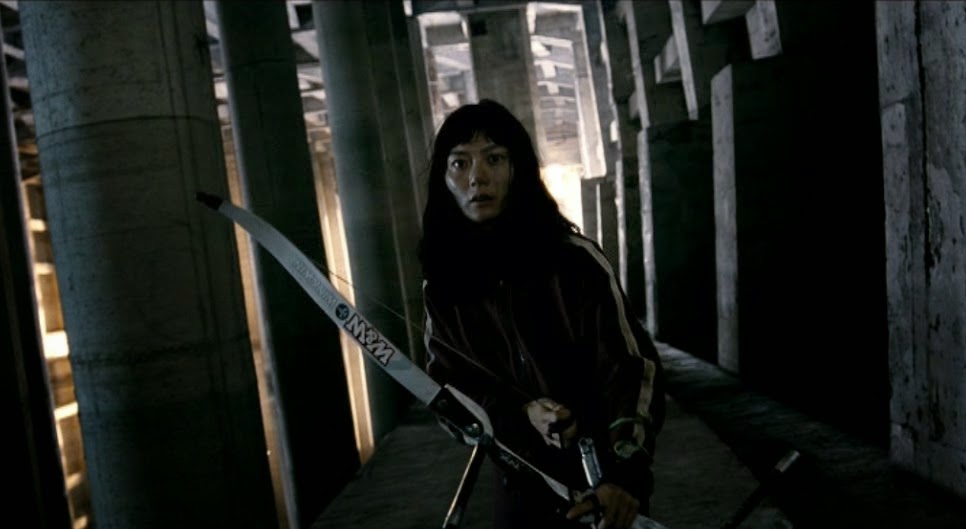
Here’s the basic premise: old-timer Hee-bong (Byun Hee-bong) runs a riverbank fast food stall, aided by his dimwitted and clumsy son Gang-du (Song Kang-ho) and Gang-du’s daughter Hyun-seo (Go Ah-Sung). Hee-bong’s other son is an unemployed college graduate, Nam-il (Park Hae-il). His daughter Nam-joo (Bae Doona) is an Olympic-standard archer who, as the film opens, defaults to bronze medal due to her habit of hesitating at the crucial moment. When the creature terrorizes the riverbank, only Gang-du is on hand to save Hyun-seo, but he trips at a crucial moment and, disorientated, grabs what he thinks is his daughter’s hand; by the time he realises he’s saved a complete stranger (albeit to her actual father’s gratitude), the creature has carried Hyun-seo off to its lair.


Gang-du has already been established as an imbecile, inveterately clumsy and a total failure. As the film progresses, virtually his every attempt to do something heroic (during the initial attack, he is one of only two people who attempt a fight back against the monster) not only backfires but sometimes costs an innocent life. The old saw about not being able to do right for doing wrong seems like a punchline the gods have written with Gang-du’s entire life being the set up.

‘The Host’, ladies and gentlemen, is comedy-horror. Horror of the most fetid and tactile variety. Comedy of cruellest hue. I’ve seen mean-spirited exploitation shockers that have put their characters through more charitable narratives than ‘The Host’. Seriously: ‘The House on the Edge of the Park’ is ‘Jackanory’ compared to this motherfucker.

You see, it’s not just Gang-du who is incompetent: Hee-bong is ripped off by a gang of tricksters who promise a means of rescuing his granddaughter; Nam-joo’s would-be iconic face-off against the monster is bluntly curtailed (same reason she got the bronze instead of the gold); Nam-il’s attempts to succeed where Gang-du has failed are thwarted at virtually every turn; Hee-bong’s moment of old-school heroism ends in abject failure; and even Hyun-seo’s make-do survivalism in the monster’s lair works its way to a subversive conclusion. I repeat: this is meant to be a comedy.


And not only is the comedy often sociopathically unfunny, it’s inconsistent. The failings and thwartings of Hee-bong’s brood suddenly morph into focused teamwork and slo-mo iconography which feel more like a sop to the audience-battering of the previous two hours than anything arrived at by narrative honesty. Moreover, a subplot which seems to be gearing up towards a shattering commentary on the tendency of political showboating to make things worse, not to mention the exacerbation resulting from American military intervention, is swiftly curtailed in favour of an effects-heavy finale.

It’s easy to overlook the faults of ‘The Host’ because its monster is so effective. Synthesizing the scaly hugeness of Godzilla, the double-mouthed razor-toothed gynaephobia of H.R. Giger’s ‘Alien’, and a weird, high-tensile, tail-like protuberance by which it can swing across the underside of bridges. Every time it appears onscreen, the effect is both hypnotic and slightly repellent. Whatever the film’s failings, ‘The Host’ can parade its monster as one of the greatest cinema has given us.

The failings, though, are in its human element. The satire chickens out, deflecting away from American interventionism and taking cheap shots at, for the most part, a mentally subnormal and patently scared individual. The narrative rewards hard-won heroism with cynical punchlines. The film spends two hours putting characters and audience alike through the wringer, continually promising them a specific denouement then pulling the rug; playing God with outcomes; and finally bowing out on an ending that it hasn’t earned and doesn’t deserve.

Sunday, October 26, 2014

13 FOR HALLOWEEN #10: Cronos


Jesus Gris (Federico Luppi) – a character whose name screams “religious subtext” – is a sixty-something antiques dealer and carer to his granddaughter Aurora (Tamara Shanath). One day he finds a device in the statue of an angel; said object – the Cronos device of the title – looks like a snuff box designed by the Cenobites. It releases arm-like needles which clamp around his hand and penetrate his skin. The Cronos device, Jesus learns, contains a lot of clockwork and a very old insect (it’s been around since 1536); the insect produces a secretion which rejuvenates the blood, but at a price.

Reclusive millionaire Dieter de la Guardia (Claudio Brook) knows all about the price: he’s a rich man and he’s prepared to go to any lengths to get his hands on the Cronos device. Unlike Jesus, however, Dieter owns the instruction manual and is cognisant of the very strict rules around its use. He dispatches his thuggish nephew Angel (Ron Perlman) to recover it by any means.


All Jesus knows about the device is that it leaves him feeling (and looking) younger. Vitality and sexual appetite reappear. He also finds himself hankering for blood. When he refuses to give over the Cronos device to Dieter and Angel, despite his shop being trashed as a warning, Angel steps up the campaign of victimisation and gives Jesus a beating. Same outcome: Jesus won’t play ball. Angel stages a car accident and leaves Jesus for dead. (And you have no idea how weird it is glancing back at that last sentence, particularly if you ignore the context.)

Hands up everyone who’s guessed he’ll come back from the dead? Hands up everyone who’s twigged that the very small and serious Aurora will welcome him back, totally unfreaked-out by his condition, and assist in his endeavours? Hands up everyone who’s intuited that said endeavours involve some unfinished business between Jesus and the de la Guardias?

‘Cronos’ adheres so doggedly to its three act structure – Jesus’s obsession with the Cronos device, ending in his “death”; Jesus as vampire, struggling to cope with being undead; Jesus vs the de la Guardias – that its hour an a half running time doesn’t leave adequate space to explore any of the ideas or issues that each of these stages deal with. Barely has Jesus’s dependence on the device been established, at the trade off of age-reversal for a taste for blood, than he’s Angel de la Guardia’s hands and there’s been no attempt to explore the cost to his essential dignity of being revitalised. A scene in a men’s room where he’s just beginning to struggle with blood-lust and is effectively prepared to debase himself in order to get his fix is curtailed bluntly and viciously and any further exploration of the theme goes with it.


Act two fares better, and there are several subtle touches (particularly the backwards-worn funeral suit) that neatly suggest that being undead is ultimate dignity. Likewise, there’s a lovely moment where the now fully-vampiric Jesus seeks shelter with his granddaughter. Intuiting that sunlight negatively affects him, Aurora hides him in a big wooden trunk formerly used to store her playthings. The innocence of childhood in the toybox as makeshift coffin. There’s a similarly effective moment where Aurora hides the Cronos device in a teddy bear, which she offers to Jesus as much as something to hug for comfort as a hiding place for the vessel of his addiction.

Sadly, all such grace notes go out of the window for the finale. Ideas about addiction, immortality, obsession and religion quickly follow. A film that had the potential to be the thinking audience’s horror movie – and in a scattering of brief moments almost gets a toehold – finally comes down on the side of safe genre tropes and keeps its villains to the fore (director Guillermo del Toro, in his feature debut, seems half in love with Angel, a character who alternately snarls at peoples and beats them up) and loses focus on its fascinating, flawed, sad and sympathetic protagonist.

Thursday, October 23, 2014

13 FOR HALLOWEEN #9: Children of the Damned


Anton M. Leader’s ‘Children of the Damned’ continues the rigorous science vs. brute force debate established in Wolf Rilla’s ‘Village of the Damned’, but in all other respects this is a sequel that utterly up-ends its predecessor.

One plays out against the quaint cottages and open fields of its rural setting, the other in the cramped and sunless streets of London. One confines its drama to country houses and spic-and-span cottages, the other to grimy bedsits and abandoned buildings. One has a pragmatic retired professor as its protagonist, the other a younger impassioned psychoanalyst. One has a group of almost identical children, the other children of different nationalities. One implies that these children are the progeny of something alien, the other that they were virgin births.

And, crucially, one casts its otherworldly children firmly as villains, the other as misunderstood innocents.


Perhaps ‘Children of the Damned’ is best approached not as a sequel but a flipside or a reinterpretation. The film starts in media res with six children – variously Chinese, Nigerian, Russian, Indian, American and English – brought together for study by a UNESCO committee on child development. Tom Llewellyn (Ian Hendry) and David Neville (Alan Badel), respectively a psychologist and a geneticist, are researching the background to the English lad, Paul (Clive Powell). Their access is hampered by his mother who is hysterical and adamant that she has no business having a son since no man has ever touched her. Tom and David, in something of a sweeping generalisation, correlate her profession as photographer’s model with licentiousness and initially disbelieve her story.

Later, following an unfortunately (and mildly suspicious) road accident, Paul enters the care of his sympathetic aunt, Susan (Barbara Ferris). The children, swiftly cohering into a telepathic unit, employ mind control over Susan to assist them take shelter in a disused church. So far, so ‘Village of the Damned’. But it soon becomes apparent that Paul and his comrades are only using their mental powers when threatened, and that their coercion of Susan is merely a temporary requirement and they mean her no harm. While still crossing a certain line in terms of social norms, their behaviour is far removed from the show of force that the children of Midwich delighted in reiterating in the first movie.

A crucial narrative development has Tom initially convince the children to leave the church and report to their nations’ embassies. The callous political brinkmanship of the adult world immediately becomes apparent: their ambassadors welcome them delightedly, keen to remodel them as weapons. Telekinetics prized for their use in some potential psychic war. It can only be speculated how much inspiration ‘Children of the Damned’ had on ‘Scanners’. As with ‘Village of the Damned’, there’s a sense of the film as pre-Cronenberg Cronenberg. If anything, Cronenberg’s visceral disgust at the human condition and his major theme of God as an absent landlord is even stronger in ‘Children of the Damned’.


Naturally, the children respond to threat by using their powers against it and, several dead ambassadors later, they’re back at the church. The house of God as social realist Alamo. Yes, that’s a distinction worth emphasizing: if ‘Village’ uses its sleepy rural setting as an effective counterpoint to its fantastical concepts, then ‘Children’ is sci-fi dystopia as kitchen sink drama.

‘Children of the Damned’ uses a broader canvas and asks thornier questions than ‘Village’. It’s 15 minutes longer yet spans a shorter timeline and contains arguably less incident. It lacks the precise craftsmanship of Wolf Rilla’s direction while John Briley’s script takes longer to debate its big themes than Stirling Silliphant’s. Together, they complement, offset and challenge each other. ‘Village’ is arguably the more superbly crafted work, ‘Children’ the more intellectually satisfying.

Tuesday, October 21, 2014

13 FOR HALLOWEEN #8: Village of the Damned


John Wyndham’s particular genius was for welding gnarly sci-fi concepts to an ineffably English worldview. And nowhere was this more fully expressed than in the rural setting of ‘The Midwich Cuckoos’.

By a strange quirk, Englishness in cinema is often more accurately rendered by filmmakers of other nationalities: Joseph Losey (American: ‘The Servant’, ‘Accident’), Alberto Cavalcanti (Brazilian: ‘Went the Day Well?’, ‘Nicholas Nickleby’), or the quintessential Englishness of Michael Powell as filtered through the Hungarian émigré sensibility (‘A Canterbury Tale’, ‘A Matter of Life and Death’).

‘The Midwich Cuckoos’ was filmed as ‘Village of the Damned’, adapted by American screenwriter Stirling Silliphant and helmed by German director Wolf Rilla. The result is a perfect depiction of stereotypical English stoicism, resilience and pragmatism, skewed just enough by a foreign perspective to emerge as something genuinely unsettling.

The film starts with everyone in the village of Midwich falling unconscious simultaneously. With the confident dexterity of a cardsharp knowing he’s got your attention from the outset, Rilla deals out images of prostrate bodies in the middle of narrow lanes, sinks overflowing, irons burning through clothes, an LP catching on a phonogram, the same note playing over and over, a tractor trundling in circles, its driver slumped over the wheel. Cosy, comfortable, English settings and images – but creepily subverted.


Next up, a self-contained sequence where the military establish a cordon around Midwich and attempt ingress, first with a caged bird, then with a human volunteer. Rilla builds tension with the steady accretion of detail, playing off the by-the-book stiff-upper-lip rationale of the top brass against the slow dawning realisation that something is very wrong.

When Midwich re-awakes and the strange forcefield that seems to have cloaked the village disappears, the film makes its one concession to prudery and elides the mass pregnancy of all female citizens of child-bearing age (speculations on xenogenesis, i.e. impregnation by an alien entity, inform the novel) into a quick sequence of visits to the village’s increasingly harassed and befuddled doctor. The film then deals out another quick series of elisions, depicting the group of disconcerting similar children first preternaturally gifted infants and then as mini-adults, far more advanced in years than their age allows for. They go everywhere en masse. Their manner is aloof. There isn’t a trace of emotion in their behaviour.

Professor Gordon Zellaby (George Sanders), father to one of these uber-children, begins a study of them, keeping in close contact with his brother-in-law (Michael Gwynn) who was one of the military personnel in the opening scenes. Zellaby blags his way onto a British Intelligence think tank and a fraught series of discussions hammer through the speculative discourses of Wyndham’s novel with an economy that does Silliphant proud as a writer. The upshot is, basically, that Zellaby wants to learn from the children in order to understand them, while the military, concerned about similar phenomena in isolated areas across the globe, do what military types in movies of any genre do best and starting figuring out the best way of destroying the problem.

The science vs. brute force dialogue is stamped across the film’s tense 77-minute running time, and Rilla milks the stand-off for all it’s worth, Zellaby desperately securing a facility in which to study the children before gradually realising that the dynamic is actually the other way round, and that his benefaction might count for nothing when their use for him is exhausted.


‘Village of the Damned’ simmers with the threat of violence, either against the children or, increasingly, by them. Their telekinetic disposal of a grief-crazed shotgun-wielding villager, whose brother’s death they’d earlier caused, is all the nastier to watch because of the sense of complete detachment. In the best scenes, Rilla simply observes the children and the result is like watching a Cronenberg film made a decade and a half before Cronenberg got started.

In some aspects ‘Village of the Damned’ is dated, and – putting it tactfully – not all of the performances are of Sanders’s calibre, but it remains an intelligent, suspenseful chiller that sets out to challenge and unnerve and does so with clinical efficiency.

Sunday, October 19, 2014

13 FOR HALLOWEEN #7: John Dies at the End


I’ve never read David Wong’s novel, or its just-as-wonderfully-titled sequel ‘This Book is Full of Spiders: Seriously, Dude, Don’t Touch It’, but I have it on good authority that it’s a madcap romp through multifarious horror genre tropes that manages to be deadpan sarcastic even as its narrative becomes increasingly ludicrous.

Perfect fit for Don Coscarelli, then.

And indeed Coscarelli delivers a film of such no-budget demented inventiveness that it makes his earlier ‘Bubba Ho Tep’ look as staid and austere as your average Strindberg play.

Opening with the old perceptional hook of whether an axe that beheaded someone and subsequently has its handle and then its blade replaced can be displayed as the same axe – only using a neo-Nazi zombie and some weird otherworldly kind of slug creature by way of illustration – ‘John Dies at the End’ continues in equally discursive fashion as David (Chase Williamson) narrates to seedy journalist Arnie (Paul Giamatti) the events which led to him and eponymous best bud John (Rob Mayes) damn near brokering the end of the world.


To say what ensues is a shaggy dog story is to make the hitherto shaggiest of dogs look virtual bald by comparison. David, possessed of a number of preternatural abilities including telepathy, precognition and astral projection, spends a decent chunk of the running time recapping how he and John found themselves working as … well … I would say ghostbusters, but Vengler and co would have to spend a lot of time on Cheech and Chong’s couch in order to approximate anything like David and John’s approach to the craft. 

Long story short, it’s exposure to a drug nicknamed “soy sauce” – a narcotic that’s more H.P. Lovecraft than ‘Breaking Bad’ – that imbues them with their abilities. During their misadventures, David ends up babysitting a labrador that belongs to his crush, the winsome Amy (Fabianne Therese), and what the drug does to the dog would make the judges at Crufts doubt their sanity. This established, we segue into the real story of David and John’s race against the clock to uncover the truth behind a spate mysterious deaths and the existence of a oddball cult who worship a Cthulu-like entity, all the while evading the psychotic interventions of a Bible-bashing detective.

It’s a story that encompasses a meat demon, a womanising televangelist, a church full of half naked people wearing freaky masks, a Rastafarian psychic who knows the date the first nuclear missile will land on America (and still has a chuckle about it), a decidedly literal case of phantom limb syndrome, the worst garage band ever to get their hands on an amplifier, a cartoon in which human sacrifices are made to giant spiders, and the most juvenile visual joke about a doorknob ever committed to film.

Oh, and there’s a deus ex machina involving a pick-up truck and the aforesaid dog. In fact, the dog is nothing short of heroic. The dog is called Bark Lee, he plays himself, and his performance is magnificent.


Working with a budget that didn’t cast its shadow quite as far as million, Coscarelli delivers a solidly-made film with acceptable effects, good cinematography and a cluster of likeable performances. Giamatti, who seems to be coasting of late, has a hell of a lot of fun; Mayes and Williamson are absolutely spot-on and play off each other beautifully, and Clancy Brown is terrific as televangelist Marconi.

‘John Dies at the End’ is utterly bonkers. It defies any real critical framework in terms of appraisal, firing off wild scattershot broadsides at genre, convention and audience expectation – beginning with the title and even ricocheting through the end credits. It’s a film that’s rated WTF and best viewed in SuperSpliffVision. It’d take an utter dullard not to get ecstatically and crazily lost in its labyrinth of absurdities.

Tuesday, October 14, 2014

13 FOR HALLOWEEN #6: The Thing (2011)


There’s an awkwardness to Matthijs van Heijningen Jr’s ‘The Thing’ that is immediately discernible from its title, which suggests a remake of John Carpenter’s bona fide classic (in my humble opinion, still the greatest horror movie ever made), which is in itself a remake of Howard Hawks’s ‘The Thing from Another World’, and all of them to a greater or lesser degree inspired by John W Campbell Jr’s novella ‘Who Goes There?’ 

But ‘The Thing’ (2011 version) – hereinafter referred to as ‘TT11’ to prevent repetitive strain injury – is actually a prequel. Only it adheres very explicitly to Carpenter’s film … except when it retro-engineers itself to fill in the lacunae … only the lacunae are there in Carpenter’s film to provide a visceral undertone of irony. Let’s face it: the trip to the ruined Norwegian base gives us just enough clues to realise that what happened there is just about to kick off at the American base.

And therein lies the problem. If ‘The Thing’ is about how an assimilative alien being decimates a research station full of big hairy Americans, then a prequel must necessarily depict how an assimilative alien being decimates a research station full of big hairy Scandinavians in almost exactly the same manner. No, wait, backtrack a minute: a research station full of big hairy Scandinavians and one very attractive American.


‘TT11’ starts with palaeontologist Kate Lloyd (Mary Elizabeth Winstead) recruited by prissy scientist Dr Halvorson (Ulrich Thomsen) to fly out to the Norwegian base at a moment’s notice to give her professional opinion on something rather unclassifiable that they’ve just retrieved from the ice; and before you can say “obvious sop to US audiences” the winsome Ms Winstead is acting as a surrogate for the audience as her oddly-vowelled paymasters release the aforementioned alien being from its frosty hibernation and … well, you’ve seen the vastly superior Carpenter film, so you know the rest.

It’s astounding how obsessively ‘TT11’ clings to ‘The Thing’, right down to the big “let’s use a blood test to determine who’s infected” sequence. Granted, ‘TT11’ contrives a way to make the blood test not viable, and the alternative at least suggests a smidgin of originality, but the scene pays off so routinely that it squanders the opportunity to do something different and surprising with the material.

Perhaps the only truly interesting thing ‘TT11’ does is at the very end. With Kate posited as final girl from the outset, the film ends on a note that initially seems like just another sop to its predominantly homeland audience. Except that it communicates a single, devious implication that works its way into your consciousness a few minutes after the end credits have rolled. A decent touch, but too little too late. Ultimately, ‘TT11’ is reasonably well-made film, rich in attention to detail, that has no reason whatsoever to exist.

Sunday, October 12, 2014

13 FOR HALLOWEEN #5: Toy Story of Terror


Woody (Tom Hanks) and the gang are passing the time during a cross-country drive. The trunk of a car can be a dark and claustrophobic place so they distract themselves by watching a horror movie on a laptop. Which is kind of like an ophidiophobe chilling out with ‘Snakes on a Plane’. And it doesn’t help that Mr Pricklepants (Timothy Dalton) – who really ought to be called Mr Smartypants – keeps talking over the film, giving a running commentary on horror movie tropes and how the narrative plays out. When a flat tyre strands them at a dreary and, more to the point, isolated motel, Mr Pricklepants is in his element, confidently predicting that before too much longer the group will be split up and “picked off one by one”.

Confidently and accurately.

‘Toy Story of Terror’ may only be a short, but it’s as rich in ideas, inventiveness and entertainment as any of its feature-length brethren. While presenting a mildly scary tale for kids, the litany of horror genre lore and specific movie references that it throws out ensure its no less entertaining for adults. Indeed, the unforced panache with which its homages are staged – be it a shower curtain placed centrally in a tense cat-and-mouse scene or Buzz Lightyear (Tim Allen) declaring “I’ll be right back” – is a delight. It even teases the knowing adult audience with the possibility of Jessie the Cowgirl (Joan Cusack) as final girl.


Speaking of whom, the film neatly keys into its predecessors, relying on Jessie’s backstory from ‘Toy Story 2’ to generate tension: her claustrophobia when she’s accidentally locked in a tool box in an early scene foreshadows her requirement to be sealed in a box during the denouement when she has to … Ah, but that would be telling. Moreover, the solidarity of the toys holding hands as they slide inexorably towards the furnace at the end of ‘Toy Story 3’ is subverted as the group are split up during the genuinely tense middle section. Likewise, a sequence of captivity and attempted escape also echoes that instalment.

How scary is it? Well, there’s nothing that reaches the clammy heights of the furnace set-piece, or even the evil playhouse that is Sid’s bedroom in ‘Toy Story’. Nor is there anything as squirmily tense as the airport sequence in ‘Toy Story 2’. But as a comedy-horror, it works brilliantly. It works because, like the absolute best of Pixar, it’s been made with care and wit and attention to detail. Director Angus MacLane, who co-wrote it with Pixar stalwart Andrew Stanton, understand the horror genre; they know when to spoof and when to scare.

Am I making it sound like ‘Toy Story Does Scream’? Then so be it, but with the caveat that ‘Toy Story of Terror’ is funnier, cleverer and more sophisticated than ‘Scream’ – and, at 21 minutes, mercifully shorter.