Thursday, October 23, 2014
13 FOR HALLOWEEN #9: Children of the Damned
Anton M. Leader’s ‘Children of the Damned’ continues the rigorous science vs. brute force debate established in Wolf Rilla’s ‘Village of the Damned’, but in all other respects this is a sequel that utterly up-ends its predecessor.
One plays out against the quaint cottages and open fields of its rural setting, the other in the cramped and sunless streets of London. One confines its drama to country houses and spic-and-span cottages, the other to grimy bedsits and abandoned buildings. One has a pragmatic retired professor as its protagonist, the other a younger impassioned psychoanalyst. One has a group of almost identical children, the other children of different nationalities. One implies that these children are the progeny of something alien, the other that they were virgin births.
And, crucially, one casts its otherworldly children firmly as villains, the other as misunderstood innocents.
Perhaps ‘Children of the Damned’ is best approached not as a sequel but a flipside or a reinterpretation. The film starts in media res with six children – variously Chinese, Nigerian, Russian, Indian, American and English – brought together for study by a UNESCO committee on child development. Tom Llewellyn (Ian Hendry) and David Neville (Alan Badel), respectively a psychologist and a geneticist, are researching the background to the English lad, Paul (Clive Powell). Their access is hampered by his mother who is hysterical and adamant that she has no business having a son since no man has ever touched her. Tom and David, in something of a sweeping generalisation, correlate her profession as photographer’s model with licentiousness and initially disbelieve her story.
Later, following an unfortunately (and mildly suspicious) road accident, Paul enters the care of his sympathetic aunt, Susan (Barbara Ferris). The children, swiftly cohering into a telepathic unit, employ mind control over Susan to assist them take shelter in a disused church. So far, so ‘Village of the Damned’. But it soon becomes apparent that Paul and his comrades are only using their mental powers when threatened, and that their coercion of Susan is merely a temporary requirement and they mean her no harm. While still crossing a certain line in terms of social norms, their behaviour is far removed from the show of force that the children of Midwich delighted in reiterating in the first movie.
A crucial narrative development has Tom initially convince the children to leave the church and report to their nations’ embassies. The callous political brinkmanship of the adult world immediately becomes apparent: their ambassadors welcome them delightedly, keen to remodel them as weapons. Telekinetics prized for their use in some potential psychic war. It can only be speculated how much inspiration ‘Children of the Damned’ had on ‘Scanners’. As with ‘Village of the Damned’, there’s a sense of the film as pre-Cronenberg Cronenberg. If anything, Cronenberg’s visceral disgust at the human condition and his major theme of God as an absent landlord is even stronger in ‘Children of the Damned’.
Naturally, the children respond to threat by using their powers against it and, several dead ambassadors later, they’re back at the church. The house of God as social realist Alamo. Yes, that’s a distinction worth emphasizing: if ‘Village’ uses its sleepy rural setting as an effective counterpoint to its fantastical concepts, then ‘Children’ is sci-fi dystopia as kitchen sink drama.
‘Children of the Damned’ uses a broader canvas and asks thornier questions than ‘Village’. It’s 15 minutes longer yet spans a shorter timeline and contains arguably less incident. It lacks the precise craftsmanship of Wolf Rilla’s direction while John Briley’s script takes longer to debate its big themes than Stirling Silliphant’s. Together, they complement, offset and challenge each other. ‘Village’ is arguably the more superbly crafted work, ‘Children’ the more intellectually satisfying.
Tuesday, October 21, 2014
13 FOR HALLOWEEN #8: Village of the Damned
John Wyndham’s particular genius was for welding gnarly sci-fi concepts to an ineffably English worldview. And nowhere was this more fully expressed than in the rural setting of ‘The Midwich Cuckoos’.
By a strange quirk, Englishness in cinema is often more accurately rendered by filmmakers of other nationalities: Joseph Losey (American: ‘The Servant’, ‘Accident’), Alberto Cavalcanti (Brazilian: ‘Went the Day Well?’, ‘Nicholas Nickleby’), or the quintessential Englishness of Michael Powell as filtered through the Hungarian émigré sensibility (‘A Canterbury Tale’, ‘A Matter of Life and Death’).
‘The Midwich Cuckoos’ was filmed as ‘Village of the Damned’, adapted by American screenwriter Stirling Silliphant and helmed by German director Wolf Rilla. The result is a perfect depiction of stereotypical English stoicism, resilience and pragmatism, skewed just enough by a foreign perspective to emerge as something genuinely unsettling.
The film starts with everyone in the village of Midwich falling unconscious simultaneously. With the confident dexterity of a cardsharp knowing he’s got your attention from the outset, Rilla deals out images of prostrate bodies in the middle of narrow lanes, sinks overflowing, irons burning through clothes, an LP catching on a phonogram, the same note playing over and over, a tractor trundling in circles, its driver slumped over the wheel. Cosy, comfortable, English settings and images – but creepily subverted.
Next up, a self-contained sequence where the military establish a cordon around Midwich and attempt ingress, first with a caged bird, then with a human volunteer. Rilla builds tension with the steady accretion of detail, playing off the by-the-book stiff-upper-lip rationale of the top brass against the slow dawning realisation that something is very wrong.
When Midwich re-awakes and the strange forcefield that seems to have cloaked the village disappears, the film makes its one concession to prudery and elides the mass pregnancy of all female citizens of child-bearing age (speculations on xenogenesis, i.e. impregnation by an alien entity, inform the novel) into a quick sequence of visits to the village’s increasingly harassed and befuddled doctor. The film then deals out another quick series of elisions, depicting the group of disconcerting similar children first preternaturally gifted infants and then as mini-adults, far more advanced in years than their age allows for. They go everywhere en masse. Their manner is aloof. There isn’t a trace of emotion in their behaviour.
Professor Gordon Zellaby (George Sanders), father to one of these uber-children, begins a study of them, keeping in close contact with his brother-in-law (Michael Gwynn) who was one of the military personnel in the opening scenes. Zellaby blags his way onto a British Intelligence think tank and a fraught series of discussions hammer through the speculative discourses of Wyndham’s novel with an economy that does Silliphant proud as a writer. The upshot is, basically, that Zellaby wants to learn from the children in order to understand them, while the military, concerned about similar phenomena in isolated areas across the globe, do what military types in movies of any genre do best and starting figuring out the best way of destroying the problem.
The science vs. brute force dialogue is stamped across the film’s tense 77-minute running time, and Rilla milks the stand-off for all it’s worth, Zellaby desperately securing a facility in which to study the children before gradually realising that the dynamic is actually the other way round, and that his benefaction might count for nothing when their use for him is exhausted.
‘Village of the Damned’ simmers with the threat of violence, either against the children or, increasingly, by them. Their telekinetic disposal of a grief-crazed shotgun-wielding villager, whose brother’s death they’d earlier caused, is all the nastier to watch because of the sense of complete detachment. In the best scenes, Rilla simply observes the children and the result is like watching a Cronenberg film made a decade and a half before Cronenberg got started.
In some aspects ‘Village of the Damned’ is dated, and – putting it tactfully – not all of the performances are of Sanders’s calibre, but it remains an intelligent, suspenseful chiller that sets out to challenge and unnerve and does so with clinical efficiency.
Sunday, October 19, 2014
13 FOR HALLOWEEN #7: John Dies at the End
I’ve never read David Wong’s novel, or its just-as-wonderfully-titled sequel ‘This Book is Full of Spiders: Seriously, Dude, Don’t Touch It’, but I have it on good authority that it’s a madcap romp through multifarious horror genre tropes that manages to be deadpan sarcastic even as its narrative becomes increasingly ludicrous.
Perfect fit for Don Coscarelli, then.
And indeed Coscarelli delivers a film of such no-budget demented inventiveness that it makes his earlier ‘Bubba Ho Tep’ look as staid and austere as your average Strindberg play.
Opening with the old perceptional hook of whether an axe that beheaded someone and subsequently has its handle and then its blade replaced can be displayed as the same axe – only using a neo-Nazi zombie and some weird otherworldly kind of slug creature by way of illustration – ‘John Dies at the End’ continues in equally discursive fashion as David (Chase Williamson) narrates to seedy journalist Arnie (Paul Giamatti) the events which led to him and eponymous best bud John (Rob Mayes) damn near brokering the end of the world.
To say what ensues is a shaggy dog story is to make the hitherto shaggiest of dogs look virtual bald by comparison. David, possessed of a number of preternatural abilities including telepathy, precognition and astral projection, spends a decent chunk of the running time recapping how he and John found themselves working as … well … I would say ghostbusters, but Vengler and co would have to spend a lot of time on Cheech and Chong’s couch in order to approximate anything like David and John’s approach to the craft.
Long story short, it’s exposure to a drug nicknamed “soy sauce” – a narcotic that’s more H.P. Lovecraft than ‘Breaking Bad’ – that imbues them with their abilities. During their misadventures, David ends up babysitting a labrador that belongs to his crush, the winsome Amy (Fabianne Therese), and what the drug does to the dog would make the judges at Crufts doubt their sanity. This established, we segue into the real story of David and John’s race against the clock to uncover the truth behind a spate mysterious deaths and the existence of a oddball cult who worship a Cthulu-like entity, all the while evading the psychotic interventions of a Bible-bashing detective.
It’s a story that encompasses a meat demon, a womanising televangelist, a church full of half naked people wearing freaky masks, a Rastafarian psychic who knows the date the first nuclear missile will land on America (and still has a chuckle about it), a decidedly literal case of phantom limb syndrome, the worst garage band ever to get their hands on an amplifier, a cartoon in which human sacrifices are made to giant spiders, and the most juvenile visual joke about a doorknob ever committed to film.
Oh, and there’s a deus ex machina involving a pick-up truck and the aforesaid dog. In fact, the dog is nothing short of heroic. The dog is called Bark Lee, he plays himself, and his performance is magnificent.
Working with a budget that didn’t cast its shadow quite as far as million, Coscarelli delivers a solidly-made film with acceptable effects, good cinematography and a cluster of likeable performances. Giamatti, who seems to be coasting of late, has a hell of a lot of fun; Mayes and Williamson are absolutely spot-on and play off each other beautifully, and Clancy Brown is terrific as televangelist Marconi.
‘John Dies at the End’ is utterly bonkers. It defies any real critical framework in terms of appraisal, firing off wild scattershot broadsides at genre, convention and audience expectation – beginning with the title and even ricocheting through the end credits. It’s a film that’s rated WTF and best viewed in SuperSpliffVision. It’d take an utter dullard not to get ecstatically and crazily lost in its labyrinth of absurdities.
Tuesday, October 14, 2014
13 FOR HALLOWEEN #6: The Thing (2011)
There’s an awkwardness to Matthijs van Heijningen Jr’s ‘The Thing’ that is immediately discernible from its title, which suggests a remake of John Carpenter’s bona fide classic (in my humble opinion, still the greatest horror movie ever made), which is in itself a remake of Howard Hawks’s ‘The Thing from Another World’, and all of them to a greater or lesser degree inspired by John W Campbell Jr’s novella ‘Who Goes There?’
But ‘The Thing’ (2011 version) – hereinafter referred to as ‘TT11’ to prevent repetitive strain injury – is actually a prequel. Only it adheres very explicitly to Carpenter’s film … except when it retro-engineers itself to fill in the lacunae … only the lacunae are there in Carpenter’s film to provide a visceral undertone of irony. Let’s face it: the trip to the ruined Norwegian base gives us just enough clues to realise that what happened there is just about to kick off at the American base.
And therein lies the problem. If ‘The Thing’ is about how an assimilative alien being decimates a research station full of big hairy Americans, then a prequel must necessarily depict how an assimilative alien being decimates a research station full of big hairy Scandinavians in almost exactly the same manner. No, wait, backtrack a minute: a research station full of big hairy Scandinavians and one very attractive American.
‘TT11’ starts with palaeontologist Kate Lloyd (Mary Elizabeth Winstead) recruited by prissy scientist Dr Halvorson (Ulrich Thomsen) to fly out to the Norwegian base at a moment’s notice to give her professional opinion on something rather unclassifiable that they’ve just retrieved from the ice; and before you can say “obvious sop to US audiences” the winsome Ms Winstead is acting as a surrogate for the audience as her oddly-vowelled paymasters release the aforementioned alien being from its frosty hibernation and … well, you’ve seen the vastly superior Carpenter film, so you know the rest.
It’s astounding how obsessively ‘TT11’ clings to ‘The Thing’, right down to the big “let’s use a blood test to determine who’s infected” sequence. Granted, ‘TT11’ contrives a way to make the blood test not viable, and the alternative at least suggests a smidgin of originality, but the scene pays off so routinely that it squanders the opportunity to do something different and surprising with the material.
Perhaps the only truly interesting thing ‘TT11’ does is at the very end. With Kate posited as final girl from the outset, the film ends on a note that initially seems like just another sop to its predominantly homeland audience. Except that it communicates a single, devious implication that works its way into your consciousness a few minutes after the end credits have rolled. A decent touch, but too little too late. Ultimately, ‘TT11’ is reasonably well-made film, rich in attention to detail, that has no reason whatsoever to exist.
Sunday, October 12, 2014
13 FOR HALLOWEEN #5: Toy Story of Terror
Woody (Tom Hanks) and the gang are passing the time during a cross-country drive. The trunk of a car can be a dark and claustrophobic place so they distract themselves by watching a horror movie on a laptop. Which is kind of like an ophidiophobe chilling out with ‘Snakes on a Plane’. And it doesn’t help that Mr Pricklepants (Timothy Dalton) – who really ought to be called Mr Smartypants – keeps talking over the film, giving a running commentary on horror movie tropes and how the narrative plays out. When a flat tyre strands them at a dreary and, more to the point, isolated motel, Mr Pricklepants is in his element, confidently predicting that before too much longer the group will be split up and “picked off one by one”.
Confidently and accurately.
‘Toy Story of Terror’ may only be a short, but it’s as rich in ideas, inventiveness and entertainment as any of its feature-length brethren. While presenting a mildly scary tale for kids, the litany of horror genre lore and specific movie references that it throws out ensure its no less entertaining for adults. Indeed, the unforced panache with which its homages are staged – be it a shower curtain placed centrally in a tense cat-and-mouse scene or Buzz Lightyear (Tim Allen) declaring “I’ll be right back” – is a delight. It even teases the knowing adult audience with the possibility of Jessie the Cowgirl (Joan Cusack) as final girl.
Speaking of whom, the film neatly keys into its predecessors, relying on Jessie’s backstory from ‘Toy Story 2’ to generate tension: her claustrophobia when she’s accidentally locked in a tool box in an early scene foreshadows her requirement to be sealed in a box during the denouement when she has to … Ah, but that would be telling. Moreover, the solidarity of the toys holding hands as they slide inexorably towards the furnace at the end of ‘Toy Story 3’ is subverted as the group are split up during the genuinely tense middle section. Likewise, a sequence of captivity and attempted escape also echoes that instalment.
How scary is it? Well, there’s nothing that reaches the clammy heights of the furnace set-piece, or even the evil playhouse that is Sid’s bedroom in ‘Toy Story’. Nor is there anything as squirmily tense as the airport sequence in ‘Toy Story 2’. But as a comedy-horror, it works brilliantly. It works because, like the absolute best of Pixar, it’s been made with care and wit and attention to detail. Director Angus MacLane, who co-wrote it with Pixar stalwart Andrew Stanton, understand the horror genre; they know when to spoof and when to scare.
Am I making it sound like ‘Toy Story Does Scream’? Then so be it, but with the caveat that ‘Toy Story of Terror’ is funnier, cleverer and more sophisticated than ‘Scream’ – and, at 21 minutes, mercifully shorter.
Friday, October 10, 2014
13 FOR HALLOWEEN #4: Blood: the Last Vampire
Chris Nahon’s visceral pop art opus sets itself the challenge of melding a ‘Kwaidan’-style backstory of a peaceful villager’s transformation into a vampire hunter with a 1970s set main plot that mixes tradition, militarism and a Japanese/American culture clash melee of frenetic and hyper-stylized action.
Wait a minute, what the fuck am I talking about? ‘Blood: the Last Vampire’ is a hopeless bit of nonsense about a hot Japanese girl in a sailor suit who despatches vampires with a bloody big sword.
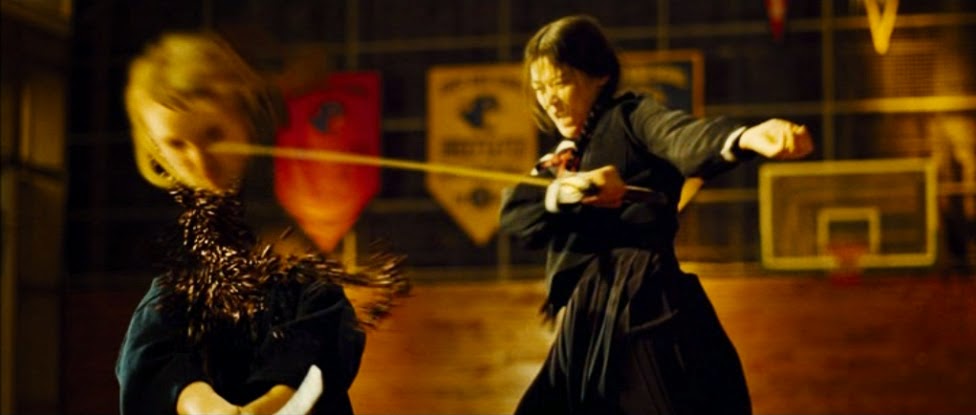
Or, only slightly expanded from the above synopsis, ‘Blood: the Last Vampire’ is about Saya (Gianna Jun), a three-hundred year old vampire killer (the longevity is due to the fact that she’s a vampire herself) who looks like she’s still in high school. Which is the perfect cover for her handler Michael Harrison (Liam Cunningham) to send her to a military academy on a US base in Toyko in the early 70s. Here she joins forces with the base commander’s rebellious daughter Alice (Allison Miller) while the shadowy organisation she works for – the Council – tears itself apart in a miasma of intrigue and treachery. Meanwhile, Saya’s centuries old nemesis, a demon named Onigen, waits in the wings.
The plot is at once stupidly simple and nonsensically overcomplicated, with the machinations of the Council ramped up to almost court-of-the-Borgias intensity for no other reason than to effect a Saya-goes-on-the-run plot point. The stakes are either world-shatteringly important or non-existent, depending on what scene you’re watching and how many proscribed substances you imbibed prior to watching the film.
What it all boils down to, though, is the entertainment value in watching a schoolgirl with a sword take down legions of the undead. Yet even with so basic an aesthetic driving it, ‘Blood: the Last Vampire’ falters. Jun certainly looks the part and she has a thousand yard stare that could make the entire cast of ‘Sons of Anarchy’ think twice about it, but her facility in the action sequences is painfully limited, and the more extended an intricate the action gets, the more desperate the editing techniques to disguise it. There’s so much of that speed-up-slow-down-speed-up nonsense that you’d swear you were watching a Guy Ritchie film on crack. Elsewhere, a scene where Onigen morphs from human form to demon and leads Saya on a rain-swept roof chase, the latter crashing through neon signs in pursuit, should have been edge-of-the-seat awesome … except that the neon sign looks like it was done in crayon by a five-year-old with no hand-eye co-ordination and Onigen resembles nothing more than a morbidly deformed wine gum.
The 1970s setting is completely arbitrary, the period evocation never convinces and the music cues are all over the place. A title card telling us we’re on an American base in 1970 is immediately superseded by a shot of some kids grooving in a corridor to Chuck Berry’s ‘You Never Can Tell’ (a big hit in 1964 that didn’t enter the charts again until Emmylou Harris covered it in 1978). The performances are uniformly turgid with even, sad to say, Liam Cunningham phoning it in. The action, as noted above, is ruined by the way it’s edited, and the gouts of CGI blood which accompany every swing of Saya’s sword look less like blood than pencilled-in motion capture of a carton of Ribena exploding.
All in all, it’s utterly dreadful, but dreadful in a way that’s strangely compelling. It’s a car-crash of a movie – mangled, broken, almost unrecognisable as an example of the form. You know you should show some common decency and look away but … you … just … can’t.
Labels:
13 for Halloween,
Allison Miller,
Gianna Jun,
Liam Cunningham
Tuesday, October 07, 2014
13 FOR HALLOWEEN #3: Scream, Blacula, Scream
Whereas ‘Blacula’ is a surprisingly faithful, if not adaptation, then reconsideration of Bram Stoker’s novel, ‘Scream, Blacula, Scream’ jettisons any connection with the source material. And the result is a mixed bag.
With cursed nobleman and reluctant bloodsucker Mamuwalde (William Marshall) decomposing at the end of the first film courtesy of a self-inflicted vampire/sunlight interface, director Bob Kelljan and no less than three scripters turn to voodoo to resurrect him. The film begins with a dying voodoo matriarch choosing diligent apprentice Lisa (Pam Grier) as her successor over her hot-tempered son Willis (Richard Lawson). Willis responds by acquiring Mamuwalde’s bones, intent on conjuring the vampire as a servant who will do his bidding and help secure what he sees as his rightful heritage. Predictably, this plan goes tits up and it’s Willis who finds himself in servitude to Mamuwalde.
In short order, Mamuwalde puts together a small army of the undead, attends a swinging party hosted by ex-cop and antiques collector Carter (John Mitchell) and meets Lisa. Looking at some African pieces that Carter is curating for a university, Mamuwalde recognises some jewellery that belonged to his long-dead wife Nuva. As with the first film, it is Mamuwalde’s romantic nostalgia for his lost love that humanises him but instead of seeking a surrogate, here he enlists Lisa’s help to lift the curse.
However, nothing in life (or in blaxploitation/horror crossovers) goes to plan, and Carter’s still-on-the-force colleague Lieutenant Dunlop (Michael Conrad) finds himself investigating several suspicious deaths, all with the same MO: puncture marks on the skin, and complete exsanguination. Misreading the face-palmingly obvious clues, he correlates the puncture marks with snakebites and snakes with voodoo and lays a strip for Willis’s pad. And thus the race against time for Lisa to complete the ritual before Dunlop and his boys lay siege.
Except that “race against time” suggests an urgency that ‘Scream, Blacula, Scream’ just doesn’t have. The rivalry for the heirdom of the voodoo clan establishes tension in the pre-credits scene, but Mamuwalde’s immediate dominance of Willis curtails that particular plot thread. Dunlop’s investigation, which counterpoints the main story, is so plodding and shambolic he makes Columbo look like Dirty Harry. And as for said main plot - Mamuwalde’s courtship of Lisa to release him from his curse – there is little dramatic or romantic dynamic in play. Consequently, much of the film consists of unconnected scenes lurching disjointedly towards a fairly small-scale denouement.
On the plus side, Marshall is every bit as commanding as he was in the original and his contemptuous disposal of a couple of jive-ass pimps is a moment to savour. Grier, too, is always worth watching, even though the script gives her a grand total of two pro-active moments, neither of which happen till the last ten minutes. The absolute best element of film, though, is the way it filters voodoo through vampire mythology and manages to play what is frankly a bonkers conceit with utter straight-faced bravado.
‘Scream, Blacula, Scream’ is to be applauded for not simply repeating its predecessor’s one-off concept of taking a timeless classic and putting a specific cultural spin on it; for instead striving towards a narrative and a direction that an entirely its own. Even if it doesn’t quite hold together as tightly ‘Blacula’, it gathers up a small collection of interesting ideas and runs pell-mell with them, even if some of them get dropped along the way.
Sunday, October 05, 2014
13 FOR HALLOWEEN #2: Blacula
Blending the horror and blaxploitation genres, and saddled with a title that seems to promise dumbass spoofery plus VAT, William Crain’s ‘Blacula’ actually emerges as a thoughtful and surprisingly faithful transportation of Stoker’s original from 1780s Transylavania to 1970s Los Angeles. Indeed, Crain opens his film at Castle Dracula in the last years of the eighteenth century as the aristocratic Mamuwalde (William Marshall) and his wife Luva (Vonetta McGee) petition Count Dracula (Charles Macaulay) to support their campaign against slavery. Dracula quickly shows his true colours (dude’s all for enslavement and subjugation) and punishes his guests for their liberal agenda by turning Mamuwalde into a vampire only to lock him in a coffin to deny him his bloodlust, and locking Luva in a crypt with said sealed sarcophagus until she expires of natural causes.
So far so cynical. Not a hint of comedy or satire. The animated opening credits sequence suggests otherwise, however, and some low-brow humour threads its way through the next sequence as the narrative jumps forward two centuries and a pair of camp antiques dealers visit Castle Dracula, on the market following a downturn in the estate’s fortunes, and cart off everything they can get their hands on, including the still-padlocked coffin containing the undead Mamuwalde. As soon as the action shifts to American soil, though, a more sombre tone predominates. Mamuwalde, seemingly nonplussed by the passage of two hundred years and entirely at home in streets bathed in neon and bustling with automotive transport to a soundtrack of R&B, swiftly notches up his first few victims.
The LAPD demonstrate a lack of concern at the pile-up of bodies, largely on account of their ethnicity. So it’s left to socially motivated coroner Dr Thomas (Thalmus Rasulala) to make the connections – exsanguination; bite marks; corpses mysteriously disappearing from morgues – and try to cajole jaded homicide dick Lt Peters (Gordon Pinsent) into taking the case more seriously. But things are about to get closer to home than Thomas imagined when his wife Michelle (Denise Nicholas)’s younger sister Tina (McGee again), the spitting image of the long-dead Nuva, attracts Mamuwalde’s attention.
‘Blacula’ boasts a brisk narrative that unfolds as both a gothic romance (the undead nobleman’s grand quest for his lost love) and a police procedural (Thomas – the film’s Helsing stand-in – and Peters working together to track down the vampire). Crain flips between the two strands with ease, maintaining both tension and a shadowy sense of inevitability. Although the script hardly gifts anyone with memorable dialogue, and the performances are generally adequate to the material and no more than that, ‘Blacula’ benefits immeasurably from its two leads. Marshall brings a dignity and gravitas to Mamuwalde that I really wasn’t expecting in a film with such a bad pun as a title (it says something that, apart from Dracula’s pre-credits curse on him, the character is steadfastly referred to as Mamuwalde throughout; the name “Blacula” is spoken maybe twice). Rasulala, too, has immense screen presence and grittily stripped down acting style reminiscent of Clint Eastwood. The ladies of the cast fare less well, but that’s more to do with underdeveloped roles. McGee is a sympathetic presence and Nicholas, in her debut film appearance, makes an impression.
The balance between Mamuwalde as tragic figure and Mamuwalde as dangerous villain is the fulcrum on which the success of the film depends – and Crain as director and Marshall as performer achieve the balancing act with aplomb. The subterranean finale creates an extraordinary dynamic between these aspects of the character, leading to a final scene that’s iconic and poignant and maybe even a tad Nietzschean.
‘Blacula’ had been on my radar for a while without my actually knowing much about the film. I approached it expecting B-movie tomfoolery and came away impressed by a thoughtful and entertaining piece of craftsmanship.
Friday, October 03, 2014
13 FOR HALLOWEEN #1: Apollo 18
The found footage genre has one essential flaw. I don’t know if there’s a collective or cultural description for it, but let’s go ahead and make one. Let’s call it Just Drop The Fucking Camera And Run You Doofus Syndrome.
Prime example of JDTCARYDS: ‘Cloverfield’. Big monster stomps all over hipster party – drop the camera and run, you doofus. Guy touting camera sees girl he likes in a state of emotional distress – drop the camera and go be a gentleman, you doofus. Guy touting camera happily goes strolling through military installation – not one rifle butt to the head or instruction to drop the camera ensues.
All damn found footage movies suffer from JDTCARYDS, even when it’s popped on a tripod and left to record ghostly goings-on overnight, a la ‘Paranormal Activity’, although in this example it’s more a case of Just Quit With The Home Movies And Go Sleep In Another Room You Doofus Syndrome.
All damn found footage movies … except one. Because how about if the camera was built into your spacesuit and you were running anyway?
Ladies and gentlemen, ‘Apollo 18’. Granted, it has a concept that sounds like barrel-scraping of highest (or should that be lowest?) order: hey guys, no-one’s made a found-footage movie in space yet! How cheap can we build an egg-carton lunar module? But at a taut 84 minutes and boasting a genuinely imaginative approach to the sub-genre, it emerges as a claustrophobically tense piece of work.
Writer Brian Miller and director Gonzalo López-Gallego get things right from the outset by wearing their influences like badges of honour: this ain’t ‘Blair Witch’ in space; this taps into a more primal and visceral stratum of fear. ‘Apollo 18’ is about isolation, about claustrophobia, about not knowing who to trust, about the terrifying realisation that there will be no rescue party, no escape route, no-one to help you. ‘Apollo 18’ taps into the same strand of horror that informed ‘Alien’ and ‘The Thing’, and it’s clear that the creative team behind it knew exactly what they were doing.
The film starts in typical found footage style with a seemingly disconnected stringing-together of grainy clips: the astronauts in training for their mission, to-camera vox-pops, home movie footage of families and barbecues. What’s impressive is how quickly small scraps of information cohere into subtle characterisation. Likewise, standard mockumentary tropes suddenly give way to a fully-formed narrative where the stakes are about as high as they get. Miller and López-Gallego sneak things up on the viewer with such legerdemain and Swiss-watch precision that ‘Apollo 18’ is a joy to watch even while it’s scaring the crap out of you. (Although it would be remiss of me, as a reviewer, not to mention that the plot lurches into some pretty melodramatic territory for no other reason than to set up a rather needless twist.)
That said, because of how cleverly and subtly it’s done, I’m loathe to discuss the mechanics of plot. There are some movies you just don’t want to spoil, even moderately, for the viewer who hasn’t yet acquainted themself. Let’s just say that ‘Apollo 18’ plays its hand simply by having an object in the corner of the screen – an object that shouldn’t have any business with mobility – moving very slightly for a fraction of a second. It should be silly; it’s actually terrifying. The film quickly seals the deal with a set-piece involving the descent into a crevasse – the whole thing lit by intermittent flashes of light – that becomes a symphony of half-glimpsed horrors.
From just south of its halfway mark onwards, ‘Apollo 18’ starts ratcheting up the tension and doesn’t give its characters a moment to draw breath until the grimly inevitable denouement. It does a similar job on the audience.
Wednesday, October 01, 2014
Bigger, better, more! Shorter, fewer, less!
It’s been barren on Agitation recently, but this time
I have a bona fide excuse. A couple of weeks ago I suffered
a flare-up of an impinged nerve that I had treated earlier this year. It
affected my right shoulder, arm and hand. Painkillers had minimal effect.
Fortunately, I had an “open appointment” with the physiotherapist. The pain
reached its worst over the weekend and I’ve barely slept in the last 72 hours
as a result. Formulating thoughts in order to structure a film review seemed
like Sisyphus getting the boulder to the top of the mountain. Typing wasn’t an
option. Even now, having seen the physio earlier today and commenced a
treatment plan, I’m typing this hunt-and-peck stylee and it’s damned bloody
frustrating!
I had two 13 For Halloween reviews in the bag before
the flare-up and these will appear in the next few days. Thereafter, 13 For
Halloween will continue as planned (my friend and fellow horror fanatic Debbie
cherrypicked her DVD collection to provide me with some cracking material) but
reviews will be shorter than usual while physio continues. Much as 13 For
Halloween and the Winter of Discontent are my favourite seasons on the blog,
getting myself back in shape and pain-free takes precedence.
Sunday, September 21, 2014
Matewan
(after the film by John Sayles)
“Welcome to Matewan. This here’s
a company town, and the company
is your benefactor and your god,
your pious mother and stern father.
Boys, think of yourselves as tools,
implements for the extraction of coal.
“We pay ninety cents per ton of coal,
but listen up: your train ride here,
your housing and clothing and tools –
them’s a debt you owe the company:
honour it like you honour your father,
pay it from your first wages, by God!
“There’s a meeting house for God
and prayer. But hear me, boys: coal’s
your cathedral, coal’s Your Father
who art in the mine, ninety cents, here
in the darkness as it is in the company,
ours is the profit and thou art the tools.”
You son of a bitch! Men ain’t tools,
doesn’t matter if they’re lost to God
or chosen to sit in His company
come the day this dark pit of coal
and all the corruption that’s here
on earth is the fuel for Our Father’s
prophecy: the last shall be first. Father,
deliver us. That, or give us the tools
to do the job ourselves: now, here,
in the face of men whose only god
is the ledger book written in coal-
black ink and tallied by the company
accountant. Deliver us from company
enforcers with clubs and guns. Father,
deliver us from the price of coal.
Or shelve forgiveness, give us the tools
and look away. In some places God
and man work differently. Like here,
in this company town. Down tools.
stand with father and brother. God’s
absent where coal is. In Matewan. Here.
(This sestina was inspired by John Sayles's film. The stanzas in quotation marks are not verbatim from the movie, but my re-imagining of the voice of the company man who, in an early scene, "welcomes" a new workforce to Matewan and informs them in no uncertain terms that they're pretty much owned by the company.)
Thursday, September 18, 2014
Kathleen Ferrier: An Ordinary Diva
In a career that lasted just fifteen meteoric years, Kathleen Ferrier went from prize-winning amateur at the Carlisle Festival to giving the definitive performance of Gluck’s ‘Orfeo ed Euridice’ at Covent Garden under Sir John Barbirolli, by way of still-unsurpassed professional relationships with Benjamin Britten (her Glyndebourne debut was in his just-written ‘The Rape of Lucretia’), Sir Adrian Boult and Bruno Walter. Ferrier’s recording with Walter of Mahler’s ‘Das Lied von der Erde’ is not only the most moving performance of the piece you’ll ever hear, but kickstarted a revival of interest in the composer following the blacklisting of his work under the Nazi regime. (Ferrier’s New York performances of Mahler with Walter and the New York Philharmonic were attended by Alma Mahler, the composer’s widow.)
Suzanne Phillips’s documentary, produced by the BBC under Lottery funding, keys into the importance of Ferrier’s discography, the sheer comet-like intensity of her career (in one single month, she gave 17 performances of Handel’s ‘Messiah’ – 17 performances of a taxing three hour oratorio in one freaking month), and the calibre of the conductors and orchestras she worked with; but the focus is always on Kathleen Ferrier as a person. And what an amazing, unpretentious, warm-hearted person! Drawing deeply on Ferrier’s correspondence – to friends and family she wrote witty, vivacious and conversational letters which she invariably signed “Kaff” – ‘An Ordinary Diva’ embraces its subject’s inherent likeability.
Indeed, there are times when the documentary almost seems like a puff piece. No-one has a bad word to say about her, and there’s almost a sense of a guilty secret finally breaking ground when soprano Adele Leigh recalls that Ferrier enjoyed reciting risqué limericks. Elsewhere, a letter dating from her 1947 collaboration with Fritz Stiedry (a conductor who is now almost forgotten) records that she recuperated from his bullish behaviour in rehearsals by taking herself off to the pub for “a dirty great pint”. This alone, even I wasn’t already in love with her recordings, makes me wish I could avail myself of a time machine, bugger off back to the late ’40s and sink a couple of pints with Ferrier. Put simply, she comes across as bloody good company.
Ferrier’s Amsterdam appearances in late 1946 marked the first time she travelled abroad and her letters capture the wide-eyed delight of the first-time tourist (albeit tempered by the working-class pragmatism of her Lancastrian upbringing). Her first concert appearance drew a small audience. A radio broadcast and a review so incandescent with praise that it made the front page of a Dutch newspaper turned the tide and successive performances sold out. Ferrier’s incursion into America was similarly bittersweet: the first tour saw her footing her own accommodation and expenses and ending up in debt as a result; next time round, she dictated terms and pocketed the proceeds instead of haemorrhaging them.
Add to the globetrotting (a seriously big deal for an English artiste in the first decade after the end of the war) a massively popular series of recordings on the Decca label and Ferrier looked set to conquer the world. Fate stepped in to dictate otherwise. In 1951, she was diagnosed with breast cancer. A mastectomy and chemotherapy (then called “radiation therapy”) seemed to keep the disease in check and Ferrier continued touring and recording. Secondary cancer proved terminal, however, with the cells moving to the bones. Under a sentence of death, Ferrier fought to complete two career-defining achievements. The first was a recording, with Walter, of ‘Das Lied von der Erde’. A beautifully understated archive interview with Ferrier’s personal assistant yields a telling memory: Ferrier, Walter and a few others listened to the master tape playback for the first time. As the last note faded, there was absolute silence. Then Ferrier turned to Walter and asked, “Was I all right, love?” That was the part of the documentary where I broke down and cried.
The second, her remission worsening, was ‘Orfeo’ – full staged performance – at Covent Garden. During the second night, her femur broke rendering her immobile on stage (and it can only be imagined in what degree of pain). Her supporting cast, including Leigh, tailored their performances to disguise her suffering and Ferrier insisted on a curtain call before being carried to a waiting ambulance. This is something worth remembering next time you watch a football match and some ponce-haired nobody plays to the gallery, clutching his leg and wailing after a tackle. Kathleen Ferrier was harder than your average professional sportsman.
Ferrier was only 41 when she died in her sleep. Ten years earlier and her career might have missed the golden age of recorded classical music. Ten years later and enough archive footage might have existed to render ‘An Ordinary Diva’ twice or three times its length. But speculation is pointless. The fact is, Kathleen Ferrier was taken from us on 8 October 1953. Her legacy is impossible to overstate. If anyone with even the vaguest interest in the repertoire can listen to her Mahler and remain dry-eyed, they’re possibly sociopathic. Decca have honoured her recordings and kept them in the catalogue. The 10-disc box set released to mark the fiftieth anniversary of her passing was a thing of beauty. Suzanne Phillips’s documentary – narrated by Robert Lindsay and with her letters read by Patricia Routledge – was not only timely but gave us the woman at the heart of the artist; the human being who embodied the passion.
Sunday, September 14, 2014
Pride (in the name of mediocrity)
During 1984 and 1985, the LGBT community – marginalised, ill-represented by the media, and denied their basic human rights by the Thatcher regime – demonstrated a remarkable socio-political stance and display of solidarity with the striking miners. They marched, they raised funds, and they battled a two-pronged assault by middle England: against homophobia, and against the anti-strike, anti-union fervour drummed up by the government and perpetuated by a media in the government’s pocket.
Plus ça motherfucking change, huh?
Early in Matthew Warchus’s film, Mark Ashton (Ben Schnetzer) points up the parallels as he rallies a group of militant protestors who centre around a gay and lesbian bookshop in London: both groups are hated by the Tory party, the police and a brainwashed society who belief what a biased media tell them. “The only problem we’ve got that they don’t is Mary Whitehouse,” he concludes. It’s a decent line and it got a good laugh at the screening I attended this afternoon. And that’s one of the problems. Stephen Beresford’s script is full of moments like this. Yeah, he makes a point. But in a throwaway manner. Too much of ‘Pride’ is reductive: a jokey line here, a cutesy moment there, a snippet of archive footage to remind us that all of this really happened.
IMDb bills ‘Pride’ as “comedy / drama / history”. The drama takes a back seat to the fuzzy feelgood moments and the zippy lines. History doesn’t seem to feature at all. ‘Pride’ reminded me a lot of ‘Made in Dagenham’: both are based on true stories, both are set in a very specific period of the recent past, and neither convinced, aesthetically, as period pieces. Whereas, say, ‘The Damned United’ utilizes cinematography and production design that conjures a convincing and evocation recreation of the 70s, ‘Made in Dagenham’ and ‘Pride’ just look like a bunch of people wearing more or less the fashions of the day filmed in bland BBC ‘Play for Today’ style against locations that haven’t even been set-dressed.
The bits of archive material that ‘Pride’ drops in – most notably the shocking image of Lesley Boulton in the split-second before she was clubbed by a mounted police officer at Orgreave – only serve to point up what the film is missing. There is no real sense of oppression by government; or of divided communities; or of hunger, deprivation and desperation; or of police brutality; or of … well … striking. In a film that clocks in at damn near two hours, there’s but one scene of picketing and it’s over in seconds.
The importance of the story told by ‘Pride’ is impossible to overestimate. Even after the strike ended, a massive contingent of Welsh miners arrived at the 1985 gay pride event, NUM (National Union of Mineworkers) banners aloft, and led the march in a show of solidarity. Subsequently, the Labour party moved to enshrined LGBT rights in its constitution, the motion powered through by block vote from the NUM. Additionally, women who had previously experienced little outside of their traditional roles as wives and mothers suddenly found themselves organising, fundraising, protesting, forming support groups, speaking to the media, addressing rallies, finding their voices and speaking out against Thatcher’s government. It’s a tragedy that Thatcher essentially betrayed her gender politically, but the immediate and damning response by a generation of working class women spoke for itself.
The miners’ strike remains a reactionary, searing and viscerally dramatic moment in British social, economic and politic history. And yet the great British movie on the strike still hasn’t been made. American cinema has given us the hammerblow of John Sayles’s ‘Matewan’; French cinema has given us both Yves Allégret and Claude Berri’s adaptations of Zola’s ‘Germinal’. Thirty years down the line, British cinema is still treating the miners’ strike as some sort of colourful backdrop to feelgood stories of self-expression, be it a brass band contest in ‘Brassed Off’ or no-son-of-mine-sensitive-lad-who-just-wants-to-dance in ‘Billy Elliott’. It’s as if no-one has had the balls to tell the real, gritty, gruelling story.
Fuck’s sake, British cinema, grow a pair, take a side, step up. Where the biopic of Arthur Scargill (imagine Andrew Scott, wasted in a nothing role in ‘Pride’, juggling with cinematic dynamite in the lead role)? Where the conspiracy thriller movie about the government’s machinations against the NUM, drawn from Seamus Milne’s ‘The Enemy Within’ (the creative team behind ‘Tinker Tailor Soldier Spy’ would ace this)? Where the underdog drama of the Nottinghamshire striking miners or the “dirty thiry” in Leicestershire holding the line against overwhelming numbers of scabs and media muck-racking (a Meadows-Consodine re-teaming waiting to happen)? Where the fearless, visceral, fuelled by white-hot righteous anger account of the events at Orgreave (Ben Wheatley: your cue, sir)?
Fuck’s sake, we have the talent, we have the passion, we have truth on our side. Please, British cinema, please: the hour is still to come.
Labels:
Andrew Scott,
Ben Schnetzer,
Matthew Warchus
Wednesday, September 10, 2014
GUEST REVIEW: Boy A
"They said I can choose my own name, any name?" says Eric Wilson, a.k.a. Jack Burridge, in the opening scene of 'Boy A'. It's a line that immediately establishes what the film is questioning. Identity. Who you are, who you don't want to be, who you can become.
Originally screened on Channel 4 in 2007, the film is an adaptation of the novel by Jonathan Triggell and it's easy to see why it's compared to the James Bulger case. But it shouldn't be. What 'Boy A' does is use the Bulger case to haunt the film, rather than be a version of it. 'Boy A' is essentially a coming-of-age story.
Jack Burridge (Andrew Garfield) has just been released from a young offenders' institution for a monstrous crime that he was involved in as a child, the details of which are gradually revealed as the film progresses. Terry (brilliantly played by Peter Mullen) is a probation officer who guides Jack into civilian life. What is apparent from the very beginning is how little Jack knows about real life: he doesn't know how to spend his wages, or what a panini is.
The relationship between Terry and Jack is almost father and son like, and it becomes obvious that Terry is proud of Jack as he becomes more independent in his new life. Terry introduces Jack as his nephew to Kelly (Siobhan Finneran), an acquaintance of Terry's who takes Jack in as a lodger. Terry helps Jack to secure a job at a local firm; it isn't clear what his duties are, but minor details are irrelevant. What is so fascinating is Jack's reactions to normal occurrences. He befriends his work colleague Chris (Shaun Evans) and begins a relationship with the office receptionist Michelle (Katie Lyons).
When Jack is invited out on a night out with his colleagues, he worries he may drink too much and reveal his past. During the evening, his colleagues keep encouraging him to relax and it is only when he is given a tab of E that he finally does so, cutting loose with some manic dance moves along the way. When the group enter the nightclub, there is an almost dream-like feel to the scene which emphasises Jack's innocent exploration/perception of his new surroundings. It is as if he can't quite believe what is happening to him, not just as a result of the drug, but the more natural high of enjoying his new life. He might be wondering if it is all a dream.
The evening ends, however, with a violent altercation that results in Jack nearly beating someone up, giving a glimpse into what he might be capable of and providing a reminder of his past. There is a flashback sequence of a young Jack - or Eric Wilson as he was then - and his friend Philip in an argument with a gang of older boys. Philip is depicted as the more violent of the two, aggressively laying into one of the gang members, and it is clear that he is the instigator in the pairs' misdoings.
The flashback sequences work very well throughout, every so often revealing a bit more of Jack's past, leaving the audience guessing as to the nature of his crime. Cumulatively, this makes for uncomfortable viewing, particularly in a sequence towards the end of the film where Jack's past catches up with him. The dream-like quality is also emphasised in these scenes. Sunlight suffuses the screen, lending a hazy feel to the outdoor scenes. Frequent scenes of Philip and Jack outside sets up a counterpoint to their future life of restraint in the young offenders' institution.
It is the denouement where Garfield really excels. Ironically, an act of heroism, rescuing a child from a crashed car, brings Jack to the attention of the local press. This precipitates a jealous response from Terry's son, disgusted at his father's drunken declaration that he sees Jack as a son, and the media focus suddenly turns upon Jack's hidden past. After being sacked from his job and Michelle's phone turned off, the realisation kicks in that the people he knows have found out about him. His breakdown is intense. Walking the streets in a hooded top, he becomes a fugitive and essentially a victim of his own crime. Unpredictably, he ends in a Blackpool where he sees Michelle on the pier and she tells him she would have forgiven him. This, however, appears to be another of the dream-like scenarios that have filled the film, and 'Boy A' leaves the audience to guess whether Jack, having left voicemail messages saying goodbye to Terry and Chris, is going to take his own life on Blackpool pier.
In what is easily Garfield's finest performance (it's a real shame he went down the Hollywood route rather than delivering more work of this calibre), he brings a boyish, fractured quality to his portrayal of Jack. He is awkward and innocent. There are moments in the film where you really care for him and it is practically forgotten why he essentially has to grow up at the age of 24 when he has already had three different lives: Eric Wilson, Boy A and finally Jack Burridge.
Amy Clarke
Saturday, September 06, 2014
The Raid
Reviewing ‘Dredd’ in May, I wondered if its lacklustre box office performance was due to the fact that it “came at the tail-end of two years’ worth of claustrophobic genre movies set in high-rise apartments, from grungy French zombie flick ‘La Horde’ to urban Brit horror ‘The Citadel’ by way of ‘Attack the Block’, ‘The Raid’, ‘Tower Block’, ‘Rammbock’ and however many others”.
And the point remains: every subgenre will eventually become overcrowded and spawn audience indifference. But by the same token, every subgenre will find its exemplar. ‘The Raid’ is the best tower-block-as-battleground movie you will ever see.
That it’s the best of its kind is probably a good thing, since much of it is clichéd, derivative and predictable. If it didn’t power through its gossamer-thin narrative with such demented energy – if it slowed its breakneck pace for even a second – the risk of outstaying its welcome would be palpable.
Here’s some of the hoary old tropes that ‘The Raid’ goes flaunting about with as if it truly were doing something new: the everything-to-lose hero introduced taking his leave of his pregnant wife; the nervous new recruit; the grizzled old-timer with a hidden agenda; the edgy, paranoid, unpredictable gang boss; the sadistic enforcer to said gang boss; the ease with which minor characters are massacred; the improbable injuries the major characters sustain and get back to their feet to fight some more; the predisposition of all parties to get into protracted bouts of hand-to-hand combat when there’s a perfectly functional small bore fireman within reach.
Plotwise, it never extends beyond cops storm tower block, crims bring the pain, an ulterior motive’s revealed, a double-cross takes place, a fuckload of people die. In fact, it’s pretty much interchangeable with ‘Dredd’ (except that ‘Dredd’ bothers to have a female character) right down to the crystal meth lab in one of the mezzanine levels. Because there’s always a crystal meth lab in a tower block, right? Never a counterfeiting operation or a fake fag house or a chop shop in the underground garage. No, it’s always a fucking crystal meth lab.
But I digress. And I’m also spending rather a lot of words banging on about the flaws in a film that I introduced as the exemplar of its subgenre. Which brings me back to the essential point: all ‘The Raid’ has to do to eclipse all other tower block based action movies is deliver more action. Be harder, faster, more relentless. And relentless is certainly the right word. It takes director Gareth Evans – a Welsh-born Jakarta-based filmmaker – just a few minutes to get his tooled up and eminently expendable squad of cops to the tower block. The tension is simmering away nicely by the ten-minute mark and things all go to hell only a few more minutes after that. There is not a dull moment in the whole 97 minutes. There isn’t a wasted frame or a moment of stasis. Everything that happens in ‘The Raid’ happens in order to perpetuate the momentum, to keep the characters on the move, to hyperlink from one violent or suspenseful scenario to the next.
The sequel is apparently a sprawling two and a half hour crime saga. How that will compare to the taut, claustrophobic setting from which Evans wrings every bit of action and suspense possible remains to be seen.
Wednesday, September 03, 2014
Calvary
A Guardian review quoted on the DVD cover blurb breathlessly labels John Michael McDonagh’s ‘Calvary’ a “rich, ripe and altogether delicious whodunit with a difference”. Which is, to varying degrees, accurate. Although a better description might be a “who’ll-do-it”. A stark, single-take pre-credits scene sets the tone: Father James (Brendan Gleeson) takes confession from an off-screen antagonist who recounts how he was sexually abused by a priest as a boy, and how he intends to kill Father James – in the full knowledge that the latter is a good priest – a week hence in retribution against the church entire.
McDonagh’s script never states it explicitly, but the parallel is clear: Jesus, innocent of worldly corruption dies for the sins of the world; two thousand years later, one good, idealistic, genuinely caring priest will die for the sins of the church. The film’s called ‘Calvary’ for a reason.
Having said that, the cinematic template that informs its increasingly doom-laden aesthetic is not so much ‘The Last Temptation of Christ’ as ‘High Noon’ … or at least a ‘High Noon’ where Will Kane wears a cassock instead of a sheriff’s badge, Frank Miller’s identity is kept hidden until the last ten minutes and there’s seven agonising days to the showdown instead of a fraught hour and a half. Again, the parallel is evident without being hammered home: both Will and Father James leave town at a critical point, only to turn back and face up to their date with destiny; both spend the finite time left to them in crucial interactions with the townsfolk. Both receive rejection from various quarters. Both benefit from the friendship of a wise elder who is nonetheless too old to be of any practical assistance – in ‘High Noon’, the retired marshal who was Will’s predecessor; in ‘Calvary’, an octogenarian novelist (M. Emmet Walsh) who is also waiting for the inevitable, but in his case via natural causes.
And both, eventually, face their enemy alone. The ending is where the similarities peter out, but again the title speaks for itself. Another difference: while Will petitions the townsfolk seeking help, Father James sets out to minister to them, to try to make a positive difference to their lives, one last time. An under-the-gun attempt to save someone’s soul; to justify the decision he made, in reaction to the death of his wife years earlier, to enter the priesthood. A decision that has complicated his relationship with his emotionally unstable daughter Fiona (Kelly Reilly).
Thus it is that Fiona returns to Father James’s parish for a few days while he makes his rounds and waits for the inevitable. His rounds bring him in contact with cynical hospital medic Dr Harte (Aidan Gillen), soulless businessman Michael Fitzgerald (Dylan Moran), smart-talking gigolo Leo (Owen Sharpe), and jovial butcher Jack Brennan (Chris O’Dowd) whose joviality masks the horns of a cuckold – his flirtatious wife Veronica (Orla O’Rourke) is carrying on with mechanic Simon (Isaach De Bankolé). Rounding out the trouble souls are Milo Herlihy (Killian Scott), a socially awkward young whom Father James is trying to talk out of joining the army, and convict Freddie Joyce (Domhnall Gleeson) who summons Father James not so much for absolution but a bit of company and time out of his cell.
If the Catholic church’s ignoble history of child abuse hangs heavily over the film like a storm cloud – nowhere more poignantly than in a scene when Father James strikes up a perfectly innocent and good-natured conversation with a young girl holidaying in the area only for her father to furiously bundle her away from him based on nothing more than the fact that he’s wearing a black robe – then its other key theme flows quietly below the surface like an underground spring: the church as anachronism, the role of the parish priest an exercise in redundancy. None of Father James’s flock have any use for him, except to mock. Or terrorise.
‘Calvary’ mines the vignettes that constitute its loose narrative – some profound, some satirical, some just plain absurd – from a pretty heavy thematic seam. A late-in-the-game meditation on forgiveness sets up a final scene fade-to-black designed to force the audience to take a thorny question away with them and spend some time wrestling with it.
All told, ‘Calvary’ comes very close to greatness. There are some awkward tonal shifts – a problem that afflicted McDonagh’s debut ‘The Guard’ – and the script often seems to stumble as it reaches for a spiritual profundity that’s clearly beyond it. Nor is McDonagh particularly well served by some of his cast. While Gleeson and Walsh are as good as they’ve ever been – and Moran is a revelation, reining in his smartarse comic persona to create a portrait of bored insouciant arrogance with a dead-eyed void at the centre of it – Reilly, O’Dowd and Gillen flounder, unable to bring to their performances what the script requires of them. I almost want to say that none of these things really matter – because when ‘Calvary’ works, it works – but the truth is, there’s nothing as frustrating as engaging with a work that truly has magnificence within its grasp but falls short.
Thursday, August 28, 2014
The Ox
I was drawn to Ben Proudfoot’s 10 minute documentary short on account of my father. Dad worked as a truck driver, an owner-operator, and undertook all the servicing and repair work himself. An intuitive mechanic, he could listen to a truck engine and know just by the sound of it if some component was running out of true. He could strip an engine down and rebuild it and not cast a glance at an owner’s manual. He’d build his own tools if necessary to get the job done.
But his real passion was woodwork. Give him a lathe, a plane, a stand-drill, a jigsaw and he morphed from artisan to artist. Eric Hollenbeck, founder of Blue Ox carpenters and the subject of Proudfoot’s film, put me in mind of my dad. True, my dad never went to Vietnam like Hollenbeck did (he was a veteran at 19), and Hollenbeck’s workshop is way bigger than dad’s, but nonetheless I experienced an immediate point of identification with the film, and something in the way that Proudfoot’s camera lingers on motes of dust swirling through a beam of sunlight that took me back to my childhood.
Hollenbeck is a documentarist’s dream subject: eloquent, thoughtful, knowledgeable; an interviewee who’s prepared to be open and honest without any prodding. Hollenbeck discusses his Vietnam experience with the quiet gravitas of someone who has been through hell and come, in his own time, to his own understanding of it. “It’s like there’s two Erics,” he explains: “the sixty-five year old, and the scared eighteen year old kid.” Describing the difficulty of reconciling the two, he uses the metaphor of bending a coiled spring out of shape: “you can try and bend it back but it never realigns”.
Shaping words as easily as he does wood, Hollenbeck employs another metaphor when discoursing on the modern age: a train going at full speed, collecting information as if shovelled up by the cowcatcher at the front of the loco, while the brakeman on the caboose is constantly throwing it out onto the tracks behind him just to make room for the next lot of information. The problem is, Hollenbeck says, “the information we’re throwing out took us two thousand years to get to”. The most modern piece of equipment in the Blue Ox workshops was made in 1948, the year its founder was born. You have to admit, the man has a point.
But there’s more to Hollenbeck than homespun wisdom and master-craftsmanship. He opens his premises to kids who are failing at school, recalling that he had a hard job fitting in and dealing with theoretical learning at that age. “These are good kids,” he says of a largely court-ordered group of what the system would probably call juveniles; “they’re makers, not sitters.” The work they produce under his tutelage, beaming with pride at their achievement, bears out his faith in them. As the film ends, Blue Ox are approached by the Veterans’ Association to run craft workshops for returning servicemen.
I’ve spent this last month on the blog engaging with offbeat documentaries, from the shameless self-promotion of Troy Hurtubise in ‘Project Grizzly’ to the demented denizens of Vernon, Florida, by way of the Tiffany-fixated individuals in ‘I Think We’re Alone Now’. But ‘The Ox’ has proved the perfect documentary with which to end this mini-season. Eric Hollenbeck is both a regular guy and an unsung hero, a true man of the people.
Tuesday, August 26, 2014
Vernon, Florida
Errol Morris started working on a documentary about the residents of the titular city when he heard that insurance companies were getting dubious about the amount of claims being filed by people who had lost limbs in “accidents”, a spate that earned Vernon the nickname “Nub City”.
Errol Morris stopped working on the “Nub City” story when he received death threats from certain parties who were concerned that their claims would be compromised. Morris took these threats seriously, proving that – pardon the pun – the armless aren’t necessarily harmless.
This perhaps accounts for the feeling of circumspection that hangs over the film Morris finally came out of Vernon with. Like ‘Gates of Heaven’, it’s un-narrated. Nor does he even name his interview subjects. Which makes things awkward for the reviewer. I guess I’ve got two options for this article:
(a) discuss the participants in turn, studding these few hundred words with such appellations as the Asshole Turkey-Hunter, the Ass-hat Preacher and the Ass-clown Christian Who Prayed To God For His Pick-up Truck, not to mention the Old Fart Who Claims To Be Ambidextrous, the Old Fart Who Keeps A Turtle And A Possum, the Old Fart Who Bangs On About God and the Even Older Fart Who Bangs On About God;
(b) try to present a brief overview of the film’s themes and concerns, and hopefully cling on to my sanity in the process.
What ‘Vernon, Florida’ shares with ‘Gates of Heaven’ (particularly where, in the former, the sons of Harbert are centre stage) is interview subjects who are deeply and misguidedly in love with the sound of their own voices. This is particularly true of the Asshole Turkey-Hunter, whose interminable stories about – guess what? – turkey hunts are delivered in a heavily-accented drawl that frequently drifts into incoherence. In a documentary that doesn’t quite stretch to an hour’s running time, this fella makes it feel like ‘Berlin Alexanderplatz’ – and the more he talks the more he seems like a cartoon come to life. You wonder if his mother demanded paternity tests of Elmer Fudd.
There’s also talk of God. Sometimes it’s of God as a supreme being who “wants to have his way with your heart” (I sniggered to hear it said and I sniggered typing it just now), but mostly of God as a provider of pick-up trucks or cheap land deals. God as the kind of guy who’s precisely and finely attuned, across the vast expanse of the firmament, with the lives and simple desires of a bunch of glass-eyed hicks from this li’l ole place called Vernon, Florida.
Monday, August 25, 2014
Polite notice
Comments are welcome apropos of the review or article in question. Debate, disagree or disparage - that's fine. But, please, no links to financial institutions, dodgy work-from-home schemes, porn sites or agencies specializing in mail order brides. These will be deleted immediately and, if particularly offensive, reported to Blogger.
Thank you.
Thank you.
Subscribe to:
Posts (Atom)