Tuesday, October 13, 2015
13 FOR HALLOWEEN #4: The Raven
Under no set of even remotely objective critical perameters can ‘The Raven’ be described as good. Charitably, the descriptions “mishmash”, “ill-conceived” and “flawed” might best apply. Anybody immediately galvanised to scroll down to the comments section and leave a remark along the lines of “what the hell are you talking about, Fulwood? it’s an abject piece of shit” would do so without any attempt at argument from yours truly.
But dammit, I’d been emotionally wrung out by ‘The Babadook’ and disappointed in the extreme by ‘It Follows’ and I went scouting for something that I’d approach with such low expectations that I might just find myself pleasantly surprised. ‘The Raven’ didn’t quite pole-vault up from the wasteland of its reputation (which, as much as it has one, is probably the critical equivalent of a shrug of the shoulders and a vocalisation of the “meh” variety) and reveal itself as an overlooked and/or misrepresented cult classic, but it did waltz me through the ballroom at the What The Fuck Lounge for an hour and three quarters while the strains of the So Bad It’s Watchable Symphony Orchestra melted around us. And for that I’m … well, no so much thankful as moderately unrepulsed by the experience.
‘The Raven’, superficially at least, takes its cue from those occasional ‘Doctor Who’ episodes that posits the Time Lord’s influence on an historical figure during a period of personal crisis (Vincent van Gogh in ‘Vincent and the Doctor’) or purports to explain a blind spot in their biography (Agatha Christie in ‘The Unicorn and the Wasp’). Here we have the final days of Edgar Allen Poe and a monumentally lurid solution to his mysterious demise. Only without David Tennant or Matt Smith or a blue telephone box. These absences prove a serious flaw: ‘The Raven’ would have been fucking amazing as a 45-minute ‘Doctor Who’ story.
As it is, we have an overwrought feature length movie scripted by Ben Livingston (a TV actor whose only writing credit this is) and Hannah Shakespeare (a writer of TV pabulum such as ‘The Playboy Club’ and ‘Killer Woman’) and brought to life by the director of ‘V for Vendetta’ and ‘Ninja Assassin’.
So, having examined the film’s credentials and vigorously washed our hands, let’s proceed to a synopsis. It’s 1849 and Poe (John Cusack) is trading on former glories, reciting his gothic poem ‘The Raven’ to anyone who’ll listen and churning out bitchy screeds of literary criticism to the indifference of newspaper editor Henry Maddux (Kevin McNally) who would much prefer the spine-chilling short stories of Poe’s earlier career. He’s also in the habit of getting thrown out of taverns on account of his inability to settle his tab, and punching way above his weight in terms of a nascent romance with Emily (Alice Eve), daughter of abrasive socialite Capt. Charles Hamilton (Brendan Gleeson). With enough going on in his life already, Poe is suddenly and bluntly hauled into a police investigation when Inspector Fields (Luke Evans in a role originally earmarked for Jeremy Renner and I could weep at how much better that would have made the film) realizes that a series of grisly murders owe their modus operandi to Poe’s fiction.
The genre fan will have immediately pegged that what we have here is Dario Argento’s ‘Tenebre’ reversed-engineered by a century or so and hung upon the gothic reputation of an actual horror writer rather than the fictive Peter Neal. And director James McTeague mines Argento’s ‘Tenebre’ and ‘Opera’ for the best scenes ‘The Raven’ has to offer. Indeed, the corvine imagery of the raven owes as much to the finale of ‘Opera’ as it does to Poe’s gothic poem. In fact, for all the imagery of ravens that haunt the film, McTeague and his writers seem to forget that ‘The Raven’ was in fact a poem and therefore doesn’t correlate with the central narrative of a copycat killer basing his crimes on Poe’s short stories. Had the film been called ‘Rue Morgue’, ‘Amontillado’, ‘Masque of the Red Death’ or ‘The Premature Burial’, those titles would have actually been earned.
Also, for all its slavish rehashing of Poe’s most macabre concepts, there are moments where scripters, director and actors demonstrate total misconception of Poe’s work, particularly in the scene where Cusack references the short story ‘The Facts in the Case of M. Valdemar’ by pronouncing the “M.” as a initial rather than “monsieur” (the character’s name is in fact Ernest Valdemar). Then there are the logistics of – no spoilers here – what it would have cost the perpetrator to reconstruct Poe’s tales (specifically the mechanism required to approximate ‘The Pit and the Pendulum’ and the rental on a building large enough to house it) in terms of what that character actually does for a living.
At its best – a cat ‘n’ mouse hunt through a theatre, a shadowy subterranean pursuit, a horseman bursting into a masked ball – ‘The Raven’ wears its cheesy B-movie heart on its sleeve and makes no pretence that it exists for any purpose other than as a delivery system for hyper-stylised but inherently camp grand guignol imagery. At its weakest, it tries to blend the best of Argento with a worst of Eli Roth and stir in the tabasco sauce of ‘Seven’. In these moments, as may be imagined, the flavor is decidedly questionable.
Labels:
13 for Halloween,
Alice Eve,
John Cusack,
John McTeague,
Kevin McNally,
Luke Evans
Friday, October 09, 2015
13 FOR HALLOWEEN #3: It Follows
There was one of those storm-in-a-teacup kerfuffles on social media recently when Quentin Tarantino said of David Robert Mitchell’s sophomore feature ‘It Follows’ that “it’s one of those movies that’s so good that you start getting mad at it for not being great”. QT went on to enumerate some of the issues, his main gripe being that Mitchell was inconsistent as regards the film’s mythology. There are those who took umbrage at Tarantino’s opinionism. Personally, I think he was being charitable.
The basic concept of ‘It Follows’ is that there’s a curse, or a haunting, or something (Mitchell’s savvy enough not to get bogged down in exposition) that is passed on through sexual encounters. Once you’ve received it, you become aware of people – they might be male or female, strangers or family members, they might appear to be alive or bear the disfigurements of death – following you relentlessly; unstoppably. If they catch up with you, it’s goodnight Vienna. The only way to break the curse, or dispel the haunting, or whatever is to have sex with someone else. Only that doesn’t entirely guarantee you a “get out of being killed” waiver. If the individual you’ve passed it onto doesn’t get rid of it by the same means before the follower catches up with them – if, in other words, they’re killed – the curse, or haunting, or summat starts working its way back down the chain.
Which, admittedly, is a pretty good concept. Particularly the idea of the follower doing a u-turn and working its way back. Thread this through an acutely observed picture of teenagers on the cusp of discovering their sexual identities and dealing with the accompanying emotional rollercoaster, and – pace Tarantino – there was no reason for this not to be something special. The problems start with the very first shot …
… which looks for all the world like a screengrab from John Carpenter’s ‘Halloween’. And for the next hour and a half Mitchell only pauses in his wholesale plundering of Carpenter’s seasonal classic in order to nick a few other bits from David Lynch. Even the music (by Disasterpiece) is a film-long riff on the ‘Halloween’ soundtrack except in one place where it throws in an homage to Mike Oldfield’s ‘Tubular Bells’ (‘The Exorcist’) and a few others where the order of the day is some discordant atonality a la ‘Twin Peaks: Fire Walk With Me’.
The problems continue with the very first line of dialogue and continue through to the last. Not the dialogue itself, I hasten to add – Mitchell often gives his teenagers interesting and thoughtful things to say, and allows that some teens will have read T.S. Eliot and Dostoyevsky and not everyone under the age of twenty-five has to act like a douchebag – but the sound recording. The music is intrusive, the foley only slightly less so, and the dialogue is often helplessly lost in the mix. I had to replay a few scenes, and some others I gave up on.
The performances are variable: as protagonist Jay, Maika Monroe has a winsome and haunted look about her that suits the narrative, but she sleepwalks much of the film. Lili Sepe as her sister Kelly and Olivia Luccardi as their friend Yara seem more at home with their characters, but are given very little to work with. Keir Gilchrist and Daniel Zovatto, as romantic rivals over Jay, create just enough by way of characterization to keep themselves afloat. Only Jake Weary as Hugh, the love rat who gives Jay the curse/haunting/whatever actually invests himself in a performance and goes for broke: the scene where the gang confront him and he sweatily tries to justify himself, warn Jay to pass it on, and absent himself before anything nasty happens (all within the space of a couple of minutes) is the best-acted moment in the movie, Weary single handedly creating a dynamic and a sense of urgency.
Elsewhere, the characters veer between acting like normal (if utterly unnerved and bemused) teenagers, then doing stupid character-in-a-horror-movie things purely because the script needs them to. There are other moments that are just plain awkward, such as Jay driving as far as she can in an attempt to escape her follower, then having to stop and get some sleep. Now, you’re being pursued by something weird and unstoppable; you’re driving a car; you just can’t keep going. Do you: (a) find somewhere off the road and out of sight, trigger the internal locking system, slide the front seats forward and huddle into the backseat footwell, hoping no-one will see you should they happen across the vehicle; or (b) stop the car right on the edge of the road, get out, curl up on the bonnet and go to sleep? It’s (a), isn’t it? Every time. Mais non! Jay, who has hitherto made very well-considered decisions, opts for (b), a course of action guaranteed to see you robbed, possibly assaulted and your car absconded with, and that’s quite without any supernatural threat!
Ultimately it’s this unholy trinity – too many borrowings from other directors’ work (which is fine if, like Tarantino, you fashion them into your own authorial style); inconsistency in the film’s internal logic; and ostensibly smart characters suddenly and pointlessly doing stupid things – that work against the film. ‘It Follows’ has a lot of promise and some intensely memorable moments – an opening scene spatially dislocated by a dizzying and entirely unexpected 360° pan; an exploring-an-abandoned-house sequence that builds its menace from social realism and avoids the obvious scaremongering; a beachside idyll that explodes into supernatural horror – and there’s enough to suggest that once Mitchell develops his own filmmaking style he’ll be a force to be reckoned with. But its weaknesses stack up mightily, particularly its puppyish obsession with mimicking ‘Halloween’. ‘It Follows’ isn’t bad – it isn’t bad at all – but it’s still the work of a beginner. To continually call to mind and allow itself to be judged against ‘Halloween’ – the work of a master – is a huge aesthetic miscalculation.
Monday, October 05, 2015
13 FOR HALLOWEEN #2: The Babadook
Of all the things ‘The Babadook’ gets right – and let’s just call it from the outset: ‘The Babadook’ is a film of such intuitive psychological intelligence and aesthetic filmmaking confidence that it’s astounding to realize that it’s a debut feature – perhaps its greatest strength is that writer/director Jennifer Kent isn’t scared to structure what is essentially a two-hander around two often unlikeable (and sometimes outright fucking detestable) characters, one of them a young child.
Indeed, it would be fair to say ‘The Babadook’ documents the unhealthiest mother/son relationship this side of Oedipus Rex. Mrs Bates and young Norman are a well-adjusted picture of fulsomeness compared to young widow Amelia (Essie Davis) and her demanding 6-year-old son Samuel (Noah Wiseman). A floaty, surreal opening sequence establishes the dynamic immediately: a heavily-pregnant Amelia was on her way to hospital when a car accident robbed her of her husband and left her with, to put it mildly, mixed feelings towards her child.
Fast forward and Amelia is working a thankless job, struggling to cope with Samuel’s neediness, trying to suppress a rollercoaster of grief/resentment/hormonal overdrive, and stoically withstanding the vaguely contemptuous pity/condescension that seems to be the standard operating procedure of the smug housewives who constitute Amelia’s poor alternative for a social life. She’s about two sleeping pills away from a nervous breakdown, and it doesn’t help that Samuel is forever tinkering away down in the basement, creating little gizmos, unearthing his late father’s possessions, and subconsciously modeling a persona on that of a man he never knew.
Kent takes her time establishing all this, almost dissecting every interaction between two people who don’t, for all that they’re bonded by blood and loss, actually like each other all that much. To Amelia, Samuel is an annoyance; an incessant drain on her patience. To Samuel, for reasons that only become apparent after Kent pulls a mid-film POV switch that’s as subtle as it is audacious, Amelia is someone he desperately needs to protect even though his motivations are underpinned by fear.
And even contriving that deliberately vague and not particularly elegant sentence, I start to wonder if I’m giving too much away. ‘The Babadook’ is grueling; upsetting; emotionally bleak. Like all the greatest horror movies, it roots its sense of horror into something all too human, all too real, all too immediately recognizable. A few nights ago, at home, I was sitting in my bedroom, reading, the window open. From the street below, the caterwauling of a young child demanding attention. Said racket was superseded by a screech from the child’s mother: “Fuckin’ shurrup!” What chance for a child raised in that environment? What effects when unconditional love is stamped out by anger and vehemence? ‘The Babadook’ renders a more effectively disturbing treatment of these questions by placing Samuel in the emotional cauldron engendered not by some teenage chavette for whom a child is merely a shortcut to a benefits claim but a mature woman with a job and responsibilities whose personal circumstances and devastating loss ought to make her a centerpiece for the audience’s sympathies.
The other great success of the film is its introduction of the supernatural. One day, Samuel demands that Amelia read him not one of his usual retinue of gently improving bedtime stories, but from a book he’s found that Amelia is sure she’s never seen before. A hardback tome with sturdy covers, rough pages, childlike but gut-wrenchingly sinister woodcuts and stark minimalist prose which tells the story of a creature called (you guessed it) the Babadook. The Babadook, it turns out, fair enjoys killing people. Amelia, naturally, recoils at the book’s content (the fact that its most horrific images are incorporated as cheesy pop-ups makes it somehow worse) and hides it on a top shelf. The book returns. She throws it out. It returns. She burns the motherfucker. Whaddaya know? Can’t keep a bad book down.
From hereon in, the Babadook threads itself through the fabric of the movie: whether seen, unseen or half-glimpsed, it literally haunts the film. And it’s under the shadow of the Babadook’s pervasive presence that Kent effects her mid-film switcheroo and suddenly the audience’s perception has changed and the stakes are higher. To say much more would be a disservice to anyone yet to discover the film’s grim delights. I say “grim” advisedly, because this is one of the most emotionally bruising horror movies I’ve encountered for a while. Entire stretches of it are depressing on an Ingmar Bergman circa ‘The Silence’ or a Lukas Moodysson circa ‘Lilya 4-Ever’ level of depressing. You could strip out every vestige of the supernatural and ‘The Babadook’ would still function as a horror movie because it taps into such a morbid and emotionally raw area of the psyche.
Indeed, back-pedalling from the obvious supernatural elements might have strengthened the finale, certainly during a couple of scenes where Kent seems to doubt her own directorial style and borrows fairly obviously from the David Lynch playbook, and not least with regards to the finale which seems very stagy and suggests that an evil spirit is best confronted when you’re super-fucking-pissed-off.
Still, genuinely scary horror films are as thin on the ground as genuinely intelligent ones, and ‘The Babadook’ manages to be both. It’s also exceptionally well crafted and the performances are raw, nervy and immediate. If you only know Essie Davis as the elegant 1920s sleuth in the ‘Miss Fisher’s Murder Mysteries’ TV show, be prepared for a revelation. And whatever Jennifer Kent directs next, prepare for one hell of movie.
Labels:
13 for Halloween,
Essie Davis,
Jennifer Kent,
Noah Wiseman
Saturday, October 03, 2015
13 FOR HALLOWEEN #1: Sinister
Described in terms of its most reductive elements – a couple with young children move into a house in which something violent and tragic occurred; inexplicable events happen; the children encounter spirits and/or start acting out of character – ‘Sinister’ sounds utterly boilerplate. The few words of that synopsis could be applied to any number of horror titles from ‘Amityville’ to ‘The Conjuring’. Most of which also ensure that the protagonists are financially overstretched so that simply grabbing the car keys and fucking right off the moment the weird shit kicks in isn’t an option to them.
The first of a handful of things that ‘Sinister’ does differently – not perhaps differently enough to vouchsafe it a reputation as a re-interpretative or deconstructive classic of its subgenre, but enough to keep the attention of the more jaded and difficult-to-please horror fan – is to make its protagonist white-collar and cerebral rather than blue-collar and mortgaged up to the hilt. (Have you ever noticed how often the paterfamilias in these kind of movies is a construction worker or similar? As if the scriptwriters are saying, “hey folks, this guy’ll be too dumb to figure out what’s going on, so he’ll have to consult priests and academics during the movie and we can therefore flood you with exposition”.) Granted, our rather nervy hero, Ellison Oswalt (Ethan Hawke), is scrabbling for a grasp at the brass ring as desperately as the bread-winners in ‘Amityville’ or ‘Conjuring’, but in his case it’s a reputational rather than fiscal imperative.
Ellison is a once-bestselling author whose reinvestigation of a murder case earned him a New York Times #1 bestseller, a period of flash-in-the-pan celebrity and the lifelong enmity of law enforcement officials wherever he goes – his wife, Tracy (Juliet Rylance), complains of spending her life driving at five miles under the legal limit and being ticketed anyway – due to his less-than-flattering portrayal of cops. Subsequent books don’t seem to have recaptured his initial success – a mordant early scene has an antagonist hick sheriff (Fred Thompson) enumerate the various inaccuracies in each volume – and he’s pinning his hopes on a literary comeback on an account of a murdered family and a missing girl.
Marital tensions are already rife between Ellison and Tracy, the latter despairing of how her husband’s writing comes before his family. Tracy’s reservations that they are once again going to be moving, as a family, “two doors down from a crime scene”, are quickly proved right. For this time Ellison has actually moved them into the crime scene. The argument that erupts when Tracy finds out is as hide-behind-the-sofa as any of the supernatural elements. Hawke and Rylance nail the dynamic of a couple whose relationship is unravelling: they yell impotently, stumble over their words, pick up mid-sentence on something the other has said and the argument zings off peripherally like a pinball. God knows whether it was scripted so precisely, or ad-libbed during filming, but it’s a tour de force of kitchen sink realism and it anchors the more obviously hokey and generic narrative beats.
Horror is generally more interesting when mature characters are called upon to deal with the inexplicable. Even a second division outing like ‘Vacancy’ immediately benefits from focussing on a couple in their thirties and the emotional baggage of their lives so far, rather than throwing a bunch of kids into the mix and thumb-twiddling through the obligatory tomfoolery and making out, merely killing time until the blood-letting starts. In ‘Sinister’, a flawed but basically decent bloke (he genuinely cares about his kids, even though Tracy’s accusation about his priorities isn’t without foundation) has a significant reason to remain in a haunted property; moreover, his co-option of a local deputy and an academic with an interest in the esoteric – the kind of characters, as noted above, who are usually introduced merely to spout exposition – are not only narratively relevant but provide insight into Ellison’s personality. His borderline exploitation of the puppyishly enthusiastic deputy (for whom a mention in a book’s acknowledgements page is the highest accomplishment he can think of) demonstrates how sneakily Ellison conducts his research and is the film’s clearest indicator of why Tracy has come to view her husband’s profession with trepidation.
The supernatural elements start innocuously: Ellison finds an old projector and some canisters of Super 8 film with bland titles like “Pool Party” and “Sleepy Time”. Running them, he finds they all follow a pattern: surreptitious documentation of a family interacting together followed by the ritualistic killing of same in a manner that mimics or subverts the dynamic which brought them to their offscreen murderer’s attention. Ellison is initially repulsed, but when he finds footage of the case he’s investigating, curiosity and the promise of a surefire bestseller prove too compelling. Naturally, he’s concerned that the material be kept from his children and he’s careful to stow the projector and the film cans away, even keeping them under lock and key. Progressively, however, he wakes in the night to find the projector set up and scenes of horror flickering across the walls of his home.
For a good chunk of the film’s middle section, director and co-writer Scott Derrickson treads an ambiguous enough line – things half-seen; Ellison behaving increasingly erratically – to suggest it’s either all in his mind or that he’s being possessed by whatever malevolent spirit is at work. Ellison’s research and the gradual uncovering of connections between the murder victims is juxtaposed against his embattled mental state, his fragmenting marriage and the potential psychological impact on his children. All told, Derrickson brings slow-burn tension to boiling point with remarkable aplomb for someone whose previous genre outings were the best-not-spoken of ‘Hellraiser: Inferno’ and the unfocussed ‘Exorcism of Emily Rose’. He keeps his villain – identified in various children’s drawings as “Mr Boogie” – firmly in the shadows. His big scare moments are earned, and there is remarkably little playing to the gallery.
Right up, that is, until the end. There would have been a really simple and effective way to conclude ‘Sinister’: right at the point where Ellison receives the crucial last piece of information. A ‘Tenebre’-like reveal of a character behind another character; a face at a window; or just an abrupt cut to black and an ambiguous noise on the soundtrack. ‘Sinister’ could easily have kept its demon in the shadows and its audience unnerved. However, Derrickson does two things in the last five minutes which threaten to unravel much of the good work he’s achieved up till then. Neither of these moments utterly deflate the film like, say, the last third of ‘Insidious’, but it’s still an annoyance that ‘Sinister’ stumbles so wonkily after not putting a foot wrong for nearly two hours.
Thursday, October 01, 2015
Fearsome fulminations from the Pumpkin King …
Greetings to however of few of you web-surfing horror
aficionados still wend your wicked way to this dastardly and disreputable
corner of the blogosphere.
Needs must, I commence this year’s prefatory address
with an apology. I usually take my annual break from Agitation (1st November to 30th September) in the secure knowledge that the wordy
little homunculus who administrates these pestilential pages will keep up a
decent schedule of sarcastic commentary, caustic opinionism and generally revel
in the kind of filmic fare that your mother would chastise you for, your wife
divorce you for, and your best mates come round to watch with a keg of beer and
a pizza the size of Kanye West’s ego. Only last year I took my break and what
did said homunculus do? He got sidetracked by a publishing project and the
training for a half marathon. And what do I come back to? A corner of the
blogosphere emptier than David Cameron’s moral conscience.
So do please accept my apologies for a half year’s
depletion of content. If this vile little blog hasn’t for some strange reason
fallen like a dead leaf from your link list, please also accept my heartiest
thanks and my assurances that young Fulwood has been imprisoned in a dank
basement with only a laptop, a WiFi password, some slightly out of date snack
foods and a stack of DVDs. Once he’s redeemed himself with this year’s 13 For
Halloween and a good showing on the Winter of Discontent, he’ll be allowed a
couple of beers, a shower and three-minute telephone call with Mrs F. Any funny
business and it’ll be the nipple clamps and some unspeakable business with a
rubber chicken.
But I digress. In the spirit of compliance, young
Fulwood has already penned this month’s first horror movie review, and is
currently sketching out the second (under threat of a rusty metal-working tool
and a Justin Bieber CD on a continuous loop). I think it’s safe to say that
things will be getting back to normal around these parts.
You’re welcome, folks. Don’t mention it. The pleasure is
all mine …
Tuesday, September 29, 2015
The British Transport Films Collection
This hefty box set collects 125 railway-related public information films in nine volumes across eighteen DVDs. With the public information film a thing of the past, the set fulfils several roles: a social document for historians, nostalgia for those of an age to remember steam rail, and a 40-hour nerdgasm for transport buffs.
It’s also interesting to look at these films as examples of the filmmakers art, since they were all designed for limited runs at cinemas prior to the main feature. You know, back in the day when you got a newsreel, some cartoons and a B-movie as well as the film you’d actually paid your money to see. Instead of the half hour of flashy, vapid adverts you get now. Particularly for cars and expensive European lager. Fuck lager.
Sorry: I got distracted there. Where were we? Ah, yes: public information films. Interesting, as I say, to look at as examples of the short feature. But not interesting enough that I was going to wade through the entire box set (which I borrowed from my dad under the misapprehension that it contained Basil Wright’s classic ‘Night Mail’. It doesn’t.) I watched a few shorts from volume one, and the results were mixed.
If I couldn’t have the poetry of W.H. Auden and the music of Benjamin Britten (what other public information film boasts such cachet? even the sound director was Alberto Cavalcanti, six years off making the wartime classic ‘Went the Day Well?’), I settled for ‘John Betjeman Goes by Train’ (1962). Full disclosure: I’m not a fan of Betjeman’s work – I find it parochial and often trite. Betjeman as host during a short rail journey (Kings Lynn to Hunstanton – not a route that was ever going to steal the Canadian Pacific’s romanticism) is far more appealing, particularly when he disembarks from the train to deliver a short monologue on station architecture or gently remind the audience that Snettisham is pronounced Snetsham and never mind how it’s spelled. There’s a winsomeness to him and touch of eccentricity. Like a favourite uncle. Unobtrusively directed by Malcolm Freegard (he simply lets Betjeman be himself and makes sure the camera crew get some good location shots), this 10-minuter was a co-production of British Transport Films and the BBC. Betjeman was something of a favourite with BBC audiences, and it’s a shame the corporation didn’t send him on more railway journeys. He was far better company than the oleaginous Michael Portillo is today.
‘Elizabethan Express’ (1954) also correlates poetry and railways. Here, the film is narrated in rhyming couplets, and two problems immediately emerge: scriptwriter Paul Le Saux was no poet, and narrators Howard Marion-Crawford and Alan Wheatley rattle off the lines with the clipped indifference of Radio Four newsreaders. There’s no nuance or sensitivity to the words, which leaves the piece entirely reliant on its images. Fortunately director Tony Thomson and his three-man camera team capture some evocative black and white footage, particularly in those scenes which document the cramped, sweaty conditions on the footplate – steam rail is only glamorous and nostalgic as long as you’re a passenger. At 20 minutes, though, ‘Elizabethan Express’ is overlong.
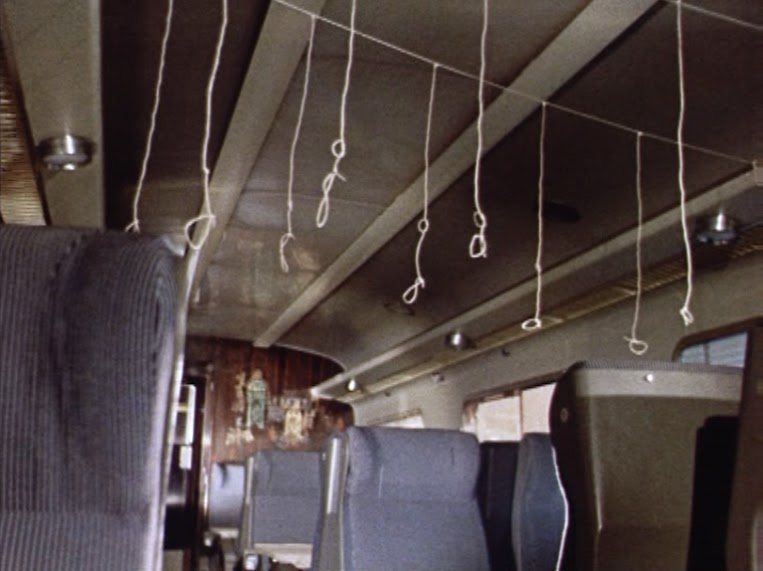
‘Blue Pullman’ (1962) was the most visually interesting feature I watched. Documenting the implementation of a commuter-specific diesel-electric express from trials through to the first day of regular service, the film opens with a series of wordless tracking shots through empty carriages as the Pullman hurtles at 90mph through the countryside. The camera lingers on various pieces of equipment recording vibration and camber on bends. There’s something almost surreal about the train’s emptiness: it’s like watching a weird conflation of ‘The Lady Vanishes’ and ’28 Days Later’. Things settle into a conventional documentary narrative less than halfway into its 25 minutes (again: too long) as technicians discuss the Pullman’s capabilities and expected performance. Most of the contributors are stilted and obviously nervous in front of the camera. Director James Ritchie seems aware and ensures there are plenty of aerial shots emphasizing the train’s speed and distinctive livery. As with all of these films, I can imagine them being of limited interest to general audiences, but there’s no denying that ‘Blue Pullman’ must have looked damned good on the big screen.
With a title that suggests a Peter Davidson era ‘Doctor Who’ episode, ‘Cybernetica’ (1972) was a commission for the Union Internationale des Chemins de Fer and explores the infrastructure of the European railway system and the computerisation of booking systems. Either subject could have made for a decent 10 minute short, and there was no reason for ‘Cybernetica’ to be anything other than visually impressive. Unfortunately, the execution is bollocksed in every conceivable manner. The shoddily filmed opening sequence is architecture porn of the dullest variety. The smarmy commentary by Michael Aspel (an inexplicably popular talkshow host from the 1970s with all the personality of a toilet roll holder) focuses on “three pretty girls crossing Europe” and Trevor Roe’s camera gets its male gaze on and forgets all about those pesky trains. There are occasional cutaways to whirring, clunking mainframes encased in acres of solid plastic that you realise with a sudden shock of recognition are what computers used to look like; but then Aspel starts drooling over the “ghurls” again. The casual sexism is appalling, and I stuck 10 of its 20 minutes before voting with my feet … or at least my thumb on the remote control.
‘On Track for the Eighties’ (1980) was the last of the shorts that I watched. Opening uncharacterisatically with shots of earth movers and heavy goods vehicles, its swift 15 minutes establish British Rail’s freight operations as part of a larger transport infrastructure including road and sea. Footage of hovercraft dates the film more effectively than any of the fashions or hairstyles on display. In fact there are very little of either. Unlike most of these British Transport Films, the focus isn’t on passengers or the perceived glamour of rail travel, but on industry and modernisation. ‘On Track for the Eighties’ was the last of British Transport Films’ occasional “rail reports” series, but one doesn’t even need to be aware of this elegiac fact to realise that what director John Legard captured here wasn’t simply a slick bit of PR but a picture of an industrially-confident Britain taking its last throw of the dice before the axe of Thatcherism descended.
Thursday, September 24, 2015
Edge of Tomorrow
The chief pleasures of ‘Edge of Tomorrow’ are threefold:
1. The sight of Tom Cruise playing a shallow, self-interested yellowbelly (at least during the early stretches of the movie) and necessarily emerging with a far more interesting performance than the central casting man of action that the script obligatorily has him morph into by the end;
2. The sight of Emily Blunt playing a pumped-up kick-ass action heroine for enough of the movie that her character’s nom-de-guerre “Full Metal Bitch” is more than earned;
3. The best take on the “protagonist continually relives same day” concept since ‘Groundhog Day’.
Note that “best since” should not be considered a synonym for “as good as”. What makes ‘Groundhog Day’ the exemplar of its particular subgenre is that it takes a hard sci-fi concept and yolks it to a romantic comedy narrative that has absolutely nothing to do with the science fiction genre. As with ‘Pleasantville’, it establishes its high concept bit of metaphysical chicanery straightaway and proceeds with such verve, likeability and imaginative energy that the audience don’t stop to ponder whether the suspension of disbelief has actually been earned. This might sound like a statement of the obvious, but consider how laboriously the likes of ‘Source Code’ and ‘Looper’ hammer home their big conceptual raisons d’etre, continually reiterating the rules and spewing exposition left, right and centre.
‘Edge of Tomorrow’ delivers two or three scenes of exposition dump but does so with brio and economy. One moment in particular (the massive suspension of disbelief bit which explains how an alien thingy can reset time) is done with such a sense of “thank fuck for that, we’ve figured it out, now we can go and twat the fucker” that audience response is less likely to be cynicism and mockery than a genuine gung-ho imperative to go kill alien thingies and then celebrate by adorning their collective bedroom walls with a poster of Emily Blunt in a khaki tee-shirt touting a weapon the size of Big Ben.
Speaking of Big Ben, the film is surprisingly set in the UK and Europe (the trailers made it look generically Stateside). A montage of news reports swiftly sets the scene: some unseen menace has been royally fucking up humanity and casualties are off the scale; however, a recent victory in war-ravaged France has (a) suggested a turning of the tide, and (b) made a poster girl of Sgt Rita Vrataski, a.k.a. Full Metal Bitch, a.k.a. the Angel of Verdun. Hold on to that last moniker: we’ll revisit it in a moment.
Into the heart of the London-based command centre comes Major William Cage (Cruise), a former ad man now in charge of military PR: his toothpaste-commercial grin and slick interview technique have helped boost recruitment. When his new commanding officer General Brigham (Brendan Gleeson) orders him to participate in a frontline amphibious assault on the coast of France in order to portray the glorious fight with even greater immediacy, Cage gets the willies and talk his way out of it. When this fails, he tries to blackmail Brigham.
Bad move.
Brigham’s security staff tazer Cage as he tries to make a run for it. He wakes up to the less than tender mercies of Master Sgt Farell (Bill Paxton, earning himself the Agitation of the Mind “man of the match” award for an absolute pearl of a performance that can only be described as what Clint Eastwood’s character in ‘Heartbreak Ridge’ would have been like if Eastwood hadn’t turned up on the first day of shooting and they’d cast Dirk Bogarde instead) who takes no small degree of pleasure in informing Cage that he’s now a member of a suicide squad.
Outfitted in one of those exoskeleton suits that every sci-fi movie between ‘Aliens’ and ‘Avatar’ has drooled over, Cage and his fellow cannon/alien fodder are dropped onto a beach in France. As you’d expect, he buys the farm pretty quickly. Then he wakes up to the less than tender mercies of Master Sgt Farell who … but you’ll have figured out the reset/restart element of the narrative already.
The beach assault is where ‘Edge of Tomorrow’ simultaneously gets its action movie funk on and becomes rather troublesome. The plus points first: it’s one hell of a sustained set-piece, with a good third of the movie concentrating on how Cage assimilates specific life-or-death details in order to progress further than a few yards inland without dying horribly; the effects are spot on; and the first glimpses of the alien thingies are pure nightmare – a sudden explosion of movement, a suggestion of tentacles, and the attack is all over in an impressionistic blur. Actual definition of the creatures, let alone their hierarchy (which becomes a key plot point), is withheld until much later in the proceedings. Also, the means by which Cage’s endlessly relived day take him in different directions – from callous survivalism as he lets his comrades die to a side-mission in which he enlists Vrataski’s help – are effected by the steady accretion of detail without ever seeming repetitive, which is no small feat.
There are, however, problems. The whole Angel of Verdun/allied beachhead aspects set up parallels with the First and Second World Wars so explicit that the film becomes freighted with a subtext it hasn’t earned, doesn’t deserve and can’t possibly hope to justify. In fact, the longer it goes on, with the sci-fi concept milked for all its worth and the character dynamics degenerating into predictability the closer Cage edges to becoming the hero of the day, the more it seems to cheapen its wartime touchstones.
The other problems are the backgrounding of Vrataski in the finale so that Cage can assume centre stage; the ennui of Cruise morphing into a generic tough guy hero when he was so much more fun to watch as a smarmy propagandist crumbling under an industrial-sized dose of his own medicine; and a final reset/restart that isn’t just a mockery of at least one last-reel act of selfless sacrifice but a narrative cheat.
That it’s still a hell of a lot of fun to watch is some testament to what director Doug Liman and his creative team get right. The early stretches give us the most entertaining Cruise performance since ‘Tropic Thunder’, Blunt hasn’t been this engaged with a role for ages, Gleeson is always good value and can I just repeat myself regarding the Bill Paxton “man of the match” award. In a way it’s frustrating that ‘Edge of Tomorrow’ isn’t a stone-cold classic, because the potential was certainly there. But as with Cruise’s earlier sci-fi outing ‘Oblivion’ what emerges is the ghost of a rigorously intelligent genre outing haunting the edges of the mainstream popcorn movie constraints that guaranteed its budget. The irony is that for its cap-doffing to commercialism, ‘Edge of Tomorrow’ did lacklustre business at the box office business. It says something that its DVD cover fixates on the movie’s tagline “Live. Die. Repeat” and consigns its actual title to the tiniest of lettering. Which part of that “Live. Die. Repeat” slogan will come to exemplify its shelf life remains to be seen.
Labels:
Bill Paxton,
Brendan Gleeson,
Doug Liman,
Emily Blunt,
Tom Cruise
Monday, September 14, 2015
From Up on Poppy Hill
Goro Miyazaki, son of Studio Ghibli founder Hayao, made his directorial debut in 2006 with ‘Tales from Earthsea’, an overly ambitious attempt to weave elements from the first four books of Ursula K. LeGuin’s ‘Earthsea’ saga into a single epic narrative. The result was intermittently awesome visually but a total clusterfuck as an exercise in storytelling. The world-building was confused and the characters ciphers.
Mercifully, his second outing avoids all those mistakes. ‘From Up on Poppy Hill’ (2011) jettisons complex plotting in favour of character development – although, for its first half, this almost threatens to work to the film’s detriment. For a good 40 minutes, all that happens is some students at an academy protest the imminent closure and demolition of their clubhouse. Oh, and a very low-key romance develops between Umi (voiced by Masami Nagasawa) and Shun (Junichi Okada).
Then Miyazaki throws in an impediment to their nascent relationship so hefty that even Shun has the good grace to deem it as “something out a cheap melodrama”. I’ll leave this review spoiler-free; suffice it to say, it’s a plot device that’s been well-worked throughout the ages and is more in-keeping with histrionic psychological dramas than a U-rated nostalgic anime. Its resolution is no less creaky. None of which bodes well …
BUT …
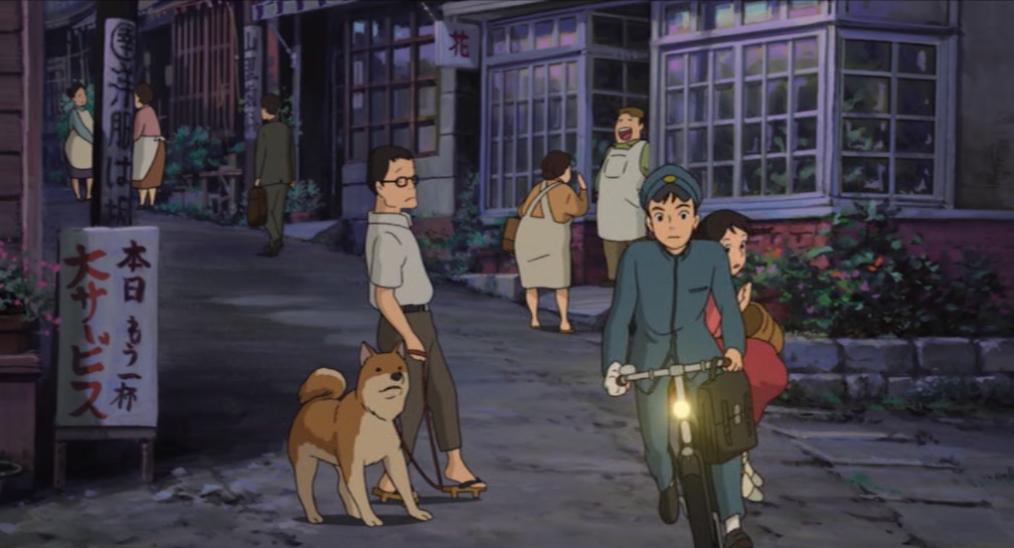
It’s just so utterly bloody gorgeous to look at. Even when nothing’s happening, as in the long opening sequence in which the minutiae of Umi’s day are observed in such detail you’d think Miyazaki was using a microscope instead of a set of storyboards, the evocation of a time and a place are effect with such visual beauty, in a such a glorious wash of colour, that it’s impossible not to be captivated.
Set in 1963 in a small harbour town, the film makes only one diversion from its self-contained and precisely defined locale for a sequence where Umi, Shun and their friend Shiro (Shunsuke Kazama) visit Tokyo. Miyazaki clearly relishes the juxtaposition, cramming his frames with imagery, energy and movement, bringing to life a metropolis gearing up for the 1964 Olympic Games. A similar sprightliness infuses the scenes of student life, particularly in wryly observed moment where two opposing factions snap from mutual animosity to well-oiled collusion in order to pull the wool over their tutors’ eyes.
The portrayal of Umi – her emotional vulnerability in sharp contrast to her can-do attitude and strong work ethic – suggests that Hayao Miyazaki’s career-long feminist sensibilities have been vouchsafed by his son. Tradition, responsibility and the innocence of childhood – also thematic staples of Hayao’s work – are also present here.
Various flashbacks to the war unravel the story that threatens to keep Umi and Shun apart, with a reference to the destruction of Nagasaki evoking Isao Takahata’s ‘Grave of the Fireflies’. The difference, of course, is that ‘Grave of the Fireflies’ didn’t offset its heart-wrenching account of the human cost of war with a rose-tinted, semi-comedic coming of age story.
And that’s the main flaw of ‘From Up on Poppy Hill’: its primary narrative is too insubstantial to carry the emotional weight of its subplot. I’m not sure, had the campaign to save the clubhouse been relegated to subplot material and the meddlings of fate in Umi and Shun’s past been the main focus, if the balance would have worked even then.
As it is, watching ‘From Up on Poppy Hill’ is to sit through a first half that simply requires you to appreciate some achingly beautiful images and then simultaneously wonder where the hell the big melodramatic humdinger came from and face-palm that anyone thought fit to include it in the first place. Without it, the film could have achieved the delightful, heartfelt simplicity and villain-free narrative of ‘My Neighbour Totoro’. Still, this is only Goro Miyazaki’s second feature, it’s a massive leap forward from his first, and (however the current production hiatus at Ghibli resolves) there is still time.
Sunday, September 06, 2015
That thing with the guy in the place
Remember when I relaunched this blog last month (and, uh, yeah, there is some content coming in September, honest), how I mentioned that I’d been busy for much of this year on a fairly big project? Here’s the inside story.
A few years ago, I blagged my way onto a committee that had been set up to honour and the life and work of Nottingham writer Alan Sillitoe (best known for ‘Saturday Night and Sunday Morning’ and ‘The Loneliness of the Long-Distance Runner’). Chaired by Alan’s son David, who provided the photographs for the terrific 1985 travelogue ‘Alan Sillitoe’s Nottinghamshire’, the committee’s aims were twofold:
- Raise funds towards a permanent memorial to Alan, to be cited in Nottingham;
- Keep Alan’s work in the public eye.
Time passed and we held several events (including film screenings and a benefit concert featuring The Smears and Sleaford Mods) and ran poetry competitions adjudicated by such luminaries as George Szirtes and Helen Ivory. But raising the kind of capital needed for a statue or something of equal prominence wasn’t easy.
In January, David and myself started talking about an anthology. I envisaged it as a 60 page collection of poetry, something that would redress the lack of recognition Alan received for his own verse, something we could sell at events, and something that we could offer as an incentive as part of a proposed crowdfunding platform. David had bigger ideas: a chunky collection of poetry, fiction, memoir, essays, travel writing (i.e. an overview of all the different literary disciplines Alan was capable of), plus photography and artwork.
With the help of poet, occasional Agitation contributor and all-round renaissance woman Viv Apple, we put together a list of people we could approach, from established to up-and-coming writers, and set about asking them for new work without so much as a red cent in payment.
We figured we’d get a positive response rate of about 30%. The actual response was more like 90%.
We figured we’d pull the anthology together and have it to the printers by the end of May. It’s now September.
We learned a hell of a lot about publishing in a very short space of time, and a lot of good people helped us up the gradient of that learning curve.
The result is ‘More Raw Material: work inspired by Alan Sillitoe’ – 52 contributors, including this year’s Keats-Shelley Poetry Prize winner, the lead singer of Sleaford Mods, and writers from the Faber, Bloodaxe, Five Leaves and Nine Arches rosters. Plus some exciting and ridiculously talented up-and-comers.
The anthology is currently being typeset and should go to press very soon. There will be a launch in Nottingham, plus a slate of other events next year. There’ll be a website to support the book, and a “mate’s rate” for Agitation readers. Details to follow.
Obviously, there is still work to be done, and there will be an impact on the regularity of content on Agitation for the remainder of the year. Rest assured, though, that 13 For Halloween and the Winter of Discontent will be going ahead as usual. Wouldn’t be Agitation if we didn’t see out the last few months of the year in a welter of cynicism and depravity!
Monday, August 31, 2015
Inside Out
Two things that Pixar have always done very well: imaginatively mapping the infrastructure of their settings (the factory in ‘Monsters, Inc’, the villain’s island lair in ‘The Incredibles’, the town of Radiator Springs in ‘Cars’); and depicting isolation, loneliness or the inability to fit in (early scenes in ‘Wall-E’ and ‘Up’ are perfect exemplars, ditto Remy’s difficulty relating to his family in ‘Ratatouille’). At the opposite end of the scale, there’s always been an intuitive understanding of the crowd-pleasing dynamic of mismatched protagonists working as a team for the greater good (the ‘Toy Story’ trilogy, ‘The Incredibles’).
‘Inside Out’ harnesses all of these elements to tell a story where the stakes are ostensibly lower (no-one’s threatened with immolation at the hands of a Sid-like sociopath or plunged into an inferno as per ‘Toy Story’ or ‘Toy Story 3’, nor is an entire city threatened with destruction a la ‘The Incredibles’) and yet the emotional payoff is infinitely higher. ‘Inside Out’, moreover, is a film without a villain. Or rather, a film without a corporeal villain.
The protagonist is 11-year-old Riley (voiced by Kaitlyn Dias), a good-natured and cheerful lass who enjoys hockey and has some great friends and who is the light of her parent’s life. Until, that is, they up sticks from the great outdoors of Minnesota to the cramped city streets of San Francisco and an apartment that the film does its best to make look squalid but actually seems a decent piece of real estate. That Riley faces this disappointment head on and tries as hard as possible to remain optimistic is due to Joy (Amy Poehler), one of five emotions who engineer Riley’s wellbeing from a futuristic control room in her mind.
Joy’s colleagues in this enterprise are Sadness (Phyllis Smith), Fear (Bill Hader), Anger (Lewis Black) and Disgust (Mindy Kaling), all of whom are permitted by control-freak Joy to do only what is needed to provide Riley with protection (Fear) or motivation (Anger). This leaves Disgust and Sadness as the most under-utilised of the team, and while Disgust affects a “yeah, whatever” kind of attitude, Sadness remains perplexed as to why certain of Riley’s memories – particularly core memories – are entirely colour-coded as products of Joy’s intervention when, given their context, they should have been tinged with an undercurrent of sadness.
How the infrastructure of memories works, with Riley’s subconscious as a series of theme parks, is something I’ll leave you to discover for yourself – the pure inventiveness of how the different aspects of her personality function is the film’s chief pleasure; suffice it to say, for the purpose of this review, that memories and core memories glow with the colour of the emotion that created them; most glow golden after Joy; and anything Sadness touches is blue. The dramatic arc of the narrative begins when Sadness persists, against Joy’s orders, in handling ostensibly happy memories. Events come to a head and Joy and Sadness find themselves ejected from the control room with Riley’s core memories, each of which powers one of the theme parks. Joy’s mission is to return these memories and make Riley emotionally functional again while keeping them from Sadness’s clutches.
Meanwhile, with the polar opposites of Joy and Sadness absent – i.e. the two emotions responsible for the majority of Riley’s emotional register – the control room is left to the dubious and unfocussed stewardship of Anger, Fear and Disgust. As a result, Riley drifts into ennui. The theme parks shut down and, as Riley’s retraction from the world around her continues, are threatened with destruction. I said earlier that the film doesn’t have a corporeal villain. It has an incorporeal one; a shadow. Other Pixar films may have dealt with loneliness and, to a certain degree, dysfunctionalism. ‘Inside Out’ is a Pixar film that deals with depression.
It does so in a way that doesn’t step outside its ostensibly-for-children animated aesthetic, but is nonetheless effective and sometimes slyly so. Sadness’s response to any situation she can’t get a handle on is to lie down, bury her face and protest that she’s too tired (“you’ll have to drag me,” she tells Joy at one point). There’s a pit-of-forgotten-memories setpiece which is thematically and visually similar to the levels-of-memory bit in ‘The Book of Life’, involving an heroic act by Riley’s already-forgotten imaginary friend from early infanthood that is the most genuine poignant moment director Pete Docter conjures.
Joy and Sadness’s journey back – a sort of day-glo ‘Odyssey’ – is juxtaposed with Riley’s transformation from outgoing prepubescent to sullen, rebellious teenager-in-waiting. Again, Docter and his creative team chart the character arc realistically but sympathetically. Riley’s behaviour is understandable and the effects of her withdrawal accrete slowly so that by the time she comes to a decision (Anger at work in the control room) that threatens the stability of the family unit, the viewer still feels sympathy.
‘Inside Out’ is a film of lush visuals (it’s Pixar: what else would you expect?) and a wealth of details, from playful humour (the literalisation of a train of thought) to unexpected in-jokes (“forget it, Jake, it’s Cloudtown”). But most of all it’s a film of grace notes and wonderfully observed details. I particularly liked the depiction of Riley’s emotions as being of different height and bounding around all over the control room, whereas those of her parents are all the same height, formally seated around a control panel and working in equilibrium; as a comment on the difference between a child’s emotional make-up and a functional adult’s, it’s spot on and incorporated into the film’s aesthetic in a way that doesn’t call itself to the audience’s attention.
In fact, Docter is very good at trusting to his audience to assimilate the material and not rely on laborious exposition (a whirlwind pre-credits tour of how memories and emotions work sets the scene incredibly swiftly for the amount of detail it imparts). Docter was behind ‘Monsters, Inc’ and ‘Up’, the latter still one of my absolute favourite Pixars, and what he delivers here stands with the studio’s best. After a fairly dispiriting run from ‘Cars 2’ to ‘Monsters University’, ‘Inside Out’ sees Pixar back on form.
Labels:
Amy Poehler,
Bill Hader,
Kaitlyn Dias,
Lewis Black,
Mindy Kaling,
Pete Docter,
Phyllis Smith,
Pixar
Wednesday, August 26, 2015
Lesson of the Evil
Takashi Miike is a force of nature. Still only in his mid-fifties, he’s directed almost a hundred features. He’s slowed down a bit in the last half-decade, only making two or three films a year. Compared to, say, 2001 when he directed eight movies, including three bona fide classics (‘Visitor Q’, ‘Ichi the Killer’ and ‘The Happiness of the Katakuris’), and presumably didn’t eat or sleep let alone consider taking any annual leave. He’s also brazenly confident in any number of genres: horror, comedy, thriller, western, musical, legal dramas, samurai epics, road movies, and children’s films.
Yes, he’s prolific and tirelessly creative, is Takashi Miike. He’s also no stranger to controversy. In fact, controversy probably hangs out with him most evenings, getting drunk and egging him on.
‘Lesson of the Evil’, made in 2012, is an adaptation of a novel by Yusuke Kishi, an award-winning crime writer who has had several of his works filmed in his native Japan (so far only ‘The Crimson Labyrinth’ has been translated for the English-language market). Whether Kishi’s novel, published in 2010, treats its subject matter with as much black humour as Miike brings to the adaptation is something I can only speculate on.
It’s probably time, 200 words into this review, to cut to the chase and talk about what ‘Lesson of the Evil’ is about. And since it’s nigh on impossible to have any useful discussion to that effect without giving away critical plot points germane to the sustained finale that occupies the last forty minutes or so, let’s hoist the jolly SPOILER ALERT (applies for the remainder of the article).
‘Lesson in the Evil’ is set at a private school where, despite their entitled lifestyles, the students experience bullying and, in one case, sexual harassment, while the staff try to determine how an exam-cheating system is being operated. Snivelly physics teacher Tsurii (Mitsuro Fukikoshi) intuits that smartphones are being clandestinely used to email questions to conspirators. Popular English teacher Hasumi (Hideaki Itō) favours using a cell phone jammer, which the principal objects to on the grounds of two wrongs (the jammer being illegal) not making a right. The scene marks out Hasumi as kind of cool, ready to beat the cheats at their own game and throw away the rule book in order to do so. His second intervention into the lives of the student body is when he assists winsome student Miya (Erina Mizuno) to turn the tables on a blackmailer who is demanding certain favours. Miike takes a slow burn approach with these early developments, with Hasumi shaping up as a sharp-witted guardian angel type, albeit one with unorthodox methods. That he’s a good-looking mo’fo’ with a nice line in rock star cool only makes him more appealing as a protagonist.
Then, with the suddenness that’s one of the trademarks of a Miike film, the rug is pulled, bodies start piling up and Hasumi enthusiastically reciprocates Miya’s affections, blackmailing fellow paedophile teacher Kume (Takehiro Hira) for the use of his swish apartment in which to conduct their assignations. I’m not sure which is greater: the chutzpah, the hypocrisy or the offensiveness potential to any audience member who isn’t a fully fledged sociopath.
And the most contentious sequence is yet to come. What all of Hasumi’s machinations are leading up to is a high-school massacre for which he intends to frame Kume. In case you’re wondering what all of this is in the service of, there’s a subplot exploring Hasumi’s past and his motivations. Maybe “exploring” isn’t the right word: Miike’s approach is more impressionistic. He gives us a specific reference to Goethe’s ‘The Sorrows of Young Werther’, repeatedly uses ‘Mack the Knife’ on the soundtrack (in both English and Japanese versions), makes a big point of Hasumi having spent some time in America, and lets the audience extrapolate from there.
Ah, yes. Hasumi’s time in America. Let’s pause here to consider a cultural comparison. School shootings are non-existent in Japan; cursory internet research before I sat down to write this review suggests that the last time a school massacre occurred was in Osaka in 2001. The assailant killed seven children and thirteen others and two teachers with a knife. I won’t bother linking to it, but a list on Wikipedia of school shootings in America takes us from 1764 to the present day and demonstrates that nutcases cut loose with firearms on American campuses with depressing frequency, the worst being the Virginia Tech massacre which cost 33 lives (not including the perpetrator’s suicide). In the year ‘Lesson of the Evil’ was made, there were 12 school shootings accounting for 42 deaths and 16 people injured. In Japan, gun ownership is rigidly controlled, handguns are verboten and even air guns require psychological testing, criminal checks and a labyrinthine degree of bureaucracy, not to mention having the police turn up every year to check you’re storing the thing properly and having to account for every single round of ammunition you fire. In America … well, let’s just say attitudes to gun ownership drift towards the opposite end of the scale.
In a particularly telling flashback, Hasumi attracts the attention of Dave (Daniel Genalo), a gentleman of fine American stock and a dedicated practitioner of murder. Eventually Hasumi terminates Dave because he simply enjoys killing too much. It’s tempting to interpret this scene as the satirical key to the film and take Hasumi’s high school massacre as a relocation to Japan of a uniquely American phenomenon. I have no idea what impact ‘Lesson of the Evil’ had on American audiences as I deliberately stay away from other reviews when I write up films for this blog, but even as an English viewer – where we don’t have school shootings (our national shame is paedophilia by privileged or celebrity abusers protected by successive Conservative governments) – I found the final stretch of ‘Lesson of the Evil’ brutally difficult to watch. Not because Miike renders the killings in documentary-style verité, but because he opts for a kinetic, hyper-stylised aesthetic reminiscent of the heightened black comedy of ‘Battle Royale’. But whereas ‘Battle Royale’ delivered its horrors within the context of dystopian satire, ‘Lesson of the Evil’ simply portrays, albeit in as iconic a manner as possible, a lunatic with a shotgun, stalking the corridors and classrooms of a school, intent on killing every one of its pupils.
I’ve seen plenty of black comedies that are so near the knuckle, they’ve practically gouged the knuckle out. I’ve laughed at questionable things and questioned myself for doing so. I’m no stranger to laughter in the dark. ‘Lesson of the Evil’ goes beyond laughter in the dark. It laughs in the stunned silence that follows something so awful that comprehension shuts down.
Friday, August 21, 2015
Frank
Frank Sidebottom is a name that will almost certainly be known to anyone who watched British TV during a certain era and had a taste for the offbeat. The alter ego of comedian and musician Chris Sievey, Frank was originally created to satirize bands’ hangers-on. When his papier-mâché-headed anonymity struck a chord with audiences, he was effectively upgraded to the band’s front man. That, right there, is a bloody great concept for a movie. The irony defines itself. You can hand the Sievey/Sidebottom story to any creative team with even the slimmest budget and tell them to get as self-reflexive with the material as they like. And when said creative team includes writer Jon Ronson, who served as keyboardist in Sievey/Sidebottom’s band, and wrote the whole experience up for a cracking newspaper article titled “Oh blimey!”, there’s no reason – no reason at all – for ‘Frank’ not to be brilliant.
And yet … and yet …
The first problem is that Ronson’s script, co-written by Peter Straughan (who had previously adapted Ronson’s book ‘The Men Who Stare at Goats’ into a not-particularly-good movie) completely fictionalises Frank, transplants him from England to Ireland, and shifts the timeline from the 80s/90s to a contemporary setting. The Sievey/Sidebottom story is a real peach; in this fictionalised version, Frank without his creator is merely a cipher, even with a capable performance from Michael Fassbender to enrich the character. The decision to surround him with a group of generally impenetrable, unlikeable and unfleshed-out bandmates – including Scoot McNair, Carla Azar and Maggie Gyllenhaal, wrestling with some of the most thankless material she’s ever been given – is distancing, although some of the band’s dynamics allow for a send-up of creative friction and artistic pretentiousness. Not necessarily a fault – but a too-familiar device – is the introduction of an “everyman” figure into their milieu in order to act as the audience’s eyes and ears.
Said everyman is Jon (Domhnall Gleeson) – in a film based on a true story that’s nonetheless totally fictionalised, the use of Ronson’s actual name for his fictive surrogate is somehow more annoying than it ought to be – a young man living a banal existence in Dublin, still living with his parents, holding down a soulless day job and trying to compose songs in his spare time. Director Lenny Abrahamson conjures some effective early scenes as he sketches in Jon’s day-to-day life and hilariously demonstrates just how fuck awful his compositions are. A contrivance sees Jon co-opted into Frank’s band as keyboardist (remember the “drummers curse” in ‘This is Spinal Tap’? ‘Frank’ recycles the gag but with keyboardists and without it being quite so funny). This leads to a long mid-section in which the band hole up in the middle of nowhere to record their new album, and to give him his dues Abrahamson gets a good few belly laughs out of the increasingly desperate lengths an already up-themselves bunch of people go to in order to kick-start the muse.
Jon never really steers the audience particularly close to Frank, though, and the character arc that the script requires him to describe – puppyish naïf to egomaniacal prick – never quite feels earned. Likewise, the revelations about Frank in the last third, when the scene’s shifted to America and it suddenly feels like you’re watching an entirely different film. ‘Frank’ makes a number of tonal lurches during its relatively short running time. Much could have been rescued if Abrahamson had embraced the material’s absurdity Monty Python stylee rather than trying for the kind of deadpan black humour that, say, Ben Wheatley achieved so effectively in ‘Sightseers’ but which often falls flat here.
Still, when ‘Frank’ hits the marks, it does so winningly. Fassbender holds the whole thing together using just vocal inflections and body language. Gleeson makes a character who is arguably the film’s biggest waste of space curiously sympathetic. James Mather’s cinematography ought to receive Valentine’s Day cards, so beautifully does he evoke his locations, lingering on clusters of small details just long enough. I’ve not seen any of Abrahamson’s earlier films (I have it on good authority that ‘Garage’ is some kind of microbudget classic) and I fully intend to rectify that. For all its problems, ‘Frank’ has some genuine offbeat talent behind it.
Friday, August 14, 2015
A Million Ways to Die in the West
In 2006, M. Night Shyamalan cast himself in a supporting role in his hugely divisive fairy tale ‘The Lady in the Water’. His character was a messaniac figure destined to bring about world peace or a successful two-state solution between Israel and Palestine, I forget which. Anyway, Shyamalan’s character was the impossibly saintly MacGuffin upon which the entire drama of the film turned. And it earned him an unholy amount of brickbats, a goodly number of critics reckoning him misguided at best and an arrogant tosspot at worst.
In 2014, Seth MacFarlane cast himself in the lead role in his hugely juvenile western ‘A Million Ways to Die in the West’ so that he could
MacFarlane plays Albert Stark, a self-deprecating sheep-farmer who lives with his parents, hates the wild west for its general ugliness and tendency to curtail lifespans, and finds his only solace in the arms of Louise (Amanda Seyfried). Well, he did for a while. The film opens with his wheedling his way out of a gunfight and earning Louise’s contempt for not acting like a man. Albert responds to rejection in the time-honoured male tradition of going out and getting drunk with his best bud. Said best bud is Edward (Giovanni Ribisi), a virginal shoe-seller whose hooker girlfriend Ruth (Sarah Silverman) is a Christian who doesn’t believe in sex before marriage. This concept, incidentally, is the film’s best joke. Just so you know what level of sophistication we’re dealing with here.
While Albert is licking his wounds, notorious outlaw Clinch Leatherwood* (Liam Neeson) relieves a prospector of his gold and his life. Clinch is riding with his wife Anna (Charlize Theron) and his gang. Tired of Anna’s continual haranguing (how dare she imply that robbery can be done without murder?), he entrusts her to the care of Lewis (Evan Jones), his loyal but knuckled-headed right-hand-man, instructing them to hole up in the township of Old Stump while he and the boys investigate the prospector’s stake.
Lewis instigates a bar fight during his first night in town and is promptly arrested. Albert saves Anna during the fracas (though later events indicate that she’d have handled herself pretty fine) and the two strike up an unlikely friendship which shades towards romance. When they encounter Louise and her new suitor, the oleaginous Foy (Neil Patrick Harris, stealing the show), Anna colludes in a scenario which sees Albert challenge Foy to a duel. There’s only one problem: Albert’s scared shitless and doesn’t know one end of a gun from the other.
Actually, two problems. But y’all knew Clinch was going to reappear at a crucial moment, didn’t you?
‘A Million Ways to Die in the West’ clings to a predictable sequence of narrative beats, the better to send them up. Clinch is a film-long riff on Jack Palance in ‘Shane’. Louise floats around dreamily in frills an a bonnet like Grace Kelly in ‘High Noon’. Ruth’s place of employment could well be the cathouse Hildy works at in ‘The Ballad of Cable Hogue’. Theron’s Anna is halfway between Jane Fonda’s Cat Ballou and the Waco Kid in ‘Blazing Saddles’ if the Waco Kid were a smoking hot blonde and didn’t have a drink problem.
Speaking of ‘Blazing Saddles’, the doffed hat scene is replicated, albeit not in honour of Randolph Scott but the withdrawing from a wallet of paper money (“take your hat off, boy, that’s a dollar bill!”), while the beanfeast transmogrifies here into an extended skit on bowel movements and the availability of cowboy hats.**
(To watch ‘Blazing Saddles’ straight after ‘A Million Ways to Die in the West’ is to laugh longer and harder at a film that runs a good twenty minutes shorter.)
MacFarlane’s film has two things working against it, and they work against it for much of its running time. The first is MacFarlane as actor. Whereas Albert in ‘A Million Ways to Die in the West’ and John in MacFarlane’s previous film ‘Ted’ are both emotionally retarded loser douchebags, John is played with a kind of coach potato rumpled charm by Mark Wahlberg. MacFarlane gives a one-note performance that lacks any of Wahlberg’s grace notes. (And seriously, folks, when “not as good as Mark Wahlberg” emerges as a critical touchstone, you know something is awry.) The second problem is the script’s dependency on scatological humour. The hat scene is low-brow but funny until MacFarlane decides to point the camera at what’s in the hat. An early scene involving shadow puppetry recycles a gag that was only funny in ‘Ted’ because of the absurdity of having a plush teddy bear enact it. The nadir involves an enuretic sheep.***
Mercifully, the film has enough moments where the humour’s earned to leave it not without merit. The Edward/Sarah subplot hits the target more often than it misses; a running joke about the arbitrariness of death in the west sets up some cynically effective sight gags; an unexpected musical number about moustaches turns a generic barn-dance into a triumph of kitsch; an Indian encampment scene in which Albert takes hallucinogenics and “sees” his future combines Francis Bacon and Salvador Dali (subject of art, Albert’s parents present a joyously foul-mouthed anti-Rockwell tableau); a ‘Back to the Future Part III’ homage earns kudos for how randomly its incorporated; and an end-credits coda proves spot-on bloody perfect.
‘A Million Ways to Die in the West’ is no classic – in fact, at least half of its running time functions on the level of okayish – but when it works (particularly in its last half hour) it achieves a demented energy. Ironically enough, this generally happens when MacFarlane quits self-reflexively referencing other movies and does his own thing instead.
*I told you it was unsophisticated.
**Seriously, I told you.
***See above.
Tuesday, August 11, 2015
The Wrestler
I’ve heard it said that with ‘The Wrestler’ (2008) and ‘Black Swan’ (2010), Darren Aronofsky essentially made the same film. Both are expositions on the nature of performance and the gruelling offences against the human body that make said performance possible; both measure physical punishment against psychological deterioration; both assess the adulation of the crowd in terms of dysfunctionalism in “real” life. ‘Black Swan’ rigorously addresses these themes within the middle-to-upper-class realm of ballet, embracing a quasi-surreal aesthetic that, as Bryce Wilson put it, is “as if Roman Polanski and Dario Argento teamed up to remake ‘The Red Shoes’.”
‘The Wrestler’ works out its issues of fame, falsity, failure and flamboyant performance in the ring. If ‘Black Swan’ embraces the gleaming marble façades of theatre and concert hall and the shiny mirrored surfaces of the barré, ‘The Wrestler’ inhabits a milieu of trailers, sports halls, strip clubs and shitty bars. ‘Black Swan’ is the more psychologically penetrating film, ‘The Wrestler’ the more honest. Once you’ve seen them both, it’s hard to critically intuit one without filtering your perceptions through the aesthetic of the other.
Moreover, both generated their frisson from existing cinematic touchstones. As Bryce notes, ‘Black Swan’ comes across as Powell & Pressburger’s deliciously morbid fantasia stuck in a blender with ‘Repulsion’ and ‘Suspiria’. ‘The Wrestler’ has an even more immediate precursor.
In 1988, respected cinematographer Michael Seresin made his only directorial feature with ‘Homeboy’, a boxing film from a script by its star, Mickey Rourke. A glacially paced, downbeat character study, ‘Homeboy’ starts with twenty-something boxer Johnny Walker (the naming of its protagonist after a fucking horrible brand of whisky is the movie’s only real flub) moving to a coastal town and trying to put his boxing days behind him. He’s been diagnosed with brain damage, and one wrongly placed punch could kill him or turn him into a vegetable. As he struggles to form a useful life outside the ring, the promise of romantic fulfilment with carnival performer Ruby (Debra Feuer) is threatened by the svengali-esque attentions of crooked promoter Pendergrass (Christopher Walken). The denouement, in a film that plays like ‘Raging Bull’ deconstructed by Charles Bukowski, is deeply ambiguous. Feuer was Rourke’s wife at the time; they separated the following year.
To make things even more meta, Rourke had been an amateur boxer from 1964 to 1973, winning his first match as a flyweight at the tender age of 12. In 1991, disaffected with his acting career, he returned to the ring as a professional boxer, winning six of his eight fights and drawing the other two. He suffered for it, though, and some disastrous reconstructive facial surgery turned him from the pugnaciously handsome actor of ‘Angel Heart’ to the puffy-lipped, beaten-up Mickey Rourke that we’ve known for the last couple of decades.
To make things even more meta still, ‘The Wrestler’ establishes clear parallels with ‘Homeboy’, but punctures that film’s punch-drunk seriousness of purpose. Boxing is boxing. Wrestling is, at best, white trash performance art. An early seen in ‘The Wrestler’ has antagonists pair off as their bouts are announced and discuss what moves they’re going to use and how best to pander to the crowd. They hug before and after fights. Even in the climactic scene, with Rourke’s has-been Randy the Ram seemingly on the verge of a seizure in the ring, his supposed antagonist, earlier seen punching him in the face and slamming him onto the canvas, nervously whispers “Ram, are you okay?” in an almost frightened voice.
If the parallels with ‘Black Swan’ and ‘Homeboy’ are immediately apparent, so is Aronofsky’s familiarity with the established narrative beats of the sports film: the broken down old timer who used to be someone; the inability to function effectively outside of his sphere of competition; the long-shot final bout. But in Aronofsky’s hands these standard issue tropes are deconstructed and examined, and he sure as hell doesn’t give us the inspirational speechifying or the rousing and redemptive finale. Small details, which are accreted from the outset, that establish Randy’s downward spiral from his glory days of the late 1980s. The credits sequence, all ’80s cock rock, lurid green titles, sports magazine headlines and ticket stubs, establish that our hero had it all back in the day. The montage abruptly fades to black, then fades in on the Ram, in late middle aged, slumped over a child’s desk in a school classroom (he’s reduced to bouts in a school sports hall), a bright yellow toy truck positioned so that it occupies the frame more commandingly that Rourke’s slumped figure. Aronofsky withholds the “twenty years later” credit for several seconds, and probably could have lost it altogether: the visual tells us all we need to know.
Seconds into the film and it’s abundantly clear that the director knows exactly what he wants. The next three cuts focus on swathes of yellow, enough to cast aspersions of the perceived masculinity of Randy’s milieu, after which Aronofsky is savvy enough to discard colour-specific cues rather than swamp the film with them. He focuses, instead, on casually observed details of Randy’s day-to-day life, details that exist in stark contrast to his stage image: his hearing aid; his bafflement during a Nintendo match with a neighbourhood kid that Call of Duty 4 is a cooler and more sophisticated game; his hair dyed and crimped in silver foil during a visit to a hairdresser who is less than impressed by his long-faded fame; his sheepish acceptance of a bollocking at his day job by a wimpy, short-arse supervisor; his equally sheepish attempts to win the affections of an exotic dancer at a seedy club he frequents; and his not-much-more-effective overtures to his estranged daughter.
On which note, here’s to the actresses who essay the trickiest and most thankless roles in ‘The Wrestler’. Marisa Tomei plays middle-aged stripper Pam: first seen being harangued about her age by some asshole college jocks, she’s working a horrible job in a shitty dive purely to provide a start in life for her nine-year-old son. As Randy’s daughter Stephanie, Evan Rachel Wood provides a study in bristling teenage angst erected as a barrier against all the times her father wasn’t there for her; and in what is still a career-best, Wood’s character tentatively allows the defences to come down only for the Ram to screw things up just when reconciliation is feasible.
The comparisons between the Ram’s “profession” and Pam’s are telling (the rhyming nature of their names is surely no coincidence). Her gyrations on the pole, eyes glazed and a bored expression on her face even as she tries to fake a salacious look at her beer-addled, pick-up-driving audience, are as phoney as the Ram’s performances in the ring. The falsity takes their toll on both of them, but at least Pam doesn’t self-mutilate (an early scene has Randy secrete a razor blade on his person; he uses it not to nobble an opponent but to cut his own forehead open, blood being what the punters want); nonetheless, she is unable to see Randy as anything other than a customer, and the only meaningful relationship she seems to have is with her nine-year-old son. Their relationship is in stark contrast to Randy and Stephanie’s.
Aronofsky doesn’t force any of these parallels. He utilises an almost documentarist style, establishing character and location, and lets the narrative unspool at its own pace. As noted earlier, small details carry most of the weight. A stylistic device used consistently through the movie has the camera follow Randy as he goes about his day (I’m convinced Rourke’s face has far less screen time than the back of his head), so that Randy getting in the ring comes to seem no more or less significant than Randy going to work in a warehouse, Randy going to work on a deli counter or Randy walking into a shitty bar. And mostly Randy ends up adopting a persona in each of these milieus in order to get through to the end of the fight, the end of the shift or the end of the day.
In Roeg and Cammell’s counter-culture classic ‘Performance’ rock star/dissipate Turner (Mick Jagger) states his raison d’etre as “the only performance that makes it, that makes it all the way, is the one that achieves madness”. What Randy the Ram’s final performance achieves is left ambiguous, but the build-up makes it achingly clear that, for him, a crowd chanting his name and some doughy fan gushingly seeking an autograph is as good as it’s ever going to get.
Subscribe to:
Posts (Atom)