Showing posts with label Abbie Cornish. Show all posts

Sunday, January 14, 2018

Three Billboards Outside Ebbing, Missouri


Having already chalked up an impressive career as a playwright, Martin McDonagh made his directorial debut in 2006 with Oscar-winning short film ‘Six Shooter’, the promise of which he made good on in memorable style with ‘In Bruges’ in 2009. His sophomore feature film ‘Seven Psychopaths’ opened to mixed reviews in 2013 – admission: never seen it – and, after another four year gap, he returns with ‘Three Billboards Outside Ebbing, Missouri’.

Now, I fucking bloody loved ‘In Bruges’ (Agitation review here) and consider it a pitch perfect black comedy. But here’s the thing: watch the deleted scenes on the DVD and it comes abundantly clear that had they made the final cut, ‘In Bruges’ wouldn’t have been anywhere near pitch perfect. It would, tonally, have been all over the fucking place.

My guess is that either: (a) McDonagh had an on-the-ball producer on ‘In Bruges’ who knew exactly what did and didn’t work and instructed him to make cuts accordingly, or (b) unanimous test audience responses led to the same outcome.

I can’t claim that ‘Seven Psychopaths’ bolsters or diminishes the observation, not having seen it, but I would hazard a guess that no-one was around on ‘Three Billboards’ to bring to McDonagh’s attention the film’s really jarring tonal shifts. A blander, more boilerplate piece of work might have been sunk by them, but fortunately ‘Three Billboards’ has a hell of a lot to commend it despite its flaws.

Narratively, the first thing it put me in mind of was that Tolstoy novella about the forged promissory note, and how its passage around a provincial town negatively affects everyone involved. Just substitute raped and murdered teenager for forged promissory note and Ebbing, Missouri for provincial Russian town.

The victim of this heinous crime is Angela Hayes (Kathryn Newton). Seven months have passed since the atrocity and the local police department have given up on the case. Angela’s mother Mildred (Frances McDormand) responds by renting three billboards on the backwoods road where Angela was assaulted and killed – she raises the money by selling off a tractor/trailer belonging to her ex-husband Charlie (John Hawkes), currently shacked up with his 19-year-old girlfriend Penelope (Samara Weaving) – and uses them to unsolved-crime-shame Ebbing sheriff Chief Willoughby (a never-better Woody Harrelson).

To put it mildly, Mildred stirs some shit. Or to put it another way, Mildred tears the bandage off Ebbing’s festering wound. Or to be it another way, if Lisbeth Salander in the novels by Stieg Larsson is the girl who kicked the hornets’ nest, then Mildred is the woman who smacked the hornets’ nest down to the ground, doused it in petrol, tossed a firecracker at it and shouted “yeah, bitch” as it went up in flames.

Mildred’s provocation has its most immediate effect on Willoughby, a man who has admitted that there’s little more he can do as regards Angela’s murder, and is also somewhat distracted by the requirements of setting his affairs in order on account of the fact that he’s dying of cancer. His terminal condition has an understandable knock-on effect on his younger wife Anne (Abbie Cornish: her best turn since ‘Bright Star’) and their two children.

Willoughby’s terminal condition doesn’t do much, either, for the equilibrium of his alcoholic short-fuse deputy Dixon (Sam Rockwell), a man-child in thrall to his obnoxiously racist mother. Unable to vent his frustrations elsewhere, Dixon targets local entrepreneur Red Welby (Caleb Landry Jones), owner of the advertising company who lease Mildred the billboards. In the broadest of strokes – broad to the point of cliché – McDonagh’s script establishes Dixon as the villain of the piece, as stupid as he is dangerous, only to flip everything on its head.

At any one time, and sometimes with the two or three minute passage of one single scene, ‘Three Billboards’ functions as a black comedy, a procedural, a melodrama, a cautionary tale as regards the exponential consequences of wrong things done for the right reason (airhead Penelope’s “anger begets anger” scene is both laugh-out-loud funny and the intellectual cornerstone of the movie), and an enquiry into the nature of responsibility, forgiveness and atonement.

Atonement is where the film scores its most palpable hits – far more effectively than McDonagh’s brother’s recent outing ‘Calvary’, which attempts a similar enquiry – with scenes between Dixon and Red, and Dixon and Mildred, communicating far more than the understated sketches that McDonagh is wise enough to be satisfied with rather than making some sweeping moral statement.

It’s not exactly front page news to declare than understatement, inference and ambiguity communicate the big themes more effectively than tub-thumping or polemics. But it’s surprising how many artists, of whatever discipline, still haven’t twigged to this. McDonagh fumbles the ball in enough places that an overall less interesting film wouldn’t have survived the uneven tonal shifts, the hackneyed characterisations and the bludgeoningly obvious narrative tropes.

That ‘Three Billboards’ just about dodges its myriad self-fired bullets owes to a first-rate cast who invest in their characters to the hilt, and to McDormand in particular who effortlessly clears the twenty-year hurdle of her achievement in ‘Fargo’ to deliver her definitive performance and bring to life a character for the ages.

Wednesday, February 19, 2014

Bright Star


By any definition, life dealt John Keats a pretty bad hand: his father died when he was eight, his mother when he was fourteen; a legacy that could have made his life easier and given him more time to write was not brought to his attention (either by oversight or design); torn between his exorbitantly expensive medical studies and the pull of literature, he suffered crippling depression; despite being championed by Leigh Hunt, his first collection – published at the tender age of 21 – was berated by the critics and barely sold; his beloved brother died of tuberculosis, a disease which later claimed Keats himself; his mature work ‘Endymion’ reached no wider readership; he borrowed heavily from his friends to keep himself in a reasonable standard of living; his adjournment to Rome for recuperation in better weather following two lung haemorrhages was made possible only by the generosity of supporters; and it was there he died, aged just 25, considering himself a failure.

All told, the basic chronology for anyone considering ‘Keats: The Movie’ as a film project makes for a depressing narrative. In fact, the only high points are his romantic relationships with Isabella Jones and – more notably – Fanny Brawne.


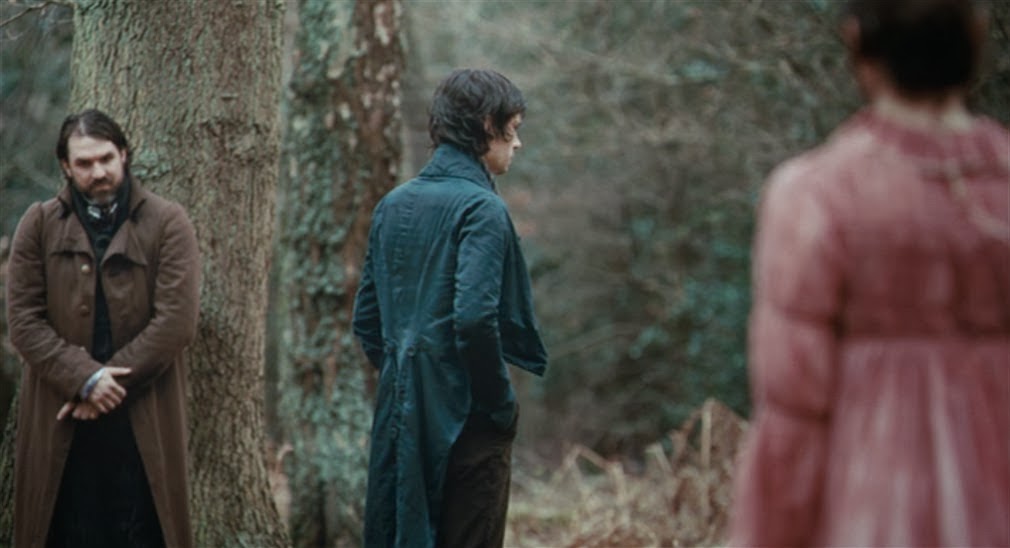
Keats and Brawne’s love story spanned the last three years of the poet’s life. Eighteen when they met, Brawne was atypical of the “proper” young lady of the times: she was feisty, enquiring, opinionated and intensely passionate. Keats was a wholehearted exponent of the Romantic school. At the risk of sounding melodramatic, their grand passion could have pre-ordained. Their years together (and apart, depending on circumstances) resulted in some of his finest work: ‘La Belle Dame Sans Merci’, ‘Ode on Melancholy’ and the much-revised sonnet ‘Bright star! would I were steadfast as thou art’, which gives its name to Jane Campion’s elegant, thoughtful and sensitive biopic.

Drawing on Andrew Motion’s acclaimed biography – Campion engaged him as script advisor – ‘Bright Star’ nonetheless proceeds from Fanny (Abbie Cornish)’s point of view. Her attraction to Keats (Ben Wishaw) is immediate but as in every love story with any enduring resonance, there are obstacles. Keats’s mentor and occasional co-author Charles Brown (Paul Schnieder) sees Fanny as something of a flibbertigibbet and a distraction from the real business of Keats’s writing.


Brown comes across as louche and arrogant to begin with, but the depths of his (entirely aesthetic) affection for the poet is revealed by degrees, culminating in a tirade of self-loathing after his friend’s death as he admits “I failed John Keats.” Another naysayer is Fanny’s mother (Kerry Fox) who quickly intuits the strength of her daughter’s feelings and tries to reason with her as diplomatically as possible. “Mr Keats knows he cannot like you,” she avers: “he has no living and no income.” It’s a quiet but devastating line.

Fanny, headstrong and in the most impressionable flush of youthful emotion, is undeterred. Keats responds almost indifferently at first, despondent over his brother’s debilitating illness, his financial situation and the general lack of interest in his book ‘Endymion’. But Fanny’s empathy and the comfort she offers him after his brother’s death draw them closer together. Keats spends Christmas with her family. The following year, however, Brown insists on a “summer rental” – i.e. their joint accommodation let out while they relocate to cheaper lodgings – and the separation is devastating to Fanny. There are moments of relief – transcendence, even – when she receives a letter from Keats (the film’s most celebrated image has Fanny sink to her knees in a field of bluebells as she reads his words, every element of the world around her suddenly and abundantly regenerated), but the toll of being apart is a destructive burden.


All this could too easily have become a study in anguished yearning, he a fey and consumptive presence, she a hypersensitive adolescent. Or for the script to have swung too far in the opposite direction and the whole enterprise emerge as a handsomely shot but stultifyingly polite costume piece, a kind of super-produced BBC drama. But Campion is too intelligent a writer and too disciplined a director. The production design doesn’t mire itself in the Regency prettification that is the bane of many costume dramas. The cinematography offers no sheen. Clothes look rumpled and lived-in, a sense of make-do-and-mend lurking beneath the ruffles and petticoats. Houses maintain a façade of social standing but rooms are sparsely furnished, paint is faded, possessions are few. This is a world away from your Bennetts and Darcys, a world where even families who maintain a staff seem to be keeping up appearances on rapidly thinning incomes. 

Campion is well-served, too, by her cast. Wishaw – one of the few actors of his generation who genuinely exhibits the hallmarks of a great performer – is savvy enough not to try to “be” Keats but to suggest the life and the haunted sense of failure and the part-wearying part-exultant emotionalism that defined the man who created the great poems. Cornish, who gave an emotionally honest performance in ‘Somersault’ and should have been better served by Hollywood than has been the case, is nothing short of revelatory here. Fanny’s vacillations between precocious self-confidence and painful vulnerability are the stuff of showboating and breast-beating; a lesser talent would have made Fanny Brawne shrewish and hysterical. Cornish nimbly dodges all the potential pitfalls and establishes every emotional beat of Fanny’s three years with Keats, a performance that culminates in two particularly difficult scenes – the outpouring of grief at the news of his death; the solemn acceptance as she recites the titular sonnet.


‘Bright Star’ is a virtually flawless film* that is understated in all the right places while injecting a heady rush of words and emotion into its audience’s sensibilities at exactly the right moments. Conventional wisdom has it that ‘The Piano’ is Campion’s masterpiece. For me, ‘Bright Star’ is her most sublime achievement as a filmmaker.


*Schiedner is slightly – slightly – heavy-handed in a few of his scenes. The script assumes an existing knowledge of some aspects of Keats’s life. These aren’t even complaints.

Tuesday, August 16, 2011

Sucker Punch

Picture the scene: self and Paula settle down to watch ‘Sucker Punch’ (because nothing says “classy dude” like making your wife sit through a film predicated on fantasy sequences featuring a quintet of attractive twenty-somethings in mini-skirts) and the following exchange occurs:

Paula: So what’s this movie about?

Me: It’s a kind of layers-of-reality thing. Like ‘Inception’.

Fast forward 105 minutes:

Paula: So what the hell was that movie about?

Me: Buggered if I know.

And sitting down a few days later to write about ‘Sucker Punch’ – which, for all its flaws, has managed to lodge itself in the back of my mind in a way I can only describe as niggling – I’m buggered if I know how to approach it, where to start, whether to put the scalpel of my critical faculties to use and deconstruct all the ways it doesn’t work, or try to pin down why/how it’s managed to get under my skin in a way I almost wish it hadn’t.

Even the tried and trusted let’s-start-with-a-plot-synopsis approach seems redundant. ‘Sucker Punch’ is the kind of movie that dares you to sketch out a plot synopsis. You can, but you’ll soon find yourself wallowing in a gratuitous amount of incidental detail to try to explain exactly why a baby dragon with two crystals in its throat is so important to stealing a cigarette lighter from a fat guy and why that in turn is essential in an escape attempt from a brothel that’s doubling up for an asylum. Or is a representation of it. Or vice versa.

This leads you into a discussion of the brothel as one of the most sexless dens of inquity modern cinema has given us. Short of ‘Showgirls’, I can’t remember a film so packed with nubile young women that managed to be so unerotic. ‘Showgirls’ remains the worst offender, though, since it managed to make female nudity uninteresting. I am still at a loss as to how Paul Verhoeven achieved this.

I am also still at a loss as to how to approach ‘Sucker Punch’. I can’t even blame my stupefaction on unrealistic expectations of the movie (although, to be fair, you only need to glance at the poster and think “hmmmm, Emily Browning, Abbie Cornish, Jamie Chung, Jena Malone and Vanessa Hudgens in the same movie modelling a nice line in sailors suits, I’ll have some of that, thank you very much” in order to cultivate unrealistic expectations) since I went into ‘Sucker Punch’ expecting an incoherent mishmash at best and a train-wreck at worst.

But I guess what was was expecting, at the heart of either the mishmash or the mangled remains of carriages and locomotive, was an exuberant and unapologetically cheesy action-fest. This, after all, was a movie I had it on good authority as containing a major set-piece featuring clockwork and steam-powered Germans circa First World War getting their trench-dwelling asses whupped by our foxy fivesome. A movie that featured samurai elements, sword and sorcery elements, sci-fi elements and feminist elements. That huge tranches of it take place in an alternative reality was a foregone conclusion this feminism certainly doesn’t equate to girls ‘n’ guns posturing in this reality. Certainly not when the girls have names like Baby Doll, Sweet Pea and Blondie. I’m guessing Germaine Greer’s services were not engaged during rewrites.

I was, in short, expecting a lightweight piece of fluff. Something fun. Surely it’s not possible to shove ‘Inception’, ‘Crouching Tiger, Hidden Dragon’, ‘Lord of the Rings’, ‘Hellboy’, ‘D.E.B.S.’ and ‘Cabaret’ in the blender (along with a train full of killer robots) and come out with a movie that’s anything less than big dumb fun. Surely?

Zack Snyder manages it. How? He also shoves ‘One Flew Over the Cuckoo’s Nest’ and ‘Through a Glass Darkly’ into the blender. He puts in bigger spoonfuls of these ingredients than any of the others. He plays out the big action scenes in the shadow of institutional miserablism. He depicts the burlesque atmosphere of the brothel in the shadow of the asylum. The threat of sexual violence hangs over his heroines in both realities. The only time they’re not in danger of being raped is when they’re battling steampunk Germans or gleaming robots – none of whom, I’m guessing, are packing a penis anyway.

(After I thought about ‘Sucker Punch’ for longer than necessary – and I guess I’d better throw up a SPOILER alert here, even though this is pure supposition – I came to the conclusion that the brothel is the top layered of reality, the asylum is how Sweet Pea has come to think of it, and ostensible main character Baby Doll is actually a figment of Sweet Pea’s imagination, an alter ego the introduction of whom into her fantasy world gives her the impetus to make an escape attempt. Please feel free to debate this theory in the comments section. SPOILERS/ABJECT GUESSWORK end.)

Maybe that’s why Snyder called it ‘Sucker Punch’ in the first place. It’s a movie that seems to promise a specific set of tropes, a certain vibe, a fanboy aesthetic of kick-ass action heroines and OTT spectacle – and to some degree lets you think you’re getting it – but continually challenges you with its unremitting returns to a milieu of incarceration, threat and depersonalization. Which denies you the payoff you want.

All told, short of painting his bizarro vision in the visceral palette of an R rating, Snyder seems to have made exactly the movie he wanted to with zero thought spared for commercialism, audience satisfaction or critical response. ‘Sucker Punch’ is a balls-to-the-wall exegesis of big-budget auteurism. And it frustrates the hell out of me that I’m unable to wholeheartedly embrace it the way I want to.