Tuesday, June 12, 2012
BOND-A-THON: The Man with the Golden Gun
12 January 2012, Nottingham, England. Yours truly decides to host a Bond-a-thon on The Agitation of the Mind. I can only assume the rationale floating through my mind went something like this: Yeah, cool, I get to watch the Connery films, I get to re-evaluate the Timothy Daltons, there was that one with Brosnan that had a pre-credits speed boat chase along the Thames, and I get to wrap the whole thing up with Craig’s reinvention of the franchise. Woo-hoo! This is going to be so cool. Bartender, bring me a vodka martini, shaken not stirred.
I cannot recall, during this moment of deluded enthusiasm, whether it ever crossed my mind that, discounting Connery’s reprisal of the role in ‘Never Say Never Again’ as non-canon, Roger Moore has made more James Bond films than any other actor. And if even the vaguest consideration of the Moore years did cross my mind, there was probably another rationale to hand, something along the lines of: ‘Live and Let Die’ is pretty decent, ‘The Spy Who Loved Me’ co-stars Caroline Munro and Valerie Leon therefore eye-candy a-go-go, and ‘For Your Eyes Only’ marks something of a return to form. Hell yeah, let’s do this thing.
If, on 12 January, someone had whispered in my ear: Yo, Fulwood, you’re also going to have to watch ‘The Man with the Golden Gun’, ‘Octopussy’ and ‘A View to a Kill’, there might have been second thoughts. I might have re-envisage the project as a best-of-Bond-a-thon. In fact, if that rhetorical whisperer had put in an appearance, there would have been no need for them to mention ‘Octopussy’ or ‘A View to a Kill’. They’d have had me at ‘The Man with the Golden Gun’.
‘TMwtGG’ is the franchise’s nadir. Just looking back at my review of ‘Live and Let Die’ and the issues I had with it throws ‘TMwtGG’ into sharp relief. Bog awful theme song? Sir Paul McCartney, I apologise: your three minutes of widdle-wank is fucking Mahler compared to Lulu’s execrable effort. Racism? The treatment of black characters in ‘Live and Let Die’ is an exercise in race relations compared to the wholesale stereotyping of Asians. How bad is the racism? Let’s put it this way, there is a ludicrous amount of screentime, just after the halfway mark, where Sheriff J.W. Pepper (Clifton James), holidaying in Bangkok, repeatedly lambasts the locals, calling them “little brown pointy-heads”. Between this and the flying car, watching ‘TMwtGG’ is a two-hour exercise in losing the will to live. Yeah, there’s a flying car.
It would be twenty years and ‘Die Another Day’ before the 007 saga gave us anything as face-palmingly stupid. And, oh Christ, I’ve got that motherfucker to watch before this whole moviethon is over.
The annoying thing is that ‘TMwtGG’ could have good. It could, conceivably, have been fucking great. For all that the films have drastically departed from the books, often to their detriment, one genuine improvement is made in this case. Ian Fleming’s novel, written just prior to the author’s death, was published in its first draft without his customary revisions; consequently, it’s a thin and sketchy piece of work and suffers from the lack of an interesting villain. Scaramanga, in the novel, is a grubby little mobster whose much-hyped facility with a pistol barely compensates for his lack of personality. In Richard Maibaum and Tom Mankiewicz’s script, Scaramanga (Christopher Lee) is Bond’s equal – indeed, the opposite side of the coin to 007: a gourmand and a sybarite who lives well and has no qualms about what he does for a living.
Christopher Lee was Ian Fleming’s cousin and would probably have made a chillingly amoral Bond (in the alternative universe where Sean Connery accepted Matt Busby’s offer of a contract to play for Manchester United and became a footballer instead of an actor, I’m still undecided as to who would have made the most interesting Bond – Christopher Lee or Patrick McGoohan). As Scaramanga, however, Lee exudes serpentine charm and menace in equal measure. I’ve never known Lee not to be magnetic whenever he’s onscreen, and ‘TMwtGG’ is not exception.
The film also flirts with topicality in its choice of McGuffin: the “Solex Agitator”, a device that ramps up the efficiency of solar power. The energy crisis was big news as the film went into production, and still in the news at the time of its release. Scaramanga’s designs on the Solex, essentially setting himself up as auctioneer to the super-rich with unlimited energy and its conversion process to electricity up for grabs by the highest bidder, elevates him from mere assassin (albeit one who pulls down a cool million per hit) to the kind of über-villain audiences had by now come to associate with the Bond movies.
The presence of Christopher Lee and the inclusion of a newsworthy subject, however, are all ‘TMwtGG’ has to offer; and the filmmakers seem perversely determined to offset these things by as many stultifying creative decisions as possible. We have mentioned Lulu’s theme song (“the man with the golden guuu-uuu-huuu-uuun”) and Sheriff Pepper’s xenophobia. Let us also consider a ludicrous kung-fu sequence where two schoolgirls beat the shit out of a gang of tough customers (the fact that neither actress seems to have any facility for the martial arts just makes the whole thing even more laughable); an otherwise fine car chase ruined by comedic sound-effects; Britt Ekland’s simpering performance as Mary Goodnight, easily the dippiest Bond girl ever to don a bikini, (particularly annoying since the much more engaging Maud Adams – as Scaramanga’s kept woman Andrea Anders, is cavalierly disposed of); and the painfully unfunny Bond vs midget final scene.
Oh, and the potentially engaging business about the Solex? It comes down to a big laser that blows things up.
Towards the end, Scaramanga challenges Bond to a duel, declaring that “it will be a battle of titans”. “There’s a handy four-letter word,” Bond replies, “and you’re full of it.” Watching ‘The Man with the Golden Gun’, it’s hard not to feel a certain affinity.
Thursday, April 19, 2012
Corpse Bride
The obvious approach to take in reviewing ‘Corpse Bride’ – and it’s so obvious there probably ought to be a law against it – is to observe that Tim Burton depicts the world of the living as grey and inert, and the world of the dead as colourful and lively, therefore yada yada yada blah blah blah upload student paper to blindingly_obvious_critiques@agitation.net.This is what ‘Corpse Bride is really about:
Class.
The basic set-up (established in a musical number that comes across like Gilbert & Sullivan after a few G&Ts too many) has upper crust but penniless couple Finis and Maudeline Everglot (voiced by Albert Finney and Joanna Lumley) scheming to marry their winsome daughter Victoria (Emily Watson) off to Victor (Johnny Depp), the hapless son of nouveau riche parvenus William and Nell Van Dort (Paul Whitehouse and Tracey Ullman).The names are just too priceless: Finis (as in “the end”) and Maudeline (maudlin) are the stuffed shirt aristocratic types drifting stoically towards their own personal financial Gotterdammerung, their stately home crumbling around them. Their nemeses/saviours are William (you can imagine he’s “Bill”, an archetypal working class diminutive, to his mates) and Nell (a name inevitably evocative of a nobleman’s consort). The romantic couple in waiting are called Victor and Victoria. The obvious filmic homage notwithstanding, both are reticent, gauche, clumsy and socially inept: there’s nothing victorious about either.
Victor, reeling under Pastor Galswells (Christopher Lee)’s admonition at being unable to memorize his wedding vows, takes a sheepish walk into the dark forest just on the outskirts of town and practices the lines and the giving of the ring. In the kind of innocent misunderstanding that could easily befall any young man, he finds himself betrothed to the titular Corpse Bride (Helena Bonham Carter).
[Parenthetically, the following exchange, which took place at chez Agitation while watching the DVD last night, might be worth recording:ME: Okay, so she’s dead, crawling with maggots and has a detachable arm, but the lass has a decent figure.
PAULA: Hmmm, I don’t know. Could do with some meat on her bones.
ME: High five.]
Hooked up with
‘Corpse Bride’ – released the same year as Burton’s overblown remake of ‘Charlie and the Chocolate Factory’ – is a curious film. Clocking in at just an hour and a quarter, its slender plot nonetheless feels dragged out in places. There are only two real set-pieces: Victor’s half-delirious half-terrified waltz through the underworld (incorporating the marvelous title song in swing band style), and the wedding finale at which arch-villain Barkis Bittern (Richard E Grant) threatens the celebrations of both the living and the dead. (We were talking about character names earlier. Barkis Bittern. Geddit? Geddit?) It packs in a vocal cast of staggering quality – in addition to the above named, Michael Gough, Jane Horrocks and Enn Reitel lend their dulcet tones – some of whom only get a line or two. The songs probably account for over a third of the screen time. Visually, it’s kind of like the characters who didn’t make the cut for ‘Nightmare Before Christmas’ decided to put on their own show and to hell with it.It looks like it’s set in a woodcut illustration from a book of German fairy tales, yet comes on as a black valentine to Englishness. It puts up an English rose against a pretty freakin’ hot (and decidedly non-living) goth chick. (And you can’t get much more goth than actually being six feet under.) It doesn’t just laugh at the Reaper, but chortles along with him. It’s glib and sardonic and takes its leave of you with a scene that’s authentically and throat-tighteningly beautiful. Well played, Mr Burton, well played.
Friday, September 16, 2011
SUMMER OF SATAN: To the Devil – a Daughter

If Hammer’s ‘The Devil Rides Out’ gave Dennis Wheatley his finest cinematic outing (although the ratio of his prolific and entertaining output to film adaptations is still woefully out of kilter), then the Hammer production of ‘To the Devil – a Daughter’ presents a thornier prospect for the reviewer.
It’s a film of two halves, that’s for sure.
The first half shapes up quite nicely. The opening sequence has Father Michael (Christopher Lee) excommunicated; “it is not heresy,” he muses as the rite is stonily intoned, “and I will not recant.” A title card transports us to Bavaria, twenty years hence, and Father Michael oversees nun Catherine (Nastassja Kinski)’s departure to Britain in the care of George and Eveline de Grass (Michael Goodliffe and Eva Maria Meineke).


Next thing, we’re at a book launch for a title on the occult by London-based American writer John Verney (Richard Widmark), who is approached by the decidedly twitchy Henry Beddowes (Denholm Elliott). Against the advice of his agent Anna (Honor Blackman) and her partner David (Anthony Valentine), he agrees to help Beddowes – the reasons aren’t revealed until almost the halfway point – thinking there might be a new book in it.
Although the title is an effective pointer as to where the whole cryptic plot is headed, director Peter Sykes (in his second film for Hammer after ‘Demons of the Mind’) keeps the dynamics sufficiently mysterious to create at least 40 minutes’ worth of genuine tension, particularly when Beddowes – who turns out to be Catherine’s father – dismisses his servants and holes up in abject terror at his manor house, as if waiting for the end to come.

Meanwhile, Verney meets Catherine at the airport and extricates her from the grasp of her guardians. Installed at Verney’s swank apartment overlooking the Thames (high quality real estate porn, here), Catherine suffers nightmares while Verney, unable to contact Beddowes, starts putting together the pieces of the puzzle and realizes that not only has he got himself involved in Satanic shenanigans, but he’s put Anna and David’s lives at risk, as well.
So far, so good. The pace is decent, the production values as high as in any Hammer film and the mythology is intriguing. Rather the roll out the usual devil-worshipping clichés, the filmmakers have Father Michael and his minions as members of a sect devoted to Astaroth, one of the crowned princes of Hell, a creature usually depicted as a naked man holding a serpent (Sykes incorporates the male nudity in a clinically observed ritual and the snake in one of the film’s most effective scenes, where Michael uses the dark arts against Beddowes). The expositional scenes where Verney researches Michael’s background and his connection with the cult of Astaroth are played seriously.

Additionally, the performances are generally commendable. Lee is chilling, Widmark strikes the right note of pragmatism, Kinski is sultry and enigmatic, Elliott reins in his usual scenery chewing, and Blackman dependable in a role that, unfortunately, never quite lets her show just how charismatic an actress she is. On the minus said, though, Valentine is stilted and the presence of Frances de la Tour and Brian Wilde in pointless cameos imports the baggage of their sitcom personas. Still, no problems thus far that threaten to scupper things.
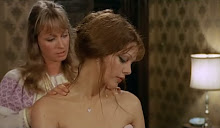
Sad to report, then, that come the second half things go – to use the kind of literary bon mot that inexplicably keeps me out of the pages of Sight and Sound – tits up. Michael’s ceremony to invoke Astaroth veers into sexploitation territory with a nude scene from Kinski (fifteen at the time of filming) …

… plus there’s some business with a demonic foetus that, while conceptually disturbing, is so obviously a finger-puppet that it becomes an object of unintentional comedy once it remains onscreen for longer than a split-second. Verney’s ability to interrupt of the ceremony, albeit theoretically explained, is laughable – particularly given Sykes’s decision to shoot the climactic moments in negative. Most lamentably, though, by this point all traces of tension, mystery and terror have dissipated.
For all its flaws, however, ‘To the Devil – a Daughter’ was sampled in a White Zombie song – and that’s cool.
Sunday, July 31, 2011
HAMMER HORROR WEEKEND/SUMMER OF SATAN: The Devil Rides Out

A quick search on the Waterstones website before I sat down to write this article showed very few of Dennis Wheatley’s books still available. Two or three out of the 70 odd titles he published during a five-decade literary career. As such, it’s easy to forget just how popular Dennis Wheatley was; how prolific; and how varied an output.
As well as the occult novels for which he is chiefly remembered, he wrote historical fiction, espionage dramas and a series of novels set in World War II. His debut novel sold so fast it was being reprinted once a week! During the ’60s, it’s estimated that his titles were shifting a million units each year.
In terms of prolificity and variety of subject matter, Dennis Wheatley was kind of like Stephen King, Bernard Cornwell, Len Deighton and James Jones rolled into one. With the sales figures to prove it. And yet only a handful of his works were adapted for cinema: ‘Forbidden Territory’ is largely forgotten, so too the creaky but enjoyable ‘Secret of Stamboul’ with James Mason and Valerie Hobson; which leaves the three Hammer adaptations: ‘The Lost Continent’ (from the novel ‘Unchartered Seas’, ‘The Devil Rides Out’ and ‘To the Devil – a Daughter’.
‘The Lost Continent’ is arguably the most oddball title in Hammer’s vaults, and definitely needs sail the choppy waters of The Agitation of the Mind at some point. ‘To the Devil – a Daughter’ bears little resemblance to Wheatley’s novel beyond the title and caused controversy over a nude scene by Nastassja Kinski (15 at the time of filming).
‘The Devil Rides Out’ also caused controversy when it was released, though not for jailbait reasons. While it was no surprise that Hammer would make a film about the dark arts – particularly with a Wheatley novel as source material – the depiction of the occult in their productions prior to ‘The Devil Rides Out’ had been firmly routed in the Gothic tradition, both in terms of imagery and historical setting. When the occult is allayed with vertiginous castles, black carriages drawn by snorting horses, and poor folk trembling in nearby taverns and warning travellers to stay away, it’s comfortingly easy to file the whole experience under “superstition” and happily munch your popcorn.
‘The Devil Rides Out’, set in 1930s England, brought Satan into the twentieth century. It’s some measure of the film’s controversy at the time that censorship issues were prevalent even before a single frame was shot. Originally slated as a Hammer project in 1963, filming didn’t start till four years later when the studio were more confident that certification would not be withheld.

Adapted by Richard Matheson and directed by Hammer stalwart Terence Fisher, ‘The Devil Rides Out’ begins with the Duc de Richlieu (Christopher Lee) and Rex van Ryn (Leon Greene) concerned for the welfare of their friend Simon Aron (Patrick Mower). Simon has come under the influence of the darkly charismatic Mocata (Charles Gray). Interrupting a gathering of thirteen at Simon’s house – he tries to pass it off as a meeting of an astronomical society, but some decidedly non-planetary charts in the observatory not to mention a pentagram inlaid on the flooring give the lie – de Richlieu immediately recognizes the cabal as Satanic. Using the simple expedient of slugging the lad unconscious and heaving him over van Ryn’s shoulder, they rescue Simon and make a hasty exit.
What follows is basically a battle of wits between de Richlieu and Mocata with the souls of Simon and Tanith (Niké Arrighi), a fellow neophyte as yet uncorrupted but still powerfully swayed by Mocata’s devilry, at stake.
Pulled into “the battle” (de Richlieu’s words) are his friends Richard (Paul Eddington) and Marie Eaton (Sarah Lawson) to whom he entrusts the care of Simon and Tanith. In one of the film’s most quietly chilling scenes, Mocata comes calling and almost manages to exert his influence over Marie. The unexpected appearance of the Eaton’s young daughter Peggy breaks the spell and Marie recovers fast enough to order Mocata out. “I’m leaving,” Mocata assures her; “I will not be back. But something will. Tonight, something will come for Simon and the girl.”

Charles Gray – a natural to play Blofeld a few year’s later in ‘Diamonds Are Forever’ – is the film’s ace in the hole. With Christopher Lee, so often an embodiment of the dark side in Hammer films (and in a couple of George Lucas films, come to think of it!), on good guy duties, it was essential that ‘The Devil Rides Out’ have a villain of real gravitas. Charles Gray delivers, projecting suavity, menace, authority and stone cold evil with just a look from those piercing eyes. And the voice. In the black mass scenes, he speaks as if each word is a slab of granite inscribed with something deliciously unholy. He poses a genuine threat to de Richlieu and his friends, so much so that there are no foregone conclusions here and even the redoubtable Duc seems almost powerless in the final confrontation.
There is very little to criticize in ‘The Devil Rides Out’ – the effects show their age in places and Arrighi’s performance is stilted (she disappeared from sight after a career lasting less than a decade) – and much to admire. I’m hard-pressed to choose between this, ‘The Wicker Man’ and the original ‘Dracula’ as my favourite Christopher Lee performance. It’s certainly Charles Gray’s finest hour. The pace is unflagging. The set-pieces – particularly de Richlieu and van Ryk’s desperate invasion of an outdoor ritual to rescue Simon and Tanith; and, later, de Richlieu and the Eaton’s invocation of the powers of good within a chalk circle as they weather a night of diabolical attacks conjured by Mocata – are among the most iconic moments Hammer created. ‘The Devil Rides Out’ takes its Satanism seriously and it lingers shadow-like in the mind.
Thursday, October 28, 2010
13 FOR HALLOWEEN #11: Dracula: Prince of Darkness
Despite its popularity with audiences – and despite the fact that Hammer Studios eventually produced nine Dracula titles – it was eight years before Fisher and Lee reteamed for a direct sequel. (There was an in-name-only sequel in 1960, ‘Brides of Dracula’, in which Cushing reprises the Van Helsing role but the Count himself does not appear.) ‘Dracula: Prince of Darkness’ opens with a re-encapsulation of the ending, then jumps ahead ten years. A group of fearful looking villagers are carrying a funeral bier through a forest. The deceased is a woman in her twenties. Her distraught mother is prevented from approaching the girl’s body. One of the villagers readies a wooden stake and hoists a hammer. A shot rings out. The stern figure of Father Sandor (Andrew Keir), rifle in hand, approaches the funeral party and warns that they are about to commit blasphemy. He examines the corpse; there are no bite marks. No evidence of vampirism. He counsels the villagers that the horror is past; that Dracula has been destroyed.
Nonetheless, our quartet of know-it-all travellers – brothers Alan and Charles Kent (Charles Tingwell and Francis Matthews) and their respective spouses Helen and Diana (Barbara Shelley and Suzan Farmer) – head for Carlsbad only to be forcibly ejected from their carriage at the outskirts of the town by a distinctly agitated driver who refuses, at knifepoint, to go any further. They’re just contemplating the less-than-four-star accommodation presented by a woodshed when a driverless carriage comes pelting out of nowhere and comes to a halt right in front of them. They hop in and Charles takes the reins. The horses won’t respond to his directions, though, and the party wind up at the castle.
This is where the shit hits the fan. Or, more to the point, where the blood dribbles into the sarcophagus.
(It might sound like I’m stating the obvious or preaching to the converted harping on about the running water thing, but you’d be surprised how many vampire movies completely ignore this rule. Think about the boathouse attack in ‘Twilight’ or the swimming bath finale of ‘Let the Right One In’ – the latter particularly annoying because so much attention is paid to the matter of a vampire having to be invited across the threshold. Bear this in mind next time you watch ‘Let the Right One In’ or read the novel. Who invites Ely into the bath-house?)
But I digress. ‘Dracula: Prince of Darkness’ works well on many levels. It’s steadily paced, a slow-burn sense of the inevitable infusing the first half. The finale delivers the goods in proper race-against-the-clock style. The problem is, it’s a good 45 minutes into an 86 minute film before Christopher Lee shows up and, as effective a performance as Philip Latham turns in as the sinister manservant Klove, when the film has “Dracula” in the title as it’s a Hammer production, it’s Christopher Lee in a cape with sharp teeth and eyes like the fires of hell that we want to see.
Thursday, May 27, 2010
Icons
Sir Ian McKellen – actor, LGBT champion and all-round top bloke – turned 71 on the 25th.
Today, Sir Christopher Lee – a man so utterly cool his filmography boasts ‘Dracula’, ‘The Wicker Man’ and a light-sabre duel with frickin’ Yoda – celebrates his 88th birthday.
Clint Eastwood – a bona fide legend whether he’s cop, cowboy, hero, anti-hero, actor or director – hits the big eight zero on Monday.
A large glass of pinot grigio is being raised at chez Agitation this evening. You guys are icons.

Sunday, April 11, 2010
HELLRAISERS: The Three Musketeers
In an embarrassing example of Well Known Film Facts Totally Passing Me By, I had no idea, when I added Richard Lester’s ‘The Three Musketeers’ to the rental list, that its sequel (the cunningly titled ‘Four Musketeers’) actually compromised the second part of Dumas’s novel instead of being the rushed-into-production quick cash-in that I’d assumed it was.Turns out, too, that both films were shot at the same time – indeed, the cast thought they were just making one (fairly long) film. When producers Alexander and Ilya Salkind released the thing in two halves, to not inconsiderable box office, the main cast united in apposite “all for one, one for all” stylee and brought a court action against the filmmakers.
Watching ‘The Three Musketeers’ over the bank holiday weekend, I had the schizophrenic experience of finding the behind-the-scenes battle more interesting than any of the swordplay on offer (don’t get me wrong: it’s excitingly done and Oliver Reed, to use the vernacular, proper goes for it; there’s just too damn much – it’s swords drawn every five minutes or so and after the fifth or sixth bout a sense of repetition sets in) and yet, as the end credits – with their little teaser for ‘The Four Musketeers’ – rolled, I was cursing that I hadn’t added that title to the rental list while I was at it.
Schizophrenic is a good description of the film overall. Oliver Reed brings real gravitas to the role of Athos, likewise Christopher Lee to the role of Rochefort, yet the presence of comic stalwarts Roy Kinnear and Spike Milligan, coupled with Frank Finlay’s buffoonish portrayal of Porthos and a general tendency by Lester to play entire sequences as exercises in broad physical comedy, gives the film an air of ‘Carry On D’Artagnan’.Speaking of D’Artagnan, the casting of Michael York (along with that of Richard Chamberlain as Aramis) turns half of the Musketeers into pretty boys, and while the shirtless York demonstrates a buffed-up muscularity, his screen presence is at odds to Reed’s brooding intensity.
Then again, the cast as a whole is something of a pick ‘n’ mix bag: where else would you find Faye Dunaway, Raquel Welsh, Charlton Heston, Joss Ackland, Jean-Pierre Cassel, Simon Ward, Geraldine Chaplin, ‘Likely Lads’ star Rodney Bewes and (I kid you not!) Sybil Danning rubbing shoulders in the same movie?
Perhaps the unlikeliest candidate emerges as most appealing: Raquel Welsh’s aptitude for deadpan comedy is priceless, her portrayal of Constance de Bonacieux as a coquettish clutz both satirises her sex symbol status and turns what could have been a mere set-dressing role into a scene-stealing success. Roy Kinnear, too, deserves a ‘man of the match’ award for two bits of inspired silliness: his attack on Rochefort with an uprooted sapling, and his twatting of a court guard while dressed as a bear.Thursday, May 28, 2009
"You have come of your own free will to the appointed place": another visit to The Wicker Man
If you’re after copy of ‘The Wicker Man’ on DVD, you’ll be most likely to find it in the horror section.But is it a horror film? The ending’s definitely horrific and the subject matter is paganism and the extremes of religious belief. And yet it’s not a horror film in the way ‘The Omen’ or ‘The Exorcist’ are horror films.
It’s not a thriller either, not really … although there are elements of that genre. It’s not a mystery or crime film, even though the main character is a police officer investigating a disappearance.
If Zavvi or HMV had curio sections, or oddity sections, that’s where ‘The Wicker Man’ would end up. The fact that the only genre you could legitimately assign it to is the musical (there are at least five carefully choreographed musical numbers, all of them pertinent to the narrative) just makes it the more curious, the more odd.
Devout Christian Sgt Neil Howie (Edward Woodward) – a man so pious he’s saving himself for the marriage bed – receives a letter summoning him to the remote island of Summerisle where a young girl, Rowan Morrison, has gone missing. How remote? Howie needs a small flying boat to get there! He goes alone (bad move) and rubs the locals up the wrong way from the word go (bad move part two).
Not that Howie and the islanders were ever going to hit it off, though. Not when the younger contingent fornicate publicly while there elders lasciviously serenade Willow (Britt Ekland), the landlord’s sultry daughter at The Green Man. Not when the local chemist has jars of foreskins and foetuses on his counter. Not when schoolteacher Miss Rose (Diane Cilento) discusses phallic symbolism with a class of girls in their early teens, or one of her colleagues leads a group of similarly aged boys in a sexually suggestive song and dance around the maypole. Not when he witnesses a fertility rite in progress whilst making his way to Lord Summerisle (Christopher Lee)’s ancestral seat to voice his suspicions that Rowan is not just missing but murdered.
Lord Summerisle: I’m confident your suspicions are wrong, Sergeant. We don’t commit murder here. We're a deeply religious people.
Sgt Howie: Religious? With ruined churches, no ministers, no priests and children dancing naked.
Lord Summerisle: They do love their divinity lessons.
Sgt Howie: But they a-are naked.
Lord Summerisle: Naturally. It’s much too dangerous to jump through fire with their clothes on.
Sgt Howie: What religion can they possibly be learning jumping over bonfires?
Lord Summerisle: Parthenogenesis.
Sgt Howie: What?
Lord Summerisle: Literally, as Miss Rose would doubtless say in her assiduous way, reproduction without sexual union.
Sgt Howie: What is all this? I mean, you’ve got fake biology, fake religion! Sir, have these children never heard of Jesus?
Lord Summerisle: Himself the son of a virgin impregnated, I believe, by a ghost.
On the off-chance you haven’t seen ‘The Wicker Man’ and the picture I used on yesterday’s post didn’t give it away, here’s a
SPOILER ALERT
The clash between Howie’s belief system (staunch, pious, puritanical Christianity) and Summerisle’s (paganism, fertility, sacrifice … you know, when necessary) is the life blood of the film. It’s what gives ‘The Wicker Man’ its structure, its tension, its symbolism and its power.
His values and moral rectitude are challenged by the islanders’ sexual liberalism, culminating in his ‘tempting’ by Willow (the darkly erotic tensions that have informed the proceedings thus far get kicked up a notch with Ekland’s renowned dance sequence); casual acts of blasphemy and heathenism fuel his slow-burning sense of outrage; obstructions to his investigation only strengthen his determination to find Rowan.
And of course it’s all, as Summerisle blandly informs him, a game. With Howie as the pawn. The sacrificial pawn. “Animals are fine,” Summerisle opines, “but their acceptability is limited. A little child is even better. But not nearly as effective as the right kind of adult.” In other words, a virgin. (Remember that line in ‘Scream’ – “There are certain rules that one must abide by in order to successfully survive a horror movie. For instance, number one: you can never have sex … Big no-no. Sex equals death”? Scratch that!)
It’s when the islanders advance on Howie and bind him and drag him up the hill to the eponymous effigy that ‘The Wicker Man’ makes the leap from compelling and well-made if somewhat offbeat movie to completely unforgettable cinematic experience. The roles played in the May Day pageant are made devastatingly clear. Howie has played the fool and been king for a day – “and who but a fool would do that?” He will, he is told, undergo death and rebirth. Not his rebirth, though; that of Summerisle’s crops. “As a Christian, I hope for resurrection,” Howie retorts, “and even if you kill me now, it is I who will live again and not your damned apples.” Summerisle reminds him that it’s a rare privilege for a man of his religious values to be granted a martyr’s death. Indeed, when Howie is stripped, anointed and dressed, prior to his sacrifice, in a white robe (arms held out at shoulder height in a crucifixion pose), the ritual is almost Christian in its iconography.
Howie warns Summerisle that another failed crop might result in his sacrifice. “The crops will not fail,” comes the defiant response. The debate – the battle, as it were, of beliefs – continues even when Howie’s been secured in the wicker man and the kindling around its base lit. As Lord Summerisle leads his people in a full-throated rendition of ‘Summer is i-cumen in’, Howie gives it some 23rd Psalm, his voice carrying over theirs. He calls down a curse upon them. He beseeches his God to receive his soul.
The closing shot shows the wicker man consumed by flames, a raging fire against a yet more fiery sunset. There’s an almost blood-like quality to the image that’s wholly appropriate for a film about the conflict between two men of equal but divergent religious fervour – one orthodox, one rooted in supposedly less enlightened times – and the fine line between faith and madness evident in both of them.
SPOILERS END
Wednesday, May 27, 2009
PERSONAL FAVES: The Wicker Man
I started The Agitation of the Mind to celebrate great movies, not to carp about mediocre ones. To indulge my passion in the art form, not to slate it. I wasn’t interested in playground-level name-calling over films I didn’t like.Which was all very noble and high-minded. But it hasn’t stopped me, over the year and a half I’ve been running this site, from vituperatively drubbing the likes of ‘The Happening’ and ‘Exorcist II: The Heretic’ and having a high old time doing it.
So, before I get on with the business at hand – a two-parter* on Robin Hardy’s cult oddity ‘The Wicker Man’ in honour of Christopher Lee’s 87th birthday – there’s something I need to get off my chest and I’m going to be very immature about it.
Neil laBute’s 2006 remake starring Nicolas Cage is a great big pile of poo. So nyah-nyah-nyah-nyah-nyah!
Right. Back to business.
Christopher Lee was riding high on his popularity as Dracula in a seemingly endless parade of Hammer films when he came across David Pinner’s novel ‘Ritual’ and recognised its potential. Anthony Shaffer was also riding high: the film version of his Tony award-winning play ‘Sleuth’, starring Laurence Olivier and Michael Caine, had garnered great acclaim, and he’d been engaged to script Alfred Hitchcock’s penultimate film, ‘Frenzy’.
Shaffer’s adaptation retained little of Pinner’s narrative, instead fashioning an enigmatic mystery rich in symbolism and enigmatic mise-en-scene based around a conflict between belief systems (Christianity and paganism). Robin Hardy landed directorial duties and probably had no idea how maligned, misappropriated, controversial and – finally – revered his film would become.
Produced through the ailing British Lion, the company had just been acquired by John Bentley. Faced with union concern that he was going to asset-strip the company, Bentley rushed ‘The Wicker Man’ into production. The May Day setting, crucial to the film’s aesthetic and imagery, called for a springtime shoot; instead, Hardy and his cast and crew found themselves shooting in October. Fake blossom was glued to trees and the dancers called upon to perform au naturel and al fresco in the fertility rite scene braved the late autumn chills.
An eclectic cast was assembled: alongside Christopher Lee and fellow Hammer alumnus Ingrid Pitt were Diane Cilento, Britt Ekland and, after David Hemmings and Michael York passed, the lead role of Sgt Neil Howie went to Edward Woodward, best known then for his role in the TV series ‘Callan’.
An opening credit thanks “The Lord Summerisle [Lee’s character in ‘The Wicker Man’] and the people of his island off the west coast of Scotland for this privileged insight into their religious practices”. However, in his magnificently titled autobiography ‘Lord of Misrule’, Lee recalls “we went to Ayrshire, Kirkcudbrightshire, Newton Stewart, the Logan Botanical Gardens and Culzean Castle … and with these and other sites on the Scottish mainland, we stitched together a totally plausible island”.
If Lee refers to the fictitious island as being “stitched together”, then Hardy’s original 100-minute cut of the film was summarily unstitched, reduced by 15 minutes and the remnants re-cobbled together with little regard for continuity. During shooting, British Lion had passed from Bentley to EMI and was now being run by Michael Deeley, who deemed ‘The Wicker Man’ one of the worst things he’d seen and enforced the cuts which brought the running time down to B-movie length; it was eventually released on a double bill with Nic Roeg’s ‘Don’t Look Now’.
It’s a testament to the atmosphere of creeping dread that suffuses every frame of ‘The Wicker Man’, as well as to the performances and Hardy’s off-kilter direction (the film has the feel of a waking dream; or, in its final stages, nightmare) that even in its ravaged 84-minute incarnation, it’s still one hell of a movie. I first saw it in this version on TV in my mid-teens and it wormed into my subconscious and twenty years later I still find it unnerving and intriguing and compelling.
Robin Hardy subsequently attempted to recover the excised footage and reassemble his original cut. The film canisters, however, were missing, popularly thought to have been amongst a consignment of obsolete stock used as landfill during construction of the M4 motorway. Which could have been the end of the story, except for a print of ‘The Wicker Man’ that had been sent, pre-Michael Deeley’s interference, to Roger Corman who was considering releasing it to the drive-in circuit.
Although there was a limited cinema re-release in 1979 (six years after the ignominious original release), it wasn’t until the 2001 DVD restoration produced by Canal+, who had, by this time, acquired the rights, that Hardy’s complete version of ‘The Wicker Man’ gained any degree of widespread distribution.
The restoration is crucial in terms of pacing, characterisation and establishing Lord Summerisle and his subjects’ paganism in stark contrast to Howie’s devout Christianity. We follow Howie’s increasingly frustrated investigation over two nights on the island (the Deeley-savaged version compresses the entire narrative across one night, making for a cluttered second half where exposition and continuity are sacrificed and Howie lurches from one set-piece to the next); more of the islanders are seen to play a part in the proceedings; and Howie’s character arc from piety to outrage to martyrdom is more effectively – and poignantly – achieved.
Interestingly, Robin Hardy – whose only directing credits since ‘The Wicker Man’ have been ‘The Fantasist’ (in 1986) and some episodes of ‘E Street’ – is currently trying to secure financing for the intriguingly titled ‘Cowboys for Christ’, described as the projected second part of a ‘Wicker Man’ trilogy and slated to reunite the director with Christopher Lee.
SOURCES
‘Lord of Misrule’ by Christopher Lee (Orion, 2003)
‘The Wicker Man’: Wikipedia article
‘The Wicker Man’ website
*The behind-the-scenes stuff today, followed by an appreciation of the film itself tomorrow.
Monday, October 20, 2008
Ill Met by Moonlight
By 1957, Powell and Pressburger were moving towards the annulment of their partnership. It had been an almost decade-long decline.‘Gone to Earth’ was a slab of melodrama, ‘The Elusive Pimpernel’ a bit of pantomime camp, ‘The Tales of Hoffmann’ a failed attempt to recapture the magnificence of ‘The Red Shoes’, and ‘O … Rosalinda!!’ a self-indulgent flop, audiences showing either a singular lack of interest in operetta or an understandable caution in approaching films with three exclamation marks in the title.
Their last two outings were a return to the war movies that had made their name; but whereas the eight-film run of classics between ‘The Spy in Black’ in 1939 and the ‘A
Matter of Life and Death’ in 1946 were made during the war years (the latter in production just as the war was reaching its conclusion), ‘The Battle of the River Plate’ and ‘Ill Met By Moonlight’ came ten years afterwards: would that curious alchemy which made art of the propaganda film still function in retrospect?
Well, not with ‘The Battle of the River Plate’. Although a decent enough account overall of the sinking of the Graf Spree, Powell’s decision to film the movements of ships at sea resulted a highly cinematic footage utterly at odds with the patently studio-bound falsity of the rest of the film.
Which leaves us with ‘Ill Met By Moonlight’, their swansong, its box-office swelled by Dirk Bogarde in his dishy, matinee-idol prime, and again another account of an actual incident from the war.
The source material was a book by W. Stanley Moss recounting the exploits in Crete of Major (now Sir) Patrick Leigh-Fermor, an authentically individualistic English hero (as T.E. Lawrence to the desert, so Leigh-Fermor to the Mediterranean), and his successful kidnap of a high ranking German officer.
Powell and Pressburger’s take on Leigh-Fermor is romanticism writ large. Bogarde’s swooning performance is entirely in keeping with the sense of hero-worship with which Powell saturates the film. P&P favourite Marius Goring essays the German general with distinctly more gravitas.
And herein lies the enigma (and pleasure) of the film. Goring’s career office is a professional, but courteous with it: a Nazi and a gentleman. (P&P had been daring enough to portray ‘good’ Germans even in the war years: the harmless Vogel (Niall MacGinnis) in ‘49th Parallel’ and the dignified Kretschmar-Schuldorff (Anton Walbrook) in ‘The Life and Death of Colonel Blimp’.) Leigh-Fermor, however, is portrayed as a gentleman amateur. Ian Christie, in his wonderful study of Powell and Pressburger’s films, ‘Arrows of Desire’, describes Bogarde/Leigh-Fermor as “dressed as a comic-opera bandit when we first see him”. He goes on:
“… the whole story is framed, not only by its Shakespearean title but by a reference to the Odyssey … If the [film’s] realization does not live up to its promise or ambition, it remains nonetheless an intriguing stage in the military ideology that runs from Blimp … a defiant assertion of the gentleman-amateur ideal at a time when Britain was learning its new role in the world of superpower conflict and the end of Empire” (‘Arrows of Desire’, Faber & Faber, p.78).
Which is absolutely spot-on. Everything from Bogarde’s dashing leading man status to Goring’s good grace in defeat to the studied poignancy of the ending (the German officer tries to ‘buy’ the affections of a local Cretan child, with a view to leaving clues to his whereabouts, only for the lad – his loyalties hitherto in doubt – to be revealed as unswayable in his devotion to Leigh-Fermor). Which only makes the film’s far-and-away best scene that much more effective in its swift, no-nonsense efficiency.
Leigh-Fermor visits his contact, a dentist, in a Nazi-held town. Unbeknownst to him, he is followed. When the Nazi patrol (its sergeant a young Christopher Lee, speaking German like a native) burst in, Leigh-Fermor finds himself hustled into the dentist’s chair, a white bib-like cloth draped around his neck. Terrified of dentists, L-F plays along, not batting an eyelid when the patrol come stomping in, but losing his cool as soon as the dentist, hands shaking from fear, starts up the drill. The Nazi sergeant has his suspicions and pulls the cloth from his neck; L-F is clutching a pistol under it. He summarily executes the German soldiers. There’s nothing do-or-die or remotely heroic about the scene; he does it because he’s scared of dentists.
Seven years after ‘The Blue Lamp’ and just five after ‘Hunted’, and a full decade or more before the darker characterisations of ‘The Damned’ and ‘The Night Porter’, the anti-romantic-hero element of Bogarde’s cinematic persona is revealed in a brief lightning flash. So too the adaptability and menacing screen presence of Christopher Lee. And between them, a scene effective enough to transform what could have been Powell and Pressburger’s death rattle into a respectable send-off.