Showing posts with label Emeric Pressburger. Show all posts

Friday, March 26, 2010

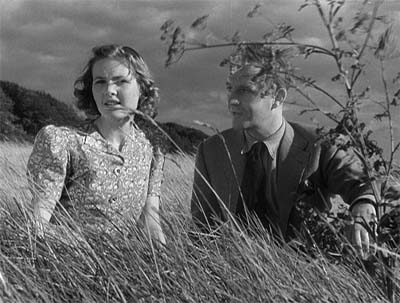
49th Parallel

Posted as part of Operation 101010
Category: films with numbers in the title / In category: 2 of 10 / Overall: 22 of 100


‘49th Parallel’ was the third of Michael Powell and Emeric Pressburger’s collaborations, and the last on which they would take separate screen credits. For their next film, ‘One of Our Aircraft is Missing’, they formed their own production company, The Archers, and bequeathed to the history of cinema that idiosyncratic and still inspirational credit “written, produced and directed by Michael Powell and Emeric Pressburger”.

‘49th Parallel’, in short, was the film that sealed the deal. It was epic in its conception and execution, and just a teensy bit controversial as well. And while I chose ‘A Matter of Life and Death’ and ‘I Know Where I’m Going!’ to represent Powell and Pressburger on my personal faves list, ‘49th Parallel’ remains a film that I wholeheartedly love: definitely a standout even among so prestigious a body of work as theirs.

The first eight films P&P made together were all produced during the war years and were all, ostensibly, propaganda films. Each was designed to communicate a specific message and/or celebrate an aspect of Britishness (ie. to reinforce the values under threat from Nazi-ism). Thus, ‘Contraband’ warned against Fifth Columnists, ‘I Know Where I’m Going!’ celebrated national values (a “why we are fighting” movie) and ‘A Canterbury Tale’ focused on Home Front activities.

‘49th Parallel’ was a plea for American involvement. Ian Christie, in his book ‘Arrows of Desire’, recounts the film’s genesis:

“Powell had read an article about how Canada had come into the war on Britain’s side despite internal French-Canadian hostility, and he understood how the forceful presentation of this issue could help win the most important propaganda battle of all: to bring America into the war quickly. With £5,000 from the Ministry of Information [this in 1940, by the way!] Powell and Pressburger embarked for Canada immediately … Back home, Treasury opposition to the idea of financing a film nearly killed the project. France was crumbling and the Luftwaffe threatened, yet ‘some bastard wants £50,000 or £60,000 to go and make a film in Canada’. But … the project proceed[ed] and within six weeks shooting had started in Canada.”

The basic plot, extrapolated by Pressburger from a scenario he and Rodney Ackland cooked up, has a German u-boat bothering shipping off the Canadian coast; when a successful aerial attack destroys it, a small group of survivors led by the borderline fanatical Lieutenant Hirth (Eric Portman) find themselves the sole Nazi invaders of Canada. Setting out from Hudson Bay, they attempt to traverse the country and cross into still-neutral America from where they hope to gain passage back to Germany. En route they encounter a French-Canadian trapper (a bizarrely-cast but enjoying himself Laurence Olivier), a holidaying and potentially draft-dodging Englishman (Leslie Howard) who responds to Hirth’s vituperative accusations of cowardice by staging a one-man resistance campaign, and a soldier gone AWOL (Raymond Massey) who beautifully outwits one of the Germans in a finale, played out above the Niagara Falls, that undercuts its tub-thumping propagandist sentiments with the quirky humour so typical of P&P.

The idea was to film the progress of Hirth and his crew through Canada on location, then wheel in the big-name guest stars (some of them released from military service in order to appear) for some studio work. One of the many achievements of ‘49th Parallel’ is how seamlessly location shooting, studio work and stock footage are cut together. The editor was a guy called David Lean. Dude made a few movies himself.

P&P’s plan was greeted with circumspection in some quarters, their critics suggesting they were whooping it up on a tax-payer-funded lark in Canada while our boys were dying valiantly etc etc etc, but when ‘49th Parallel’ opened the response was almost unanimously positive; it was, again to quote Christie, “greeted as the first considerable fiction film of the war: good propaganda and good entertainment”.

And it’s certainly entertaining. The structure – six vignettes in which Hirth’s crew progress (or devolve, since their numbers are gradually whittled down) through Canada – accounts for a brevity of mise-en-scene that paces the two-hour film faster than most movies of the time. The star names acquit themselves generally well. Olivier chews the scenery like a starving man who’s just been seated in a restaurant and reassured that he doesn’t have to worry about the bill. Howard is lumbered with the most literal bit of proselytising in Pressburger’s otherwise well-crafted script, but his affable charisma sells it. Raymond Massey, rubbery faced and having a whale of a time, steals his last-minute section.

But it’s the actors playing the Germans – and it’s worth pausing to reflect on the quirkiness of a British propaganda film made released in 1941 boasting six Nazi u-boat survivors as its protagonists – who take the honours. Particularly Eric Portman, appearing in the first of three films for P&P. Eric Portman in ‘49th Parallel’ is simply magnificent. A Yorkshireman by birth, you’d swear the man was a Prussian aristocrat. His portrayal of Hirth lays the groundwork for Paul Scofield’s von Waldheim in Frankenheimer’s ‘The Train’, Maximillan von Schell’s Stransky in Peckinpah’s ‘Cross of Iron’ and Christoph Waltz’s Hans Landa in Tarantino’s ‘Inglourious Basterds’.

Daringly, P&P also incorporate the idea of the “good German”, an archetype they would revisit in the character of Theo Kretschmar-Schuldorff (played by Anton Walbrook) in ‘The Life and Death of Colonel Blimp’. I won’t give anything away, but there’s an almost unbearably poignant scene, ending in a moment as chillingly inevitable as the outcome of Landa’s interrogation at the start of ‘Inglourious Basterds’, in which one of the group reveals himself as an honest and decent working man, a man of no political affiliations, a conscript purely because he was drafted, who comes close to embracing a new and gentler life in a foreign place … before the full force of brainwashed, unblinkered, hate-fuelled, jack-booted Nazi doctrine comes crashing down on him. It’s this scene that gives ‘49th Parallel’ its power, that imbues rhetoric with humanitarianism. It’s in this scene that P&P – as they would succeed in doing so many times during those first eight films – take the basest motivation for film-making (propagandism) and turn it into art.

Thursday, June 25, 2009

Visual poetry: I Know Where I'm Going!

Having posted some 800 words yesterday in praise of 'I Know Where I'm Going!', I seriously doubt that I've even scratched the surface in terms of just how utterly visually stunning it is. Nor do I think I can achieve this without recourse to the film's imagery itself. Therefore I'm borrowing a style of entry from Jeremy at Moon in the Gutter: a selection of images that distill the essence of the movie.


Wednesday, June 24, 2009

PERSONAL FAVES: I Know Where I'm Going!

The penultimate of Powell and Pressburger's wartime collaborations, 'I Know Where I'm Going!' is beautifully simple in terms of narrative and yet yields more and more with each successive viewing.


Ambitious twenty-something Joan Webster (Wendy Hiller) has bagged herself a rich older man, Sir Robert Berringer, CEO of Consolidated Chemical Industries. The date set for their wedding, she begins a journey which will take her to the Scottish Isles, specifically the isle of Killoran which she is led to believe Berringer owns. Arriving at Tobermory, a storm prevents her from crossing to Killoran. While the storm rages and Joan impatiently waits, she makes the acquaintance of some of Sir Robert's toffee-nosed friends, as well as Torquil MacNeil (Roger Livesey), a navy officer on leave and also wanting to make it to the island.


In quick succession, Joan learns from the locals that Sir Robert is a parvenu ("quite the little king, he is"), that MacNeil is the actual Laird of Kiloran (he leases the island out: "if I rent it for three years, I can live on it for six - Highland economics"), that MacNeil's friends are the opposite of Sir Robert's (earthy instead of stuffy, full of life instead of half dead), and that - most troublingly of all - she's starting to fall for him.

Desparate now to make the crossing, her entreaties to boatman Ruairidh Mhor (Finlay Currie) fall on deaf ears, so she bribes his impressionable son Kenny (Murdo Morrison). But the storm proves the least of their worries when the diminutive boat gets under way and the raging whirlpool that is Corryvreckan threatens to drag all on board to their deaths ...


As he had proved with his pre-Pressburger masterpiece 'The Edge of the World', Michael Powell was an Englishman in love with the rugged landscape, ancient mysticism and cultural heritage of Scotland (and in this respect a man after my own heart). Many a film has drawn from a Scottish setting its inspiration, its flavour and its wry humour - 'Whisky Galore!' (up next on the personal faves project) and 'Local Hero' being sterling examples. 'I Know Where I'm Going!' takes gold to their silver and bronze.


It also belongs to a tradition in cinema that stretches back to the very beginning of the art form, that of an investigation into the urban vs the pastoral, the city vs the country; a tradition perhaps best epitomised in silent film by F.W. Murnau's 'Sunrise: A Song of Two Humans'. There is much in 'I Know Where I'm Going!' that evokes the cinematic purity of silent movies. The voice-over accompanying the opening sequence could easily be a series of title cards interspersing the imaginative tableaux that sketch in Joan's growth from small child to young woman, a fixation on self-betterment greedily evident at every stage.


Subsequent scenes depict Joan in her element - a city girl, in fancy restaurants, trendy clubs; in charge, in control; dead certain of everything. Her idea of Scotland, however, is woefully naive: some words on a map, a snatch of the hackneyed old song "Ye Tak the High Road", a dream of her train trundling through a tartan landscape. The real Scotland is as fiercely elemental as it is beautiful. Weather is a metaphor for the passion that becomes aroused in Joan; a force she cannot control. Almost immediately on arrival, a strong gust of wind rips Sir Robert's carefully compiled itinerary from her hand and deposits it in the harbour. The storm dashes her plans of marrying him. Corryvreckan nearly drowns her. Ultimately, though, it's her wedding dress that's lost to the waves, and Joan is freed from the falsity of her engagement to Sir Robert and a marriage that would have been founded on materialism.


Anti-materialism was something of a theme in Powell and Pressburger's work. 'A Canterbury Tale' was a hymn to everyday miracles. In 'A Matter of Life and Death', art and science are the noble pursuits. 'I Know Where I'm Going!' values tradition, loyalty and comradeship. When Joan remarks that many of the islanders are poor, MacNeil corrects her: "They're not poor, they just don't have money." City girl that she is, Joan mistakenly believes the two states of being are synonymous.


If the sentiment sounds twee - the kind of message that many a Hollywood production would labour - the execution is anything but. In 'Arrows of Desire', his illuminating but too-brief study of Powell and Pressburger's work, Ian Christie notes that some scenes have "a rare cinematic intensity ... A fable of the age-old opposition between head and heart, the corruption of riches and the collision between commerce and tradition, becomes also a fable of post-war optimism."


But not restricted to post-war audiences. 'I Know Where I'm Going!' is a fable for any age, a timeless and life-affirming work of art, visually beautiful and emotionally transcendental.

Monday, October 20, 2008

Ill Met by Moonlight

By 1957, Powell and Pressburger were moving towards the annulment of their partnership. It had been an almost decade-long decline.

‘Gone to Earth’ was a slab of melodrama, ‘The Elusive Pimpernel’ a bit of pantomime camp, ‘The Tales of Hoffmann’ a failed attempt to recapture the magnificence of ‘The Red Shoes’, and ‘O … Rosalinda!!’ a self-indulgent flop, audiences showing either a singular lack of interest in operetta or an understandable caution in approaching films with three exclamation marks in the title.

Their last two outings were a return to the war movies that had made their name; but whereas the eight-film run of classics between ‘The Spy in Black’ in 1939 and the ‘A
Matter of Life and Death’
in 1946 were made during the war years (the latter in production just as the war was reaching its conclusion), ‘The Battle of the River Plate’ and ‘Ill Met By Moonlight’ came ten years afterwards: would that curious alchemy which made art of the propaganda film still function in retrospect?

Well, not with ‘The Battle of the River Plate’. Although a decent enough account overall of the sinking of the Graf Spree, Powell’s decision to film the movements of ships at sea resulted a highly cinematic footage utterly at odds with the patently studio-bound falsity of the rest of the film.

Which leaves us with ‘Ill Met By Moonlight’, their swansong, its box-office swelled by Dirk Bogarde in his dishy, matinee-idol prime, and again another account of an actual incident from the war.

The source material was a book by W. Stanley Moss recounting the exploits in Crete of Major (now Sir) Patrick Leigh-Fermor, an authentically individualistic English hero (as T.E. Lawrence to the desert, so Leigh-Fermor to the Mediterranean), and his successful kidnap of a high ranking German officer.

Powell and Pressburger’s take on Leigh-Fermor is romanticism writ large. Bogarde’s swooning performance is entirely in keeping with the sense of hero-worship with which Powell saturates the film. P&P favourite Marius Goring essays the German general with distinctly more gravitas.

And herein lies the enigma (and pleasure) of the film. Goring’s career office is a professional, but courteous with it: a Nazi and a gentleman. (P&P had been daring enough to portray ‘good’ Germans even in the war years: the harmless Vogel (Niall MacGinnis) in ‘49th Parallel’ and the dignified Kretschmar-Schuldorff (Anton Walbrook) in ‘The Life and Death of Colonel Blimp’.) Leigh-Fermor, however, is portrayed as a gentleman amateur. Ian Christie, in his wonderful study of Powell and Pressburger’s films, ‘Arrows of Desire’, describes Bogarde/Leigh-Fermor as “dressed as a comic-opera bandit when we first see him”. He goes on:

“… the whole story is framed, not only by its Shakespearean title but by a reference to the Odyssey … If the [film’s] realization does not live up to its promise or ambition, it remains nonetheless an intriguing stage in the military ideology that runs from Blimp … a defiant assertion of the gentleman-amateur ideal at a time when Britain was learning its new role in the world of superpower conflict and the end of Empire” (‘Arrows of Desire’, Faber & Faber, p.78).

Which is absolutely spot-on. Everything from Bogarde’s dashing leading man status to Goring’s good grace in defeat to the studied poignancy of the ending (the German officer tries to ‘buy’ the affections of a local Cretan child, with a view to leaving clues to his whereabouts, only for the lad – his loyalties hitherto in doubt – to be revealed as unswayable in his devotion to Leigh-Fermor). Which only makes the film’s far-and-away best scene that much more effective in its swift, no-nonsense efficiency.

Leigh-Fermor visits his contact, a dentist, in a Nazi-held town. Unbeknownst to him, he is followed. When the Nazi patrol (its sergeant a young Christopher Lee, speaking German like a native) burst in, Leigh-Fermor finds himself hustled into the dentist’s chair, a white bib-like cloth draped around his neck. Terrified of dentists, L-F plays along, not batting an eyelid when the patrol come stomping in, but losing his cool as soon as the dentist, hands shaking from fear, starts up the drill. The Nazi sergeant has his suspicions and pulls the cloth from his neck; L-F is clutching a pistol under it. He summarily executes the German soldiers. There’s nothing do-or-die or remotely heroic about the scene; he does it because he’s scared of dentists.

Seven years after ‘The Blue Lamp’ and just five after ‘Hunted’, and a full decade or more before the darker characterisations of ‘The Damned’ and ‘The Night Porter’, the anti-romantic-hero element of Bogarde’s cinematic persona is revealed in a brief lightning flash. So too the adaptability and menacing screen presence of Christopher Lee. And between them, a scene effective enough to transform what could have been Powell and Pressburger’s death rattle into a respectable send-off.

Monday, May 26, 2008

PERSONAL FAVES: A Matter of Life and Death

There are personal faves and there are personal faves. If you asked me to fillet the list of 100 films and extract just ten - ten movies to represent what is truly essential to me in cinema - Powell and Pressburger's 'A Matter of Life and Death' would be one of the first, if not the first, I reached for.

I absolutely, completely, wholeheartedly bloody love this film.

The opening balances the metaphysical with the human element: the camera pans through the depths of space. "This is the universe," intones an unseen narrator, his voice almost the drone of a lecturer; "big, isn't it?" A whistlestop tour of nebula clusters and supernovas ends up at a blue-and-green globe, turning steadily, reassuringly on its axis. The camera swoops down, through fog; somewhere below, there is a glowing fiery mass. The narrator's voice changes, becomes more intense: "It's night over Europe, the night of 2nd May 1945. That point of fire is a burning city. It had a thousand-bomber raid an hour ago." Radio static, dashes of morse code, klaxons - harsh noises now fill the soundtrack: the sounds of the mid-twentieth century. The sounds of a world at war. A snippet of Churchill's immortal speech - "this was their finest hour" - is buried among them.

Every time I watch 'A Matter of Life and Death' - and I have honestly lost count of how many times I've seen it - the hairs on the back of my neck stand to attention by this point ... and we're only a couple of minutes into the film.

What happens next slays me. Every time.

A voice floats out of the night, that of a young woman: June (Kim Hunter), an American WAAF stationed at a coastal base in England. She is receiving, over the radio, the last words of Squadron Leader Peter Carter (David Niven). Carter is certain they'll be his last words: the skipper of a shot-to-ribbons Lancaster bomber, his crew have bailed out on his orders, his radio operator is dead, one engine is blazing uncontrollably, and he's about bail out himself ...

Carter: ... but there's a catch. I've got no parachute ... Don't be afraid, June. It's quite simple: we've had it, and I'd rather jump than fry. After the first thousand feet, what's the difference? ... June, are you pretty?
June: Not bad, I -
Carter: Can you hear me as well as I hear you?
June: Yes.
Carter: Good. You've got a good voice. You've got guts, too. I was lucky to get you. It's funny, I've known dozens of girls, been in love with some of them, but an American girl who I've never met and never will, will hear my last words.
June: Perhaps we can do something, let me report it, Peter.
Carter: No, no-one can help. Only you. Let me do this is my own way. I want to be alone with you, June. Where were you born?
June: Boston.
Carter: Mass?
June: Yes.
Carter: There's a place to be born! History was made there. Are you in love with anybody? No! No, don't answer that.
June: I could love a man like you, Peter.
Carter: I love you, June; you're life and I'm leaving you.

I love you, June; you're life and I'm leaving you. I get tears in my eyes at this point. Every time. I sincerely believe that if you don't at least have a lump in your throat during this sequence, it can be taken as scientific proof that you're simply not human.

So: Peter Carter plummets from his aircraft. Washed up on the beach the next morning, he's convinced he is dead and in Heaven, an impression strengthened during a pastoral encounter with a shepherd boy surrounded by animals. Then a Mosquito roars overhead and Carter realises that he's alive. He spots a woman in WAAF uniform cycling along the beach and goes hoving off after her to get directions. She is, of course, June. Neither can understand why Carter is still alive, but this mystery is soon eclipsed as they fall in love.

Which is nice. But not for Conductor 71 (Marius Goring), the angel charged with collecting Peter Carter's soul for onward transmission to Heaven*. Up before a celestial tribunal to account for his ineptitude, Conductor 71 blames "your ridiculous English weather". He is instructed to visit Earth, explain the situation to Carter and conduct him to the afterlife. Carter, with good reason, refuses. "I'm in an entirely different position," he explains, demanding a right to appeal. Conductor 71 threatens to use force. "You could always try," Carter laughingly responds, one of the great put-downs in cinema. When Conductor 71 disappears, Carter is struck by a blinding headache and almost passes out. June, worried that he's hallucinating, arranges for him to see her friend, village doctor Frank Reeves (Roger Livesey).

Reeves and Carter form an ersatz father-son relationship (Carter's biological father died in the First World War) which plays out in counterpoint to the romantic relationship between Carter and June. Meanwhile, Carter receives subsequent visits from Conductor 71, informing him that he has been allowed to appeal and can appoint anyone who has ever lived as his defending counsel. He is cautioned that the case for the prosecution is being headed by Abraham Farland (Daniel Massey), the first American killed by a British bullet in the war of independence and therefore ineffably prejudiced against all Englishmen.

While Carter frets over his indecision in appointing counsel, and worries that Farland's case will outweigh his, Reeves arrives at a diagnosis and determines that the key to Carter's condition is the winning or losing of his case. Reeves convinces a practiced neurosurgeon that the complex operation necessary to save Carter must occur immediately.

The operation is scheduled for that very evening. A storm lashes the village. The ambulance is delayed. Reeves clambers onto his motorcycle and tears off into the night to locate the medicos. Losing control of his machine, he swerves in front of the ambulance and is killed outright. Conducted to Heaven by 'Pilgrim's Progress' scribe John Bunyan, he is given over to the care of Conductor 71 who tells him Carter has requested Reeves represent him at the court of Heaven. Reeves agrees and goes head-to-head against the rabidly anti-Anglo Farlane to plead Carter's right to live and to love.

'A Matter of Life and Death' was the eighth and last of Powell and Pressburger's collaborations to be made during the wartime and funded by the Ministry of Information as a propaganda film. Their first film together, 'The Spy in Black' was a why-we-need-to-be-in-the-war film; '49th Parallel' was a why-the-Americans-need-to-be-in-the-war film; 'A Canterbury Tale' was an importance-of-the-home-front film. 'A Matter of Life and Death' was pitched as a film designed to reconcile the differences between English and American allies. By the time Powell and Pressburger completed it, the war was effectively over, not that this makes an iota of difference.

Powell and Pressburger took the propaganda film and made it art, in a way that perhaps only Hitchcock's 'Foreign Correspondent' equals (and I think 'Foreign Correspondent' will be the next film I write about on The Agitation of the Mind).

Let's pause to define art. Here's my definition (feel free to agree, disagree or leave comments): a true work of art functions, equally and simultaneously, on an aesthetic, intellectual and emotional level, the cumulative effect being the betterment of those who experience it.

Let's take these one at a time:

1) Aesthetic: the film is utterly gorgeous to look at. Powell entrusted the cinematography - ranging from the glorious technicolor of the here-and-now to the austere black-and-white of the Heaven scenes - to genius-in-waiting Jack Cardiff. It was his first gig as DoP. Cardiff rose to the challenge admirably and transformed P&P's concept into inspired actuality.

2) Intellectual: as fanciful as some of the conceits in 'A Matter of Life and Death' are, the screenplay never entirely veers into fantasy. The closest contemporary equivalent I can find is Guillermo del Toro's 'Pan's Labyrinth', in which the boundaries between the real world and a supposedly imagined one are transgressed at one point only and even then in such a manner that enough ambiguity remains that the viewer can take the film as reality or a fantasy ... and it still function as powerfully given either reading.

3) Emotional: it's about a man who defies Heaven to be with the woman he loves. 'Nuff said.

4) The betterment of those who experience it: I've never met anyone who avowed a deep affection for 'A Matter of Life and Death' who didn't believe in love, who didn't appreciate cinema.

Michael Powell and Emeric Pressburger formed one of the most unique film-making partnerships. 'A Matter of Life and Death', in my opinion anyway, represents their highest achievement. It does everything cinema should do, everything art should do, and speaks to the heart, the mind and the soul with equal intensity and sincerity.


*In the interests of context, I should point out that I'm an atheist. I do not believe in Heaven or life after death. As regards 'A Matter of Life and Death', however, this matters not one jot. It's a beautiful, life-affirming work of film art and, as far as I'm concerned, that's all that matters.

Friday, December 21, 2007

A Canterbury Tale


The first half of Powell and Pressburger’s output consisted, superficially at least, of propaganda pieces. Films like ‘49th Parallel’ and ‘One of Our Aircraft is Missing’ were funded by the Ministry of Information, while production of ‘The Life and Death of Colonel Blimp’ – inspired by David Low’s satirical cartoon strip – provoked enough controversy that Churchill fired off memos about it.*

‘49th Parallel’ was an invitation to American involvement; ‘One of Our Aircraft’ a tribute to the indomitable British spirit. ‘Blimp’ fell into the category of “what we are fighting for”, the eponymous Colonel’s gentlemanly, old-school style of soldiering held up as outmoded in the face of the then-contemporary conflict. ‘A Canterbury Tale’ belongs to a smaller, less remembered sub-genre of wartime propaganda: the Home Front film.

A disparate trio descend upon a small village near Canterbury: former sales assistant Alison Smith (Sheila Sim), now assigned to duties as a Land Girl; former cinema organist Peter Gibbs (Dennis Price), now a sergeant in the army, his regiment about to be posted overseas; and former coffee-drinking American Sgt Bob Johnson (John Sweet**), now stationed in England and not enamoured of the national propensity for tea drinking.

Local squire Thomas Colpeper (Eric Portman) strives to retain some sense of tradition and rural identity, giving illustrated talks to the visiting soldiers and expounding on the history and culture of the area. He believes in “pouring knowledge into people’s heads, by force if necessary”. Not that his latest potential converts (or modern day pilgrims, as Pressburger’s sometimes overly literal script paints them) don’t have other things on their mind: Alison is haunted by past holidays in the area with her fiancé, now missing in action. Johnson is cut up because his girl back home has stopped writing to him. Gibbs is looking for something more spiritual. On top of this, there’s the “Glueman”, attacking girls by night, smearing glue into their hair.

The investigation into the Glueman’s identity is the thin peg upon which the meandering narrative is hung. You’ll twig the guilty party from the get-go. The film’s real concerns are an investigation into Englishness: Powell’s camera captures the timeless beauty of the landscape. History and tradition are at the forefront (in a scene that should be twee but is actually quite wonderful, Johnson, a lumberman by trade, befriends a wheelwright twice his age, their mutual respect based on an understanding of how long wood should be aged and when it should be cut; “you can’t hurry an elm” remains my favourite line), with the occasional troop carrier crashing through the woods or Spitfire roaring overhead as a reminder of modernity.

Speaking of Spitfires, the film’s opening sequence offers its most celebrated moment – often cited as a precursor to the bone-to-spaceship jump cut in Kubrick’s ‘2001: A Space Odyssey’. Chaucer’s pilgrims set out for Canterbury, some walking, some on horseback. A falconer releases his bird. It soars into the sky, majestically. Cut: a Spitfire replaces it, engine shattering the silence, swooping down over a landscape that hasn’t changed.

Finally, with the protagonists finding their way to Canterbury – to the cathedral itself – the scene is set for a small helping of everyday miracles. It’s here that the script is at its most strained, individual resolutions feeling a little too pat. But after two unhurried hours of pastoral idyll (including an hilarious ‘Swallows and Amazons’-type scene where two rival gangs of children stage their own manoeuvres, neatly mocking those Gibbs and his regiment are engaged on), who’s complaining? ‘A Canterbury Tale’ isn’t the most memorable, most offbeat, most challenging or most indulgent film Powell and Pressburger made, but it’s still a film that only they could have created.


*See the introduction to the published screenplay (Faber & Faber) and A.L. Kennedy’s BFI chapbook on ‘Blimp’ for more information.

**Sgt John Sweet was a real-life American soldier whom Powell had seen in an amateur production. His performance makes it clear that he wasn’t a professional actor, but there’s an unpretentiousness to his screen persona that, stopping just short of “gee whiz” cornball hokum, is somehow endearing.

Tuesday, December 18, 2007

The Small Back Room


My thanks to Beyond the Valley of the Cinephile for inviting all film-loving bloggers to contribute to a week-long Powell and Pressburger blog-a-thon, the only excuse I need to wax lyrical about one of my personal favourites.

The Small Back Room’ is an adaptation of a novel by Nigel Balchin, one of the most popular and well-respected British writers of his time. The title refers to the sub-basement office occupied by a research and development team – ‘boffins’, to use the vernacular. Professor Mair (Milton Rosmer) is a man of science, lending his acumen to projects designed to assist the war effort and effect a swifter victory for the Allies. His team includes Sammy Rice (David Farrar), the brains of the outfit but a man with his personal demons, and the walking case of nerves Corporal Taylor (Cyril Cusack), whose cuckolding by his wife is an open secret in the department.

Not that Sammy fares much better. Limping from a wound which has resulted in a tin foot, fighting the pain with beer and prescription drugs that do nothing for him, Sammy valiantly tries to stay off the Scotch – the only thing guaranteed to dull the pain – for the sake of his on-off girlfriend Susan (Kathleen Byron). Matters are complicated in that Susan is secretary to Sammy’s oleaginous boss R.B. Waring (Jack Hawkins). Waring is more salesman than scientist, schmoozing with government contacts – a scene involving a minister’s visit (the politico, billed as “A Guest” in the credits, is immediately recognisable as Robert Morley) is one of the best bits of political satire that side of ‘Yes, Minister’ – and not really caring about the poor bastard in the firing line who has to use the product.

The narrative centres around several (personal and professional) challenges to Sammy’s equilibrium. Firstly, a new type of unexploded bomb has been discovered. Designed to resemble a harmless thermos flask, but producing deadly results if handled, this is “Jerry’s” latest booby-trap. As the film opens, Sammy is approached by idealistic Captain Stuart (Michael Gough) to give a professional opinion on the device with only the barest amount of information to go on. The best he can offer is to be called to the scene the next time one is discovered. Secondly, he is summoned to give evidence at committee on a new, still-being-tested piece of ordnance, the Reeves gun, which Sammy can see is badly flawed, but which Waring wants to push through to government contract stage.

Sammy’s clash with Waring over the Reeves gun leads to ministerial resignation and potentially negative changes within the research department. It also fuels a stand-up row between him and Sue. She walks out on him. He goes back on the whisky, big time. Trashing his apartment in the throes of a drunken rage, Sammy gets a call – Stuart has tried to defuse one of the new UXBs and died in the attempt. Another device has been found, buried in the treacherously unstable pebbles of Chesil Sand. Frustrated, angry and hungover, an emotionally unstable Sammy presents himself at the scene and begins to defuse the bomb …

‘The Small Back Room’ operates pithily and effectively on three levels: knife-in-the-back political satire, nail-chewing suspense thriller, and character study of an alcoholic. Make no mistake, ‘The Small Back Room’ is up there with ‘The Lost Weekend’ and ‘Withnail and I’ as one of the greatest drinking movies ever made. Take the scene where Sammy, terrified of being alone, agrees to meet Sue at his apartment only for her to be kept late at work. He sits at a bare table and regards two objects: an (as yet) unopened bottle of whisky and a clock. He stares the clock out through the passage of an hour. He begins to hallucinate. The endlessly ticking clock, every tick hideously and surreally amplified, insinuates itself into the pattern of the wallpaper. The whisky bottle swells so that it occupies the entire room, bearing down on Sammy, forcing him up against the wall. Remember the magnificently off-the-wall cold turkey sequence in ‘Trainspotting’? … ‘The Small Back Room’ did it first.

Then there’s Sammy going off the wagon: argument with Sue; exeunt girlfriend; uncertain future at work. He heads for his local and implores barman Knucksie (a pre-‘Carry On’ Sid [billed as Sidney] James) to serve him whisky. Knucksie, well aware of Sammy’s inability to handle the hard stuff, refuses. Sammy starts wrecking the joint. “Knucksie,” he slurs, “has anyone ever given you a thick ear?” The barman stares him down: “Not without paying cash for it.”

I don’t think anyone’s given a more convincing performance of a drunkard violently (and pitifully) losing it as Farrar does here.

All of this makes the climactic scene that much more tense. Actually, ‘tense’ doesn’t do it justice. ‘The Small Back Room’ delivers its payoff in a twelve-minute scene that is sweatily, agonisingly, sphincter-tighteningly unbearable. Sammy treads slowly out towards the UXB, the pebbles of Chesil Bank cascading beneath his feet with every step. He nearly blows himself to shit just latching up supports around the device. Then he takes a couple of monkey wrenches to the cylinder to try to open it … If you’re not watching through your fingers whilst desperately needing to pee by this point, then congratulations: you officially have nerves of steel.

Bomb disposal scenes are a staple of cinema. Bond movies ‘Goldfinger’ and ‘Octopussy’ … child’s play. TV spin-off ‘Sweeney 2’ … amateur hour. ‘The Small Back Room’, as I may have mentioned before, did it first and did it best. Its only shortcoming is that Powell and Pressburger directed it. In the all-time P&P greatest movies list, arguably half a dozen features rank above ‘The Small Back Room’ … but that shouldn’t detract from one simple fact: it’s the best film of its kind bar none.