You can pretty much date the “angry young man” movement in British literature as having its beginnings with John Osborne’s play ‘Look Back in Anger’ in 1956. In fact it was a press officer at the Royal Court Theatre who came up with the phrase as part of the play’s publicity.
The “angry young man” movement in British cinema was coterminous with the kitchen sink drama. These grimly realistic films, often tackling controversial social issues (infidelity, abortion, domestic violence, alcoholism), reached their fullest expression in the 1960s with the likes of ‘Saturday Night and Sunday Morning’, ‘A Taste of Honey’, ‘The L-Shaped Room’, ‘This Sporting Life’, ‘The Family Way’ and ‘Poor Cow’. Two striking examples, however, were made in the late ’50s: Jack Clayton’s ‘Room at the Top’, from the novel by John Braine, and Tony Richardson’s adaptation (having directed the original theatrical production) of ‘Look Back in Anger’.
The clue’s in the title. And for anyone who missed it, it’s made explicitly clear in the towering fury of Richard Burton’s performance as Jimmy Porter, the mid-twenties university graduate who has turned his back on everything that university and education stand for and ekes out a basic living behind a market stall. At night, he plays trumpet and drinks at jazz clubs.
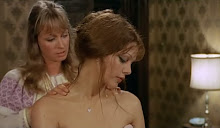
He lives in a dingy flat with put-upon wife Alison (Mary Ure) and lodger and co-worker at the stall Cliff (Gary Raymond). The flat, with its proximity to a church whose bells toll the faithful to and from worship with metronomic regularity, is a prison. Alison has become the personification of all the upper-middle-class superficiality he has so robustly eschewed. There is no love left in their marriage. Jimmy’s vehemence towards her leaves her fearful. She can’t bring herself to tell him she’s pregnant.
Cliff does his best to keep the peace between Jimmy and Alison, but his affectionate (though entirely platonic) relationship with Alison adds tension. Jimmy is as derogatory in his treatment of Cliff as he is towards Alison; and there’s no doubt that Cliff is second fiddle at the stall, Jimmy leaving him to tend to customers without a break while he hares off to the pub with “Ma” Tanner (Edith Evans). “Ma” Tanner is Jimmy’s erstwhile landlady and, as the maternal appellation suggests, something of a mother figure to him. A decent side to Jimmy emerges while he’s in her company; he accompanies her to a forlorn cemetery, goods trains clanking past in the distance, where she tends to her husband’s grave.
There’s a grimness to every frame of ‘Look Back in Anger’. From the dismal cemetery to the pubs wreathed in cigarette smoke; from the cramped rows of terraced houses to Jimmy and Alison’s equally cramped flat; from the grubby station platform where leave-takings and returnings are played out to the litter-strewn market place where stall inspector Hurst (Donald Pleasance) sneeringly and punctiliously makes his rounds and a coterie of stall holders close ranks against Indian tradesman Kapoor (S.P. Kapoor). Jimmy is a witness to the racially motivated accusations against Kapoor which see Hurst revoke his licence, and urges him to stand up to his accusers. Kapoor replies sadly and pragmatically that there are other towns and prepares to make his departure. “What made you come to this bloody country?” Jimmy asks him. “In India, I was an outcast,” Kapoor replies.
The more things change, the more they stay the same.
‘Look Back in Anger’ kicks Englishness in the teeth. It’s easy to see why the clanging churchbells drive Jimmy mad: he has rejected the doctrines they vouchsafe; he knows full well that the racket they make never quite disguises the provincialism, the xenophobia or the smug hypocrisies of which the likes of Alison’s parents are emblematic; never quite drowns out the bleating of mealy-mouthed jobsworths like Hurst. ‘Look Back in Anger’ kicks against church, state, education and ambition (asked what he really wants, Jimmy answers “Everything. Nothing”). It even cocks a snook at the theatrical tradition (notwithstanding the origins of its source material) by having Jimmy and Cliff boisterously interrupt the rehearsals of a parlour room play Alison’s friend Helena (Claire Bloom) is appearing in.
 Jimmy’s an unlikeable character for much of the 100-minute running time (he’s probably even more insufferable for the two hours plus of the play), and my sympathies while watching the film are generally more with Alison despite the fact that she does herself no favours by being such a doormat, but I can understand where the anger comes from and what it’s directed towards. Anyone who can’t is either from the upper-middle-classes Jimmy’s so contemptuous of, or they’ve never lived in England.
As a feel-bad film, ‘Look Back in Anger’ is up there with anything Ken Loach has ever put his name to. As a document of working class Britain, it’s a lot more convincing than anything Mike Leigh has ever put his name to. As a showcase for a searing, raging, no-holds-barred, tear-the-screen-up performance, it’s arguably Richard Burton’s finest hour.