Showing posts with label Max von Sydow. Show all posts

Thursday, May 26, 2011

Shutter Island


Ever had a movie spoiled for you? I mean the ending completely and utterly blown?

In descending order of both recency and annoyance, I present three examples:

3) Twenty years ago, my aunt was watching ‘Dances With Wolves’ when some stumbling inebriate came lurching into the cinema, a good hour and a half into the film, and stood swaying in the aisle, blinking myopically as he focussed on the screen. “Oh yeah,” he slurred, “seen this. Wolf gets shot.” And blundered back out.

2) Ten years ago, a mate of mine was driving to the cinema to see ‘The Sixth Sense’ – actually frickin’ en route – and listening to the car radio when a blabbermouth DJ gave the ending away.

1) Last year, the day before I was planning to go and see ‘Shutter Island’, I read an online review whose author didn’t have the common decency to throw up a spoiler alert. Moreover, the way this doofus painted the ending, it sounded like the kind of movie I’d feel conned by and get annoyed at. So I stayed away. There’s something downright fucking unholy about being made to feel that you need to stay away from a Martin Scorsese film.

A few weeks ago, I felt that enough time had passed and added it to my rental list. The DVD turned up over the weekend. On Monday evening, fortified by half a bottle of wine, I sat down to watch it.

Damn, I wish I’d seen it at the cinema!


Granted, ‘Shutter Island’ isn’t perfect – at nearly two and a half hours it’s overlong and its revelatory final act threatens to drown the drama in exposition – but as an exercise in one of the modern masters of mainstream cinema basically fucking with the audience, it’s as audacious as it is pulpy. Even if Scorsese hadn’t namechecked Val Lewton as an influence, there’d be no doubt that ‘Shutter Island’ is his second sortie into schlock, his biggest and boldest battering at the barricades of the B-movie since Max Cady strode tattooed and unreformed from jail in ‘Cape Fear’ and promised that “you will learn about loss”.

In ‘Shutter Island’, US Marshal Teddy Daniels (Leonardo diCaprio) learns about –

And here, ladies and gentlemen, is as good a place as any to ensure I don’t do unto others as was done unto me. In other words: SPOILER ALERT. I say again: SPOILER ALERT. And for a third time, just to make sure nobody holds anything against me: SPOILER ALERT.

In ‘Shutter Island’, US Marshal Teddy Daniels (Leonardo diCaprio) learns about himself. About his past. About why his dreams are rendered into nightmare by memories of his dead wife Dolores (Michelle Williams). He learns why he doesn’t really know anything about his new partner Chuck Aule (Mark Ruffalo) prior to their assignation to track down an escaped mental patient on the Alcatraz-like clinical facility of the title. He learns why his painful memories of the liberation of Auschwitz and inextricably bound up with the present, why he is so fixated on the whereabouts of deranged arsonist Andrew Laeddis (Elias Koteas), and what the cryptic note left by the enigmatic Rachel Solando (played in two incarnations by Emily Mortimer and Patricia Clarkson) truly means.


The dual casting of Mortimer and Clarkson is genius. Both have a fragile beauty, a visceral intelligence and a quixotic combination of vulnerability and steely resolve. The two Rachels, for me, are the key to the film. ‘Shutter Island’ is a study in duality. In Teddy’s mind, the facility gets mixed up with the death camps; his wife with one of the inmates; the head of security with a Nazi officer. The facility’s senior management seems to exist under a similar schism. Who is really in charge, the suave but persuasive Dr Cawley (Ben Kingsley) or the authoritarian Dr Naehring (Max von Sydow)? Teddy’s dreams – vividly depicted in some of the film’s most challenging visual tableaux – centre around fire and ash, yet his fear of water is what opens the floodgates (pardon the pun) to the narrative’s nastiest resolution.

Having seen the film only in the context of knowing its ending, I’d like to hazard a guess that like, say, Dario Argento’s ‘Deep Red’, it’s a work that becomes infinitely more rewarding – certainly a film that reveals itself as subversively multi-faceted – once you know what to look for. The opening scene, depicting Teddy and Chuck’s ferry crossing to the island, initially comes across as shoddily edited, all weird cuts, spatial dislocations and shots that clearly don’t match. In hindsight, it’s cinematic sleight of hand, a woozy syncopation that throws the viewer out of normalcy and into a state of mind.

Scorsese perpetuates the tactic right up until the final act: gothic imagery abounds, apocalyptic storms lash the island, the agonies of Mahler are seared into the soundtrack, paranoia bleeds into the fabric of the film, conspiracies ooze out of the woodwork and the stone walls, identities are incrementally challenged, reality and madness dance a dizzying pas de deux around each other, and the lunatics – in more than one chillingly effective set-piece – seem ready to take over the asylum.


In one respect, ‘Shutter Island’ is an almost-masterpiece of psychological portraiture; in another its pure shlock. The viewer willing to let go and just experience the head-fuck will find something reasonably close to the best of both worlds. For a work of such aesthetic artifice, ‘Shutter Island’ is pure cinema. It embodies a dichotomy and damn near resolves it.

To the doofus whose review I mentioned earlier, thank you for giving me the tools by which to fully appreciate ‘Shutter Island’ on first viewing. And screw you that I didn’t go see it on the big screen.

Sunday, April 10, 2011

GIALLO SUNDAY: Sleepless

Posted to coincide with Max von Sydow’s 82nd birthday

Broadly speaking, the glory days of the giallo were the mid 60s to the late 70s. But the genre never entirely went away. Still hasn’t. Dario Argento saw in the new millennium with ‘Sleepless’, a rather calculated return to form that gave him the biggest hit in his native Italy that he’d had since ‘The Stendahl Syndrome’ five years earlier.

A prologue set in 1983 has world-weary cop Inspector Moretti (Max von Sydow) promised the young son of a murder victim that he’ll bring the killer to justice if it takes him the rest of his life. A promise he thinks he’s fulfilled when the dead body of the dwarf identified as the killer is retrieved and the case is closed.

Eighteen years later, Moretti has retired, the young lad Giacomo (Stefano Dionisi) is now in his twenties and embarking on a relationship with harpist Gloria (Chiara Caselli), and Moretti’s successor Inspector Manni (Paolo Maria Scalondro) finds himself reopening Moretti’s old case when an identical series of murders occur.

There are two ways to look at ‘Sleepless’: an old-school return to the giallo stamping ground that Argento made his name with; or a “greatest hits” package that simply rehashes former glories. Indeed, the case for the latter hardly needs to be made. There isn’t a single set-piece that doesn’t recall an earlier example of Argento’s filmography, with ‘Deep Red’ in particular being worked over (major plot points involve a child’s nursery rhyme, a buried childhood memory, a character poking about in an old dark house, and a victim menaced by a mechanical doll marching inexorably out of the shadows) like there’s no tomorrow. A secret unearthed in a graveyard recalls ‘Cat of Nine Tails’; a victim framed between the windows of a train is reminiscent of the huge glass doors both framing and denying prevention of the murder in ‘The Bird with the Crystal Plumage’; some prowling camerawork in a concert hall is straight out of ‘Opera’, and the plot device of a novelist whose opus the killing spree seems to be patterned on is ‘Tenebre’ writ large.

However, coming after the abysmal ‘Phantom of the Opera’, and providing the last hurrah of satisfyingly stylish Argento goodness prior to a decade’s worth of offerings (‘The Card Player’, ‘Do You Like Hitchcock?’, ‘Mother of Tears’, ‘Giallo’) that has seen his stock plummet to a new low, even something as deliberately reflexive as ‘Sleepless’ is to be embraced: it’s a reminder, however self-derivative, of what you love about Argento.

Tuesday, February 16, 2010

Winter Light

Posted as part of Operation 101010
Category: Eurovisions (Sweden) / In category: 2 of 10 / Overall: 12 of 100


‘Winter Light’ is the second title in Ingmar Bergman’s loosely connected “trilogy on faith”. Free from the psycho-drama of the first film, ‘Through a Glass Darkly’, the nihilistic despair of the concluding episode ‘The Silence’ and the incestuous subtext of both of them, ‘Winter Light’ is nonetheless a shattering, profound and deeply personal work; arguably the essential work in the trilogy not only in that it connects the films that bookend it but because it is the only film in a trilogy exploring faith which has a man of the cloth as its main character.

The disturbed heroine of ‘Through a Glass Darkly’ makes reference to a “spider god” during her mental turmoil. The phrase recurs in ‘Winter Light’ in a more contemplative context as Pastor Tomas Ericsson (Gunnar Bjornstrand) addresses his crisis of faith. Unable to provide spiritual comfort or assuage the doubts of his flock, Tomas goes through the motions as he presides over Sunday morning service and evensong. In his occasional candid moments, he names the thing that constitutes his greatest agony: God’s silence.

Thus the title of the concluding film. ‘The Silence’ is a feature-length metaphor for this dispiriting concept. ‘The Silence’ is one of the most depressing films I’ve ever seen. It makes your average Andrei Tarkovsky or Bela Tarr opus look like an Ealing comedy.

‘Winter Light’ isn’t much happier. It takes place during a single day, a Sunday. The opening sequence has Tomas conducts the morning service. The church is half empty. Frederik Blom (Olof Thunberg), the organist, checks his watch and almost misses his cue when Tomas concludes his sermon; Algot Frovik (Allan Edwall), the sexton, suffers through the service, crippled, hunched and in pain; the elderly Magdalena (Elsa Ebbesen) mumbles the responses to the prayers and warbles her way off-key through the hymns; heavily pregnant Karin Persson (Gunnel Lindblom) accompanies her depressed and uncommunicative husband Jonas (Max von Sydow) and encourages him to “talk it out” with Tomas after the service; Knut Aronsson (Kolbjorn Knudsen) splutters his way through the hymns as if the words – pious and by rote – have become stuck in his throat; and schoolteacher Marta Lundberg (Ingrid Thulin) carries a torch for Tomas and suppresses a lack of belief in God as long as she can be close to him.

During the course of this single day, Tomas will reject Marta’s love, be faced with one of his flock questioning of Christ’s suffering, and deal with the aftermath of another’s suicide. He will also be confronted with the accusation that his erstwhile passion in his vocation owed more to his late wife’s love than God’s.

‘Winter Light’ opens with Sunday morning service, at which attendance barely scrapes double figures. It concludes with evensong, at which only Frederik, Algot and Marta are present. Frederik and Algot because they are required to be, Marta despite Tomas’s rejection of her. In spiritual terms, his church is empty. Tomas begins the service nonetheless.

It is to his eternal credit that Bergman the director shoots every scene with complete detachment, just as Bergman the writer employs an observation approach. In both incarnations, Bergman acts not as a commentator or a moralist, but as a witness. He simply observes and records. Reports back. He imbues the accoutrements of communion with as much gravitas as the empty pews and cold architecture of the church. With the exception of a scene in which a character reads a letter and Bergman cuts to a non-naturalistic close-up of the sender reciting the contents of said letter, ‘Winter Light’ is possessed of enough austere observationalism to almost pass as a documentary.

And this is the key to Bergman’s approach to the material. The meaning is in the silences, in the ellipses, in what is unspoken. Is ‘Winter Light’ about God’s silence, or do the silences present spaces in which the doubter can find faith, the questioner receive answers and the helpless benefit from guidance? Is an empty church a symbol of the failure of religion, or less cluttered so that the one person whose belief is in the reckoning can engage with their deepest and darkest conflicts? When Tomas, being driven back to the church for evensong, uses the delay in the barrier at a railway crossing blocking the road to admit that he entered the seminary because of his parents’ wishes, is it symbolic of the path he took being adumbrated, or is the eventual lifting of the barrier and his continued journey the more appropriate metaphor?
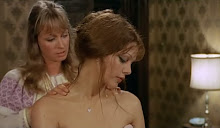
As an atheist, I find concatenation in much of ‘Winter Light’ to a rejection of religion. But in Bergman’s refusal to call it either way – and in the rigidly ambiguous final scene in which Tomas, preaching to an all but empty church, faces the camera in tight close-up and speaks words in praise of God – Tomas’s internal struggle for belief finds an onscreen corollary in which the last few seconds before the screen fades to black could equally denote despair or redemption.

Monday, May 11, 2009

Exorcist II: The Heretic

To paraphrase Jane Austen, it is a truth universally acknowledged that all studios in possession of a financially successful property must be in search of a sequel. William Friedkin’s ‘The Exorcist’ made over $66 million in its first year’s release in America*, an impressive return on a total budget (including prints and advertising) of $15 million.

A follow-up was inevitable. Friedkin and Blatty were approached but refused. Retaining the services of playwright William Goodhart to script, co-producer Richard Lederer went scouting for a director. Initially, Lederer conceived the sequel as a quickie cash-in, perhaps even utilising footage from the original that didn’t make the final cut. Again a priest would be the central character but his role would be investigative, probing the circumstances of Merrin’s death. It would be low-budget and make Warner Bros an easy profit.

At least that was the theory.

John Boorman, who felt that ‘The Exorcist’ was little more than a film about the torture of a child, was an odd choice to direct, but Goodhart’s treatment piqued his interest. Goodhart wanted to explore the theories and theology of Pierre Teilhard de Chardin, a Jesuit priest and archaeologist on whom Blatty had based Father Merrin. Teilhard believed that mankind was moving towards an evolutionary stage where telepathic communication would engender global consciousness. This dovetailed with Boorman’s ideal that ‘The Heretic’ “would be the antidote” to ‘The Exorcist’ instead of a sequel; a metaphysical drama instead of a horror film. (It’s telling that Boorman’s autobiography refers to the film as simply ‘The Heretic’, pointedly leaving the word “exorcist” out of the title.)

So far, so dubious. A producer looking for a low-budget hit; a director who didn’t like the original; a writer in thrall to philosophical theorising.

It started going wrong with Goodhart’s first draft. Boorman wasn’t happy with it and states, in his autobiography that “long discussions were required to get him to change a comma”. Boorman and his writing partner Rospo Pallenberg did uncredited rewrites, the script undergoing almost continual revision as production approached. Originally, Kinderman had a prominent role; after Lee J. Cobb’s death, the script was rewritten. Main character Father Lamont was conceived as an idealistic young priest inspired by Merrin’s life and work; when Jon Voight, Boorman’s first choice, turned the part down, the script was revised to make him an older, world-weary character. Richard Burton was cast.

Linda Blair returned as Regan, but Ellen Burstyn had no interest in reprising her role as Chris. Accordingly, Kitty Winn found herself with more screen time as Sharon, formerly Chris MacNeil’s secretary and now apparently Regan’s guardian. Max von Sydow was convinced to reprise his role as Merrin (in flashbacks) even though he had tried to distance himself from ‘The Exorcist’ after it started generating so much controversy.

Blair, Winn and von Sydow are an auto-pilot throughout the whole film. Burton is magnificently indifferent to the material, barking his lines and scowling and looking very much like he wants to get off the set and into a pub as expediently as possible. Louise Fletcher, hot off her Oscar-winning turn in ‘One Flew Over the Cuckoo’s Nest’ seems to have been cast for her resemblance to Burstyn. Paul Henreid, as the Cardinal from whom Lamont receives his instructions, mumbles his way through his few minutes of screen time. And pity James Earl Jones, reduced to playing most of his scenes decked out in a witch-doctor type get-up – the worst costuming since some doofus decided to put Sean Connery in a nappy/bandolier combo in ‘Zardoz’. (Said doofus was John Boorman, btw. Coincidence? I think not.)

In the six autobiographical pages he devotes to ‘Exorcist II: The Heretic’, Boorman blames (i) illness, (ii) an overambitious script and (iii) Richard Burton for its box office failure. The prosecution wishes to re-examine in order to establish that: (i) Joseph Losey was ill during the filming of ‘The Servant’ and that film’s a masterpiece; (ii) unless “overambitious” is an accepted synonym for “incoherent”, this evidence should be deemed inadmissible; and (iii) Burton’s is certainly not the worst performance on display.

Let’s consider the issue of incoherence. Here’s my attempt at a plot synopsis. I use the word “attempt” advisedly. I’ve seen the film exactly twice: at a midnight screening double bill with its considerably more illustrious predecessor (I fell asleep during the mid-section of ‘Heretic’) and just a couple of days ago on DVD when I sat aghast through its two-hour running time, mouth agape and eyes bulging at the sheer, unmitigated, wanton, unapologetic, colossal, spectacular awfulness of it.

But I digress. The, ahem, “narrative” goes something like this: it’s four years since the events of the first film and Regan is now a pouting teenager living in a designer apartment under Sharon’s guardianship. She’s taking dance classes (wanna see the kind of choreography that makes your embarrassing uncle drunkenly strutting his stuff at a wedding look like Busby Berkeley? look no further) and attending sessions with psychiatrist Dr Tuskin (Fletcher). Tuskin is using a machine called the Synchronizer to link people’s minds and explore their memories, a supposedly ultra-high-tech bit of kit that resembles a mug tree with two lightbulbs strapped to it, which makes an incredibly annoying sonar-like sound every time it’s used (ie. for most of the first half of the film). Meanwhile, in a scene that contains two jarring WTF moments, Father Lamont is asked to investigate Merrin’s death. WTF moment #1: why is the investigation only now being opened, four years after the event? WTF moment #2: why does the Cardinal tell Lamont the church is considering Merrin a heretic for practising exorcism when the first film clearly demonstrates that it was not only sanctioned by church authorities but Merrin was actually asked to do it?

Lamont’s investigations bring him in contact with Regan and Dr Tuskin. Despite an immediate antagonism, Tuskin lets Lamont sit in on a Synchronizer session during which he witnesses a flashback/hallucination/vision (delete as applicable) of Merrin expiring at the hands of the possessed Regan of four years ago – who then reaches across time, space and all other logical barriers and attempts to stop Dr Tuskin’s heart. The good Regan of the present tries to comfort Dr Tuskin while Lamont dons a Synchronizer headset and goes into Dr Tuskin’s mind to rescue her from evil Regan.

I swear to God I am not making this up.

Regan begins to demonstrate otherworldly powers: precognition, telekinesis, faith healing. Lamont goes to Africa (or at least a few square meters of polystyrene rocks and an artificial sun hanging over a back lot masquerading as Africa) to track down Kokumo (Earl Jones), who was exorcised as a boy by Merrin. By now there is a telepathic link between Regan and Lamont so that when Lamont is set upon by an African tribe offended by his heretical religious views, Regan plunges off stage during her tap-dancing routine, giving a whole new meaning to coming out in sympathy.

To reiterate: I am not making this up. Nor am I under the influence of narcotics.

Lamont learns that Kukumo has the power to predict a plague of locusts (I’m laughing out loud as I type this) and can repel them by whirling his fist in the air. (Parenthetically, when Blatty saw a cut of ‘Exorcist II’, he informed the producers that he could, without changing a frame, come up with an entirely new plot, dub the film into a foreign language, subtitle it with his script and market it as a comedy. Oh, that they had listened!) There’s also something to do with good locusts, but I think I was trying to slit my wrists at that point and I might have missed something.

The internal logic of the film doesn’t just get lost at this point, it hails a cab, hightails it to the airport, books a one-way ticket to the Twilight Zone and gets wasted in the airport bar while it waits for the flight to be called. I don’t know why, but the finale has Regan and Lamont on a train back to Georgetown while Dr Tuskin and Sharon catch a plane to the same destination. These various parties converge on Prospect Street. Lamont is tempted by an adult version of evil Regan in a slinky nightdress who gives him the come-on …

No, really, I’m not making this up. Honest. On my mother’s life.

… while good Regan clings tearfully onto the stair rail as the house disintegrates around her. Lamont performs an exorcism which dispenses with holy water, religious texts and such piffling requirements as invocations to the Almighty and takes the more direct punch-the-evil-nightgown-wearing-Regan-in-the-face-a-few-times-then-rip-her-heart-out route. The plague of locusts turns up, Regan flaps a hand in the air and they all die. Sharon immolates herself. Tuskin blubs a bit. Lamont and Regan wander off and the end credits role.

Not surprisingly, when the film opened, audiences rioted, hurled abuse at the screen and demanded Boorman’s head on a plate. Fortunately, he survived and went on to make ‘Hope and Glory’ and ‘The General’. Both of which are good films.

‘Exorcist II: The Heretic’ isn’t.

‘Exorcist II: The Heretic’ is a piece of shit. A waste of celluloid that could have been melted down, reconstituted and used as condom wrappers; then at least paying customers could have got fucked in a good way.


*Since its original release in 1974, total worldwide earnings on ‘The Exorcist’ are in excess of $400 million.


SOURCES
‘Adventures of a Suburban Boy’ by John Boorman (Faber & Faber, 2003)
‘The Exorcist: Out of the Shadows’ by Bob McCade (Omnibus Press, 1999)

Sunday, May 10, 2009

The Exorcist

In 1949, The Washington Post reported that a Catholic priest in Mount Rainier, Maryland, had exorcised a young boy apparently possessed by a malignant force or spirit. William Peter Blatty, studying at Georgetown University, read of the case a year later and became passionate about developing it into a book-length study. He managed to contact a priest involved in the exorcism, but church authorities denied him permission to discuss the events, citing the potentially traumatic effects on the boy should the case become widely publicised.

Blatty embarked on a career as a screenwriter and sometime novelist, mainly penning lightweight comedies. But the exorcism case stayed with him. In 1971, he published ‘The Exorcist’. Although ostensibly based on the actual case, Blatty made numerous diversions, both in terms of the circumstances surrounding the possession and the nature of the manifestations, as well as changing the possessed child from a 13-year old boy to a 12-year old girl.

Blatty’s first compromise came when his publishers stipulated a more ambiguous ending (Blatty has always been concerned that the ending of the piece, book or film, should emphasis that evil has been defeated, normalcy has returned and all is well). When Warner Bros acquired the film rights, Blatty himself wrote the first draft screenplay, bringing it in an unrealistic 220 pages (using the industry standard rule of thumb that a page of script equates to a minute of screen time, Blatty’s preferred script would have resulted in a four hour movie).

Various directors were offered the project: Stanley Kubrick, John Boorman, Peter Bogdanovich, Arthur Penn and Mike Nichols all turned it down. Kubrick simply wasn’t interested in the material, while Penn had teaching commitments at Yale. Both Nichols and Boorman were hesitant over casting a child actor in such a demanding role. Blatty lobbied for William Friedkin, even though the director had been openly critical of one of his earlier scripts.

Friedkin began whittling down Blatty’s screenplay, truncating (or even excising) entire screeds of theological discourse, and reducing the centrality of Lieutenant Kinderman (Lee J. Cobb). Still, his original 140-minute cut of ‘The Exorcist’ earned Blatty’s approbation. It was the changes he made as the release date approached and the commercial considerations of a 2-hour running time became paramount that caused ruptions between writer and director.

Amongst the scenes Friedkin cut wholesale are the now-legendary ‘spider-walk’ (although both agreed on its deletion, given that it would have freighted an already emotional scene with a double climax); a scene where Regan (Linda Blair) is checked out by her doctor (leading to discontinuity given an allusion in a subsequent scene to Regan being prescribed pills); a conversation between Fathers Merrin (Max von Sydow) and Karras (Jason Miller) during a lull in the exorcism; and, perhaps most significantly to Blatty, the original ending focusing on the developing friendship between Kinderman and Father Dyer (Father William O’Malley). This he replaced with a more dour scene in which Dyer, having bade farewell to Chris MacNeil (Ellen Burstyn) and Regan, glances down the vertiginous flight of steps where Karras plunged to his death, then turns and walks away, alone.

If Blatty found Friedkin’s aesthetic decisions controversial, they pale in comparison to his directorial techniques. The undisputed highlight is Friedkin’s treatment of Father O’Malley. A Jesuit priest, author and teacher, O’Malley had been hired as technical advisor; Friedkin then decided to cast him as Karras’s friend and mentor. Dyer’s big scene is his horrified and shaky administering of the last rites to Karras following his fatal plunge. A non-actor, O’Malley was unable to emote in front of the camera. Between takes Friedkin asked O’Malley, “Do you trust me?” O’Malley replied that he did. Friedkin hauled off and slapped the priest across the face, then shoved him onto the set to do the take.

Elsewhere, Burstyn and Blair sustain back injuries during physically gruelling stunt work; Friedkin discharged a blank round from a pistol to startle Miller for a key scene; and the sound effects for the exorcism sequence were blasted out at extreme volume on set without warning to create a tense, nervous, jumpy atmosphere.

The film opened to packed cinemas and round-the-block queues. Controversy was immediate. There were reports of vomiting, fainting* and miscarriages. Much was made of Friedkin’s use of subliminal imagery (the ghost face in Karras’s dream), however this is a very brief edit rather than something truly subliminal. As Friedkin inarguably put it, “if you can see it, it’s not subliminal”. True to the tendency of urban legend to attached itself to the film, this has been taken as a suggestion that there are subliminal shots in the film.

Evangelist Billy Graham went further, declaring that there was evil in the very celluloid. Why the devil would want to possess a few cans of raw film stock is something Graham failed to elaborate on, though it does explain a few things about the work of Michael Bay.

Mark Kermode’s definitive book (published as part of the BFI Modern Classics series) is essential reading. He discusses the “complex and contradictory” nature of the film, stating that in depicting the invasion of the abnormal into the normalcy of a white middle-class American home, the setting firmly rooted in a recognisably suburban environment, Friedkin pushed back the boundaries of what audiences of the time were comfortable with (particularly in terms of the horror genre, which had hitherto channelled its aesthetic from the gothic); and yet the good vs. evil narrative that ‘The Exorcist’ finally boils down to represents a highly conservative worldview “in which priests, policemen, good mothers and devoted sons” are the arbiters of what is right and sanctified.

Kermode nails it perfectly when he says, “It is in this tension between the progressive and the regressive, the divine and the depraved, the hidden and the apparent, that the power of ‘The Exorcist’ lies.”

The 2nd edition includes a transcript of a conversation between Friedkin and Blatty conducted by Kermode in 1998. Friedkin considers the film finished. Blatty – who has written alternative endings suggesting Karras’s resurrection/ascension – feels otherwise. Beyond the divergent visions of writer and director, beyond the very tensions that make the film what it is, ‘The Exorcist’ continues to haunt the imagination, permeate popular culture/consciousness and agitate the mind.


*The first time I saw ‘The Exorcist’, back when it was still banned on video in the UK, was at a midnight screening at a local fleapit. During the arteriogram sequence – a set-piece that is arguably more disturbing than any of the supernatural shenanigans – I bolted from my seat, weaved shakily to the gents and communed with the cold water tap for a minute or two.


SOURCES
‘The Exorcist’ by William Peter Blatty (Harper & Row, 1971)
‘The Exorcist’ (2nd edn) by Mark Kermode (BFI Publishing, 1998)
‘The Fear of God’ (1998 BBC documentary produced by Nick Freand-Jones)

Tuesday, October 28, 2008

PERSONAL FAVES: The Exorcist

The first time I saw ‘The Exorcist’, I was eighteen. It was 1990 and the film was still a good few years away from its video-ban repeal. One of the cinemas in Nottingham held a midnight screening – the Odeon or the ABC, I can’t remember which. Both closed in the last decade.

At eighteen, my interest in horror movies was at its height. Of late, and I know exactly why (it was called ‘Hostel’ and left me wondering why I’d wasted an hour and a half of my life on it), there has been something of a parting of the ways between me and the horror genre, particularly its vicious offspring the ‘torture porn’ film.

Thus the likes of ‘Captivity’, ‘Paradise Lost’ and ‘Eden Lake’ have come and gone without tempting me into my local multiplex.

Looking back through over 130 entries on The Agitation of the Mind, horror film write-ups only barely edge into the double figures: Romero’s ‘Dead’ sequence, a handful of gialli, ‘Freaks’, ‘The Orphanage’, ‘Tremors’ … that’s about it.

But I still enjoy a scary movie – there’s at least half a dozen on the personal faves list – it’s just that gore as a raison d’etre doesn’t interest me anymore. In context, as in John Carpenter’s ‘The Thing’, viscera is a powerful aesthetic tool (oops, I’m straying into the kind of pseudy pontificating I started The Agitation of the Mind to get away from!). But it needs to be backed up by character and atmosphere or by the kind of psychologically-based terror that is so much more effective than any of Eli Roth’s graphic blood-lettings.

‘The Exorcist’ is a gore-free film. Sure, it has projectile pea-soup vomiting and the possessed Regan (Linda Blair) doing something rather irreligious with a crucifix, but the horror comes from its intelligent study of the nature of – and conflict between – good and evil.

And it delivers some memorably creepy scenes that aren’t supernatural:

* The wild dogs in frenzy as Father Merrin (Max von Sydow) gazes at the statue of Pazuzu in the Iraq-set opening sequence.

* Father Karras (Jason Miller) visiting his mother in hospital, lunatics grabbing at him as he enters the ward.

* A group of nuns walking along a suburban street as the wind blows leaves around them and Mike Oldfield’s ‘Tubular Bells’ plays on the soundtrack (a combination of atmosphere, music and a sense of impending dread that always creeps me out).

* Regan – her mother still searching for a medical solution to her ‘condition’ – hospitalised for a brain scan. Not a hint of the otherworldly, but the harsh, clinical way William Friedkin films this scene leaves me feeling queasy every time I watch it.

* Merrin stepping out of a cab and pausing momentarily, silhouetted by a streetlight, before approaching the McNeil residence: a deliberately painterly image (the use of light is inspired by the canvasses of Rene Magritte), but hugely iconic.

This is perhaps the key to Friedkin’s genius*: this is a film about possession and exorcism, about the testing of faith by satanic evil, that is shot through with such documentary clarity that you can easily forget it’s a horror film. Perhaps, ultimately, it isn’t. But, importantly, it scared the crap out of me at eighteen, and it continues to scare the crap out of me now.


*Caveat: when I use the words ‘Friedkin’ and ‘genuis’ in the same sentence, it’s in reference to this film or ‘The French Connection’. Catch me doing it anywhere else in the Friedkin filmography and you’re more than welcome to leave a very vehement comment.