Showing posts with label Stanley Baker. Show all posts

Wednesday, October 21, 2009

A Lizard in a Woman's Skin

Posted as part of the Hugo Stiglitz Makes Movies Italian horror movie blog-a-thon.


Made a year before 'Don't Torture a Duckling', Lucio Fulci's 'A Lizard in a Woman's Skin' demonstrates the same straight-to-business facility for striking, provocative imagery in its opening sequence:

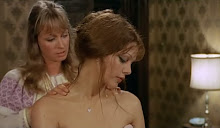
Carol (Florinda Bolkan) is traversing the length of a railway carriage, desperately trying to open one compartment door after another; all are locked. The corridor goes from empty but for Carol to jammed with people. Suddenly these others are naked and writhing against each other sexually. Carol tries to force her way through the crush of bodies. Then the carriage is replaced by a long white corridor, like a hospital corridor, still packed with naked bodies. Then Carol is falling. Falling into a dark room with a bed at its centre. A bed draped with garish red silk sheets. A statuesque blonde appears. Inconsistent editing has her sprawled on the bed half naked, then kneeling as if in supplication to Carol, then Carol's on the bed and the blonde is approaching her with an almost predatory look in her eye, her diaphanous robe falling open to reveal her breasts. Then she's easing Carol's fur coat off. Quelle surprise: more nudity! It all gets very sapphic at this point, before a rapid series of edits reveal the whole thing as a dream sequence, Carol awaking in a state of part arousal, part agitation.


A session with her analyst identifies the blonde as Carol's neighbour, Julia (Anita Strindberg), a free spirit known for her rowdy parties and promiscuous behaviour. Later, when Carol reports a dream wherein she kills Julia (Fulci direction heavily sexualises the violence), the shrink congratulates her on a highly liberating expression of her subconscious. But before a successful conclusion to the therapy can be celebrated, the police are on the scene and interested in what Carol might know about Julia's murder. Which - wouldn'tcha know it? - was perpetrated exactly as in Carol's dream.

Carol's family - her politically connected QC father (Leo Genn), adulterous husband Frank (Jean Sorel) and stepdaughter Joan (Ely Galleani) - rally around her (in as much as walking on eggshells, avoiding the issue and evincing a slightly embarrassed denial at her deteriorating mental state can be deemed rallying around) - while Inspector Corvin (Stanley Baker) determines to get at the truth no matter that it brings him into conflict with his boss, a career cop hesitant at antagonising someone as well connected as Carol's father, or puts him at odds with his colleagues. There's a 'Sweeney'-like scene where Corvin deals with a subordinate who's fucked up. "You," he tells the underling with contemptuous relish, "will enjoy working in archives."

'A Lizard in a Woman's Skin' conflates two highly familiar concepts: the person who foretells a murder but is powerless to prevent it and the innocent accused, to whom all evidence points, who must fight to clear their name. Bizarre symbols and fragments of images which may or may not contain the key to solving the mystery are also present; very much a staple of the giallo. The genre's earliest and most defining proponents - Mario Bava's 'The Girl Who Knew Too Much', Dario Argento's 'The Bird with the Crystal Plumage' - are shot through with an indebtedness to Hitchcock, and there's definitely something Hitchcockian about the innocent accused aspect of 'A Lizard in a Woman's Skin'. But it's hard to imagine even such an accomplished rug-puller as Hitch coming up with as trippy and twisted a mind-fuck as this.


Everything about the film disorientates: whip pans, jump cuts, sudden flashes of light, abrupt juxtapositions (sometimes in split screen), off-kilter compositions; restless, roving, weirdly subjective camerawork; arrhythmic editing. The assault on the viewer's senses carries through to the aural: storms and traffic noise blast out far louder than the dialogue; Corvin's tuneless whistling sussurates through entire scenes; Ennio Morricone's score is just plain schizophrenic. Everything disorientates, even the geography: 'A Lizard in a Woman's Skin' takes place in a version of London where the map has been folded and compressed and the Underground has presumably been replaced with wormholes, where the Old Bailey is right across the street from the Royal Albert Hall.

Images from Carol's dream spill over into her life. A letter opener disappears from her room and turns up at the murder scene. A blackmail plot has something to do with it. A couple of drug addicts turn up at periodic intervals, graduating from lurking mysteriously in the background to actively terrorising Carol. The narrative unfolds with the fragmentary, vividly illogical delirium of a dream, particularly in a sequence where the by now nervously afflicted Carol, "resting" at a convalescents' home, is menaced by a cloaked figure. Fleeing to the upper storeys, the building seems to take on unrealistically expansive dimensions as Carol hurtles along a maze of featureless corridors which seem to carry over from her original dream. Doors leading off them are locked. Finally - in a room that resembles a morgue - she is assailed by an hallucination of three vivisected dogs, connected and kept alive by a series of tubes pumping blood into their exposed hearts.

It's a nightmarish image, a slap in the face that stays with you on a squirmly subconscious level even though you wish you could get it out of your mind. It makes the crucifix masturbation scene in 'The Exorcist' look like 'Jackanory' and makes you wonder why Fulci continues to be remembered/reviled for the splinter-into-the-eyeball bit in 'Zombie Flesh Eaters'. You wanna see the most disturbing, fucked up shit that ol' Lucio was capable of putting on screen? Right here, buddy. (It also landed Fulci in court in Italy, where he was obliged to present the special effects model as proof that he didn't actually butcher a trio of dogs in order to get the shot.)

Fulci's genius in 'A Lizard in a Woman's Skin' - and I'm struggling while writing to decide whether this or 'Don't Torture a Duckling' marks his high point as a film-maker - is to plunge the viewer, from the outset, into the perceptional disconnections of a mind psychologically deconstructing. A chase through a bizarre compendium of locations ends with the beleagured Carol attacked by bats. Until the police intervene and her attacker is identified, there's no telling how much of what we've just seen is in her mind. Fulci establishes a mood of uncertainty from the outset and maintains it till the very last scene when all the pieces are put in place with an understatement atypical in gialli. Too, he breaks the mold by eschewing the bumbling inefficiency and comic relief that usually characterises the procedure aspects of gialli. Here, Baker portrays Corvin as an introspective and bloody-minded copper who actually conducts forensic and evidence-based detective and moreover, in the closing scene, solves the case.


Baker's performance is good, Sorel's and Genn's by the numbers; Galleani sashays short-skirtedly through a nothing role, while Strindberg is given little to do but radiate dangerous allure (such was her lot, generally speaking, in gialli). It's Bolkan to whom the acting honours are due. Carol is multi-layered, emotionally exhausting role and Bolkan gives it all she's got - a full-throttle, all or nothing performance which should have netted her a mantlepiece full of awards. But 'A Lizard in a Woman's Skin' is a giallo and the kind of critics who think they know more than people who generally love film have it that gialli are pulp movies and devoid of artistic legitimacy.

Which is why I'm a movie lover and not a critic.

Saturday, October 10, 2009

Campbell's Kingdom

Ah, the great and prolific actor/director relationships: John Wayne and John Ford, Robert de Niro and Martin Scorsese, Johnny Depp and Tim Burton, Dirk Bogarde and Basil Dearden Joseph Losey Ralph Thomas.

Bollocks!

It pains me to discuss the Bogarde/Thomas relationship (nine films together compared to the five he made with Losey and the four with Dearden) since Thomas was a journeyman director and did little to tap into either the brooding sensuality or the tortured intensity of Bogarde as an actor. Nevertheless, it was the likes of the 'Doctor' films ('~ in the House', '~at Sea', '~ at Large', '~in Distress'*) which made him a matinee idol. His dreamy turns in 'A Tale of Two Cities' and 'The Wind Cannot Read' went over big with his legions of fans, as well. 'Hot Enough for June' - considered elsewhere in this year's Dirk-fest - didn't quite recapture the mainstream magic, while their final collaboration, 'The High Bright Sun', is largely forgotten.

Which leaves 'Campbell's Kingdom' - certainly my favourite of a frankly not-that-remarkable canon. Adapted from Hammond Innes's bestseller, it opens with Bruce Campbell** (Bogarde) turning up at ramshackle Canadian mining town Come Lucky having inherited his late grandfather's land, a tract the old man was convinced was rich in oil. Old man Campbell's undoing was an unscrupulous partner who defrauded their backers, amscrayed with the money and left Campbell to take the fall ... and do some time. Bruce, recently given six months to live following (it transpires) something of a misdiagnosis, decides Campbell's Kingdom is a nice isolated spot to end his days.

He hasn't reckoned with crooked contractor Owen Morgan (Stanley Baker) who is cutting corners and using cheap materials in the building of a dam which will eventually flood Campbell's land. Prevented from even visiting the Kingdom (the only way to the high ground it occupies is a clanking industrial hoist which Morgan owns and controls), Bruce bristles at Morgan's assertion that the land is worth nothing and is suspicious of the geologist's report Morgan produces which indicates there was no oil. Refusing to sell Morgan the land, Bruce makes contact with the geologist, Bladon (Michael Craig), and discovers that Morgan falsified the report.

Never mind that he's pale, weary and at death's door, Bruce gets a new lease of life fending off Morgan's overtures (which graduate from fiscal imperatives to acts of sabotage) and determining to prove that his grandfather was right about oil under the Kingdom. To this end, he engages the services of roughneck driller MacDonald (a spendidly miscast but loving-every-minute James Robertson Justice) who in turn employs world-weary trucker Tim (an equally miscast Sid James) to head a convoy hauling his equipment from Calgary to the Kingdom. A five hour drive with the little matter of roadblocks and Morgan's hoist at the end of it.

What follows is the centrepiece of Thomas's proficient thriller: a contrived but decently executed quarter of an hour's worth of hairpin bends, vertiginous drops, rock falls and dynamited bridges as Campbell, Boyden and MacDonald strive to outwit Morgan and has vicious crew and get the convoy up to the Kingdom. Scenes of truck wheels spinning and failing to gain traction as chasms yawn beneath them homage Clouzot's 'Wages of Fear' (released three years earlier), while the mechanics of the hoist and its tense ascent of the unforgiving mountainside predate 'Where Eagles Dare' by more than a decade.

This and a couple of other set-pieces (a night attack on the Kingdom and the inevitable climax as the jerry-built dam bursts) tick the right boxes; Baker is rugged, menacing and properly hissable as the villain; the Rockies provide a dramatic backdrop (even if Ernest Steward's cinematography does tend to come on a bit like a tourist brochure); and at a tight 100 minutes it never outstays its welcome.

On the flipside, the presence of half of Thomas's usual stable of Rank Organisation bit-players is somewhat offputting - you know you're in Canada because of the mountains but it all seems a bit East End, dahnit? - and Bogarde resolutely fails to gel with Barbara Murray in the shoehorned-in romantic subplot. The ending's a bit of a cop-out, as well, but to be fair it's replicated more or less faithfully from the source material (the only false note in Innes's otherwise pacy and atmospheric novel). Thomas's worst sins, though, are his blithe rejection of the standard editing room modus operandi of actually having shots that match. I don't think I've ever seen more screamingly blatant day-for-night shots than in 'Campbell's Kingdom'. Day-for-night? More like bright-blue-sky-for-pitch-black. The high bright sun, indeed.


*The latter a belated, almost cameo-like, return to the role.

**No relation to the prominently-chinned actor.

Wednesday, December 12, 2007

Accident


Joseph Losey directed ‘The Servant’ from a script by Harold Pinter based on a novel by Robin (nephew of W. Somerset) Maugham. Likewise, ‘Accident’ re-teamed Losey and Pinter for an adaptation of a novel by Nicholas (son of Oswald) Moseley. And, of course, Dirk Bogarde was back in the fold: between ‘The Servant’ and ‘Accident’, he and Losey had made ‘King and Country’ and ‘Modesty Blaise’ together.

‘Modesty Blaise’ is the odd-man-out of their films, a lightweight bit of fluff: fun but forgettable). ‘King and Country’, however, was a shattering anti-war film comparable to Kubrick’s ‘Paths of Glory’, in which Bogarde plays an officer who defends Tom Courtenay’s simpleton private in a court martial for desertion, an offence punishable by execution. As such, Losey’s pre-occupation with class, society and hypocrisy are again to the fore, Losey’s cinematic microcosm being the trenches of the First World War.

‘Accident’, the final Losey/Bogarde picture, is again about class. But the microcosm here is the groves of academe. The dreaming spires of Oxford. Granted, it’s the perfect milieu for an examination of repression, thwarted ambition, staid traditionalism and social hypocrisy, dark emotions lurking behind the leisurely punts down the river, the elegant soirĂ©es and the endless games of cricket or tennis … but compared to the more explicit portrayal of social degeneracy and power games in ‘The Servant’ or the brutal backdrop of wartime suffering in ‘King and Country’, ‘Accident’ suffers from the worst affliction that can befall a motion picture (I use this cornball term advisedly: motion = movement; picture = visual): inertia.

Everything about ‘Accident’ is sluggish. With the titular accident happening offscreen, the ‘action’ is limited to book-lined rooms, manicured lawns and the sun-dappled river. Gerry Fisher’s colour-saturated cinematography prettifies everything when the script calls for the starkness of Douglas Slocombe’s crisp black-and-white lensing on ‘The Servant’. Pinter’s script, typically oblique, is heavy with pregnant pauses. Elsewhere in his ouevre this is hugely effective – small pockets of silence which hidden meanings and suggestions seep into – but here they drag on to the point of … well, we’re back at that word again: inertia.

Fortunately, a cluster of great performances hold the attention: Bogarde gives a finely nuanced turn as Stephen, an Oxford don going through a mid-life crisis; Stanley Baker is ruggedly effective as Stephen’s colleague Charley, whose success as an academic, novelist, TV pundit and womaniser throws into sharp relief Stephen’s sense of self-doubt; Vivien Merchant anchors the film as Stephen’s homely wife; and Jacqueline Sassard is luminous as Anna, the student Stephen lusts after.

Two scenes remain in the mind long after the rest of the film has faded: a dinner party which ends in drunken embarrassment, the veneer of Stephen’s home life cracking apart to reveal his desperate insecurities; and Stephen’s less-than-proper attentions towards Anna as she drifts in an out of consciousness following the accident, a scene so suggestive and ambiguous that it finally – at the last post – lifts the film into the realms of the memorable.