Monday, March 12, 2012

The Men Who Stare at Goats

Posted as part of an intermittent series of espionage-related cinema leading up to the release of the new James Bond film ‘Skyfall’ later this year


I’d had it on good authority that ‘The Men Who Stare at Goats’ was a POS. Despite this, I neglected to delete it from my rental list. So when it turned up last week, my rationale was something like this: aww, hell, it stars George Clooney, Ewan McGregor, Jeff Bridges and Kevin Spacey, and at a pinch I can feature it as part of my intermittent series of espionage-related cinema, surely it’s worth a watch.

Readers, I watched it.

POS is perhaps a tad harsh – there are a couple of bona fide laugh out loud moments – but to watch Grant Heslov’s film is ultimately to watch a terrific cast squander themselves as a brilliant concept is simply frittered away.

For this reason, we won’t dwell on it too long. Synopsis time: journo Bob Wilton (McGregor) does a human interest piece on bonkers ex-soldier Gus Lacey (Stephen Root) who reminisces about his time with Lyn Cassady (Clooney) in a psychic military unit led by quasi-hippie Bill Django (Bridges). Initially sceptical, Wilton files the story then heads to Iraq to prove himself as a front-line reporter after the breakdown of his marriage. It’s here he bumps into Cassady, who recounts the story of Django’s unit as the pair head across country so Cassady can complete some mysterious mission.


Herein my first problem with the film. Point of view and lead character duties skip from Wilton to Cassady to Django with such skittish abandon that I couldn’t get a handle on whether Heslov and scripter Peter Straughan were being arbitrary, indecisive, or full-on going for an anti-narrative. The tone, too, veers from genuinely amusing to trying-too-hard to actually-quite-mean-spirited, seemingly on a whim.

Round at the halfway mark, the film coheres into the Wilton and Cassady road show, but it’s delivered all its satirical barbs by this point and only one inspired but narratively redundant scene involving Robert Patrick as the head of a US security who gets into a firefight with a different US security force which he happily blames on the Iraqis emerges as memorable. The firefight, incidentally, is over superiority in a queue at a petrol station.

Based on a non-fiction work by Jon Ronson, and opening with the irresistible credit “more of this is true than you would believe”, ‘The Men Who Stare at Goats’ starts out knee-deep in potential but never fully gets to grips with the off-the-wall political satire the concept demands. Instead we get a smorgasbord of contrived and often unfunny in-jokes, mostly referencing the casts’ previous work. McGregor seems to have been cast purely as the butt of the joke every time one of the psychic irregulars refers to himself as a Jedi warrior.

Heslov, making his feature debut, doesn’t stamp a strong enough visual or satirical signature on the material, particularly when the finale cries out for the demented visual flair of a David Lynch or an Alejandro Jodorowsky. What Heslov manages is ninety minutes of moderate amusement, when Ronson’s book could easily have lit the fuse on a two-hour delirious headfuck.

Sunday, March 11, 2012

Normal service will be resumed

That project I was working on? The one that was preventing me from updating Agitation as much as I’d like?

Finished!

Or at least, a first draft is now complete.

Which means that we can get back to some film reviews around these here parts. Join me tomorrow as we get this show back on the road.

Wednesday, March 07, 2012

Rachel Weisz


Happy 42nd birthday to Rachel Weisz. A glass is being raised at chez Agitation and there's a distinct possibility that 'The Constant Gardener' might find its way into the DVD player.

Sunday, March 04, 2012

Literary birthdays


It’s James Ellroy’s 64th birthday today. Here’s the demon dog of crime fiction on being knows at “the guy who wrote ‘L.A. Confidential’.” This quote also contains advice on the etiquette of talking to little old ladies.

‘L.A. Confidential’, the movie, is the best thing that happened to me in my career that I had absolutely nothing to do with. It was a fluke—and a wonderful one—and it is never going to happen again, a movie of that quality. Here’s my final comment on ‘L.A. Confidential’, the movie: I go to a video store in Prairie Village, Kansas. The youngsters who work there know me as the guy who wrote ‘L.A. Confidential’. They tell all the little old ladies who come in there to get their G-rated family flick. They come up to me, they say, “Oooooh, you wrote ’L.A. Confidential’. Oh, what a wonderful, wonderful movie. I saw it four times. You don’t see storytelling like that on the screen anymore.” I smile, I say, “Yes, it’s a wonderful movie, and a salutary adaptation of my wonderful novel. But listen, granny – you love the movie, did you go out and buy the book?” And granny invariably says, “Well, no, I didn’t.” And I say to granny, “Then what the fuck good are you to me?”


Alan Sillitoe would have turned 84 today. As regular readers of this blog know, I’m involved with the Alan Sillitoe Committee, a group dedicated to promoting Alan’s work through a variety of media, and to raising funds for a permanent memorial to Alan to be sited in his hometown of Nottingham. Please visit our website for information on forthcoming events and a variety of articles, archive photos and more. The website is an ongoing project which we intend to build into a major online resource. Please like our Facebook page, as well. If you can spare a little for a donation, it would be greatly appreciated and we’ll happily feature your name on our wall of honour.

Here’s Alan’s most famous creation – the belligerent Arthur Seaton in ‘Saturday Night and Sunday Morning’ – slogging through his National Service and resolutely refusing to let the bastards grind him down:

On his first parade the sergeant-major exclaimed that he couldn't make out the shape of Arthur's head because there was so much hair on it, and Arthur jocularly agreed to get it cut, intending to forget about it until the fifteen days was over, which he did. 'You're a soldier now, not a Teddy-boy,' the sergeant-major said, but Arthur knew he was wrong in either case. He was nothing at all when people tried to tell him what he was. Not even his own name was enough, though it might be on on his pay-book. What am I? he wondered. A six-foot pit-prop that wants a pint of ale. That's what I am. And if any knowing bastard says that's what I am, I'm a dynamite-dealer, Sten-gun seller, hundred-ton tank trader, a capstan-lathe operator waiting to blow the army to Kingdom Cum. I'm me and nobody else; and what people think I am or say I am, that's what I'm not, because they don't know a bloody thing about me.

Saturday, March 03, 2012

Mini reviews

That project I was working on? The one that's been preventing me from updating Agitation as much as I'd like? The one I was hoping to have done by the end of February?

Still working on it.

Normal service should be resumed shortly. In the meantime, here's some mini reviews in Rupert Bear-style rhyming couplets. Bit of a sci-fi theme going on.


I, ROBOT

Decent enough, but from the director of 'Dark City'
It should have been harsher; more noirish; less pretty.


SUPER 8

An homage so blatant you could easily confuse it
With the 70s films of the man who produced it.


FORBIDDEN PLANET

Prospero's book drowned amongst the stars.
Anne Francis rocks a mini-skirt. Be still my heart!

Monday, February 27, 2012

Tinker Tailor Fuck You Oscar

Gary Oldman wuz robbed.

That is all.

Saturday, February 25, 2012

We aim to please

J.D. of the essential Radiator Heaven left a comment on my last post (a birthday tribute to the very lovely and very talented Emily Blunt) saying that more pictures would have been nice.

And you know what? He was right!


Thursday, February 23, 2012

Emily Blunt

In what is becoming something of an annual tradition on The Agitation of the Mind, here’s a raised glass to Emily Blunt – for my money of the best actors of her generation – who celebrates her 29th birthday today.

I normally upload unapologetic cheesecake shots in these kind of entries, but whenever I see Emily Blunt I’m reminded of that quote about the eyes being the windows to the soul.

Saturday, February 18, 2012

The Disappearance of Alice Creed


My two least favourite genres are the kidnap movie and the courtroom drama. The same reason applies: by their own definition, they’re inherently uncinematic. There are only so many angles from which you can film the interior of a courtroom, or the enclosed space in which a kidnap victim is held. A static milieu; narratives that unfold via dialogue rather than by visual pacing or rhythm.

So I approached ‘The Disappearance of Alice Creed’ without much enthusiasm. And it took me by surprise.

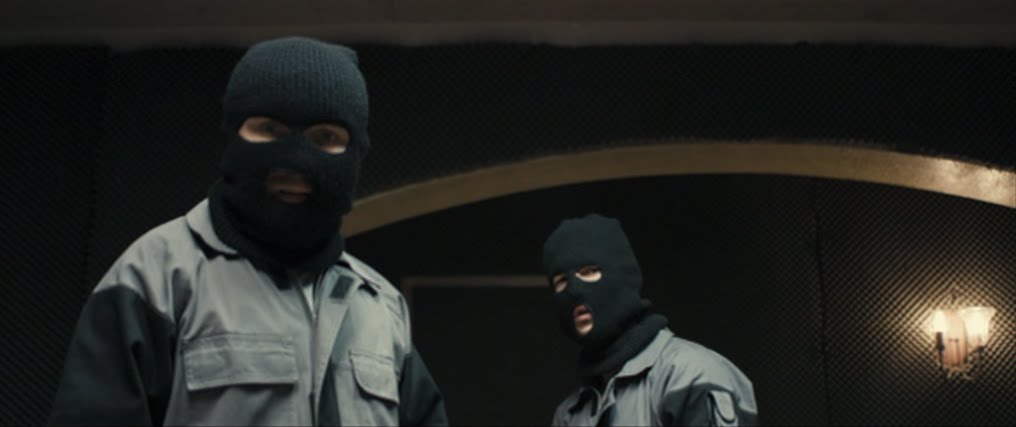
The wordless five-minute opening sequence was the hook. Shot with a documentary-style attention to detail and edited with a slowly building sense of urgency, it depicts the preparations made by Vic (Eddie Marsen) and Danny (Martin Compston) prior to their abduction of the eponymous Alice (Gemma Arterton). That’s yer entire cast, right there, by the way.

Essentially, this sequence gives us the Vic and Danny Guide to Soundproofing and Securing a Bedroom. Our boys break out staple-guns, cordless drills, hammers and rolls of duct tape and work with a studious intensity that would be a little bit frightening even if they weren’t essentially turning a bland back room into a prison right before our eyes.

Then they pile into an equally bland Transit van and peel out of a car park. Locations are kept purposefully vague. Next thing they’re yanking the back doors open and bundling in the unfortunate Alice, her hands tied and a bag over her head. No build-up to the snatch, no laborious stalking scene, no hint of Alice’s everyday life or who she is, just wham-bam, back of the van, cut to the bedroom, tied to the bed and hey-ho, Miss Creed, best hope your rich daddy pays up. Then writer/director J Blakeson follows Vic and Danny out, leaves Alice in the dark, and proceeds to spend more time with his monosyllabic villains than he does with his photogenic protagonist.


‘The Disappearance of Alice Creed’ basically fucked with my expectations from the word go, the title being both the first and last of the ways it did so. Putting Alice’s name right there in the title – and giving Arterton lead billing – suggests she’s our primary focus. She’s not; it’s the relationship between Vic and Danny that Blakeson is most interested in. Also, withholding the title until the end of the movie – not a new thing, but done here for a reason – puts a very different spin in what it means.

Talking of spin, kudos to Blakeson for having the cojones to go with a couple of narrative curveballs that could deep-sixed the movie if he’d made the slightest mis-timing. I probably should have seen both of them coming (or least had an inkling that they were on the way), but I honestly didn’t. Maybe it was because I’d come to the film with so much indifference and was prepared to just let it wash over me. Either way, they completely blindsided me and that’s exactly what a twist is supposed to do.

So: visually interesting when the mise en scene ought to be uncinematic; effective twists when the three-hander set-up should only allow for so much leeway; and a sparky, enervated performance from Arterton, who I’d never really rated in any of her other roles. Seriously, Hollywood, quit treating the girl as set-dressing and let her cut loose. Also, the violence is handled in a manner than made me think of early Scorsese, erupting out of the fabric of the film and the infrastructure of character relations, only for things to settle back to some ostensible form of normality just seconds later, rather than being lovingly and wincingly obsessed over as is the standard post-Tarantino operating procedure. Some indication of Blakeson’s interest in character over hardware is in any of the numerous scenes where a character is framed pointing a gun at the camera. Almost invariably, the weapon is blurred and the actor – and therefore the performance – kept in focus.


This says a lot, and it’ll be interesting to see how Blakeson’s career develops. ‘The Disappearance of Alice Creed’ is certainly an accomplished debut: cleverly put together, confidently directed, tense and engrossing.

Tuesday, February 14, 2012

Lassie Come Home

‘Lassie Come Home’ isn’t a film I’d normally review on Agitation, however my good friend Viv Apple has provided such a unique perspective on this evergreen family favourite – at once a review and a piece of social history – that I’m honoured to share her recollections on the blog.


I have waited nearly seventy years to see this film; the story of a dog who couldn’t bear to be parted from her owner, a young Yorkshire boy called Joe. Watching it on Channel 4 the other day with 21st century eyes, I could see (or rather hear) the incongruity of its very Home Counties accents as spoken by American actors, punctuated by valiant attempts to authenticate the setting by the occasional insertion of ‘Aye, lad’ and ‘It’s champion, champion’. But the story and the production itself, although of its time, is still magic to me for very special reasons.

It was released in 1943 at the height of the Second Word War, when I was seven and had just been evacuated from London to the ‘safety’ of a farm in Staffordshire. I was the only evacuee billeted with the farmer and his wife and son, and very homesick as my mother had stayed in London to be with my father, who was exempted from military service. I had a difficult time at the farm, and after about a year was taken back to London.

It took me a while to recover from being away on my own, but in my absence my mother had been to the cinema to see ‘Lassie Come Home’. So, knowing how I loved animals, she began telling me the story of the film each night to help me sleep. London was still in the grip of wartime chaos, and if there was an air raid expected or a sudden siren later on, we would go down the garden to spend the night in the Anderson shelter, a corrugated iron structure offering protection from blast and flying debris - but not from a direct hit.

The shelter smelled of its damp concrete base and of the smoky remains of the previous night’s candles, which were the only source of light. There were thick woollen blankets on the three bunks, and my mother would sit on the edge of mine while I watched her face as she recounted to me Lassie’s dangerous journey back to Joe. The story caught my imagination at once, perhaps because it was about a beautiful and intelligent dog but also because, like me, Lassie had found her way home in the end. So I would ask for it to be told again, night after night, until my mother must have grown weary – though she never showed it.

Outside, the drone of planes overhead (which could have been Wellington bombers on their way to Germany or German planes about to bomb us) was punctuated by bursts of flak from anti-aircraft guns stationed a few miles away. But I was aware of ‘the war’, and to me these sounds were a normal background to the shadowy shelter - and Lassie bounding to meet Joe from school or struggling to find her way back from Scotland to Yorkshire across rivers and through strange landscapes.

Watching the film in 2012, scenes I’d only heard about seemed to find their allotted place in my memory, a seamless step from the eight-year-old me...to now. Roddy McDowall was Joe, Elsa Lanchester was his mother and Donald Crisp his father. Elizabeth Taylor, in the role of Pricilla, granddaughter of the tender hearted Duke who buys Lassie when the family is forced to sell her, was a natural actress who didn’t yet know how beautiful she was.

From my perspective it is difficult to review ‘Lassie Come Home’ dispassionately, but if I were to try I’d say that the training of the dog (a male collie called Pal) was exemplary and enabled him/her to carry the film effortlessly. Joe and his family were well cast, villains and heroes well defined but not in a cloying way, and Californian scenery was cleverly shot to look like Scotland and Yorkshire. Most importantly, the interaction between humans and dog throughout Lassie’s long journey was convincing and at times, moving. The film was nominated for several awards, and has been described as ‘one of the truly great family films’. It was praised by the New York Times in 1943 as ‘...a story of such poignancy and simple beauty that only the hardest heart can fail to be moved.’ So it’s not just me who loves it.

And that’s good to know.


by Viv Apple

Saturday, February 11, 2012

Apologies for the lack of new content around these here parts ...


... I've been a bit tied up lately.

There's been plenty going on with the Alan Sillitoe Memorial Fund. The open poetry competition closed last month, with 486 poems entered by 185 poets, netting over £850 for the fund. We're hosting a prize-giving event at the Nottingham Contemporary on 2 March, featuring live music from local roots band Blue Yonder. A literary lunch with Nottingham's premier crime writer John Harvey is taking place on 21 April, and there are a whole slew of other events in the pipeline for 2012. Please visit our website for full information.

Also, work on a major project - which is pushing towards the three-quarters completed mark - has kept me busy as hell for the last few weeks. I've watched very few films recently and my reading has bottomed out appallingly. Of those few films I have watched, I've not really felt motivated to write about most of them; and the one exception - 'A Single Man' - deserves a lot more time and attention than I'm able to give it right now.

So please bear with me for a while. Content might tend to the pictorial for much of this month, but I will return, by March, with the opening salvoes in the Bond-a-thon.

Oh - and a directive from the Shameless Self-Publicity Committee orders me to share this with you - by the way, my short story 'The Call of Chavthulu' has been accepted for the next issue of Dark Horizons, which I'm absurdly excited about.

Tuesday, February 07, 2012

Alejandro Jodorowsky

Happy 83rd birthday to eccentric genius Alejandro Jodorowsky.


“Most directors make films with their eyes; I make films with my testicles.”

“One day, someone showed me a glass of water that was half full. And he said, ‘Is it half full or half empty?’ So I drank the water. No more problem.”

“What I am trying to do when I use symbols is to awaken in your unconscious some reaction. I am very conscious of what I am using because symbols can be very dangerous. When we use normal language we can defend ourselves because our society is a linguistic society, a semantic society. But when you start to speak, not with words, but only with images, the people cannot defend themselves.”

Witty, visionary and – let’s face it – pretty fucking dangerous, how can you not love a guy who is so completely true to his art?

Saturday, February 04, 2012

Ben Gazzara

Sometimes you hear of an actor’s death and you think “Aw, that’s a shame, I liked that person.”

Sometimes you hear of an actor’s death and it hits you in the solar plexus, winding you, doubling you up and taking everything out of you.

Ben Gazzara: ‘Anatomy of a Murder’, ‘The Killing of a Chinese Bookie’, ‘Saint Jack’, ‘Tales of Ordinary Madness’, ‘The Big Lebowski’, ‘Summer of Sam’, ‘Dogville’.

Ben Gazzara: legend.

Rest in peace, sir. Cinema is poorer for your loss.


i.m. Ben Gazzara, 28 August 1930 – 3 February 2012

Thursday, February 02, 2012

Jennifer Westfeldt


Happy 42nd birthday to the multi-talented Jennifer Westfeldt. Best known for for indie bi-curious rom-com 'Kissing Jessica Stein', she's also a bona fide Broadway star thanks to her show-stopping role in 'Happy Town'.

Sunday, January 29, 2012

Charlie Wilson's War

Posted as part of an intermittent series of espionage-related cinema leading up to the release of the new James Bond film ‘Skyfall’ later this year


How best to describe ‘Charlie Wilson’s War’? The “based on a true story” tag-line screams biopic, but it’s more like ‘Wag the Dog’ with a covert war instead of a stage-managed one, or ‘Rambo III’ with more in the way of strippers and hot tubs.


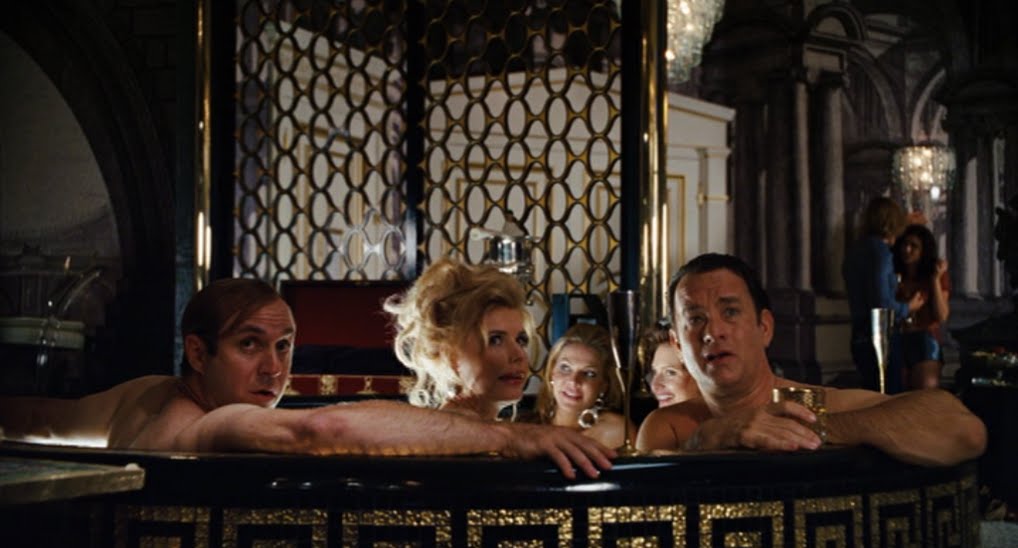
This is how we meet our … uh, let’s just go with “hero” and place all moral considerations in cold storage for 98 minutes. He’s the Charlie of the title (Tom Hanks), he’s a Texan congressman and his principle interests appear to be women, whisky and … actually, I think we got done with his interests at women and whisky. He’s hanging out in a penthouse apartment with some – not to be judgemental here, but let’s call it like it is – lowlifes. High-rolling lowlifes, but lowlifes all the same. His choice of company comes back to haunt him later.

It’s the 1980s, the Russkies are in Afghanistan and Wilson is swiftly coerced by hifalutin society lady Joanne Herring (Julia Roberts) to help the Afghanis out in the name of God and country and … well, mainly God. Which he proceeds to do, with the aid of disenfranchised CIA agent Gust Avrakotos (Philip Seymour Hoffman). Avrakotos is given an equally memorable introduction, effectively torpedo-ing his career prospects by telling his boss to go fuck himself and vandalising the fellow’s office into the bargain.


And while Mike Nichols’s film focuses on Wilson wheeling and dealing, and Avrakotos belligerently out to hammer the Red Menace, it’s fast, funny and scabrously satirical, Aaron Sorkin’s script zinging with the razoer-sharp dialogue for which he’s renowned. But all too often Nichols and Sorkin wear their hearts on their sleeves and the review-o-meter dips from “pretty good” to mediocre. Wilson’s transformation from political player to humanitarian never quite rings true. A visit to a refugee camp on the Pakistan/Afghanistan border wants to deliver the same howl of outrage as the last half of ‘The Constant Gardener’, but doesn’t make the grade. An apposite moment, here, to mention Stephen Goldblatt’s flat and utilitarian cinematography: he never fully integrates with any scene, visually parlaying the viewer into the thick of events. The film retains a slightly bland sheen throughout; you’re always aware that you’re watching a film, and that’s never a sign of success.

The cast is top-notch, though: Hanks and Roberts are clearly having big fun, while Hoffman doesn’t just steal scenes but walk away with the whole movie. Amy Adams, Emily Blunt, Rachel Nichols, Om Puri, Ken Stott, Peter Gerety and Ned Beatty all get their moment in front of the camera (even if, in some cases, it is only a moment: Blunt in particular is wasted).


A handful of set-pieces can hold themselves up to anything in Nichols’s distinguished (if, of late, somewhat hit-and-miss) filmography, particularly Wilson and Avrakotos’s first meeting, played out against the revelation that Wilson is being stalked by bad press and a possible subpoena due to the aforementioned lowlife company; it’s beautifully paced, laugh-out-loud funny, with enough entrances and exits to invite comparison with a Brian Rix farce.

And yet … and yet … ‘Charlie Wilson’s War’ never fully coheres. As a satire (how the Americans armed Afghanistan: a timely tale of ulterior motives and irresponsibility!), it pulls its punches. As a political drama, it’s a little too glib to deliver any real insight. As a thriller, it keeps its protagonists away from any element of danger, thereby failing to generate tension. As an exercise in mapping out the contours of conspiracy, it’s never convincingly labyrinthine enough.

All told, that first paragraph ‘Wag the Dog’ comparison arguably sums it up: like Barry Levinson’s film, made ten years earlier, it takes a terrific concept and a powerhouse cast, delivers some genuinely amusing moments but squanders so much potential through its inability to decide what it wants to be.

Monday, January 23, 2012

Cowboys and Aliens


Danny Craig and Harry Ford,
Some mighty fine castin, Lord!
Tough guys wearin spurs n guns,
Shootin up them ay-lee-uns.
Sam Rockwell’s also in the cast,
Miss ’Livia Wilde’s a purdy lass.
Too many folk dun wrote the script,
’Haps that’s why it’s hit n miss!
That kinda title, it should be fun,
’Cept it ain’t – it’s moribund.
Danny Craig and Harry Ford,
Who’d thunk I’d be so bored?

Sunday, January 22, 2012

Diane Lane


Happy 47th birthday to the perennially beautiful Diane Lane

Friday, January 20, 2012

THE SILLITOE PROJECT: Road to Volgograd

It’s strange how sometimes a work can be overtaken by time. Even when I discovered Alan Sillitoe, as a teenager in the late 80s, ‘Road to Volgograd’ was the Sillitoe title I knew of only by its inclusion in the “also by” section in the other titles I owned.

When, last year, I found a copy on eBay, it was the original Pan paperback with a pre-deciminalization cover price of three shillings and sixpence. It was a 1966 reprinting of a book first published in 1964. Its pages were sepia. It had been printed six years before my birth.

As early as 1939, Winston Churchill (not a popular figure in the Sillitoe canon – see ‘Key to the Door’) said “I cannot forecast to you the action of Russia. It is a riddle, wrapped in a mystery, inside an enigma.” That was pretty much still the post-divided Berlin, post-Berlin Wall, post-Iron Curtain public perception of the Soviet Union in 1964.

1964 – the year after John le Carre published his watershed novel ‘The Spy Who Came in from the Cold’, a bitter and angry response to the erection of the Wall; the year that Ian Fleming died, whose immortal secret agent – if more in the movies than the books – would give the Red menace a good seeing-to. 1964 – a year which started with British motor manufacturer Leyland exporting buses to Cuba in defiance of the US blockade. 1964 – the year that Alan Sillitoe published an account of his travels and observations in the Soviet Union.

Alan Sillitoe (in translation) was one of the USSR’s bestselling authors. In 1963 he was invited to spend a month in Russia. A socialist, a worker himself and – as ‘Key to the Door’ attests – an avowed leftist, he jumped at the chance. ‘Road to Volgograd’ isn’t as gee-whiz as it might have been (Sillitoe was too perceptive, enquiring, cynical and world-weary to have fallen into that trap), but it’s clear – reading the book with the smug benefit of hindsight – that his hosts took pains to steer him clear of the brutal realities of life under the Soviet regime. Later, when Sillitoe discovered these aspects, he spoke out against the totalitarian rule. It’s interesting to note that ‘Road to Volgograd’ found its corollary and corrective, forty-three years later, in his last published work ‘Gadfly in Russia’. Much of his work emerged in pairings – the short story ‘Mimic’ and the novel ‘The Storyteller’; ‘The Lost Flying Boat’ and ‘The German Numbers Woman’; ‘Raw Material’ and ‘A Man of His Time’; the short story ‘The Good Women’ and the novel ‘Her Victory’ – but never have two interconnected works occurred at such chronological odds to each other as ‘Road to Volgograd’ and ‘Gadfly in Russia’.

History and retrospect make ‘Road to Volgograd’ a strange and awkward book – awkward not in its writing (hell no; Sillitoe is on excellent form here) but in the perspective of retrospect. To repeat myself, it’s a work overtaken by time. It faded all too soon from the Sillitoe bibliography and wouldn’t be readdressed until the very end.

Tuesday, January 17, 2012

Betty White

Kudos to anyone who looks like your favourite aunt while delivering this line like she means it:


Happy 90th birthday to the inimitable Betty White.

Monday, January 16, 2012

John Carpenter


Happy 64th birthday to John Carpenter.

Thanks for some of my all-time favourite horror movies, sir!