Monday, February 14, 2011

BLACK VALENTINES: In the Realm of the Senses

NOTE (1): Apologies for the smartarse captions. Between ‘The New York Ripper’ and ‘In the Realm of the Senses’, I had to do something to retain my sense of humour.

NOTE (2): SPOILERS. If you honestly don’t know how this one ends, stop reading now.


There’s a Bill Hicks routine where he talks about the frustration of watching a pay-per-view porno movie only to find that the adult content has been cut out, so that “you don’t see the woman at all but you do get the hairy bobbing man ass”. Hicks advocates that “I’d leave those fucking scenes in, just for, you know, continuity. I don’t think the plot and dialogue alone are enough to carry these movies.”

Here’s how the continuity works in Nagisa Oshima’s ‘In the Realm of the Senses’:

Non-fucking scene

Fucking scene

Non-fucking scene

Fucking scene

Fucking scene

Fucking scene

[repeat interminably]

Auto-eroticism scene

Dismemberment scene


Or, in only slightly more detail: ex-prostitute Sada Abe (Eiko Matsuda) begins work at the home of merchant Kichi Ishado (Tatsuya Fuji); they begin an obsessive sexual relationship; Kichi sets her up as his mistress, even conducting a bigamous marriage; Sada becomes increasingly possessive of Kichi, even though she still services the odd client; Kichi and Sada’s lovemaking gets more desperate and violent; they practice auto-eroticism; he dies; she cuts his willy off.

Oh, by the way, it’s based on a true story.


With its scenes of fellatio, penetration, people strangling each other while in flagrante, and something done with a hard-boiled egg that wouldn’t find in Delia Smith’s “Complete Cookery Course”, ‘In the Realm of the Senses’ was, to put it mildly, controversial. Censorship laws in Japan were so draconian at the time of production that even making the film was difficult, let alone showing it. The film was made under the auspices of it being a French production. Footage was sent to France to be developed and edited. When premiered in Japan, the scenes of unsimulated sexual activity were optically altered to blur out the, ahem, man bits and lady bits in a forerunner of pixelating.


Despite finding favour with critics, censorship issues plagued the film outside of Japan. Its initial release in the UK, for instance, meant that it was certified only to be shown at private filmclubs rather than grant it any mainstream distribution. Re-certificated in 1989, it got the 18-rating allowing mainstream distribution and home video certification, but only after a particularly notorious scene was reframed to remove an image that might otherwise have been considered child pornography.

Even with this scene rectified, we still have the gaggle of geishas, turned on by Kichi and Sada’s “honeymoon” exertions, holding down one of their own number, disrobing her and none-too-gently administering a dildo. Or Kichi, seconds after Sada has taken her leave of him, throwing up the skirts of his portly and somewhat matronly housekeeper and, ah, proving himself a back door man.


So: the age old question. Is it art or is it porn? It’s artfully done, certainly. The direction is focussed and controlled, the cinematography atmospheric, the performances very good. Fuji in particular captures the louche charm of an amoral sensualist who gradually abandons everything in his life (and finally his life itself) for the pleasures of the flesh. Matsuda brings an almost frightening intensity to Sada, a lithe and perpetually oversexed creature from the id.

But it’s got the kind of scenes – quite a few of them, actually – that would only have been seen in pornographic films at that period in time. And, frankly, even in today’s post-‘Brown Bunny’, post-‘9 Songs’, post-the-internet-as-a-delivery-system-for-porn climate, ‘In the Realm of the Senses’ still has the power to shock. Yet, put up against your average John Holmes or Nina Hartley starrer, it’s quite clearly a different beast. This isn’t a case of Kichi turns up to fix the plumbing, Sada opens the door dressed in a basque, Kichi unbuckles his toolbelt, Sada slips into something a little more naked and fifteen minutes of bedroom athletics ensue, scored to either a sleazy saxophone solo or the buttock-wobbling sonority of a wah-wah pedal being given some hammer.


‘In the Realm of the Senses’ does investigate the dynamics of extreme dependency in a relationship solely defined by sexual attraction. By the time Sada has taken to strangling Kichi to increase their carnal pleasure, the act seems almost banal. This is Oshima’s great achievement: he realizes that the darker, more painful and more obsessive his protagonists’ sexual relationship gets, the less meaningful the sexual act becomes. Ultimately it means nothing, and Kichi’s butchered penis, against which Sada curls up as the film ends, provides as nihilistic an image as cinema has offered.

The BAFTA awards

So. 'The King's Speech' won big.

And, uh, some other people won for ... er, other films and ...

Oh fuck it, this is what Jennifer Lawrence was wearing:

Sunday, February 13, 2011

GIALLO SUNDAY: The New York Ripper

Early in Lucio Fulci’s censor-baiting controversy-magnet ‘The New York Ripper’ – that staple of the BBFC and DOP hit lists, a film that remains so infamous that even mentioning the title gets you filthy looks in most social situations (try it; five points for talking about it at work, ten at the kids’ playground, fifteen in front of your mother, twenty in church) – there’s a scene where pathologist Dr Jones (Giordano Falzoni) performs an autopsy on a young woman who has been brutally murdered by the eponymous nut job, and describes his findings to Detective Williams (Jack Hedley). The murder weapon: a fucking big knife. The application thereof: “He stuck it up her love trail.”

Allow me to repeat that, just in case you didn’t pick up on the subtleties and nuances on a first reading:

“He stuck it up her love trail.”

Ladies and gentlemen, abandon your sense of aesthetics, put your aspirations to classy entertainment in cold storage, mothball your morality and drape the dust covers over your finer feelings. We’re about to submerge ourselves in 93 minutes of sleaze, depravity and nastily sexualized violence. (Well, what else were you going to do on a Sunday afternoon?)

An old man out walking his dog finds the mutilated corpse of a young woman. Williams pegs it as the same modus operandi as the killing of a hooker some weeks earlier. A cyclist in hot pants has an altercation with a motorist and is brutally assaulted and killed on the Manhattan ferry shortly thereafter. Jane Lodge (Alexandra Delli Colli), the sexually provocative wife of respected academic Dr Lodge (Laurence Welles) attends a sex show after which one of the performers is murdered by way of a broken bottle applied to her nether regions. Jane’s taste for the seedier side of life brings her into the orbit of Mickey Scellenda (Howard Ross), a small time thug who might know more about the “Ripper” case than he’s letting on.

Meanwhile, troubled student Fay Majors (Alamanta Keller) has a narrow escape from a stalker on the subway. She’s the only witness Williams has, but with the taunting phone calls he’s receiving from the killer, and his somewhat seedy private life about to go public, can Williams hold it together, nail the “Ripper” and keep Fay out of danger? And does Fay herself have something to hide? Will her milquetoast boyfriend Peter Bunch (Andrew Painter) be able to defend her? And why does cynical psychologist Dr Paul Davis (Paolo Malco) so eagerly respond to Williams’s invitation to help profile the killer?

On the one hand, ‘The New York Ripper’ has all the elements of a clinically efficient giallo, ticking all the boxes as regards sleaze, nudity, protracted death scenes, cod-psychology and a pass-the-parcel red herrings game in which most of the major characters have good reason to invite suspicion at one time or another. Add to this the presence of Lucio Fulci – a man who, for all his notoriety, was a highly capable director who knew how to generate tension and keep a film’s narrative going, even when the script was no great shakes – and there ought to be enough here to mount a sterling defence of ‘The New York Ripper’ as a minor classic, undeservedly tainted by the smug, hyperbolic moralizing of the chattering classes.

But for one small problem.

It is fucking nasty. It is, in fact, one of the nastiest, seediest, grubbiest and downright unpleasant pieces of work I’ve seen. I’d make a case for the artistic integrity of ‘Cannibal Holocaust’ over ‘The New York Ripper’. ‘Cannibal Holocaust’ at least reserves its journey into the most joyless recesses of the human psyche for the last half hour or so – and delivers its catalogue of cruelties in the service of a statement about the manipulation of the medium and whether “civilized” man is actually more reprehensible in his actions than the so-called savage.

‘The New York Ripper’, however, presents an interminable succession of women being murdered and sexually objectified, usually at the same time. Even scene that don’t end in slaughter treat the female characters like so much meat. Case in point: the narratively redundant but gratuitously lingered-on moment (for “moment” read “about ten minutes”) when Jane wanders into a pool hall and gets frigged by a latino thug’s toe. (Which is not a sentence I imagined myself typing when I got up this morning.) It’s a scene that serves no discernible purpose (it’s already been established that Jane likes it kinky), yet Fulci’s camera gloats over it like a voyeur.

Moreover, there’s none of the visual brilliance of ‘The Beyond’, ‘A Lizard in a Woman’s Skin’, ‘Murder to the Tune of Seven Black Notes’ or ‘Don’t Torture a Duckling’. In fact, the only commonality with that straight-up giallo classic is the duck-like voice the killer adopts prior to offing another poor woman or making a “you can’t catch me” call to Williams. Subject of whom, for all that Hedley tries to imbue him with some world-weary characterization, there’s no backstory to the cop, no motivational factor, and no indication of why the “Ripper” targets him when he rings the cops to bait them about his latest atrocity. In fact, this entire element seems to have been included purely as parallel to the actual Jack the Ripper case, where JtR wrote provocative letters to the press, mocking the police’s inability to catch him.

I’m not sure whether Fulci took the decision from the outset to make the film as visually dreary as possible, but he certainly succeeds in painting one of the unloveliest cinematic pictures of New York.

So, with an arguably deliberate anti-aesthetic, little to no emotional investment in the characters, and the procedural aspects of the story purely an exercise in mechanics (even the race-against-time finale is blandly by-the-numbers), all that is left are the killings themselves. All of which of have an explicitly sexual imperative. When the defining shot of a film is a close-up of a straight razor being applied to a woman’s breast, that pretty much tells you all you need to know.

There’s a lot of hate for ‘The New York Ripper’ – and it’s been earned.

Saturday, February 12, 2011

Christina Ricci

Once again, I’ve failed to prepare a review …

Once again, sheer unmitigated laziness has played its part …

Once again, I’m using the fact that it’s an extremely photogenic celebrity’s birthday to bail myself out.

So happy 31st to Christina Ricci.


Friday, February 11, 2011

BLACK VALENTINES: The Image


Remember that scene in Edgar Wright’s ‘Hot Fuzz’ where Nicholas (Simon Pegg) and Danny (Nick Frost) are discussing a woman of a certain standing in the community, and they touch upon her predilection for the mature male? The dialogue goes something like this:

DANNY: She was in my year at school. Always had a thing for her.
NICHOLAS: She clearly has a thing for older men.
DANNY: Hey, now you come to mention it, I too have reason to believe she favours the older gent.
NICHOLAS: Really? How so?
DANNY: Marcus Carter’s big brother said he’d fingered her up the duck pond.

You can take Danny’s little homily two ways: either the fingering occurred in the geographical location of a duck pond, or the “duck pond” (used as a metaphor for the, uh, map of Tasmania) was the biological location up which he fi— … well, you get the point.

Linguistic nuances notwithstanding, this scene sprang to mind twenty minutes into Radley Metzger’s ‘The Image’ when Anne (Rebecca Brooke) is taken to a place of horticultural interest and, not to put to fine a point on it, gets fingered up the rose garden.

(To those readers who still frequent these pages in the hope that one day I will again write intelligent reviews of classy films using non-colloquial language: please bear with me. To my mother, in the unlikely event that she ever buys a computer and gets internet access: sorry, ma!)

The point is, once I heard Nick Frost’s voice exclaiming “He fingered her up the rose garden”, I became increasingly unable to take the remaining hour or so of ‘The Image’ (a.k.a. ‘The Mistress and the Slave’, a.k.a. ‘The Punishment of Anne’) seriously. Which made it hopelessly funny, since Metzger’s approach to the material is so desperately, desperately serious.

While there’s no doubt that Metzger was both a pioneer of adult cinema (films like ‘Carmen, Baby’, ‘The Lickerish Quartet’ and the determinedly non-classical-music related ‘The Opening of Misty Beethoven’ helped take blue movies into the mainstream) and one its most accomplished practitioners, ‘The Image’ represents a strange and (it has to be said) semi-successful attempt to imbue a porno flick with the aesthetic of a European art movie.

Based on a novel by Catherine Robbe-Grillet (writer, sometime actress and wife of ‘Last Year in Marienbad’ director Alain Robbe-Grillet), ‘The Image’ is narrated by Jean (Carl Parker), a writer – although if his novels are as ponderous as his voiceover, he probably makes Marcel Proust look like Raymond Chandler – who attends a soiree at which blandly pretentious people flit about saying blandly pretentious things and is quite bored by the whole thing until he bumps into an old flame, Claire (Marilyn Roberts). Claire is in the company of a stunningly attractive but curiously reserved young woman, Anne.

Jean quickly discovers that Claire and Anne’s relationship is defined by a dynamic of power and subjugation, the sexual element of which is characterized by – … oh, fuck it. Let’s not prettify things. Anne is Claire’s slave. Claire gets off on dominating, humiliating and controlling Anne. Correctly intuiting that Jean would quite like the opportunity to do the same, Claire essentially pimps out her bee-yatch (in a manner of speaking) to the furtherment of Jean’s carnal desires.


The novelistic origins of the material are explicit in the ten chapter titles which intersperse the loosely delineated narrative arc. The first chapter is called “An Evening at the X...’s”, the banality of the phrase counterpointed by the suggestiveness of the “X” and its accompanying ellipsis. The title of the final chapter – “Everything Resolves Itself” – could almost suggest a light romantic comedy, the lovers glibly paired off, the obstacles removed and the audience applauding as the good-natured laughter subsides.

Which brings me back the unintentional humour. The po-faced solemnity with which Metzger gets his arty European funk on is funny in and of itself, and that’s before you get to the portentous screeds of waffle that Jean intones in voiceover, for all the world as if he were reciting a shopping list. This is probably a good thing, since there is precious little in the parade of explicit set-pieces – which range from whippings to urination to enforced acts of fellatio – to inspire much merriment.

But, as I said earlier, the odd juxtaposition of pornography and arty stylizations is at least semi-successful. For the most part, the film has an elegant look to it (this slips a little in the fellatio scenes, but if there’s a way of making a penis look even remotely elegant on screen, then I sure as hell don’t know about it). The main set-pieces are driven by character dynamics and Metzger certainly goes some way towards exploring the nature of dominance and submission and how these interlinked polarities (if that isn’t a contradiction in terms!) are incorporated into a relationship. It’s a bloody sight more successful than Just Jaekin’s ‘The Story of O’ in this regard.

And then there’s Rebecca Brooke. A beguiling and enigmatic actress with a background in theatre, she’s about as far removed as possible from what you’d imagine an actress in an adult movie to conform to. Given little dialogue, for the most part naked and used for Claire and Jean’s pleasure, her characterization of Anne is imbued with a fragile yet resilient humanity. Like Christina Lindberg in ‘Thriller – A Cruel Picture’, she single-handedly bootstraps an essentially cynical (albeit well-made) piece of exploitation and redefines it, purely by the strength of her performance, as something iconic.

Thursday, February 10, 2011

Elizabeth Banks

Because I've been damn lazy and not prepared a film review this evening ...

Because I'm about to head down the pub ...

And because it's the gorgeous, talented and funny Elizabeth Banks's 37th birthday ...


Wednesday, February 09, 2011

BLACK VALENTINES: Love Exposure

Ever watched a movie that’s kept you waiting fifteen or twenty minutes for the opening title credit? To the point where you figure they may as well not have bothered.

Sono Sion’s demented epic ‘Love Exposure’ flashes its title up onscreen after 58 minutes.

True, ‘Love Exposure’ clocks in at an evening-consuming four hours (though I’ll wager it’s one of the zippiest four hour movies you’ll ever see; ‘La Belle Noiseuse’ moved nowhere near this fast), but it does give the impression of that first hour being something of an introduction. A curtain-raiser before the main business of the film gets underway.

This is both a stroke of legerdemain and mildly frustrating, since that first hour delivers a smorgasbord of inventive satire, lowbrow humour, inspired set-pieces and demented iconography. Although things get deeper, edgier and even more irreverent as the remaining 180 minutes unfold, it’s this first section that remains the most entertaining.

It details the travails of goody-two-shoes Yu (Takahiro Nishijima), beginning with the death of his devout Christian mother. As a coping mechanism, his father devotes his life to the church and is eventually ordained a priest. Even priests can be tempted though, and he falls prey to the flighty, demanding and provocatively dressed Keiko (Yuko Genkaku). Yu distrusts her and is right to. She eventually leaves him for a younger man. Yu’s father employs a different coping mechanism this time: he projects onto his son, bullying him into endlessly making confession.


One problem: the well-mannered and resolutely virginal Yu has no sins to confess. To appease his father, however, he pleads guilty to stepping on ants, not kicking some kids’ ball back to them when asked and refusing to help a little old lady across the road. All lies, incidentally. Out of frustration and the desire to communicate with his old man even through the weird medium of a confessional, Yu decides to sin. He gets involved with a street gang, commits minor acts of vandalism, does a bit of shoplifting and gets in fights. He discovers his truly calling, however, by stalking girls in mini-skirts and snapping them with his digital camera. Specifically, employing an aesthetic approach which might best be termed “upskirt shots”.

The scenes where he trains in the surreptitious art of the, ahem, upskirt shot – and, later, takes to the streets like a whirling dervish, pouncing, darting, back-flipping and sliding as his camera clicks away and his portfolio of panty pictures proliferates – are way way way funnier than they have any right to be. In fact, scenes of a teenage lad attaching a camera to a bungee so that he can whip it under the micro-skirt of a sailor-suited oriental nymphet and photograph her strawberry-patterned underwear with neither her knowledge or permission ought by any reasonable standards to fall somewhere between creepily objectionable and desperately sad.

But snap my man-muff with an instamatic if Sion doesn’t turn this stretch of the film into one of the funniest extended sequences I’ve seen in quite some time.


Yu quickly styles himself “king of the perverts” and gets quite the following. He happily goes to confession and gets slapped around the head by his dear old pa. Yu’s delighted; they haven’t been this close for ages. He redoubles his efforts. But one unavoidable fact begins to wear him down: for all the panties he takes snaps of, he never gets turned on. Then one day, dressed in a wig and a women’s trouser suit (long story) he meets the coquettish Yoko (Hikari Mitsushima) and it’s love at first boner. Yup: a single glance of her in her sailor suit, about to kick seven kinds of shit out of a bunch of guys in a street brawl (even longer story) and Yu experiences the first raging woody of his misspent life.

Unfortunately with the fight over, and Yu too mortified to remove his disguise (he acts the part of a woman, calling himself “Miss Scorpion”), Yoko skips away head over heels in love with Miss Scorpion and decides that she’s a lesbian. Oh, Yoko’s also the stepdaughter of Keiko and she’s at war with every man on the planet on account how her dad used to … well, yeah, you can probably guess the rest of that one.

The brawl, it turns out, was both orchestrated and observed by the manipulative (but no less comely in a short skirt) Aya (Sakura Ando), a dangerously seductive type who recruits followers for a religious cult called The Zero Church. And Aya has just decided that a fallen priest “redeemed” by their “faith” will be just the thing to boost their profile and attract more recruits.

‘Love Exposure’ is, first and foremost, a treatise on the arbitrary nature of sin and the dangers of religious cults. It’s also about sexual confusion, the awkwardness of first love, tranvestitism, friendship, the peculiar dynamics of the family unit, voyeurism, deceit, rivalry, pornography (one particular plot twist has Yu working for an adult film production company called Bukkake-Sha) and rebellion against establishments, be they religious, quasi-religious, social, educational or institutional.


There are a few lapses into melodrama, particularly in the final hour, and digital cinematography often has the flat, unlovely look of a home movie. But none of that detracts from the fact that ‘Love Exposure’ is a unique, often exhilarating and unexpectedly poignant piece of work, directed with supreme confidence and boasting full throttle performances from its mainly young cast. The soundtrack is great, alternating between infectious J-pop and classical. Yu’s duck-to-a-water induction into the art of the upskirt is scored to the best use of Ravel’s ‘Bolero’ since Torville and Dean laced up the ice skates, while the slow movement of Beethoven’s 7th provides a heartfelt accompaniment to the deeper moments.

‘Love Exposure’ comes on like an hallucinatory hybrid of ‘Holy Smoke’, ‘One Flew Over the Cuckoo’s Nest’, ‘Cyrano’ and a bizarre Japanese version of ‘Fight Club’ (except with panty-peeping instead of bare-knuckle smack-downs) as if co-directed by Alejandro Jodorowsky and the guy who made ‘Vampire Girl vs Frankenstein Girl’ while out of their skulls on a fat line of coke cut with icing sugar and ground up communion wafers.

And if that doesn’t give you some idea of the film, ponder on this: I wrote that last paragraph stone cold sober but high as dragon-shaped kite, riding the pure buzz of a film that reminded me why I fell in love with movies in the first place.

Tuesday, February 08, 2011

Lock up your sons!

The late, great Bill Hicks famously wound up a routine on personal freedom by asking the can’t-argue-with-it question, “About alchohol, about drugs, about pornography...what business is it of yours what I do, read, buy, see or take into my body as long as I don't harm another human being whilst on this planet? And for those of you having a little moral dilemma on how to answer this, I'll answer for you: none of your fucking business! Take that to the bank, cash it and go on a vacation outta my fucking life.”

Then, with the deadpan, world-weary frustration at the state of the world that was his stock-in-trade, he reflected: “But here’s their answer, every time: we have to protect the children, we have to protect the children. Let me tell you something, kids are a lot smarter than you think. You wanna know how I know? I don’t know a single kid with a full-time job and kids!”

I mention this in light of another storm-in-a-teacup over ‘Glee’. A show that I don’t even watch and that I’ve now freakin’ blogged about twice! The first time was in November last year, after Dianna Agron diplomatically attempted to diffuse the furore over her photoshoot with fellow cast member Lea Michele in GQ, a photoshoot which saw her expose a few inches of midriff and show a big of leg and frankly not much else. A photoshoot that the Parents’ Television Council, in all its small-minded and lower ‘c’ conservative “wisdom”, decided to decry as “bordering on paedophilia”. Quite how a 24-year old actress baring her belly-button can be considered paedophilia is something the PTC never explained. Nor did the salivating gutter press call them on it, instead reprinting their groundless hyperbole ad naseum.
Less than three months later, here we go again. Lea Michele posed for Cosmopolitan in a supposedly racy cover shot.

The result? More tabloid hyperbole, more outraged moralizing, more column inches, more bullshit. How deep is the bullshit this time round? By way of an answer here’s one Kim Trefcer, described by the media as a “New York mom”:

“I think Lea Michele is sending the wrong message. She plays such a ‘good girl’ on Glee and a lot of kids look up to her persona. Then she poses very provocatively on two magazine covers which makes my almost-13-year-old son very confused and offended. I find it frustrating as a parent who is trying to teach right from wrong to their kids and then you have things like this happen which is showing middle schoolers things like sex sells and all that goes along with that.”

I have a few questions for Ms Trefcer:

1) Are you the same Kim Trefcer who is associated with the Unitarian Universalist Congregration (a wishy-washy outfit so concerned with being all-inclusive that they manage to be a spiritual organization who don’t actually hold to the tenets of any single religion)? If so, is this just a recruiting drive?

2) If not, are you actually Hojatoleslam Kazem Sedighi in drag?

3) “My almost 13-year old son”. Why don’t you just say he’s 12?

4) “A parent who is trying to teach right from wrong.” Your kid’s on the cusp of his teenage years and you’re still “trying” to teach right from wrong – WTF?!?!

4b) If you want to teach your kid right from wrong, here’s a suggestion: nudity goooood, drugs baaaaaad. Masturbation gooooood, guns baaaaaad. Sex gooooood, stealing cars baaaaaad. You see, it’s all about perspective.

5) Honestly: if your 12 year old son’s “confused and offended” by that magazine cover, is Lea Michele’s décolletage really what you’re worried about?

6) Lady, do you have ANY FUCKING IDEA how much shit your poor kid’s going to have to take at school this week just so you get your name in the papers?

Seriously. Won’t anyone think of the children?


POSTSCRIPT:

For the record, these are racy covers:


Monday, February 07, 2011

BLACK VALENTINES: The Loved Ones

In this character-driven, low-budget Australian indie movie, desperately insecure high school student Lola Stone (Robin McLeavy) plucks up the courage to ask hunky but emotionally troubled Brent (Xavier Samuel) to be her date at the prom.

Still reeling from the death of his father in a car crash six months earlier – and ridden with guilt that he was driving at the time – Brent finds solace in pot, heavy metal and self-harm. Despite his insularity and tendency to disappear into the outback, his devoted girlfriend Holly (Victoria Thaine) does her best to help him reconnect with life.

For all his inability to communicate, Brent is loyal enough to Holly to sensitively turn down Lola’s offer. Meanwhile Brent’s best mate Jamie (Richard Wilson) pines for goth bad girl Mia (Jessica McNamee), little realizing that her don’t-give-a-shit exterior masks her own unspoken heartache.

Okay, assuming you’d not heard of (or possibly seen) ‘The Loved Ones’ before, and taking into account (a) the title, (b) the above synopsis, (c) its Antipodean indie status and (d) the presence of Kasey Chambers’ lachrymose ballad “Not Pretty Enough” on the soundtrack, you’d easily be forgiven for thinking that you were in for an hour and a half of angst-addled adolescents sitting around feeling sorry for themselves, with perhaps a big emotional meltdown in the second act and a feel-bad finale just to make sure it goes over well at Sundance.

Kudos, then, to writer/director Sean Byrne that what he delivers instead is the sickest, funniest, most original horror movie not made by a European director in ages. Imagine a rom-com absurdist torture porn movie: ‘Hostel’ made by Nora Ephron, or ‘When Harry Met Sally’ directed by Eli Roth. Imagine, if you will, ‘When Lola [insert psychotic act here] Brent’. Imagine if Leatherface had a daughter who was obsessed with pink and totally divorced from reality and who decided one day that Brent would be just the strapping young lad to make her life complete … and imagine if Daddy dearest (John Brumpton) took it upon himself to make it all come true for his precious princess.

Welcome, dear readers, to the pastel coloured and extremely violent world of ‘The Loved Ones’, where the screams are agonized but the music is cutesy, where the blood runs red but the prom dress is pink.

Although Byrne might not seem to do anything particularly new on a purely narrative level – although the way he links the Brent/Lola and Jamie/Mia strands is neatly done – the advances he makes with the genre are numerous. Firstly, it doesn’t look as grubby, grainy, murky and moribund as most films of this ilk. In fact, the cinematography is pretty damn gorgeous in places. Secondly, there’s wit aplenty to alleviate the darker moments (oh, how welcome would some tombstone humour have been in the ‘Saw’ franchise or any of the Platinum Dunes remakes?) Thirdly, Byrne actually gives a shit about his characters, and presents us with teenage protagonists who are more than just grungy ciphers. Even the obligatory sex scenes are handled with aplomb, one sensitively directed, the other played for laughs but realistic in its awkwardness.

And best of all, ‘The Loved Ones’ isn’t the usual male psycho/terrorized woman routine (a la ‘Hostel 2’, ‘Captivity’, ‘P2’, ‘Eden Lake’ etc etc). Here we have the frankly wonderful McLeavy giving one of the best balls-to-the-wall performances in ages as the demented Lola. In fact, my only real complaint about the film is that the DVD cover has Samuel’s name above the title and no mention of McLeavy. Sort it, Optimum Releasing – Robin McLeavy has “next big thing” written all over her and ‘The Loved Ones’ is her show from start to finish.


Sunday, February 06, 2011

GIALLO SUNDAY: The Designated Victim

It’s a hard life for Stefano Argenti (Tomas Milian). His company’s doing well and he’s got a nice little weekend in Venice lined up with his fashion model mistress Fabienne (Katia Christine). What a shame that his brittle wife Luisa (Marisa Bartoli) won’t let him sell the shares – worth millions – that are in her name. What a shame that he won’t be able to use said moolah to run off to Venezuela with Fabienne. Poor Stefano. What’s a cold-hearted selfish bastard to do?

Well, he starts by heading off for that weekend break with Fabienne anyway, even though she seems to be enjoying it more than he is.


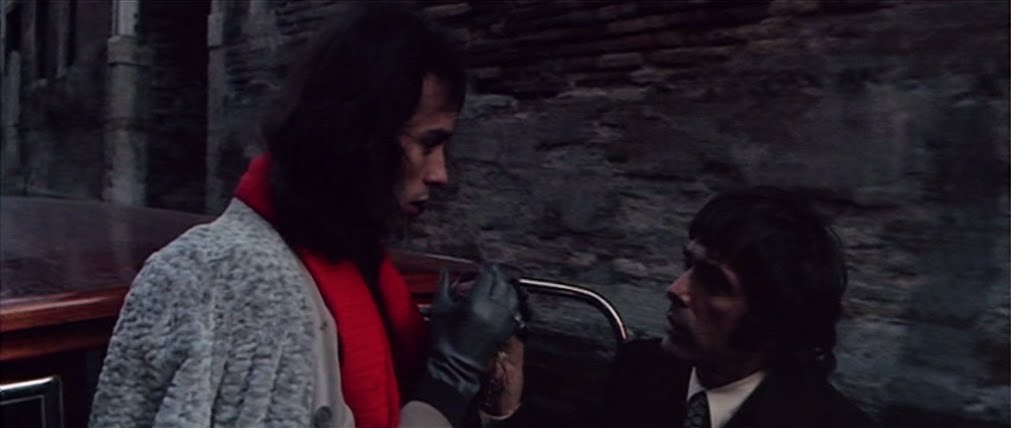
It’s here that they meet the enigmatic Count Matteo Tiepolo (Pierre Clementi). You can tell he’s enigmatic because he wears the kind of suits that wouldn’t look out of place on Dirk Bogarde’s von Aschenbach in ‘Death in Venice’ but twins them with long overcoats draped over his shoulders like a gangster and grey leather gloves. He also has a haircut that makes him look like a prototype for Russell Brand.


Here, though, the similarity ends since he neither launches into stand-up comedy routines or pursues pneumatic raven-haired pop singers; instead, he takes rather a shine to Stefano and they flit around each while the homo-erotic subtext heats up to a steady simmer. Then they get down to business. Umm, actually I could have phrased that better. Let me clarify: by “get down to business”, I don’t mean they leave Fabienne at the Rialto, go find a room and break out lube. By “get down to business”, I mean talk murder. Two murders, in fact. Matteo proposes that he murder Stefano’s wife and Stefano do away with Matteo’s brother.


Stop me if you’ve heard this one before.

You have? Only with a tennis pro and the reciprocal hit being on the other guy’s dear old ma, not his brother?

You’re dead right. We’re in unofficial remake territory, and Maurizio Lucidi’s ‘The Designated Victim’ is basically Hitchcock’s ‘Strangers on a Train’ relocated to Venice. Hitch’s film was a slightly less sexually ambiguous adaptation of a novel by Patricia Highsmith, whose best known work, ‘The Talented Mr Ripley’, was set in Venice. And indeed, the mid-section of Lucidi’s film, wherein Stefano tries to extricate himself from the suspicions of the tenacious Commissario Finzi (Luigi Caselleto) following Luisa’s death (as well as ensuring that nothing leads back to Matteo, who has the goods on him), recalls the increasingly labyrinthine construction of half-truths, outright lies and tenuous evasions the titular Ripley spends half of Highsmith’s novel telling.

I’d like to think that Lucidi was deliberately playing on the audience’s familiarity with Highsmith’s works and Hitchcock’s ‘Strangers on a Train’, hitting the expected narrative beats during the set-up and Matteo’s murder of Luisa, only for things to spiral off during the second half, slowly to begin with, then faster and faster as Matteo deftly manoeuvres Stefano into an untenable position while Finzi gets closer and closer to the truth. The ending, though, is the real rug-pull and I’m saying no more about it.

‘The Designated Victim’ is a more formal giallo than most – relatively bloodless and with little sleaze. Spiral staircases, rooftop shenanigans and lurid set-design are on hand, though, to offset the absence of J&B and incompetent cops. Finzi is up there with Stanley Baker’s Inspector Corvin in Lucio Fulci’s ‘A Lizard in a Woman’s Skin’ as one of the giallo’s few genuinely competent, pro-active and intelligent law enforcement types.


It boasts solid acting performances from all of the leads (even if Katia Christine isn’t given a whole lot to work with as the simpering Fabienne). Milian – no stranger to gialli with excellent turns in Fulci’s ‘Perversion Story’ and ‘Don’t Torture a Duckling’ – brings solid acting credentials, as does Clementi, best known for his brooding turn as Marcel in ‘Belle de Jour’. (Outside of their genre work, Milian and Clementi have between them worked with Visconti, Bunuel, Antonioni, Pasolini, Liliana Cavani, Spielberg, Soderbergh, Dennis Hopper and Oliver Stone.)

Luis Bacalov’s score is haunting and melancholy, his recycling of motifs by classical composers seeming appropriate in the Venice setting rather than derivative. Aldo Tonti’s cinematography delivers some striking images, even if it doesn’t achieve the whacked out brilliance or spatial dislocations of the best gialli.


What lets the film down, unfortunately, is how pedestrian Lucidi’s direction is. Watching ‘The Designated Victim’ is like listening to a technically proficient pianist tackle a Beethoven sonata: they’re playing the notes and not making any mistakes, but there’s no life, no passion and magnificent sense of risk in the performance.

Friday, February 04, 2011

BLACK VALENTINES: Thirst

Let’s try a scenario on for size: boy meets girl; obstacles prevent them from being together; boy and girl get together any way; a major obstacle puts their clandestine relationship under strain; things change between them.

Old as the hills, right? Seen it all before.

Now let’s layer in a little context. For “boy meets girl” read “priest meets married woman”. For “obstacles” … well, hell, he’s a priest and she’s a married woman. For major obstacle, take your pick from: (a) the priest is also a vampire; (b) the married woman is treated as a slave by her adoptive mother, the sickly and simpleton son of whom she has been forced into marriage with; (c) the married woman would quite like the vampire priest to kill the hell out of the sickly, simpleton husband and, oh yeah, turn her into a vampire while he’s at it; (d) the priest is really having a hard time with the whole being a vampire thing, let alone getting into the husband-disposal business; or (e) all of the above.

Ladies and gentlemen, welcome to ‘Thirst’. It ain’t fucking ‘Twilight’.


In fact, it ain’t like any other vampire film you’re ever likely to see, and – yes – I am including the works of Jean Rollin, Jose Larrez and Harry Kumel in that rather bold statement.

The reason I feel confident in making said statement is that ‘Thirst’ is directed by Chan-wook Park, and the man doesn’t make films like anyone else, period. Chan-wook Park is a trail-blazing cinematic talent as unique, maverick, instantly identifiable and (quite possibly) as bonkers as Werner Herzog. This is the man who completely deconstructed and re-imagined the vigilante genre in his jaw-droppingly awesome trilogy ‘Sympathy for Mr Vengeance’, ‘Oldboy’ (one of the greatest head-fucks in the whole of cinema) and ‘Lady Vengeance’. This is the man who made the jaw-plummetingly one-of-a-kind ‘I’m a Cyborg … But That’s Okay’, a film that plays out like ‘One Flew Over the Cuckoo’s Nest’ meets ‘The Terminator’ on a first date where they go and see a revival of ‘Brief Encounter’. Then drop acid. While on another planet.

Which is a long-winded way of saying that Chan-wook Park does things a tad differently. And he certainly does the vampire movie very differently. I’ve already said that it ain’t ‘Twilight’. Well, it ain’t ‘Nosferatu’, ‘Dracula’, ‘The Lost Boys’, ‘Near Dark’, ‘Let the Right One In’ or ‘True Blood’, either. To start with, our vampire isn’t an aristocrat, a frat boy teenager, a hardass redneck, a creepy Swedish kid or a Suth’n gennelman with a penchant for barmaids in the kind of tee-shirt/hotpants ensemble that makes your average Hooters girl look like a nun. No, siree, our partaker of the type-O negative is one Father Sang-hyeon (Kang-Ho Song). He doesn’t get infected by a bite to the neck courtesy of another vampire, but from a blood transfusion after he falls victim to a supposedly incurable disease whilst ministering to a mission hospital dedicated to those dying from it. Once turned, he doesn’t go out into the dark and shadowy, latching himself to the first available throat and slurping it down like an alcoholic locked in a brewery overnight. Au contraire, he hangs around hospitals, siphoning off the odd half pint here and there from comatose patients. No neck/teeth interface, either; he simply lies on the floor and lets an IV tube and gravity do the work for him.


The romantic element of the film is just as offbeat. Tae-ju (Ok-bin Kim) initially comes across as a downtrodden and mistreated heroine, the kind of put-upon waif you could imagine stepping living and breathing from the pages of a Catherine Cookson novel. She then turns into a shag-happy femme fatale type. And not gradually, either. By the end of the film …

Ah, but that would be telling.

There’s so much I want to say about ‘Thirst’, from the awesome set design (particularly when … oh bollocks, that would be telling) to the stunning admixture of tension, blackly comic absurdity and curious poeticism in the scene where Sang-hyeon and Tae-ju … but that, also, would be telling.

And then there’s the denouement. Which I mustn’t tell you about, even though I want to scream a detailed description of every wonderful, inspired and straight-up demented moment of it from the highest rooftop. It’s something you just have to see for yourself. It’s pure genius and could only have come from the mind of Chan-wook Park.

Which is an apt description of his entire filmography.