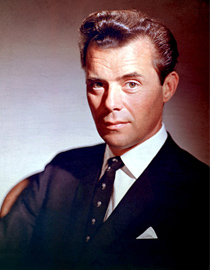
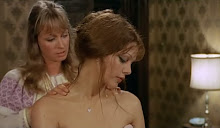
Thursday, November 13, 2008

ANNIVERSARY SPECIAL: Great name for a porn star, eh?

It’s a year to the day since I started The Agitation of the Mind and I’d planned on posting a rambling kind of entry yesterday about the hit-and-miss ratio of new material on the site and how I see the blog progressing, then following up with a review of one of the Personal Faves today.

However, a dinner party yesterday evening for my sister-in-law and her partner turned into something of an all-nighter, the conversation flowing, the wine really flowing, and some good whisky doing the rounds just for good measure. That I made it into work today is a feat. That I didn’t get fired owing to the state I was in is miraculous.

So, the rambling kind of entry will have to do as The Agitation of the Mind’s birthday present, and the Personal Faves article will have to wait for the weekend.

’Kay. Let the ramble commence. I’ll get the unfortunately necessary blowing-of-one’s-own-trumpet bit out of the way first:

Outside of blogging, I have published three books on cinema: ‘The Films of Sam Peckinpah’, ‘One Hundred Violent Films That Changed Cinema’ and – don’t tell my mother I wrote this one, she thinks I play piano in a whorehouse – ‘One Hundred Sex Scenes That Changed Cinema’. I wrote that one for the money, honest.

They’re all available through Amazon; the Peckinpah one is the best.

(Parenthetically, ‘Violent Films’ got a write-up on Mr Wonderful’s Review Of Books just last month. Here’s an excerpt: “Being that the author is British, more British films are included in his listings than a jingoistic American might have thought proper. Also, the British author, Neil Fulwood (great name for a porn star eh?) sides with the far left politically in the United States, and oddly expresses more hatred for war than is typically expressed by the actual opponents in a war.” So there you have it: I’m left-wing peacenik limey who ought to be starring in Bareback Mountain 3.)

These books were published between 2001 and 2003. Although I pitched several other ideas – a critique of Steven Soderbergh’s oeuvre, a study of the Ealing films, something on Powell & Pressburger – no further commissions were forthcoming and, beyond the odd poem or review in the small press, I’ve published nothing since.

Four years ago, I tried my hand at a novel. A crime thriller. Had a blast writing it, but the narrative was swamped with backstory and I struggled with the discipline of maintaining a constant output over the weeks and months it takes to complete a 90,000 word manuscript.

Since then, I’ve had three more tries at writing a novel. I fell by the wayside each time. A couple of months ago, I came up with (in my humble opinion) a fucking great idea. I’m not going to say anything about it because I can see no surer way of jinxing myself. I held off commencing work while I thought it through, made notes, got my head around the narrative arc, let the characters develop in my imagination. I also held off because I was apprehensive about starting. I didn’t want to fuck up again.

Last month, however, I started writing and, with only a couple of lapses I’ve kept to a discipline of working on the project for an hour each evening. This, along with the day job, car problems and (amazingly) a still-functional social life, has left me with little time to write for The Agitation of the Mind (although the brief burst of Hallowe’en activity was fun: I enjoyed dashing off those impromptu pieces).

What I don’t want to do is abandon the blog or let it stagnate. I enjoy it too much. So, for the next few months at least (I’m not confident to speculate on how long the novel will take), I’ll endeavour to post at least one new article per week at some point during the weekend. Ideally, I’d like to feature more material than that, so I’ll end the ramble on an open offer:

If anyone wants to contribute an article – long, short, whatever: I don’t mind if you send me a haiku on an epic – on anything cinema related, please email it, in Word format, to opentosuggestions.neil@lycos.co.uk with the title in the subject box. Any editing will be with your agreement, and authorship will be acknowledged (unless you want to do the Anon thing). Over to you.

Wednesday, November 05, 2008

A rare political interlude

Dear Mr Obama

Congratulations on your election victory. The phrase “making history” is often bandied about in the media, usually out of context and always with the tang of hyperbole.

In your case, however, it happens to be a simple statement of fact.

It is not just remarkable because of your ethnicity and comparative youth; the sheer scale of voter turnout is perhaps unprecedented and represents a laudable pro-activeness on the part of the American public. Your victory represents a massive sea-change in American thinking. Your administration has the opportunity to fulfil an equally positive sea-change in American politics.

I will confess to having always been sceptical about politics. Here in my native England, I have never voted for anyone; I have always used my vote as a vote against. Your countrymen, however, have overwhelmingly voted for.

It has long been my opinion that a politician – however progressive and humanitarian their principles and policies – is still shackled to the huge machinery of government and that by ascending to leadership of a party, or of a country, they have automatically received custodianship of a poisoned chalice; have already become compromised.

I think – I hope – that you have the potential to prove me wrong on this.

You also have the potential to re-represent America to the rest of the world (indeed, you have already begun doing this). You have the potential steer America away from the course your predecessor so ill-advisedly set it on.

Good luck and good wishes,

Neil Fulwood

Friday, October 31, 2008

Hallowe'en Triple Bill

The glow-in-the-dark bats are glowing in the dark, the illuminated pumpkin is trying to disassociate itself from how crap a movie 'Halloween III: Season of the Witch' is, the nibbles are arrayed in bowls on the coffee table, the wine is poured and Paula pulls the first title out of the witches' cauldron.

Way-hey! One from the faves list.

PERSONAL FAVES: A Tale of Two Sisters

Getting the triple bill in and posting before midnight means thumbnail write-ups and this film suits brevity down to the ground. There's almost nothing you can say about it - you certainly can't get into a discussion about director Kim Jee-Woon's genius for misdirection and the keeping of crucial things under wraps - without spoiling the twist.

Although perhaps twist is the wrong word. Twist implies something that's thrown in at the last minute to take you by surprise. What 'A Tale of Two Sisters' has is one fuck-off big hum-dinger of a narrative development; it comes about two-thirds of the way through and forces you to re-evaluate everything you've seen up to this point. But Jee-Woon's not satisfied with that and the last half hour or so takes the film into ever darker territory.

Giving nothing away, I'll just say this: it's about guilt (this applies to more than one character); you might think that one of the characters is a ghost (they kind of are and aren't); pay attention to the cringeingly embarrassing dinner party (it's all about perspectives: who sees what).

It's a beautifully shot, incredibly well acted and infinitely creepy piece of work. It proves that 'The Ring' doesn't necessarily have the monopoly on freaky women with lank black hair creeping slowly towards you. It blends psychological horror with arguably the best take on the haunted house movie since Robert Wise's 'The Haunting'. It yields up its many facets and ambiguities with repeated viewings: think 'Memento' or 'The Prestige', but with the requirement that you shelter behind the sofa to watch much of it.

*

A short break, the topping up of drinks, a bit of mood music ('Danse Macabre' by Saint-Saens), then the next title is drawn:

Land of the Dead

The most maligned of Romero's zombie sequence (even the decidedly hit-and-miss 'Diary of the Dead' got better reviews). Nonetheless, 'Land of the Dead' is a film I enjoy for its socio-political themes, and one that I see as the logical conclusion of the critique of Americana that spans 'Night', 'Dawn' and 'Day' and pretty much makes 'Diary' superfluous. The zombies evolve, fall in behind a leader, revenge themselves on a surviving core of humanity who have become so inured they treat the living dead as sideshow entertainments. Maybe it should have been called 'Sympathy for the Dead'.

Plenty to love: Asia Argento's tough-chick performance; the 'Shaun of the Dead' stars in an inspired cameo; supporting roles by Dennis Hopper and John Leguizamo ("I still prefer him as Chichi," Paula comments*). Then there's the whole post-9/11 American insularity subtext ...

But enough. My musings on Romero's ground-breaking sequence have already been documented on this blog, here, here, here, here and here.

*


Another short break, another gothic tune (Mussorgsky's 'Night on the Bare Mountain'), then it's heads-down-and-see-you-at-the-end. Here we go: the final title is picked.

Oh.

The Addams Family

Barry Sonnenfeld: a master of style over substance. Yes, 'The Addams Family' looks great. Yes, everyone's perfectly cast. Yes, it's a pleasant little diversion after the head-fuck of 'A Tale of Two Sisters' and the viscera of 'Land of the Dead', but I find myself wishing it was the sequel, with its gloriously subversive summer camp subplot and expanded role for Christina Ricci's deliciously deadpan Wednesday, that we were watching.


* 'To Wong Foo, Thanks for Everything, Julie Newmar' up next on The Agitation of the Mind? Watch this space.

Thursday, October 30, 2008

All Hallows Eve

Hallowe’en tomorrow, and it’s looking set to be an appropriately cold and frosty night. Nonetheless, the little darlings will doubtless be out and about, done up as witches and wizards, ghosts and goblins, vampires and vegetables (I’m guessing pumpkins count as a vegetable … anything to keep the alliteration going). Kids ringing doorbells, singing out “Trick or treat”, racing happily off with handfuls of sweets and chocolate …

Well, maybe in other neighbourhoods. Round here it’ll be a gang of hoodies wanting money. So the gate will be chained, noises outside ignored, the lights dimmed and we’ll settle down to our own Hallowe’en celebrations:

There will be alcohol (red wine, natch, served in the wineglasses decorated with pewter representations of the grim reaper … a present a few years ago from my aunt*).

There will be nibbles.

There will be a DVD triple-bill. A cheapie plastic witches cauldron has been acquired (along with some glow-in-the-dark plastic bats and an illuminated plastic pumpkin) into which we have placed folded-up squares of paper bearing the titles of all the films in our collection apposite to the occasion. Including spoofy stuff like ‘Slither’ and ‘Eight Legged Freaks’, and is-it-or-isn’t-it hybrids like ‘From Dusk Till Dawn’: is it a crime caper? is it a vampire flick? is it spoof? (answer: who cares, it’s got George Clooney, Harvey Keitel and Salma Hayek doing a snake dance in string bikini …).

Three titles will be drawn at random and watched back-to-back. I’ll be logging on just before midnight with a witches’ brew of a posting.


*You can’t get further from the twin-set and weak-cups-of-tea cliché of a maiden aunt than my Auntie Carole: her taste in films is even more esoteric than mine, she loves horror novels, and thinks Ozzy Osbourne is cool.

Wednesday, October 29, 2008

Switchblade Romance

After the remarks I made about the likes of ‘Hostel’ in last night’s entry, perhaps a tip of the chapeau is in order to a film that is unapologetically of that ilk … and that works brutally, brilliantly and memorably.

To whit, ‘Switchblade Romance’.

I can only assume that director and co-writer Alexandre Aja set himself the task of bringing to the screen the most extreme, graphically violent, unnecessarily gratuitous, utterly amoral exploitation movie he could possibly envisage. If so, the result is an unqualified success.

Take the home invasion scenario familiar to viewers of everything from ‘Extremities’ to ‘Straw Dogs’; add a dash of vengeful heroine turning the tables (‘I Spit on Your Grave’, ‘Halloween H20’); introduce a homicidal, motiveless truck driver (‘Duel’, ‘Jeepers Creepers’); finish with a facially-scarred monstrosity intent on using a power tool in a most unorthodox manner (‘The Texas Chain Saw Massacre’). Make no mistake, ‘Switchblade Romance’ is a hugely derivative film. It also boasts at least four sequences which rank amongst the most unbearably tense set-pieces in the horror genre.

What frustrates and delights in equal measure is how schizophrenic a viewing experience it is. For every moment that leaves you digging your fingernails into the nearest available surface (be it the seat rest or your partner’s arm), there's another that’s so contrived and unrelenting in its bloodletting that it makes the House of Blue Leaves centrepiece from ‘Kill Bill’ look like cinema-verite. For every genuinely original touch, there’s a cliche so shamelessly evoked that it virtually has a trademark symbol next to it.

The finale, in particular (as brilliant a spoof of ‘The Texas Chain Saw Massacre’ as it is) threatens to elicit sniggers when it should make you gasp. The much-vaunted twist ending is self-evident from the outset (three clues: the title, the pre-credits ‘dream’ sequence, the empty swing outside the farmhouse).

So what does ‘Switchblade Romance’ have to recommend it? Plenty, actually: energy, immediacy, iconography, a knowing sense of irony, and a full-tilt commitment to narrative. Whereas ‘Hostel’ sent me out of the cinema feeling slightly soiled, ‘Switchblade Romance’ fucked with my head, kneed me in the solar plexus and gave me a damn good kicking as I crawled for the exit.

Tuesday, October 28, 2008

PERSONAL FAVES: The Exorcist

The first time I saw ‘The Exorcist’, I was eighteen. It was 1990 and the film was still a good few years away from its video-ban repeal. One of the cinemas in Nottingham held a midnight screening – the Odeon or the ABC, I can’t remember which. Both closed in the last decade.

At eighteen, my interest in horror movies was at its height. Of late, and I know exactly why (it was called ‘Hostel’ and left me wondering why I’d wasted an hour and a half of my life on it), there has been something of a parting of the ways between me and the horror genre, particularly its vicious offspring the ‘torture porn’ film.

Thus the likes of ‘Captivity’, ‘Paradise Lost’ and ‘Eden Lake’ have come and gone without tempting me into my local multiplex.

Looking back through over 130 entries on The Agitation of the Mind, horror film write-ups only barely edge into the double figures: Romero’s ‘Dead’ sequence, a handful of gialli, ‘Freaks’, ‘The Orphanage’, ‘Tremors’ … that’s about it.

But I still enjoy a scary movie – there’s at least half a dozen on the personal faves list – it’s just that gore as a raison d’etre doesn’t interest me anymore. In context, as in John Carpenter’s ‘The Thing’, viscera is a powerful aesthetic tool (oops, I’m straying into the kind of pseudy pontificating I started The Agitation of the Mind to get away from!). But it needs to be backed up by character and atmosphere or by the kind of psychologically-based terror that is so much more effective than any of Eli Roth’s graphic blood-lettings.

‘The Exorcist’ is a gore-free film. Sure, it has projectile pea-soup vomiting and the possessed Regan (Linda Blair) doing something rather irreligious with a crucifix, but the horror comes from its intelligent study of the nature of – and conflict between – good and evil.

And it delivers some memorably creepy scenes that aren’t supernatural:

* The wild dogs in frenzy as Father Merrin (Max von Sydow) gazes at the statue of Pazuzu in the Iraq-set opening sequence.

* Father Karras (Jason Miller) visiting his mother in hospital, lunatics grabbing at him as he enters the ward.

* A group of nuns walking along a suburban street as the wind blows leaves around them and Mike Oldfield’s ‘Tubular Bells’ plays on the soundtrack (a combination of atmosphere, music and a sense of impending dread that always creeps me out).

* Regan – her mother still searching for a medical solution to her ‘condition’ – hospitalised for a brain scan. Not a hint of the otherworldly, but the harsh, clinical way William Friedkin films this scene leaves me feeling queasy every time I watch it.

* Merrin stepping out of a cab and pausing momentarily, silhouetted by a streetlight, before approaching the McNeil residence: a deliberately painterly image (the use of light is inspired by the canvasses of Rene Magritte), but hugely iconic.

This is perhaps the key to Friedkin’s genius*: this is a film about possession and exorcism, about the testing of faith by satanic evil, that is shot through with such documentary clarity that you can easily forget it’s a horror film. Perhaps, ultimately, it isn’t. But, importantly, it scared the crap out of me at eighteen, and it continues to scare the crap out of me now.


*Caveat: when I use the words ‘Friedkin’ and ‘genuis’ in the same sentence, it’s in reference to this film or ‘The French Connection’. Catch me doing it anywhere else in the Friedkin filmography and you’re more than welcome to leave a very vehement comment.

Sunday, October 26, 2008

The Damned

On the night of 30th June 1934, Nazi troops moved against Ernst Rohm’s paramilitary SA (Sturmabteilung) in a putsch that lasted three days and saw over 85 deaths. Hitler’s antagonism against the SA owed to their continued independence; the putsch was also an excuse for striking at his critics, demonstrating the force and deadly efficiency of his own SS troups, and consolidating his power base.

The carefully orchestrated coup was called Operation Hummingbird, but has gone down in history as the Night of the Long Knives.

This nefarious moment in German history provides the 20-minute centrepiece to Luchino Visconti’s ‘The Damned’. Subtitled ‘Götterdämmerung’ (trans. “twilight of the gods”), the Wagnerian reference is apposite. Visconti’s film is operatic to the point of being overwrought, particularly in its increasingly melodramatic last half hour.

The stage upon which this opera of Nazi-ism, power struggles, sexual ambiguities and compromised morality plays out is the Essenbeck Steelworks, owned by a powerful industrial family whose political allegiance is important to Machiavellian SS officer Aschenbach (Helmut Griem). ‘The Damned’ opens with a birthday party for the ageing Baron von Essenbeck who announces his retirement, leading to instantly fractured interrelationships inside and outside of the family as the appointment of the new director of the company hangs in the balance.

The rank outsider* in all of this is Frederick Bruckmann (Dirk Bogarde); however, he has two aces up his sleeve: his relationship with the Baron’s widowed daughter, Sophie (Ingrid Thulin), and the backing of Aschenbach.

Through Aschenbach’s machinations and Sophie’s borderline erotic manipulation of her sexually confused son Martin (Helmut Berger) – whose predilections range from cross-dressing to paedophilia to mother-fixation – Bruckmann is appointed director of the steelworks. But it’s not long before his obsession with complete control over both firm and family – not to mention his reluctance to take the political hard line that his deal with the devil (or rather his suave earthly representative Aschenbach) requires – leads to his downfall.

Bogarde excels as Bruckmann: a vivid, complex study of ambition, fear, moral cowardice, desperation and, finally, abject defeat. Ingrid Thulin goes a wee bit ‘Lady Macbeth’ towards the end, but by this point Visconti’s shovelling on the theatrics like there’s tomorrow. Helmut Berger, Visconti’s homo-erotic camera clearly favouring him over the rest of the cast, gives a memorable performance if sometimes for the wrong reasons; but there’s no doubt that he gets across Martin’s vicious amorality.

Further down the cast list, Umberto Orsini and Charlotte Rampling deliver compelling turns.

But it’s Helmut Griem who eclipses even Bogarde. “That one may smile, and smile, and be a villain,” to quote ‘Hamlet’. Aschenbach smiles, and smiles, and soothes, and coerces and chills. Martin’s demonic ascension and engineering of Bruckmann and Sophie’s fate is nothing but the movement of Aschenbach pulling the strings. Griem plays him with infinite charm and assured understatement. Amidst the emotional excesses of Visconti’s lurid epic, he’s the calm centre of stillness, composure and complete ruthlessness.


*Readers of Sheridan Morley’s book on Dirk Bogarde’s early career will, I hope, forgive the pun.

Monday, October 20, 2008

Ill Met by Moonlight

By 1957, Powell and Pressburger were moving towards the annulment of their partnership. It had been an almost decade-long decline.

‘Gone to Earth’ was a slab of melodrama, ‘The Elusive Pimpernel’ a bit of pantomime camp, ‘The Tales of Hoffmann’ a failed attempt to recapture the magnificence of ‘The Red Shoes’, and ‘O … Rosalinda!!’ a self-indulgent flop, audiences showing either a singular lack of interest in operetta or an understandable caution in approaching films with three exclamation marks in the title.

Their last two outings were a return to the war movies that had made their name; but whereas the eight-film run of classics between ‘The Spy in Black’ in 1939 and the ‘A
Matter of Life and Death’
in 1946 were made during the war years (the latter in production just as the war was reaching its conclusion), ‘The Battle of the River Plate’ and ‘Ill Met By Moonlight’ came ten years afterwards: would that curious alchemy which made art of the propaganda film still function in retrospect?

Well, not with ‘The Battle of the River Plate’. Although a decent enough account overall of the sinking of the Graf Spree, Powell’s decision to film the movements of ships at sea resulted a highly cinematic footage utterly at odds with the patently studio-bound falsity of the rest of the film.

Which leaves us with ‘Ill Met By Moonlight’, their swansong, its box-office swelled by Dirk Bogarde in his dishy, matinee-idol prime, and again another account of an actual incident from the war.

The source material was a book by W. Stanley Moss recounting the exploits in Crete of Major (now Sir) Patrick Leigh-Fermor, an authentically individualistic English hero (as T.E. Lawrence to the desert, so Leigh-Fermor to the Mediterranean), and his successful kidnap of a high ranking German officer.

Powell and Pressburger’s take on Leigh-Fermor is romanticism writ large. Bogarde’s swooning performance is entirely in keeping with the sense of hero-worship with which Powell saturates the film. P&P favourite Marius Goring essays the German general with distinctly more gravitas.

And herein lies the enigma (and pleasure) of the film. Goring’s career office is a professional, but courteous with it: a Nazi and a gentleman. (P&P had been daring enough to portray ‘good’ Germans even in the war years: the harmless Vogel (Niall MacGinnis) in ‘49th Parallel’ and the dignified Kretschmar-Schuldorff (Anton Walbrook) in ‘The Life and Death of Colonel Blimp’.) Leigh-Fermor, however, is portrayed as a gentleman amateur. Ian Christie, in his wonderful study of Powell and Pressburger’s films, ‘Arrows of Desire’, describes Bogarde/Leigh-Fermor as “dressed as a comic-opera bandit when we first see him”. He goes on:

“… the whole story is framed, not only by its Shakespearean title but by a reference to the Odyssey … If the [film’s] realization does not live up to its promise or ambition, it remains nonetheless an intriguing stage in the military ideology that runs from Blimp … a defiant assertion of the gentleman-amateur ideal at a time when Britain was learning its new role in the world of superpower conflict and the end of Empire” (‘Arrows of Desire’, Faber & Faber, p.78).

Which is absolutely spot-on. Everything from Bogarde’s dashing leading man status to Goring’s good grace in defeat to the studied poignancy of the ending (the German officer tries to ‘buy’ the affections of a local Cretan child, with a view to leaving clues to his whereabouts, only for the lad – his loyalties hitherto in doubt – to be revealed as unswayable in his devotion to Leigh-Fermor). Which only makes the film’s far-and-away best scene that much more effective in its swift, no-nonsense efficiency.

Leigh-Fermor visits his contact, a dentist, in a Nazi-held town. Unbeknownst to him, he is followed. When the Nazi patrol (its sergeant a young Christopher Lee, speaking German like a native) burst in, Leigh-Fermor finds himself hustled into the dentist’s chair, a white bib-like cloth draped around his neck. Terrified of dentists, L-F plays along, not batting an eyelid when the patrol come stomping in, but losing his cool as soon as the dentist, hands shaking from fear, starts up the drill. The Nazi sergeant has his suspicions and pulls the cloth from his neck; L-F is clutching a pistol under it. He summarily executes the German soldiers. There’s nothing do-or-die or remotely heroic about the scene; he does it because he’s scared of dentists.

Seven years after ‘The Blue Lamp’ and just five after ‘Hunted’, and a full decade or more before the darker characterisations of ‘The Damned’ and ‘The Night Porter’, the anti-romantic-hero element of Bogarde’s cinematic persona is revealed in a brief lightning flash. So too the adaptability and menacing screen presence of Christopher Lee. And between them, a scene effective enough to transform what could have been Powell and Pressburger’s death rattle into a respectable send-off.

Friday, October 10, 2008

These Foolish Things

Rainer Werner Fassbinder’s ‘Despair’ (1978) was almost Dirk Bogarde’s last film, an experience that soured his already sceptical feelings about film-making. Fassbinder re-edited the film drastically, despite his star’s preference of the original cut. “He fucked up my performance” was Bogarde's blunt assessment during the BBC interview ‘By Myself’ which aired shortly after he received his knighthood in 1992.

He withdrew to Clermont, his house in France (referred to in the autobiographies as Le Pigeonnier) and concentrated his efforts on his writing, only taking the occasional bit of television work out of financial necessity. Directors continued to offer him scripts; Bogarde inevitably politely declined.

Fortunately for cineastes, Bertrand Tavernier tempted him out of retirement in 1990, a full twelve years since he had last appeared before a movie camera, with the lead role in the intimate family drama ‘These Foolish Things’ (or ‘Daddy Nostalgie’ to use the indigenous title).
‘These Foolish Things’ is the better title. ‘Daddy Nostalgie’ hints at a certain sentimentality. Nothing could be further from Tavernier’s aesthetic. There is not a trace of false emotion here.
Tony* (Bogarde) is a well-travelled Englishman living out his retirement in seaside villa in France which he shares with his humourless and emotionally inexpressive French wife Miche (Odette Laure). Following an operation, Tony finds himself almost housebound. As he supposed recuperation progresses, it becomes apparent that the surgery might not have been successful.
The couple’s all-but-estranged daughter Caroline (Jane Birkin) returns to the villa to stay with them and help nurse her ailing father. For the first time in their respective lives, father and daughter get to know each other. The poignancy of their relationship has its counterpoint in Tony and Miche’s fractious marriage.

With its deceptively slight narrative and numerous scenes of marital disharmony, ‘These Foolish Things’ could easily have been tedious, talky and decidedly uncinematic. Three things redeem it: the beautiful widescreen cinematography, effortlessly establishing location and mood; Tavernier’s intelligent handling of a fine, literate screenplay by Colo Tavernier O’Hagan; and Dirk Bogarde, giving his finest performance since ‘Death in Venice’. Waspish, sarcastic and yet, at heart, utterly vulnerable, Bogarde’s characterisation of Tony is multi-layered and completely real.

‘These Foolish Things’ is about a man in the twilight of his years. It is illuminated by one of Bogarde’s most desperately moving performances (kudos to Laure and Birkin, too; the film is, after all, a chamber piece) and stands as a fitting swansong to a great actor.


*And how bittersweet must it have been for Bogarde to play a character with the same first name as his then-deceased partner of fifty years, Anthony Forwood?

Sunday, October 05, 2008

PERSONAL FAVES: Death in Venice

Thomas Mann’s ‘Death in Venice’ had already been adapted, operatically, by Benjamin Britten before Luchino Visconti came to film it in 1971. Both Britten and Visconti were gay, which perhaps accounts for the common misconception that the film is about an old man’s obsessive lust for a boy barely in his teens.

Wrong. The film, like its literary source, is about many things, not least the nature of art and beauty and the thorny question of where, between the two, the humanity of the artist resides. There is nothing perverse or cynical about the film. For all of its melancholy it is, in fact, one of the most beautiful works of film art in the history of the medium.

Mann’s novella was inspired by the author’s encounter with Gustav Mahler during a train journey. Shocked at Mahler’s physical appearance (the haggard Aschenbach at the end of the story, powdered, a line of mascara running down his face, is Mann’s fictive approximation). And it was for the purposes of fiction that the character became Gustav von Aschenbach, a writer of books, not of music.

A director whose forte was his immaculate attention to detail, particularly in the observation of social rituals (the minutiae of Mann’s descriptions are captured in vivid and poetic images), Visconti’s film is a faithful adaptation but for one crucial alteration.

The director’s most decisive aesthetic decision was to allay the character more closely with the man who inspired him. Thus the Aschenbach of the film is a composer - moreover, by dint of the soundtrack, Aschenbach is Mahler. Evocative use is made of his Third and Fifth Symphonies, particularly the latter’s adagietto. (Even Karajan, a non-Mahlerian, was taken by the film enough to record the Fifth with the Berlin Philharmonic.)

Visconti also adds a series of flashbacks which concern, variously, Aschenbach’s attitude to his art, the death of his beloved infant daughter (viewed in this light, the effeminate young boy Tadzio [Bjorn Andresen], of an age Aschenbach’s daughter would have been, becomes almost a replacement for the composer’s fatherly devotion), and his debasement in the boudoir of a hooker - this last being the event that instils in him an obsession with cerebral and artistic purity and dignity.

A key flashback sees him in heated debate with Alfred (Mark Burns), a fellow composer:

Aschenbach: The creation of beauty and purity is a spiritual act.

Alfried: No, Gustav. Beauty belongs to the senses, only to the senses.

Aschenbach: You cannot reach the spirit from the senses. It’s only through complete domination of the senses that you can achieve wisdom, truth and purity.

At the risk of oversimplifying a deep, profound and thought-provoking film, ‘Death in Venice’ is about an artist who, suffering from nervous exhaustion, takes a supposedly recuperative sojourn only to be confronted with a vision of purity and beauty, but one that, by definition of his reaction to it, completely invalidates the principles by which he has tried to live.

The last half hour is shattering. Scenes dealing with Aschenbach’s increasing bad health, played out against a plague-ridden Venice stained with disinfectant and ravaged by fires, bookend the final flashback sequence, which demonstrates Aschenbach’s failure as an artist and public vilification.

Throughout, Dirk Bogarde’s performance as Aschenbach has been perfectly nuanced and intricately mannered, suggesting through the minimum of dialogue (he is onscreen the whole time, but entire stretches of the film pass without him uttering a word) the brittleness and emotional void of a man who has kept his humanity tightly under wraps. The last quarter of the film, however, is acting on another level. Bogarde progressively tears away layer after layer of his character, culminating in a moment of heart-breaking acceptance as Aschenbach finally attempts to reach out to someone only for it to be too late. He slumps back into his deckchair; the man and the artist are dead. It is arguably one of the most moving death scenes that any actor has played.

For Bogarde, Aschenbach was more than just a role:

The five months of work on ‘Death in Venice’ had been the hardest I had ever known for stress and mental strain; daily I had struggled with a personality … who had overwhelmed me to such an extent that every single function I performed in my daily life was as he would have done. I was never without his influence at any time, even in sleep. - Dirk Bogarde, ‘An Orderly Man’, chapter 1.

Thursday, October 02, 2008

A Bridge Too Far

It's easy to see how Richard Attenborough's 'A Bridge Too Far', based on Cornelius Ryan's exhaustive account of Arnhem debacle Operation Market-Garden, was intended as a corrective to the big-budget, all-star-cast jingoist war epics so popular in the 60s and 70s.

For all intents and purposes, it takes its cue from the likes of 'The Longest Day' - epic running time (just shy of three hours); huge, intricately-orchestrated set-pieces; famous faces all over the shop (Sean Connery, Gene Hackman, Michael Caine, James Caan, Sir Laurence Olivier ... the list would be longer than the article itself if I listed everyone); an almost inappropriately stirring score by John Addison. In fact, it differs in only one crucial way.

It's about a fuck-up.

An Allied fuck-up.

This aspect of 'A Bridge Too Far' was never going to be its most popular attribute. And yet, when it was released, the almost inevitable storm of controversy that greeted it centred almost solely around Dirk Bogarde.

Here's Christian Browning, son of General Sir Frederick Browning (the real-life character Bogarde played) on his performance: "... poncing around with white gloves. Those gloves! Dirk played Anacleto in 'The Singer Not the Song' more or less the way he played Dad." (Quoted in John Coldstream's biography.) Here's co-star Edward Fox (quoted in same): "He was impersonating Freddie Browning completely wrongly. It was as if he set out to play him as a poofy waiter."

(The very idea of Edward Fox, whose okay-chaps-what-ho performance isn't far short of parody, criticising a Bogarde characterisation as 'poofy' is hilariously ludicrous.)

So why all the Dirk bashing?

The answer goes back to one of the two reasons Bogarde accepted the role (three if you count the fact that Attenborough, by dint of a holiday home in Provence, was more or less Bogarde's neighbour): (i) a $100,000 salary, and (ii) Bogarde was first billed and his character has 'the Line'.

Discarding the former (okay, $100K is decent chunk now and was a fuckload back in 1977, but it was still peanuts compared to what the American cast members earned), Bogarde's ego was certainly stroked by the latter. Because so many big stars were cast, billing was alphabetical: therefore, before Caan, Caine and Connery, let alone the likes of Elliott Gould or Ryan O'Neal, Dirk Bogarde stands as top-billed actor.

Then there's the Line. Again, a note of explanation: Browning was under considerable pressure from High Command (specifically Montgomery) to deliver an against-the-odds success with Operation Market-Garden. Concerned over the logistics, dubious about taking Arnhem, Browning famously averred that they'd be going "a bridge too far". It's worth bearing in mind that he said this before the operation.

William Goldman's script - in all other respects a clear-sighted adaptation of Ryan's book - indulges in a jarring anachronism. Because Goldman opted to omit the critical meeting between Montgomery and Browning, Browning is essentially cast as the villain of the piece: monomanicially pushing the mission through despite everyone else's misgivings, fixated in true death-or-glory stylee that Market-Garden is infallible. Worse, in order to retain the line that gives both book and film their title, he has Browning foppishly muse, after the operation goes disastrously wrong, "Well, as you know, I've always thought that we tried to go a bridge too far". Which basically makes Browning sound like a pompous dick, blithely stating the obvious after the fact.

The script, however, is the writer's business; in this case an American scribe's take on a British snafu. That a British director happily filmed it is a matter for discussion elsewhere.
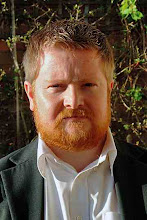
As regards Bogarde's involvement .... call me biased (I'm a fan, after all), but wasn't he merely doing what all actors do - reading the lines and taking direction?

And his performance? He plays Browning as aloof, slightly disconnected (attributes I'd imagine are necessary for a high-ranking officer in wartime, who makes decisions, and by extension gambles with lives, coolly and dispassionately). In a film where so many of the other stars just be themselves (Connery is Connery, Caine is Caine) or ham it up (Hackman as a Polish officer) or phone in wooden performances (O'Neal) or play on their established persona (Maximilian Schell and Hardy Kruger reprise their rent-a-Kraut roles from any number of previous outings), Bogarde's performance is definitely not the worst. Far from it. In fact, perhaps only Anthony Hopkins emerges from the whole production as giving a rounded, subtle, memorable performance.

'A Bridge Too Far' has some stunningly brilliant scenes and a fair smattering of shruggingly ordinary ones. Attenborough's direction is often geared to spectacle when human drama needs to be at the fore (I'd love Peckinpah to have made this film, to have given it the sense of waste, loss, brutality, desperation and hard-won, shell-shocked humanity that permeates every frame of 'Cross of Iron'). Peckinpah had been a Marine. Dirk Bogarde, too, had a military background. He served in World War II. His evocative poem 'Steel Cathedrals' is still frequently anthologised in collections of war poetry.

I wonder how many other actors in 'A Bridge Too Far' had also worn the uniform for real, not just as a costume.

Saturday, September 27, 2008

The Singer Not the Song

In his biography of Dirk Bogarde, John Coldstream infers that the actor’s disinterest in ‘The Singer Not the Song’, his last outing for the Rank Organisation, led to his deliberately camp performance, a factor crucial to the film’s failure.

Although Bogarde was at the height of his fame when it was released in 1961, audiences clearly preferred him as the lovable Dr Simon Sparrow, or as dashing war heroes in the likes of ‘Ill Met by Moonlight’ or ‘They Who Dare’.

Bogarde was given his choice of the two main roles in ‘The Singer Not the Song’, indicative of Rank's fears of losing him. Bogarde was already tired of the formulaic fare on offer, and ill-feeling between him and Rank supremo Earl St John had been in the wind for a while. Nonetheless, he was one of their biggest stars, and had already been lured to Hollywood for the Franz Liszt biopic ‘Song Without End’.

So Bogarde, swayed no doubt by a significant paycheque (Rank threw a serious budget at the production), took the role of Anacleto, the Mexican bandit chief who enters into a love-hate relationship with an unorthodox priest. Title as metaphor, geddit? The singer not the song = the priest not the religion.

Clad in black (most notably in the extremely tight-fitting leather trouser department), sneer fixed in place, eyebrow perpetually arched, a white cat on his knee in several scenes - this four years before the first onscreen appearance of Blofeld in ‘Thunderball’! - there can be no doubt that this was miscasting writ large. It says something, then, that Bogarde is easily the best thing about the film.

Equally miscast is John Mills at his most avuncular as Father Keogh, the priest who stands up to Anacleto. The script calls for a dynamic - almost an attraction - between the antagonists. Clearly, a much younger, more energetic actor should have been cast instead of Mills.

Of Mylene Demongeot, the European starlet who plays the girl caught between them (a role which should provide the film’s human centre), the kindest that can be said is that she was no actress.

Another misjudgement was retaining Nigel Balchin as scriptwriter. A writer at the forefront of twentieth century British realism (his best known work, ‘The Small Back Room’, was filmed by Powell and Pressburger in 1948), he was simply the wrong man to adapt Audrey Erskine-Lindrop’s melodramatic novel. Also, the geniuses at Rank saw fit to put the whole thing in the hands of Roy Ward Baker, director of ‘The One That Got Away’ and ‘A Night to Remember’, films which demonstrate attention to detail and emotional distance from otherwise thorny subject matter (a German POW’s successful escape bid in the former; the sinking of the ‘Titanic’ in the latter) - again, obviously the wrong man for the job.

In ‘Snakes and Ladders’ - his only autobiographical volume that deals in any detail with his Rank years - Bogarde includes a publicity still from ‘The Singer Not the Song’, but doesn’t mention the film by name anywhere in the text. No reason for him to; audiences stayed away in droves. Baker took the brunt: his career deflated; it was six years before he directed again, and even then he was reduced to trashy Hammer horror quickies.

Curiously - perversely, even - ‘The Singer Not the Song’ began to find its champions. Particularly in France, where it swiftly became a cult hit. Today it exists as a cinephile’s guilty pleasure, one that’s all the more enjoyable for knowing that Bogarde was in on the joke.

Friday, September 26, 2008

The Night Porter

An assertion contested in John Coldstream’s biography, but one that Dirk Bogarde comes back to time and again in his autobiographical writings, is his presence at the liberation of Belsen.

Only during really bad thunderstorms would I remember Belsen, and the girl, shorn head covered in scabs, face cracked with running sores from which she carelessly waved away the April flies, who grabbed my hand and stumbled with me along the sandy tracks amongst the filth … - Dirk Bogarde, ‘Snakes and Ladders’, chapter 3.

In April … we came to Belsen and the first concentration camp: a hideous ‘liberation’ this time which erased forever the erroneous idea we had that ‘Jerry is really just the same as us’. No way was he. - ‘Backcloth’, chapter 4.

In Vught Camp, or perhaps in Belsen, I can’t remember exactly which now (both were as terrible) I had wandered through huts piled high with the relics of human life: hair in mounds, higher than myself, from shaven heads. - ‘An Orderly Man’, chapter 9.

This latter passage is perhaps the most contentious in Bogarde’s memoirs, since he discusses the atrocities in the context of 'The Night Porter', easily the most controversial film in which he appeared.

Ironically, its genesis was in a visit the director, Liliana Cavani, made to Dachau for a documentary. Witnessing a well-dressed woman laying a wreath not to any of the victims but to the Nazi officer with whom she’d had a sexual relationship whilst an inmate, Cavani began to wonder what would happen if the officer had survived and they met again after the war.

Accordingly, ‘The Night Porter’ begins in 1957, former concentration camp commandant Max (Bogarde) holding down the titular job at the Hotel zum Oper, a fading remnant of Viennese society. He attends periodic reunions with comrades from the war at which they hold mock trials for each other. These serve two purposes: a cathartic 'defence', allowing them to reassert their loyalty to the Third Reich, and a weeding out of actual evidence or witnesses against them - such evidence swiftly disappears ... as do witnesses.

As Max's 'trial' approaches, he starts to get cold feet. His fellow officer Klaus (Philippe Leroy), the self-appointed "devil's advocate" in these proceedings, takes the whole thing very seriously. When Max states that he just wants to live a quiet, unassuming life ("like a church-mouse"), Klaus assumes Max has something to hide and decides to have him watched and followed.

It turns out that Max does have something to hide: the latest guest at the Hotel zum Oper, Lucia (Charlotte Rampling), wife of a world famous conductor in town to premiere a new production of Mozart’s Die Zauberflote*. Flashbacks weave through the fabric of Max's day-to-day life, revealing their earlier association: Lucia the submissive to Max’s sexual sadism, the whole perverse affair played out under the shadow of the swastika. In the film’s most provocative image, seized upon for the poster artwork, he exerts his sexual control by having her perform a torch song for the benefit of the other officers dressed only in trousers, braces, a pair of leather gloves and a Nazi cap. Costume has seldom been used in film to make such a darkly erotic statement.

This middle section of the film is Cavani's greatest achievement, the past and present interconnecting so fluidly; overlapping. As the Fifties-set sequence segues into a resumption of their relationship, this time with Lucia participating "of my own free will", things threaten to tip into melodrama. Lucia’s husband harries the Austrian authorities to investigate her disappearance; Max’s fellow Nazis get hot under the collar about the attention his indiscretions could draw to them. They stake out his apartment, preventing food or supplies from reaching him and Lucia. As Morgan Freeman puts it in 'Seven', "this ain't gonna have a happy ending" ...

To put it mildly, ‘The Night Porter’ upset quite a few people on its release and is still a cinematic hot potato now. My mother, one of staunchest Dirk Bogarde fans alive (her zeal for him in his matinee idol days is a good indication of how popular the man was - kind of the di Caprio of post-war British cinema), says of 'The Night Porter', "I didn't like him so much when he started making those kind of films."

The agitation of the mind? Just a bit! Cavani turns in a challenging and complex study of attraction, exploitation and twisted sexual dependence. She is aided by the searing performances of her two stars. Bogarde is disturbingly credible, his characterisation an extension of the ambitious, amoral Nazi sympathiser he had played four years earlier in Visconti’s ‘The Damned’.

But as compelling as Bogarde is, though, ‘The Night Porter’ is Charlotte Rampling’s film all the way**. Fearlessly putting herself through an emotional wringer from which most performers would recoil, she delivers a tour de force of acting. If you think, say, Emily Watson's performance in 'Breaking the Waves' or Nicole Kidman's in 'Dogville' are brave (and they are), then check out 'The Night Porter' - Rampling defines what a brave performance truly is.


*Its satirical treatment of Masonic secrecy notwithstanding, Die Zauberflote (The Magic Flute) is Mozart's most accessible opera, boasting some of his loveliest arias. Cavani turns it into a symphony of horrors, the way Kubrick did with Beethoven's Ninth in 'A Clockwork Orange'.

**Bogarde and Rampling became close friends after 'The Damned'. Bogarde only agreed to 'The Night Porter' so long as Rampling was cast as Lucia. His novel 'Voices in the Garden' is dedicated to Charlotte Rampling and her then-husband Jean-Michel Jarre.

Thursday, September 25, 2008

Introducing the Second Annual Dirk-Fest

Apologies (again) for the dearth of new material. Redecorating and a weekend-long tussle with the hedge (not been trimmed in almost a year; starting to look like an out-take from 'Day of the Triffids') have kept me ungainfully occupied. My few scraps of spare time, it has to be admitted, have been spent reading rather than movie-going.

In particular, I've immersed myself in 'Ever, Dirk', a volume of Dirk Bogarde's correspondence edited by John Coldstream, the author of a superlative biography of Bogarde published a few years ago.

Bogarde's seven volumes of autobiography, while elegant and sumptuously readable, are pretty much an act of obfuscation on his part. An earlier volume of letters, 'A Particular Friendship', published in his lifetime, was - how shall we say? - selective. 'Ever, Dirk' provides an interesting counterpoint to these works and functions, with a few references back to Coldstream's book for purposes of clarification, as the closest Bogarde ever came to a completely unfettered autobiographical account.

By turns waspish, witty, generous and judgemental, the letters reveal Bogarde as multi-faceted, changeable, controversial (anyone with an abiding sense of political correctness would be advised to steer clear) and complicated. In other words, human.

His deplorable grasp of spelling and total non-conformism in the face of grammar (his published works were professionally retyped with an eye to eradicating these offences) grate for the first few pages, but soon provide a pleasing sense of idiosyncracy. It's as if the imperfections put the reader closer to the real Bogarde.

'Ever, Dirk' is a fascinating and, in its closing pages, profoundly poignant book. Accordingly, the next week or so will be given over to The Second Annual Dirk-Fest, kicking off with one of his most controversial appearances ...

Wednesday, September 17, 2008

Savage Grace

A week or so ago, me and Paula were invited for a meal by our friend Viv, with the suggestion that we then take in a post-prandial movie. Nothing at the multiplex grabbed our attention (I had a yen to see ‘The Duchess’, but neither Paula nor Viv like costume dramas) and we were of divided opinion on the films showing at the Broadway.

So we turned our attention to the Screen Room – officially the smallest cinema in the world (it’s as cosy and intimate as watched a professionally projected movie in your living room; their concessions stand even offers coffee and cake). They were showing ‘Savage Grace’. Beyond the fact that it starred the always-watchable Julianne Moore and was based on a true story, none of us knew much about the film.

So it was that we toddled off to see ‘Savage Grace’. Since Viv had cooked for us, I did the honourable thing, pulled out my ‘Pulp Fiction’-stylee BAD MOTHERFUCKER wallet, and stumped up for the tickets.

Early scenes were low-key and talky; the film opened out cinematically in its middle section (it’s structured in six ‘chapters’ covering different periods of time and geographical locations as its protagonists waltz through four decades of dysfunctionalism), then returned to dull interiors in its closing stages. It was waspishly scripted, powerfully acted and anaemically directed. There wasn’t a single character you could motivate yourself actually to give a damn about.

But, in parts, it proved curiously gripping. And then. About an hour and a half in …

SPOILER ALERT

… emotionally unstable socialite Barbara Baekeland (Moore), crosses the line in terms of maternal affection with her sexually confused son Tony (Eddie Redmayne) and some Oedipal shenanigans ensue. When sonny-boy informs mommy-dearest that, ahem, he didn’t reach completion, she finishes the job with a bit of the old five-fingered widow.

SPOILERS END

Imagine the three of us sitting there: Viv was staring at the screen in shocked silence, Paula’s head was in her hands and I’d suddenly taken a profound interest in my shoelaces.

A little later, after …

BUGGER ME, IT’S ANOTHER SPOILER ALERT

… sonny-boy stabs mommy-dearest with a kitchen knife during an argument then makes two phone calls, one for an ambulance, one to order a Chinese (the meal arrives before the ambulance: I have got to get the number of that takeaway!) …

SPOILERS END

… we wandered out into a particularly rainy night and compared notes. “That’s an hour and a half of my life I won’t have again,” Paula opined. My opinion was that ‘Savage Grace’ should have been a French or Italian movie from the 70s, subtitled and angst-y, the kind of movie you could tut over as you left the cinema, shaking your head and coming out with something like “Honestly, those Europeans …”

Viv’s final word was succinct and priceless. “You know what it says on your wallet,” she said; “well, now you’ve actually seen one.”

Sunday, September 14, 2008

Tremors

The satirical horror movie has proved as popular, in recent years, as the horror movie proper. With franchise reboots for ‘Texas Chain Saw Massacre’ and ‘The Hills Have Eyes’ and a new franchise courtesy of the ‘Saw’ movies, there have been any number of ironic repasts, from the subversively satirical ‘Severance’ to the out-and-out spoofery of the ‘Scary Movie’ quartet.

But before any of these, before ‘Black Sheep’ or ‘Dog Soldiers’, before ‘Eight Legged Freaks’, there was ‘Tremors’. And ‘Tremors’ did it better than any of its successors. And definitely better than any of its sequels.

Let’s draw a discreet veil over its sequels. And its prequel.

‘Tremors’ is a knowing, playful, but – when it matters – impressively suspenseful throwback to the “creature features” of the 1950s. It boasts a smart script with plentiful sharp dialogue (“we use forward planning – that way we don’t have to do anything right now”), a terrific double act in Kevin Bacon and Fred Ward, an effectively offbeat supporting role for C&W megastar Reba McEntire (who also provides the toe-tapping end credits song) as a gun-toting survivalist, and pacy direction from Ron Underwood that makes the best use of the Nevada setting.

The film opens with casual labourers Earl (Ward) and Valentine (Bacon) vowing to leave the small town of Perfection (a place that could be described as ‘backwater’ except that it’s a desert) when their situation – by dint of a succession of shitty jobs, quite literally in the case of a nasty encounter with a septic tank – becomes untenable. Only fate is working against them. Within the first quarter of the film, they make three attempts to leave the facetiously named Perfection, but are forced to turn back each time, Valentine opining the occurrence of divine intervention when a rockfall proves the last straw.

Already the movie is whole lot better than it has any right to be, because of the economy with which Underwood establishes his protagonists, their razor-sharp repartee and – more so – because Earl and Valentine are Everyman personified. Anyone who has held down a crap job, bemoaned their lot in life and/or wished for something better will recognise in them kindred spirits. The fact that things proceed to get a whole lot worse, thanks entirely to the ministrations of a bunch of subterranean monsters, just seems perfectly in keeping with Earl and Valentine’s talent for misfortune.

Ah, the monsters. I don’t know why – it probably says something about the weird workings of my mind – but I can’t help thinking that if the spice worms from ‘Dune’ hung out with the hillbillies from ‘Deliverance’, necked a little moonshine and spent a few generations breeding with their sisters, the big ugly wormy things in ‘Tremors’ are pretty much what the result would be. Their grotesqueness is almost comical, and this epitomises ‘Tremors’ nicely.

The film is tense in the right places (the worms’ attack on a couple out camping is a brilliantly sustained set piece) and gooey in the right places (don’t watch it over dinner), with a sardonic sense of dark humour overarching the whole thing. It set Underwood up to direct ‘City Slickers’ the following year, though sadly he’s done nothing of note since, and it still remains arguably the best film of its kind.

Tuesday, September 09, 2008

PERSONAL FAVES: Seven Days to Noon

Professor Willingdon (Barry Jones), in London for a political protest, sees a picture of himself in the paper. It is a picture that will soon be displayed on hoarding-sized posters throughout the city, posters bearing the stark legend ‘THIS IS THE MAN WE WANT’. Realising his moustache is his most identifiable feature, Willingdon hastens to a barber’s. Emerging, one close shave later (he’ll have close shaves of an entirely different variety later), he pauses to get his bearings, then heads off past an undertaker’s. A sign in the window of this grim establishment reads ‘FUNERALS AT GOVERNMENT PRICES’.

Willingdon is wanted by the police. His letter to the Prime Minister (Ronald Adam), demanding Britain’s immediate cessation of atomic weapons manufacture is bad enough. That he has been part of the very research team dedicated to creating them is worse. The really unforgivable sin, however, is his appropriation of the one of the devices – which he intends to detonate in Greater London, destroying a twelve-mile radius of the capital, if the PM doesn’t publicly commit to disarmament.

CID bod Inspect Folland (Andre Morrell) finds himself heading up the manhunt. Folland enlists the help of Willingdon’s research assistant, Hugh Cross (Steve Lane) – a man already professionally compromised through his relationship with Willingdon’s daughter Ann (Sheila Manahan) – but their efforts bear little fruit. A brief sighting of the professor ends in his escape. A call from his suspicious landlady (a terrific Joan Hickson, a TV star in later life headlining the ‘Miss Marple’ adaptations) results in a heavy-handed police presence: Willingdon quietly slips away and finds lodgings with faded middle-aged ‘showgirl’ Goldie (Olive Sloane).

With the clock ticking and police activity yielding nothing (a search of a bathhouse, a walrus-moustached overweight man blustering impotently, waspishly satirises the opening sequence of Powell & Pressburger’s ‘The Life and Death of Colonel Blimp’), the military are called in. Plans for the evacuation of London are put into action. Two railway workers paste destination numbers onto carriages – “Remember last time we did this?” one of them asks. “It was Dunkirk.”

Dunkirk is referenced more than once in the film. Wartime imagery is everywhere (the Powell & Pressburger send-up is apposite: this is an England far removed from the bucolic idylls of The Archers; an England, in fact, which is as dangerous as any other country that has access to atomic weaponry): soldiers search a deserted city, going house-to-house; Willingdon shelters in an abandoned church, a sign outside soliciting donations towards its rebuilding (‘BLITZED TEN YEARS AGO’); a looter is gunned down without a word of warning; a station platform stands empty apart from a sign reading ‘ALL ANIMALS TO BE LEFT HERE’ and, beneath it, a menagerie of now-ownerless pets, mewling and whining and barking as they pace their cages.

‘Seven Days to Noon’ was made in 1950.

Let me repeat that. ‘Seven Days to Noon’ – with its anti-atomic weaponry message, its scenes of evacuation, its threat to the nation’s capital, its unheroic soldiers (one paws through someone’s underwear drawer, stealing a pair of knickers; another raids a wine cellar; all complain about their duty to king and country) – was made just five years after the end of the war.

I can only imagine what it would have been like to see the film on its original release – particularly at a cinema in London. I imagine it was like having a couple of hundred volts applied to a still open wound (bomb sites would scar London for two decades after Nazi Germany’s surrender), the too-real nightmares of only a few years ago howling back at you from the cinema screen.

John and Roy Boulting’s film is perhaps the riskiest choice in a career which pretty much baited controversy. ‘Brighton Rock’, only John’s second film as director, was film noir writ as brutal and unflinchingly as anything America produced; their string of acerbic satires – ‘Private’s Progress’, ‘Lucky Jim’, ‘I’m All Right Jack’ (to the best of my knowledge, the only film to make a villain of the fork lift truck) and ‘Heavens Above’ – stick it to the military, academia, trade unionism and the church respectively.

In the pantheon of great partnerships from the golden age of British film-making, Powell & Pressburger melded a nostalgic Home Counties mindset with a distinctly European aesthetic (sometimes successfully, sometimes awkwardly), while Launder & Gilliat sneaked a sly subversiveness under the radar of populist entertainment. The Boulting Brothers, however, squared off against the realities of post-war life in a less-than-Great Britain. Mostly, they used the comforting buffer of (albeit razor-sharp) comedy. In ‘Seven Days to Noon’ – a film without heroes or villains – the gloves came off: not only were they were serious, not only did they ask some big questions, but they created a bloody good thriller that – despite its occasionally dated moments – comes across, and does so emphatically with repeated viewings, as years ahead of its time.

Friday, September 05, 2008

Loafing oafs in all-night chemists ...

This from telegraph.co.uk:

It seems like sacrilege, but the director and writer Rowan Joffé tells Mandrake that he is to remake John Boulting's classic film Brighton Rock with an emphasis on knife crime.

"With the recent spate of stabbings, Graham Greene's tale about a murderous 17-year-old clearly still has something to tell us about the world we live in," he says.

Joffé, the son of Roland Joffé, who directed The Killing Fields, is seeking the blessing of Lord Attenborough, who starred as the gang leader Pinky in the 1947 film.

"I will be showing him a finished version of the script," he says. "Fingers crossed he will be supportive – his praise would mean a hell of a lot."

Excuse me? “With an emphasis on knife crime?” And what exactly did Pinky use in the original, a fucking pencil sharpener?

Thursday, September 04, 2008

Summer of the superhero (2): Hellboy II and The Dark Knight

So, my two most anticipated films of the year have come and gone, both sequels, both saddled with the challenge of facing up to an awesome first instalment, both reuniting director and key players, both with the potential for greatness.

One was masterful, one disappointing. Let’s get the disappointment out of the way first.

A few weeks before it opened, I mentioned to a friend that I was eagerly anticipating ‘Hellboy II: the Golden Army’. His response was a cautious, “Might just be more of the same, though.”

Oh, that it had have been! The original ‘Hellboy’ was a delight: it came out of nowhere, unheralded, the brainchild of Guillermo del Toro, a man who had made a career out of alternating highly personal Spanish-language films (‘Cronos’ – what a debut!) with generic Hollywood productions … a ‘one for you, one for me’ arrangement that seemed to serve him well. Only with ‘Hellboy’, it was more a case of ‘one for me while I pretend it’s one for you’. Studio film-making shot through with a style all of his own. And I dug it big time.

I dug ‘Pan’s Labyrinth’ a whole lot more – it’s on the personal faves list and I’m itching for it to get pulled out of the hat (a certain revisionist Boulting Brothers classic is next on the list) – and was in a state of almost pant-wetting excitement at the prospect of a ‘Hellboy’ sequel.

Ordinarily, this would be the point where I’d come out with an eminently sarcastic paragraph consisting of a single sentence where every component word is full stopped, just to ram the message home as bluntly as possible. Something like:

But. It. All. Went. Wrong.

I can’t quite bring myself to grind the axe so viciously with ‘Hellboy II’, though. Whatever its deficiencies (see next few paragraphs), it is nothing less than visually magnificent. The troll market sequence is a standout, likewise an extended sequence involving a forest elemental; although seemingly vindictive to begin with, once defeated by Hellboy, it dies the most poetic of all movie deaths, turning a grimy city sidewalk into a pastoral glade. Likewise, del Toro’s take on the angel of death: a deliciously ambivalent creation on every level.

Del Toro’s imagination gets free rein when it comes to the creatures and visuals, and he exploits it in to the full. Oh, that the same degree of imagination, of artistic flair had been lavished on the script. For the script is the albatross around the film’s neck, the millstone forcing it to shuffle when it should sprint, leap, fly …

The original succeeded because of its script, its direction and its cast. All elements lined up and clicked into place. The sequel fails because it takes the intelligent characterisations of its predecessor and dumbs them down. Remember the lovelorn Hellboy (Ron Perlman), worshipping Liz Sherman (Selma Blair) from afar, taking advance on matters of the heart from a nine-year-old kid? A wonderful, perfectly played scene. In the sequel, Hellboy and Liz are a couple and their constant bickering is on par with the last, desperately unfunny, series of ‘Men Behaving Badly’.

Or how about Manning (Jeffrey Tambor), Hellboy’s nominal departmental nemesis: originally a stuffed shirt who later proves his mettle and earns Hellboy’s grudging respect. Here, he’s reduced to a stuttering imbecile paraded in front of the audience for cheap laughs. Liz Sherman’s erstwhile edgy, unpredictable heroine is recast as a doe-eyed sap. Doug Jones as Abe Sapien – a cool, intelligent foil to Hellboy first time round, is forced into a lapdog-like romantic subplot and saddled with dimestore motivation purely to drive the plot forward in the final act.

Yeah, ‘Hellboy II’ is a glory to behold imagery-wise, but its nothing short of a betrayal of everything that made the first film so priceless.

Fortunately, Christopher Nolan doesn’t make the same mistakes in ‘The Dark Knight’. In fact, he doesn’t make any mistakes at all. ‘The Dark Knight’ is not only an improvement on the frankly fucking bloody brilliant ‘Batman Begins’, and not only the best film of the summer, but it’s one of the best films of the year, period.*

I’m aware that I’ve just spent about 600 words bemoaning ‘Hellboy II’ and I could easily knock out twice that many praising ‘The Dark Knight’ to the heavens, but before this posting gets too long, and too reliant upon strings of fanboy-grasped adjectives, I’ll just pick out just four aspects of the film at random and hopefully, if there’s anyone within a hundred miles of a cinema who hasn’t seen it yet, said individual will log off this blog and head for the multiplex in question PDQ:

1) Heath Ledger as The Joker. Christ, I feel his loss so badly watching this film. The Joker is quite simply his greatest performance. It telegraphs the career he would – should – have gone on to. Like Malcolm McDowell in ‘A Clockwork Orange’, Ledger tears down the screen, eradicates the boundary between actor and audience, and makes every fucking one of us complicit in his gouts of inspired mayhem.

2) Christian Bale as Batman. Going deeper and darker into Bruce Wayne’s psyche, his balls-to-the-wall acting style creating an even more emphatic schism between the two personalities, Bale takes a comic book (anti) hero and turns him into a mainstream Hamlet. I can’t think of any other blockbusting, studio produced summer event movie that delves with such Shakespeare fearlessness into the compromised morality of its ostensible hero.

3) The supporting cast: Michael Caine, making it a quadruple-whammy after ‘Batman Begins’, ‘Children of Men’ and ‘The Prestige’, doing some of the best work of his career; Morgan Freeman, the Mister Cool of cinema, who – as Antagony & Ecstacy has pointed out – claims the single best line of the film; Gary Oldman, building on the rugged humanity of Lieutenant Gordon in the first film, here developing the character to heights of almost tragic intensity; and Aaron Eckhart as Harvey Dent/Two Face, the only complaint about whom is that, with The Joker taking centre stage, he doesn’t survive to become the antagonist of a third instalment – Eckhart’s performance would easily have driven another movie.

4) The co-writer and director, Christopher Nolan, who, six films into his career has yet to deliver a film that is less than fascinating, and half of whose filmography – in my opinion – constitutes bona fide masterpieces. For what he’s done so far: slainte, Mr Nolan. For what he has the potential to go on to do: I can’t fucking wait!


*To qualify this remark, two of the US critics’ best films of ’07 – ‘No Country for Old Men’ and ‘There Will Be Blood’ – didn’t open in the UK till January and February of this year respectively.

Monday, September 01, 2008

An ideal husband

Another Oscar Wilde adaptation? No, just my mission statement now that Paula has made an honest man of me.

We honeymooned in Scotland, staying in an idyllic little village called Drumnadrochit, on the shores of Loch Ness. If you're ever in the vicinity, I highly recommend an evening meal at Fiddler's restaurant, followed by a sampling from their exquisite collection of single malts.

Subject of which, distilleries were visited, drams partaken of, and bottles procured. We are now officially skint, but there are some things money can't buy.

One of the things it can, however, is the Cineworld Unlimited card, and I must confess I've not been putting mine to proper use. I've seen exactly one film on the big screen in the last fortnight - of which more next posting - and barely more than that on the small screen.

But I'm back, and the financial imperative of spending a good few weeks watching the pennies means that plenty of DVD viewing is on the cards, the Bond-fest over at Guilty Pleasures will resume, and I'll be catching up on a few of the personal faves here on The Agitation of the Mind.

It's good to be back.

(For the record, that's confetti on my head, not bird poo. Honest.)